- Market Value (2025): USD 790.0 Mn
- Estimated Value (2026): USD 835.8 Mn
- Forecast Value (2036): USD 1,468.8 Mn
- CAGR (2026-2036): 5.8%
What is the Recyclable Sleeve Materials Market forecast to be worth by 2036?
USD 835.8 million in 2026 and USD 1,468.8 million by 2036, reflecting a 5.8% CAGR.
- The recyclable sleeve materials market crossed a valuation of USD 790.0 million in 2025 as paperboard substitution programs entered commercial qualification.
- Recyclable sleeve materials demand is anticipated to rise from USD 835.8 million in 2026 to USD 1,468.8 million by 2036.
- The market is forecast to record a 5.8% CAGR from 2026 to 2036 because manufacturers fund recyclable secondary-packaging conversions.
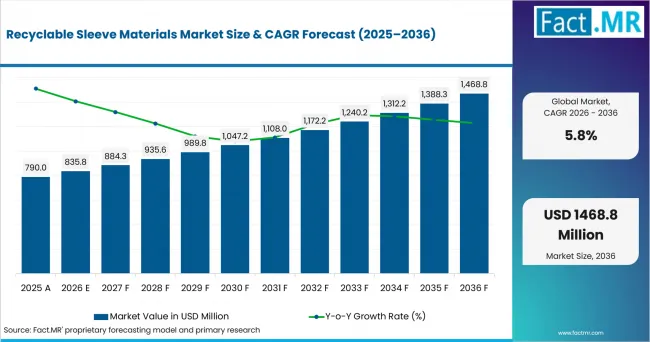
Recyclable Sleeve Materials Market Value Analysis | Source: Fact.MR
What are the defining numbers behind Recyclable Sleeve Materials Market growth?
USD 633.0 million absolute opportunity by 2036 led by recyclable paperboard and multipack sleeves across food and beverage applications.
- Demand Drivers in the Market
- Brand packaging teams need sleeve structures that remove plastic components while preserving print quality across established product portfolios.
- Beverage plant engineers require moisture-tolerant blanks and applicator settings that protect production speed during commercial conversion.
- Retail packaging managers need material declarations and local recovery evidence so environmental claims withstand regulatory review.
- Paperboard converters prefer stable caliper and coating performance across cutting and creasing operations on high-speed lines.
- Key Segments Analyzed
- By material: Recyclable paperboard is expected to account for 58.0% share in 2026 supported by stiffness and recovery routes.
- By product type: Multipack sleeves are projected to garner 36.0% share in 2026 owing to efficient bottle and can unitization.
- By reusability: Single-use recyclable formats are anticipated to record 66.0% share in 2026 driven by one-way retail distribution.
- By application: Beverage multipacks are estimated to capture 40.0% share in 2026 attributable to recurring high-volume bundling.
- By end use: Food and beverage is forecast to represent 66.0% share in 2026 reinforced by frequent packaging runs.
- Analyst Opinion at Fact.MR
- Shambhu Nath Jha, Principal Analyst at Fact.MR states: “Recyclable sleeves attract investment because material changes affect regulation and line performance, while qualified designs must pass recovery tests without lowering pack-out speed.”
- Strategic Implications
- Brand owners should qualify sleeve designs against collection and repulping conditions across every significant sales geography.
- Beverage operations teams must measure throughput and reject rates during wet-condition trials before broad portfolio conversions.
- Converters require document coating and adhesive changes so qualified recovery performance remains stable across production sites.
- Packaging machinery partners should align tooling and control settings with board tolerances before commercial line transitions.
Stable caliper helps maintain print quality and supports high-speed application across packaging lines. Each recyclable sleeve material requires thorough crease-performance testing and machinery validation to ensure compatibility, operational efficiency and consistent results before broader commercial adoption.
India is projected to be the steady-growing market, expanding at a CAGR of 8.2% through 2036, followed by China at 7.4% CAGR. Brazil and the United Kingdom are expected to register CAGRs of 6.3% and 6.2%, respectively, while Germany is forecast to grow steadily at 5.5% during the assessment period.
How does the Recyclable Sleeve Materials Market break down by segment?
Recyclable paperboard is projected to account for 58.0% share while multipack sleeves are estimated to garner 36.0% share.
Which Material category dominates?
Recyclable paperboard is expected to account for 58.0% share in 2026
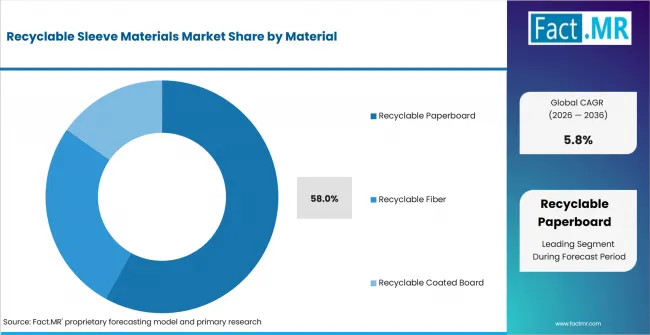
Recyclable Sleeve Materials Market Analysis By Material | Source: Fact.MR
Based on material, recyclable paperboard is projected to account for 58.0% share in 2026 due to controlled stiffness and recovery access. Graphic Packaging introduced PaceSetter Ridgeline in July 2026 to support paper packaging materials and fiber packaging design with controlled caliper for crease qualification.
What leads the Product Type segment?
Multipack sleeves are estimated to garner 36.0% share in 2026
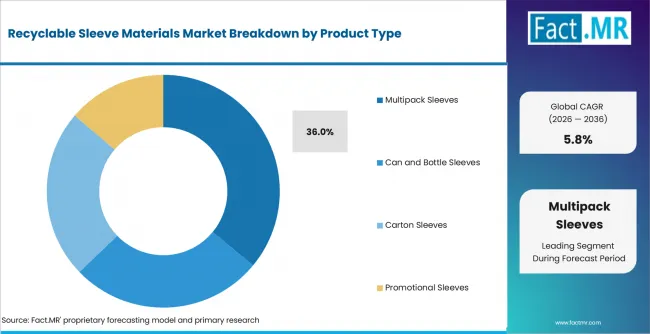
Recyclable Sleeve Materials Market Analysis By Product Type | Source: Fact.MR
By product type, multipack sleeves are estimated to hold 36.0% share in 2026 owing to efficient unitization. Graphic Packaging introduced two systems in September 2025 to align folding carton packaging and point-of-purchase packaging with beverage-line requirements.
How does Reusability shape demand?
Single-use recyclable formats are anticipated to capture 66.0% share in 2026
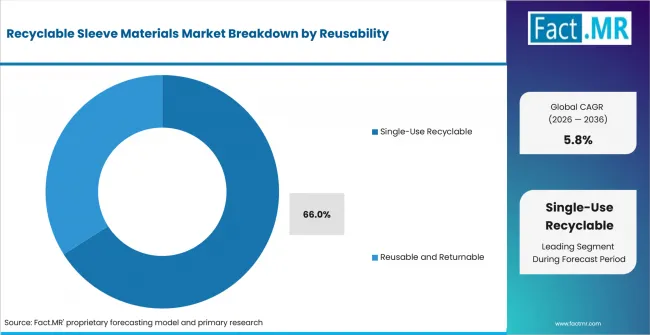
Recyclable Sleeve Materials Market Analysis By Reusability | Source: Fact.MR
Single-use recyclable formats are expected to lead reusability at 66.0% share in 2026 because retail networks lack return loops. Reusable designs suit controlled zero-waste packaging systems, while custom packaging programs serve one-way recovery routes.
What supports Beverage Multipacks within Application?
Beverage multipacks are forecast to represent 40.0% share in 2026
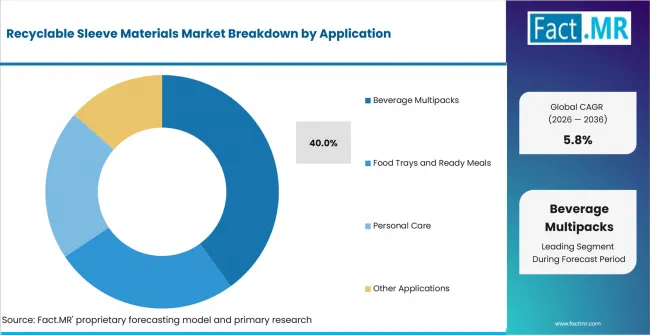
Recyclable Sleeve Materials Market Analysis By Application | Source: Fact.MR
By application, beverage multipacks are forecast to represent 40.0% share in 2026 driven by recurring container bundling. Stora Enso started its Oulu board line in March 2025 to expand protective packaging capacity for next-generation fiber packaging formats.
Which End Use category holds the primary share?
Food and beverage is expected to hold 66.0% share in 2026
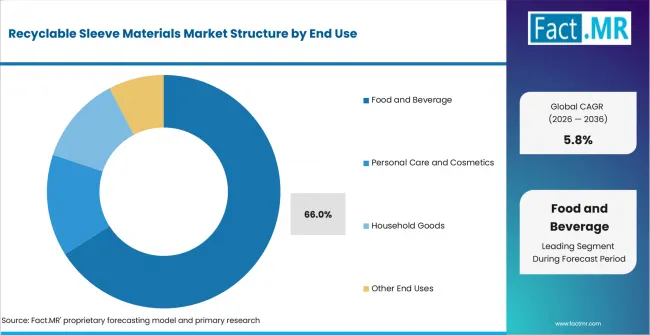
Recyclable Sleeve Materials Market Analysis By End Use | Source: Fact.MR
The end-use category is forecast to be led by food and beverage at 66.0% share in 2026 due to recurring production. Mondi expanded its portfolio in November 2025 to support paperboard luxury packaging and corrugated packaging across repeated food runs.
What is accelerating Recyclable Sleeve Materials Market adoption, and what is holding it back?
Producer-responsibility rules drive conversion while barrier performance and line-qualification trade-offs restrain adoption across major applications.
Drivers Impact Analysis
| DRIVER | (~) % IMPACT ON CAGR | GEOGRAPHIC RELEVANCE | IMPACT TIMELINE |
|---|---|---|---|
| Producer-responsibility and plastic-reduction rules | +0.9% | Europe and North America | Short term (<= 2 years) |
| Portfolio conversion programs | +0.7% | Global consumer goods | Medium term (2-4 years) |
| High-volume beverage conversions | +0.5% | North America, Europe and Asia Pacific | Medium term (2-4 years) |
| Recovered-fiber access | +0.4% | Europe and North America | Long term (>= 4 years) |
| Multi-plant packaging standardization | +0.3% | Global brand networks | Long term (>= 4 years) |
Source: Fact.MR analysis. Updated Aug 1, 2026
- Producer-responsibility rules: Packaging teams fund redesigns as California's May 2026 rules require recyclable or compostable packaging by 2032.
- Portfolio conversion programs: Consumer-goods companies reduce engineering costs by applying one qualified sleeve architecture across related product sizes.
- High-volume beverage conversions: Repeated can and bottle runs create recurring orders, although condensation and vibration increase qualification requirements.
- Recovered-fiber access: Established collection systems support recycled paperboard grades that retain performance and repulping compatibility.
Opportunity Impact Analysis
| OPPORTUNITY | (~) % IMPACT ON CAGR | GEOGRAPHIC RELEVANCE | IMPACT TIMELINE |
|---|---|---|---|
| Lightweight high-stiffness board structures | +0.5% | Europe and North America | Medium term (2-4 years) |
| Glue-light and mechanical locking designs | +0.4% | Europe and Asia Pacific | Short term (<= 2 years) |
| Automation-ready multipack systems | +0.4% | Global beverage plants | Medium term (2-4 years) |
| Regional qualification and field service | +0.3% | India, China and Brazil | Long term (>= 4 years) |
Source: Fact.MR analysis. Updated Aug 1, 2026
- Lightweight board structures: High-stiffness grades reduce material use while retaining carrying strength throughout retail handling and distribution.
- Glue-light assembly: Smurfit Westrock's May 2026 ActiBlu pilot created a practical sleeve testing route with lower adhesive complexity.
- Automation-ready multipacks: Tested applicator settings reduce qualification steps and protect throughput during actual production trials.
Restraints Impact Analysis
| RESTRAINT | (~) % IMPACT ON CAGR | GEOGRAPHIC RELEVANCE | IMPACT TIMELINE |
|---|---|---|---|
| Barrier and wet-strength trade-offs | -0.5% | Food and beverage applications | Short term (<= 2 years) |
| Line qualification and tooling costs | -0.4% | Global high-speed plants | Medium term (2-4 years) |
| Different local recyclability rules | -0.3% | Europe and North America | Medium term (2-4 years) |
| Board and converting cost volatility | -0.2% | India, China and Latin America | Long term (>= 4 years) |
Source: Fact.MR analysis. Updated Aug 1, 2026
- Barrier trade-offs: Chilled and greasy packs need coatings that protect strength without preventing fiber separation.
- Line qualification costs: Feeding and sealing trials can delay smaller brands facing tooling changes across several formats.
- Local recyclability rules: Cross-border programs need separate documentation because national methods can classify coated sleeves differently.
Which countries are scaling Recyclable Sleeve Materials Market fastest?
Brazil 6.3%, United Kingdom 6.2%, Germany 5.5%.
Recyclable Sleeve Materials Market is segmented into North America, Europe, Asia Pacific, Latin America, and the Middle East & Africa.
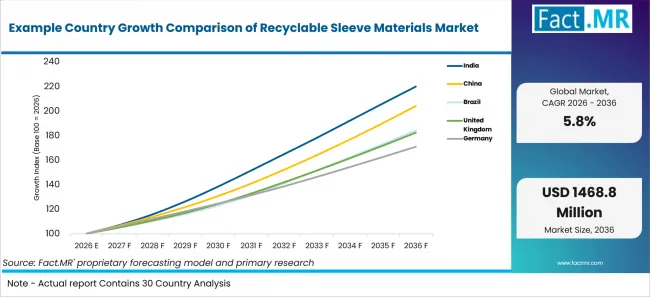
Example Country Growth Comparison Of Recyclable Sleeve Materials Market | Source: Fact.MR
| COUNTRY | CAGR |
|---|---|
| Brazil | 6.3% |
| United Kingdom | 6.2% |
| Germany | 5.5% |
Source: Fact.MR analysis. Updated Aug 1, 2026
What supports Brazil's outlook?
6.3% CAGR, owing to plastic recovery obligations and beverage production across major regions.
Brazilian sleeve programs serve beverage volumes across long distribution routes, making local converting essential for maintaining pack performance. Industry is anticipated to register a 6.3% CAGR through 2036, supported by recovery targets under Decree 12,688 and sustained beverage-sector activity.
How is the United Kingdom market expected to expand?
6.2% CAGR, reinforced by formal recyclability ratings and fee-linked documentation.
United Kingdom brands classify household packaging through a formal recyclability methodology linked to disposal fees. The market is forecast to post a 6.2% CAGR through
2036, aided by PackUK's April 2025 RAM update that formalizes documentation requirements.
Which factor is shaping Germany's growth?
5.5% CAGR, shaped by component-level design requirements and established domestic packaging engineering.
German packaging teams require detailed component records before approving fiber sleeves for repeated production runs. Industry is expected to expand at a 5.5% CAGR through 2036, reinforced by ZSVR's August 2025 standard that influences material selection.
Who leads the Recyclable Sleeve Materials Market?
Graphic Packaging International and Smurfit Westrock provide broad sleeve-design coverage while Mondi Group and International Paper expand converting reach.
Competition is concentrated among integrated suppliers that combine paperboard production, structural design expertise and field-support services. Graphic Packaging International and Smurfit Westrock integrate material development with machinery support capabilities, while Mondi Group and International Paper strengthen market presence through extensive regional converting networks.
Which companies are the key providers?
Key providers include Graphic Packaging International, Smurfit Westrock, Mondi Group, International Paper, Sonoco Products Company, Stora Enso and Huhtamaki.
- Graphic Packaging International
- Smurfit Westrock
- Mondi Group
- International Paper
- Sonoco Products Company
- Stora Enso
- Huhtamaki.
Bibliography
- California Department of Resources Recycling and Recovery. (2026, May 1). California approves new plastic and packaging rules that put consumers first.
- Central Agency Packaging Register. (2025, August 29). 2025 minimum standard published – initial touchstone for companies preparing for the EU Packaging and Packaging Waste Regulation (PPWR).
- Graphic Packaging Holding Company. (2026, July 13). Graphic Packaging Enters Uncoated Recycled Paperboard Market with Launch of PaceSetter Ridgeline.
- Graphic Packaging International. (2025, September 10). Graphic Packaging Debuts Duo of Beverage Multipack Innovations at drinktec 2025.
- Huhtamaki. (2025, February 28). Huhtamaki launches recyclable single coated paper cups for yogurt and dairy.
- Mondi Group. (2025, November 18). Mondi launches extended corrugated and solid board portfolio for the food packaging industry.
- Press Information Bureau, Government of India. (2026, March 23). PARLIAMENT QUESTION: Circular Economy Framework and Extended Producer Responsibility.
- Presidency of the Federative Republic of Brazil. (2025, October 21). Decree No. 12,688 of October 21, 2025.
- Smurfit Westrock. (2026, May 5). Smurfit Westrock launches prototype of glueline-free packaging solution.
- Stora Enso. (2025, March 19). Stora Enso's New Consumer Board Line at the Oulu Site in Finland Has Started Operations.
This Report Addresses
- The report explains material and product choices that shape recyclable sleeve conversion in major packaging programs.
- Segment analysis covers paperboard and multipack sleeves among others.
- Regional analysis compares India and China with Brazil, UK and German market conditions through 2036.
- Competitive analysis key active paperboard and fiber-packaging companies serving recyclable sleeve programs across regions.
- Material assessment covers paperboard, recyclable fiber and coated formats with separate barrier and recovery requirements.
- Application assessment covers beverage multipacks, food trays, personal care and other consumer sleeve uses worldwide.
What does the Recyclable Sleeve Materials Market cover?
Paperboard and fiber sleeves with coated-board formats used to bundle and present packaged consumer goods.
The market covers fiber structures that connect primary packs without functioning as complete cartons commercially. Commercial value depends on defined bundling or display functions, while full cartons remain outside scope.
What is included in the scope?
Recyclable sleeve systems used across beverage and food packaging alongside personal-care and household-goods distribution networks.
The scope includes recyclable paperboard and coated fiber used in multipack, container and promotional sleeves. Applications cover food and beverage with personal-care and household uses across single-use and controlled reusable systems.
What is excluded from the scope?
Full folding cartons and primary plastic labels remain outside the defined recyclable sleeve market scope.
The scope excludes boxes and primary labels, while shrink film and ring carriers remain substitutes.
How Was the Analysis Built?
The analysis draws on 120+ sources, 35+ company portfolios, 25+ countries, and more than 20 industry interviews.
- Primary Research: Primary research includes discussions with manufacturers, service providers, technology developers, distributors, end users, procurement teams, and subject-matter experts. These conversations examine purchasing priorities, product adoption, operational challenges, approval requirements, competitive positioning, and the factors that influence wider market acceptance.
- Desk Research: Desk research covers government statistics, regulatory publications, company filings, trade data, technical studies, industry associations, standards, public policy, and other authoritative sources. Every source used in the analysis is documented in the bibliography.
- Market Sizing and Forecasting: Market estimates combine historical performance, demand indicators, pricing and volume trends, segment shares, company participation, country-level growth, adoption patterns, investment activity, and barriers to market expansion.
- Data Validation and Update Cycle: Findings are validated by comparing primary interviews with public data, company activity, regulatory changes, trade patterns, and industry developments. Regular updates review new product launches, capacity changes, partnerships, approvals, procurement trends, and shifts in commercial adoption.
Segmentation
What is the report scope and coverage?
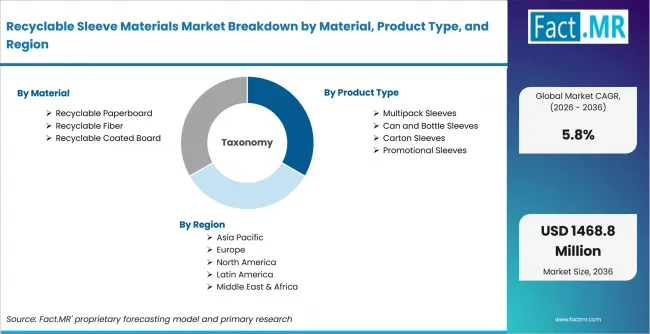
Recyclable Sleeve Materials Market Breakdown By Material, Product Type, And Region | Source: Fact.MR
| Coverage field | Report scope |
|---|---|
| Quantitative Units | USD Million |
| Market Definition | Recyclable paperboard and fiber sleeves that bundle or present consumer goods while remaining compatible with established recovery routes. |
| Material | Recyclable Paperboard, Recyclable Fiber, Recyclable Coated Board |
| Product Type | Multipack Sleeves, Can and Bottle Sleeves, Carton Sleeves, Promotional Sleeves |
| Reusability | Single-Use Recyclable, Reusable and Returnable |
| Application | Beverage Multipacks, Food Trays and Ready Meals, Personal Care, Other Applications |
| End Use | Food and Beverage, Personal Care and Cosmetics, Household Goods, Other End Uses |
| Regions | North America, Europe, Asia Pacific, Latin America, Middle East and Africa |
| Countries | United States, Canada, Germany, United Kingdom, France, India, China, Japan, South Korea, Brazil, Mexico, UAE, South Africa |
| Key Companies | Graphic Packaging International, Smurfit Westrock, Mondi Group, International Paper, Sonoco Products Company, Stora Enso, Huhtamaki |
| Forecast Period | 2026 to 2036 |
| Approach | Hybrid top-down and bottom-up approach using board availability, conversion activity, segment shares, application throughput, policy timing, company participation |
Source: Fact.MR analysis. Updated Aug 1, 2026
How is the market segmented?
-
By Material:
- Recyclable Paperboard
- Recyclable Fiber
- Recyclable Coated Board
-
By Product Type:
- Multipack Sleeves
- Can and Bottle Sleeves
- Carton Sleeves
- Promotional Sleeves
-
By Reusability:
- Single-Use Recyclable
- Reusable and Returnable
-
By Application:
- Beverage Multipacks
- Food Trays and Ready Meals
- Personal Care
- Other Applications
-
By End Use:
- Food and Beverage
- Personal Care and Cosmetics
- Household Goods
- Other End Uses
-
By Region:
- North America
- United States
- Canada
- Mexico
- Europe
- Germany
- United Kingdom
- France
- Italy
- Spain
- Netherlands
- Poland
- Asia Pacific
- India
- China
- Japan
- South Korea
- Australia
- ASEAN
- Latin America
- Brazil
- Argentina
- Chile
- Middle East & Africa
- UAE
- Saudi Arabia
- South Africa
- North America
Frequently Asked Questions
Which Material category leads the Recyclable Sleeve Materials Market?
Which Product Type records the primary share?
Which Reusability category carries the larger share?
What supports Beverage Multipacks within Application demand?
How much End Use share does Food and Beverage represent?
How does India perform in the Recyclable Sleeve Materials Market?
What is the primary market driver?
What is the main market restraint?
Who worked on this report


Preview the report firsthand - request a free sample
Free SampleGet the brochure for pricing and purchase details
Download PDF