- Market Value (2025): USD 712.9 Mn
- Estimated Value (2026): USD 760.0 Mn
- Forecast Value (2036): USD 1440.1 Mn
- CAGR (2026-2036): 6.6%
What is the Refurbished Soft Starters Market forecast to be worth by 2036?
USD 760.0 million in 2026 to USD 1,440.1 million by 2036 at a 6.6% CAGR.
- 2025 market value: USD 712.9 million.
- 2026 to 2036 value progression: USD 760.0 million to USD 1,440.1 million.
- 2026 to 2036 CAGR: 6.6%.
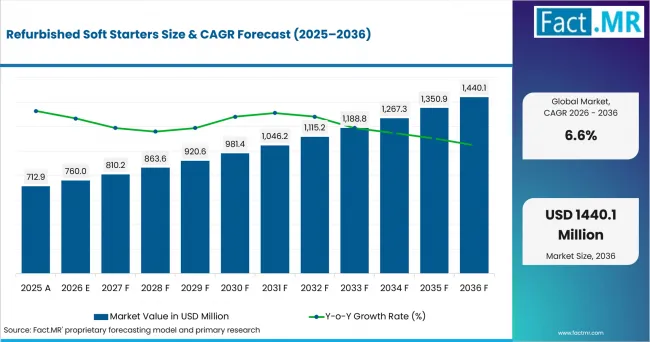
Refurbished Soft Starters Value Analysis | Source: Fact.MR
What are the defining numbers behind Refurbished Soft Starters Market growth?
The market is projected to create an absolute opportunity of USD 680.1 million between 2026 and 2036.
- Demand Drivers in the Market
- Installed motor-control assets create replacement demand when a soft starter fails but the surrounding panel, motor and process equipment remain serviceable. Repair and exchange channels allow operators to restore a compatible control point without redesigning the wider system.
- Capital discipline supports refurbished purchases where downtime and replacement budgets matter more than owning a newly manufactured starter. Factory-tested units reduce the gap between used equipment and a predictable maintenance outcome.
- Circular procurement is moving refurbishment from an informal repair decision toward a documented lifecycle option. Siemens introduced a refurbished SIRIUS 3RW5 soft starter in 2026 using testing, replacement of critical components and product-level traceability, while European policy increasingly emphasizes repair, reuse and remanufacturing.
- Demand also follows the installed base of industrial motors, since soft starters sit directly in motor-driven systems used in pumps, conveyors, compressors and process equipment.
- Key Segments Analyzed
- Refurbishment Level: OEM-certified remanufactured accounts for 35.0% in 2026 because factory-controlled testing, component replacement and documentation reduce buyer uncertainty around second-life equipment.
- Power Range: 30-110 kW represents 30.0% in 2026, supported by broad use across pumps, fans, conveyors and mid-sized industrial machinery where starter replacement can be standardized.
- End-user Driver: Capex savings accounts for 39.0% in 2026 as maintenance teams compare a validated second-life unit with the cost of purchasing and commissioning a new starter.
- Industry: Manufacturing represents 28.0% in 2026 due to the depth of motor-driven production assets and the need to restore failed controls without prolonged interruption.
- Analyst Opinion at Fact.MR
- “Refurbished soft starters are purchased when the economics of restoring a known motor-control architecture are better than replacing the control stack around it. Offers that combine electrical testing, traceable component replacement and clear warranty terms are better aligned with industrial buyer requirements, because buyers need a predictable second-life asset rather than an unverified used device,” says Shambhu Nath Jha, Senior Consultant, Fact.MR.
- Strategic Implications
- Suppliers should separate certified refurbishment from basic resale. Buyers in manufacturing and process industries need test records, serial traceability and clear replacement-part policies before a refurbished starter can be approved for production duty.
- Service networks matter because many purchases are triggered by a failure event. Core-exchange inventory, rapid diagnosis and prequalified replacement models can shorten shutdowns. OEMs can use lifecycle data from connected starters to identify units suitable for a second service life, while independent refurbishers can compete through multi-brand capability and board-level repair expertise.
- The opportunity also overlaps with motor soft starters used in water systems, compressors and industrial process equipment, where controlled starting protects mechanical assets and limits electrical stress.
How does the Refurbished Soft Starters Market break down by segment?
The market is segmented by Refurbishment Level, Power Range, End-user Driver and Industry.
Why does OEM-certified remanufactured lead Refurbishment Level?
OEM-certified remanufactured accounts for 35.0% of Refurbishment Level in 2026.
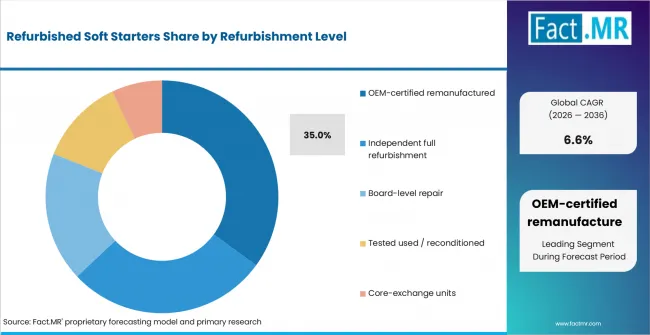
Refurbished Soft Starters Analysis By Refurbishment Level | Source: Fact.MR
- This route reduces uncertainty around condition and performance because the refurbishment process can follow defined test procedures, approved replacement parts and documented quality checks. Siemens states that its refurbished SIRIUS 3RW5 units are thoroughly tested, have critical components replaced and are function-tested to new-device quality standards.
- Industrial maintenance teams are more likely to approve a second-life starter when the unit retains installation compatibility and arrives with traceable service history. That makes certification and process control commercially important in plants where an unreliable restart can extend downtime.
Why does 30-110 kW lead Power Range?
30-110 kW accounts for 30.0% of Power Range in 2026.
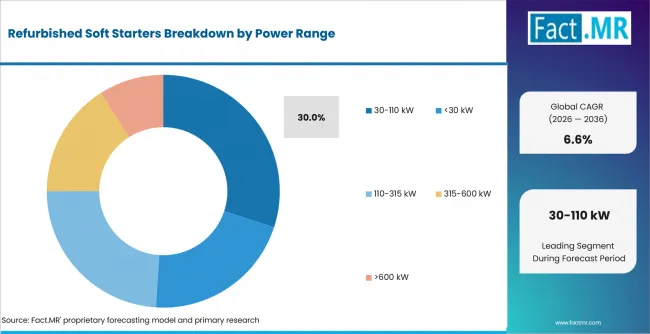
Refurbished Soft Starters Analysis By Power Range | Source: Fact.MR
- This range covers a broad band of motors used in pumps, fans, conveyors and other machine-drive duties. The U.S. Department of Energy identifies motors as central to pumps, conveyors, compressors and processing equipment, which creates a wide installed base of associated starters requiring maintenance and replacement.
- Refurbishment is practical in this range because units are common enough for repair depots and exchange programs to standardize diagnostics, component stocking and functional testing. Very high-power starters can require more project-specific engineering, while small starters can face stronger replacement economics from lower-priced new units.
Why does Capex savings lead End-user Driver?
Capex savings accounts for 39.0% of End-user Driver in 2026.
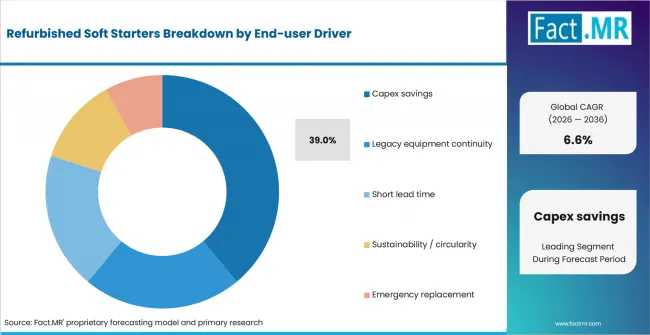
Refurbished Soft Starters Analysis By End User Driver | Source: Fact.MR
- The purchase decision often occurs after a failed starter has interrupted a working asset. If the motor, enclosure and upstream electrical architecture remain usable, a compatible refurbished unit can avoid the cost of redesigning the panel or replacing adjacent equipment.
- The savings case improves when the refurbished unit is tested and supported. Siemens offers repair and exchange services for active SIRIUS soft starters, while ABB includes workshop repair, reconditioning, replacement and recycling within its drive and soft-starter service portfolio. These service models make lifecycle extension a procurement option rather than a purely local repair decision.
Why does Manufacturing lead Industry?
Manufacturing accounts for 28.0% of Industry in 2026.
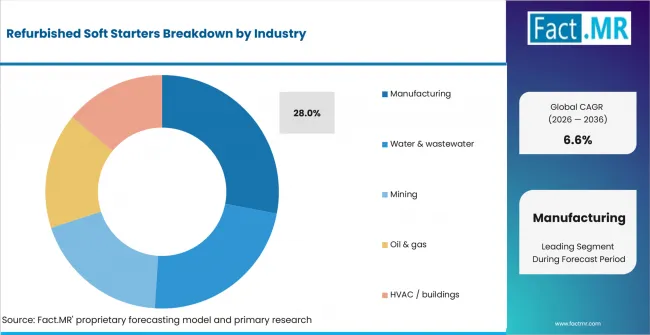
Refurbished Soft Starters Analysis By Industry | Source: Fact.MR
- Manufacturing plants use motor-driven equipment across material handling, pumping, ventilation and process machinery. The U.S. Department of Energy reports that machine-drive motors account for a substantial share of electricity use in U.S. manufacturing, illustrating the depth of the installed motor base that depends on motor-control hardware.
- A starter failure can stop an otherwise serviceable line, so maintenance teams value compatible replacements that can be installed quickly. Refurbished units fit this workflow when they preserve parameterization and wiring arrangements while reducing procurement cost and lead time.
- The same installed-base logic is visible across industrial automation, where maintenance decisions are shaped by continuity of existing control architectures.
What is accelerating Refurbished Soft Starters Market adoption, and what is holding it back?
Adoption is being accelerated by the need to restore legacy motor-control assets at lower capital cost, the availability of repair and exchange services, and circular-economy policies that favor longer equipment life. The main restraints are quality variability across independent channels, limited availability of parts for obsolete models, and the risk that a repaired unit may no longer meet current plant standards.
Drivers Impact Analysis
| Factor | (~) % Impact on CAGR | Geographic Relevance | Impact Timeline |
|---|---|---|---|
| Installed-base replacement demand | +0.9% | North America and Europe | Near to long term |
| Capex savings from validated second-life units | +0.7% | Global industrial markets | Near to mid term |
| OEM repair and exchange infrastructure | +0.5% | USA, Germany, UK, France, Italy | Near to long term |
Source: Fact.MR analysis. Updated Sep 8, 2026
Opportunity Impact Analysis
| Factor | (~) % Impact on CAGR | Geographic Relevance | Impact Timeline |
|---|---|---|---|
| Traceable OEM remanufacturing programs | +0.6% | Europe and North America | Mid to long term |
| Core-exchange inventory for shutdown replacement | +0.4% | Manufacturing and process industries | Near to mid term |
| Circular procurement requirements | +0.3% | Europe | Mid to long term |
Source: Fact.MR analysis. Updated Sep 8, 2026
Restraints Impact Analysis
| Factor | (~) % Impact on CAGR | Geographic Relevance | Impact Timeline |
|---|---|---|---|
| Quality variation in independent refurbishment | -0.6% | Global | Near to long term |
| Obsolescence and unavailable components | -0.5% | Legacy industrial sites | Near to long term |
| New-product replacement economics at low power | -0.3% | Global | Near to mid term |
Source: Fact.MR analysis. Updated Sep 8, 2026
Which countries are scaling the Refurbished Soft Starters Market through 2036?
- USA: A deep motor-driven manufacturing base and large water and wastewater infrastructure create recurring maintenance demand. The U.S. Department of Energy and EPA both emphasize motor and pumping-system efficiency, which keeps starter condition and replacement decisions inside ongoing asset-management programs.
- Germany: Industrial equipment users are operating under a policy environment that gives more weight to product longevity, repair and remanufacturing. Germany’s National Circular Economy Strategy explicitly supports longer product life, reuse and repair across electrical equipment and industrial materials.
- UK: Refurbishment aligns with the government’s circular-economy direction, which identifies repair, refurbishing and remanufacturing as ways to keep products in use and improve supply-chain resilience. This supports procurement models that extend the service life of industrial electrical equipment.
- France: Circular-economy policy has institutionalized repair and second-life thinking across electrical and electronic goods, while the manufacturing sector maintains a large installed base of capital equipment. Refurbished soft starters can serve plants seeking lower replacement expenditure without abandoning established motor-control architectures.
- Italy: Industrial policy programs have supported manufacturing investment linked with circular-economy transition. This creates a favorable setting for repair, reuse and life-extension of control equipment in machinery-intensive plants.
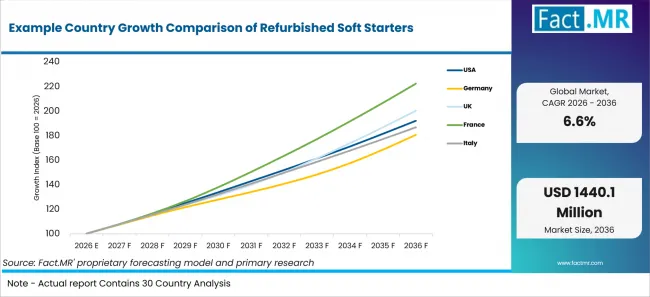
Example Country Growth Comparison Of Refurbished Soft Starters | Source: Fact.MR
Country CAGR (2026-2036)
| Country | CAGR (2026-2036) |
|---|---|
| USA | 6.8% |
| Germany | 6.1% |
| UK | 7.2% |
| France | 8.3% |
| Italy | 6.4% |
Source: Fact.MR analysis. Updated Sep 8, 2026
What is driving USA's growth through 2036?
The USA market is projected to grow at a 6.8% CAGR through 2036.
- Industrial motor systems remain deeply embedded in manufacturing, where motors power pumps, conveyors, compressors and processing equipment. The U.S. Department of Energy notes that motor-driven machine systems account for a substantial share of manufacturing electricity use, creating a broad installed base where starter failures and lifecycle maintenance recur.
- Water and wastewater facilities add another replacement pool. EPA guidance identifies energy efficiency and equipment upgrades as continuing priorities for utility facilities. When a compatible starter can be restored or exchanged faster than a full control redesign, refurbishment can reduce both capital outlay and shutdown duration.
- This demand overlaps with the installed base of pumps used in municipal and industrial fluid systems.
What is driving Germany's growth through 2036?
Germany is projected to grow at a 6.1% CAGR through 2036.
- The country combines a large industrial equipment base with policy support for longer product life. Germany’s National Circular Economy Strategy states that electrical and electronic equipment should support reuse, repairs and remanufacturing, giving lifecycle extension a clearer place in procurement and product design.
- The German manufacturing cycle also creates cost pressure that can favor repair over premature replacement. Destatis reported weaker machinery production in 2025, a setting in which maintenance teams have more reason to protect installed capital and extend usable equipment life when technical performance can be validated.
What is driving UK's growth through 2036?
The UK market is projected to grow at a 7.2% CAGR through 2036.
- The Environmental Improvement Plan 2025 defines circularity around sharing, repairing, refurbishing and remanufacturing, with supply-chain resilience among the stated benefits. That direction supports industrial buyers that want lower material use while maintaining operational continuity.
- Refurbished starters are especially relevant when legacy machinery remains productive but control components have failed or reached service limits. Repair and exchange channels can preserve wiring, motor selection and plant-standard configurations, which reduces engineering work during maintenance events.
What is driving France's growth through 2036?
France is projected to grow at an 8.3% CAGR through 2036.
- National circular-economy policy promotes longer product use through repair, reuse and second-life components, creating a broader acceptance of refurbishment as a resource-efficiency measure.
- France also retains a substantial manufacturing economy. INSEE reported manufacturing production of EUR 981 billion in 2025, approximately USD 1.1 trillion, providing a wide base of motor-driven equipment where maintenance economics can support refurbished electrical controls. Buyers are likely to favor units with documented testing and service support over unverified used equipment.
What is driving Italy's growth through 2036?
Italy is projected to grow at a 6.4% CAGR through 2036.
- National programs for innovative machinery and circular-economy research have supported industrial investment models that keep resources in productive use for longer. This is relevant to soft starters because much of the addressable demand arises from existing machinery rather than first-time motor installations.
- Industrial production remained active through 2025, according to Istat. In machinery-intensive plants, board-level repair and full refurbishment can provide a practical route when a starter is serviceable but the cost or lead time of a new equivalent is unattractive.
- Mining applications provide a parallel lifecycle case for rugged electrical controls, reflected in the wider mining equipment ecosystem.
Who Leads the Refurbished Soft Starters Market?
Key players in the Refurbished Soft Starters Market include ABB, Siemens, Schneider Electric, Rockwell Automation, WEG and Danfoss. Competition centers on installed-base access, test capability, spare-parts support, repair turnaround, compatibility with legacy models and the ability to document a second-life unit for industrial approval.
OEMs have an advantage where they can combine lifecycle records with factory service. Siemens now markets a refurbished SIRIUS soft starter with controlled testing and traceability. ABB documents reconditioning, workshop repair, replacement and recycling for soft starters. Schneider Electric maintains model-specific repair, exchange and after-sales support for portions of its Altistart installed base. Independent channels remain relevant where multi-brand repair capability or board-level service can reduce turnaround time.
Which companies are the key providers?
Key companies include ABB, Siemens, Schneider Electric, Rockwell Automation, WEG and Danfoss.
- ABB
- Siemens
- Schneider Electric
- Rockwell Automation
- WEG
- Danfoss
Bibliography
- Siemens. (2026). Siemens expands semiconductor-based circuit protection portfolio, debuts circular soft starter. Siemens AG.
- ABB. (2021). Service for Softstarters: Motor Starting Matters. ABB.
- ABB. (2026). Service Workshop for Drive Technology: Repair and Reconditioning Services. ABB.
- U.S. Department of Energy. (n.d.). Motors. Better Buildings & Better Plants Initiative.
- U.S. Environmental Protection Agency. (2026). Energy Efficiency for Water Utilities. U.S. EPA.
- Federal Ministry for the Environment, Germany. (2024). The National Circular Economy Strategy. German Federal Government.
- UK Department for Environment, Food & Rural Affairs. (2025). Environmental Improvement Plan 2025. UK Government.
- French Ministry for Ecological Transition. (2018). L’économie circulaire. Government of France.
- Ministry of Enterprises and Made in Italy. (2025). Research and Development for the Circular Economy. Government of Italy.
- German Federal Statistical Office. (2026). Production in December 2025: -1.9% on the Previous Month. Destatis.
- INSEE. (2026). Macroeconomic Indicators for Manufacturing Industry, 2025. Government of France.
- Istat. (2026). Industrial Production, December 2025. Italian National Institute of Statistics.
- Schneider Electric. (2006; updated 2026). Are the Altistart ATS23 units repairable? Schneider Electric.
- Schneider Electric. (2015; updated 2026). How can I return an inoperative drive or soft start under warranty? Schneider Electric.
- Schneider Electric. (n.d.). ATS48C41Q - soft starter for asynchronous motor, Altistart 48, 388A, 230 to 415V, 90 to 315kW. Schneider Electric.
This Report Answers
- How much revenue is generated by refurbished and remanufactured soft starters?
- Which refurbishment level sees broader buyer acceptance?
- Which power bands create recurring repair and exchange demand?
- Why do industrial buyers choose refurbished units instead of new replacements?
- How do legacy-equipment continuity and lead time affect purchasing?
- Which industries create recurring second-life soft-starter demand?
- How do repairability and circular-economy policies influence procurement?
- Which countries are building stronger conditions for refurbishment?
- What capabilities differentiate OEM service programs from independent refurbishers?
- Which suppliers participate in the market?
What does the Refurbished Soft Starters Market cover?
The market covers revenue from complete soft starters that are restored for resale or exchange after inspection, repair, component replacement, testing or remanufacturing. It includes OEM-certified remanufactured units, independently refurbished units, board-level repaired units, tested used or reconditioned units and core-exchange units sold into industrial motor-control applications.
What is included in the scope?
Included products are second-life soft starters used to control the starting and stopping of industrial AC motors across the specified power ranges.
Coverage includes units purchased for manufacturing, water and wastewater, mining, oil and gas, and HVAC or building applications. Revenue is counted when a refurbished or exchange starter is commercially supplied as a usable unit.
What is excluded from the scope?
The scope excludes newly manufactured soft starters, variable frequency drives sold as separate products, complete motors, contactors and motor-control centers sold independently, field labor without a supplied refurbished unit, scrap electronics, and untested used equipment sold without functional reconditioning.
General industrial repair services are excluded unless tied directly to a refurbished soft starter supplied to the customer.
How Was the Analysis Built?
- Primary research focuses on industrial maintenance managers, motor-control distributors, repair depots, automation integrators, OEM service teams and procurement managers in manufacturing and process industries. Interviews examine failure triggers, repair-versus-replace thresholds, turnaround requirements, warranty expectations and acceptance of independently refurbished versus OEM-certified units.
- Desk research draws on manufacturer lifecycle documentation, repair and exchange programs, public industrial statistics, circular-economy policy, motor-system guidance and sector-level evidence from manufacturing, water utilities and other motor-intensive industries.
- Market sizing uses the installed soft-starter base, replacement and failure cycles, repairable share, refurbished-unit pricing, exchange-program penetration, power-range mix and industry mix. Forecasting considers new repair infrastructure, component availability, product obsolescence, circular procurement and buyer acceptance of documented second-life equipment.
- Validation checks compare supplier service capability with observed buyer workflows and country-specific industrial conditions. Updates focus on product lifecycle notices, repairability, new OEM refurbishment programs, industrial output and policy changes affecting reuse or remanufacturing.
Segmentation
What is the report's scope and coverage?
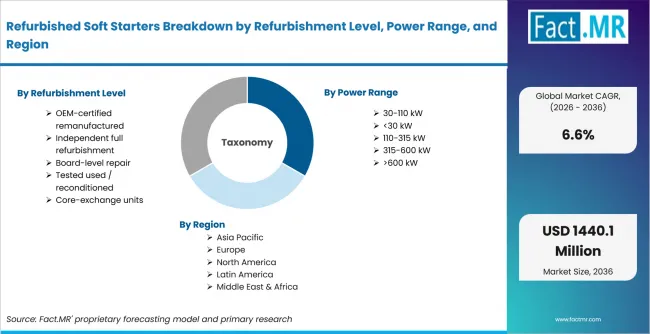
Refurbished Soft Starters Breakdown By Refurbishment Level, Power Range, And Region | Source: Fact.MR
| Attribute | Details |
|---|---|
| Quantitative Units | USD Million |
| Market Definition | Commercially supplied refurbished, repaired, reconditioned, remanufactured and core-exchange soft starters for industrial motor-control applications |
| Segments Covered | Refurbishment Level; Power Range; End-user Driver; Industry |
| Regions Covered | North America; Europe; other international markets |
| Countries Covered | USA; Germany; UK; France; Italy |
| Key Companies | ABB; Siemens; Schneider Electric; Rockwell Automation; WEG; Danfoss |
| Forecast Period | 2026-2036 |
| Base Year | 2026 |
| Market Value, 2026 | USD 760.0 million |
| Market Value, 2036 | USD 1,440.1 million |
| CAGR, 2026-2036 | 6.6% |
| Absolute Opportunity | USD 680.1 million |
| Approach | Installed-base and replacement-cycle model supported by pricing, service-channel validation and primary interviews |
Source: Fact.MR analysis. Updated Sep 8, 2026
How is the market segmented?
-
By Refurbishment Level
- OEM-certified remanufactured
- Independent full refurbishment
- Board-level repair
- Tested used / reconditioned
- Core-exchange units
-
By Power Range
- 30-110 kW
- <30 kW
- 110-315 kW
- 315-600 kW
- >600 kW
-
By End-user Driver
- Capex savings
- Legacy equipment continuity
- Short lead time
- Sustainability / circularity
- Emergency replacement
-
By Industry
- Manufacturing
- Water & wastewater
- Mining
- Oil & gas
- HVAC / buildings
-
By Region
- North America
- Latin America
- Western Europe
- Eastern Europe
- East Asia
- South Asia and Pacific
- Middle East & Africa
Frequently Asked Questions
What is the Refurbished Soft Starters Market value in 2026?
At what CAGR is the market projected to grow?
What is the projected market value by 2036?
Which Refurbishment Level leads in 2026?
Which Power Range leads in 2026?
Which End-user Driver leads in 2026?
Which Industry leads in 2026?
What is driving demand for refurbished soft starters?
What restrains adoption?
Which companies are active in the market?
Who worked on this report


Preview the report firsthand - request a free sample
Free SampleGet the brochure for pricing and purchase details
Download PDF