Rye Bran Beta-Glucan as Cholesterol-Lowering Food Ingredient Market (2026 - 2036)

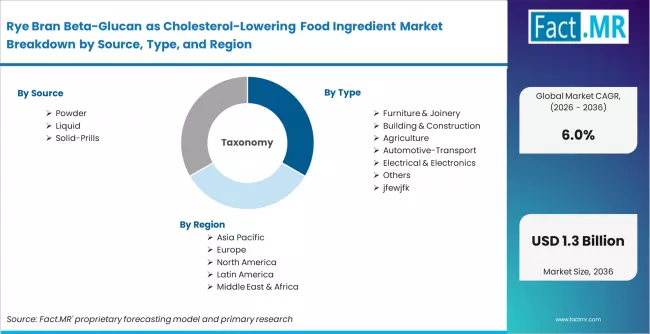
The Rye Bran Beta-Glucan as Cholesterol-Lowering Food Ingredient Market is segmented by Source (Yeast-Derived and Cereal-Based), Type (Soluble Beta-Glucan and Insoluble Beta-Glucan), Application (Food & Beverages, Dietary Supplements, and Pharmaceuticals), and Region. Forecast for 2026 to 2036.

Fact.MR analysis indicates a shift toward precision nutrition in the rye bran beta-glucan market. Bulk cereal fiber volumes are declining in relevance. Demand is moving toward high-concentration, clinically validated beta-glucan concentrates. This shift is driven by EFSA and FDA-approved cholesterol health claims. Growth is defined by product specifications rather than volume. Suppliers must offer standardised purity and viscosity data. Regulatory documentation is also becoming essential. Only such suppliers can access premium functional food and supplement markets through 2036.

Rye Bran Beta-Glucan as Cholesterol-Lowering Food Ingredient Market Forecast and Outlook By Fact.MR

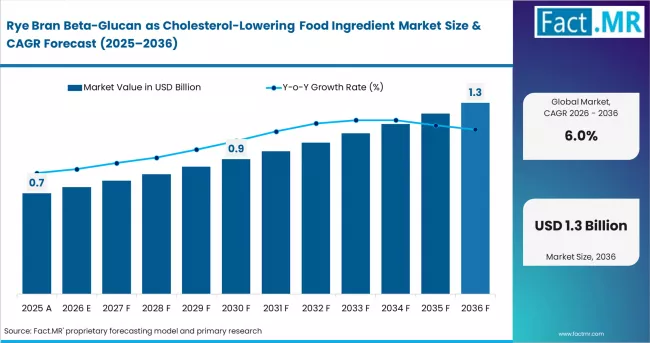
In 2025, the rye bran beta-glucan as cholesterol-lowering food ingredient market was valued at USD 0.5 billion. Based on Fact.MR analysis, demand for rye bran beta-glucan as a cholesterol-lowering food ingredient is estimated to grow to USD 0.7 billion in 2026 and USD 1.3 billion by 2036. FACT.MR projects a CAGR of 6.0% during the forecast period.
Rye Bran Beta Glucan As Cholesterol Lowering Food Ingredient Market Market Value Analysis

Metric Value
Estimated Value in 2026 USD 0.7 billion
Forecast Value in 2036 USD 1.3 billion
Forecast CAGR (2026 to 2036) 6.0%

Summary of Rye Bran Beta-Glucan as Cholesterol-Lowering Food Ingredient Market

  • Market Definition
    • Market covers cereal-based and yeast-derived beta-glucan concentrates used as cholesterol-lowering ingredients.
  • Demand Drivers
    • EFSA-approved claims are driving adoption in European food products.
    • China nutraceutical growth is increasing beta-glucan demand.
    • Japan ageing population is supporting FOSHU-based product demand.
  • Key Segments Analyzed
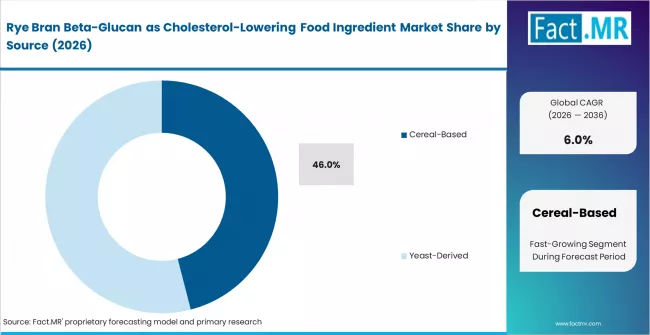
    • By Source: Cereal-based leads with 46% share in 2026 due to regulatory approval and supply scale.
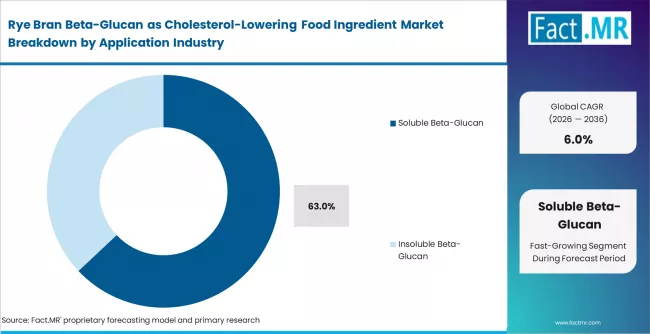
    • By Type: Soluble leads with 63% share due to functional cholesterol-lowering properties.
    • By Application: Food & beverages lead with 45% share driven by product fortification demand.
  • Analyst Opinion at FACT.MR
    • Shambhu Nath Jha highlights the importance of purity, viscosity data, and regulatory documentation. Suppliers with validated claims will capture premium market share.
  • Strategic Implications
    • Invest in high-purity extraction and regulatory dossier development.
    • Use traceability and standardisation to differentiate from commodity products.
    • Expand into pharmaceutical and FOSHU-regulated applications.
  • Methodology
    • Market sizing based on production volumes and pricing benchmarks.
    • Supported by EFSA, FDA, FOSHU, and FSSAI data.
    • Forecasts include regulatory timelines and procurement trends.

The market is expected to generate around USD 0.6 billion in incremental revenue over the forecast period. Growth is driven by clean-label reformulation in bakery and beverage segments. Dietary supplement demand is also expanding. Pharmaceutical-grade applications are emerging as an additional driver. However, high extraction costs for purified beta-glucan remain a constraint. Variability in rye harvest yields also impacts supply and pricing stability.

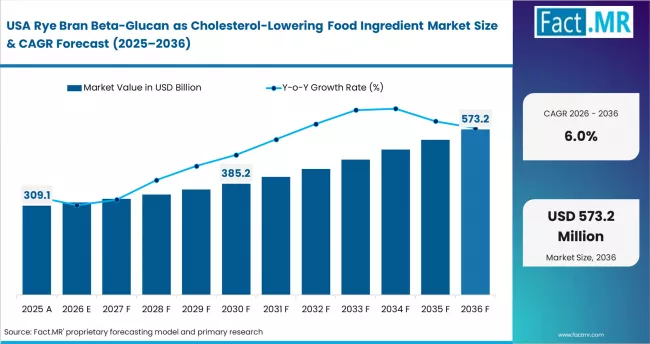
China leads with 8.4% CAGR through 2036. Growth is driven by functional food demand and nutraceutical expansion. India follows at 8.0%, supported by rising health awareness and product reformulation. Japan grows at 7.2% with strong demand for premium heart-healthy ingredients. Germany records 6.8%, driven by clean-label adoption and rye consumption. The United States grows at 6.0%, supported by use in beverages and protein bars but limited by cost competition.

Segmental Analysis

Rye Bran Beta-Glucan as Cholesterol-Lowering Food Ingredient Market Analysis by Source
Rye Bran Beta Glucan As Cholesterol Lowering Food Ingredient Market Analysis By Source

Based on FACT.MR, cereal-based beta-glucan holds around 46% share in 2026. It leads due to EFSA and FDA-approved health claims. It is cost-effective and widely available from oat and rye bran. It also fits clean-label functional food formulations.

  • Tate & Lyle Acquisition of CP Kelco: The company completed a USD 1.8 billion acquisition in 2024. This expands its nature-based ingredient portfolio. It strengthens supply of health-claim compliant ingredients globally. [2]
  • Lesaffre Acquisition of Biorigin: Lesaffre acquired a majority stake in 2024. This expands yeast-derived beta-glucan production. It strengthens its position in food and nutraceutical markets. [3]
  • Cereal Beta-Glucan Trend: Cereal sources accounted for over 42% of market revenue in 2024. Established supply chains support consistent availability. FDA health claim validation supports commercial adoption. [4]

Rye Bran Beta-Glucan as Cholesterol-Lowering Food Ingredient Market Analysis by Type
Rye Bran Beta Glucan As Cholesterol Lowering Food Ingredient Market Analysis By Type

Soluble beta-glucan holds around 63% share in 2026. It leads due to its proven cholesterol-lowering mechanism. It is the only format approved for on-pack health claims. This makes it critical for regulated markets.

  • Layn Natural Ingredients Galacan Launch: The company introduced a soluble beta-glucan product in 2025. It offers improved solubility and bioavailability. It is targeting functional food and supplement applications. [5]
  • EFSA Paramylon Approval: EFSA approved paramylon as a novel ingredient in 2024. This expands beta-glucan sourcing pathways. It also supports innovation in soluble formats. [6]
  • Soluble Format Trend: Food and beverages led soluble beta-glucan demand in 2024. Supplement demand is growing at a faster rate. This reflects rising adoption in cholesterol management products.

Drivers, Restraints, and Opportunities
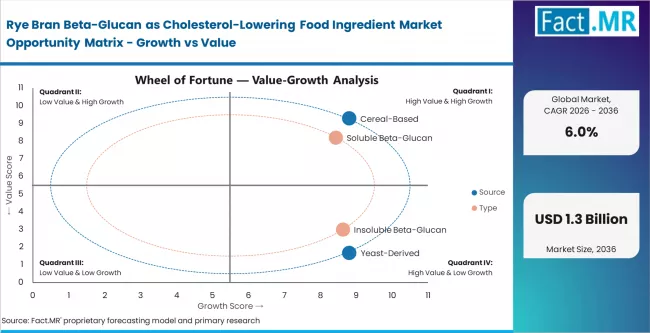
Rye Bran Beta Glucan As Cholesterol Lowering Food Ingredient Market Opportunity Matrix Growth Vs Value

Fact.MR notes the market has shifted to a precision-nutrition phase. Growth is driven by EFSA and FDA-backed health claims. Demand is expanding beyond Europe into Asia Pacific. Ageing populations and nutraceutical growth are key drivers.

The market shows strong quality differentiation. Bulk fiber products are losing relevance. High-purity soluble concentrates are gaining preference. These products command 20% to 40% price premiums. Pharmaceutical-grade variants command even higher premiums.

  • EFSA Health Claim Mandate: EU regulations support beta-glucan use for cholesterol reduction. Tate & Lyle PromOat qualifies under this claim. The CP Kelco acquisition strengthens its portfolio. [1]
  • Asia Pacific Nutraceutical Growth: China and Japan are expanding functional food markets. Demand for cholesterol-lowering ingredients is increasing. Regulatory approvals are supporting adoption. [7]

U.S. FDA Labelling Update:  FDA updated its “healthy” definition in 2025. Beta-glucan products now qualify for premium positioning. This supports wider adoption in food categories.

Regional Analysis

The rye bran beta-glucan as cholesterol-lowering food ingredient market is assessed across Asia Pacific, Europe, North America, Latin America, and Middle East and Africa, covering 40+ countries with distinct demand profiles shaped by regulatory health claim frameworks, functional food sector maturity, ageing population dynamics, and cereal beta-glucan supply chain infrastructure. The full report provides market attractiveness analysis by region and country.

Top Country Growth Comparison Rye Bran Beta Glucan As Cholesterol Lowering Food Ingredient Market Cagr (2026 2036)

Country CAGR (2026 to 2036)
China 8.4%
India 8.0%
Japan 7.2%
Germany 6.8%
United States 6.0%

Source: Fact.MR (FACT.MR) analysis, based on proprietary forecasting model and primary research
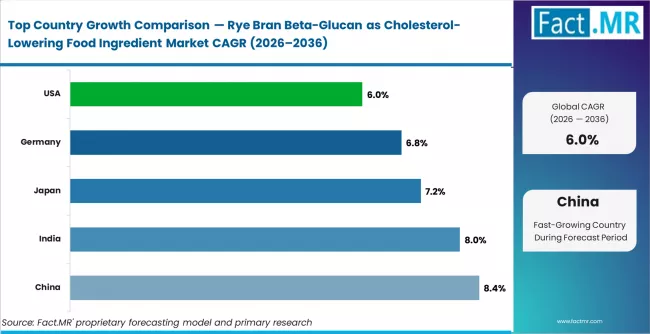
Rye Bran Beta Glucan As Cholesterol Lowering Food Ingredient Market Cagr Analysis By Country

Asia Pacific Rye Bran Beta-Glucan as Cholesterol-Lowering Food Ingredient Market Analysis
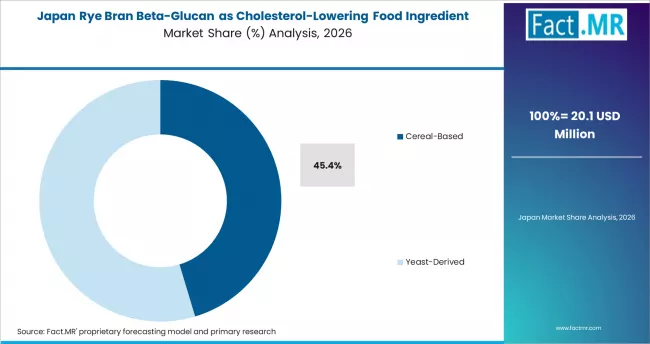
Rye Bran Beta Glucan As Cholesterol Lowering Food Ingredient Market Japan Market Share Analysis By Source

Asia Pacific is the fastest-growing region. Growth is supported by regulatory expansion and rising health awareness. Demand reflects a mix of policy-driven and retail-led procurement. Kerry Group and DSM-Firmenich serve the region with diverse portfolios.

  • China: Market in china is shaped by a strong e-commerce-led nutraceutical ecosystem. Growth is projected at 8.4% CAGR through 2036. Functional food brands are actively integrating beta-glucan into cholesterol-focused products. NHC approvals are enabling structured ingredient adoption. Demand remains regulatory-driven rather than retail-led.
  • India: India’s growth is driven by expanding urban health awareness and dietary shifts. Demand is projected at 8.0% CAGR through 2036. Beta-glucan is being incorporated into bakery, dairy, and beverage products. FSSAI frameworks are supporting both domestic and imported supply. Growth is led by organised retail and supplement channels.
  • Japan: Japan market is defined by strict clinical validation and premium positioning. Demand is projected at 7.2% CAGR through 2036. FOSHU and FFC systems are supporting continued product approvals. Procurement is highly specification-driven with strong focus on documented health claims.

FACT.MR covers China, India, Japan, South Korea, ASEAN, and Australia & New Zealand. Includes regulatory timelines, procurement benchmarks, and investment data.

Europe Rye Bran Beta-Glucan as Cholesterol-Lowering Food Ingredient Market Analysis
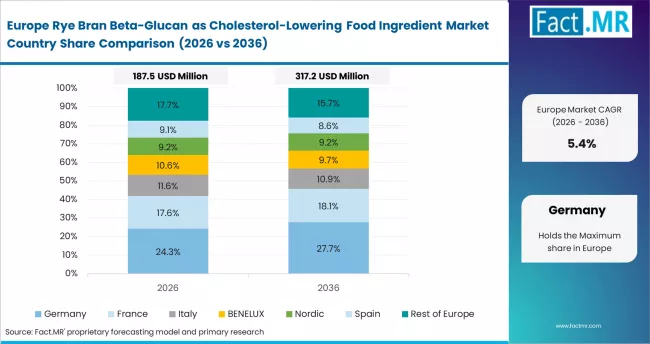
Rye Bran Beta Glucan As Cholesterol Lowering Food Ingredient Market Europe Country Market Share Analysis, 2026 & 2036

Europe operates as a compliance-driven market with strict regulatory standards. EFSA health claims define adoption patterns across food categories. Kerry Group, Tate & Lyle, and Lantmännen maintain strong supply positions.

  • Germany: Germany’s market benefits from its deep-rooted rye consumption and health-focused retail base. Growth is projected at 6.8% CAGR through 2036. EFSA-approved claims support strong on-pack positioning in functional foods. Tate & Lyle continues to expand supply capabilities through strategic acquisitions. Demand is structured and regulation-led.

FACT.MR covers Germany, France, the UK, Italy, Spain, Nordic countries, and BENELUX. Includes EFSA compliance data and procurement benchmarks.

North America Rye Bran Beta-Glucan as Cholesterol-Lowering Food Ingredient Market Analysis
Rye Bran Beta Glucan As Cholesterol Lowering Food Ingredient Market Country Value Analysis

North America represents a mature and innovation-driven market. FDA-authorised health claims define ingredient positioning and competition. Kerry Group and Tate & Lyle hold strong positions through claim-backed portfolios.

  • United States: The United States market is characterised by strong demand for functional and fortified foods. Growth is projected at 6.0% CAGR through 2036. FDA’s updated “healthy” labelling framework is expanding commercial opportunities. Beta-glucan is widely used in plant-based beverages and protein bars. Growth is moderated by competition from oat-based alternatives.

FACT.MR covers the United States, Canada, and Mexico. Includes FDA compliance data and functional food demand trends.

Competitive Aligners for Market Players
Rye Bran Beta Glucan As Cholesterol Lowering Food Ingredient Market Analysis By Company

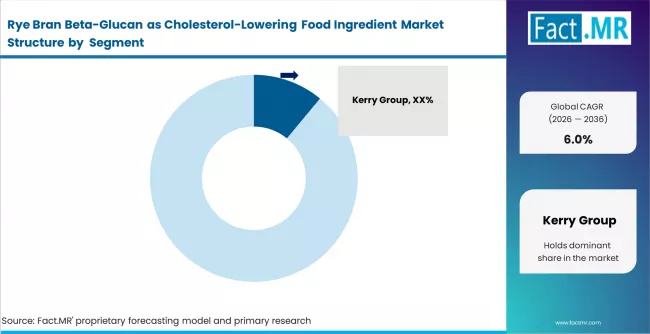
The rye bran beta-glucan as cholesterol-lowering food ingredient market is moderately concentrated, with a limited group of established suppliers controlling the majority of claim-eligible, high-purity beta-glucan supply. Key players such as Kerry Group, Tate & Lyle, DSM-Firmenich, and Lantmännen dominate premium functional food and supplement procurement. Competitive differentiation is driven primarily by regulatory compliance, health claim validation, and consistency of product specifications rather than pricing alone, particularly within EFSA and FDA-regulated markets.

Leading suppliers benefit from vertically integrated cereal processing capabilities and strong regulatory expertise. Tate & Lyle maintains a competitive edge through its PromOat beta-glucan, which holds both European Commission and FDA-authorised cholesterol health claims. Its acquisition of CP Kelco in 2024 has further expanded its specialty ingredient portfolio and global supply capabilities. Lantmännen focuses on oat-derived soluble beta-glucan, supported by documented extraction processes and application-level technical support for food and cosmetic manufacturers. Meanwhile, Lesaffre has strengthened its position through the acquisition of Biorigin, enhancing its yeast-derived beta-glucan portfolio for supplement applications. Procurement across functional food and nutraceutical manufacturers is highly specification-driven. Buyers require validated purity levels, viscosity profiles, and alignment with approved health claims before supplier onboarding.

Once a specific beta-glucan grade is incorporated into a formulation, switching costs are significant due to reformulation requirements and regulatory revalidation. This creates long-term supplier relationships and reinforces pricing power for compliant producers. Large supplement and food brands are increasingly adopting dual-sourcing strategies, particularly between Tate & Lyle and Kerry Group, to balance supply security with regulatory continuity.

Key Players

  • Kerry Group
  • DSM-Firmenich
  • Kemin Industries
  • Lantmännen
  • Tate & Lyle
  • Lesaffre

Bibliography

  • [1] Lantmannen Functional Foods / European Commission. PromOat Oat Beta-Glucan European Commission Authorised Health Claim: 'Oat Beta-Glucan Has Been Shown to Lower/Reduce Blood Cholesterol' Under Regulation EC 1924/2006. lantmannenfunctionalfoods.com / knowde.com/stores/lantmannen-functional-foods
  • [2] Tate & Lyle PLC. (November 2024). Completion of Combination of Tate & Lyle and CP Kelco to Create a Leading Global Speciality Food and Beverage Solutions Business. November 15, 2024. tateandlyle.com/news
  • [3] Food Ingredient First. (October 2024). Lesaffre Acquires 70% Stake in Biorigin, Brazilian Yeast-Derived Products Specialist for Human and Animal Nutrition Including Beta-Glucan Derivatives. October 2024. foodingredientsfirst.com
  • [4] Tate & Lyle PLC. FDA Healthy Food Labelling Update February 2025: PromOat Beta-Glucan Qualification Under FDA Updated 'Healthy' Food Labelling Definition Through Pre-Existing Authorised Oat Beta-Glucan Cholesterol-Lowering Health Claim at 3-Gram Daily Intake. tateandlyle.com/news
  • [5] Mordor Intelligence / Layn Natural Ingredients. (February 2025). Layn Natural Ingredients Develops Galacan Soluble Beta-Glucan via Precision Fermentation at Expanded Biotechnology Facility: Improved Bioavailability and Water Solubility for Gut Health and Functional Food Applications. February 2025. mordorintelligence.com
  • [6] Mordor Intelligence. (2024-2025). Soluble Beta-Glucan Market Analysis: EFSA Approval of Paramylon from Euglena gracilis as Novel Food Ingredient 2024; Food and Beverages 57.19% Revenue Share 2024; Dietary Supplements 8.06% CAGR. mordorintelligence.com/industry-reports/soluble-beta-glucan-market
  • [7] NutraIngredients / Smooth Link Inc. (December 2025). Japan Immune Health Functional Foods Record High: 1,584 Foods with Function Claims Notified to CAA in FY2024 Surpassing Prior Year 1,433 Notifications. December 2025. nutraingredients.com

This Report Addresses

  • Strategic insights on rye bran beta-glucan demand across China e-commerce nutraceutical expansion, India retail-led functional food adoption, Japan FOSHU-framework heart-health procurement, Germany EFSA clean-label reformulation, and U.S. FDA healthy labelling-driven ingredient upgrading.
  • Market forecast from USD 0.7 billion in 2026 to USD 1.3 billion by 2036 at a CAGR of 6.0%.
  • Growth opportunity mapping across soluble beta-glucan functional food fortification, cereal-source cholesterol claims compliance, dietary supplement channel expansion, and pharmaceutical-grade ingredient adoption.
  • Segment analysis by source (yeast-derived, cereal-based), type (soluble, insoluble), and application (food & beverages, dietary supplements, pharmaceuticals).
  • Regional outlook covering Asia Pacific nutraceutical-led demand growth, European EFSA-claim-driven functional food reformulation cycles, and North America FDA healthy labelling-led procurement expansion.
  • Competitive landscape of Kerry Group, Tate & Lyle, DSM-Firmenich, Lantmännen, Kemin Industries, and Lesaffre. Focus on EFSA and FDA health claim dossier quality, purity standardisation, and application-specific grade documentation.
  • Regulatory impact analysis covering EFSA Regulation EC 1924/2006 cholesterol health claim requirements, FDA authorised oat beta-glucan health claims, Japan FOSHU and FFC framework approvals, and FSSAI functional ingredient review pathways.
  • Report delivered in PDF, Excel datasets, and presentation formats. Supported by primary research, regulatory filings, producer disclosures, and functional food procurement benchmarks.

Rye Bran Beta-Glucan as Cholesterol-Lowering Food Ingredient Market Definition

The market covers rye bran beta-glucan concentrates in soluble and insoluble forms. These are used as cholesterol-lowering functional ingredients. They are applied in bakery, beverages, supplements, and pharmaceuticals.

Rye Bran Beta-Glucan as Cholesterol-Lowering Food Ingredient Market Inclusions

Includes global and regional forecasts from 2026 to 2036 by source, type, and application. Covers cereal-based and yeast-derived beta-glucan. Includes food, supplement, and pharmaceutical applications.

Rye Bran Beta-Glucan as Cholesterol-Lowering Food Ingredient Market Exclusions

Excludes mushroom and seaweed-derived beta-glucans. Finished functional food and retail supplement products are not included. Focus remains on ingredient-level supply to processors.

Rye Bran Beta-Glucan as Cholesterol-Lowering Food Ingredient Market Research Methodology

  • Primary Research: Includes interviews with ingredient suppliers, formulators, brand managers, and procurement specialists across key markets.
  • Desk Research: Covers EFSA and FDA health claim data, FSSAI approvals, and Japan FOSHU database. Includes producer reports from 2024 to 2025.
  • Market Sizing and Forecasting: Uses a hybrid top-down and bottom-up model. Based on production volumes, pricing, and application demand.
  • Data Validation and Update Cycle: Validated through producer revenues, regulatory filings, and procurement benchmarks. Updated regularly.

Scope of Report

Rye Bran Beta Glucan As Cholesterol Lowering Food Ingredient Market Breakdown By Source, Type, And Region

Attribute Details
Quantitative Units USD 0.7 billion (2026) to USD 1.3 billion (2036), at a CAGR of 6.0%
Market Definition Cereal-based and yeast-derived beta-glucan concentrates in soluble and insoluble forms sold as cholesterol-lowering food additives for functional food, supplement, and pharmaceutical applications globally.
Source Segmentation Yeast-Derived, Cereal-Based
Type Segmentation Soluble Beta-Glucan, Insoluble Beta-Glucan
Application Segmentation Food & Beverages, Dietary Supplements, Pharmaceuticals
Application Coverage Functional food and bakery fortification, cholesterol management supplement formulation, plant-based beverage fiber enrichment, and pharmaceutical-grade clinical nutrition ingredient procurement.
Regions Covered North America, Europe, Asia Pacific, Latin America, Middle East and Africa
Countries Covered USA, Canada, Mexico, Germany, UK, France, Italy, Spain, Nordic, BENELUX, China, Japan, South Korea, India, ASEAN, Australia and New Zealand, Brazil, Argentina, Chile, Saudi Arabia, GCC, Turkey, South Africa, Rest of MEA
Key Companies Profiled Kerry Group, DSM-Firmenich, Kemin Industries, Lantmännen, Tate & Lyle, Lesaffre
Forecast Period 2026 to 2036
Approach Hybrid top-down and bottom-up model using cereal beta-glucan ingredient production volumes by source and type, average selling prices by application grade, regulatory health claim compliance timelines, functional food procurement benchmarks, and primary interviews with ingredient suppliers and food formulators.

Rye Bran Beta-Glucan as Cholesterol-Lowering Food Ingredient Market by Segments

  • By Source:

    • Yeast-Derived
    • Cereal-Based
  • By Type:

    • Soluble Beta-Glucan
    • Insoluble Beta-Glucan
  • By Application:

    • Food & Beverages
    • Dietary Supplements
    • Pharmaceuticals
  • By Region:

    • North America

      • United States
      • Canada
      • Mexico
    • Latin America

      • Brazil
      • Mexico
      • Argentina
      • Chile
      • Rest of Latin America
    • Western Europe

      • Germany
      • United Kingdom
      • France
      • Italy
      • Spain
      • Nordic Countries
      • BENELUX
      • Rest of Western Europe
    • Eastern Europe

      • Russia
      • Poland
      • Hungary
      • Balkan and Baltic
      • Rest of Eastern Europe
    • East Asia

      • China
      • Japan
      • South Korea
    • South Asia and Pacific

      • India
      • ASEAN
      • Australia and New Zealand
      • Rest of South Asia and Pacific
    • Middle East and Africa

      • Kingdom of Saudi Arabia
      • Other GCC Countries
      • Turkey
      • South Africa
      • Rest of Middle East and Africa

Table of Content

  1. Executive Summary
    • Global Market Outlook
    • Demand to side Trends
    • Supply to side Trends
    • Technology Roadmap Analysis
    • Analysis and Recommendations
  2. Market Overview
    • Market Coverage / Taxonomy
    • Market Definition / Scope / Limitations
  3. Research Methodology
    • Chapter Orientation
    • Analytical Lens and Working Hypotheses
      • Market Structure, Signals, and Trend Drivers
      • Benchmarking and Cross-market Comparability
      • Market Sizing, Forecasting, and Opportunity Mapping
    • Research Design and Evidence Framework
      • Desk Research Programme (Secondary Evidence)
        • Company Annual and Sustainability Reports
        • Peer-reviewed Journals and Academic Literature
        • Corporate Websites, Product Literature, and Technical Notes
        • Earnings Decks and Investor Briefings
        • Statutory Filings and Regulatory Disclosures
        • Technical White Papers and Standards Notes
        • Trade Journals, Industry Magazines, and Analyst Briefs
        • Conference Proceedings, Webinars, and Seminar Materials
        • Government Statistics Portals and Public Data Releases
        • Press Releases and Reputable Media Coverage
        • Specialist Newsletters and Curated Briefings
        • Sector Databases and Reference Repositories
        • Fact.MR Internal Proprietary Databases and Historical Market Datasets
        • Subscription Datasets and Paid Sources
        • Social Channels, Communities, and Digital Listening Inputs
        • Additional Desk Sources
      • Expert Input and Fieldwork (Primary Evidence)
        • Primary Modes
          • Qualitative Interviews and Expert Elicitation
          • Quantitative Surveys and Structured Data Capture
          • Blended Approach
        • Why Primary Evidence is Used
        • Field Techniques
          • Interviews
          • Surveys
          • Focus Groups
          • Observational and In-context Research
          • Social and Community Interactions
        • Stakeholder Universe Engaged
          • C-suite Leaders
          • Board Members
          • Presidents and Vice Presidents
          • R&D and Innovation Heads
          • Technical Specialists
          • Domain Subject-matter Experts
          • Scientists
          • Physicians and Other Healthcare Professionals
        • Governance, Ethics, and Data Stewardship
          • Research Ethics
          • Data Integrity and Handling
      • Tooling, Models, and Reference Databases
    • Data Engineering and Model Build
      • Data Acquisition and Ingestion
      • Cleaning, Normalisation, and Verification
      • Synthesis, Triangulation, and Analysis
    • Quality Assurance and Audit Trail
  4. Market Background
    • Market Dynamics
      • Drivers
      • Restraints
      • Opportunity
      • Trends
    • Scenario Forecast
      • Demand in Optimistic Scenario
      • Demand in Likely Scenario
      • Demand in Conservative Scenario
    • Opportunity Map Analysis
    • Product Life Cycle Analysis
    • Supply Chain Analysis
    • Investment Feasibility Matrix
    • Value Chain Analysis
    • PESTLE and Porter’s Analysis
    • Regulatory Landscape
    • Regional Parent Market Outlook
    • Production and Consumption Statistics
    • Import and Export Statistics
  5. Global Market Analysis 2021 to 2025 and Forecast, 2026 to 2036
    • Historical Market Size Value (USD Million) Analysis, 2021 to 2025
    • Current and Future Market Size Value (USD Million) Projections, 2026 to 2036
      • Y to o to Y Growth Trend Analysis
      • Absolute $ Opportunity Analysis
  6. Global Market Pricing Analysis 2021 to 2025 and Forecast 2026 to 2036
  7. Global Market Analysis 2021 to 2025 and Forecast 2026 to 2036, By Navigation
    • Introduction / Key Findings
    • Historical Market Size Value (USD Million) Analysis By Navigation , 2021 to 2025
    • Current and Future Market Size Value (USD Million) Analysis and Forecast By Navigation , 2026 to 2036
      • LiDAR SLAM
      • Vision Guidance
      • Magnetic Guidance
    • Y to o to Y Growth Trend Analysis By Navigation , 2021 to 2025
    • Absolute $ Opportunity Analysis By Navigation , 2026 to 2036
  8. Global Market Analysis 2021 to 2025 and Forecast 2026 to 2036, By Payload Capacity
    • Introduction / Key Findings
    • Historical Market Size Value (USD Million) Analysis By Payload Capacity, 2021 to 2025
    • Current and Future Market Size Value (USD Million) Analysis and Forecast By Payload Capacity, 2026 to 2036
      • Up to 500 kg
      • 500 to 1,000 kg
      • Above 1,000 kg
    • Y to o to Y Growth Trend Analysis By Payload Capacity, 2021 to 2025
    • Absolute $ Opportunity Analysis By Payload Capacity, 2026 to 2036
  9. Global Market Analysis 2021 to 2025 and Forecast 2026 to 2036, By Region
    • Introduction
    • Historical Market Size Value (USD Million) Analysis By Region, 2021 to 2025
    • Current Market Size Value (USD Million) Analysis and Forecast By Region, 2026 to 2036
      • North America
      • Latin America
      • Western Europe
      • Eastern Europe
      • East Asia
      • South Asia and Pacific
      • Middle East & Africa
    • Market Attractiveness Analysis By Region
  10. North America Market Analysis 2021 to 2025 and Forecast 2026 to 2036, By Country
    • Historical Market Size Value (USD Million) Trend Analysis By Market Taxonomy, 2021 to 2025
    • Market Size Value (USD Million) Forecast By Market Taxonomy, 2026 to 2036
      • By Country
        • USA
        • Canada
        • Mexico
      • By Navigation
      • By Payload Capacity
    • Market Attractiveness Analysis
      • By Country
      • By Navigation
      • By Payload Capacity
    • Key Takeaways
  11. Latin America Market Analysis 2021 to 2025 and Forecast 2026 to 2036, By Country
    • Historical Market Size Value (USD Million) Trend Analysis By Market Taxonomy, 2021 to 2025
    • Market Size Value (USD Million) Forecast By Market Taxonomy, 2026 to 2036
      • By Country
        • Brazil
        • Chile
        • Rest of Latin America
      • By Navigation
      • By Payload Capacity
    • Market Attractiveness Analysis
      • By Country
      • By Navigation
      • By Payload Capacity
    • Key Takeaways
  12. Western Europe Market Analysis 2021 to 2025 and Forecast 2026 to 2036, By Country
    • Historical Market Size Value (USD Million) Trend Analysis By Market Taxonomy, 2021 to 2025
    • Market Size Value (USD Million) Forecast By Market Taxonomy, 2026 to 2036
      • By Country
        • Germany
        • UK
        • Italy
        • Spain
        • France
        • Nordic
        • BENELUX
        • Rest of Western Europe
      • By Navigation
      • By Payload Capacity
    • Market Attractiveness Analysis
      • By Country
      • By Navigation
      • By Payload Capacity
    • Key Takeaways
  13. Eastern Europe Market Analysis 2021 to 2025 and Forecast 2026 to 2036, By Country
    • Historical Market Size Value (USD Million) Trend Analysis By Market Taxonomy, 2021 to 2025
    • Market Size Value (USD Million) Forecast By Market Taxonomy, 2026 to 2036
      • By Country
        • Russia
        • Poland
        • Hungary
        • Balkan & Baltic
        • Rest of Eastern Europe
      • By Navigation
      • By Payload Capacity
    • Market Attractiveness Analysis
      • By Country
      • By Navigation
      • By Payload Capacity
    • Key Takeaways
  14. East Asia Market Analysis 2021 to 2025 and Forecast 2026 to 2036, By Country
    • Historical Market Size Value (USD Million) Trend Analysis By Market Taxonomy, 2021 to 2025
    • Market Size Value (USD Million) Forecast By Market Taxonomy, 2026 to 2036
      • By Country
        • China
        • Japan
        • South Korea
      • By Navigation
      • By Payload Capacity
    • Market Attractiveness Analysis
      • By Country
      • By Navigation
      • By Payload Capacity
    • Key Takeaways
  15. South Asia and Pacific Market Analysis 2021 to 2025 and Forecast 2026 to 2036, By Country
    • Historical Market Size Value (USD Million) Trend Analysis By Market Taxonomy, 2021 to 2025
    • Market Size Value (USD Million) Forecast By Market Taxonomy, 2026 to 2036
      • By Country
        • India
        • ASEAN
        • Australia & New Zealand
        • Rest of South Asia and Pacific
      • By Navigation
      • By Payload Capacity
    • Market Attractiveness Analysis
      • By Country
      • By Navigation
      • By Payload Capacity
    • Key Takeaways
  16. Middle East & Africa Market Analysis 2021 to 2025 and Forecast 2026 to 2036, By Country
    • Historical Market Size Value (USD Million) Trend Analysis By Market Taxonomy, 2021 to 2025
    • Market Size Value (USD Million) Forecast By Market Taxonomy, 2026 to 2036
      • By Country
        • Kingdom of Saudi Arabia
        • Other GCC Countries
        • Turkiye
        • South Africa
        • Other African Union
        • Rest of Middle East & Africa
      • By Navigation
      • By Payload Capacity
    • Market Attractiveness Analysis
      • By Country
      • By Navigation
      • By Payload Capacity
    • Key Takeaways
  17. Key Countries Market Analysis
    • USA
      • Pricing Analysis
      • Market Share Analysis, 2025
        • By Navigation
        • By Payload Capacity
    • Canada
      • Pricing Analysis
      • Market Share Analysis, 2025
        • By Navigation
        • By Payload Capacity
    • Mexico
      • Pricing Analysis
      • Market Share Analysis, 2025
        • By Navigation
        • By Payload Capacity
    • Brazil
      • Pricing Analysis
      • Market Share Analysis, 2025
        • By Navigation
        • By Payload Capacity
    • Chile
      • Pricing Analysis
      • Market Share Analysis, 2025
        • By Navigation
        • By Payload Capacity
    • Germany
      • Pricing Analysis
      • Market Share Analysis, 2025
        • By Navigation
        • By Payload Capacity
    • UK
      • Pricing Analysis
      • Market Share Analysis, 2025
        • By Navigation
        • By Payload Capacity
    • Italy
      • Pricing Analysis
      • Market Share Analysis, 2025
        • By Navigation
        • By Payload Capacity
    • Spain
      • Pricing Analysis
      • Market Share Analysis, 2025
        • By Navigation
        • By Payload Capacity
    • France
      • Pricing Analysis
      • Market Share Analysis, 2025
        • By Navigation
        • By Payload Capacity
    • India
      • Pricing Analysis
      • Market Share Analysis, 2025
        • By Navigation
        • By Payload Capacity
    • ASEAN
      • Pricing Analysis
      • Market Share Analysis, 2025
        • By Navigation
        • By Payload Capacity
    • Australia & New Zealand
      • Pricing Analysis
      • Market Share Analysis, 2025
        • By Navigation
        • By Payload Capacity
    • China
      • Pricing Analysis
      • Market Share Analysis, 2025
        • By Navigation
        • By Payload Capacity
    • Japan
      • Pricing Analysis
      • Market Share Analysis, 2025
        • By Navigation
        • By Payload Capacity
    • South Korea
      • Pricing Analysis
      • Market Share Analysis, 2025
        • By Navigation
        • By Payload Capacity
    • Russia
      • Pricing Analysis
      • Market Share Analysis, 2025
        • By Navigation
        • By Payload Capacity
    • Poland
      • Pricing Analysis
      • Market Share Analysis, 2025
        • By Navigation
        • By Payload Capacity
    • Hungary
      • Pricing Analysis
      • Market Share Analysis, 2025
        • By Navigation
        • By Payload Capacity
    • Kingdom of Saudi Arabia
      • Pricing Analysis
      • Market Share Analysis, 2025
        • By Navigation
        • By Payload Capacity
    • Turkiye
      • Pricing Analysis
      • Market Share Analysis, 2025
        • By Navigation
        • By Payload Capacity
    • South Africa
      • Pricing Analysis
      • Market Share Analysis, 2025
        • By Navigation
        • By Payload Capacity
  18. Market Structure Analysis
    • Competition Dashboard
    • Competition Benchmarking
    • Market Share Analysis of Top Players
      • By Regional
      • By Navigation
      • By Payload Capacity
  19. Competition Analysis
    • Competition Deep Dive
      • KUKA AG
        • Overview
        • Product Portfolio
        • Profitability by Market Segments (Product/Age /Sales Channel/Region)
        • Sales Footprint
        • Strategy Overview
          • Marketing Strategy
          • Product Strategy
          • Channel Strategy
      • ABB Ltd.
      • Omron Corporation
      • Daifuku Co. Ltd.
      • SSI Schaefer AG
      • Jungheinrich AG
      • Toyota Industries Corporation
      • Murata Machinery Ltd.
  20. Assumptions & Acronyms Used

List Of Table

  • Table 1: Global Market Value (USD Million) Forecast by Region, 2021 to 2036
  • Table 2: Global Market Value (USD Million) Forecast by Navigation , 2021 to 2036
  • Table 3: Global Market Value (USD Million) Forecast by Payload Capacity, 2021 to 2036
  • Table 4: North America Market Value (USD Million) Forecast by Country, 2021 to 2036
  • Table 5: North America Market Value (USD Million) Forecast by Navigation , 2021 to 2036
  • Table 6: North America Market Value (USD Million) Forecast by Payload Capacity, 2021 to 2036
  • Table 7: Latin America Market Value (USD Million) Forecast by Country, 2021 to 2036
  • Table 8: Latin America Market Value (USD Million) Forecast by Navigation , 2021 to 2036
  • Table 9: Latin America Market Value (USD Million) Forecast by Payload Capacity, 2021 to 2036
  • Table 10: Western Europe Market Value (USD Million) Forecast by Country, 2021 to 2036
  • Table 11: Western Europe Market Value (USD Million) Forecast by Navigation , 2021 to 2036
  • Table 12: Western Europe Market Value (USD Million) Forecast by Payload Capacity, 2021 to 2036
  • Table 13: Eastern Europe Market Value (USD Million) Forecast by Country, 2021 to 2036
  • Table 14: Eastern Europe Market Value (USD Million) Forecast by Navigation , 2021 to 2036
  • Table 15: Eastern Europe Market Value (USD Million) Forecast by Payload Capacity, 2021 to 2036
  • Table 16: East Asia Market Value (USD Million) Forecast by Country, 2021 to 2036
  • Table 17: East Asia Market Value (USD Million) Forecast by Navigation , 2021 to 2036
  • Table 18: East Asia Market Value (USD Million) Forecast by Payload Capacity, 2021 to 2036
  • Table 19: South Asia and Pacific Market Value (USD Million) Forecast by Country, 2021 to 2036
  • Table 20: South Asia and Pacific Market Value (USD Million) Forecast by Navigation , 2021 to 2036
  • Table 21: South Asia and Pacific Market Value (USD Million) Forecast by Payload Capacity, 2021 to 2036
  • Table 22: Middle East & Africa Market Value (USD Million) Forecast by Country, 2021 to 2036
  • Table 23: Middle East & Africa Market Value (USD Million) Forecast by Navigation , 2021 to 2036
  • Table 24: Middle East & Africa Market Value (USD Million) Forecast by Payload Capacity, 2021 to 2036

List Of Figures

  • Figure 1: Global Market Pricing Analysis
  • Figure 2: Global Market Value (USD Million) Forecast 2021-2036
  • Figure 3: Global Market Value Share and BPS Analysis by Navigation, 2026 and 2036
  • Figure 4: Global Market Y-o-Y Growth Comparison by Navigation, 2026 to 2036
  • Figure 5: Global Market Attractiveness Analysis by Navigation
  • Figure 6: Global Market Value Share and BPS Analysis by Payload Capacity, 2026 and 2036
  • Figure 7: Global Market Y-o-Y Growth Comparison by Payload Capacity, 2026 to 2036
  • Figure 8: Global Market Attractiveness Analysis by Payload Capacity
  • Figure 9: Global Market Value (USD Million) Share and BPS Analysis by Region, 2026 and 2036
  • Figure 10: Global Market Y-o-Y Growth Comparison by Region, 2026 to 2036
  • Figure 11: Global Market Attractiveness Analysis by Region
  • Figure 12: North America Market Incremental Dollar Opportunity, 2026 to 2036
  • Figure 13: Latin America Market Incremental Dollar Opportunity, 2026 to 2036
  • Figure 14: Western Europe Market Incremental Dollar Opportunity, 2026 to 2036
  • Figure 15: Eastern Europe Market Incremental Dollar Opportunity, 2026 to 2036
  • Figure 16: East Asia Market Incremental Dollar Opportunity, 2026 to 2036
  • Figure 17: South Asia and Pacific Market Incremental Dollar Opportunity, 2026 to 2036
  • Figure 18: Middle East & Africa Market Incremental Dollar Opportunity, 2026 to 2036
  • Figure 19: North America Market Value Share and BPS Analysis by Country, 2026 and 2036
  • Figure 20: North America Market Value Share and BPS Analysis by Navigation, 2026 and 2036
  • Figure 21: North America Market Y-o-Y Growth Comparison by Navigation, 2026 to 2036
  • Figure 22: North America Market Attractiveness Analysis by Navigation
  • Figure 23: North America Market Value Share and BPS Analysis by Payload Capacity, 2026 and 2036
  • Figure 24: North America Market Y-o-Y Growth Comparison by Payload Capacity, 2026 to 2036
  • Figure 25: North America Market Attractiveness Analysis by Payload Capacity
  • Figure 26: Latin America Market Value Share and BPS Analysis by Country, 2026 and 2036
  • Figure 27: Latin America Market Value Share and BPS Analysis by Navigation, 2026 and 2036
  • Figure 28: Latin America Market Y-o-Y Growth Comparison by Navigation, 2026 to 2036
  • Figure 29: Latin America Market Attractiveness Analysis by Navigation
  • Figure 30: Latin America Market Value Share and BPS Analysis by Payload Capacity, 2026 and 2036
  • Figure 31: Latin America Market Y-o-Y Growth Comparison by Payload Capacity, 2026 to 2036
  • Figure 32: Latin America Market Attractiveness Analysis by Payload Capacity
  • Figure 33: Western Europe Market Value Share and BPS Analysis by Country, 2026 and 2036
  • Figure 34: Western Europe Market Value Share and BPS Analysis by Navigation, 2026 and 2036
  • Figure 35: Western Europe Market Y-o-Y Growth Comparison by Navigation, 2026 to 2036
  • Figure 36: Western Europe Market Attractiveness Analysis by Navigation
  • Figure 37: Western Europe Market Value Share and BPS Analysis by Payload Capacity, 2026 and 2036
  • Figure 38: Western Europe Market Y-o-Y Growth Comparison by Payload Capacity, 2026 to 2036
  • Figure 39: Western Europe Market Attractiveness Analysis by Payload Capacity
  • Figure 40: Eastern Europe Market Value Share and BPS Analysis by Country, 2026 and 2036
  • Figure 41: Eastern Europe Market Value Share and BPS Analysis by Navigation, 2026 and 2036
  • Figure 42: Eastern Europe Market Y-o-Y Growth Comparison by Navigation, 2026 to 2036
  • Figure 43: Eastern Europe Market Attractiveness Analysis by Navigation
  • Figure 44: Eastern Europe Market Value Share and BPS Analysis by Payload Capacity, 2026 and 2036
  • Figure 45: Eastern Europe Market Y-o-Y Growth Comparison by Payload Capacity, 2026 to 2036
  • Figure 46: Eastern Europe Market Attractiveness Analysis by Payload Capacity
  • Figure 47: East Asia Market Value Share and BPS Analysis by Country, 2026 and 2036
  • Figure 48: East Asia Market Value Share and BPS Analysis by Navigation, 2026 and 2036
  • Figure 49: East Asia Market Y-o-Y Growth Comparison by Navigation, 2026 to 2036
  • Figure 50: East Asia Market Attractiveness Analysis by Navigation
  • Figure 51: East Asia Market Value Share and BPS Analysis by Payload Capacity, 2026 and 2036
  • Figure 52: East Asia Market Y-o-Y Growth Comparison by Payload Capacity, 2026 to 2036
  • Figure 53: East Asia Market Attractiveness Analysis by Payload Capacity
  • Figure 54: South Asia and Pacific Market Value Share and BPS Analysis by Country, 2026 and 2036
  • Figure 55: South Asia and Pacific Market Value Share and BPS Analysis by Navigation, 2026 and 2036
  • Figure 56: South Asia and Pacific Market Y-o-Y Growth Comparison by Navigation, 2026 to 2036
  • Figure 57: South Asia and Pacific Market Attractiveness Analysis by Navigation
  • Figure 58: South Asia and Pacific Market Value Share and BPS Analysis by Payload Capacity, 2026 and 2036
  • Figure 59: South Asia and Pacific Market Y-o-Y Growth Comparison by Payload Capacity, 2026 to 2036
  • Figure 60: South Asia and Pacific Market Attractiveness Analysis by Payload Capacity
  • Figure 61: Middle East & Africa Market Value Share and BPS Analysis by Country, 2026 and 2036
  • Figure 62: Middle East & Africa Market Value Share and BPS Analysis by Navigation, 2026 and 2036
  • Figure 63: Middle East & Africa Market Y-o-Y Growth Comparison by Navigation, 2026 to 2036
  • Figure 64: Middle East & Africa Market Attractiveness Analysis by Navigation
  • Figure 65: Middle East & Africa Market Value Share and BPS Analysis by Payload Capacity, 2026 and 2036
  • Figure 66: Middle East & Africa Market Y-o-Y Growth Comparison by Payload Capacity, 2026 to 2036
  • Figure 67: Middle East & Africa Market Attractiveness Analysis by Payload Capacity
  • Figure 68: Global Market - Tier Structure Analysis
  • Figure 69: Global Market - Company Share Analysis

- Frequently Asked Questions -

How large is the rye bran beta-glucan as cholesterol-lowering food ingredient market in 2025?

The market was valued at USD 0.5 billion in 2025.

What will the market size be in 2026?

The market is estimated to reach USD 0.7 billion in 2026.

What is the projected market size by 2036?

The market is projected to reach USD 1.3 billion by 2036.

What is the expected CAGR of this market?

The market is expected to grow at a CAGR of 6.0% from 2026 to 2036.

What is the absolute dollar opportunity in this market?

The market is expected to create an absolute dollar opportunity of USD 0.6 billion between 2026 and 2036.

Which source segment leads the market?

Cereal-Based leads with approximately 46% share in 2026, driven by established EFSA and FDA health claim status for oat and rye-derived beta-glucans.

Which type segment holds the largest share?

Soluble Beta-Glucan leads with approximately 63% share in 2026.

Which application segment dominates?

Food & Beverages leads with approximately 45% share in 2026.

Which country shows the fastest growth?

China leads with a CAGR of 8.4% through 2036.

What is driving market growth?

Growth is driven by EFSA and FDA cholesterol health claim substantiation requirements, Japan FOSHU-framework ageing population demand, China nutraceutical sector expansion, and U.S. FDA healthy food labelling reforms effective February 2025.

What are the major restraints?

Key restraints include higher extraction costs for high-purity soluble beta-glucan relative to raw bran fractions, variability in rye harvest yields affecting supply pricing, and limited consumer awareness of rye-source beta-glucan versus established oat-based product branding.

Who are the key players?

Leading companies include Kerry Group, Tate & Lyle, DSM-Firmenich, Lantmännen, Kemin Industries, and Lesaffre.

Rye Bran Beta-Glucan as Cholesterol-Lowering Food Ingredient Market