- Market Value (2025): USD 327.4 Mn
- Estimated Value (2026): USD 356.5 Mn
- Forecast Value (2036): USD 836.2 Mn
- CAGR (2026-2036): 8.9%
What is the Sensor-based Ore Sorting Market forecast to be worth by 2036?
USD 356.5 million in 2026 to USD 836.2 million by 2036, at 8.9% CAGR.
- The sensor-based ore sorting market crossed a valuation of USD 327.4 million in 2025 influenced by mining automation equipment upgrades.
- Demand is projected to increase from USD 356.5 million in 2026 to USD 836.2 million by 2036.
- Market expansion is forecast to record 8.9% CAGR from 2026 to 2036 as mine operators use ore upgrading before grinding and beneficiation.
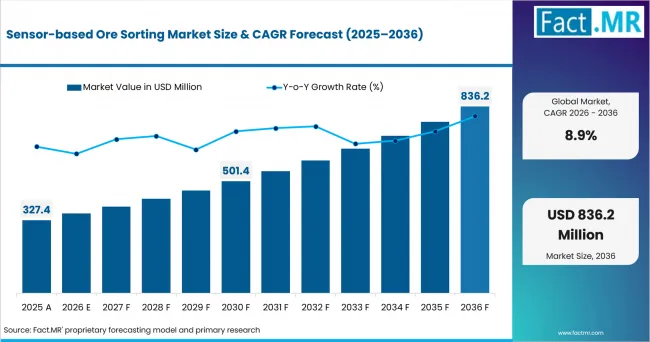
Sensor Based Ore Sorting Market Market Value Analysis | Source: Fact.MR
What are the defining numbers behind Sensor-based Ore Sorting Market growth?
USD 479.7 million in absolute opportunity by 2036, led by X-ray Transmission, Metal Ores, High Capacity systems, and Metal Mining.
- Demand Drivers in the Market
- Mine planners need early waste rejection driven by declining ore quality and rising grinding load.
- Plant engineers need sensor-fusion software supported by real-time particle classification.
- Site automation teams need sorter integration reinforced by fleet, conveyor, and plant-control data.
- Equipment providers need serviceable modules shaped by dust, vibration, moisture, and belt-speed conditions.
- Key Segments Analyzed
- By Sensor type: X-ray Transmission (XRT) is estimated to represent 33% share in 2026, shaped by density-based sorting and mineral recognition needs.
- By Mineral: Metal Ores are forecast to account for 48% share in 2026, reinforced by copper, nickel, iron, and base-metal processing requirements.
- By Throughput: High Capacity is projected to account for 44% share in 2026, driven by large-volume mine feed and pre-mill sorting demand.
- By End use: Metal Mining is projected to account for 52% share in 2026, backed by ore upgrading and waste rejection before beneficiation.
- Analyst Opinion at Fact.MR
- Shambhu Nath Jha, Senior Analyst at Fact.MR, states, “Ore sorting is becoming a proof-led decision, not a simple equipment purchase. Adoption is expected to favor providers proving sorter response across ore variability, moisture, particle size, and plant integration. Better-positioned providers should combine ore testing, software tuning, sensor depth, and after-sales support near mining districts.”
- Strategic Implications
- Mine planners should test ore variability before approving sorter installation across full plant flows.
- Plant engineers should compare rejected waste, recovered grade, and mill energy before scaling units.
- Equipment providers should document sensor response across mineralogy, particle size, and moisture ranges.
- Service teams should support calibration, spare parts, and operator training after commissioning.
TOMRA Mining launched CONTAIN™ in June 2025 as a deep-learning classification tool for inclusion-type ores. TOMRA reported training on tens of thousands of ore samples and field performance at Wolfram Bergbau, including 8.0% higher plant throughput and 33.0% lower ore mineral losses. Product development reflects a shift toward software-led sorter decisions and ore-specific model training.
India is projected to record 10.7% CAGR by 2036 driven by iron ore output and beneficiation upgrades. China is expected to post 10.0% CAGR by 2036 supported by steel-linked ore processing and critical mineral programs. Australia is anticipated to advance at 8.7% CAGR by 2036 propelled by surface mining renewal and lithium sorting projects. United Kingdom is estimated to hold 8.4% CAGR by 2036 attributable to quarry modernization and critical mineral policy. United States is forecast to record 8.2% CAGR by 2036 reinforced by copper, lithium, and domestic mineral security needs.
How does the Sensor-based Ore Sorting Market break down by segment?
Metal Mining is likely to lead at 52%; Metal Ores are anticipated to lead at 48%.
Which sensor type category is projected to lead?
X-ray Transmission (XRT) is likely to hold 33% share in 2026.
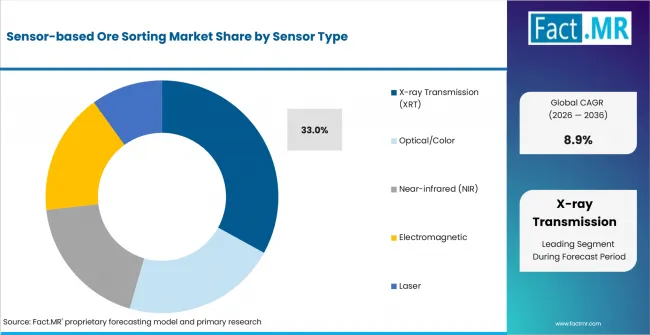
Sensor Based Ore Sorting Market Analysis By Sensor Type | Source: Fact.MR
X-ray Transmission (XRT) is expected to garner 33% share in 2026, driven by density-based particle recognition and ore-waste separation. Optical/Color follows through visible mineral differences and industrial mineral sorting. Near-infrared (NIR) and Laser systems remain linked to selective mineral response and material-specific sorting requirements. TOMRA Mining reported in June 2025 that CONTAIN™ detected tungsten-bearing inclusions at grain sizes up to 65 mm, showing how sensor-led recognition improves sorting in complex ores.
Which mineral category is forecast to capture the leading share?
Metal Ores are estimated to secure 48% share in 2026.
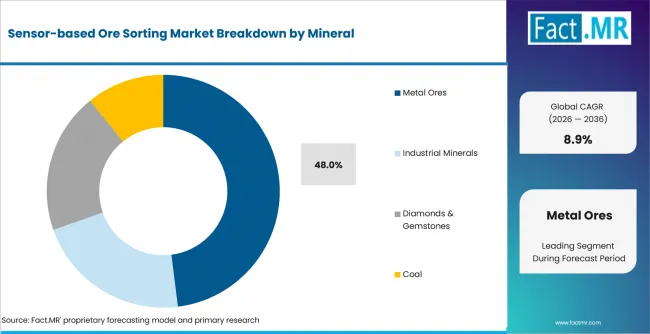
Sensor Based Ore Sorting Market Analysis By Mineral | Source: Fact.MR
Metal Ores are projected to account for 48% share in 2026, led by zinc and lead pre-concentration needs. Industrial Minerals follow through magnesite and phosphate sorting. Diamonds & Gemstones support high-value separation use cases. Coal retains selective relevance where sorting improves feed quality. U.S. Geological Survey reported in February 2026 claiming global nickel mine production to have increased 5.0% to an estimated 3.9 million tons in 2025, supporting sorting interest across metal ore processing.
Which throughput category is anticipated to hold the leading position?
High Capacity is projected to represent 44% share in 2026.
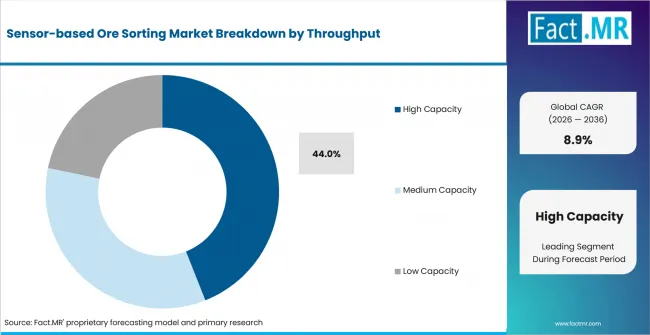
Sensor Based Ore Sorting Market Analysis By Throughput | Source: Fact.MR
High Capacity is anticipated to capture 44% share in 2026, backed by large-volume ore movement and plant-level pre-concentration. Medium Capacity follows across brownfield upgrades and smaller mineral processing lines. Low Capacity remains relevant for pilot testing and early-stage sorter qualification. TOMRA reported in January 2025 stating Pilbara Minerals’ lithium sorting plant having delivered more than 1,000 tonnes per hour capacity, reinforcing demand for high-throughput sorter systems near major mine infrastructure.
Which end use is estimated to see the strongest demand?
Metal Mining is set to account for 52% share in 2026.
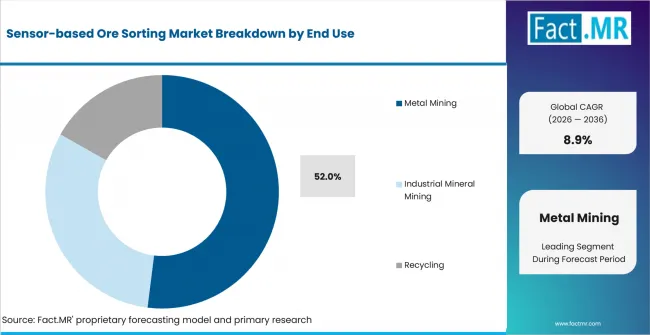
Sensor Based Ore Sorting Market Analysis By End Use | Source: Fact.MR
Metal Mining is estimated to represent 52% share in 2026, shaped by ore upgrading and beneficiation efficiency needs. Industrial Mineral Mining follows across quarry and specialty mineral sorting. Recycling remains relevant where sensor-based separation improves secondary material recovery. Press Information Bureau reported in July 2025 for India having ranked third in iron ore production and among the top 10 refined copper producers, supporting sorter opportunities across metal mining operations.
What is accelerating Sensor-based Ore Sorting Market adoption, and what is holding it back?
Ore waste rejection drives it; ore variability restrains it.
Drivers Impact Analysis
| Driver | (~) % Impact on CAGR | Geographic Relevance | Impact Timeline |
|---|---|---|---|
| Ore grade pressure and mill-load reduction | +0.9% | Australia, China, India | Medium term (2-4 years) |
| Sensor-fusion software control | +0.8% | United States, Germany, Australia | Short term (<= 2 years) |
| Critical mineral supply security | +0.7% | United States, India, United Kingdom | Medium term (2-4 years) |
| Dry pre-concentration near water-stressed mines | +0.5% | Australia, India, Africa | Medium term (2-4 years) |
| Brownfield productivity upgrades | +0.4% | Global mining hubs | Long term (>= 4 years) |
Source: Fact.MR analysis. Updated Jul 10, 2026
- Ore grade pressure and mill-load reduction: Ore quality pressure is pushing operators to remove barren material before crushing and grinding. U.S. Geological Survey reported in February 2026 that world iron ore resources are greater than 900 billion tons, containing more than 260 billion tons of iron. Large low-grade resource bases are projected to keep pre-concentration trials active across long-life mines.
- Sensor-fusion software control: Modern sorters increasingly combine XRT, XRF, optical, and laser signals before ejector decisions are made. Metso reported in October 2025 that its bulk ore sorting solutions combine crushing expertise with ore sorting to increase mineable tonnes and energy efficiency. Software-led control is expected to support retrofit projects as mines seek more data before capital approvals.
- Critical mineral supply security: National mineral policies are placing more attention on copper, lithium, nickel, rare earths, and battery materials. European Union Regulation 2024/1252 set 2030 benchmarks of 10.0% extraction, 40.0% processing, and 25.0% recycling capacity for strategic raw materials. Ore sorting is anticipated to gain more evaluation work as projects seek higher recovery from domestic deposits.
- Dry pre-concentration near water-stressed mines: Dry sorting reduces reliance on wet processing during early ore upgrading. STEINERT stated in November 2025 that Navachab’s sorting route requires minimum water and has operating costs about one quarter of DMS costs. Adoption is estimated to improve at mines facing water limits and high tailings handling burdens.
- Brownfield productivity upgrades: Existing plants often need better feed quality before expensive plant expansion. Metso’s May 2025 investor presentation identified sorting as covering bulk and particle sorting, with more than 100 solutions linked to improved productivity and lower energy and water use. Brownfield demand is forecast to rise as operators assess sorter payback against mill bottlenecks.
Opportunity Impact Analysis
| Opportunity | (~) % Impact on CAGR | Geographic Relevance | Impact Timeline |
|---|---|---|---|
| AI classification for complex ores | +0.6% | Europe, Australia, United States | Short term (<= 2 years) |
| Lithium and battery mineral sorting | +0.5% | Australia, China, India | Medium term (2-4 years) |
| Stockpile recovery programs | +0.4% | Africa, Australia, Latin America | Medium term (2-4 years) |
| Service-led retrofit packages | +0.3% | Global installed base | Long term (>= 4 years) |
Source: Fact.MR analysis. Updated Jul 10, 2026
- AI classification for complex ores: Inclusion-type ores need pattern recognition beyond density separation. TOMRA reported in June 2025 that CONTAIN™ used deep learning for ores containing tungsten, nickel, tin, gold, chromite, iron, and copper. AI classification is projected to support ore-specific model training across deposits with mixed mineral response.
- Lithium and battery mineral sorting: Lithium mines need early removal of barren minerals before concentration. U.S. Geological Survey reported in February 2026 that worldwide lithium production excluding U.S. output increased 31.0% to about 290,000 tons in 2025. Sorting opportunity is expected to expand around spodumene projects seeking stable feed grade.
- Stockpile recovery programs: Low-grade stockpiles become more useful after sorter tests prove grade uplift. TOMRA reported in January 2025 that Pilbara Minerals’ lithium sorting plant delivered more than 1,000 tonnes per hour capacity and reduced annual energy consumption by 8 to 15 GWh. Stockpile recovery is anticipated to benefit from large-capacity sorter plants near existing mine infrastructure.
- Service-led retrofit packages: Sorter value depends on feed control, calibration, spares, and operator training after commissioning. MineSense stated in February 2024 that ShovelSense measures grade at bucket scale using XRF sensors and redirects loads based on ore classification. Retrofit services are likely to gain buyer attention as mines combine face data and plant sorting.
Restraints Impact Analysis
| Restraint | (~) % Impact on CAGR | Geographic Relevance | Impact Timeline |
|---|---|---|---|
| Ore variability and test burden | -0.6% | Global | Short term (<= 2 years) |
| Feed preparation cost | -0.4% | Brownfield plants | Medium term (2-4 years) |
| Dust and moisture interference | -0.3% | Surface and underground mines | Medium term (2-4 years) |
| Legacy plant integration risk | -0.2% | Established mining regions | Long term (>= 4 years) |
Source: Fact.MR analysis. Updated Jul 10, 2026
- Ore variability and test burden: Each orebody needs proof that sensors distinguish valuable particles from waste. U.S. Geological Survey stated in February 2026 that Mineral Commodity Summaries covers more than 90 individual minerals and materials, reflecting how mineral behavior differs across commodity groups. Adoption is estimated to slow at sites lacking representative ore samples.
- Feed preparation cost: Sorters need controlled particle size, clean presentation, and stable belt loading. TOMRA stated in June 2025 that CONTAIN™ performs analysis in dense and fast-paced input streams without relying on specific throughput or spacing. Plant changes are expected to delay smaller projects if screening and feeding upgrades add too much upfront work.
- Dust and moisture interference: Harsh mine conditions reduce camera clarity, X-ray response, and ejector accuracy. MineSense stated in 2026 that ShovelSense is designed for extreme environmental conditions and shovel shock and vibration. Uptake is anticipated to remain selective at sites lacking maintenance discipline and protected sensor zones.
- Legacy plant integration risk: Older circuits often lack space for feed preparation, reject handling, and control-room data review. Metso reported in April 2024 that customer requests for quotations in minerals equipment stayed high during 2024, even as investment decisions slowed. Retrofit demand is forecast to improve only after engineering teams prove plant disruption remains manageable.
Which countries are scaling Sensor-based Ore Sorting Market?
India 10.7%, China 10.0%, Australia 8.7%, United Kingdom 8.4%, United States 8.2%.
.webp "Top Country Growth Comparison Sensor Based Ore Sorting Market Cagr (2026 2036)")
Top Country Growth Comparison Sensor Based Ore Sorting Market Cagr (2026 2036) | Source: Fact.MR
Regional analysis covers North America, Latin America, Europe, East Asia, South Asia and Pacific, and Middle East and Africa.
| Country | CAGR |
|---|---|
| India | 10.7% |
| China | 10.0% |
| Australia | 8.7% |
| United Kingdom | 8.4% |
| United States | 8.2% |
Source: Fact.MR analysis. Updated Jul 10, 2026
What is driving India’s growth by 2036?
10.7% CAGR, driven by iron ore output and beneficiation upgrades.
India’s mining base is adding output pressure across iron ore, bauxite, manganese, and lead-zinc ore. Press Information Bureau reported in July 2025 that iron ore production rose from 52.7 MMT in April-May FY 2024-25 to 53.0 MMT in April-May FY 2025-26. Sensor-based ore sorting demand is projected to expand at 10.7% CAGR by 2036 as mine operators assess pre-concentration near beneficiation circuits.
How is China scaling Sensor-based Ore Sorting demand?
10.0% CAGR, supported by steel-linked ore processing and critical mineral programs.
China remains a high-volume ore processing base across iron ore, copper, lithium, and industrial minerals. World Steel Association reported in April 2026 that China produced 87.0 Mt of crude steel in March 2026. Market demand is expected to post 10.0% CAGR by 2036 as processors evaluate automated sorting near high-throughput mineral circuits.
What supports Australia’s outlook?
8.7% CAGR, propelled by surface mining renewal and lithium sorting projects.
Australia’s outlook is shaped by Pilbara iron ore renewal, lithium projects, and remote mine economics. Australian government reporting in July 2026 noted iron ore export volumes rose 6.0% year-on-year in March quarter 2026. Market adoption is anticipated to reach 8.7% CAGR by 2036 as operators test sorters against haulage, water, and mill-energy reduction.
What underpins United Kingdom demand?
8.4% CAGR, attributable to quarry modernization and critical mineral policy.
United Kingdom demand is linked to quarry processing, industrial minerals, and critical mineral planning. British Geological Survey announced in April 2026 that United Kingdom Minerals Yearbook 2025 provides production, consumption, and trade data up to 2025. Market expansion is estimated at 8.4% CAGR by 2036 as quarry operators review optical and XRF sorting for mineral quality control.
How is United States demand developing?
8.2% CAGR, reinforced by copper security and mine-grade control.
United States demand is linked to copper output, lithium projects, and domestic mineral security. U.S. Geological Survey reported in February 2026 that 26 copper mines were active in 2025, with 17 mines accounting for more than 99.0% of U.S. copper mine production. Sensor-based ore sorting demand is forecast to record 8.2% CAGR by 2036 as operators seek better grade control before processing.
Who leads the Sensor-based Ore Sorting Market?
TOMRA Mining and STEINERT lead direct ore sorting coverage, while Metso and MineSense strengthen bulk sorting and grade-control capabilities.
TOMRA Mining brings XRT sorting, deep-learning classification, and lithium plant experience. STEINERT provides KSS multi-sensor sorting, XSS systems, and Intelligent.Declustering software for particle separation. Metso adds particle ore sorting, bulk ore sorting, crushing integration, and plant-engineering support across greenfield and brownfield mine projects.
MineSense supports ore and waste classification at extraction points through ShovelSense® and BeltSense® systems. REDWAVE and Binder+Co broaden provider coverage across XRF, optical, and mineral sorting systems for ores and industrial minerals. Competition by 2036 is expected to be shaped by ore testing depth, sensor accuracy, software tuning, maintenance access, and proof after commissioning.
What companies are the key providers?
TOMRA Mining and STEINERT are key providers. Metso and MineSense are also profiled. REDWAVE and Binder+Co complete the company set.
- TOMRA Mining
- STEINERT
- Metso
- MineSense Technologies
- REDWAVE
- Binder+Co
Bibliography
- Australian Government Department of Industry, Science and Resources. (2026, July 3). Resources and energy quarterly: June 2026. Australian Government Department of Industry, Science and Resources.
- British Geological Survey. (2026, April 21). UK Minerals Yearbook 2025 now available. British Geological Survey.
- European Parliament and Council of the European Union. (2024, May 3). Regulation (EU) 2024/1252 establishing a framework for ensuring a secure and sustainable supply of critical raw materials. Official Journal of the European Union.
- Metso. (2024, April 25). Metso annual report 2024 financial review. Metso.
- Metso. (2024, May 29). 5 reasons to choose bulk ore sorting. Metso.
- Metso. (2025, May). Metso investor presentation May-June 2025. Metso.
- Metso. (2025, October). Bulk ore sorting solutions. Metso.
- MineSense Technologies. (2024, February 27). Pre-concentration & ore sorting annual feature. MineSense Technologies.
- MineSense Technologies. (2026). ShovelSense®. MineSense Technologies.
- Ministry of Mines, Government of India. (2025, July 1). Mineral and non-ferrous metal production on growth track in FY 2025-26. Press Information Bureau.
- STEINERT. (2025, November 17). Navachab Gold Mine is investing in the latest sorting technology. STEINERT.
- TOMRA Mining. (2025, January 9). TOMRA’s role in Pilbara: Lithium sorting plant success. TOMRA Mining.
- TOMRA Mining. (2025, June 12). TOMRA Mining launches CONTAIN™: Deep learning classification for inclusion-type ore sorting. TOMRA Mining.
- U.S. Geological Survey. (2026, February). Mineral Commodity Summaries 2026: Copper. U.S. Geological Survey.
- U.S. Geological Survey. (2026, February). Mineral Commodity Summaries 2026: Iron ore. U.S. Geological Survey.
- U.S. Geological Survey. (2026, February). Mineral Commodity Summaries 2026: Lithium. U.S. Geological Survey.
- U.S. Geological Survey. (2026, February). Mineral Commodity Summaries 2026: Nickel. U.S. Geological Survey.
- U.S. Geological Survey. (2026, February 6). Mineral Commodity Summaries 2026. U.S. Geological Survey.
This Report Addresses
- The report provides strategic intelligence on Sensor-Based Ore Sorting across Sensor Type, Mineral, Throughput, End Use, and Region.
- Segment analysis covers X-ray Transmission, Metal Ores, High Capacity systems, and Metal Mining.
- Regional outlook evaluates India, China, Australia, United Kingdom, and United States across country CAGR comparison.
- Competitive analysis profiles TOMRA Mining and STEINERT alongside Metso, MineSense Technologies, REDWAVE, and Binder+Co.
- Sensor Type assessment covers X-ray Transmission, Optical/Color, Near-infrared, Electromagnetic, and Laser sorting systems.
- Mineral assessment covers Metal Ores, Industrial Minerals, Diamonds & Gemstones, and Coal.
- Forecast review uses official mineral statistics, supplier developments, company portfolio checks, and operator interview inputs.
What does the Sensor-based Ore Sorting Market cover?
XRT, XRF, optical, laser, and sensor-fusion sorting systems used for ore upgrading.
Sensor-based ore sorting market covers machines, software, sensors, and service packages used to classify ore particles before downstream processing. Systems separate valuable ore from waste using density, chemistry, colour, shape, fluorescence, and transmission signals.
Market coverage differs from general mining automation equipment since its commercial function is ore separation. Exploration sensors, handheld analyzers, and laboratory-only testing tools remain outside scope unless sold as part of sorter qualification and plant implementation.
What is included in the scope?
Sensor-based ore sorting systems used in mine and mineral-processing circuits.
Scope includes software, sensors, mechanical sorting modules, service packages, and control interfaces used in particle or bulk ore sorting. Coverage spans surface mines, underground mines, hybrid mine sites, and pilot lines. Applications include waste rejection, grade control, stockpile recovery. End uses include base metals, industrial minerals, precious metals, battery minerals, and gemstones. Adjacent equipment context is informed by mining automation, autonomous mining equipment, and mining material handling equipment.
What is excluded from the scope?
General exploration sensors and laboratory-only mineral analyzers are outside scope.
Scope excludes handheld exploration analyzers, drilling sensors, standalone laboratory spectroscopy instruments, and general conveyor automation not used for ore separation. Full beneficiation plants are excluded unless the commercial package includes a sensor-based sorting unit and associated controls.
How was the analysis built?
120+ sources, 40+ company portfolios, 25+ countries, 20+ interviews.
- Primary Research
- Primary research includes interviews with mine planners, plant engineers, sorter operators and mineral-processing managers. It also includes input from automation leads, service managers, equipment integrators and technical sales teams involved in sorter trials and plant commissioning.
- Desk Research
- Desk research reviews official mineral production statistics, mining equipment regulations, sensor-based sorting portfolios, ore sorting case studies and supplier product catalogs. Company announcements, investor materials and technical product pages are also evaluated to assess market developments and competitive positioning.
- Market-Sizing and Forecasting
- Forecasting uses ore production activity, sorter attachment rates, mine upgrade cycles, application-specific demand and service intensity. Forecast models also consider brownfield retrofit activity, regional mining output, ore variability and sensor configuration preferences across end-use applications.
- Data Validation and Update Cycle
- Forecasts are validated through provider checks and industry interviews that test assumptions on product demand, ore sorting trials and plant adoption. Portfolio mapping, regional demand assessment and service feedback help confirm market direction, while ongoing reviews of official mineral statistics and company launches support forecast updates.
Segmentation
What is the report’s scope and coverage?
| Attribute | Details |
|---|---|
| Quantitative Units | USD 356.5 million in 2026 to USD 836.2 million by 2036 at a CAGR of 8.9% |
| Market Definition | Sensor-enabled ore classification and separation systems designed to identify valuable minerals and reject waste before downstream processing |
| Component | Software; Sensors; Mechanical Modules; Services; Control Interfaces |
| Sensor Type | X-ray Transmission (XRT); Optical/Color; Near-infrared (NIR); Electromagnetic; Laser |
| Mineral | Metal Ores; Industrial Minerals; Diamonds & Gemstones; Coal |
| Throughput | High Capacity;Medium Capacity;Low Capacity |
| End Use | Metal Mining;Industrial Mineral Mining;Recycling |
| Regions Covered | North America; Latin America; Europe; East Asia; South Asia and Pacific; Middle East and Africa |
| Countries Covered | India; China; Australia; United Kingdom; United States |
| Key Companies Profiled | TOMRA Mining; STEINERT; Metso; MineSense Technologies; REDWAVE; Binder+Co |
| Forecast Period | 2026 to 2036 |
| Approach | Hybrid top-down and bottom-up approach using ore production activity; sorter attachment rates; mine upgrade cycles; ore testing evidence; application mix; regional mining activity |
Source: Fact.MR analysis. Updated Jul 10, 2026
How is the market segmented?
-
By Sensor Type:
- X-ray Transmission (XRT)
- Optical/Color
- Near-infrared (NIR)
- Electromagnetic
- Laser
-
By Mineral:
- Metal Ores
- Industrial Minerals
- Diamonds & Gemstones
- Coal
-
By Throughput:
- High Capacity
- Medium Capacity
- Low Capacity
-
By End Use:
- o Metal Mining
- o Industrial Mineral Mining
- o Recycling
-
By Region:
- North America
- United States
- Canada
- Latin America
- Brazil
- Chile
- Peru
- Mexico
- Europe
- United Kingdom
- Germany
- France
- Spain
- Sweden
- East Asia
- China
- Japan
- South Korea
- South Asia and Pacific
- India
- Australia
- Indonesia
- Middle East and Africa
- South Africa
- Saudi Arabia
- UAE
- North America
Frequently Asked Questions
What Deployment leads the Sensor-based Ore Sorting Market?
What are the key sensor types in the Sensor-based Ore Sorting Market?
How does China perform in the Sensor-based Ore Sorting Market?
How does Australia perform in the Sensor-based Ore Sorting Market?
How does the United Kingdom perform in the Sensor-based Ore Sorting Market?
What is the primary driver in the Sensor-based Ore Sorting Market?
What is the main restraint in the Sensor-based Ore Sorting Market?
Why does Software lead Component?
Why does Waste Rejection lead Application?
Who worked on this report


Preview the report firsthand - request a free sample
Free SampleGet the brochure for pricing and purchase details
Download PDF