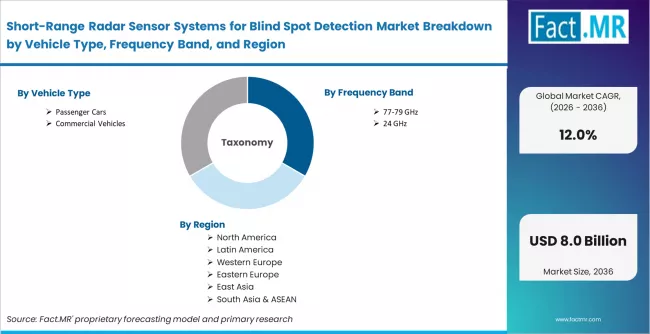
Short-Range Radar Sensor Systems for Blind Spot Detection Market Size, Share, Growth and Forecast (2026 - 2036)

The Short-Range Radar Sensor Systems for Blind Spot Detection Market is segmented by Vehicle Type (Passenger Cars, Commercial Vehicles), Frequency Band (24 GHz, 77-79 GHz), Fitment (OEM, Aftermarket), and Region. Forecast for 2026 to 2036.

Fact.MR analysis indicates that blind spot detection radar systems have transitioned from premium vehicle features to standard safety components. Adoption is tied directly to vehicle safety regulations and OEM strategies to reduce collision risk. Short-range radar sensors provide continuous monitoring of adjacent lanes and rear blind zones, enabling safer lane-change decisions. Demand is closely linked to passenger vehicle production, regulatory mandates, and the integration of advanced driver assistance systems (ADAS) across mid-range vehicle segments.

Short-Range Radar Sensor Systems for Blind Spot Detection Market Forecast and Outlook by FACT.MR

The market was valued at USD 2.0 billion in 2025 and is estimated to reach USD 2.3 billion in 2026.It is projected to expand to USD 7.2 billion by 2036, registering a CAGR of12.0%over the forecast period. Growth reflects increasing integration of radar-based sensing technologies within vehicle safety systems, wheredetectionaccuracy and reliability are critical. The market is set to generate USD 4.9 billion in incremental opportunity between 2026 and 2036, supported by rising adoption of ADAS features across passenger vehicles.
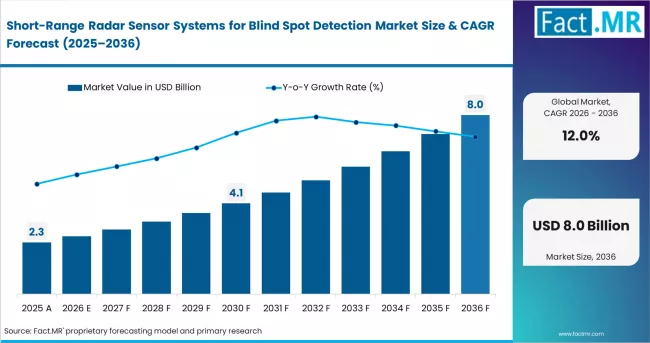
Short Range Radar Sensor Systems For Blind Spot Detection Market Market Value Analysis

Metric Value
Estimated Value in 2026 USD 2.3billion
Forecast Value in 2036 USD 7.2billion
Forecast CAGR (2026 to 2036) 12.0%

Summary of Short-Range Radar Sensor Systems for Blind Spot Detection Market

  • Market Definition
    • Short-rangeradar sensorsmonitor blind zones around vehicles and support lane-change safety through object detection.
  • Demand Drivers
    • European safety regulations are mandating blind spot detection systems in new passenger vehicles.
    • OEMs are integrating radar sensors to supportADASfeatures across mid-range vehicle platforms.
    • Rising accident prevention requirements are increasing demand for real-time vehicle monitoring systems.
  • Key Segments Analyzed
    • By Vehicle Type: Passenger cars are projected to account for 74.0% share in 2026, supported by high ADAS adoption.
    • By Frequency Band: 77-79 GHz is expected torepresent89.0% share in 2026, driven by higher accuracy and compact design.
    • By Geography: China leads growth at 13.4% CAGR, supported by production scale and regulatory enforcement.
  • Analyst Opinion at FACT.MR
    • ShambhuNathJha, Senior Analyst at Fact.MR, states that blind spot detection radar systems are moving into standard vehicle safety configurations across passenger cars. OEMs are prioritizing integration to meet regulatory requirements and align with rising consumer expectations for safety features. These systems support continuous monitoring of surrounding traffic, improving driverawarenessand reducing collision risk. As ADAS adoption expands, blind spot detection is becoming a consistent part of vehicle safety architecture.
  • Strategic Implications
    • Expand 77-79 GHz radar deployment to improve detection accuracy, range, and resolution, supporting more reliable blind spot monitoring and overall system performance across vehicle platforms.
    • Strengthen OEM partnerships to secure long-term supply contracts, align product development with vehicle platforms, and ensure consistent integration within ADAS architectures.
    • Focus on cost optimization to support wider adoption in entry and mid-range vehicles, balancing performance with affordability to increase volume deployment.
  • Methodology
    • Market sizing uses vehicle production data and ADAS penetration benchmarks to estimate demand across different vehicle segments and regions.
    • Analysis includes regulatory frameworks and OEM integration strategies, highlighting how safety mandates and platform design influence radar system adoption.
    • Forecasts incorporate sensor adoption trends and evolving safety mandates, reflecting how increasing ADAS integration is shaping long-term demand for radar-based detection systems.

Regulatory enforcement is a key driver, as safety mandates require features such as blind spot detection, collision warning, and lane assistance systems.OEM-level integration is expanding, with radar sensors being embedded during vehicle manufacturing to ensure system compatibility and performance. Blind spot detection is shifting from optional packages to standard fitment, particularly in developed automotive markets where safety compliance and consumer expectations are higher. This transition is increasing sensor demand across vehicle segments.

China is projected to grow at13.4%CAGR through 2036, supported by large-scale vehicle production and regulatory enforcement. South Korea is expected to expand at12.7%, driven by strong technology integration in export-focused manufacturing. Germany is likely to grow at11.8%, followed by the United States at11.1%and Japan at10.4%, where adoption is supported by safety regulations and demand for advanced vehicle technologies.

Drivers, Restraints, and Opportunities
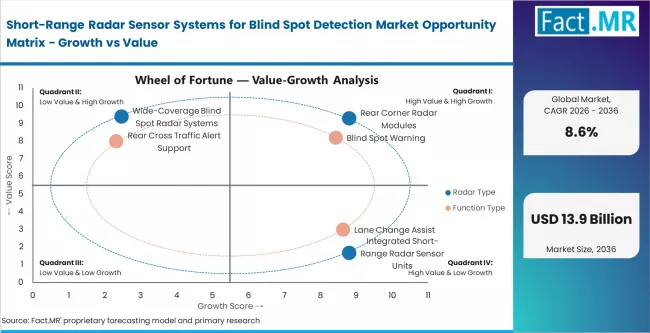
Short Range Radar Sensor Systems For Blind Spot Detection Market Opportunity Matrix Growth Vs Value

Fact.MR analysis indicates that the market is in a strong growth phase driven by regulatory enforcement and OEM integration strategies. Blind spot detection systems have become a key safety requirement across automotive markets. The current market size reflects increasing standardization of ADAS features, particularly in passenger vehicles. Demand is anchored in safety compliance and the need to reduce collision risk in high-density traffic environments.

The market is shifting toward higher-frequency radar systems that offer improved accuracy and smaller form factors. Older 24 GHz systems are gradually being replaced by 77-79 GHz radar due to regulatory constraints and performance advantages. Advanced radar systems increase per-unit costs but improve detection capability, which supports adoption in premium and mid-range vehicles. Volume growth in cost-sensitive segments offsets higher pricing in advanced systems.

Safety mandates: Regulations such as the EU General Safety Regulation are requiring blind spot detection systems in new vehicles, increasing radar sensor demand.
Technology transition: Shift from 24 GHz to 77-79 GHz radar improves detection accuracy and supports compact system design.
Asia demand growth: Vehicle production expansion in China and South Korea is driving large-scale radar sensor adoption.

Segmental Analysis

Short-Range Radar Sensor Systems Market Analysis by Vehicle Type
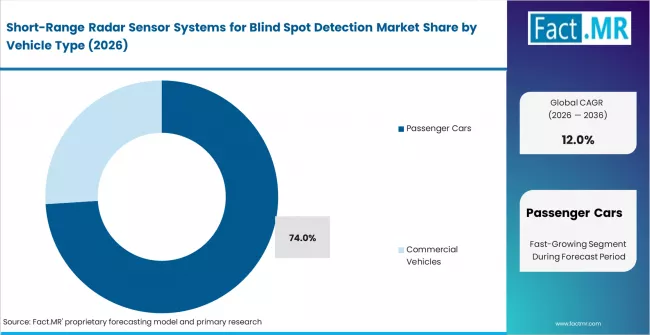
Short Range Radar Sensor Systems For Blind Spot Detection Market Analysis By Vehicle Type

Passenger cars are estimated to hold 74.0% share of the short-range radar sensor systems market in 2026, supported by high production volumes and faster adoption of vehicle safety technologies. Radar-based systems such as blind spot detection, rear cross-traffic alert, and parking assistance are increasingly being integrated into passenger vehicles as standard features. This shift reflects both regulatory requirements and consumer preference for safety-enabled vehicles. OEMs are embedding radar sensors during the manufacturing stage to ensure system compatibility with ADAS architectures and to maintain consistent performance across vehicle platforms. As safety features move beyond premium segments into mid-range vehicles, demand for short-range radar systems continues to expand.

  • Bosch integration: Robert Bosch GmbH expanded radar sensor integration programs across passenger vehicles in 2024, supporting large-scale OEM deployment and improving system availability across multiple vehicle segments [1]
  • OEM strategy: Automakers are standardizing blind spot detection and related radar-based safety systems across product lines to meet evolving safety regulations and improve feature consistency
  • Market trend: Consumer demand for safety features is influencing vehicle purchasing decisions, increasing the importance of radar-based systems in competitive vehicle offerings

Short-Range Radar Sensor Systems Market Analysis by Frequency Band
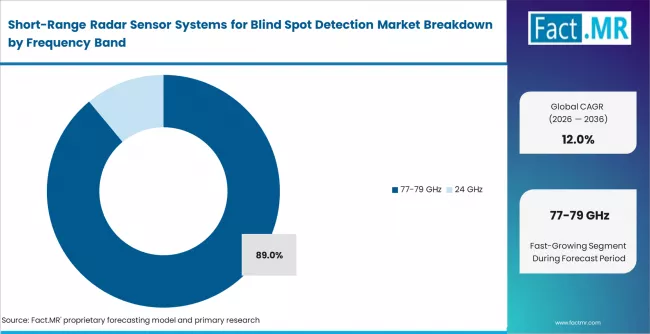
Short Range Radar Sensor Systems For Blind Spot Detection Market Analysis By Frequency Band

77-79 GHz radar systems are estimated to hold 89.0% share of the market in 2026, driven by their higher resolution, improved object detection capability, and compliance with regulatory standards. These high-frequency systems provide better performance in dense traffic conditions, enabling accurate detection of nearby vehicles, pedestrians, and obstacles. Their compact design also supports easier integration into vehicle structures such as bumpers and side panels. As legacy 24 GHz systems are phased out due to regulatory changes, OEMs are shifting toward 77-79 GHz radar to meet performance and compliance requirements. This transition is strengthening demand for advanced radar technologies across vehicle platforms.

  • Continental development: Continental AG expanded 77 GHz radar production capacity in 2024 to meet rising OEM demand and support large-scale deployment across ADAS applications [2]
  • Technology shift: 77-79 GHz radar systems are replacing legacy 24 GHz systems due to regulatory phase-out and the need for higher detection accuracy
  • Industry trend: Higher frequency radar enables compact sensor design, improved resolution, and better performance in complex driving environments

Short-Range Radar Sensor Systems Market Analysis by Fitment
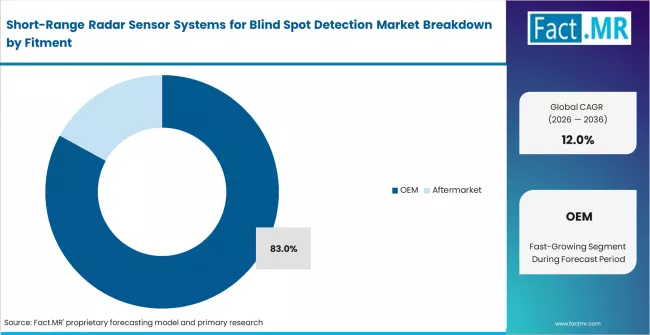
Short Range Radar Sensor Systems For Blind Spot Detection Market Analysis By Fitment

OEM fitment is estimated to hold 83.0% share of the market in 2026, as integration during vehicle production ensures compatibility with electronic systems and supports large-scale deployment. Embedding radar sensors at the manufacturing stage allows for better calibration, system reliability, and alignment with ADAS architectures. OEM-driven integration also helps manufacturers meet regulatory safety requirements and maintain consistent performance across vehicle models. As radar systems become standard components, factory-level installation is becoming the preferred approach across the industry.

  • Valeo investment: Valeo expanded radar sensor production facilities in 2024 to support growing OEM demand and strengthen supply capacity for ADAS systems [3]
  • Integration advantage: OEM fitment ensures seamless integration with vehicle electronics, improving system performance and reducing installation complexity

Supply chain trend: Long-term OEM contracts stabilize demand, support production planning, and reduce supplier switching across vehicle programs

Regional Analysis

The market is assessed across North America, Europe, Asia Pacific, Latin America, and the Middle East & Africa. Demand varies based on vehicle production, safety regulations, and ADAS adoption rates. Asia Pacific leads in volume, while Europe and North America are driven by regulatory compliance. The full report provides market attractiveness analysis by region.

Top Country Growth Comparison Short Range Radar Sensor Systems For Blind Spot Detection Market Cagr (2026 2036)

Country CAGR (2026-2036)
China 13.4%
South Korea 12.7%
Germany 11.8%
United States 11.1%
Japan 10.4%

Source: Fact.MR (FACTMR) analysis, based on proprietary forecasting model and primary research
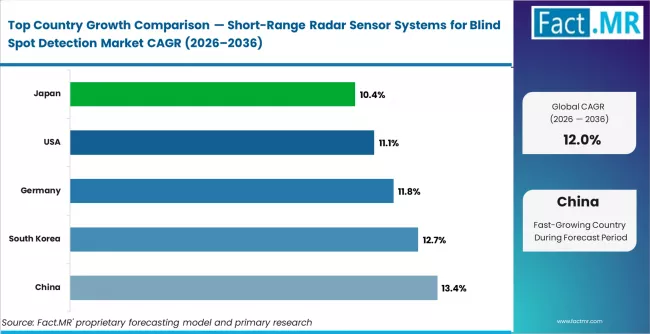
Short Range Radar Sensor Systems For Blind Spot Detection Market Cagr Analysis By Country

Asia Pacific: The production-driven growth center
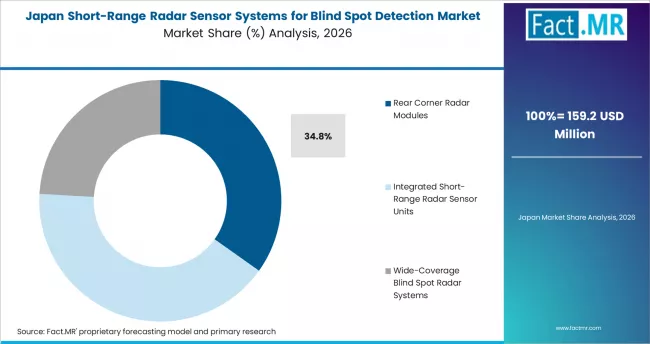
Short Range Radar Sensor Systems For Blind Spot Detection Market Japan Market Share Analysis By Radar Type

Asia Pacific remains the largest contributor, supported by vehicle manufacturing scale and increasing safety integration. Companies such as Denso Corporation, Hyundai Mobis, and local OEMs drive demand through production-linked adoption.

  • China: Demand for radar sensor systems in China is projected to rise at a CAGR of 13.4%. Strong domestic vehicle production and safety regulations introduced in 2024 are accelerating adoption. Local OEMs are integrating radar systems into mid-range vehicles to improve safety and export competitiveness. Large-scale manufacturing supports cost reduction, enabling wider deployment across vehicle segments. Growth reflects both regulatory enforcement and production-driven demand expansion.
  • South Korea: The market is set to record 12.7% CAGR through the forecast period. Export-focused automotive manufacturing drives adoption of advanced safety systems. Hyundai Mobis expanded radar module production capacity in 2024 to support OEM demand [4]. High technology integration standards in domestic manufacturing ensure consistent adoption across vehicle platforms.
  • Japan: Japan represents a precision-driven market where radar sensor adoption is supported by strong engineering standards and a focus on safety innovation. Domestic automakers emphasize reliability, accuracy, and system efficiency, which aligns well with advanced sensing technologies. The market is forecast to grow at a CAGR of 10.4%, reflecting steady integration of radar systems across vehicle platforms. Companies such as Denso Corporation are actively expanding development programs, including initiatives introduced in 2024 to improve detection accuracy and system performance [5]. Demand is reinforced by the country’s commitment to high-quality manufacturing and continuous technological improvement. Suppliers that align with these expectations can maintain stable growth in a market where precision and consistency remain critical.

Europe: The Regulatory Compliance Hub
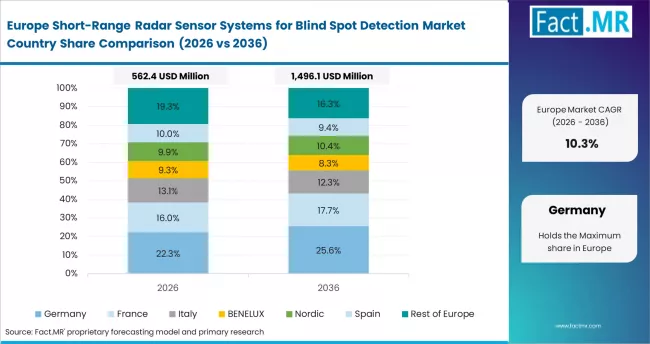
Short Range Radar Sensor Systems For Blind Spot Detection Market Europe Country Market Share Analysis, 2026 & 2036

Europe represents a regulation-driven market where safety mandates strongly influence radar sensor system adoption across vehicle platforms. Strict EU safety frameworks are accelerating the integration of ADAS technologies, making radar systems a core requirement rather than an optional feature. Suppliers such as Continental AG and Valeo maintain strong positions by aligning with compliance standards and OEM requirements.

  • Germany: Germany remains a key market within the region, supported by its advanced automotive manufacturing base and strong engineering capabilities. Sales of radar sensor systems in Germany are expected to increase at a CAGR of 11.8%. Implementation of EU safety regulations is driving OEMs to integrate radar systems across both premium and mass-market vehicles. Demand is also supported by the country’s focus on product quality and performance, which reinforces long-term adoption. Suppliers that meet strict regulatory and technical standards are well positioned to secure sustained partnerships.

North America: The Technology Adoption Market
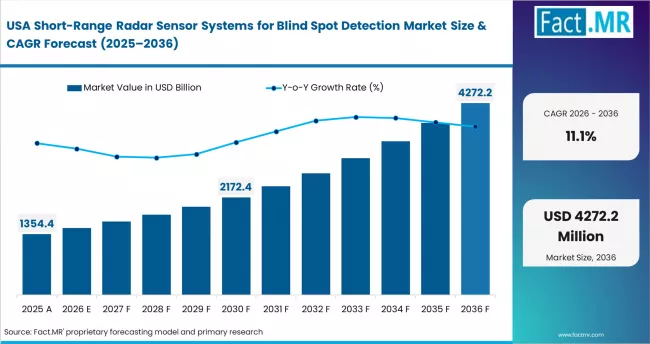
Short Range Radar Sensor Systems For Blind Spot Detection Market Country Value Analysis

North America reflects a mature and technology-driven environment where radar sensor systems are widely adopted to meet both regulatory requirements and consumer expectations. Buyers in this region prioritize advanced safety features, encouraging OEMs to integrate radar systems across vehicle segments. Suppliers such as Aptiv and Magna play a central role in supporting OEM integration through strong technical capabilities and established relationships.

  • U.S.: The United States leads regional demand, supported by safety initiatives and growing consumer preference for ADAS-enabled vehicles. The market for radar sensor systems is expected to grow at a CAGR of 11.1%. Regulatory bodies such as the National Highway Traffic Safety Administration continue to promote safety technologies, reinforcing adoption across passenger and commercial vehicles. OEMs are integrating radar systems to enhance collision avoidance, adaptive cruise control, and other safety functions. Growth remains steady as these features transition from premium offerings to standard equipment.

FACTMR's analysis of short-range radar sensor systems market consists of country-wise assessment that includes China, South Korea, Germany, United States, and Japan. Readers can find insights on production trends, safety regulations, and ADAS adoption.

Competitive Aligners for Market Players
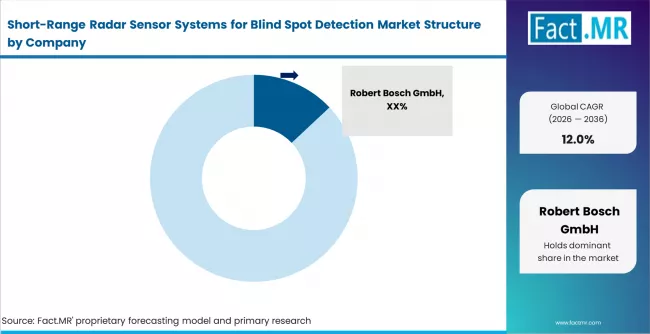
Short Range Radar Sensor Systems For Blind Spot Detection Market Analysis By Company

The market remains moderately concentrated, with leading automotive suppliers accounting for a significant share of radar sensor production across passenger vehicle platforms. Competition is defined by technology capability, cost efficiency, and integration performance within ADAS architectures. Suppliers must deliver consistent sensing accuracy under varying driving conditions, including dense traffic, low visibility, and high-speed environments. Strict validation standards set by OEMs require proven reliability, which limits entry for new suppliers and favors companies with established performance records.

Companies with strong OEM partnerships and advanced radar technology maintain a clear competitive advantage. Robert Bosch GmbH, Continental AG, and Denso Corporation benefit from large-scale production capacity, global supply networks, and experience in system-level integration. Their ability to deliver complete ADAS solutions, combining radar hardware with software processing and control systems, strengthens their position in supplier selection. Established relationships with OEMs also support long-term sourcing programs and platform-level integration.

Buyer leverage remains strong, as OEMs diversify sourcing strategies and negotiate long-term supply agreements to manage risk and control costs. This approach limits supplier pricing power, particularly in entry-level vehicle segments where cost sensitivity is higher. At the same time, advanced radar systems with improved resolution, range, and processing capability continue to command premium pricing in higher-end vehicle platforms, where performance and safety requirements justify higher system costs.

Key Players

  • Robert Bosch GmbH
  • Continental AG
  • Aptiv PLC
  • Valeo SA
  • ZF Friedrichshafen AG
  • Denso Corporation
  • Magna International Inc.
  • FORVIA Hella
  • Veoneer
  • Mobileye

This Report Addresses

  • Provides strategic intelligence on radar sensor systems used in blind spot detection, covering sensing performance, integration trends, and role within ADAS architectures.
  • Covers market size from USD 2.3 billion in 2026 to USD 7.2 billion by 2036, reflecting growth driven by safety regulations and increasing radar adoption.
  • Identifies growth opportunities across ADAS deployment and vehicle safety systems, including expansion into mid-range vehicle segments.
  • Offers segment and regional demand analysis with clear insights into adoption patterns across key automotive markets.
  • Evaluates competitive strategy and OEM partnerships, focusing on integration capability, production scale, and long-term sourcing relationships.
  • Tracks product development and regulatory compliance trends influencing radar system design and deployment.
  • Assesses regulatory impact on safety system adoption, highlighting how mandates drive radar integration across vehicle platforms.
  • Delivered in PDF and dataset formats for structured analysis and easier access across technical and commercial teams.

Short-Range Radar Sensor Systems for Blind Spot Detection Market Definition

Short-range radar sensor systems for blind spot detection are electronic sensing devices installed on vehicles to detect objects in areas not visible to the driver. These systems emit radio waves and analyze reflections to identify nearby vehicles, obstacles, or movement in adjacent lanes. Their primary function is to alert drivers during lane changes and prevent collisions. These sensors are widely used in passenger cars and commercial vehicles as part of advanced driver assistance systems, supporting safer driving by monitoring blind zones continuously.

Short-Range Radar Sensor Systems for Blind Spot Detection Market Inclusions

The report covers global and regional market size, forecast from 2026 to 2036, and segmentation by vehicle type, frequency band, and fitment type. It includes OEM and aftermarket demand, adoption across ADAS platforms, and regional regulatory impacts. The study also evaluates pricing trends, radar technology evolution, and integration within vehicle electronic architectures.

Short-Range Radar Sensor Systems for Blind Spot Detection Market Exclusions

The scope excludes long-range radar systems used for adaptive cruise control and autonomous driving beyond blind spot detection. It does not include camera-only or LiDAR-only sensing technologies unless integrated with radar systems. Rear parking sensors and ultrasonic detection systems are also excluded. The focus remains strictly on short-range radar components used for blind spot detection functions.

Short-Range Radar Sensor Systems for Blind Spot Detection Research Methodology

  • Primary Research
    • Interviews with automotive OEMs, Tier-1 suppliers, radar module manufacturers, and ADAS system integrators.
  • Desk Research
    • Analysis of vehicle production data, safety regulations, and company disclosures.
  • Market-Sizing and Forecasting
    • Hybrid model based on vehicle production volumes, ADAS penetration rates, and radar sensor installation per vehicle.
  • Data Validation and Update Cycle
    • Validated using OEM sourcing data, supplier shipment volumes, and regulatory compliance tracking.

Segment Taxonomy

  • By Vehicle Type :

    • Passenger Cars
    • Commercial Vehicles
  • By Frequency Band :

    • 24 GHz
    • 77-79 GHz
  • By Fitment :

    • OEM
    • Aftermarket
  • By Region :

    • North America
      • United States
      • Canada
    • Europe
      • Germany
      • United Kingdom
      • France
      • Italy
      • Spain
    • Asia Pacific
      • China
      • Japan
      • South Korea
      • Taiwan
      • Singapore
    • Latin America
      • Brazil
      • Mexico
      • Argentina
    • Middle East & Africa
      • GCC Countries
      • South Africa
      • Israel

Scope of Report

Short Range Radar Sensor Systems For Blind Spot Detection Market Breakdown By Vehicle Type, Frequency Band, And Region

Attribute Value
Quantitative Units USD 2.3 billion (2026) to USD 7.2 billion (2036), at a CAGR of 12.0%
Market Definition Short-range radar sensor systems used for blind spot detection in vehicles, enabling real-time monitoring of adjacent lanes and improving driving safety through ADAS integration
Vehicle Type Segmentation Passenger Cars, Commercial Vehicles
Frequency Band Segmentation 24 GHz, 77-79 GHz
Fitment Segmentation OEM, Aftermarket
Application Coverage Blind spot detection, lane-change assistance, collision avoidance, real-time vehicle proximity sensing in ADAS-enabled vehicles
Regions Covered North America, Europe, Asia Pacific, Latin America, Middle East & Africa
Countries Covered United States, Canada, Germany, United Kingdom, France, Italy, Spain, China, Japan, South Korea, Taiwan, Singapore, Brazil, Mexico, Argentina, GCC Countries, South Africa, Israel
Key Companies Profiled Robert Bosch GmbH, Continental AG, Aptiv PLC, Valeo SA, ZF Friedrichshafen AG, Denso Corporation, Magna International Inc., FORVIA Hella, Veoneer, Mobileye
Forecast Period 2026 to 2036
Approach Hybrid top-down and bottom-up model using vehicle production, ADAS penetration rates, radar sensor installation per vehicle, pricing trends, and primary interviews with OEMs and Tier-1 suppliers

- Frequently Asked Questions -

What is the size of the short-range radar sensor market in 2025?

The market was valued at USD 2.0 billion in 2025.

What will the market size be in 2026?

The market is expected to reach USD 2.3 billion in 2026.

What is the projected market size by 2036?

The market is forecast to grow to USD 7.2 billion by 2036.

What is the expected CAGR of this market?

The market is projected to expand at a 12.0% CAGR from 2026 to 2036.

What are short-range radar sensor systems?

Short-range radar sensors are small electronic devices used in vehicles to detect objects in nearby areas, especially blind spots, by using radio waves.

What is blind spot detection in vehicles?

Blind spot detection is a safety feature that alerts drivers when another vehicle or object is in an area they cannot see using mirrors.

Where are short-range radar sensors used?

They are mainly used in passenger cars and commercial vehicles as part of advanced driver assistance systems (ADAS).

Which vehicle type uses these systems the most?

Passenger cars are expected to account for 74.0% share in 2026, as safety features are widely adopted in this segment.

Which frequency band dominates the market?

77-79 GHz radar is expected to represent 89.0% share in 2026, due to better accuracy and compact design.

Which fitment type leads the market?

OEM fitment is projected to account for 83.0% share in 2026, as sensors are installed during vehicle production.

Why is demand increasing for these radar systems?

Demand is rising due to safety regulations, increasing ADAS adoption, and growing awareness of accident prevention.

Which country is growing the fastest in this market?

China is expected to lead with a 13.4% CAGR, supported by high vehicle production and safety regulations.

How do short-range radar sensors work?

They send out radio waves and measure how those waves bounce back after hitting objects, helping the system detect nearby vehicles.

What challenges affect this market?

High system costs and integration complexity can limit adoption in lower-cost vehicles.

What opportunities exist in this market?

Opportunities include expanding ADAS adoption in emerging markets and improving radar performance with advanced frequency bands.

Table of Content

  1. Executive Summary
    • Global Market Outlook
    • Demand to side Trends
    • Supply to side Trends
    • Technology Roadmap Analysis
    • Analysis and Recommendations
  2. Market Overview
    • Market Coverage / Taxonomy
    • Market Definition / Scope / Limitations
  3. Research Methodology
    • Chapter Orientation
    • Analytical Lens and Working Hypotheses
      • Market Structure, Signals, and Trend Drivers
      • Benchmarking and Cross-market Comparability
      • Market Sizing, Forecasting, and Opportunity Mapping
    • Research Design and Evidence Framework
      • Desk Research Programme (Secondary Evidence)
        • Company Annual and Sustainability Reports
        • Peer-reviewed Journals and Academic Literature
        • Corporate Websites, Product Literature, and Technical Notes
        • Earnings Decks and Investor Briefings
        • Statutory Filings and Regulatory Disclosures
        • Technical White Papers and Standards Notes
        • Trade Journals, Industry Magazines, and Analyst Briefs
        • Conference Proceedings, Webinars, and Seminar Materials
        • Government Statistics Portals and Public Data Releases
        • Press Releases and Reputable Media Coverage
        • Specialist Newsletters and Curated Briefings
        • Sector Databases and Reference Repositories
        • Fact.MR Internal Proprietary Databases and Historical Market Datasets
        • Subscription Datasets and Paid Sources
        • Social Channels, Communities, and Digital Listening Inputs
        • Additional Desk Sources
      • Expert Input and Fieldwork (Primary Evidence)
        • Primary Modes
          • Qualitative Interviews and Expert Elicitation
          • Quantitative Surveys and Structured Data Capture
          • Blended Approach
        • Why Primary Evidence is Used
        • Field Techniques
          • Interviews
          • Surveys
          • Focus Groups
          • Observational and In-context Research
          • Social and Community Interactions
        • Stakeholder Universe Engaged
          • C-suite Leaders
          • Board Members
          • Presidents and Vice Presidents
          • R&D and Innovation Heads
          • Technical Specialists
          • Domain Subject-matter Experts
          • Scientists
          • Physicians and Other Healthcare Professionals
        • Governance, Ethics, and Data Stewardship
          • Research Ethics
          • Data Integrity and Handling
      • Tooling, Models, and Reference Databases
    • Data Engineering and Model Build
      • Data Acquisition and Ingestion
      • Cleaning, Normalisation, and Verification
      • Synthesis, Triangulation, and Analysis
    • Quality Assurance and Audit Trail
  4. Market Background
    • Market Dynamics
      • Drivers
      • Restraints
      • Opportunity
      • Trends
    • Scenario Forecast
      • Demand in Optimistic Scenario
      • Demand in Likely Scenario
      • Demand in Conservative Scenario
    • Opportunity Map Analysis
    • Product Life Cycle Analysis
    • Supply Chain Analysis
    • Investment Feasibility Matrix
    • Value Chain Analysis
    • PESTLE and Porter’s Analysis
    • Regulatory Landscape
    • Regional Parent Market Outlook
    • Production and Consumption Statistics
    • Import and Export Statistics
  5. Global Market Analysis 2021 to 2025 and Forecast, 2026 to 2036
    • Historical Market Size Value (USD Million) Analysis, 2021 to 2025
    • Current and Future Market Size Value (USD Million) Projections, 2026 to 2036
      • Y to o to Y Growth Trend Analysis
      • Absolute $ Opportunity Analysis
  6. Global Market Pricing Analysis 2021 to 2025 and Forecast 2026 to 2036
  7. Global Market Analysis 2021 to 2025 and Forecast 2026 to 2036, By Vehicle Type
    • Introduction / Key Findings
    • Historical Market Size Value (USD Million) Analysis By Vehicle Type , 2021 to 2025
    • Current and Future Market Size Value (USD Million) Analysis and Forecast By Vehicle Type , 2026 to 2036
      • Passenger Cars
      • Commercial Vehicles
    • Y to o to Y Growth Trend Analysis By Vehicle Type , 2021 to 2025
    • Absolute $ Opportunity Analysis By Vehicle Type , 2026 to 2036
  8. Global Market Analysis 2021 to 2025 and Forecast 2026 to 2036, By Frequency Band
    • Introduction / Key Findings
    • Historical Market Size Value (USD Million) Analysis By Frequency Band, 2021 to 2025
    • Current and Future Market Size Value (USD Million) Analysis and Forecast By Frequency Band, 2026 to 2036
      • 77-79 GHz
      • 24 GHz
    • Y to o to Y Growth Trend Analysis By Frequency Band, 2021 to 2025
    • Absolute $ Opportunity Analysis By Frequency Band, 2026 to 2036
  9. Global Market Analysis 2021 to 2025 and Forecast 2026 to 2036, By Fitment
    • Introduction / Key Findings
    • Historical Market Size Value (USD Million) Analysis By Fitment, 2021 to 2025
    • Current and Future Market Size Value (USD Million) Analysis and Forecast By Fitment, 2026 to 2036
      • OEM
      • Aftermarket
    • Y to o to Y Growth Trend Analysis By Fitment, 2021 to 2025
    • Absolute $ Opportunity Analysis By Fitment, 2026 to 2036
  10. Global Market Analysis 2021 to 2025 and Forecast 2026 to 2036, By Region
    • Introduction
    • Historical Market Size Value (USD Million) Analysis By Region, 2021 to 2025
    • Current Market Size Value (USD Million) Analysis and Forecast By Region, 2026 to 2036
      • North America
      • Latin America
      • Western Europe
      • Eastern Europe
      • East Asia
      • South Asia and Pacific
      • Middle East & Africa
    • Market Attractiveness Analysis By Region
  11. North America Market Analysis 2021 to 2025 and Forecast 2026 to 2036, By Country
    • Historical Market Size Value (USD Million) Trend Analysis By Market Taxonomy, 2021 to 2025
    • Market Size Value (USD Million) Forecast By Market Taxonomy, 2026 to 2036
      • By Country
        • USA
        • Canada
        • Mexico
      • By Vehicle Type
      • By Frequency Band
      • By Fitment
    • Market Attractiveness Analysis
      • By Country
      • By Vehicle Type
      • By Frequency Band
      • By Fitment
    • Key Takeaways
  12. Latin America Market Analysis 2021 to 2025 and Forecast 2026 to 2036, By Country
    • Historical Market Size Value (USD Million) Trend Analysis By Market Taxonomy, 2021 to 2025
    • Market Size Value (USD Million) Forecast By Market Taxonomy, 2026 to 2036
      • By Country
        • Brazil
        • Chile
        • Rest of Latin America
      • By Vehicle Type
      • By Frequency Band
      • By Fitment
    • Market Attractiveness Analysis
      • By Country
      • By Vehicle Type
      • By Frequency Band
      • By Fitment
    • Key Takeaways
  13. Western Europe Market Analysis 2021 to 2025 and Forecast 2026 to 2036, By Country
    • Historical Market Size Value (USD Million) Trend Analysis By Market Taxonomy, 2021 to 2025
    • Market Size Value (USD Million) Forecast By Market Taxonomy, 2026 to 2036
      • By Country
        • Germany
        • UK
        • Italy
        • Spain
        • France
        • Nordic
        • BENELUX
        • Rest of Western Europe
      • By Vehicle Type
      • By Frequency Band
      • By Fitment
    • Market Attractiveness Analysis
      • By Country
      • By Vehicle Type
      • By Frequency Band
      • By Fitment
    • Key Takeaways
  14. Eastern Europe Market Analysis 2021 to 2025 and Forecast 2026 to 2036, By Country
    • Historical Market Size Value (USD Million) Trend Analysis By Market Taxonomy, 2021 to 2025
    • Market Size Value (USD Million) Forecast By Market Taxonomy, 2026 to 2036
      • By Country
        • Russia
        • Poland
        • Hungary
        • Balkan & Baltic
        • Rest of Eastern Europe
      • By Vehicle Type
      • By Frequency Band
      • By Fitment
    • Market Attractiveness Analysis
      • By Country
      • By Vehicle Type
      • By Frequency Band
      • By Fitment
    • Key Takeaways
  15. East Asia Market Analysis 2021 to 2025 and Forecast 2026 to 2036, By Country
    • Historical Market Size Value (USD Million) Trend Analysis By Market Taxonomy, 2021 to 2025
    • Market Size Value (USD Million) Forecast By Market Taxonomy, 2026 to 2036
      • By Country
        • China
        • Japan
        • South Korea
      • By Vehicle Type
      • By Frequency Band
      • By Fitment
    • Market Attractiveness Analysis
      • By Country
      • By Vehicle Type
      • By Frequency Band
      • By Fitment
    • Key Takeaways
  16. South Asia and Pacific Market Analysis 2021 to 2025 and Forecast 2026 to 2036, By Country
    • Historical Market Size Value (USD Million) Trend Analysis By Market Taxonomy, 2021 to 2025
    • Market Size Value (USD Million) Forecast By Market Taxonomy, 2026 to 2036
      • By Country
        • India
        • ASEAN
        • Australia & New Zealand
        • Rest of South Asia and Pacific
      • By Vehicle Type
      • By Frequency Band
      • By Fitment
    • Market Attractiveness Analysis
      • By Country
      • By Vehicle Type
      • By Frequency Band
      • By Fitment
    • Key Takeaways
  17. Middle East & Africa Market Analysis 2021 to 2025 and Forecast 2026 to 2036, By Country
    • Historical Market Size Value (USD Million) Trend Analysis By Market Taxonomy, 2021 to 2025
    • Market Size Value (USD Million) Forecast By Market Taxonomy, 2026 to 2036
      • By Country
        • Kingdom of Saudi Arabia
        • Other GCC Countries
        • Turkiye
        • South Africa
        • Other African Union
        • Rest of Middle East & Africa
      • By Vehicle Type
      • By Frequency Band
      • By Fitment
    • Market Attractiveness Analysis
      • By Country
      • By Vehicle Type
      • By Frequency Band
      • By Fitment
    • Key Takeaways
  18. Key Countries Market Analysis
    • USA
      • Pricing Analysis
      • Market Share Analysis, 2025
        • By Vehicle Type
        • By Frequency Band
        • By Fitment
    • Canada
      • Pricing Analysis
      • Market Share Analysis, 2025
        • By Vehicle Type
        • By Frequency Band
        • By Fitment
    • Mexico
      • Pricing Analysis
      • Market Share Analysis, 2025
        • By Vehicle Type
        • By Frequency Band
        • By Fitment
    • Brazil
      • Pricing Analysis
      • Market Share Analysis, 2025
        • By Vehicle Type
        • By Frequency Band
        • By Fitment
    • Chile
      • Pricing Analysis
      • Market Share Analysis, 2025
        • By Vehicle Type
        • By Frequency Band
        • By Fitment
    • Germany
      • Pricing Analysis
      • Market Share Analysis, 2025
        • By Vehicle Type
        • By Frequency Band
        • By Fitment
    • UK
      • Pricing Analysis
      • Market Share Analysis, 2025
        • By Vehicle Type
        • By Frequency Band
        • By Fitment
    • Italy
      • Pricing Analysis
      • Market Share Analysis, 2025
        • By Vehicle Type
        • By Frequency Band
        • By Fitment
    • Spain
      • Pricing Analysis
      • Market Share Analysis, 2025
        • By Vehicle Type
        • By Frequency Band
        • By Fitment
    • France
      • Pricing Analysis
      • Market Share Analysis, 2025
        • By Vehicle Type
        • By Frequency Band
        • By Fitment
    • India
      • Pricing Analysis
      • Market Share Analysis, 2025
        • By Vehicle Type
        • By Frequency Band
        • By Fitment
    • ASEAN
      • Pricing Analysis
      • Market Share Analysis, 2025
        • By Vehicle Type
        • By Frequency Band
        • By Fitment
    • Australia & New Zealand
      • Pricing Analysis
      • Market Share Analysis, 2025
        • By Vehicle Type
        • By Frequency Band
        • By Fitment
    • China
      • Pricing Analysis
      • Market Share Analysis, 2025
        • By Vehicle Type
        • By Frequency Band
        • By Fitment
    • Japan
      • Pricing Analysis
      • Market Share Analysis, 2025
        • By Vehicle Type
        • By Frequency Band
        • By Fitment
    • South Korea
      • Pricing Analysis
      • Market Share Analysis, 2025
        • By Vehicle Type
        • By Frequency Band
        • By Fitment
    • Russia
      • Pricing Analysis
      • Market Share Analysis, 2025
        • By Vehicle Type
        • By Frequency Band
        • By Fitment
    • Poland
      • Pricing Analysis
      • Market Share Analysis, 2025
        • By Vehicle Type
        • By Frequency Band
        • By Fitment
    • Hungary
      • Pricing Analysis
      • Market Share Analysis, 2025
        • By Vehicle Type
        • By Frequency Band
        • By Fitment
    • Kingdom of Saudi Arabia
      • Pricing Analysis
      • Market Share Analysis, 2025
        • By Vehicle Type
        • By Frequency Band
        • By Fitment
    • Turkiye
      • Pricing Analysis
      • Market Share Analysis, 2025
        • By Vehicle Type
        • By Frequency Band
        • By Fitment
    • South Africa
      • Pricing Analysis
      • Market Share Analysis, 2025
        • By Vehicle Type
        • By Frequency Band
        • By Fitment
  19. Market Structure Analysis
    • Competition Dashboard
    • Competition Benchmarking
    • Market Share Analysis of Top Players
      • By Regional
      • By Vehicle Type
      • By Frequency Band
      • By Fitment
  20. Competition Analysis
    • Competition Deep Dive
      • Robert Bosch GmbH
        • Overview
        • Product Portfolio
        • Profitability by Market Segments (Product/Age /Sales Channel/Region)
        • Sales Footprint
        • Strategy Overview
          • Marketing Strategy
          • Product Strategy
          • Channel Strategy
      • Continental AG
      • Aptiv PLC
      • Valeo SA
      • ZF Friedrichshafen AG
      • Denso Corporation
      • Magna International Inc.
      • FORVIA Hella
      • Veoneer
      • Mobileye
  21. Assumptions & Acronyms Used

List Of Table

  • Table 1: Global Market Value (USD Million) Forecast by Region, 2021 to 2036
  • Table 2: Global Market Value (USD Million) Forecast by Vehicle Type , 2021 to 2036
  • Table 3: Global Market Value (USD Million) Forecast by Frequency Band, 2021 to 2036
  • Table 4: Global Market Value (USD Million) Forecast by Fitment, 2021 to 2036
  • Table 5: North America Market Value (USD Million) Forecast by Country, 2021 to 2036
  • Table 6: North America Market Value (USD Million) Forecast by Vehicle Type , 2021 to 2036
  • Table 7: North America Market Value (USD Million) Forecast by Frequency Band, 2021 to 2036
  • Table 8: North America Market Value (USD Million) Forecast by Fitment, 2021 to 2036
  • Table 9: Latin America Market Value (USD Million) Forecast by Country, 2021 to 2036
  • Table 10: Latin America Market Value (USD Million) Forecast by Vehicle Type , 2021 to 2036
  • Table 11: Latin America Market Value (USD Million) Forecast by Frequency Band, 2021 to 2036
  • Table 12: Latin America Market Value (USD Million) Forecast by Fitment, 2021 to 2036
  • Table 13: Western Europe Market Value (USD Million) Forecast by Country, 2021 to 2036
  • Table 14: Western Europe Market Value (USD Million) Forecast by Vehicle Type , 2021 to 2036
  • Table 15: Western Europe Market Value (USD Million) Forecast by Frequency Band, 2021 to 2036
  • Table 16: Western Europe Market Value (USD Million) Forecast by Fitment, 2021 to 2036
  • Table 17: Eastern Europe Market Value (USD Million) Forecast by Country, 2021 to 2036
  • Table 18: Eastern Europe Market Value (USD Million) Forecast by Vehicle Type , 2021 to 2036
  • Table 19: Eastern Europe Market Value (USD Million) Forecast by Frequency Band, 2021 to 2036
  • Table 20: Eastern Europe Market Value (USD Million) Forecast by Fitment, 2021 to 2036
  • Table 21: East Asia Market Value (USD Million) Forecast by Country, 2021 to 2036
  • Table 22: East Asia Market Value (USD Million) Forecast by Vehicle Type , 2021 to 2036
  • Table 23: East Asia Market Value (USD Million) Forecast by Frequency Band, 2021 to 2036
  • Table 24: East Asia Market Value (USD Million) Forecast by Fitment, 2021 to 2036
  • Table 25: South Asia and Pacific Market Value (USD Million) Forecast by Country, 2021 to 2036
  • Table 26: South Asia and Pacific Market Value (USD Million) Forecast by Vehicle Type , 2021 to 2036
  • Table 27: South Asia and Pacific Market Value (USD Million) Forecast by Frequency Band, 2021 to 2036
  • Table 28: South Asia and Pacific Market Value (USD Million) Forecast by Fitment, 2021 to 2036
  • Table 29: Middle East & Africa Market Value (USD Million) Forecast by Country, 2021 to 2036
  • Table 30: Middle East & Africa Market Value (USD Million) Forecast by Vehicle Type , 2021 to 2036
  • Table 31: Middle East & Africa Market Value (USD Million) Forecast by Frequency Band, 2021 to 2036
  • Table 32: Middle East & Africa Market Value (USD Million) Forecast by Fitment, 2021 to 2036

List Of Figures

  • Figure 1: Global Market Pricing Analysis
  • Figure 2: Global Market Value (USD Million) Forecast 2021-2036
  • Figure 3: Global Market Value Share and BPS Analysis by Vehicle Type, 2026 and 2036
  • Figure 4: Global Market Y-o-Y Growth Comparison by Vehicle Type, 2026 to 2036
  • Figure 5: Global Market Attractiveness Analysis by Vehicle Type
  • Figure 6: Global Market Value Share and BPS Analysis by Frequency Band, 2026 and 2036
  • Figure 7: Global Market Y-o-Y Growth Comparison by Frequency Band, 2026 to 2036
  • Figure 8: Global Market Attractiveness Analysis by Frequency Band
  • Figure 9: Global Market Value Share and BPS Analysis by Fitment, 2026 and 2036
  • Figure 10: Global Market Y-o-Y Growth Comparison by Fitment, 2026 to 2036
  • Figure 11: Global Market Attractiveness Analysis by Fitment
  • Figure 12: Global Market Value (USD Million) Share and BPS Analysis by Region, 2026 and 2036
  • Figure 13: Global Market Y-o-Y Growth Comparison by Region, 2026 to 2036
  • Figure 14: Global Market Attractiveness Analysis by Region
  • Figure 15: North America Market Incremental Dollar Opportunity, 2026 to 2036
  • Figure 16: Latin America Market Incremental Dollar Opportunity, 2026 to 2036
  • Figure 17: Western Europe Market Incremental Dollar Opportunity, 2026 to 2036
  • Figure 18: Eastern Europe Market Incremental Dollar Opportunity, 2026 to 2036
  • Figure 19: East Asia Market Incremental Dollar Opportunity, 2026 to 2036
  • Figure 20: South Asia and Pacific Market Incremental Dollar Opportunity, 2026 to 2036
  • Figure 21: Middle East & Africa Market Incremental Dollar Opportunity, 2026 to 2036
  • Figure 22: North America Market Value Share and BPS Analysis by Country, 2026 and 2036
  • Figure 23: North America Market Value Share and BPS Analysis by Vehicle Type, 2026 and 2036
  • Figure 24: North America Market Y-o-Y Growth Comparison by Vehicle Type, 2026 to 2036
  • Figure 25: North America Market Attractiveness Analysis by Vehicle Type
  • Figure 26: North America Market Value Share and BPS Analysis by Frequency Band, 2026 and 2036
  • Figure 27: North America Market Y-o-Y Growth Comparison by Frequency Band, 2026 to 2036
  • Figure 28: North America Market Attractiveness Analysis by Frequency Band
  • Figure 29: North America Market Value Share and BPS Analysis by Fitment, 2026 and 2036
  • Figure 30: North America Market Y-o-Y Growth Comparison by Fitment, 2026 to 2036
  • Figure 31: North America Market Attractiveness Analysis by Fitment
  • Figure 32: Latin America Market Value Share and BPS Analysis by Country, 2026 and 2036
  • Figure 33: Latin America Market Value Share and BPS Analysis by Vehicle Type, 2026 and 2036
  • Figure 34: Latin America Market Y-o-Y Growth Comparison by Vehicle Type, 2026 to 2036
  • Figure 35: Latin America Market Attractiveness Analysis by Vehicle Type
  • Figure 36: Latin America Market Value Share and BPS Analysis by Frequency Band, 2026 and 2036
  • Figure 37: Latin America Market Y-o-Y Growth Comparison by Frequency Band, 2026 to 2036
  • Figure 38: Latin America Market Attractiveness Analysis by Frequency Band
  • Figure 39: Latin America Market Value Share and BPS Analysis by Fitment, 2026 and 2036
  • Figure 40: Latin America Market Y-o-Y Growth Comparison by Fitment, 2026 to 2036
  • Figure 41: Latin America Market Attractiveness Analysis by Fitment
  • Figure 42: Western Europe Market Value Share and BPS Analysis by Country, 2026 and 2036
  • Figure 43: Western Europe Market Value Share and BPS Analysis by Vehicle Type, 2026 and 2036
  • Figure 44: Western Europe Market Y-o-Y Growth Comparison by Vehicle Type, 2026 to 2036
  • Figure 45: Western Europe Market Attractiveness Analysis by Vehicle Type
  • Figure 46: Western Europe Market Value Share and BPS Analysis by Frequency Band, 2026 and 2036
  • Figure 47: Western Europe Market Y-o-Y Growth Comparison by Frequency Band, 2026 to 2036
  • Figure 48: Western Europe Market Attractiveness Analysis by Frequency Band
  • Figure 49: Western Europe Market Value Share and BPS Analysis by Fitment, 2026 and 2036
  • Figure 50: Western Europe Market Y-o-Y Growth Comparison by Fitment, 2026 to 2036
  • Figure 51: Western Europe Market Attractiveness Analysis by Fitment
  • Figure 52: Eastern Europe Market Value Share and BPS Analysis by Country, 2026 and 2036
  • Figure 53: Eastern Europe Market Value Share and BPS Analysis by Vehicle Type, 2026 and 2036
  • Figure 54: Eastern Europe Market Y-o-Y Growth Comparison by Vehicle Type, 2026 to 2036
  • Figure 55: Eastern Europe Market Attractiveness Analysis by Vehicle Type
  • Figure 56: Eastern Europe Market Value Share and BPS Analysis by Frequency Band, 2026 and 2036
  • Figure 57: Eastern Europe Market Y-o-Y Growth Comparison by Frequency Band, 2026 to 2036
  • Figure 58: Eastern Europe Market Attractiveness Analysis by Frequency Band
  • Figure 59: Eastern Europe Market Value Share and BPS Analysis by Fitment, 2026 and 2036
  • Figure 60: Eastern Europe Market Y-o-Y Growth Comparison by Fitment, 2026 to 2036
  • Figure 61: Eastern Europe Market Attractiveness Analysis by Fitment
  • Figure 62: East Asia Market Value Share and BPS Analysis by Country, 2026 and 2036
  • Figure 63: East Asia Market Value Share and BPS Analysis by Vehicle Type, 2026 and 2036
  • Figure 64: East Asia Market Y-o-Y Growth Comparison by Vehicle Type, 2026 to 2036
  • Figure 65: East Asia Market Attractiveness Analysis by Vehicle Type
  • Figure 66: East Asia Market Value Share and BPS Analysis by Frequency Band, 2026 and 2036
  • Figure 67: East Asia Market Y-o-Y Growth Comparison by Frequency Band, 2026 to 2036
  • Figure 68: East Asia Market Attractiveness Analysis by Frequency Band
  • Figure 69: East Asia Market Value Share and BPS Analysis by Fitment, 2026 and 2036
  • Figure 70: East Asia Market Y-o-Y Growth Comparison by Fitment, 2026 to 2036
  • Figure 71: East Asia Market Attractiveness Analysis by Fitment
  • Figure 72: South Asia and Pacific Market Value Share and BPS Analysis by Country, 2026 and 2036
  • Figure 73: South Asia and Pacific Market Value Share and BPS Analysis by Vehicle Type, 2026 and 2036
  • Figure 74: South Asia and Pacific Market Y-o-Y Growth Comparison by Vehicle Type, 2026 to 2036
  • Figure 75: South Asia and Pacific Market Attractiveness Analysis by Vehicle Type
  • Figure 76: South Asia and Pacific Market Value Share and BPS Analysis by Frequency Band, 2026 and 2036
  • Figure 77: South Asia and Pacific Market Y-o-Y Growth Comparison by Frequency Band, 2026 to 2036
  • Figure 78: South Asia and Pacific Market Attractiveness Analysis by Frequency Band
  • Figure 79: South Asia and Pacific Market Value Share and BPS Analysis by Fitment, 2026 and 2036
  • Figure 80: South Asia and Pacific Market Y-o-Y Growth Comparison by Fitment, 2026 to 2036
  • Figure 81: South Asia and Pacific Market Attractiveness Analysis by Fitment
  • Figure 82: Middle East & Africa Market Value Share and BPS Analysis by Country, 2026 and 2036
  • Figure 83: Middle East & Africa Market Value Share and BPS Analysis by Vehicle Type, 2026 and 2036
  • Figure 84: Middle East & Africa Market Y-o-Y Growth Comparison by Vehicle Type, 2026 to 2036
  • Figure 85: Middle East & Africa Market Attractiveness Analysis by Vehicle Type
  • Figure 86: Middle East & Africa Market Value Share and BPS Analysis by Frequency Band, 2026 and 2036
  • Figure 87: Middle East & Africa Market Y-o-Y Growth Comparison by Frequency Band, 2026 to 2036
  • Figure 88: Middle East & Africa Market Attractiveness Analysis by Frequency Band
  • Figure 89: Middle East & Africa Market Value Share and BPS Analysis by Fitment, 2026 and 2036
  • Figure 90: Middle East & Africa Market Y-o-Y Growth Comparison by Fitment, 2026 to 2036
  • Figure 91: Middle East & Africa Market Attractiveness Analysis by Fitment
  • Figure 92: Global Market - Tier Structure Analysis
  • Figure 93: Global Market - Company Share Analysis

Short-Range Radar Sensor Systems for Blind Spot Detection Market