Cars Market (2026 - 2036)

The Cars Market is segmented by Vehicle Type (SUV, Hatchback, Sedan, Sports Car, and Others), Propulsion Type (Gasoline, Diesel, Electric, and FCEV), End Use (Individual and Commercial), and Region. Forecast for 2026 to 2036.

Core Findings

    Cars Market Forecast and Outlook 2026 to 2036

    In 2025, the cars market was valued at USD 2,592.3 billion. Based on Future Market Insights’ analysis, demand for cars is estimated to grow to USD 2,794.5 billion in 2026 and USD 5,922.3 billion by 2036. FACT.MR projects a CAGR of 7.8% during the forecast period.

    FACT.MR analysis suggests that the cars market will generate an absolute dollar opportunity of USD 3,127.8 billion between 2026 and 2036. Market expansion is supported by increasing personal vehicle ownership in emerging economies, rising vehicle prices due to advanced technology integration, and the transition toward electric vehicles which adds higher value per unit. However, battery raw material supply constraints, affordability challenges in developing markets, and evolving geopolitical trade barriers may moderate growth momentum.

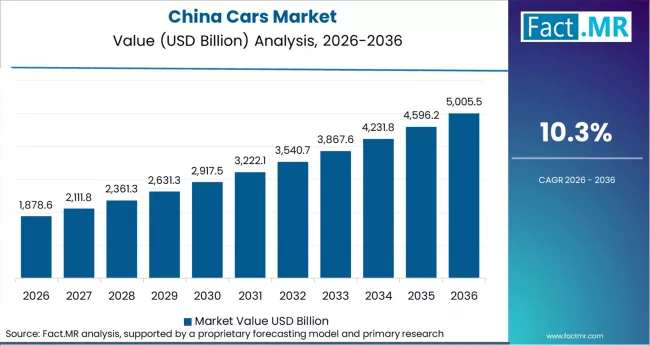
    Country growth reflects EV policy support, rising incomes, and automotive investment. China leads with a 10.3% CAGR driven by intense EV competition and premium SUV demand. India follows at 9.9% supported by first-time car ownership and EV incentives. Germany records 8.4% on premium EV exports. Brazil grows 7.0% through expanding consumer credit and ethanol-hybrid adoption. The United States posts 6.8% with strong SUV and EV demand. The United Kingdom grows 6.0% under ZEV mandates. Japan records 5.5%, driven by hybrid-to-EV transition.
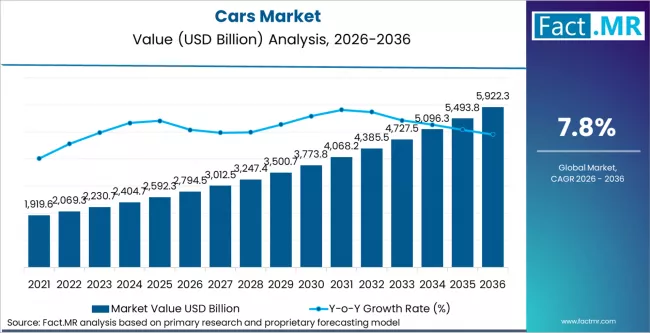
    Cars Market Market Value Analysis

    Metric Value
    Estimated Value in 2026 USD 2,794.5& billion
    Forecast Value in 2036 USD 5,922.3 billion
    Forecast CAGR (2026 to 2036) 7.8%

    Cars Market Definition

    The cars market covers passenger vehicles used for personal and commercial mobility. It includes SUVs, hatchbacks, sedans, sports cars, and other body styles across gasoline, diesel, electric, and fuel cell drivetrains. Cars serve individual ownership, ride-hailing fleets, corporate transport, and taxi services across urban and rural regions.

    Cars Market Inclusions

    Includes global and regional revenue forecasts from 2026 to 2036 by vehicle type, propulsion type, and end use. Covers all passenger car body styles and drivetrain technologies across major global regions.

    Cars Market Exclusions

    Excludes light commercial vehicles, vans, pickup trucks, heavy trucks, and motorcycles. Also excludes autonomous driving platforms, aftermarket vehicle modifications, telematics services, and automotive parts not sold with complete vehicles.

    Research Methodology

    • Primary Research: Interviews with automotive OEM executives, fleet procurement managers, retail network managers, and vehicle registration authorities across major regions.
    • Desk Research: Sources include OEM reports, national vehicle registration data, IEA EV outlook, EU CO₂ regulations, U.S. EPA standards, and automotive industry production statistics.
    • Market Sizing and Forecasting: A hybrid model using passenger vehicle sales volumes, average selling prices, income growth projections, and EV adoption forecasts.
    • Data Validation and Update Cycle: Forecasts validated using OEM revenues, vehicle registration databases, EV sales statistics, and EV incentive programme data.

    Cars Market Summary

    • Market Definition

      • The cars market includes passenger vehicles across all body styles and drivetrain technologies used for personal and commercial transport.
    • Demand Drivers

      • Rising middle-class income in China, India, and Southeast Asia is increasing first-time car ownership, especially SUVs and hatchbacks.
      • EU CO₂ emission rules and 2035 zero-emission targets are accelerating electric vehicle adoption.
      • EV incentives in the U.S. and India are reducing purchase costs and supporting higher electric car sales.
    • Key Segments Analyzed

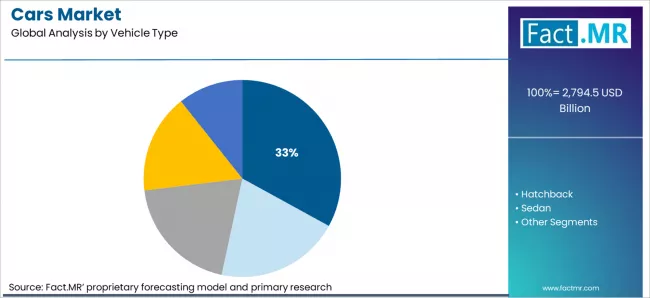
      • By Vehicle Type: SUVs hold approximately 33% share in 2026 due to consumer preference for versatile, high-utility vehicles with spacious interiors and premium technology content across all major markets.
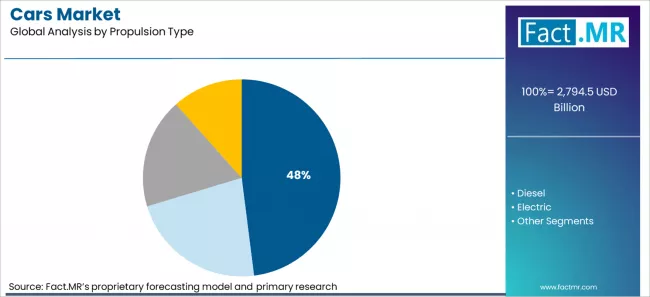
      • By Propulsion Type: Gasoline vehicles lead at approximately 48% share in 2026, reflecting established fuelling infrastructure and lower upfront cost in regions with less developed electric vehicle ecosystems.
      • By End Use: Individual buyers dominate at approximately 56% share in 2026, reflecting the fundamental role of personal vehicle ownership in global automotive demand.
    • Analyst Opinion at FACT.MR

      • Shambhu Nath Jha, Principal Consultant at Future Market Insights, opines that CXOs will find the market’s 7.8% CAGR through 2036 driven by a dual growth engine of Asia Pacific first-time ownership expansion and developed market EV technology premiumisation, with the SUV segment sustaining structural share leadership across all major geographies.
    • Strategic Implications

      • OEMs should accelerate development of affordable EV platforms below USD 25,000 for India and Southeast Asia, where price sensitivity strongly influences first-time buyer adoption.
      • Automakers should expand dedicated electric SUV line-ups for China and Europe, where SUV demand and ZEV regulations are creating major EV growth opportunities.
      • Companies should secure battery supply agreements and local cell manufacturing partnerships to reduce raw material price exposure and ensure EV production stability.
    • Methodology

      • Market sizing used vehicle registration volumes and average selling prices by propulsion and vehicle type, validated with OEM revenue disclosures and industry production data.
      • EU CO₂ standards, U.S. IRA EV incentives, India FAME scheme data, and China NEV subsidy statistics supported electrification demand analysis.
      • Forecasts incorporated income growth projections, EV adoption surveys, OEM electrification investments, and interviews with product planners and fleet managers.

    Category-wise Analysis

    Cars Market Analysis by Vehicle Type
    Cars Market Analysis By Vehicle Type

    Based on FACT.MR’s cars market report, SUVs are expected to hold around 33% share in 2026. SUVs lead due to higher utility, elevated seating position, safety integration, and strong consumer preference across major markets.

    • Toyota SUV Electrification Investment: Toyota expanded electric SUV production in 2025 with new battery assembly capacity and additional EV SUV models targeting global markets. [5]
    • Tesla SUV Model Technology Development: Tesla refreshed the Model Y in 2024 with updated design and software improvements, reinforcing its position as the best-selling global passenger vehicle. [6]
    • SUV Segment Share Growth Trend: Global SUV and crossover production reached 48% of passenger car output in 2024, reflecting rising consumer preference across China, Europe, and North America. [7]

    Cars Market Analysis by Propulsion Type
    Cars Market Analysis By Propulsion Type

    Based on FACT.MR’s cars market report, gasoline vehicles are projected to hold about 48% share in 2026. They remain widely used due to lower purchase cost, established refuelling infrastructure, and long driving range.

    • Volkswagen EV Platform Investment: Volkswagen announced a EUR 15 billion investment in its Trinity EV platform to support affordable electric vehicle production from 2026. [8]
    • BMW FCEV Technology Development: BMW began limited deliveries of its iX5 Hydrogen fuel cell vehicle in 2024, expanding alternative propulsion technology options. [9]
    • Diesel Displacement Trend: Diesel passenger car share in the EU declined to 13.4% in 2024 as gasoline hybrids and electric vehicles replaced diesel models. [10]

    Drivers, Restraints, and Opportunities

    FACT.MR analysts observe that the cars market, valued at USD 2,592.3 billion in 2025, is driven by income growth, urban mobility expansion, and the transition from internal combustion to electric drivetrains. Asia Pacific contributes large registration volumes, while premium vehicle technology in Europe and North America sustains high per-unit revenue.

    The industry is undergoing a major shift toward electrification. Gasoline vehicles still dominate in developing markets but face regulatory phase-outs in Europe by 2035. EVs command higher unit prices, supporting revenue growth even as powertrain transitions accelerate globally.

    • EU 2035 ICE Phase-Out Regulation: Regulation (EU) 2023/851 mandates zero-emission passenger car sales by 2035, pushing European OEMs to accelerate electric vehicle launches and reduce investment in gasoline platforms. [2]
    • China NEV Scale Advantage: China’s NEV market reached 12.9 million units in 2024, driven by competitive pricing from domestic manufacturers and continued government EV purchase incentives. [3]
    • India PLI Automotive Scheme: India’s automotive PLI and FAME III programmes are supporting domestic EV production and consumer adoption through manufacturing incentives and purchase subsidies. [4]

    Regional Analysis

    The cars market is analysed across Asia Pacific, Europe, North America, Latin America, and Middle East and Africa, covering 40+ countries with distinct demand profiles shaped by income growth, electric vehicle policy support, consumer vehicle preferences, and OEM manufacturing investment. The full report offers market attractiveness analysis based on EV adoption timelines, regulatory enforcement schedules, and vehicle ownership penetration trajectories.
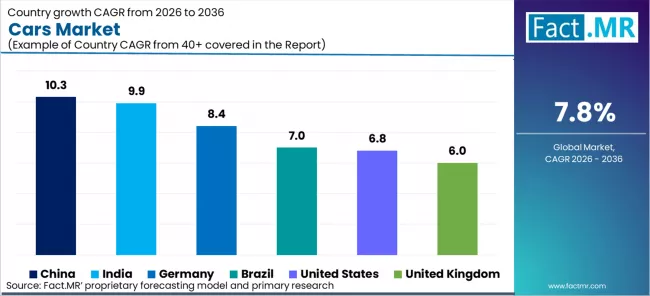
    Cars Market Cagr Analysis By Country

    Country CAGR (2026-2036)
    China 10.3%
    India 9.9%
    Germany 8.4%
    Brazil 7.0%
    United States 6.8%
    United Kingdom 6.0%

    Source: Fact.MR (FACT.MR) analysis, based on proprietary forecasting model and primary research

    Asia Pacific Cars Market Analysis
    Cars Market Country Value Analysis

    Asia Pacific is the largest and fastest-growing passenger car market, supported by China’s EV manufacturing scale and India’s expanding first-time ownership base. Toyota, BYD, and Hyundai lead regional volumes, while Chinese OEMs are strengthening global competitiveness through EV price leadership.

    • China: With an estimated 10.3% CAGR through 2036, China remains the fastest-growing major car market. Strong NEV policies, large domestic EV production, and rising middle-class SUV demand continue to accelerate passenger car sales.
    • India: India’s passenger car sector is set to advance at a 9.9% CAGR through 2036. Increasing household income, rapid urbanisation, and EV incentives are supporting strong growth in SUV and compact vehicle segments.

    FACT.MR’s Asia Pacific analysis of the cars market covers China, Japan, South Korea, India, Australia and New Zealand, ASEAN, and Rest of South Asia and Pacific. Readers can find country CAGR forecasts, NEV policy incentive timelines, OEM electrification investment data, and vehicle segment share projections by propulsion type.

    Europe Cars Market Analysis

    Europe remains a key passenger car market shaped by strict emissions regulations and strong premium vehicle manufacturing. Automakers are rapidly expanding electric vehicle portfolios to comply with zero-emission mandates.

    • Germany: Germany is anticipated to post an 8.4% CAGR through 2036. Premium EV launches from major German automakers and corporate fleet electrification programmes are sustaining vehicle demand.
    • United Kingdom: Passenger car sales in the United Kingdom are expected to expand at a 6.0% CAGR through 2036. Enforcement of the ZEV mandate and growing EV model availability are supporting the shift toward electric vehicles.

    FACT.MR’s European analysis of the cars market covers Germany, France, the United Kingdom, Italy, Spain, Nordic countries, BENELUX, and Rest of Western Europe. Readers can find EU ZEV mandate enforcement timelines, OEM electrification investment data, premium segment revenue forecasts, and country-level car sales and propulsion mix projections.

    North America Cars Market Analysis

    North America represents the highest-value passenger car market, supported by strong SUV demand, high average transaction prices, and rising EV adoption.

    • United States: The U.S. market is projected to expand at a 6.8% CAGR through 2036. Federal EV incentives, strong consumer preference for SUVs, and continued OEM electrification investments are driving long-term growth.

    FACT.MR’s North American analysis of the cars market covers the United States, Canada, and Mexico. Readers can find IRA tax credit impact data, OEM EV investment programme timelines, SUV segment revenue forecasts, and country-level sales projections by propulsion type and vehicle category.

    Latin America Cars Market Analysis

    Latin America is a developing passenger car market supported by rising vehicle ownership aspirations and improving access to consumer credit.

    • Brazil: Brazil’s passenger car market is forecast to grow at a 7.0% CAGR through 2036. Hybrid and EV production investment along with expanding charging infrastructure are gradually strengthening the electric vehicle ecosystem.

    FACT.MR’s Latin American analysis of the cars market covers Brazil, Chile, Ecuador, and Rest of Latin America. Readers can find Mover programme investment timelines, flex-fuel and hybrid vehicle adoption trends, EV infrastructure development data, and country-level car sales forecasts by propulsion type.

    Competitive Aligners for Market Players
    Cars Market Analysis By Company

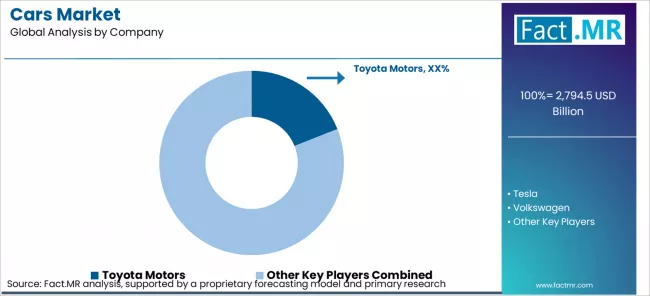
    The global cars market is moderately concentrated in premium segments and highly competitive in mass-market segments. Toyota, Volkswagen Group, Hyundai-Kia, Stellantis, and General Motors hold the largest combined passenger vehicle production volumes globally, with each group selling over 3 million cars annually. The primary competitive variables are shifting from powertrain refinement and fuel efficiency, which were the dominant differentiators for decades, to electric vehicle range and charging speed, software-defined vehicle features, and total cost of ownership over a five-year ownership cycle. Tesla and Chinese OEMs including BYD are reshaping competitive benchmarks through integrated software development, battery vertical integration, and aggressive EV pricing strategies.

    Structural competitive advantages belong to OEMs with vertically integrated battery cell production and proprietary EV platform architectures that enable shared component cost reduction across multiple models. Toyota’s hybrid drivetrain system dominance, built over 25 years of Prius development, gives it a structural margin advantage in hybrid segment volumes that is difficult for competitors to replicate quickly. BYD’s Blade Battery and e-Platform 3.0 vertical integration allow it to price electric sedans and SUVs at levels that Western OEMs cannot match without equivalent battery supply chain ownership. BMW Group’s Neue Klasse dedicated EV platform, launching from 2025, represents its strategic response to close the cost and range gap with leading EV-native competitors.

    Individual consumer buyers manage model risk through test drives, brand loyalty programmes, and manufacturer warranty terms rather than multi-vendor procurement strategies, giving OEMs with strong brand equity significant pricing power in their established segments. Fleet operators managing large corporate, rental, and ride-hailing accounts do maintain multi-OEM preferred vehicle lists that limit individual supplier pricing power, but OEMs that provide fleet management software integration, guaranteed residual value programmes, and total cost of ownership modelling tools develop stickier commercial relationships that sustain fleet contract renewals across model generation transitions.

    Key Players in Cars Market

    • Toyota Motors
    • Tesla
    • Volkswagen
    • BMW
    • Ford Motors
    • General Motors
    • Honda Motor
    • Hyundai Motor
    • Suzuki Motor
    • Tata Motors

    Scope of Report

    Country CAGR (2026-2036)

    Quantitative Units

    USD 2,794.5 billion (2026) to USD 5,922.3 billion (2036), at a CAGR of 7.8%

    Market Definition

    Passenger cars across all body styles and drivetrain technologies sold for personal and commercial mobility, including SUVs, hatchbacks, sedans, sports cars, and others.

    Vehicle Type Segmentation

    SUV (33%), Hatchback, Sedan, Sports Car, Others

    Propulsion Segmentation

    Gasoline (48%), Diesel, Electric, FCEV

    End Use Segmentation

    Individual (56%), Commercial

    Application Coverage

    Personal vehicle ownership, corporate fleet transport, ride-hailing and taxi operations, car rental fleet procurement, and government and public sector vehicle fleet management.

    Regions Covered

    Asia Pacific, Europe, North America, Latin America, Middle East and Africa

    Countries Covered

    China, Japan, South Korea, India, Australia and New Zealand, ASEAN, Rest of South Asia and Pacific, Germany, UK, France, Italy, Spain, Nordic, BENELUX, Rest of Western Europe, Russia, Poland, Hungary, Balkan and Baltic, USA, Canada, Mexico, Brazil, Chile, Ecuador, Rest of Latin America, Saudi Arabia, GCC, Turkey, South Africa, Rest of MEA

    Key Companies Profiled

    Toyota Motors, Tesla, Volkswagen, BMW, Ford Motors, General Motors, Honda Motor, Hyundai Motor, Suzuki Motor, Tata Motors

    Forecast Period

    2026 to 2036

    Approach

    Hybrid top-down and bottom-up model using vehicle registration volumes, average selling prices by propulsion and vehicle type, consumer income growth projections, EV adoption forecasts, and primary interviews with OEM planners and fleet procurement managers.

    Cars Market by Segments

    • By Vehicle Type :

      • SUV
      • Hatchback
      • Sedan
      • Sports Car
      • Others
    • By Propulsion Type:

      • Gasoline
      • Diesel
      • Electric
      • FCEV
    • By End Use:

      • Individual
      • Commercial
    • By Region:

      • North America
        • United States
        • Canada
        • Mexico
      • Latin America
        • Brazil
        • Chile
        • Ecuador
        • Rest of Latin America
      • Western Europe
        • Germany
        • United Kingdom
        • France
        • Italy
        • Spain
        • Nordic
        • BENELUX
        • Rest of Western Europe
      • Eastern Europe
        • Russia
        • Poland
        • Hungary
        • Balkan and Baltic
        • Rest of Eastern Europe
      • East Asia
        • China
        • Japan
        • South Korea
      • South Asia and Pacific
        • India
        • ASEAN
        • Australia and New Zealand
        • Rest of South Asia and Pacific
      • Middle East and Africa
        • Kingdom of Saudi Arabia
        • Other GCC Countries
        • Turkey
        • South Africa
        • Other African Union
        • Rest of Middle East and Africa

    Bibliography

    [1] European Commission. (2025). Regulation (EU) 2023/851 Implementation: Zero-Emission Passenger Car Sales Mandate Progress Report and National Incentive Programme Status. January 2025. ec.europa.eu

    [2 Ministry of Industry and Information Technology, People’s Republic of China. (2025). New Energy Vehicle Industry Development Plan 2035 and NEV Road Tax Exemption Extension Announcement. January 2025. miit.gov.cn

    [3] Ministry of Heavy Industries, Government of India. (2025). FAME III Scheme Notification: Electric Four-Wheeler Purchase Subsidy Allocation and Eligibility Criteria. March 2025. heavyindustries.gov.in

    [4] Toyota Motor Corporation. (2025). Product and Manufacturing Investment Announcement: bZ4X Production Expansion at Motomachi Plant and bZ5X Large Electric SUV Programme for China and North America. February 2025. global.toyota

    [5] Tesla Inc. (2024). Product Launch: Refreshed Model Y with Updated Design, Interior, and Battery Management Software for Global Markets. January 2024. tesla.com

    [6] International Organization of Motor Vehicle Manufacturers (OICA). (2025). Global Vehicle Production Statistics 2024: SUV and Crossover Share of Passenger Car Production by Region. January 2025. oica.net

    [7] Volkswagen AG. (2025). Investment Programme Announcement: EUR 15 Billion Trinity Electric Vehicle Platform at Wolfsburg for Affordable Electric Sedan from 2026. February 2025. volkswagen-group.com

    [8] BMW Group. (2024). Product Launch: iX5 Hydrogen Fuel Cell Electric Vehicle Limited Production Deliveries in Europe and Asia. March 2024. press.bmwgroup.com

    [9] European Automobile Manufacturers’ Association (ACEA). (2025). Passenger Car Registration Statistics: Diesel and Gasoline Share Decline and BEV Growth Full Year 2024. January 2025. acea.auto

    This Report Addresses

    • Strategic intelligence on EU ZEV mandate enforcement reshaping OEM product investment, China NEV scale driving global EV pricing benchmarks, India first-time ownership expansion, and U.S. IRA tax credit sustaining premium electric vehicle demand.
    • Market forecast from USD 2,794.5 billion in 2026 to USD 5,922.3 billion by 2036 at 7.8% CAGR, segmented by vehicle type, propulsion type, end use, and region.
    • Growth opportunity mapping across China’s NEV industrial policy, India’s FAME III EV scheme, Germany’s reinstated fleet EV subsidies, Brazil’s Mover programme, and U.S. IRA clean vehicle credits.
    • Country CAGR outlook for China 10.3%, India 9.9%, Germany 8.4%, Brazil 7.0%, United States 6.8%, United Kingdom 6.0%, and Japan 5.5%, with key EV policy, income growth, and OEM investment drivers per country.
    • Competitive analysis of Toyota, Volkswagen, Tesla, BYD, Hyundai, BMW, and Stellantis covering vehicle portfolios, EV platform strategies, battery supply chain investments, and market positioning by vehicle type and propulsion.
    • Technology tracking including solid-state battery development, FCEV passenger car commercialisation, software-defined vehicle platforms, over-the-air update capability, and autonomous driving feature adoption timelines.
    • Regulatory analysis covering EU Regulation 2023/851 ICE phase-out, UK ZEV mandate, U.S. IRA Section 30D EV credits, China MIIT NEV policy, India FAME III scheme, and Brazil Mover programme investment framework.
    • Report delivered in PDF, Excel datasets, PowerPoint summary, and dashboard formats supported by OEM registration data, national vehicle sales databases, IEA EV Outlook statistics, and primary research interviews.

    Table of Content

    1. Executive Summary
      • Global Market Outlook
      • Demand to side Trends
      • Supply to side Trends
      • Technology Roadmap Analysis
      • Analysis and Recommendations
    2. Market Overview
      • Market Coverage / Taxonomy
      • Market Definition / Scope / Limitations
    3. Research Methodology
      • Chapter Orientation
      • Analytical Lens and Working Hypotheses
        • Market Structure, Signals, and Trend Drivers
        • Benchmarking and Cross-market Comparability
        • Market Sizing, Forecasting, and Opportunity Mapping
      • Research Design and Evidence Framework
        • Desk Research Programme (Secondary Evidence)
          • Company Annual and Sustainability Reports
          • Peer-reviewed Journals and Academic Literature
          • Corporate Websites, Product Literature, and Technical Notes
          • Earnings Decks and Investor Briefings
          • Statutory Filings and Regulatory Disclosures
          • Technical White Papers and Standards Notes
          • Trade Journals, Industry Magazines, and Analyst Briefs
          • Conference Proceedings, Webinars, and Seminar Materials
          • Government Statistics Portals and Public Data Releases
          • Press Releases and Reputable Media Coverage
          • Specialist Newsletters and Curated Briefings
          • Sector Databases and Reference Repositories
          • FMR Internal Proprietary Databases and Historical Market Datasets
          • Subscription Datasets and Paid Sources
          • Social Channels, Communities, and Digital Listening Inputs
          • Additional Desk Sources
        • Expert Input and Fieldwork (Primary Evidence)
          • Primary Modes
            • Qualitative Interviews and Expert Elicitation
            • Quantitative Surveys and Structured Data Capture
            • Blended Approach
          • Why Primary Evidence is Used
          • Field Techniques
            • Interviews
            • Surveys
            • Focus Groups
            • Observational and In-context Research
            • Social and Community Interactions
          • Stakeholder Universe Engaged
            • C-suite Leaders
            • Board Members
            • Presidents and Vice Presidents
            • R&D and Innovation Heads
            • Technical Specialists
            • Domain Subject-matter Experts
            • Scientists
            • Physicians and Other Healthcare Professionals
          • Governance, Ethics, and Data Stewardship
            • Research Ethics
            • Data Integrity and Handling
        • Tooling, Models, and Reference Databases
      • Data Engineering and Model Build
        • Data Acquisition and Ingestion
        • Cleaning, Normalisation, and Verification
        • Synthesis, Triangulation, and Analysis
      • Quality Assurance and Audit Trail
    4. Market Background
      • Market Dynamics
        • Drivers
        • Restraints
        • Opportunity
        • Trends
      • Scenario Forecast
        • Demand in Optimistic Scenario
        • Demand in Likely Scenario
        • Demand in Conservative Scenario
      • Opportunity Map Analysis
      • Product Life Cycle Analysis
      • Supply Chain Analysis
      • Investment Feasibility Matrix
      • Value Chain Analysis
      • PESTLE and Porter’s Analysis
      • Regulatory Landscape
      • Regional Parent Market Outlook
      • Production and Consumption Statistics
      • Import and Export Statistics
    5. Global Market Analysis 2021 to 2025 and Forecast, 2026 to 2036
      • Historical Market Size Value (USD Million) Analysis, 2021 to 2025
      • Current and Future Market Size Value (USD Million) Projections, 2026 to 2036
        • Y to o to Y Growth Trend Analysis
        • Absolute $ Opportunity Analysis
    6. Global Market Pricing Analysis 2021 to 2025 and Forecast 2026 to 2036
    7. Global Market Analysis 2021 to 2025 and Forecast 2026 to 2036, By Vehicle Type
      • Introduction / Key Findings
      • Historical Market Size Value (USD Million) Analysis By Vehicle Type , 2021 to 2025
      • Current and Future Market Size Value (USD Million) Analysis and Forecast By Vehicle Type , 2026 to 2036
        • SUV
        • Hatchback
        • Sedan
        • Sports Car
        • Others
      • Y to o to Y Growth Trend Analysis By Vehicle Type , 2021 to 2025
      • Absolute $ Opportunity Analysis By Vehicle Type , 2026 to 2036
    8. Global Market Analysis 2021 to 2025 and Forecast 2026 to 2036, By Propulsion Type
      • Introduction / Key Findings
      • Historical Market Size Value (USD Million) Analysis By Propulsion Type, 2021 to 2025
      • Current and Future Market Size Value (USD Million) Analysis and Forecast By Propulsion Type, 2026 to 2036
        • Gasoline
        • Diesel
        • Electric
        • FCEV
      • Y to o to Y Growth Trend Analysis By Propulsion Type, 2021 to 2025
      • Absolute $ Opportunity Analysis By Propulsion Type, 2026 to 2036
    9. Global Market Analysis 2021 to 2025 and Forecast 2026 to 2036, By Region
      • Introduction
      • Historical Market Size Value (USD Million) Analysis By Region, 2021 to 2025
      • Current Market Size Value (USD Million) Analysis and Forecast By Region, 2026 to 2036
        • North America
        • Latin America
        • Western Europe
        • Eastern Europe
        • East Asia
        • South Asia and Pacific
        • Middle East & Africa
      • Market Attractiveness Analysis By Region
    10. North America Market Analysis 2021 to 2025 and Forecast 2026 to 2036, By Country
      • Historical Market Size Value (USD Million) Trend Analysis By Market Taxonomy, 2021 to 2025
      • Market Size Value (USD Million) Forecast By Market Taxonomy, 2026 to 2036
        • By Country
          • USA
          • Canada
          • Mexico
        • By Vehicle Type
        • By Propulsion Type
      • Market Attractiveness Analysis
        • By Country
        • By Vehicle Type
        • By Propulsion Type
      • Key Takeaways
    11. Latin America Market Analysis 2021 to 2025 and Forecast 2026 to 2036, By Country
      • Historical Market Size Value (USD Million) Trend Analysis By Market Taxonomy, 2021 to 2025
      • Market Size Value (USD Million) Forecast By Market Taxonomy, 2026 to 2036
        • By Country
          • Brazil
          • Chile
          • Rest of Latin America
        • By Vehicle Type
        • By Propulsion Type
      • Market Attractiveness Analysis
        • By Country
        • By Vehicle Type
        • By Propulsion Type
      • Key Takeaways
    12. Western Europe Market Analysis 2021 to 2025 and Forecast 2026 to 2036, By Country
      • Historical Market Size Value (USD Million) Trend Analysis By Market Taxonomy, 2021 to 2025
      • Market Size Value (USD Million) Forecast By Market Taxonomy, 2026 to 2036
        • By Country
          • Germany
          • UK
          • Italy
          • Spain
          • France
          • Nordic
          • BENELUX
          • Rest of Western Europe
        • By Vehicle Type
        • By Propulsion Type
      • Market Attractiveness Analysis
        • By Country
        • By Vehicle Type
        • By Propulsion Type
      • Key Takeaways
    13. Eastern Europe Market Analysis 2021 to 2025 and Forecast 2026 to 2036, By Country
      • Historical Market Size Value (USD Million) Trend Analysis By Market Taxonomy, 2021 to 2025
      • Market Size Value (USD Million) Forecast By Market Taxonomy, 2026 to 2036
        • By Country
          • Russia
          • Poland
          • Hungary
          • Balkan & Baltic
          • Rest of Eastern Europe
        • By Vehicle Type
        • By Propulsion Type
      • Market Attractiveness Analysis
        • By Country
        • By Vehicle Type
        • By Propulsion Type
      • Key Takeaways
    14. East Asia Market Analysis 2021 to 2025 and Forecast 2026 to 2036, By Country
      • Historical Market Size Value (USD Million) Trend Analysis By Market Taxonomy, 2021 to 2025
      • Market Size Value (USD Million) Forecast By Market Taxonomy, 2026 to 2036
        • By Country
          • China
          • Japan
          • South Korea
        • By Vehicle Type
        • By Propulsion Type
      • Market Attractiveness Analysis
        • By Country
        • By Vehicle Type
        • By Propulsion Type
      • Key Takeaways
    15. South Asia and Pacific Market Analysis 2021 to 2025 and Forecast 2026 to 2036, By Country
      • Historical Market Size Value (USD Million) Trend Analysis By Market Taxonomy, 2021 to 2025
      • Market Size Value (USD Million) Forecast By Market Taxonomy, 2026 to 2036
        • By Country
          • India
          • ASEAN
          • Australia & New Zealand
          • Rest of South Asia and Pacific
        • By Vehicle Type
        • By Propulsion Type
      • Market Attractiveness Analysis
        • By Country
        • By Vehicle Type
        • By Propulsion Type
      • Key Takeaways
    16. Middle East & Africa Market Analysis 2021 to 2025 and Forecast 2026 to 2036, By Country
      • Historical Market Size Value (USD Million) Trend Analysis By Market Taxonomy, 2021 to 2025
      • Market Size Value (USD Million) Forecast By Market Taxonomy, 2026 to 2036
        • By Country
          • Kingdom of Saudi Arabia
          • Other GCC Countries
          • Turkiye
          • South Africa
          • Other African Union
          • Rest of Middle East & Africa
        • By Vehicle Type
        • By Propulsion Type
      • Market Attractiveness Analysis
        • By Country
        • By Vehicle Type
        • By Propulsion Type
      • Key Takeaways
    17. Key Countries Market Analysis
      • USA
        • Pricing Analysis
        • Market Share Analysis, 2025
          • By Vehicle Type
          • By Propulsion Type
      • Canada
        • Pricing Analysis
        • Market Share Analysis, 2025
          • By Vehicle Type
          • By Propulsion Type
      • Mexico
        • Pricing Analysis
        • Market Share Analysis, 2025
          • By Vehicle Type
          • By Propulsion Type
      • Brazil
        • Pricing Analysis
        • Market Share Analysis, 2025
          • By Vehicle Type
          • By Propulsion Type
      • Chile
        • Pricing Analysis
        • Market Share Analysis, 2025
          • By Vehicle Type
          • By Propulsion Type
      • Germany
        • Pricing Analysis
        • Market Share Analysis, 2025
          • By Vehicle Type
          • By Propulsion Type
      • UK
        • Pricing Analysis
        • Market Share Analysis, 2025
          • By Vehicle Type
          • By Propulsion Type
      • Italy
        • Pricing Analysis
        • Market Share Analysis, 2025
          • By Vehicle Type
          • By Propulsion Type
      • Spain
        • Pricing Analysis
        • Market Share Analysis, 2025
          • By Vehicle Type
          • By Propulsion Type
      • France
        • Pricing Analysis
        • Market Share Analysis, 2025
          • By Vehicle Type
          • By Propulsion Type
      • India
        • Pricing Analysis
        • Market Share Analysis, 2025
          • By Vehicle Type
          • By Propulsion Type
      • ASEAN
        • Pricing Analysis
        • Market Share Analysis, 2025
          • By Vehicle Type
          • By Propulsion Type
      • Australia & New Zealand
        • Pricing Analysis
        • Market Share Analysis, 2025
          • By Vehicle Type
          • By Propulsion Type
      • China
        • Pricing Analysis
        • Market Share Analysis, 2025
          • By Vehicle Type
          • By Propulsion Type
      • Japan
        • Pricing Analysis
        • Market Share Analysis, 2025
          • By Vehicle Type
          • By Propulsion Type
      • South Korea
        • Pricing Analysis
        • Market Share Analysis, 2025
          • By Vehicle Type
          • By Propulsion Type
      • Russia
        • Pricing Analysis
        • Market Share Analysis, 2025
          • By Vehicle Type
          • By Propulsion Type
      • Poland
        • Pricing Analysis
        • Market Share Analysis, 2025
          • By Vehicle Type
          • By Propulsion Type
      • Hungary
        • Pricing Analysis
        • Market Share Analysis, 2025
          • By Vehicle Type
          • By Propulsion Type
      • Kingdom of Saudi Arabia
        • Pricing Analysis
        • Market Share Analysis, 2025
          • By Vehicle Type
          • By Propulsion Type
      • Turkiye
        • Pricing Analysis
        • Market Share Analysis, 2025
          • By Vehicle Type
          • By Propulsion Type
      • South Africa
        • Pricing Analysis
        • Market Share Analysis, 2025
          • By Vehicle Type
          • By Propulsion Type
    18. Market Structure Analysis
      • Competition Dashboard
      • Competition Benchmarking
      • Market Share Analysis of Top Players
        • By Regional
        • By Vehicle Type
        • By Propulsion Type
    19. Competition Analysis
      • Competition Deep Dive
        • Toyota Motors
          • Overview
          • Product Portfolio
          • Profitability by Market Segments (Product/Age /Sales Channel/Region)
          • Sales Footprint
          • Strategy Overview
            • Marketing Strategy
            • Product Strategy
            • Channel Strategy
        • Tesla
        • Volkswagen
        • BMW
        • Ford Motors
        • General Motors
        • Honda Motor
        • Hyundai Motor
        • Suzuki Motor
        • Tata Motors
    20. Assumptions & Acronyms Used

    List Of Table

    • Table 1: Global Market Value (USD Million) Forecast by Region, 2021 to 2036
    • Table 2: Global Market Value (USD Million) Forecast by Vehicle Type, 2021 to 2036
    • Table 3: Global Market Value (USD Million) Forecast by Propulsion Type, 2021 to 2036
    • Table 4: North America Market Value (USD Million) Forecast by Country, 2021 to 2036
    • Table 5: North America Market Value (USD Million) Forecast by Vehicle Type, 2021 to 2036
    • Table 6: North America Market Value (USD Million) Forecast by Propulsion Type, 2021 to 2036
    • Table 7: Latin America Market Value (USD Million) Forecast by Country, 2021 to 2036
    • Table 8: Latin America Market Value (USD Million) Forecast by Vehicle Type, 2021 to 2036
    • Table 9: Latin America Market Value (USD Million) Forecast by Propulsion Type, 2021 to 2036
    • Table 10: Western Europe Market Value (USD Million) Forecast by Country, 2021 to 2036
    • Table 11: Western Europe Market Value (USD Million) Forecast by Vehicle Type, 2021 to 2036
    • Table 12: Western Europe Market Value (USD Million) Forecast by Propulsion Type, 2021 to 2036
    • Table 13: Eastern Europe Market Value (USD Million) Forecast by Country, 2021 to 2036
    • Table 14: Eastern Europe Market Value (USD Million) Forecast by Vehicle Type, 2021 to 2036
    • Table 15: Eastern Europe Market Value (USD Million) Forecast by Propulsion Type, 2021 to 2036
    • Table 16: East Asia Market Value (USD Million) Forecast by Country, 2021 to 2036
    • Table 17: East Asia Market Value (USD Million) Forecast by Vehicle Type, 2021 to 2036
    • Table 18: East Asia Market Value (USD Million) Forecast by Propulsion Type, 2021 to 2036
    • Table 19: South Asia and Pacific Market Value (USD Million) Forecast by Country, 2021 to 2036
    • Table 20: South Asia and Pacific Market Value (USD Million) Forecast by Vehicle Type, 2021 to 2036
    • Table 21: South Asia and Pacific Market Value (USD Million) Forecast by Propulsion Type, 2021 to 2036
    • Table 22: Middle East & Africa Market Value (USD Million) Forecast by Country, 2021 to 2036
    • Table 23: Middle East & Africa Market Value (USD Million) Forecast by Vehicle Type, 2021 to 2036
    • Table 24: Middle East & Africa Market Value (USD Million) Forecast by Propulsion Type, 2021 to 2036

    List Of Figures

    • Figure 1: Global Market Pricing Analysis
    • Figure 2: Global Market Value (USD Million) Forecast 2021-2036
    • Figure 3: Global Market Value Share and BPS Analysis by Vehicle Type, 2026 and 2036
    • Figure 4: Global Market Y to o to Y Growth Comparison by Vehicle Type, 2026 to 2036
    • Figure 5: Global Market Attractiveness Analysis by Vehicle Type
    • Figure 6: Global Market Value Share and BPS Analysis by Propulsion Type, 2026 and 2036
    • Figure 7: Global Market Y to o to Y Growth Comparison by Propulsion Type, 2026 to 2036
    • Figure 8: Global Market Attractiveness Analysis by Propulsion Type
    • Figure 9: Global Market Value (USD Million) Share and BPS Analysis by Region, 2026 and 2036
    • Figure 10: Global Market Y to o to Y Growth Comparison by Region, 2026 to 2036
    • Figure 11: Global Market Attractiveness Analysis by Region
    • Figure 12: North America Market Incremental Dollar Opportunity, 2026 to 2036
    • Figure 13: Latin America Market Incremental Dollar Opportunity, 2026 to 2036
    • Figure 14: Western Europe Market Incremental Dollar Opportunity, 2026 to 2036
    • Figure 15: Eastern Europe Market Incremental Dollar Opportunity, 2026 to 2036
    • Figure 16: East Asia Market Incremental Dollar Opportunity, 2026 to 2036
    • Figure 17: South Asia and Pacific Market Incremental Dollar Opportunity, 2026 to 2036
    • Figure 18: Middle East & Africa Market Incremental Dollar Opportunity, 2026 to 2036
    • Figure 19: North America Market Value Share and BPS Analysis by Country, 2026 and 2036
    • Figure 20: North America Market Value Share and BPS Analysis by Vehicle Type, 2026 and 2036
    • Figure 21: North America Market Y to o to Y Growth Comparison by Vehicle Type, 2026 to 2036
    • Figure 22: North America Market Attractiveness Analysis by Vehicle Type
    • Figure 23: North America Market Value Share and BPS Analysis by Propulsion Type, 2026 and 2036
    • Figure 24: North America Market Y to o to Y Growth Comparison by Propulsion Type, 2026 to 2036
    • Figure 25: North America Market Attractiveness Analysis by Propulsion Type
    • Figure 26: Latin America Market Value Share and BPS Analysis by Country, 2026 and 2036
    • Figure 27: Latin America Market Value Share and BPS Analysis by Vehicle Type, 2026 and 2036
    • Figure 28: Latin America Market Y to o to Y Growth Comparison by Vehicle Type, 2026 to 2036
    • Figure 29: Latin America Market Attractiveness Analysis by Vehicle Type
    • Figure 30: Latin America Market Value Share and BPS Analysis by Propulsion Type, 2026 and 2036
    • Figure 31: Latin America Market Y to o to Y Growth Comparison by Propulsion Type, 2026 to 2036
    • Figure 32: Latin America Market Attractiveness Analysis by Propulsion Type
    • Figure 33: Western Europe Market Value Share and BPS Analysis by Country, 2026 and 2036
    • Figure 34: Western Europe Market Value Share and BPS Analysis by Vehicle Type, 2026 and 2036
    • Figure 35: Western Europe Market Y to o to Y Growth Comparison by Vehicle Type, 2026 to 2036
    • Figure 36: Western Europe Market Attractiveness Analysis by Vehicle Type
    • Figure 37: Western Europe Market Value Share and BPS Analysis by Propulsion Type, 2026 and 2036
    • Figure 38: Western Europe Market Y to o to Y Growth Comparison by Propulsion Type, 2026 to 2036
    • Figure 39: Western Europe Market Attractiveness Analysis by Propulsion Type
    • Figure 40: Eastern Europe Market Value Share and BPS Analysis by Country, 2026 and 2036
    • Figure 41: Eastern Europe Market Value Share and BPS Analysis by Vehicle Type, 2026 and 2036
    • Figure 42: Eastern Europe Market Y to o to Y Growth Comparison by Vehicle Type, 2026 to 2036
    • Figure 43: Eastern Europe Market Attractiveness Analysis by Vehicle Type
    • Figure 44: Eastern Europe Market Value Share and BPS Analysis by Propulsion Type, 2026 and 2036
    • Figure 45: Eastern Europe Market Y to o to Y Growth Comparison by Propulsion Type, 2026 to 2036
    • Figure 46: Eastern Europe Market Attractiveness Analysis by Propulsion Type
    • Figure 47: East Asia Market Value Share and BPS Analysis by Country, 2026 and 2036
    • Figure 48: East Asia Market Value Share and BPS Analysis by Vehicle Type, 2026 and 2036
    • Figure 49: East Asia Market Y to o to Y Growth Comparison by Vehicle Type, 2026 to 2036
    • Figure 50: East Asia Market Attractiveness Analysis by Vehicle Type
    • Figure 51: East Asia Market Value Share and BPS Analysis by Propulsion Type, 2026 and 2036
    • Figure 52: East Asia Market Y to o to Y Growth Comparison by Propulsion Type, 2026 to 2036
    • Figure 53: East Asia Market Attractiveness Analysis by Propulsion Type
    • Figure 54: South Asia and Pacific Market Value Share and BPS Analysis by Country, 2026 and 2036
    • Figure 55: South Asia and Pacific Market Value Share and BPS Analysis by Vehicle Type, 2026 and 2036
    • Figure 56: South Asia and Pacific Market Y to o to Y Growth Comparison by Vehicle Type, 2026 to 2036
    • Figure 57: South Asia and Pacific Market Attractiveness Analysis by Vehicle Type
    • Figure 58: South Asia and Pacific Market Value Share and BPS Analysis by Propulsion Type, 2026 and 2036
    • Figure 59: South Asia and Pacific Market Y to o to Y Growth Comparison by Propulsion Type, 2026 to 2036
    • Figure 60: South Asia and Pacific Market Attractiveness Analysis by Propulsion Type
    • Figure 61: Middle East & Africa Market Value Share and BPS Analysis by Country, 2026 and 2036
    • Figure 62: Middle East & Africa Market Value Share and BPS Analysis by Vehicle Type, 2026 and 2036
    • Figure 63: Middle East & Africa Market Y to o to Y Growth Comparison by Vehicle Type, 2026 to 2036
    • Figure 64: Middle East & Africa Market Attractiveness Analysis by Vehicle Type
    • Figure 65: Middle East & Africa Market Value Share and BPS Analysis by Propulsion Type, 2026 and 2036
    • Figure 66: Middle East & Africa Market Y to o to Y Growth Comparison by Propulsion Type, 2026 to 2036
    • Figure 67: Middle East & Africa Market Attractiveness Analysis by Propulsion Type
    • Figure 68: Global Market - Tier Structure Analysis
    • Figure 69: Global Market - Company Share Analysis

    - FAQs -

    How large is the cars market in 2025?

    The market was valued at USD 2,592.3 billion in 2025.

    What will the market size be in 2026?

    The market is estimated to reach USD 2,794.5 billion in 2026.

    What is the projected market size by 2036?

    The market is projected to reach USD 5,922.3 billion by 2036, creating a USD 3,127.8 billion absolute dollar opportunity over the forecast period.

    What is the expected CAGR?

    The forecast CAGR from 2026 to 2036 is 7.8%.

    Which vehicle type leads the market?

    SUVs lead with approximately 33% share in 2026 due to consumer preference for versatile, high-utility vehicles with spacious interiors and advanced technology content across all major markets.

    Which propulsion type dominates?

    Gasoline vehicles lead at approximately 48% share in 2026, reflecting established fuelling infrastructure and lower upfront acquisition cost in markets with limited electric vehicle charging ecosystems.

    Which end use segment holds the largest share?

    Individual buyers dominate at approximately 56% share in 2026, driven by rising personal vehicle ownership in Asia Pacific and sustained replacement demand from individual consumers in mature markets.

    Which country shows the fastest growth?

    China leads at 10.3% CAGR through 2036, driven by domestic NEV scale, price-competitive electric vehicles from BYD and SAIC, and rising middle-class consumer demand for premium SUVs.

    What is the primary restraint?

    Battery raw material supply tightness moderating electric vehicle cost reduction timelines, combined with consumer affordability limits in price-sensitive developing markets, are the main structural constraints on electric car adoption growth.

    Cars Market