- Base Value(2026): 5.06 Bn
- Forecast Value (2036): 13.12 Bn
- CAGR (2036): 10.0%
Prostate Cancer Diagnostics Market Size, Market Forecast and Outlook By FACT.MR
The Prostate Cancer Diagnostics market was valued at USD 5.06 billion in 2026 and is forecast to reach USD 13.12 billion by 2036, advancing at a 10.0% CAGR. As per FACT.MR's analysis, expanding clinical adoption, regulatory modernisation, and technology integration across global healthcare systems are accelerating market growth through the forecast decade.
The absolute value expansion of USD 8.06 billion over the 2026 to 2036 period reflects structural investment in diagnostic and therapeutic infrastructure across established and emerging markets. Supply chain localisation initiatives, increased healthcare capital budgets in Asia Pacific, and regulatory compliance investment cycles in North America and Europe are collectively sustaining market momentum across the forecast window.
Country-level CAGR projections span 9.7% in USA to 11.2% in China. China advances at 11.2% driven by Healthy China 2030 male cancer screening programme expansion and domestic PSMA PET tracer manufacturing scale-up. South Korea advances at 10.8% driven by National Health Insurance Service PSA screening coverage expansion and mpMRI adoption mandate for prostate biopsy guidance. Germany advances at 10.3% driven by EU IVDR compliance-driven urology diagnostic upgrades and S3 guideline mandated PSMA PET staging for high-risk prostate cancer. USA advances at 9.7% driven by FDA approval of PSMA PET agents and CMS reimbursement establishment driving PSMA imaging centre investment across urology networks.
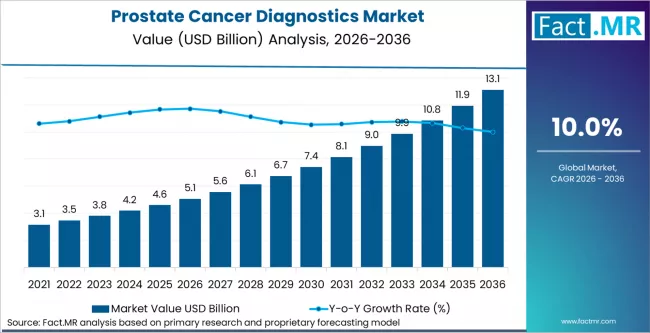
Prostate Cancer Diagnostics Market Market Value Analysis | Source: Fact.MR
Prostate Cancer Diagnostics Market Key Takeaways
| Metric | Details |
|---|---|
| Industry Size (2026) | USD 5.06 Billion |
| Industry Value (2036) | USD 13.12 Billion |
| CAGR (2026-2036) | 10.0% |
Source: Fact.MR analysis. Updated Mar 12, 2026
Prostate Cancer Diagnostics Market Definition
The Prostate Cancer Diagnostics encompasses all products, platforms, and services deployed for hospital urology departments and related psa & biomarker testing applications within clinical, research, and public health settings. Market scope covers PSA & Biomarker Testing, MRI/mpMRI Imaging, Biopsy/Histopathology, and associated consumables and software systems compliant with applicable regulatory frameworks.
Prostate Cancer Diagnostics Market Inclusions
The report covers PSA & Biomarker Testing, MRI/mpMRI Imaging, Biopsy/Histopathology, Molecular/Genomic Testing, PSMA PET/CT Imaging across all commercial formulations. Segment breakdowns by End-User Setting and region, pricing trend analysis, competitive landscape assessment, and regulatory compliance tracking are fully incorporated across 40-plus countries over the 2026 to 2036 forecast period.
Prostate Cancer Diagnostics Market Exclusions
Combination products incorporating prostate cancer diagnostics as a minor sub-component within a broader platform system are excluded. Experimental or pre-clinical stage technologies without regulatory clearance or established commercial distribution, and niche applications representing less than 1% of total market revenue, fall outside the defined scope.
Prostate Cancer Diagnostics Market Research Methodology
- Primary Research: FACT.MR analysts conducted structured interviews with clinical specialists, procurement directors, and regulatory affairs professionals across 40 countries to validate adoption timelines and pricing dynamics.
- Desk Research: Data aggregation covered regulatory body approvals, institutional procurement records, company annual reports, investor presentations, and official clinical guideline publications.
- Market-Sizing and Forecasting: A hybrid top-down and bottom-up methodology applies installed base metrics and regional adoption velocity curves to project market value trajectories through 2036.
- Data Validation and Update Cycle: Segment forecasts are cross-validated against quarterly revenue disclosures from publicly listed market participants and reconciled with procurement data from institutional sourcing bodies.
Summary of Prostate Cancer Diagnostics Market
- Prostate Cancer Diagnostics Market Definition
- The Prostate Cancer Diagnostics covers psa & biomarker testing, mri/mpmri imaging, and related platforms used for hospital urology departments across clinical and research settings globally.
- Demand Drivers in the Market
- Regulatory compliance cycles in major markets drive procurement upgrades and technology refresh investment across psa & biomarker testing categories.
- Rising chronic disease burden and ageing population demographics in high-income markets expand the volume of hospital urology departments procedures requiring advanced prostate cancer diagnostics solutions.
- Greenfield healthcare infrastructure investment in Asia Pacific and Africa creates first-time adoption opportunities for psa & biomarker testing and biopsy/histopathology platforms.
- Key Segments Analyzed in the FACT.MR Report
- PSA & Biomarker Testing holds 45.0% of Diagnostic Technology segment revenue in 2026, anchored by its established clinical utility and broad reimbursement coverage across major markets.
- Hospital Urology Departments commands the highest End-User Setting revenue share in 2026, reflecting institutional procurement concentration in high-volume healthcare settings.
- China leads regional growth at 11.2% CAGR through 2036, driven by Healthy China 2030 male cancer screening programme expansion and domestic PSMA PET tracer manufacturing scale-up.
- Analyst Opinion at FACT.MR
- FACT.MR analysts observe that the Prostate Cancer Diagnostics market is entering a technology consolidation phase where integrated platforms with regulatory-validated performance data command systematic procurement preference over standalone legacy devices. Capital project directors at leading healthcare systems face binary decisions between extending ageing equipment service contracts and committing to next-generation platform upgrades that satisfy both clinical performance and compliance requirements simultaneously.
- Strategic Implications / Executive Takeaways
- Manufacturers must secure regulatory clearance and reimbursement code establishment in the USA, Germany, and Japan simultaneously to qualify for multi-market tender cycles that now specify cross-jurisdictional compliance as a minimum shortlisting criterion.
- Distribution partners and group purchasing organisations that consolidate prostate cancer diagnostics procurement across hospital networks gain disproportionate negotiating leverage, requiring suppliers to invest in GPO contract management capabilities.
- Emerging market entry strategies must account for local manufacturing content requirements and halal or country-specific certification obligations that add 12 to 18 months to standard market entry timelines.
Prostate Cancer Diagnostics Market Drivers, Restraints, and Opportunities
FACT.MR analysis of the Prostate Cancer Diagnostics market identifies regulatory-driven procurement cycles, technology consolidation among major OEMs, and greenfield healthcare infrastructure expansion in Asia Pacific as the three primary structural forces shaping market velocity through 2036. Organisations that align product development roadmaps with confirmed reimbursement pathways and clinical guideline integration timelines will capture disproportionate share in the early forecast years.
Restraining forces include capital expenditure cycles that extend replacement timelines in budget-constrained health systems, and technical integration complexity that slows the adoption of next-generation platforms in facilities with legacy IT infrastructure. Opportunities are concentrated in point-of-care and decentralised settings where lower-cost platforms with simplified operation interfaces are expanding the addressable market beyond traditional hospital procurement channels.
- Regulatory Compliance Investment: EU MDR/IVDR and US FDA 510(k) modernisation requirements force systematic equipment upgrades across European and North American hospital networks, generating replacement demand independent of clinical performance lifecycle considerations.
- AI Integration and Workflow Automation: Leading OEMs are embedding AI-assisted decision support and automated measurement tools directly into psa & biomarker testing platforms, expanding their clinical value proposition and justifying premium pricing in hospital capital procurement budgets.
- Emerging Market Healthcare Access: WHO Universal Health Coverage targets and national health insurance expansions in India, Indonesia, and sub-Saharan Africa are directly funding first-time prostate cancer diagnostics procurement in district and primary care facilities that previously had no access to these diagnostic tools.
What is a Key Prostate Cancer Diagnostics Market Trend?
“Integration of Digital Technologies to Offer Accurate and Reliable Prostate Cancer Diagnostic Solutions”
Development of improved screening techniques is one of the notable prostate cancer diagnostics market trends. Effective prostate cancer treatment depends upon early detection. Advanced cancer diagnostic technologies can help to get quick and accurate screening of disease. Prostate-specific antigen (PSA) testing is one of the effective technologies in the early detection of prostate cancer. Liquid biopsy and DNA probes-based diagnostic solutions are also effective in cancer detection.
Integration of artificial intelligence (AI) and machine learning (ML) algorithms is set to offer reliable and accurate diagnostic solutions. Digital technologies such as AI, ML, the Internet of Things (IoT), and predictive data analytics are contributing to the development of advanced imaging technologies such as positron emission tomography (PET), magnetic resonance imaging (MRI), and multiparametric MRI. These technologies are effective in providing accurate images of the prostate gland aiding doctors to identify abnormalities and implement efficacious treatment procedures. Thus, technological advancements are projected to boost the profits of prostate cancer diagnostic technology providers.
Which Issues Should Prostate Cancer Diagnostic Solution Producers Focus On?
“Lack of Awareness and High Costs Associated with Diagnosis”
Even though technological breakthroughs are expected to offer high-growth opportunities for prostate cancer diagnostic solution providers lack of knowledge or awareness of cancer type is expected to hamper their revenue growth to some extent. People in developing countries are unaware of the prostate cancer and its symptoms. Leading manufacturers should focus on awareness programs to increase the early detection of disease.
High costs of screening are also one of the factors hampering the prostate cancer diagnostic solution sales growth. Patients with low income are often deterred from being diagnosed with cancer due to high screening costs.
Start-Up Ecosystem
- Enrich Bioscience is a Canada-based start-up that offers DNA methylation detection solutions for cancer diagnosis. By detecting anomalous DNA methylation, the start-up's solution offers accurate and specific methylation data. This solution is effective in performing accurate, non-invasive cancer screening for individuals.
- SAGA Diagnostics is a Swedish start-up that offers dPCR testing technology for cancer detection. The company’s SAGAsafe solutions provide accurate detection of various cancer types through a non-invasive in-vitro diagnostic (IVD) kit.
Regional Analysis
The Prostate Cancer Diagnostics Market is analysed across North America, Latin America, Europe, East Asia, South Asia, Oceania, and Middle East & Africa covering 40-plus countries. The full FACT.MR report provides market attractiveness analysis and country-level CAGR projections for each region.
| Country | CAGR (2026 to 2036) |
|---|---|
| China | 11.2% |
| South Korea | 10.8% |
| Germany | 10.3% |
| USA | 9.7% |
Source: Fact.MR analysis. Updated Mar 12, 2026
Source: FACT.MR analysis, based on proprietary forecasting model and primary research
China: Prostate Cancer Diagnostics Market Analysis
China: Demand for prostate cancer diagnostics in China is projected to grow at a 11.2% CAGR through 2036. Healthy China 2030 male cancer screening programme expansion and domestic PSMA PET tracer manufacturing scale-up. Healthcare procurement agencies in China are prioritising psa & biomarker testing and mri/mpmri imaging platforms that meet local regulatory standards while delivering measurable performance improvements over legacy systems. Government-funded health programmes and private sector hospital expansion projects jointly support technology adoption across both primary and tertiary care settings in China. As per FACT.MR's regional assessment, China represents a priority market for prostate cancer diagnostics suppliers seeking exposure to above-average growth trajectories during the 2026 to 2036 forecast period.
South Korea: Prostate Cancer Diagnostics Market Analysis
South Korea: Demand for prostate cancer diagnostics in South Korea is projected to grow at a 10.8% CAGR through 2036. National Health Insurance Service PSA screening coverage expansion and mpMRI adoption mandate for prostate biopsy guidance. Healthcare procurement agencies in South Korea are prioritising psa & biomarker testing and mri/mpmri imaging platforms that meet local regulatory standards while delivering measurable performance improvements over legacy systems. Government-funded health programmes and private sector hospital expansion projects jointly support technology adoption across both primary and tertiary care settings in South Korea. As per FACT.MR's regional assessment, South Korea represents a priority market for prostate cancer diagnostics suppliers seeking exposure to above-average growth trajectories during the 2026 to 2036 forecast period.
Germany: Prostate Cancer Diagnostics Market Analysis
Germany: Demand for prostate cancer diagnostics in Germany is projected to grow at a 10.3% CAGR through 2036. EU IVDR compliance-driven urology diagnostic upgrades and S3 guideline mandated PSMA PET staging for high-risk prostate cancer. Healthcare procurement agencies in Germany are prioritising psa & biomarker testing and mri/mpmri imaging platforms that meet local regulatory standards while delivering measurable performance improvements over legacy systems. Government-funded health programmes and private sector hospital expansion projects jointly support technology adoption across both primary and tertiary care settings in Germany. As per FACT.MR's regional assessment, Germany represents a priority market for prostate cancer diagnostics suppliers seeking exposure to above-average growth trajectories during the 2026 to 2036 forecast period.
USA: Prostate Cancer Diagnostics Market Analysis
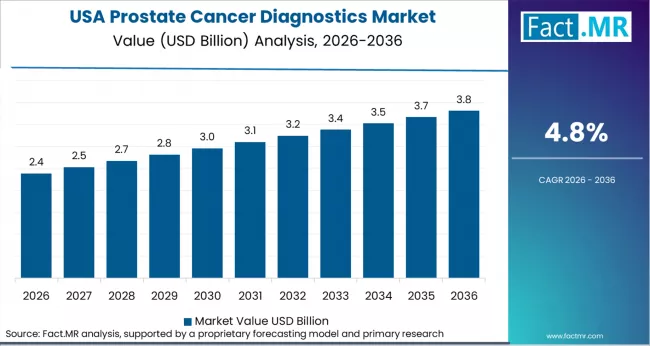
Prostate Cancer Diagnostics Market Country Value Analysis | Source: Fact.MR
USA: Demand for prostate cancer diagnostics in USA is projected to grow at a 9.7% CAGR through 2036. FDA approval of PSMA PET agents and CMS reimbursement establishment driving PSMA imaging centre investment across urology networks. Healthcare procurement agencies in USA are prioritising psa & biomarker testing and mri/mpmri imaging platforms that meet local regulatory standards while delivering measurable performance improvements over legacy systems. Government-funded health programmes and private sector hospital expansion projects jointly support technology adoption across both primary and tertiary care settings in USA. As per FACT.MR's regional assessment, USA represents a priority market for prostate cancer diagnostics suppliers seeking exposure to above-average growth trajectories during the 2026 to 2036 forecast period.
Category-wise Analysis
Prostate Cancer Diagnostics Market Analysis by Diagnostic Technology
Based on FACT.MR analysis, PSA and Biomarker Testing hold 45.0% of prostate cancer diagnostics revenue in 2026. Prostate-specific antigen testing remains the most widely performed prostate cancer screening tool globally, generating hundreds of millions of tests annually across primary care and urology settings. The introduction of next-generation PSA derivative markers including phi (Prostate Health Index), 4Kscore, and PCA3 urine testing is upgrading the diagnostic algorithm beyond single PSA measurements, increasing average test spend per patient.
- PSMA PET/CT Approval Impact: The FDA approved Lantheus Holdings' piflufolastat F18 (Pylarify) PSMA PET agent in 2021 and Blue Earth Diagnostics' flotufolastat F18 in 2023, establishing PSMA PET/CT as the standard staging modality for biochemically recurrent prostate cancer and creating a new high-value imaging segment.
- Genomic Risk Classification Adoption: Genomic Health's Oncotype DX Genomic Prostate Score and Veracyte's Decipher Prostate Genomic Classifier received expanded CMS reimbursement coverage in 2024 for active surveillance decision guidance, increasing molecular testing volumes in newly diagnosed localised prostate cancer.
- mpMRI-Guided Biopsy Mandates: NICE updated UK prostate cancer guidelines in 2023 to mandate multiparametric MRI before prostate biopsy, reducing unnecessary biopsy procedures while creating sustained demand for mpMRI reporting capacity and PI-RADS v2.1 radiologist training programmes.
Prostate Cancer Diagnostics Market Analysis by End-User Setting
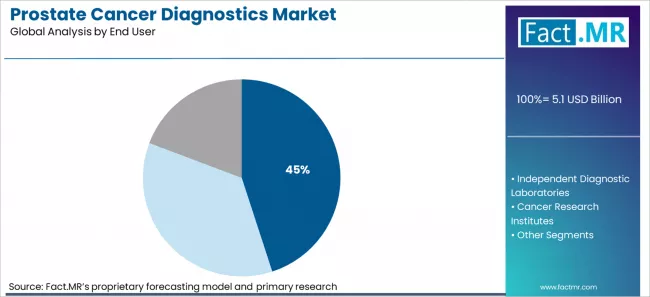
Prostate Cancer Diagnostics Market Analysis By End User | Source: Fact.MR
Hospital Urology Departments account for 50.0% of prostate cancer diagnostic volume in 2026. Integrated urology-oncology care pathways within hospital settings concentrate PSA testing, biopsy procedures, mpMRI reporting, and molecular test ordering under a single clinical team, ensuring diagnostic continuity and maximising guideline adherence. Academic medical centre consolidation is further concentrating complex prostate cancer diagnostic workup in hospital settings with PSMA PET cameras and in-house genomic testing platforms.
- PSMA PET Infrastructure Investment: Siemens Healthineers and GE HealthCare both reported expanded PET/CT installation pipelines in their 2024 annual reports, driven by PSMA PET reimbursement establishment in the United States, Germany, and South Korea creating capital investment justification for hospital nuclear medicine departments.
- Point-of-Care PSA Testing Expansion: Abbott's Alere Afinion PSA rapid assay and Roche's cobas point-of-care PSA system received expanded regulatory clearances in 2023, enabling PSA testing beyond hospital laboratories into primary care and men's health screening programmes.
- Reference Laboratory Competition: Exact Sciences and Myriad Genetics both expanded their prostate cancer genomic test menus in 2024 annual reports, competing for oncologist and urologist referrals for molecular risk stratification tests previously performed only at academic medical centres.
Competitive Aligners for Prostate Cancer Diagnostics Market Players
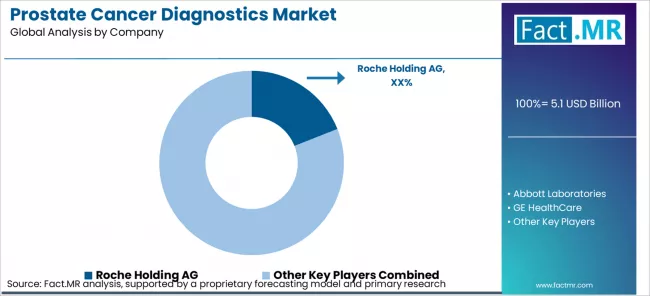
Prostate Cancer Diagnostics Market Analysis By Company | Source: Fact.MR
The Prostate Cancer Diagnostics Market is moderately concentrated, with the top five companies collectively holding approximately 55 to 65% of global revenue. Competitive differentiation is primarily driven by regulatory clearance breadth, clinical evidence portfolios, and the depth of integration with hospital information systems and electronic health record platforms. First-mover advantage in securing companion diagnostic designations and reimbursement code establishment creates durable competitive moats in oncology and specialty diagnostic sub-segments.
Vertically integrated manufacturers that control both the instrument platform and consumable supply chain maintain superior gross margins and switching cost advantages compared to device-only players dependent on third-party reagent or consumable supply agreements. Long-term service contracts and application specialist support programmes are becoming the primary competitive battleground as hardware performance gaps narrow between tier-one and tier-two suppliers in established markets.
FMI analysts note that buyer leverage is increasing as hospital group purchasing organisations consolidate procurement across larger facility networks, forcing suppliers to offer volume-tiered pricing and bundled service agreements that compress unit margins. This trend is accelerating platform standardisation within health systems, reducing the frequency of competitive re-evaluation but increasing the stakes of initial contract awards. Suppliers investing in digital health integration and outcome data analytics are best positioned to sustain premium pricing through contract renewal cycles.
Key Players in the Market
- F. Hoffmann-La Roche AG
- Abbott Laboratories
- Siemens Healthineers AG
- GE HealthCare Technologies Inc.
- Beckman Coulter Inc.
- Myriad Genetics Inc.
- Veracyte Inc.
- MDxHealth SA
- Genomic Health (Exact Sciences)
- Lantheus Holdings Inc.
Bibliography
- European Parliament and Council. (2017). Regulation (EU) 2017/746 on in vitro diagnostic medical devices. Official Journal of the European Union.
- World Health Organization. (2024). Global cancer observatory: Prostate cancer incidence and mortality statistics 2024. IARC.
- National Comprehensive Cancer Network. (2024). NCCN clinical practice guidelines in oncology: Prostate cancer (Version 2.2024). NCCN.
- National Institute for Health and Care Excellence. (2023). Prostate cancer: Diagnosis and management. NICE guideline NG131 updated. NICE.
- U.S. Food and Drug Administration. (2023). FDA approvals for PSMA PET radiopharmaceuticals: Pylarify and flotufolastat F18. U.S. FDA.
- Centers for Medicare and Medicaid Services. (2024). MolDX reimbursement decisions for prostate genomic classifiers. CMS.
This Report Addresses
- Market sizing and quantitative forecast metrics detailing prostate cancer diagnostics revenue projections through 2036 across all key segments and regions.
- Segmentation analysis mapping adoption velocity of specific psa & biomarker testing and mri/mpmri imaging technologies and evaluating the technical factors driving procurement decisions.
- Regional deployment intelligence comparing growth dynamics in Asia Pacific greenfield markets against brownfield upgrade cycles in European and North American healthcare networks.
- Regulatory compliance assessment analysing how MDR, IVDR, and FDA modernisation requirements are forcing equipment refresh cycles and creating structured replacement demand.
- Competitive landscape evaluation tracking supplier positioning, companion diagnostic designations, reimbursement code coverage, and key account contract award patterns.
- Capital project strategic guidance defining procurement specifications, integration requirements, and total cost of ownership parameters for next-generation platform selection.
- Supply chain vulnerability analysis identifying logistics bottlenecks, component sourcing concentration risks, and lead time pressures affecting market supply.
- Custom data delivery formats including interactive dashboards, raw Excel datasets, and comprehensive PDF narrative reports with regional sub-market detail.
Segmentation
Scope of the Report
| Metric | Value |
|---|---|
| Quantitative Units | USD 5.06 billion to USD 13.12 billion, at a CAGR of 10.0% |
| Market Definition | Prostate Cancer Diagnostics encompasses psa & biomarker testing, mri/mpmri imaging, and related systems for hospital urology departments applications across clinical and research settings. |
| Diagnostic Technology Segmentation | PSA & Biomarker Testing, MRI/mpMRI Imaging, Biopsy/Histopathology, Molecular/Genomic Testing, PSMA PET/CT Imaging |
| End-User Setting Segmentation | Hospital Urology Departments, Oncology Reference Laboratories, Diagnostic Imaging Centers, Urology Clinics, Research & Academic Institutes |
| Regions Covered | North America, Latin America, Europe, East Asia, South Asia, Oceania, Middle East & Africa |
| Countries Covered | China, South Korea, Germany, USA, and 40 plus countries |
| Key Companies Profiled | F. Hoffmann-La Roche AG, Abbott Laboratories, Siemens Healthineers AG, GE HealthCare Technologies Inc., Beckman Coulter Inc., Myriad Genetics Inc., Veracyte Inc., MDxHealth SA, Genomic Health (Exact Sciences), Lantheus Holdings Inc. |
| Forecast Period | 2026 to 2036 |
| Approach | Hybrid top-down and bottom-up methodology starting with installed base metrics and projecting adoption velocity through 2036 |
Source: Fact.MR analysis. Updated Mar 12, 2026
Prostate Cancer Diagnostics Market Analysis by Segments
-
Diagnostic Technology:
- PSA & Biomarker Testing
- MRI/mpMRI Imaging
- Biopsy/Histopathology
- Molecular/Genomic Testing
- PSMA PET/CT Imaging
-
End-User Setting:
- Hospital Urology Departments
- Oncology Reference Laboratories
- Diagnostic Imaging Centers
- Urology Clinics
- Research & Academic Institutes
-
Region:
- North America (USA, Canada, Mexico)
- Latin America (Brazil, Argentina, Rest of Latin America)
- Europe (Germany, UK, France, Italy, Spain, Nordics, Rest of Europe)
- East Asia (China, Japan, South Korea)
- South Asia & Pacific (India, ASEAN, Australia & New Zealand)
- Middle East & Africa (Saudi Arabia, UAE, South Africa, Rest of MEA)
Frequently Asked Questions
How large is the Prostate Cancer Diagnostics Market in 2026?
What will the Prostate Cancer Diagnostics Market reach by 2036?
What is the expected CAGR for the Prostate Cancer Diagnostics Market between 2026 and 2036?
Which Diagnostic Technology leads the Prostate Cancer Diagnostics Market in 2026?
What is the fastest-growing country in the Prostate Cancer Diagnostics Market?
What does the FACT.MR Prostate Cancer Diagnostics Market report cover?
What is excluded from the Prostate Cancer Diagnostics Market scope?
How does FACT.MR forecast the Prostate Cancer Diagnostics Market?
Who worked on this report


Preview the report firsthand - request a free sample
Free SampleGet the brochure for pricing and purchase details
Download PDF