- Forecast Value (2036): 27.6 Bn
- CAGR (2036): 12.6%
What is the stadium connectivity solutions market forecast to be worth by 2036?
USD 8.4 billion in 2026 to USD 27.6 billion by 2036, at 12.6% CAGR.
- The stadium connectivity solutions market crossed a valuation of USD 7.6 billion in 2025.
- Demand is expected to increase from USD 8.4 billion in 2026 to USD 27.6 billion by 2036.
- The market is forecast to record 12.6% CAGR during 2026 to 2036 as stadium operators use venue networks to support mobile entry and real-time crowd coordination.
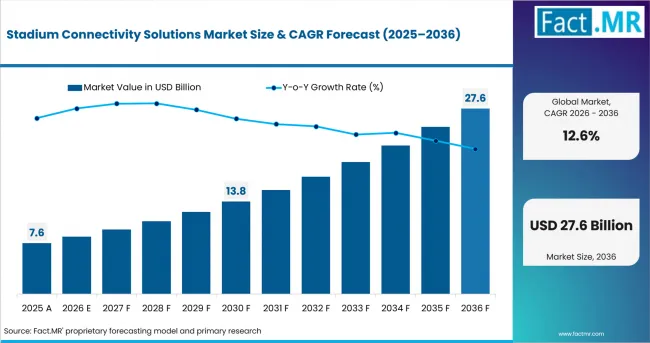
Stadium Connectivity Solutions Market Value Analysis | Source: Fact.MR
What are the defining numbers behind stadium connectivity solutions market growth?
USD 19.2 billion absolute opportunity by 2036, led by the United States and Saudi Arabia.
- Demand Drivers in the Market
- Stadium CIOs need stable wireless capacity during match-day traffic.
- Venue operations teams need connected systems for entry control and concession service.
- Network architects need private wireless layers for staff communication.
- Commercial teams need app-ready infrastructure for sponsorship and premium seating services.
- Key Segments Analyzed
- By Connectivity Type: High-Density Wi-Fi is expected to hold 37.0% share in 2026 because fan access starts with venue-wide wireless coverage.
- By Component: Network Hardware leads because access points and switching gear form the first deployment layer. The share is projected at 41.0% in 2026.
- By Deployment Model: Managed Venue Connectivity is likely to account for 34.0% share in 2026 because stadium teams need event-day monitoring.
- By Venue Type: Outdoor Stadiums lead with 46.0% share in 2026 because large seating bowls create the hardest radio planning challenge.
- By Use Case: Fan Engagement Connectivity is expected to hold 39.0% share in 2026 because mobile entry and ordering rely on stable access.
- By Geography: The United States is projected to record 15.4% CAGR through 2036 as professional leagues standardize connectivity performance.
- Analyst Opinion at Fact.MR
- Shambhu Nath Jha, Senior Analyst at Fact.MR, states, “Stadium connectivity is becoming the operating system of the venue. We see technology teams shifting from fan Wi-Fi projects toward network control that protects revenue moments. Providers that combine radio design with event-day support will gain stronger access to stadium modernization budgets.”
- Strategic Implications
- Network providers should position Wi-Fi and private wireless as one venue operating layer.
- Venue owners should test connectivity under live event load before expanding mobile services.
- Sports leagues can set common network performance rules across venue portfolios.
- System integrators should build repeatable deployment templates for seating bowls and concourse zones.
Stadium connectivity solutions provide high-density wireless coverage and operational network control inside stadiums. A stadium connectivity solution supports fan-facing services and venue operations through one connected layer. The strongest adoption case comes from live events because network failure can slow entry flow and interrupt service transactions.
Private wireless is creating a second demand base. Verizon deployed Managed Private Wireless for coach-to-coach communication across 30 NFL stadiums for the 2023 season. [1] This shows why stadium networks need controlled wireless performance for mission-critical communication.
Stadium Wi-Fi is becoming a capacity planning issue. Reuters reported that Cisco installed nearly 1,500 Wi-Fi 7 wireless routers for Super Bowl LX at Levi’s Stadium. [2] This reflects the pressure on venues to support upload-heavy fan behavior during short event windows.
The United States is projected to record 15.4% CAGR through 2036 as league-level network standards and private wireless projects increase. Saudi Arabia is expected to post 14.8% CAGR through 2036 as new sports venues integrate digital infrastructure at design stage. Japan is likely to record 13.7% CAGR as compact urban venues require dense connectivity. The United Kingdom is forecast to advance at 12.9% CAGR as football stadiums upgrade fan services. Germany is set to record 12.2% CAGR as venues connect ticketing and public safety systems.
How does the stadium connectivity solutions market break down by segment?
High-Density Wi-Fi leads at 37.0%; Network Hardware leads at 41.0%.
Which connectivity type dominates?
High-Density Wi-Fi holds 37.0% share in 2026.
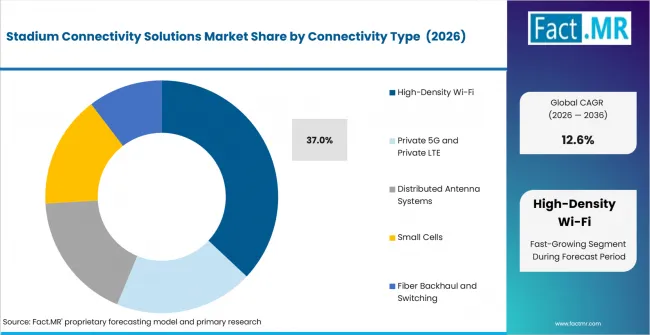
Stadium Connectivity Solutions Market Analysis By Connectivity Type | Source: Fact.MR
High-Density Wi-Fi is expected to hold 37.0% share in 2026 because visitors first judge the digital stadium experience through mobile access. The segment supports ticket scanning, social sharing, live content and food ordering. Stadium operators need careful radio planning because seats and moving crowds affect signal quality. The structured cabling layer supports the wired foundation behind access points and control rooms.
Which component dominates?
Network Hardware holds 41.0% share in 2026.
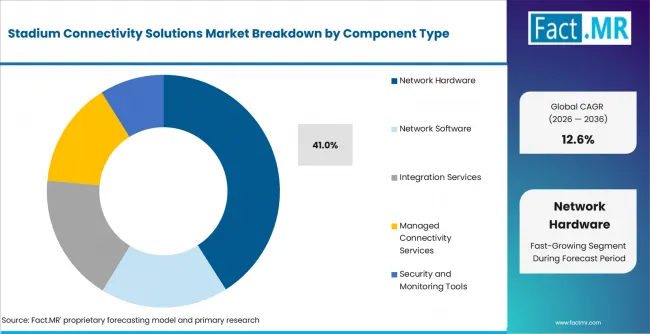
Stadium Connectivity Solutions Market Analysis By Component Type | Source: Fact.MR
Network Hardware leads because stadium connectivity performance starts with the physical layout. Access points and antennas decide whether coverage reaches seating bowls and service areas. The component is projected to capture 41.0% share in 2026. Software adds control after the base network is installed. Stadium teams usually schedule hardware refreshes around off-season windows.
Which deployment model dominates?
Managed Venue Connectivity holds 34.0% share in 2026.
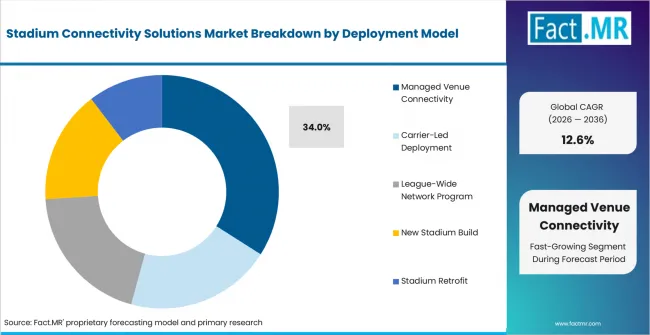
Stadium Connectivity Solutions Market Analysis By Deployment Model | Source: Fact.MR
Managed Connectivity Services lead because live event support is central to uptime. Internal IT teams may lack enough RF specialists during match-day surges. The deployment model is projected to hold 34.0% share in 2026. Service providers can tune networks before events and review performance after them. Venue operators value partners that understand scanners and connected concession devices inside one network plan.
Which venue type dominates?
Outdoor Stadiums hold 46.0% share in 2026.
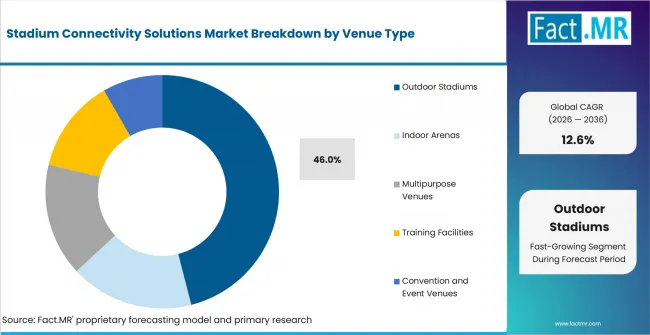
Stadium Connectivity Solutions Market Analysis By Venue Type | Source: Fact.MR
Outdoor Stadiums lead because device density concentrates in large open seating bowls. Signal planning must limit interference while protecting equipment from weather and fan contact. The venue type is expected to hold 46.0% share in 2026. Indoor arenas face dense traffic too. Outdoor stadiums require more careful antenna placement and fiber routing.
Which use case dominates?
Fan Engagement Connectivity holds 39.0% share in 2026.
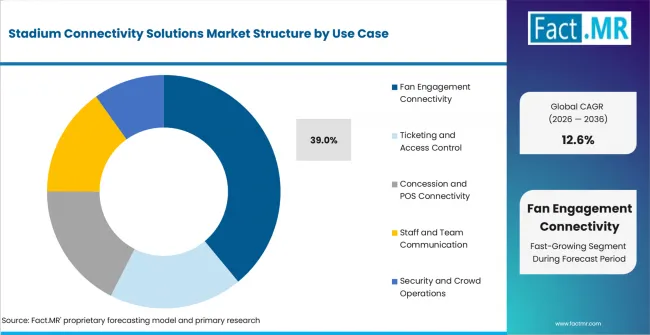
Stadium Connectivity Solutions Market Analysis By Use Case | Source: Fact.MR
Fan Engagement Connectivity leads because fans expect mobile entry and ordering from the same device. The network must support upload traffic during goals and halftime. The use case is expected to account for 39.0% share in 2026. Operators can use edge analytics to support faster local decisions around crowd flow.
What is accelerating stadium connectivity solutions demand, and what is holding it back?
Mobile-first venue operations drive demand; integration complexity restrains rollout.
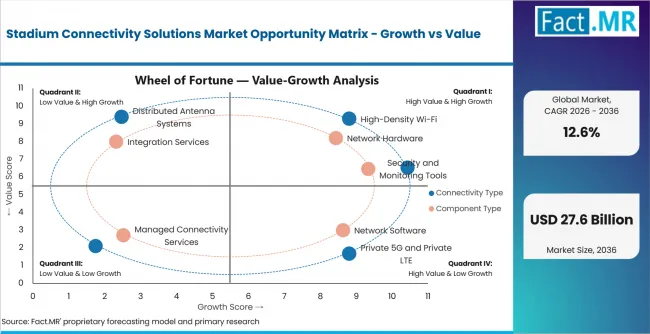
Stadium Connectivity Solutions Market Opportunity Matrix Growth Vs Value | Source: Fact.MR
Mobile-first venue operations are the main driver. Stadium teams now rely on connected devices for entry control and service workflows. Boingo stated in 2024 that 5G, Wi-Fi and private networks can transform venue connectivity strategies. [3] Access control integration adds another driver. Stadium operators need entry systems that connect with mobile tickets and turnstiles. The stadium access control layer becomes more valuable as venue networks share data with entry systems.
Private wireless supports critical staff communication. Coach communication and operations teams need controlled service quality. 3GPP states that Release 18 is the first release of 5G-Advanced. [4] Wi-Fi upgrades support the dense-venue case. Wireless Broadband Alliance states that Wi-Fi 7 is designed for low latency and higher reliability. [5] This supports stadium Wi-Fi upgrades where fans generate high upload traffic.
The main restraint is integration complexity. Stadiums often operate old cabling and legacy POS systems. New connectivity solutions must work around event calendars and sponsor assets. Providers need strong site survey methods before promising performance.
Where do the biggest stadium connectivity solution opportunities sit?
Fan experience and private wireless communication.
- Fan Experience: Stadium operators can use reliable connectivity to support mobile entry and in-seat service.
- Event Operations: Venue teams can connect POS devices and staff workflows through one network plan.
- Private Wireless: Leagues and large venues can use controlled wireless layers for mission-critical communication.
Which countries are scaling stadium connectivity solutions fastest?
United States 15.4%, Saudi Arabia 14.8%, Japan 13.7%, United Kingdom 12.9%, Germany 12.2%.
Based on regional analysis, the stadium connectivity solutions market is segmented into North America, Western Europe, Asia Pacific, Latin America, and Middle East and Africa.
.webp "Top Country Growth Comparison Stadium Connectivity Solutions Market Cagr (2026 2036)")
Top Country Growth Comparison Stadium Connectivity Solutions Market Cagr (2026 2036) | Source: Fact.MR
| Country | CAGR |
|---|---|
| United States | 15.4% |
| Saudi Arabia | 14.8% |
| Japan | 13.7% |
| United Kingdom | 12.9% |
| Germany | 12.2% |
Source: Fact.MR analysis. Updated Jun 24, 2026
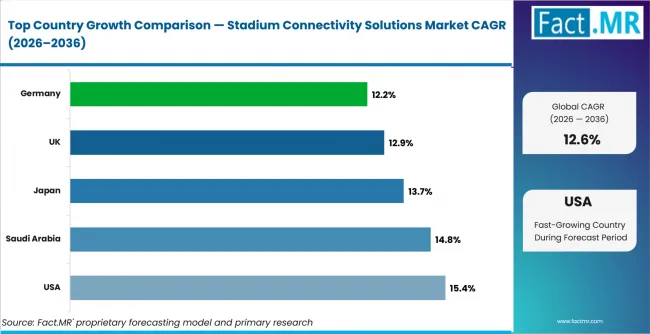
Stadium Connectivity Solutions Market Cagr Analysis By Country | Source: Fact.MR
What is powering the United States lead?
15.4% CAGR, driven by Verizon Business and professional league network standardization.
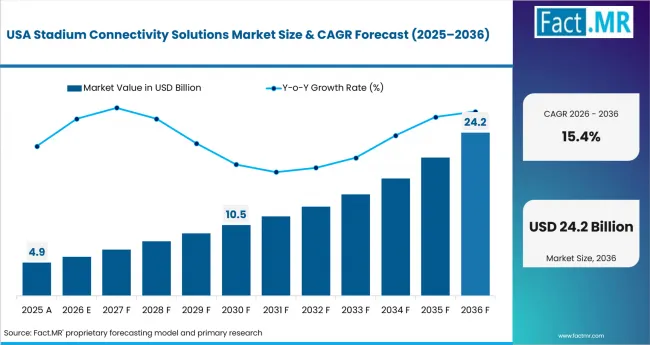
Stadium Connectivity Solutions Market Country Value Analysis | Source: Fact.MR
The United States is projected to record 15.4% CAGR from 2026 to 2036 as professional leagues standardize venue connectivity. Stadium operators need networks that serve fans and team staff during the same event. Carrier partnerships support private wireless use cases. Growth will favor providers that can support league-level rollouts.
How is Saudi Arabia scaling stadium connectivity demand?
14.8% CAGR, supported by new sports venues and event infrastructure programs.
Saudi Arabia is building demand through new venue construction and large entertainment projects. The country is expected to post 14.8% CAGR through 2036 because new stadiums can integrate connectivity during design. This reduces retrofit complexity. Growth will favor providers with stadium network planning experience.
What underpins Japan’s growth?
13.7% CAGR, backed by dense urban venues and mobile-first spectators.
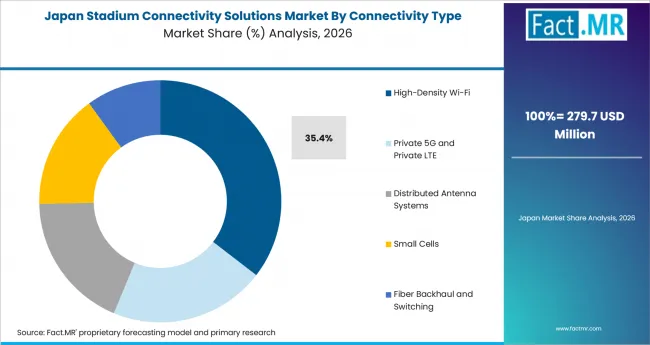
Stadium Connectivity Solutions Market Japan Market Share Analysis By Connectivity Type | Source: Fact.MR
Japan is likely to record 13.7% CAGR by 2036 as compact venues require precise wireless planning. Stadium teams need reliable mobile service for entry and wayfinding. Dense city settings support small-cell and Wi-Fi upgrades. Growth will favor compact hardware and careful radio design.
What supports the United Kingdom outlook?
12.9% CAGR, driven by football stadium upgrades and connected fan services.
The United Kingdom is forecast to advance at 12.9% CAGR through 2036 as football venues upgrade fan services. Clubs need stronger connectivity for ticketing and hospitality areas. Live event operators can add digital services around concerts. Network upgrades will focus on seating bowls and premium areas.
How is Germany scaling stadium connectivity adoption?
12.2% CAGR, supported by football infrastructure and venue safety needs.
Germany is set to record 12.2% CAGR through 2036 as football venues connect ticketing and safety systems. Stadium operators need dependable network support for crowd services. Connectivity upgrades will focus on security coordination. Growth will favor integrators with structured refresh-cycle expertise.
Who leads the stadium connectivity solutions market?
Cisco and Verizon Business lead through stadium Wi-Fi and private wireless expertise.
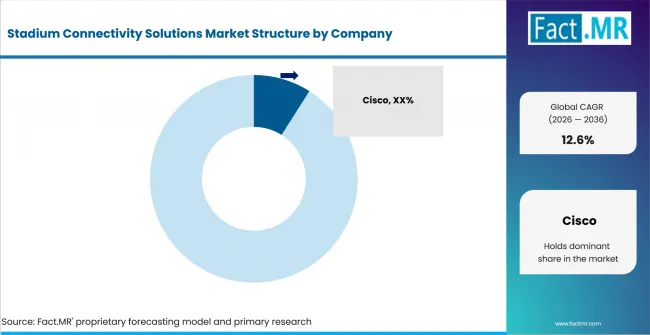
Stadium Connectivity Solutions Market Analysis By Company | Source: Fact.MR
Stadium connectivity solutions are supplied by network equipment providers, carriers, integrators and managed service firms. Cisco supports connected stadium Wi-Fi and venue networking. Verizon Business supports private wireless and 5G venue applications.
Extreme Networks competes through stadium Wi-Fi analytics and cloud networking. The company stated in 2025 that Wi-Fi offloads cellular traffic in high-density stadium environments. [6] This reinforces the role of Wi-Fi as a core stadium layer rather than a guest-access add-on.
Ericsson and Nokia support private wireless infrastructure for venue use cases. CommScope supports DAS and in-building coverage. Providers that connect small cell coverage with venue networks can improve dense-zone performance around bowls and concourses.
Competition through 2036 will depend on deployment skill rather than hardware alone. Stadium operators need site surveys, RF design, cabling coordination and event testing. Firms with stadium and arena management knowledge can connect network performance with staffing and fan service planning. Public safety use cases will create another competitive lane. Venue operators need connectivity that supports cameras and crowd dashboards. Providers that combine crowd-control technology with network operations can strengthen safety-led deployment cases.
Which companies are the key providers?
Cisco, Verizon Business, Extreme Networks, Boingo Wireless, Ericsson, Nokia, CommScope.
- Cisco
- Verizon Business
- Extreme Networks
- Boingo Wireless
- Ericsson
- Nokia
- CommScope
Bibliography
- [1] Verizon Business. (2024). NFL optimizes coach-to-coach communications in all 30 stadiums with Managed Private Wireless from Verizon. Verizon.
- [2] Cherney, M. A. (2026, February 4). Super Bowl prepares for potential AI cybersecurity threat. Reuters.
- [3] Boingo Wireless. (2024, April 22). 5G connectivity highlighted at SBJ World Congress of Sports. Boingo Wireless.
- [4] Kim, Y., Xu, X., & Mazzarese, D. (2024, March 10). RAN1, 5G-Advanced and Rel-18 completion. 3GPP.
- [5] Wireless Broadband Alliance. (2024, January 25). Wi-Fi 7: Low latency, high reliability, and extremely high throughput. Wireless Broadband Alliance.
- [6] Perry, C. (2025, March 20). 5G and Wi-Fi: What is the future of stadium connectivity? Extreme Networks.
- [7] Boingo Wireless. (2026, January 14). Boingo Wireless selected as the cellular infrastructure and Wi-Fi provider for the New York Mets and Citi Field. Business Wire.
This Report Addresses
- Strategic intelligence on stadium connectivity solutions across connectivity type, component, deployment model and use case.
- Segment analysis covering High-Density Wi-Fi, Network Hardware, Managed Connectivity Services, Outdoor Stadiums and Fan Engagement Connectivity.
- Regional outlook covering the United States, Saudi Arabia, Japan, the United Kingdom and Germany.
- Competitive analysis of Cisco, Verizon Business, Extreme Networks, Boingo Wireless, Ericsson, Nokia and CommScope.
- Technology assessment covering Wi-Fi, private wireless, DAS, small cells and fiber backhaul.
- Use case assessment covering fan engagement, access control, concession connectivity and staff communication.
- Primary interviews, provider checks, official source review and stadium technology references support the forecast.
What does the stadium connectivity solutions market cover?
High-density venue networks that connect fans, staff, security systems and commercial services.
The stadium connectivity solutions market covers network design, hardware, software and managed services used inside stadiums and arenas. It includes Wi-Fi access points and monitoring software. The scope connects with in-building wireless because stadium operators need indoor coverage and seating-bowl coverage during peak load.
The market differs from ordinary enterprise networking because event traffic arrives in compressed peaks. A venue can stay quiet during the week and then carry extreme device load during a match. Network design must account for seating bowls and media zones.
What is included in the scope?
Venue Wi-Fi and private wireless systems.
The scope includes high-density Wi-Fi and fiber-backed switching. It includes Wi-Fi networks designed for stadium seats and premium zones. It covers network design and lifecycle upgrades.
The scope includes connectivity layers that support mobile tickets and staff communication. It covers single-stadium upgrades and multi-venue programs for leagues or venue groups.
What is excluded from the scope?
General IT systems without stadium-grade connectivity function.
The scope excludes office Wi-Fi that does not serve seating bowls or concourse traffic. It excludes standalone ticketing software if it does not connect with the venue network. It excludes broadcast production systems unless they use stadium network infrastructure. Consumer apps are excluded unless they form part of the stadium connectivity experience.
How was the analysis built?
100+ sources, 40+ company portfolios, 25+ countries, 20+ interviews.
- Primary Research: Primary research includes interviews with stadium CIOs and venue operations directors. It includes input from network architects and sports technology integrators.
- Desk Research: Desk research reviews venue network design references and official provider sources. It covers high-density Wi-Fi, private wireless and network equipment used in large venues.
- Market-Sizing and Forecasting: Forecasting uses stadium modernization activity and network refresh cycles. Managed service attachment and carrier-led deployment patterns support the market assessment.
- Data Validation and Update Cycle: Forecasts are validated through provider checks and venue technology references. Event-day network requirements and stadium upgrade patterns help confirm market direction.
Segmentation
What is the report’s scope and coverage?
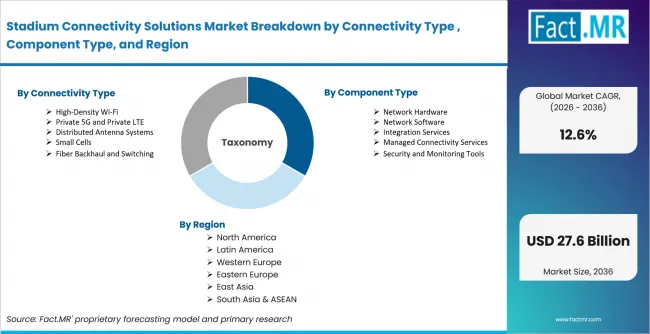
Stadium Connectivity Solutions Market Breakdown By Connectivity Type , Component Type, And Region | Source: Fact.MR
| Attribute | Details |
|---|---|
| Quantitative Units | USD Billion in 2026 to USD Billion by 2036 at CAGR |
| Market Definition | High-density venue connectivity systems and services that connect fans, staff operations and commercial services inside stadiums and arenas |
| Connectivity Type | High-Density Wi-Fi; Private 5G and Private LTE; Distributed Antenna Systems; Small Cells; Fiber Backhaul and Switching |
| Component | Network Hardware; Network Software; Integration Services; Managed Connectivity Services; Security and Monitoring Tools |
| Deployment Model | New Stadium Build; Stadium Retrofit; Managed Venue Connectivity; Carrier-Led Deployment; League-Wide Network Program |
| Venue Type | Outdoor Stadiums; Indoor Arenas; Multipurpose Venues; Training Facilities; Convention and Event Venues |
| Use Case | Fan Engagement Connectivity; Ticketing and Access Control; Concession and POS Connectivity; Staff and Team Communication; Security and Crowd Operations |
| Regions Covered | North America; Western Europe; Asia Pacific; Latin America; Middle East and Africa |
| Countries Covered | United States; Saudi Arabia; Japan; United Kingdom; Germany |
| Key Companies Profiled | Cisco; Verizon Business; Extreme Networks; Boingo Wireless; Ericsson; Nokia; CommScope |
| Forecast Period | 2026 to 2036 |
| Approach | Hybrid top-down and bottom-up approach using venue modernization activity, network refresh cycles, carrier deployments and provider validation |
Source: Fact.MR analysis. Updated Jun 24, 2026
How is the market segmented?
-
By Connectivity Type:
- High-Density Wi-Fi
- Private 5G and Private LTE
- Distributed Antenna Systems
- Small Cells
- Fiber Backhaul and Switching
-
By Component:
- Network Hardware
- Network Software
- Integration Services
- Managed Connectivity Services
- Security and Monitoring Tools
-
By Deployment Model:
- New Stadium Build
- Stadium Retrofit
- Managed Venue Connectivity
- Carrier-Led Deployment
- League-Wide Network Program
-
By Venue Type:
- Outdoor Stadiums
- Indoor Arenas
- Multipurpose Venues
- Training Facilities
- Convention and Event Venues
-
By Use Case:
- Fan Engagement Connectivity
- Ticketing and Access Control
- Concession and POS Connectivity
- Staff and Team Communication
- Security and Crowd Operations
-
Region:
- North America
- United States
- Canada
- Europe
- United Kingdom
- Germany
- France
- Spain
- Italy
- Asia Pacific
- Japan
- South Korea
- Australia
- China
- India
- Latin America
- Brazil
- Mexico
- Chile
- Middle East & Africa
- Saudi Arabia
- UAE
- South Africa
- Qatar
- North America
Frequently Asked Questions
Which connectivity type leads the Stadium Connectivity Solutions Market?
Which component leads the Stadium Connectivity Solutions Market?
Which deployment model leads the Stadium Connectivity Solutions Market?
Which venue type leads the Stadium Connectivity Solutions Market?
Which use case leads the Stadium Connectivity Solutions Market?
Which country expands fastest in the Stadium Connectivity Solutions Market?
How does Saudi Arabia perform in the Stadium Connectivity Solutions Market?
How does Japan perform in the Stadium Connectivity Solutions Market?
How does the United Kingdom perform in the Stadium Connectivity Solutions Market?
How does Germany perform in the Stadium Connectivity Solutions Market?
What is the primary driver in the Stadium Connectivity Solutions Market?
What is the main restraint in the Stadium Connectivity Solutions Market?
Why is private wireless important in the Stadium Connectivity Solutions Market?
Why is high-density Wi-Fi important in the Stadium Connectivity Solutions Market?
Who worked on this report


Preview the report firsthand - request a free sample
Free SampleGet the brochure for pricing and purchase details
Download PDF