- Base Value(2025): 135 Mn
- Forecast Value (2036): 620 Mn
- CAGR (2036): 14.8%
What is the sterile connector clamps market forecast to be worth by 2036?
USD 156 million in 2026 to USD 620 million by 2036 at 14.8% CAGR.
- The Sterile Connector Clamps Market was valued at USD 135 million in 2025.
- The market is estimated at USD 156 million in 2026 and is projected to reach USD 620 million by 2036.
- The market is forecast to expand at 14.8% CAGR during the forecast period as biologics production, vaccine manufacturing and cell therapy processing continue expanding.
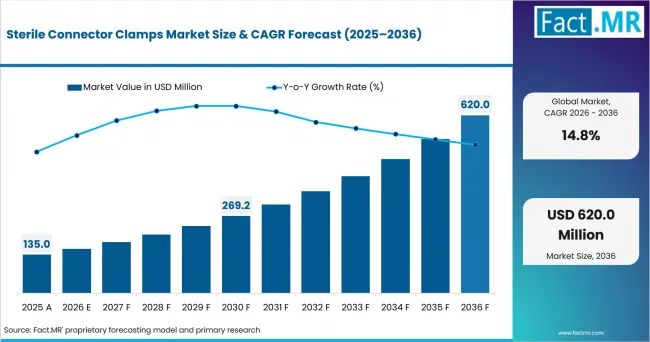
Sterile Connector Clamps Market Market Value Analysis | Source: Fact.MR
What are the defining numbers behind sterile connector clamp growth?
USD 464 million absolute opportunity by 2036 led by the United States and Germany.
- Demand Drivers in the Market
- Single-use bioprocessing continues expanding worldwide.
- Biologics manufacturing requires sterile tubing connections.
- Cell therapy production depends on contamination-free processing.
- Pharmaceutical companies continue adopting closed manufacturing systems.
- Key Segments Analyzed
- By Clamp Type: Sanitary Clamps are expected to hold 33.0% share in 2026 because they are widely used across sterile manufacturing systems.
- By Material: Polycarbonate is projected to account for 31.0% share in 2026 because it offers high strength and gamma compatibility.
- By Tubing Compatibility: Silicone Tubing is expected to hold 35.0% share in 2026 because it remains the preferred tubing material for bioprocessing.
- By Application: Bioreactor Feed Lines are projected to account for 29.0% share in 2026 because they require reliable sterile connections throughout production.
- By Geography: The United States is projected to record 15.5% CAGR through 2036.
- Analyst Opinion at Fact.MR
- Shambhu Nath Jha, Senior Analyst at Fact.MR, states, "Sterile connector clamps have become an essential part of single-use bioprocess manufacturing. Reliable clamp systems help maintain sterile fluid transfer while reducing contamination risk. Growing biologics production continues supporting demand for validated connection technologies."
- Strategic Implications
- Expand production of sterile connector clamp systems.
- Develop clamps compatible with advanced tubing materials.
- Strengthen partnerships with biopharma manufacturers and CDMOs.
- Invest in validation-ready products for regulated applications.
- Sterile connector clamps secure tubing connections during aseptic fluid transfer. They help maintain closed processing conditions and reduce contamination risk throughout pharmaceutical manufacturing.
The United States is projected to record 15.5% CAGR through 2036 because biologics manufacturing continues expanding. Germany is expected to grow at 15.0% CAGR due to strong pharmaceutical production. China is forecast to expand at 14.6% CAGR as biotechnology investment increases. South Korea is projected to register 14.2% CAGR through 2036 because biologics manufacturing capacity continues growing. India is expected to grow at 13.8% CAGR due to rising vaccine production and CDMO expansion.
How does the sterile connector clamps market break down by segment?
Sanitary Clamps lead at 33.0%. Bioreactor Feed Lines lead at 29.0%.
Which clamp type dominates?
Sanitary Clamps hold 33.0% share in 2026.
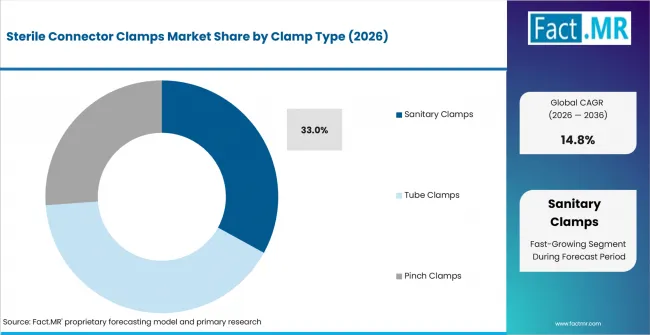
Sterile Connector Clamps Market Analysis By Clamp Type | Source: Fact.MR
Sanitary clamps lead because they provide secure sterile connections. They are widely used across biopharmaceutical manufacturing facilities. Manufacturers prefer these clamps because they support closed processing. They also simplify equipment assembly and maintenance. Demand remains strong across biologics and vaccine production. Getinge introduced the DPTE®-FLEX Alpha Port, a manually operated, externally openable sterile transfer port designed for pharmaceutical and biopharmaceutical manufacturing. The new system enables gloveless component transfer, reducing human intervention and contamination risks during aseptic production processes. [1]
Which material dominates?
Polycarbonate holds 31.0% share in 2026.
Polycarbonate leads because it provides high strength and excellent impact resistance. It also performs well after gamma sterilization. Manufacturers select this material because it supports repeated handling. It also maintains dimensional stability during production. Demand continues increasing across sterile processing systems. CPC (Colder Products Company) launched the MicroCNX® Nano Series, described as the smallest aseptic connector available for cell and gene therapy (CGT) processing. The connector enables users to create a sterile flow path by simply connecting the two halves, eliminating the need for tube welding or biosafety cabinets. [2]
Which tubing compatibility dominates?
Silicone Tubing holds 35.0% share in 2026.
Silicone tubing leads because it offers strong flexibility and biocompatibility. It is widely used across sterile manufacturing operations. Sterile connector clamps are commonly designed for silicone tubing. This improves compatibility across single-use systems. Growing biologics production continues supporting demand. Avantor launched a next-generation sterile sampling platform and Pre-Use Post-Sterilization Integrity Testing (PUPSIT) assemblies for biopharmaceutical manufacturing. The solutions are designed to improve aseptic sampling, sterile filtration workflows, and contamination control in GMP production environments. [3]
Which application dominates?
Bioreactor Feed Lines hold 29.0% share in 2026.
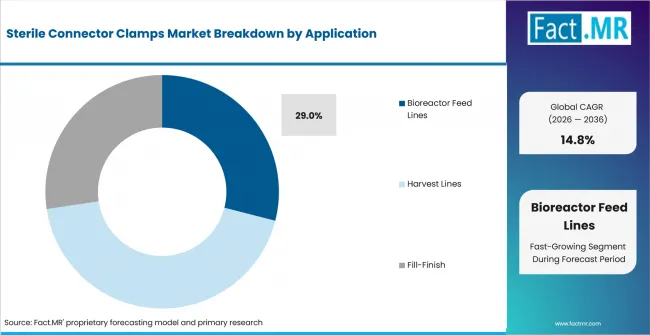
Sterile Connector Clamps Market Analysis By Application | Source: Fact.MR
Bioreactor feed lines remain the leading application because they require reliable sterile connections throughout production. Secure clamps help maintain process integrity. Closed transfer systems reduce contamination risk. They also improve production reliability. Commercial biologics manufacturing continues supporting demand.
What is accelerating sterile connector clamp demand and what is holding it back?
Single-use manufacturing drives demand while validation costs restrain adoption.
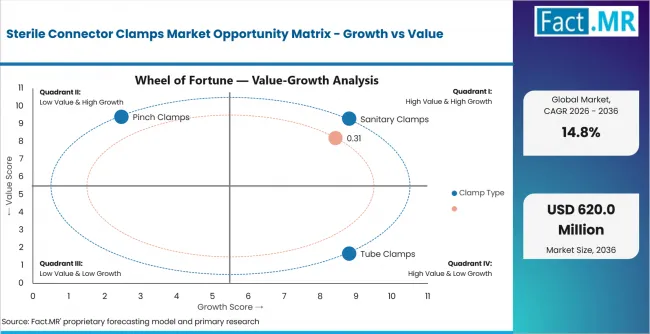
Sterile Connector Clamps Market Opportunity Matrix Growth Vs Value | Source: Fact.MR
The primary growth driver is expanding biologics production. Manufacturers continue increasing investment in single-use processing technologies. Cell therapy production also creates strong demand for sterile connection products. Vaccine manufacturing continues supporting market expansion. Closed processing improves product quality. It also reduces contamination during fluid transfer.
The primary restraint is product qualification cost. Validation requirements increase development time. Premium sterile components also cost more than standard products. Smaller facilities may delay upgrades because of budget limitations.
Where do the biggest sterile connector clamp opportunities sit?
- Biologics Manufacturing:Biopharma companies continue expanding production capacity. This creates steady demand for sterile connector clamps.
- Cell Therapy:Cell therapy developers require contamination-free fluid transfer. Sterile clamps support closed manufacturing processes.
- Vaccine Production:Vaccine manufacturers continue investing in disposable production systems. Reliable connection products remain essential.
- CDMO Facilities:Contract manufacturers continue expanding commercial production. Flexible connection systems support multi-product manufacturing.
Which countries are scaling sterile connector clamp adoption fastest?
United States 15.5%, Germany 15.0%, China 14.6%, South Korea 14.2%, India 13.8%.
Based on regional analysis the sterile connector clamps market is segmented into North America, Western Europe, Asia Pacific, Latin America and Middle East & Africa.
.webp "Top Country Growth Comparison Sterile Connector Clamps Market Cagr (2026 2036)")
Top Country Growth Comparison Sterile Connector Clamps Market Cagr (2026 2036) | Source: Fact.MR
| Country | CAGR (2026-2036) |
|---|---|
| United States | 15.5% |
| Germany | 15.0% |
| China | 14.6% |
| South Korea | 14.2% |
| India | 13.8% |
Source: Fact.MR analysis. Updated Jun 26, 2026
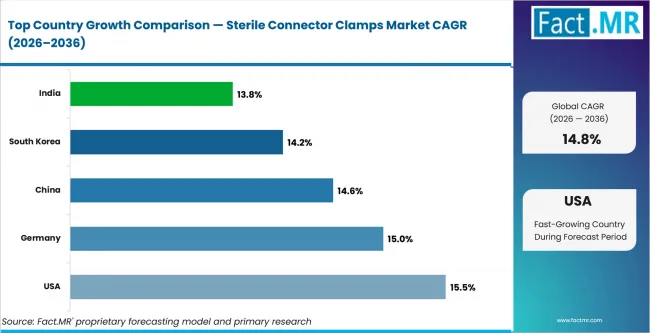
Sterile Connector Clamps Market Cagr Analysis By Country | Source: Fact.MR
Why is the United States leading the sterile connector clamps market?
15.5% CAGR, supported by biologics manufacturing
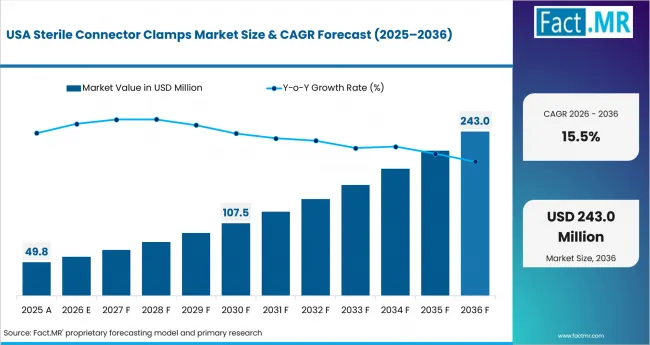
Sterile Connector Clamps Market Country Value Analysis | Source: Fact.MR
The United States is projected to record 15.5% CAGR through 2036 because biologics manufacturing continues expanding. Companies are increasing investment in advanced single-use production systems. Demand is also rising from cell therapy developers. Vaccine manufacturers continue adopting sterile connection technologies. The country leads demand for bioprocess components.
What is driving growth in Germany?
15.0% CAGR, driven by pharmaceutical production
Germany is expected to post 15.0% CAGR through 2036 because pharmaceutical manufacturing continues growing. Companies are upgrading facilities with advanced sterile processing equipment. CDMOs continue investing in single-use technologies. Demand also benefits from expanding biologics production. Germany remains a major European life science hub.
How is China expanding adoption?
14.6% CAGR, supported by biotechnology investment
China is forecast to advance at 14.6% CAGR by 2036 because biotechnology investment continues increasing. Manufacturers are expanding biologics and vaccine production facilities. Demand for sterile connector clamps is rising. Single-use manufacturing is also becoming more common across commercial facilities. The country remains an important growth market.
Why is South Korea becoming a strong market?
14.2% CAGR, supported by biologics expansion
South Korea is projected to register 14.2% CAGR through 2036 because biologics manufacturing capacity continues growing. Companies are investing in modern sterile production technologies. Cell therapy development creates additional demand. Government support also encourages biotechnology investment. The country continues strengthening its biologics industry.
What supports market growth in India?
13.8% CAGR, driven by vaccine manufacturing
India is expected to grow at 13.8% CAGR by 2036 because vaccine production continues expanding. CDMOs are also increasing investment in sterile manufacturing systems. Biopharma exports continue increasing. Sterile connector clamps help improve production quality. The country remains an important supplier of vaccines and biologic medicines.
Who leads the sterile connector clamps landscape?
Cytiva / Pall legacy, Sartorius, Merck KGaA / MilliporeSigma, Colder Products Company lead through sterile connection expertise and single-use bioprocess capabilities.
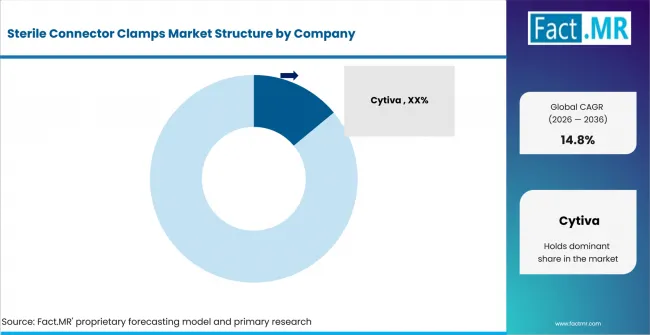
Sterile Connector Clamps Market Analysis By Company | Source: Fact.MR
The market remains moderately consolidated. Competition centers on connection reliability and product quality. Manufacturers continue improving clamp designs to support secure fluid transfer. They are also developing products that simplify installation and reduce handling time. Biopharma manufacturers account for the largest share of demand. CDMOs continue increasing purchases as commercial biologics production expands. Rising adoption of single-use manufacturing is also supporting demand for validated connection components.
Bioreactor feed lines remain the largest application. Buffer transfer also creates steady demand across sterile manufacturing facilities. Growth in cell therapy production and vaccine manufacturing is further increasing the use of sterile connector clamps. Cytiva / Pall legacy and Sartorius maintain broad single-use portfolios. Merck KGaA / MilliporeSigma continues expanding sterile fluid management products. Colder Products Company develops advanced aseptic connection technologies. Saint-Gobain, Nordson Medical continue strengthening their product portfolios through material innovation and application support.
Competition is increasingly shaped by regulatory compliance and product validation. Companies that deliver reliable performance and strong technical support are expected to strengthen their market position through 2036.
Which companies are the key players?
Cytiva / Pall legacy, Sartorius, Merck KGaA / MilliporeSigma, Colder Products Company, Saint-Gobain
- Cytiva / Pall legacy
- Sartorius
- Merck KGaA / MilliporeSigma
- Colder Products Company
- Saint-Gobain
- Nordson Medical
Bibliography
- [1] Getinge. (2025, February 27). Getinge’s new DPTE®-FLEX Alpha Port enables gloveless component transfer for pharmaceutical manufacturing. Getinge.
- [2] CPC. (2025, January 29). CPC launches industry-first product for cell and gene therapy sterile processing. Dover Corporation.
- [3] Avantor, Inc. (2025, October 30). Avantor® unveils next-generation sterile sampling platform and PUPSIT assemblies. Avantor, Inc.
This Report Addresses
- Strategic intelligence on sterile connector clamp technologies.
- Segment analysis covering clamp types and material selection.
- Assessment of tubing compatibility and application demand.
- Regional outlook covering the United States and Germany.
- Analysis of China, South Korea, and India.
- Competitive assessment of leading sterile connector suppliers.
- Evaluation of single-use bioprocessing trends.
- Analysis of biologics and cell therapy manufacturing demand.
- Primary interviews and supplier benchmarking.
- Assessment of opportunities across sterile fluid transfer systems.
What does the sterile connector clamps market cover?
Sterile clamp systems used for secure bioprocess tubing connections.
The market covers clamp products designed for closed fluid transfer across pharmaceutical manufacturing. These products support sterile processing and single-use production systems.
What is included in the scope?
Sterile connector clamps for bioprocess applications.
The scope includes pinch clamps, tube clamps, sanitary clamps, aseptic disconnect clamps and validation-ready clamps.
What is excluded from the scope?
General industrial clamps and non-sterile fastening products.
The scope excludes mechanical pipe clamps, industrial hose clamps and conventional fastening hardware.
How was the analysis built?
100+ sources, 30+ company assessments, 25+ countries and industry interviews.
- Primary Research: Interviews with bioprocess engineers, pharmaceutical manufacturers and component suppliers.
- Desk Research: Analysis of biologics production, single-use processing and sterile manufacturing trends.
- Market Sizing and Forecasting: Estimates based on bioprocess capacity, tubing demand and sterile connector adoption.
- Data Validation and Update Cycle: Forecasts validated through supplier benchmarking and industry interviews.
Segmentation
What is the report's scope and coverage?
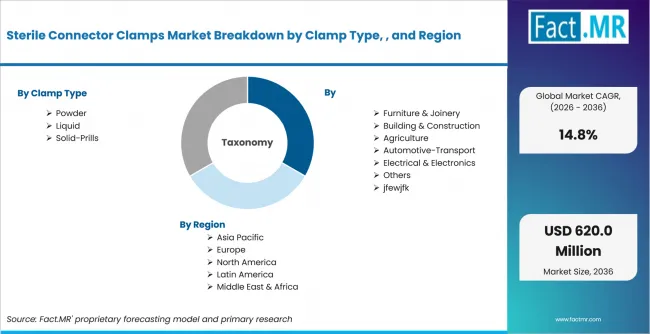
Sterile Connector Clamps Market Breakdown By Clamp Type, , And Region | Source: Fact.MR
| Attribute | Details |
|---|---|
| Quantitative Units | USD Million in 2026 to USD Million by 2036 |
| Market Definition | Sterile connector clamps used for secure tubing connections in biopharmaceutical manufacturing |
| Clamp Types Covered | Pinch Clamps, Tube Clamps, Sanitary Clamps, Aseptic Disconnect Clamps, Validation-Ready Clamps |
| Materials Covered | Polycarbonate, Polypropylene, Stainless Steel, PVDF, Gamma-Stable Polymers |
| Tubing Compatibility | Silicone Tubing, TPE Tubing, Weldable Tubing, Reinforced Tubing, High-Flow Tubing |
| Applications Covered | Bioreactor Feed Lines, Harvest Lines, Buffer Transfer, Sampling, Fill-Finish |
| Regions Covered | North America, Western Europe, Asia Pacific, Latin America, Middle East & Africa |
| Key Countries Covered | United States, Germany, China, South Korea, India |
| Companies Covered | Cytiva / Pall legacy, Sartorius, Merck KGaA / MilliporeSigma, Colder Products Company, Saint-Gobain, Nordson Medical |
| Forecast Period | 2026 to 2036 |
| Research Approach | Hybrid top-down and bottom-up methodology using biologics production, single-use adoption and sterile processing demand |
Source: Fact.MR analysis. Updated Jun 26, 2026
How is the market segmented?
-
By Clamp Type
- Pinch Clamps
- Tube Clamps
- Sanitary Clamps
- Aseptic Disconnect Clamps
- Validation-Ready Clamps
-
By Material
- Polycarbonate
- Polypropylene
- Stainless Steel
- PVDF
- Gamma-Stable Polymers
-
By Tubing Compatibility
- Silicone Tubing
- TPE Tubing
- Weldable Tubing
- Reinforced Tubing
- High-Flow Tubing
-
By Application
- Bioreactor Feed Lines
- Harvest Lines
- Buffer Transfer
- Sampling
- Fill-Finish
-
Region:
- North America
- United States
- Canada
- Europe
- Germany
- United Kingdom
- France
- Italy
- Spain
- Asia Pacific
- China
- Japan
- South Korea
- India
- Singapore
- Latin America
- Brazil
- Mexico
- Argentina
- Middle East & Africa
- GCC Countries
- South Africa
- Israel
- North America
Frequently Asked Questions
Which clamp type leads the market?
Which material accounts for the largest share?
What is driving demand for sterile connector clamps?
Which country is growing the fastest?
What is the primary challenge facing the market?
Which application accounts for the largest share?
What opportunities exist for suppliers?
Why are manufacturers adopting sterile connector clamps?
Which tubing compatibility generates the highest demand?
Who worked on this report


Preview the report firsthand - request a free sample
Free SampleGet the brochure for pricing and purchase details
Download PDF