Stockpile Crusting Agents Market Size, Share, Growth and Forecast (2026 - 2036)
The Stockpile Crusting Agents Market is segmented by Chemistry, by Stockpile Type, by Performance, by End User and Region. Forecast for 2026 to 2036.
What is the stockpile crusting agents market forecast to be worth by 2036?
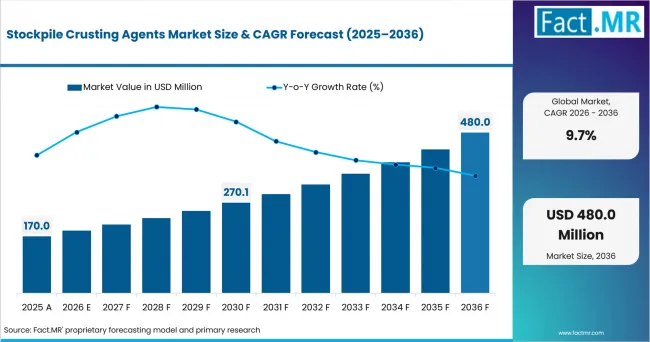
USD 190 million in 2026 to USD 480 million by 2036, at 9.7% CAGR.
- The Stockpile Crusting Agents Market was valued at USD 170 million in 2025.
- The market is estimated at USD 190 million in 2026 and is projected to reach USD 480 million by 2036.
- The market is forecast to expand at 9.7% CAGR during the forecast period as mining companies, ports and bulk material handlers increase investment in dust control and stockpile management solutions.
What are the defining numbers behind stockpile crusting agent growth?
USD 290 million absolute opportunity by 2036 led by Australia and the United States.
- Demand Drivers in the Market
- Environmental regulations are increasing focus on stockpile dust control.
- Mining companies are investing in material preservation and emission reduction technologies.
- Ports are strengthening dust management programs for bulk cargo operations.
- Industrial operators seek solutions that reduce material loss and maintenance costs.
- Key Segments Analyzed
- By Chemistry: Polymer Crusting Agents are expected to hold 33.0% share in 2026 due to strong binding performance and long treatment life.
- By Stockpile Type: Coal Stockpiles are projected to account for 28.0% share in 2026 because of extensive storage volumes and dust generation risks.
- By Performance: Dust Reduction is expected to hold 30.0% share in 2026 as environmental compliance remains the primary purchasing factor.
- By End User: Mining is projected to account for 36.0% share in 2026 due to widespread stockpile management requirements.
- By Geography: Australia is projected to record 10.6% CAGR through 2036 supported by large export-oriented mining operations.
- Analyst Opinion at Fact.MR
- Shambhu Nath Jha, Senior Analyst at Fact.MR, states, “Stockpile crusting agents are becoming an important component of industrial dust management strategies. Operators are prioritizing products that provide longer surface protection while reducing application frequency and environmental impact.”
- Strategic Implications
- Develop formulations that improve crust durability under harsh weather conditions.
- Expand product offerings for mining, ports and bulk materials handling facilities.
- Focus on biodegradable technologies that support environmental compliance goals.
- Strengthen technical support capabilities to improve treatment effectiveness across different stockpile materials.
Stockpile crusting agents form a protective surface layer over stored materials. This layer reduces dust emissions and prevents material displacement caused by wind and weather exposure. Demand is increasing as operators seek cost-effective methods to improve environmental performance and reduce product losses.
Australia remains a leading market due to extensive mining exports and large-scale stockpile operations. The United States continues to witness growing adoption across mining, aggregates and industrial sectors. Canada benefits from strong resource extraction activity and environmental management programs. Chile remains an important market due to copper mining operations. South Africa continues expanding adoption through mining modernization and dust control investments.
How does the stockpile crusting agents market break down by segment?
Polymer Crusting Agents lead at 33.0%; Mining leads at 36.0%.
Which chemistry dominates?
Polymer Crusting Agents hold 33.0% share in 2026.
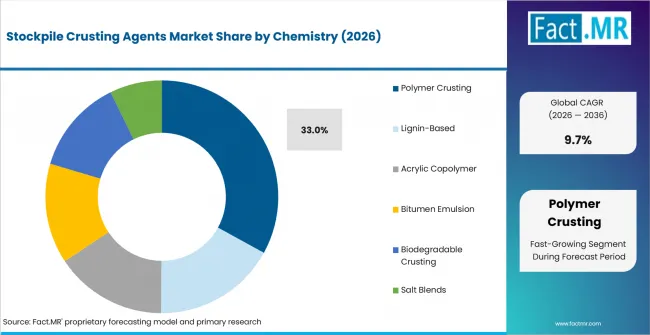
Polymer crusting agents lead because they create durable surface layers that resist wind erosion and material displacement. These products provide long-lasting protection and perform well across a wide range of stockpile materials. Operators prefer polymer formulations because they reduce the need for repeated treatment. Their ability to maintain crust integrity under demanding conditions supports widespread adoption. The announcement states that Les Entreprises Bourget will distribute Earth Alive's ea1™ dust suppressant, which works by binding soil and particulate matter, retaining moisture, and creating a firm surface layer that prevents dust from becoming airborne. These are the core functions of stockpile crusting and dust-binding agents used on bulk material storage areas, mining sites, roads, and construction sites. [1]
Which stockpile type dominates?
Coal Stockpiles lead with 28.0% share in 2026.
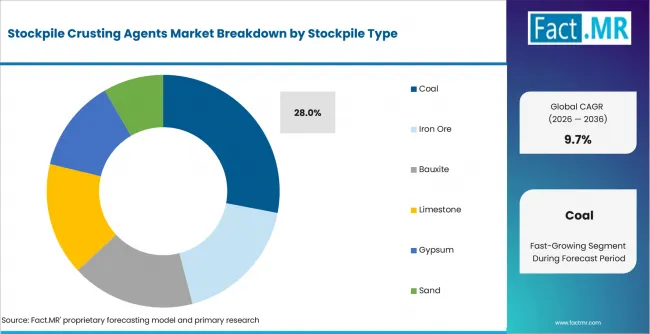
Coal stockpiles account for the largest share because coal handling operations generate significant dust emissions during storage and transport. Large stockpile volumes increase the need for reliable surface stabilization. Crusting agents help reduce wind-blown dust and material loss. They also support environmental compliance at mining sites, power plants and export terminals. Continued coal production and export activity sustain demand across this segment. Gautam ZEN UK's lignin-based BioBinder XyloBIND™ was successfully used in the first asphalt surface-course trial on the UK's Strategic Road Network (A590, Cumbria). The renewable binder partially replaced bitumen, improving durability and reducing carbon emissions in road construction applications. [2]
Which performance category dominates?
Dust Reduction accounts for 30.0% share in 2026.
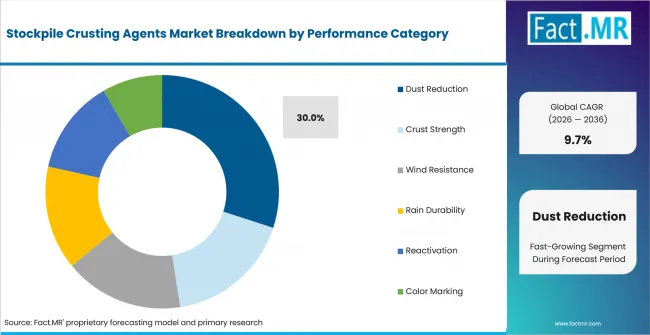
Dust reduction leads because controlling particulate emissions remains the primary objective for most end users. Airborne dust can create environmental and regulatory challenges. Stockpile operators increasingly invest in technologies that improve air quality and reduce community impact. Effective dust control also helps lower material losses from exposed surfaces. Growing environmental oversight continues supporting demand for high-performance crusting solutions.
Which end user dominates?
Mining holds 36.0% share in 2026.
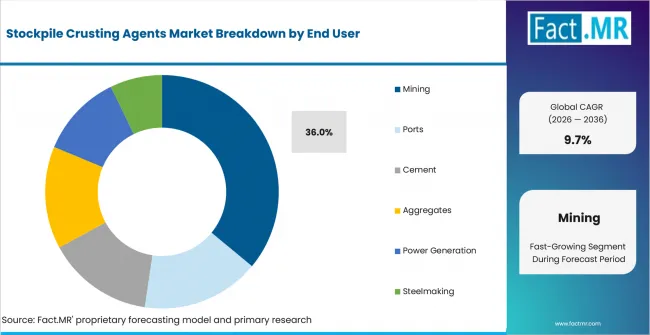
Mining remains the largest end user because extraction and processing operations rely on large stockpiles of coal, ore and mineral concentrates. These materials require continuous dust management. Mining companies use crusting agents to improve environmental performance and maintain compliance with site regulations. Surface stabilization also helps protect valuable materials from wind erosion. Large mining regions in Australia, North America and Latin America continue driving market demand. Borregaard's Dustex® is specifically marketed for dust control and road stabilization, where the lignin-based product binds fine particles together, reduces wind erosion, and forms a durable surface crust on unpaved roads, mine sites, aggregate storage areas, and other bulk-material handling environments. [3]
What is accelerating stockpile crusting agent demand and what is holding it back?
Environmental compliance drives demand while treatment costs restrain adoption.
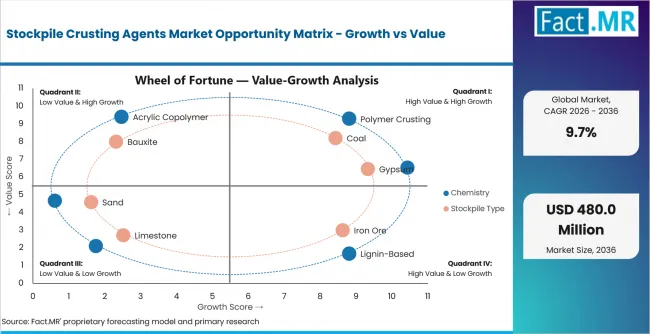
The main growth driver is increasing pressure to control dust emissions from industrial storage sites. Regulators and local communities are placing greater focus on air quality and environmental performance. Researchers developed a multifunctional dust suppressant using Sapindus mukorossi extract and bentonite clay. The formulation created a durable surface crust while reducing particulate emissions, highlighting new bio-based alternatives for stockpile and bulk-material dust control. [4]
Mining companies and bulk handling operators are adopting crusting technologies to reduce emissions and improve operational efficiency. Demand is also supported by efforts to reduce material loss from exposed stockpiles. Growing bulk commodity production continues creating opportunities for market expansion. The primary restraint is treatment cost. Large stockpiles often require substantial product volumes and periodic reapplication. Performance can also vary depending on rainfall, wind exposure and stockpile composition. This can influence treatment frequency and operating costs.
Where do the biggest stockpile crusting agent opportunities sit?
- Mining Stockpiles: Mining companies continue expanding dust management programs for coal, iron ore and mineral storage facilities.
- Export Ports: Ports handling dry bulk commodities require effective crusting technologies to reduce dust during storage and loading operations.
- Cement and Aggregate Facilities: Construction material producers are investing in stockpile management solutions that improve site conditions and regulatory compliance.
- Steelmaking Operations: Steel producers use crusting agents to manage raw material stockpiles and reduce dust generation across industrial sites.
Which countries are scaling stockpile crusting agent adoption fastest?
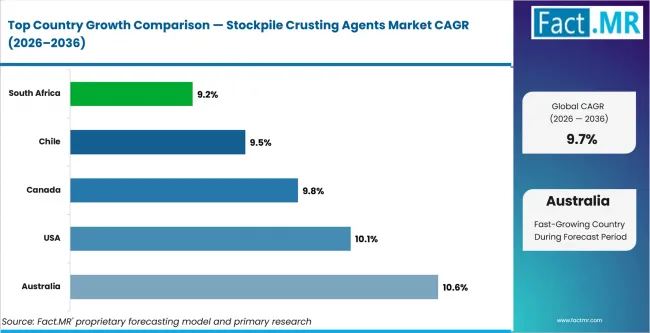
Australia 10.6%, United States 10.1%, Canada 9.8%, Chile 9.5%, South Africa 9.2%.
Based on regional analysis, the stockpile crusting agents market is segmented into North America, Western Europe, Asia Pacific, Latin America and Middle East & Africa.
.webp)
| Country | CAGR (2026-2036) |
|---|---|
| Australia | 10.6% |
| United States | 10.1% |
| Canada | 9.8% |
| Chile | 9.5% |
| South Africa | 9.2% |

Why is Australia leading the stockpile crusting agents market?
10.6% CAGR, supported by large mining exports and bulk material storage activity
Australia is projected to record 10.6% CAGR through 2036 due to extensive iron ore, coal and mineral export operations. Large stockpile volumes require continuous dust control and surface stabilization measures. Mining operators are increasing investment in crusting technologies that reduce wind erosion and material loss. Export terminals also require reliable dust management solutions to meet environmental standards. Demand remains concentrated in major mining and port regions where bulk commodity handling volumes are high.
What is driving growth in the United States?
10.1% CAGR, driven by environmental compliance and industrial storage requirements
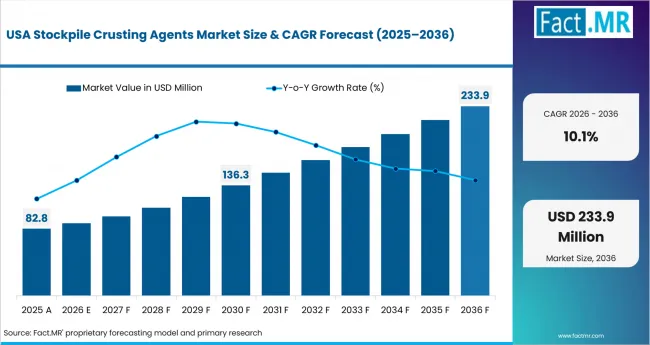
The United States is expected to post 10.1% CAGR by 2036 as mining companies, power producers and aggregate operators strengthen dust management programs. Regulatory pressure is encouraging wider adoption of stockpile treatment solutions. Industrial facilities are seeking technologies that improve air quality and reduce maintenance costs. Growing focus on operational efficiency is further supporting market growth. Demand remains strong across mining regions and major bulk materials handling centers.
How is Canada expanding adoption?
9.8% CAGR, supported by mining and resource development
Canada is forecast to advance at 9.8% CAGR through 2036 due to continued investment in mining and natural resource projects. Large stockpile operations require effective surface stabilization technologies. Mining operators are adopting crusting agents to reduce particulate emissions and improve environmental performance. Harsh weather conditions also increase demand for durable treatment solutions. Resource extraction activity continues creating growth opportunities across the country.
What supports demand in Chile?
9.5% CAGR, driven by copper mining operations
Chile is expected to register 9.5% CAGR by 2036 due to its position as a major copper producer. Mining operations generate large stockpiles of ore and processing materials that require dust control measures. Environmental compliance remains a key priority for mining operators. Crusting agents help reduce dust emissions while improving material retention.
Why is South Africa an important market?
9.2% CAGR, supported by mining modernization and environmental management
South Africa is projected to grow at 9.2% CAGR through 2036 as mining companies continue upgrading environmental management practices. Dust control is becoming a larger component of operational planning. Stockpile crusting technologies help improve site conditions and reduce airborne particulate emissions. Operators are also seeking solutions that lower long-term dust management costs.
Who leads the stockpile crusting agents landscape?
Dust-A-Side, Soilworks, Global Road Technology, Midwest Industrial Supply and SNF lead through dust control expertise and bulk materials handling experience.
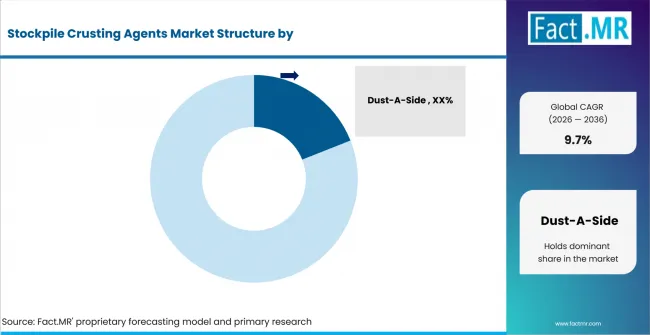
The market is characterized by competition focused on crust durability, dust suppression performance and environmental compliance. Suppliers continue developing formulations that improve wind resistance and extend treatment life. Mining remains the largest opportunity for leading participants. Companies are also expanding into ports, cement plants and aggregate storage facilities where dust management requirements continue increasing.
Product performance under varying weather conditions remains an important purchasing factor. End users increasingly prefer solutions that maintain surface integrity during wind exposure and rainfall events. Longer treatment life and lower reapplication frequency are becoming key competitive advantages. Suppliers that demonstrate measurable reductions in dust emissions and material loss are expected to strengthen their market position through 2036.
Which companies are the key players?
Dust-A-Side, Soilworks, Global Road Technology, Midwest Industrial Supply
- Dust-A-Side
- Soilworks
- Global Road Technology
- Midwest Industrial Supply
- SNF
- Borregaard
Bibliography
- [1] Les Entreprises Bourget Inc. (2024, April 1). Earth Alive announces a strategic distribution partnership with Les Entreprises Bourget Inc. Les Entreprises Bourget Inc.
- [2] Borregaard ASA. (2024). Dust control and road stabilisation. Borregaard ASA.
- [3] Dust-A-Side. (2026). Dust suppression and stockpile management solutions. Dust-A-Side.
- [4] Soilworks. (2026). Dust control and soil stabilization solutions. Soilworks.
- [5] Global Road Technology. (2026). Dust control and stockpile management solutions. Global Road Technology.
- [6] Midwest Industrial Supply. (2026). Dust control and stockpile stabilization products. Midwest Industrial Supply.
This Report Addresses
- Strategic intelligence on stockpile crusting agents and surface stabilization technologies.
- Segment analysis covering chemistry, stockpile types, performance attributes and end users.
- Regional outlook covering Australia, United States, Canada, Chile and South Africa.
- Competitive assessment of Dust-A-Side, Soilworks, Global Road Technology and leading dust control suppliers.
- Analysis of stockpile management, dust reduction and environmental compliance trends.
- Evaluation of crust durability, wind resistance and material preservation requirements.
- Primary interviews, supplier benchmarking and industry validation supporting forecast development.
- Assessment of mining, port, cement and aggregate sector demand patterns.
- Analysis of product innovation and treatment performance developments.
- Evaluation of opportunities linked to bulk commodity storage and export infrastructure.
What does the stockpile crusting agents market cover?
Surface stabilization products used to control dust and material loss from bulk stockpiles.
The market covers chemical and bio-based crusting agents applied to stockpiles to improve surface integrity and reduce airborne particulate emissions.
What is included in the scope?
Stockpile crusting technologies, dust control products and surface stabilization solutions.
The scope includes polymer crusting agents, lignin-based products, acrylic copolymers, bitumen emulsions, biodegradable crusting agents and salt blend formulations.
What is excluded from the scope?
Dust collection equipment and standalone air filtration technologies.
The scope excludes baghouse systems, industrial filtration units and mechanical dust collection equipment.
How was the analysis built?
100+ sources, 35+ industrial assessments, 25+ countries and industry interviews.
- Primary Research: Interviews with dust control suppliers, mining operators, port managers and environmental consultants.
- Desk Research: Analysis of mining activity, bulk materials handling trends, environmental regulations and stockpile management practices.
- Market Sizing and Forecasting: Estimates based on treatment volumes, stockpile inventories and industrial dust control spending.
- Data Validation and Update Cycle: Forecasts validated through supplier benchmarking, project assessments and end-user interviews.
What is the report's scope and coverage?
| Attribute | Details |
|---|---|
| Quantitative Units | USD Million in 2026 to USD Million by 2036 |
| Market Definition | Surface treatment products designed to form a protective crust over stockpiles and reduce dust emissions |
| Chemistry Covered | Polymer Crusting, Lignin-Based, Acrylic Copolymer, Bitumen Emulsion, Biodegradable Crusting, Salt Blends |
| Stockpile Types Covered | Coal, Iron Ore, Bauxite, Limestone, Gypsum, Sand, Aggregate, Fly Ash, Tailings |
| Performance Covered | Crust Strength, Wind Resistance, Rain Durability, Reactivation, Color Marking, Dust Reduction |
| End Users Covered | Mining, Ports, Cement, Aggregates, Power Generation, Steelmaking |
| Regions Covered | North America, Western Europe, Asia Pacific, Latin America, Middle East & Africa |
| Key Countries Covered | Australia, United States, Canada, Chile, South Africa |
| Companies Covered | Dust-A-Side, Soilworks, Global Road Technology, Midwest Industrial Supply, SNF, Borregaard |
| Forecast Period | 2026 to 2036 |
| Approach | Hybrid top-down and bottom-up methodology using stockpile treatment volumes, mining activity, bulk commodity handling and environmental compliance spending |
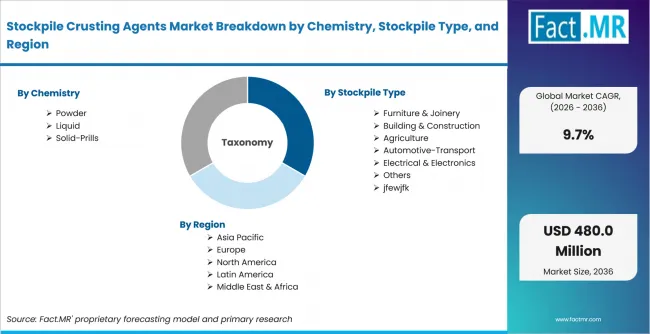
How is the market segmented?
-
By Chemistry
- Polymer Crusting
- Lignin-Based
- Acrylic Copolymer
- Bitumen Emulsion
- Biodegradable Crusting
- Salt Blends
-
By Stockpile Type
- Coal
- Iron Ore
- Bauxite
- Limestone
- Gypsum
- Sand
- Aggregate
- Fly Ash
- Tailings
-
By Performance
- Crust Strength
- Wind Resistance
- Rain Durability
- Reactivation
- Color Marking
- Dust Reduction
-
By End User
- Mining
- Ports
- Cement
- Aggregates
- Power Generation
- Steelmaking
-
By Region
- North America
- United States
- Canada
- Mexico
- Western Europe
- Germany
- United Kingdom
- France
- Spain
- Asia Pacific
- Australia
- China
- India
- Japan
- Latin America
- Chile
- Brazil
- Peru
- Middle East & Africa
- South Africa
- Saudi Arabia
- UAE
- North America
- Frequently Asked Questions -
Which chemistry leads the market?
Polymer crusting agents lead with 33.0% share in 2026 due to strong binding performance, long treatment life and broad suitability across stockpile materials.
Which stockpile type accounts for the largest share?
Coal stockpiles hold 28.0% share in 2026 because of high storage volumes and significant dust-generation risks.
What is driving demand for stockpile crusting agents?
Environmental compliance requirements, material preservation needs and dust reduction goals are driving market growth.
Which country is growing the fastest?
Australia is projected to record the highest CAGR through 2036 due to extensive mining exports and large stockpile operations.
What is the primary challenge facing the market?
Treatment costs and performance variation under different weather conditions remain key challenges.
Which end user accounts for the largest share?
Mining holds 36.0% share in 2026 due to extensive stockpile management and dust-control requirements.
What opportunities exist for suppliers?
Mining projects, export ports, tailings facilities and aggregate storage sites offer strong growth opportunities.
Why are ports adopting stockpile crusting agents?
Ports use crusting agents to reduce dust emissions and minimize material loss during bulk cargo storage.
Which performance attribute is most important?
Dust reduction remains the most important attribute because it directly supports environmental compliance and operational efficiency.
Table of Content
- Key Takeaways
- Market Size and CAGR
- Top Growth Driver
- Fastest Growing Segment
- Leading Region
- Key Companies
- Emerging Opportunities
- Executive Summary
- Global Market Outlook
- Demand-side Trends
- Supply-side Trends
- Technology Roadmap Analysis
- Analysis and Recommendations
- Analyst Perspective (What is happening? Why now? What should investors know?)
- Key Questions Answered
- How large is the market?
- What is the CAGR?
- What are key trends?
- Which region dominates?
- Who are the leaders?
- Market Overview
- Market Coverage / Taxonomy
- Market Definition / Scope / Limitations
- Research Methodology
- Chapter Orientation
- Analytical Lens and Working Hypotheses
- Market Structure, Signals, and Trend Drivers
- Benchmarking and Cross-market Comparability
- Market Sizing, Forecasting, and Opportunity Mapping
- Research Design and Evidence Framework
- Desk Research Programme (Secondary Evidence)
- Expert Input and Fieldwork (Primary Evidence)
- Tooling, Models, and Reference Databases
- Data Engineering and Model Build
- Quality Assurance and Audit Trail
- Market Background
- Market Dynamics (Drivers, Restraints, Opportunity, Trends)
- Scenario Forecast (Optimistic, Likely, Conservative)
- Impact Analysis
- AI Impact
- Sustainability Impact
- Regulatory Impact
- Technology Impact
- Consumer / Buyer Analysis
- Purchase Drivers
- Adoption Barriers
- Buyer Journey
- Opportunity Map Analysis
- Product Life Cycle Analysis
- Supply Chain Analysis
- Investment Feasibility Matrix
- Value Chain Analysis
- PESTLE and Porter's Analysis
- Regulatory Landscape
- Regional Parent Market Outlook
- Production and Consumption Statistics
- Import and Export Statistics
- Global Market Analysis and Forecast, 2021 to 2036
- Historical Market Size Value (USD Million) Analysis, 2021 to 2025
- Current and Future Market Size Value (USD Million) Projections, 2026 to 2036
- Y-o-Y Growth Trend Analysis
- Absolute $ Opportunity Analysis
- Global Market Pricing Analysis, 2021 to 2036
- Global Market Analysis and Forecast, By Chemistry, 2021 to 2036
- Introduction / Key Findings
- Historical Market Size Value (USD Million) Analysis By Chemistry, 2021 to 2025
- Current and Future Market Size Value (USD Million) Analysis and Forecast By Chemistry, 2026 to 2036
- Polymer Crusting
- Lignin-Based
- Acrylic Copolymer
- Bitumen Emulsion
- Biodegradable Crusting
- Salt Blends
- Polymer Crusting
- Y-o-Y Growth Trend Analysis By Chemistry, 2021 to 2025
- Absolute $ Opportunity Analysis By Chemistry, 2026 to 2036
- Global Market Analysis and Forecast, By Stockpile Type, 2021 to 2036
- Introduction / Key Findings
- Historical Market Size Value (USD Million) Analysis By Stockpile Type, 2021 to 2025
- Current and Future Market Size Value (USD Million) Analysis and Forecast By Stockpile Type, 2026 to 2036
- Coal
- Iron Ore
- Bauxite
- Limestone
- Gypsum
- Sand
- Aggregate
- Fly Ash
- Tailings
- Coal
- Y-o-Y Growth Trend Analysis By Stockpile Type, 2021 to 2025
- Absolute $ Opportunity Analysis By Stockpile Type, 2026 to 2036
- Global Market Analysis and Forecast, By Performance Category, 2021 to 2036
- Introduction / Key Findings
- Historical Market Size Value (USD Million) Analysis By Performance Category, 2021 to 2025
- Current and Future Market Size Value (USD Million) Analysis and Forecast By Performance Category, 2026 to 2036
- Dust Reduction
- Crust Strength
- Wind Resistance
- Rain Durability
- Reactivation
- Color Marking
- Dust Reduction
- Y-o-Y Growth Trend Analysis By Performance Category, 2021 to 2025
- Absolute $ Opportunity Analysis By Performance Category, 2026 to 2036
- Global Market Analysis and Forecast, By End User, 2021 to 2036
- Introduction / Key Findings
- Historical Market Size Value (USD Million) Analysis By End User, 2021 to 2025
- Current and Future Market Size Value (USD Million) Analysis and Forecast By End User, 2026 to 2036
- Mining
- Ports
- Cement
- Aggregates
- Power Generation
- Steelmaking
- Mining
- Y-o-Y Growth Trend Analysis By End User, 2021 to 2025
- Absolute $ Opportunity Analysis By End User, 2026 to 2036
- Global Market Analysis and Forecast, By Region, 2021 to 2036
- Introduction
- Historical Market Size Value (USD Million) Analysis By Region, 2021 to 2025
- Current Market Size Value (USD Million) Analysis and Forecast By Region, 2026 to 2036
- North America
- Latin America
- Western Europe
- Eastern Europe
- East Asia
- South Asia and Pacific
- Middle East & Africa
- Market Attractiveness Analysis By Region
- North America Market Analysis and Forecast, By Country, 2021 to 2036
- Historical Market Size Value (USD Million) Trend Analysis By Market Taxonomy, 2021 to 2025
- Market Size Value (USD Million) Forecast By Market Taxonomy, 2026 to 2036
- By Country
- USA
- Canada
- Mexico
- By Chemistry
- By Stockpile Type
- By Performance Category
- By End User
- By Country
- Market Attractiveness Analysis
- By Country
- By Chemistry
- By Stockpile Type
- By Performance Category
- By End User
- Key Takeaways
- Latin America Market Analysis and Forecast, By Country
- Historical Market Size Value (USD Million) Trend Analysis By Market Taxonomy, 2021 to 2025
- Market Size Value (USD Million) Forecast By Market Taxonomy, 2026 to 2036
- By Country
- Brazil
- Chile
- Rest of Latin America
- By Chemistry
- By Stockpile Type
- By Performance Category
- By End User
- By Country
- Market Attractiveness Analysis
- By Country
- By Chemistry
- By Stockpile Type
- By Performance Category
- By End User
- Key Takeaways
- Western Europe Market Analysis and Forecast, By Country
- Historical Market Size Value (USD Million) Trend Analysis By Market Taxonomy, 2021 to 2025
- Market Size Value (USD Million) Forecast By Market Taxonomy, 2026 to 2036
- By Country
- Germany
- UK
- Italy
- Spain
- France
- Nordic
- BENELUX
- Rest of Western Europe
- By Chemistry
- By Stockpile Type
- By Performance Category
- By End User
- By Country
- Market Attractiveness Analysis
- By Country
- By Chemistry
- By Stockpile Type
- By Performance Category
- By End User
- Key Takeaways
- Eastern Europe Market Analysis and Forecast, By Country
- Historical Market Size Value (USD Million) Trend Analysis By Market Taxonomy, 2021 to 2025
- Market Size Value (USD Million) Forecast By Market Taxonomy, 2026 to 2036
- By Country
- Russia
- Poland
- Hungary
- Balkan & Baltic
- Rest of Eastern Europe
- By Chemistry
- By Stockpile Type
- By Performance Category
- By End User
- By Country
- Market Attractiveness Analysis
- By Country
- By Chemistry
- By Stockpile Type
- By Performance Category
- By End User
- Key Takeaways
- East Asia Market Analysis and Forecast, By Country
- Historical Market Size Value (USD Million) Trend Analysis By Market Taxonomy, 2021 to 2025
- Market Size Value (USD Million) Forecast By Market Taxonomy, 2026 to 2036
- By Country
- China
- Japan
- South Korea
- By Chemistry
- By Stockpile Type
- By Performance Category
- By End User
- By Country
- Market Attractiveness Analysis
- By Country
- By Chemistry
- By Stockpile Type
- By Performance Category
- By End User
- Key Takeaways
- South Asia and Pacific Market Analysis and Forecast, By Country
- Historical Market Size Value (USD Million) Trend Analysis By Market Taxonomy, 2021 to 2025
- Market Size Value (USD Million) Forecast By Market Taxonomy, 2026 to 2036
- By Country
- India
- ASEAN
- Australia & New Zealand
- Rest of South Asia and Pacific
- By Chemistry
- By Stockpile Type
- By Performance Category
- By End User
- By Country
- Market Attractiveness Analysis
- By Country
- By Chemistry
- By Stockpile Type
- By Performance Category
- By End User
- Key Takeaways
- Middle East & Africa Market Analysis and Forecast, By Country
- Historical Market Size Value (USD Million) Trend Analysis By Market Taxonomy, 2021 to 2025
- Market Size Value (USD Million) Forecast By Market Taxonomy, 2026 to 2036
- By Country
- Kingdom of Saudi Arabia
- Other GCC Countries
- Turkiye
- South Africa
- Other African Union
- Rest of Middle East & Africa
- By Chemistry
- By Stockpile Type
- By Performance Category
- By End User
- By Country
- Market Attractiveness Analysis
- By Country
- By Chemistry
- By Stockpile Type
- By Performance Category
- By End User
- Key Takeaways
- Key Countries Market Analysis
- USA
- Pricing Analysis
- Market Share Analysis, 2025
- By Chemistry
- By Stockpile Type
- By Performance Category
- By End User
- Canada
- Pricing Analysis
- Market Share Analysis, 2025
- By Chemistry
- By Stockpile Type
- By Performance Category
- By End User
- Mexico
- Pricing Analysis
- Market Share Analysis, 2025
- By Chemistry
- By Stockpile Type
- By Performance Category
- By End User
- Brazil
- Pricing Analysis
- Market Share Analysis, 2025
- By Chemistry
- By Stockpile Type
- By Performance Category
- By End User
- Chile
- Pricing Analysis
- Market Share Analysis, 2025
- By Chemistry
- By Stockpile Type
- By Performance Category
- By End User
- Germany
- Pricing Analysis
- Market Share Analysis, 2025
- By Chemistry
- By Stockpile Type
- By Performance Category
- By End User
- UK
- Pricing Analysis
- Market Share Analysis, 2025
- By Chemistry
- By Stockpile Type
- By Performance Category
- By End User
- Italy
- Pricing Analysis
- Market Share Analysis, 2025
- By Chemistry
- By Stockpile Type
- By Performance Category
- By End User
- Spain
- Pricing Analysis
- Market Share Analysis, 2025
- By Chemistry
- By Stockpile Type
- By Performance Category
- By End User
- France
- Pricing Analysis
- Market Share Analysis, 2025
- By Chemistry
- By Stockpile Type
- By Performance Category
- By End User
- India
- Pricing Analysis
- Market Share Analysis, 2025
- By Chemistry
- By Stockpile Type
- By Performance Category
- By End User
- ASEAN
- Pricing Analysis
- Market Share Analysis, 2025
- By Chemistry
- By Stockpile Type
- By Performance Category
- By End User
- Australia & New Zealand
- Pricing Analysis
- Market Share Analysis, 2025
- By Chemistry
- By Stockpile Type
- By Performance Category
- By End User
- China
- Pricing Analysis
- Market Share Analysis, 2025
- By Chemistry
- By Stockpile Type
- By Performance Category
- By End User
- Japan
- Pricing Analysis
- Market Share Analysis, 2025
- By Chemistry
- By Stockpile Type
- By Performance Category
- By End User
- South Korea
- Pricing Analysis
- Market Share Analysis, 2025
- By Chemistry
- By Stockpile Type
- By Performance Category
- By End User
- Russia
- Pricing Analysis
- Market Share Analysis, 2025
- By Chemistry
- By Stockpile Type
- By Performance Category
- By End User
- Poland
- Pricing Analysis
- Market Share Analysis, 2025
- By Chemistry
- By Stockpile Type
- By Performance Category
- By End User
- Hungary
- Pricing Analysis
- Market Share Analysis, 2025
- By Chemistry
- By Stockpile Type
- By Performance Category
- By End User
- Kingdom of Saudi Arabia
- Pricing Analysis
- Market Share Analysis, 2025
- By Chemistry
- By Stockpile Type
- By Performance Category
- By End User
- Turkiye
- Pricing Analysis
- Market Share Analysis, 2025
- By Chemistry
- By Stockpile Type
- By Performance Category
- By End User
- South Africa
- Pricing Analysis
- Market Share Analysis, 2025
- By Chemistry
- By Stockpile Type
- By Performance Category
- By End User
- USA
- Market Structure Analysis
- Competition Dashboard
- Competition Benchmarking
- Market Share Analysis of Top Players
- By Regional
- By Chemistry
- By Stockpile Type
- By Performance Category
- By End User
- Emerging Startups
- Innovation Benchmarking
- Competition Analysis
- Competition Deep Dive
- Dust-A-Side
- Overview
- Product Portfolio
- Profitability by Market Segments (Product/Age /Sales Channel/Region)
- Sales Footprint
- Strategy Overview
- Marketing Strategy
- Product Strategy
- Channel Strategy
- Soilworks
- Global Road Technology
- Midwest Industrial Supply
- SNF
- Borregaard
- Dust-A-Side
- Competition Deep Dive
- Case Studies
- Success Stories
- Recent Developments
- Assumptions & Acronyms Used
List Of Table
- Table 1: Global Market Value (USD Million) Forecast by Region, 2021 - 2036
- Table 2: Global Market Value (USD Million) Forecast by Chemistry, 2021 - 2036
- Table 3: Global Market Value (USD Million) Forecast by Stockpile Type, 2021 - 2036
- Table 4: Global Market Value (USD Million) Forecast by Performance Category, 2021 - 2036
- Table 5: Global Market Value (USD Million) Forecast by End User, 2021 - 2036
- Table 6: North America Market Value (USD Million) Forecast by Country, 2021 - 2036
- Table 7: North America Market Value (USD Million) Forecast by Chemistry, 2021 - 2036
- Table 8: North America Market Value (USD Million) Forecast by Stockpile Type, 2021 - 2036
- Table 9: North America Market Value (USD Million) Forecast by Performance Category, 2021 - 2036
- Table 10: North America Market Value (USD Million) Forecast by End User, 2021 - 2036
- Table 11: Latin America Market Value (USD Million) Forecast by Country, 2021 - 2036
- Table 12: Latin America Market Value (USD Million) Forecast by Chemistry, 2021 - 2036
- Table 13: Latin America Market Value (USD Million) Forecast by Stockpile Type, 2021 - 2036
- Table 14: Latin America Market Value (USD Million) Forecast by Performance Category, 2021 - 2036
- Table 15: Latin America Market Value (USD Million) Forecast by End User, 2021 - 2036
- Table 16: Western Europe Market Value (USD Million) Forecast by Country, 2021 - 2036
- Table 17: Western Europe Market Value (USD Million) Forecast by Chemistry, 2021 - 2036
- Table 18: Western Europe Market Value (USD Million) Forecast by Stockpile Type, 2021 - 2036
- Table 19: Western Europe Market Value (USD Million) Forecast by Performance Category, 2021 - 2036
- Table 20: Western Europe Market Value (USD Million) Forecast by End User, 2021 - 2036
- Table 21: Eastern Europe Market Value (USD Million) Forecast by Country, 2021 - 2036
- Table 22: Eastern Europe Market Value (USD Million) Forecast by Chemistry, 2021 - 2036
- Table 23: Eastern Europe Market Value (USD Million) Forecast by Stockpile Type, 2021 - 2036
- Table 24: Eastern Europe Market Value (USD Million) Forecast by Performance Category, 2021 - 2036
- Table 25: Eastern Europe Market Value (USD Million) Forecast by End User, 2021 - 2036
- Table 26: East Asia Market Value (USD Million) Forecast by Country, 2021 - 2036
- Table 27: East Asia Market Value (USD Million) Forecast by Chemistry, 2021 - 2036
- Table 28: East Asia Market Value (USD Million) Forecast by Stockpile Type, 2021 - 2036
- Table 29: East Asia Market Value (USD Million) Forecast by Performance Category, 2021 - 2036
- Table 30: East Asia Market Value (USD Million) Forecast by End User, 2021 - 2036
- Table 31: South Asia and Pacific Market Value (USD Million) Forecast by Country, 2021 - 2036
- Table 32: South Asia and Pacific Market Value (USD Million) Forecast by Chemistry, 2021 - 2036
- Table 33: South Asia and Pacific Market Value (USD Million) Forecast by Stockpile Type, 2021 - 2036
- Table 34: South Asia and Pacific Market Value (USD Million) Forecast by Performance Category, 2021 - 2036
- Table 35: South Asia and Pacific Market Value (USD Million) Forecast by End User, 2021 - 2036
- Table 36: Middle East & Africa Market Value (USD Million) Forecast by Country, 2021 - 2036
- Table 37: Middle East & Africa Market Value (USD Million) Forecast by Chemistry, 2021 - 2036
- Table 38: Middle East & Africa Market Value (USD Million) Forecast by Stockpile Type, 2021 - 2036
- Table 39: Middle East & Africa Market Value (USD Million) Forecast by Performance Category, 2021 - 2036
- Table 40: Middle East & Africa Market Value (USD Million) Forecast by End User, 2021 - 2036
List Of Figures
- Figure 1: Global Market Pricing Analysis
- Figure 2: Global Market Value (USD Million) Forecast 2021-2036
- Figure 3: Global Market Value Share and BPS Analysis by Chemistry, 2026 and 2036
- Figure 4: Global Market Y-o-Y Growth Comparison by Chemistry, 2026-2036
- Figure 5: Global Market Attractiveness Analysis by Chemistry
- Figure 6: Global Market Value Share and BPS Analysis by Stockpile Type, 2026 and 2036
- Figure 7: Global Market Y-o-Y Growth Comparison by Stockpile Type, 2026-2036
- Figure 8: Global Market Attractiveness Analysis by Stockpile Type
- Figure 9: Global Market Value Share and BPS Analysis by Performance Category, 2026 and 2036
- Figure 10: Global Market Y-o-Y Growth Comparison by Performance Category, 2026-2036
- Figure 11: Global Market Attractiveness Analysis by Performance Category
- Figure 12: Global Market Value Share and BPS Analysis by End User, 2026 and 2036
- Figure 13: Global Market Y-o-Y Growth Comparison by End User, 2026-2036
- Figure 14: Global Market Attractiveness Analysis by End User
- Figure 15: Global Market Value (USD Million) Share and BPS Analysis by Region, 2026 and 2036
- Figure 16: Global Market Y-o-Y Growth Comparison by Region, 2026-2036
- Figure 17: Global Market Attractiveness Analysis by Region
- Figure 18: North America Market Incremental Dollar Opportunity, 2026-2036
- Figure 19: Latin America Market Incremental Dollar Opportunity, 2026-2036
- Figure 20: Western Europe Market Incremental Dollar Opportunity, 2026-2036
- Figure 21: Eastern Europe Market Incremental Dollar Opportunity, 2026-2036
- Figure 22: East Asia Market Incremental Dollar Opportunity, 2026-2036
- Figure 23: South Asia and Pacific Market Incremental Dollar Opportunity, 2026-2036
- Figure 24: Middle East & Africa Market Incremental Dollar Opportunity, 2026-2036
- Figure 25: North America Market Value Share and BPS Analysis by Country, 2026 and 2036
- Figure 26: North America Market Value Share and BPS Analysis by Chemistry, 2026 and 2036
- Figure 27: North America Market Y-o-Y Growth Comparison by Chemistry, 2026-2036
- Figure 28: North America Market Attractiveness Analysis by Chemistry
- Figure 29: North America Market Value Share and BPS Analysis by Stockpile Type, 2026 and 2036
- Figure 30: North America Market Y-o-Y Growth Comparison by Stockpile Type, 2026-2036
- Figure 31: North America Market Attractiveness Analysis by Stockpile Type
- Figure 32: North America Market Value Share and BPS Analysis by Performance Category, 2026 and 2036
- Figure 33: North America Market Y-o-Y Growth Comparison by Performance Category, 2026-2036
- Figure 34: North America Market Attractiveness Analysis by Performance Category
- Figure 35: North America Market Value Share and BPS Analysis by End User, 2026 and 2036
- Figure 36: North America Market Y-o-Y Growth Comparison by End User, 2026-2036
- Figure 37: North America Market Attractiveness Analysis by End User
- Figure 38: Latin America Market Value Share and BPS Analysis by Country, 2026 and 2036
- Figure 39: Latin America Market Value Share and BPS Analysis by Chemistry, 2026 and 2036
- Figure 40: Latin America Market Y-o-Y Growth Comparison by Chemistry, 2026-2036
- Figure 41: Latin America Market Attractiveness Analysis by Chemistry
- Figure 42: Latin America Market Value Share and BPS Analysis by Stockpile Type, 2026 and 2036
- Figure 43: Latin America Market Y-o-Y Growth Comparison by Stockpile Type, 2026-2036
- Figure 44: Latin America Market Attractiveness Analysis by Stockpile Type
- Figure 45: Latin America Market Value Share and BPS Analysis by Performance Category, 2026 and 2036
- Figure 46: Latin America Market Y-o-Y Growth Comparison by Performance Category, 2026-2036
- Figure 47: Latin America Market Attractiveness Analysis by Performance Category
- Figure 48: Latin America Market Value Share and BPS Analysis by End User, 2026 and 2036
- Figure 49: Latin America Market Y-o-Y Growth Comparison by End User, 2026-2036
- Figure 50: Latin America Market Attractiveness Analysis by End User
- Figure 51: Western Europe Market Value Share and BPS Analysis by Country, 2026 and 2036
- Figure 52: Western Europe Market Value Share and BPS Analysis by Chemistry, 2026 and 2036
- Figure 53: Western Europe Market Y-o-Y Growth Comparison by Chemistry, 2026-2036
- Figure 54: Western Europe Market Attractiveness Analysis by Chemistry
- Figure 55: Western Europe Market Value Share and BPS Analysis by Stockpile Type, 2026 and 2036
- Figure 56: Western Europe Market Y-o-Y Growth Comparison by Stockpile Type, 2026-2036
- Figure 57: Western Europe Market Attractiveness Analysis by Stockpile Type
- Figure 58: Western Europe Market Value Share and BPS Analysis by Performance Category, 2026 and 2036
- Figure 59: Western Europe Market Y-o-Y Growth Comparison by Performance Category, 2026-2036
- Figure 60: Western Europe Market Attractiveness Analysis by Performance Category
- Figure 61: Western Europe Market Value Share and BPS Analysis by End User, 2026 and 2036
- Figure 62: Western Europe Market Y-o-Y Growth Comparison by End User, 2026-2036
- Figure 63: Western Europe Market Attractiveness Analysis by End User
- Figure 64: Eastern Europe Market Value Share and BPS Analysis by Country, 2026 and 2036
- Figure 65: Eastern Europe Market Value Share and BPS Analysis by Chemistry, 2026 and 2036
- Figure 66: Eastern Europe Market Y-o-Y Growth Comparison by Chemistry, 2026-2036
- Figure 67: Eastern Europe Market Attractiveness Analysis by Chemistry
- Figure 68: Eastern Europe Market Value Share and BPS Analysis by Stockpile Type, 2026 and 2036
- Figure 69: Eastern Europe Market Y-o-Y Growth Comparison by Stockpile Type, 2026-2036
- Figure 70: Eastern Europe Market Attractiveness Analysis by Stockpile Type
- Figure 71: Eastern Europe Market Value Share and BPS Analysis by Performance Category, 2026 and 2036
- Figure 72: Eastern Europe Market Y-o-Y Growth Comparison by Performance Category, 2026-2036
- Figure 73: Eastern Europe Market Attractiveness Analysis by Performance Category
- Figure 74: Eastern Europe Market Value Share and BPS Analysis by End User, 2026 and 2036
- Figure 75: Eastern Europe Market Y-o-Y Growth Comparison by End User, 2026-2036
- Figure 76: Eastern Europe Market Attractiveness Analysis by End User
- Figure 77: East Asia Market Value Share and BPS Analysis by Country, 2026 and 2036
- Figure 78: East Asia Market Value Share and BPS Analysis by Chemistry, 2026 and 2036
- Figure 79: East Asia Market Y-o-Y Growth Comparison by Chemistry, 2026-2036
- Figure 80: East Asia Market Attractiveness Analysis by Chemistry
- Figure 81: East Asia Market Value Share and BPS Analysis by Stockpile Type, 2026 and 2036
- Figure 82: East Asia Market Y-o-Y Growth Comparison by Stockpile Type, 2026-2036
- Figure 83: East Asia Market Attractiveness Analysis by Stockpile Type
- Figure 84: East Asia Market Value Share and BPS Analysis by Performance Category, 2026 and 2036
- Figure 85: East Asia Market Y-o-Y Growth Comparison by Performance Category, 2026-2036
- Figure 86: East Asia Market Attractiveness Analysis by Performance Category
- Figure 87: East Asia Market Value Share and BPS Analysis by End User, 2026 and 2036
- Figure 88: East Asia Market Y-o-Y Growth Comparison by End User, 2026-2036
- Figure 89: East Asia Market Attractiveness Analysis by End User
- Figure 90: South Asia and Pacific Market Value Share and BPS Analysis by Country, 2026 and 2036
- Figure 91: South Asia and Pacific Market Value Share and BPS Analysis by Chemistry, 2026 and 2036
- Figure 92: South Asia and Pacific Market Y-o-Y Growth Comparison by Chemistry, 2026-2036
- Figure 93: South Asia and Pacific Market Attractiveness Analysis by Chemistry
- Figure 94: South Asia and Pacific Market Value Share and BPS Analysis by Stockpile Type, 2026 and 2036
- Figure 95: South Asia and Pacific Market Y-o-Y Growth Comparison by Stockpile Type, 2026-2036
- Figure 96: South Asia and Pacific Market Attractiveness Analysis by Stockpile Type
- Figure 97: South Asia and Pacific Market Value Share and BPS Analysis by Performance Category, 2026 and 2036
- Figure 98: South Asia and Pacific Market Y-o-Y Growth Comparison by Performance Category, 2026-2036
- Figure 99: South Asia and Pacific Market Attractiveness Analysis by Performance Category
- Figure 100: South Asia and Pacific Market Value Share and BPS Analysis by End User, 2026 and 2036
- Figure 101: South Asia and Pacific Market Y-o-Y Growth Comparison by End User, 2026-2036
- Figure 102: South Asia and Pacific Market Attractiveness Analysis by End User
- Figure 103: Middle East & Africa Market Value Share and BPS Analysis by Country, 2026 and 2036
- Figure 104: Middle East & Africa Market Value Share and BPS Analysis by Chemistry, 2026 and 2036
- Figure 105: Middle East & Africa Market Y-o-Y Growth Comparison by Chemistry, 2026-2036
- Figure 106: Middle East & Africa Market Attractiveness Analysis by Chemistry
- Figure 107: Middle East & Africa Market Value Share and BPS Analysis by Stockpile Type, 2026 and 2036
- Figure 108: Middle East & Africa Market Y-o-Y Growth Comparison by Stockpile Type, 2026-2036
- Figure 109: Middle East & Africa Market Attractiveness Analysis by Stockpile Type
- Figure 110: Middle East & Africa Market Value Share and BPS Analysis by Performance Category, 2026 and 2036
- Figure 111: Middle East & Africa Market Y-o-Y Growth Comparison by Performance Category, 2026-2036
- Figure 112: Middle East & Africa Market Attractiveness Analysis by Performance Category
- Figure 113: Middle East & Africa Market Value Share and BPS Analysis by End User, 2026 and 2036
- Figure 114: Middle East & Africa Market Y-o-Y Growth Comparison by End User, 2026-2036
- Figure 115: Middle East & Africa Market Attractiveness Analysis by End User
- Figure 116: Global Market - Tier Structure Analysis
- Figure 117: Global Market - Company Share Analysis