- Market Value (2025):USD 0.5 Bn
- Estimated Value (2026):USD 0.6 Bn
- Forecast Value (2036):USD 3.9 Bn
- CAGR (2026-2036):20.5%
What is the synthetic driving scenarios market forecast to be worth by 2036?
USD 0.6 billion in 2026, USD 3.9 billion by 2036, CAGR of 20.5%.
- The synthetic driving scenarios market crossed USD 0.5 billion in 2025.
- Demand is estimated at USD 0.6 billion in 2026.It is projected to reach USD 3.9 billion by 2036.
- The market is forecast to record 20.5% CAGR from 2026 to 2036 as vehicle OEMs and automated driving developers require repeatable scenario evidence before expanding ADAS and autonomous vehicle validation programs.
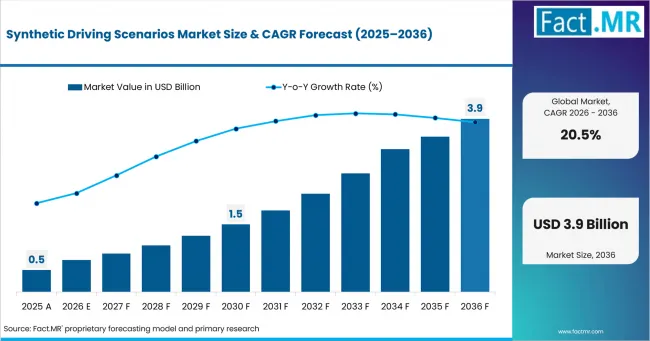
Synthetic Driving Scenarios Market Market Value Analysis | Source: Fact.MR
What are the defining numbers behind synthetic driving scenarios growth?
USD 3.3 billion absolute opportunity.
- Demand Drivers in the Market
- OEMs need synthetic road cases before driver assistance features move into broader vehicle programs.
- Autonomous vehicle developers use generated scenes to test rare hazards before real-road exposure.
- Tier-1 suppliers need repeatable camera, LiDAR and radar cases to qualify perception stacks.
- Simulation vendors gain demand as safety teams ask for documented scenario coverage instead of informal road replay.
- Key Segments Analyzed
- By Scenario Type: Urban Edge Cases account for 31.0% share because city streets combine pedestrians and cyclists with parked vehicles.
- By Application: ADAS Validation accounts for 38.0% share as OEMs test braking, lane and speed support before vehicle release.
- By Vehicle Type: Passenger Cars account for 46.0% share because software-defined vehicle platforms carry the widest validation workload.
- By Data Type: Camera accounts for 34.0% share as perception teams need lighting, occlusion and object-recognition coverage.
- By Buyer Type: OEMs account for 41.0% share because they control platform release gates and safety evidence budgets.
- By Geography: The United States is projected to record 22.8% CAGR through 2036 as AV testing density and software supplier depth support scenario demand.
- Analyst Opinion at Fact.MR
- Shambhu Nath Jha, Senior Analyst at Fact.MR, states, "Synthetic driving scenarios are becoming a validation currency for automated driving teams. I see buyers asking whether a scenario provider can recreate the exact failure pattern, not whether the provider can supply more simulated miles. Vendors that connect rare-event generation with safety case documentation should gain earlier access to OEM programs."
- Strategic Implications
- Scenario providers should map each library to specific safety cases before selling into OEM validation teams.
- Automated driving developers need traceable synthetic scenes that can be replayed after software changes.
- Tier-1 suppliers should package camera, LiDAR and radar scenes around release-gate evidence.
- Simulation vendors should support scenario portability between internal tools and customer validation stacks.
Generated driving situations for automated driving validation form the core of this market. In January 2026, the United States Department of Transportation through the National Highway Traffic Safety Administration published an analysis of automated driving crash data. The study included 1,493 unique crashes. The review covered cases where an automated driving system was engaged before impact. This supports demand for synthetic scenarios because developers need safe versions of rear-end cases, sideswipe cases and intersection conflicts that cannot be repeated at scale on public roads.
The United States is projected to record 22.8% CAGR through 2036 as AV testing density and software supplier depth support scenario demand. China is expected to expand at 22.0% CAGR through 2036 as local vehicle platforms and automated driving pilots create high validation workload. Germany is forecast to grow at 20.9% CAGR through 2036 as safety rules and OEM engineering depth support scenario-based testing. Japan is expected to advance at 20.3% CAGR through 2036 as passenger car programs require cautious validation. South Korea is projected to rise at 19.8% CAGR through 2036 as test corridors and electronics strength support sensor-rich validation.
How does the synthetic driving scenarios market break down by segment?
Urban edge cases lead with 31.0% share, while ADAS validation leads with 38.0% share.
Which scenario type leads?
Urban Edge Cases hold 31.0% share.
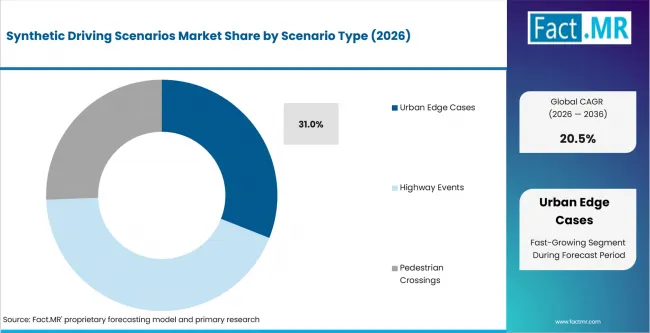
Synthetic Driving Scenarios Market Analysis By Scenario Type | Source: Fact.MR
Urban Edge Cases lead because city driving creates dense interaction between vehicles, pedestrians and cyclists. Synthetic versions of cut-ins, curbside stops and occluded crossings help teams test vehicle behavior before expensive road trials. Developers of automotive simulation software are also aligning scenario catalogs with the release gates used by OEM safety teams.
Which application leads?
ADAS Validation accounts for 38.0% share.
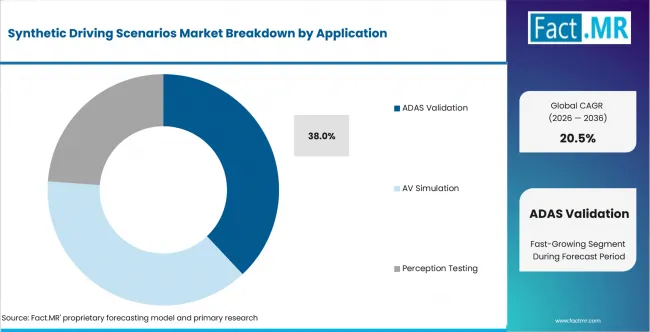
Synthetic Driving Scenarios Market Analysis By Application | Source: Fact.MR
ADAS Validation leads because lane support, emergency braking and speed assistance features need repeatable scenario evidence. Euro NCAP released assisted driving protocol updates in October 2025. [4] These updates keep pressure on OEMs to test highway behavior, driver engagement and system response before commercial release.
Which vehicle type leads?
Passenger Cars hold 46.0% share.
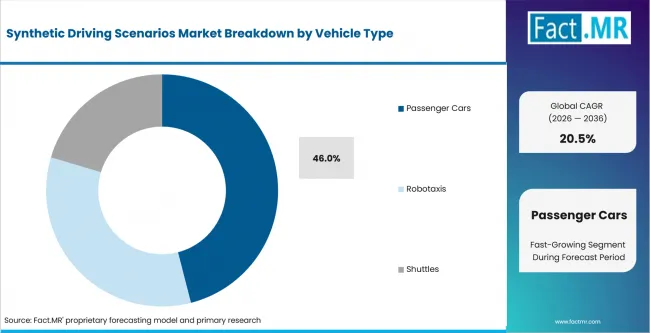
Synthetic Driving Scenarios Market Analysis By Vehicle Type | Source: Fact.MR
Passenger Cars lead because they carry the largest mix of driver assistance functions and automated driving pilots. This buyer base also spends on automotive software platforms that need scenario evidence during release planning. Fleet and robotaxi workloads increase depth, but passenger car programs set the base volume.
Which data type leads?
Camera leads with 34.0% share.
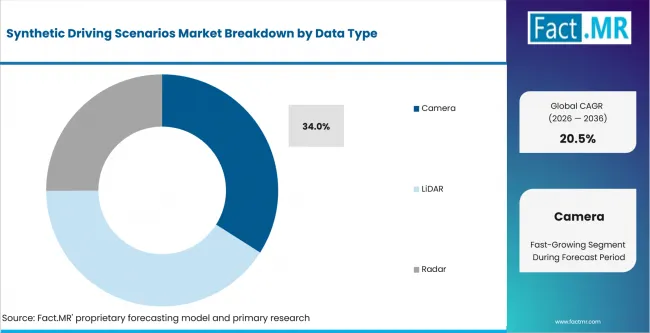
Synthetic Driving Scenarios Market Analysis By Data Type | Source: Fact.MR
Camera data leads because vision stacks need lighting, object class and occlusion coverage. Synthetic images also help fill gaps in night scenes, rain scenes and unusual pedestrian behavior. LiDAR and radar scenes grow as validation teams combine sensor evidence into one test record.
Which buyer type leads?
OEMs hold 41.0% share.
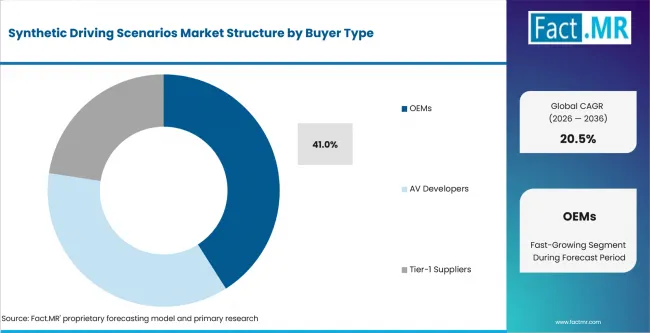
Synthetic Driving Scenarios Market Analysis By Buyer Type | Source: Fact.MR
OEMs lead because they control vehicle launch decisions and sign off safety evidence. They also decide whether synthetic scenes can enter official validation workflows. Tier-1 suppliers remain close buyers because sensor and perception modules must be tested before integration into customer platforms.
What is accelerating synthetic driving scenario adoption, and what is holding it back?
Rare-event validation and safety-case evidence drive it, while synthetic-to-road trust gaps and scenario traceability burden restrain it.
Drivers Impact Analysis
| DRIVER | (~) % IMPACT ON CAGR | GEOGRAPHIC RELEVANCE | IMPACT TIMELINE |
|---|---|---|---|
| Safety case evidence replacing mileage claims | +4.4% | USA, Germany, Japan | Short term |
| ADAS protocols adding scenario depth | +3.8% | Europe, USA, China | Medium term |
| Sensor fusion requiring repeatable scenes | +3.5% | Global OEM hubs | Medium term |
| Rare-event coverage reducing road risk | +3.0% | USA, China, UK | Short term |
| Simulation budgets moving into release gates | +2.6% | Global vehicle programs | Long term |
Source: Fact.MR analysis. Updated Jul 2, 2026
- Safety case evidence
- Validation teams are shifting from mileage volume toward evidence that a vehicle handled a defined hazard. Scenario suppliers can turn these patterns into libraries that support safety case files.
- ADAS protocol pressure
- European safety testing is adding more structured road behavior checks. Euro NCAP states that on-road driving assessment changes in 2026 extend vehicle assessment beyond a short route. This supports demand for highway scenario test platforms because highway cut-ins and lane-change behavior need repeatable virtual checks before public-road testing.
- Sensor fusion workload
- Perception teams need one scenario to exercise camera, LiDAR and radar behavior under the same traffic event. Synthetic data helps expose disagreement between sensors before the vehicle reaches road testing. This logic also supports spend on automotive radar sensors because radar response must be tested alongside visual and LiDAR evidence.
Opportunity Impact Analysis
| OPPORTUNITY | (~) % IMPACT ON CAGR | GEOGRAPHIC RELEVANCE | IMPACT TIMELINE |
|---|---|---|---|
| Generated urban hazard packs | +3.9% | USA, China, Europe | Short term |
| Closed-loop validation subscriptions | +3.4% | Global OEM hubs | Medium term |
| Parking and low-speed scene libraries | +2.9% | Europe, Japan, South Korea | Medium term |
| Sensor-specific synthetic data | +2.7% | USA, Germany, China | Short term |
| Truck and shuttle validation cases | +2.2% | USA, China, UK | Long term |
Source: Fact.MR analysis. Updated Jul 2, 2026
- Urban hazard packs
- Urban hazard packs create a practical entry point because they package many rare street events into a testable library. Suppliers can price these packs by scenario count, sensor set and annotation depth. Buyers value them when the pack links each hazard to a release requirement.
- Parking and low-speed cases
- Low-speed automation needs scene detail around pedestrians and curbs as well as columns and parked vehicles. The European Commission action plan referenced approval of unlimited series vehicles with automated parking systems in 2025. Scenario suppliers can connect this need with autonomous valet parking scenario systems that test garage and curb behavior.
- Sensor-specific data services
- Sensor-specific services are becoming attractive to perception teams because one synthetic scene can be rendered for several sensor configurations. Camera-led data remains the base layer, but automotive LiDAR scenes help teams test distance and object geometry under poor visibility.
Restraints Impact Analysis
| RESTRAINT | (~) % IMPACT ON CAGR | GEOGRAPHIC RELEVANCE | IMPACT TIMELINE |
|---|---|---|---|
| Trust gap between synthetic and road data | -3.6% | Global | Short term |
| Scenario traceability burden | -2.9% | Europe, USA, Japan | Medium term |
| High compute and labeling cost | -2.5% | USA, China, Germany | Medium term |
| Toolchain integration friction | -2.1% | Global OEM hubs | Short term |
| Limited standards for scenario reuse | -1.8% | Global | Long term |
Source: Fact.MR analysis. Updated Jul 2, 2026
- Synthetic-to-road trust gap
- Buyers still ask how closely a generated scene matches real-world sensor behavior. The restraint is strongest when safety teams need evidence for corner cases that have few field examples. Scenario suppliers reduce this gap by showing source logs, annotation lineage and replay results.
- Traceability burden
- Scenario traceability creates work beyond the initial dataset purchase. Each case needs version control, parameter records and test outcomes that survive software updates. This is why buyers also compare ADAS calibration equipment workflows with simulation evidence before approving release gates.
- Sensor realism limits
- Generated scenes can miss glare, lens artifacts and poor-weather sensor noise. This limits buyer confidence in some night and rain cases. The issue supports adjacent interest in thermal imaging sensor systems because those sensors require validation under conditions that standard camera datasets may not capture well.
Which countries are scaling synthetic driving scenario demand fastest?
United States 22.8%, China 22.0%, Germany 20.9%, Japan 20.3%, South Korea 19.8%.
Based on regional analysis, the synthetic driving scenarios market is segmented into North America and East Asia. It also includes Western Europe and South Asia and Pacific. Latin America and Middle East and Africa complete the regional view.
| Country | CAGR |
|---|---|
| United States | 22.8% |
| China | 22.0% |
| Germany | 20.9% |
| Japan | 20.3% |
| South Korea | 19.8% |
| United Kingdom | 19.2% |
| France | 18.7% |
Source: Fact.MR analysis. Updated Jul 2, 2026
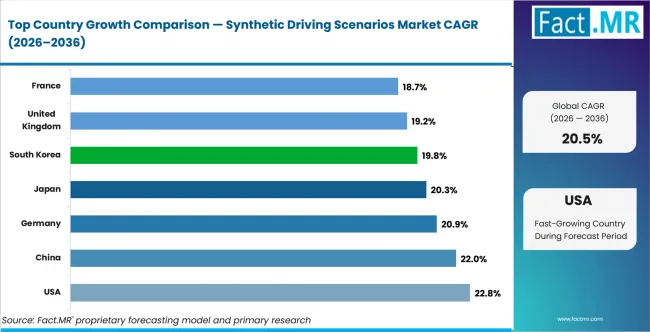
Synthetic Driving Scenarios Market Cagr Analysis By Country | Source: Fact.MR
What supports the United States outlook?
22.8% CAGR, supported by AV testing density and software supplier depth.
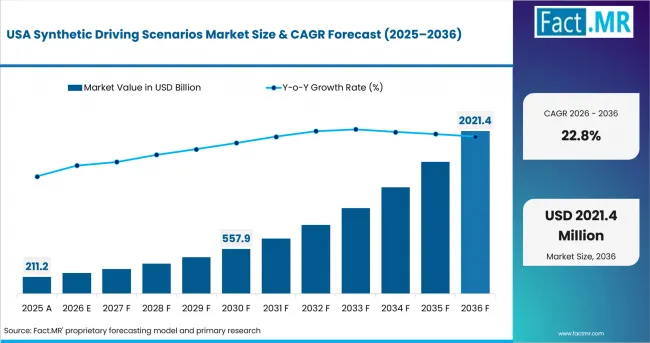
Synthetic Driving Scenarios Market Country Value Analysis | Source: Fact.MR
The United States has a large base of AV developers and simulation suppliers. The 22.8% country CAGR reflects automated driving testing density and strong software supplier depth. NHTSA recorded automated driving crash data that can be converted into synthetic validation cases. Buyers are expected to favor scenario providers that connect field incidents with release-ready test assets.
How is China scaling validation workload?
22.0% CAGR, driven by vehicle production scale and local AV pilots.
China combines large vehicle production with local automated driving pilots. The 22.0% country CAGR reflects scenario needs across passenger cars and robotaxi programs. The 2024 production base was 31.282 million vehicles according to the State Council of the People's Republic of China. Heavy goods corridors add another route for generated test cases. This links China to automated truck validation work.
Why is Germany a high-readiness market?
20.9% CAGR, backed by OEM engineering depth and EU safety rules.
German buyers make validation decisions through engineering proof and regulatory readiness. The 20.9% country CAGR reflects premium OEM programs and Europe-wide safety rules. Suppliers that can align scenario libraries with EU approval paths should gain access to German validation budgets.
What underpins Japan’s scenario demand?
20.3% CAGR, supported by passenger car production and cautious validation culture.
Japan keeps a high bar for vehicle safety evidence. The 20.3% country CAGR reflects passenger car platforms and conservative release decisions. Japan recorded 4.42 million new passenger vehicle sales in 2024 according to the United States International Trade Administration. Scenario suppliers are expected to win when they support traceable test cases and localized traffic behavior.
What is driving South Korea’s position?
19.8% CAGR, driven by testbeds and electronics strength.
South Korea has public test activity and electronics suppliers that need sensor-rich validation assets. The 19.8% country CAGR reflects AV testbeds and perception hardware depth. The country is also a natural base for camera and radar validation because electronics and vehicle integration sit close together. Local buyers are expected to prefer suppliers that can support Korean road rules and export programs.
How does the United Kingdom build opportunity?
19.2% CAGR, supported by connected mobility funding and pilot programs.
The United Kingdom uses public programs and controlled trials to shape automated driving adoption. The 19.2% country CAGR reflects safety-case requirements and pilot funding. Logistics yards and ports create low-speed use cases that connect scenario demand with autonomous yard vehicles in controlled operating areas.
Why does France remain relevant?
18.7% CAGR, backed by national road mobility strategy and EU alignment.
France has a national strategy for automated and connected road mobility. The 18.7% country CAGR reflects scenario-based safety demonstration and European approval alignment. EU safety rules keep French validation aligned with scenario-based approval logic. Suppliers can use automotive radar and camera cases to localize testing for city routes. They can extend the same cases to highway and shuttle routes.
Who leads the synthetic driving scenarios landscape?
NVIDIA, Applied Intuition and Foretellix lead through simulation ecosystems and scenario tooling.
Synthetic driving scenario services are used by OEMs and AV developers that need trusted validation evidence before vehicle release. NVIDIA supports world modeling and simulation through Cosmos and Omniverse. Applied Intuition offers Neural Sim for ADAS and automated driving programs. Foretellix focuses on scenario-based testing and safety verification workflows.
Synopsys supports the market through the Ansys simulation portfolio used by vehicle software teams. dSPACE provides sensor simulation and validation workflows through AURELION. Siemens supports vehicle-level digital twin workflows for automated driving validation. Cognata and Parallel Domain add scenario generation and synthetic sensor data depth.
Providers that combine field-log conversion and scenario generation should be better placed. OEMs are expected to prefer suppliers that fit into existing validation stacks. Smaller providers can win selected use cases when their scenes reproduce rare hazards better than broad simulation suites.
Which companies are the main players?
NVIDIA leads with Applied Intuition and Foretellix. Synopsys, dSPACE and Siemens add engineering simulation depth. Cognata and Parallel Domain remain relevant in generated sensor data.
- NVIDIA
- Applied Intuition
- Foretellix
- Synopsys
- dSPACE
- Siemens
- Parallel Domain
- Cognata
Bibliography
- European Commission. (2024, July 5). Mandatory drivers assistance systems expected to help save over 25,000 lives by 2038.
- European Commission. (2025, March 5). Industrial Action Plan for the European automotive sector.
- Euro NCAP. (2025, October). Assisted Driving: Highway & Interurban Assist Systems, Version 1.1.
- Euro NCAP. (2026). Euro NCAP at a glance 2026.
- NVIDIA Corporation. (2025, January 6). NVIDIA launches Cosmos world foundation model platform to accelerate physical AI development.
- Applied Intuition, Inc. (2025, January 6). Introducing Neural Sim: AI-powered simulator for next-generation ADAS and AD.
- Synopsys, Inc. (2025, July 17). Synopsys completes acquisition of Ansys.
- dSPACE GmbH. (2025). Accelerating the development of AD applications.
- Siemens Digital Industries Software. (2025, December 18). Siemens’ new PAVE360 Automotive drives next-generation vehicle development with real-world validation.
- International Trade Administration. (2025, November 20). Japan - Automotive.
This Report Addresses
- Strategic intelligence on synthetic driving scenarios across scenario type, application and buyer type.
- Segment analysis covering Urban Edge Cases, ADAS Validation, Passenger Cars, Camera and OEMs.
- Regional outlook covering United States, China, Germany, Japan, South Korea, United Kingdom and France.
- Competitive analysis of NVIDIA, Applied Intuition, Synopsys, Foretellix, Cognata, dSPACE, Siemens and Parallel Domain.
- Scenario service assessment covering scenario libraries, synthetic sensor scenes, annotated 3D scenes and behavior trajectories.
- Validation assessment covering ADAS validation, AV simulation, perception testing and safety case development.
- Primary interviews, provider checks, official source review and validation workflow checks support the forecast.
What does the synthetic driving scenarios market cover?
Generated driving situations used to test ADAS and autonomous driving behavior.
The synthetic driving scenarios market covers software assets and scenario data services that create artificial traffic situations for vehicle perception and safety validation. It includes urban edge cases and highway events. It also includes pedestrian crossings, adverse weather and rare hazards. It differs from physical road testing because the service focus is controlled scenario creation and repeatable validation evidence.
What is included in the scope?
Scenario libraries, synthetic sensor scenes and behavior trajectories.
The scope includes generated scenario catalogs for automated driving validation. It covers camera, LiDAR and radar scenes. It also includes annotated three-dimensional scenes and behavior trajectories used by simulation, perception testing and safety case teams.
What is excluded from the scope?
Physical proving-ground tests without generated scenario assets.
The scope excludes vehicle hardware sales without scenario generation support. It excludes raw road video storage unless scenes are converted into reusable synthetic cases. It also excludes general simulation consulting without scenario data, annotation or validation output.
How was the analysis built?
100+ sources, 40+ company portfolios, 25+ countries, 20+ interviews.
- Primary Research:
- Interviews covered simulation leads at vehicle OEMs, ADAS validation managers and autonomous vehicle developers. Inputs from Tier-1 suppliers and scenario software vendors helped confirm buyer selection logic.
- Desk Research:
- Desk research reviewed safety rules, automated driving policy documents and official testing frameworks. It also covered company product pages, official launches and simulation workflow disclosures.
- Market-Sizing and Forecasting:
- Forecasting used a bottom-up model built from vehicle program counts, scenario library licensing intensity and buyer validation workload. Estimates were reconciled against automotive software spending and simulation platform adoption.
- Data Validation and Update Cycle:
- Forecasts were validated through provider checks and buyer interviews. Updates in Euro NCAP protocols, European Commission rules and NHTSA crash reporting informed the timing assumptions.
Segmentation
What is the report’s scope and coverage?
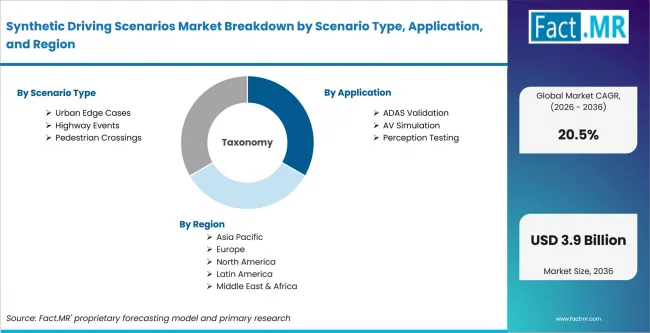
Synthetic Driving Scenarios Market Breakdown By Scenario Type, Application, And Region | Source: Fact.MR
| Attribute | Details |
|---|---|
| Quantitative Units | USD Billion in 2026 to USD Billion by 2036 at CAGR |
| Market Definition | Generated driving scenarios used for ADAS, automated driving and safety validation |
| Scenario Type | Urban Edge Cases, Highway Events, Pedestrian Crossings, Adverse Weather, Rare Hazards |
| Application | ADAS Validation, AV Simulation, Perception Testing, Safety Case Development |
| Vehicle Type | Passenger Cars, Robotaxis, Trucks, Shuttles, Off-Road Vehicles |
| Data Type | Camera, LiDAR, Radar, Annotated 3D Scenes, Behavior Trajectories |
| Buyer Type | OEMs, AV Developers, Tier-1 Suppliers, Simulation Vendors |
| Regions Covered | North America, Latin America, Europe, Asia Pacific, Middle East and Africa |
| Countries Covered | United States, China, Germany, Japan, South Korea, United Kingdom, France |
| Companies Profiled | NVIDIA, Applied Intuition, Synopsys, Foretellix, Cognata, dSPACE, Siemens, Parallel Domain |
| Forecast Period | 2026 to 2036 |
| Approach | Hybrid top-down and bottom-up approach using vehicle program counts, scenario licensing intensity, validation workload and provider checks |
Source: Fact.MR analysis. Updated Jul 2, 2026
How is the market segmented?
-
By Scenario Type:
- Urban Edge Cases
- Highway Events
- Pedestrian Crossings
- Adverse Weather
- Rare Hazards
-
By Application:
- ADAS Validation
- AV Simulatin
- Perception Testing
- Safety Case Develpment
-
By Vehicle Type:
- Passenger Cars
- Robotaxis
- Trucks
- Shuttles
- Off-Road Vehicles
-
By Data Type:
- Camera
- LiDAR
- Radar
- Annotated 3D Scenes
- Behavior Trajectories
-
By Buyer Type:
- OEMs
- AV Developers
- Tier-1 Suppliers
- Simulation Vendors
-
By Region:
- North America
- United States
- Canada
- Mexico
- Latin America
- Brazil
- Argentina
- Rest of Latin America
- Europe
- Germany
- United Kingdom
- France
- Italy
- Spain
- Rest of Europe
- Asia Pacific
- China
- India
- Japan
- South Korea
- ASEAN
- Middle East & Africa
- GCC Countries
- South Africa
- UAE
- Rest of Middle East & Africa
- North America
Frequently Asked Questions
Which scenario type leads the Synthetic Driving Scenarios Market?
Which application leads the Synthetic Driving Scenarios Market?
Which country expands faster in the Synthetic Driving Scenarios Market?
How does China perform in the Synthetic Driving Scenarios Market?
How does Germany perform in the Synthetic Driving Scenarios Market?
How does Japan perform in the Synthetic Driving Scenarios Market?
How does South Korea perform in the Synthetic Driving Scenarios Market?
What is the primary driver in the Synthetic Driving Scenarios Market?
What is the main restraint in the Synthetic Driving Scenarios Market?
Why are synthetic driving scenarios important?
Who worked on this report


Preview the report firsthand - request a free sample
Free SampleGet the brochure for pricing and purchase details
Download PDF