What is the tamper-evident syringe caps market forecast to be worth by 2036?
USD 198.0 million in 2026 to USD 470.0 million by 2036, at 9.0% CAGR.
- The tamper-evident syringe caps market crossed USD 180.0 million in 2025.
- The tamper-evident syringe caps market is estimated at USD 198.0 million in 2026. It is projected to reach USD 470.0 million by 2036.
- The market is forecast to record 9.0% CAGR from 2026 to 2036.
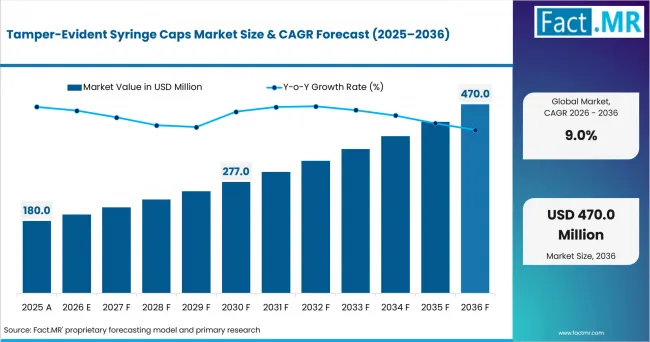
Tamper Evident Syringe Caps Market Market Value Analysis | Source: Fact.MR
What are the defining numbers behind tamper-evident syringe caps growth?
Absolute opportunity is USD 272.0 million by 2036. India and China lead the country outlook.
- Demand Drivers in the Market
- Biologic fillers need closure evidence because high-value doses must remain sealed during filling, storage and patient administration.
- Vaccine programs support recurring syringe cap use because mass immunization relies on ready-to-use delivery formats.
- Ophthalmic drug makers require low-particle closures because eye injections have strict tolerance for visible and subvisible contamination.
- Hospital buyers prefer visible first-opening features because pharmacy teams need simple checks before stocked injectables reach wards.
- Key Segments Analyzed
- By Cap Type: Luer Lock is expected to hold 36.0% share in 2026 because high-value injectables need secure threaded closure compatibility.
- By Material: Polypropylene is projected to hold 43.0% share in 2026 because it supports molding scale and common sterilization routes.
- By Syringe Type: Glass PFS is likely to account for 46.0% share in 2026 as biologics and vaccines continue to use glass containment.
- By Application: Biologics are forecast to capture 34.0% share in 2026 because injectable therapies need validated closure performance.
- By Geography: India is projected to record 10.6% CAGR through 2036 as domestic pharmaceutical output and export-oriented filling expand.
- Analyst Opinion at Fact.MR
- Shambhu Nath Jha, Senior Analyst at Fact.MR, states, “Syringe caps are small components, but they decide whether a filled syringe can move through release checks without rework. Pharma fillers are asking for closure evidence earlier in device selection. Suppliers that understand sterilization, extractables and line handling can win accounts before commercial filling begins.”
- Strategic Implications
- Cap suppliers should qualify materials for biologics before pharma teams freeze syringe platform designs.
- Pharma fillers need tamper evidence that remains readable after sterilization and cold-chain handling.
- Device OEMs should pair cap selection with luer compatibility and line release testing.
- Regional distributors can gain accounts by offering documented alternatives during syringe supply reviews.
The market is a small but necessary part of prefilled syringes because the closure affects filling line release, shipping checks and patient-facing trust. The forecast is based on provided market anchors and checked against prefilled syringe output, injectable drug demand and closure supplier activity.
Luer lock caps are projected to account for 36.0% share in 2026. North America leads early value because large pharmaceutical fillers use stricter documentation for syringe component changes.
How does the tamper-evident syringe caps market break down by segment?
Luer Lock leads at 36.0% share. Polypropylene leads at 43.0% share.
Which cap type leads?
Luer Lock holds 36.0% share in 2026.
Luer Lock caps lead because threaded syringe connections are favored for biologics and emergency injectables. Buyers use the cap to protect the front end and confirm that the device has not been opened before administration. The U.S. Food and Drug Administration issued warning letters in March 2024 related to unauthorized plastic syringes made in China. Closure suppliers that can document fit and removal behavior gain stronger access to qualified syringe platforms.
Which material leads?
Polypropylene accounts for 43.0% share in 2026.
Polypropylene leads because it is widely molded, available at scale and familiar to medical component converters. The material is used where cap geometry must stay consistent after sterilization and distribution. Demand also connects to medical grade polypropylene because syringe closure buyers compare biocompatibility and sterilization resistance before switching suppliers.
Which syringe type leads?
Glass PFS holds 46.0% share in 2026.
Glass PFS leads because many biologics and vaccines still use glass containment during development and commercial filling. ISO 11040-4:2024 specifies materials, dimensions and performance requirements for glass barrels and sterilized subassembled syringes ready for filling. This standard supports tighter cap fit checks because front-end closure behavior affects ready-to-fill syringe release.
Which application leads?
Biologics lead with 34.0% share in 2026.
Biologics lead because higher dose value raises the cost of any closure failure. Buyers also evaluate extractables and seal integrity before commercial release. The U.S. Food and Drug Administration issued draft guidance for Essential Drug Delivery Outputs in June 2024. Cap removal evidence matters because device output must be assessed before a drug delivery product reaches patients.
What is accelerating tamper-evident syringe cap demand, and what is holding it back?
Regulatory review and biologic filling support it. Tooling costs and material validation slow it.
The main driver is the shift from bulk injectable handling toward ready-to-administer systems. World Health Organization and the United Nations Children’s Fund reported that about 115 million infants received at least one DTP-containing vaccine dose in 2024. That vaccination base supports repeat use of disposable syringes and related closure formats where first-opening evidence is required.
The main restraint is the cost of qualifying cap changes once a drug-device system is validated. The U.S. Food and Drug Administration guidance for Essential Drug Delivery Outputs addresses device design outputs for drug delivery performance. [3] This makes post-selection changes difficult because cap geometry can affect compatibility with syringes and connecting devices.
Where do the biggest tamper-evident syringe cap opportunities sit?
Biologics, ophthalmics and dual-chamber systems create the clearest openings.
- Biologic Closure Sets: Suppliers can build cap lines that combine seal evidence with low-particle performance for high-value therapies.
- Ophthalmic PFS: Makers can serve eye-care drugs by pairing low silicone exposure with readable cap removal evidence.
- Dual-Chamber Systems: Component suppliers can support dual chamber prefilled syringes by testing cap integrity during storage and reconstitution steps.
- Sterile Barrier Caps: ISO 11040-8:2026 covers finished prefilled syringes with a front-end closure for parenteral preparations.
Which countries are scaling tamper-evident syringe caps fastest?
India records the highest country CAGR. The table below gives the full country view.
Based on regional analysis, the tamper-evident syringe caps market is segmented into North America, Europe, East Asia, South Asia, Latin America, and Middle East and Africa.
| Country | CAGR |
|---|---|
| India | 10.6% |
| China | 10.1% |
| South Korea | 9.7% |
| United States | 9.2% |
| Germany | 8.8% |
| Japan | 8.5% |
| France | 8.2% |
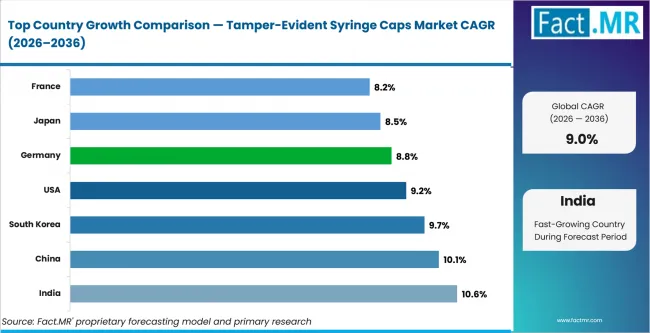
Tamper Evident Syringe Caps Market Cagr Analysis By Country | Source: Fact.MR
What is powering India’s lead?
10.6% CAGR, supported by pharmaceutical output and export-linked filling.
India has a large injectable manufacturing base that buys components for domestic and export supply. The Department of Pharmaceuticals reported pharmaceutical turnover of ₹4,71,898 crore for FY2024-25 in its Annual Report 2025-26. India is projected to record a 10.6% CAGR through 2036, supported by domestic filling scale and lower component conversion costs. Suppliers that offer local documentation and short lead times are better placed for Indian accounts.
How is China scaling cap demand?
10.1% CAGR, driven by syringe production depth and quality review.
China remains structurally important because it supplies plastic syringe components and injectable packaging inputs to many export channels. Quality review has become stricter after U.S. actions on some China-made syringes. China is expected to expand at 10.1% CAGR through 2036, supported by local syringe output and growing demand for documented caps. Export-focused suppliers need stronger evidence files to reduce customer hesitation.
Why is South Korea important?
9.7% CAGR, supported by biologics filling and device partnerships.
South Korea’s biologics manufacturing base creates demand for syringe closure systems used in clinical and commercial injectable programs. Biologics fillers in the country compare cap suppliers on sterility support, validation files, and device fit. South Korea is forecast to grow at 9.7% CAGR through 2036, attributable to biologics fill-finish work and local device integration. Supplier wins are likely to depend on technical support during line qualification.
What supports the United States outlook?
9.2% CAGR, backed by combination product review and domestic capacity.
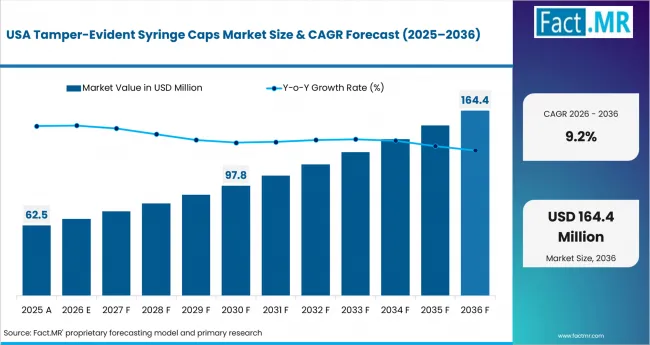
Tamper Evident Syringe Caps Market Country Value Analysis | Source: Fact.MR
United States buyers place early emphasis on supplier quality files because syringe caps can affect a drug-device combination product. SCHOTT Pharma announced a U.S. prefillable syringe manufacturing facility in March 2024. The company stated that the site would triple its glass and polymer syringe contribution to the U.S. market by 2030. The United States is expected to advance at 9.2% CAGR through 2036, supported by domestic syringe capacity and stricter supplier review. Buyers are likely to prefer cap vendors with local technical support.
What underpins Germany’s growth?
8.8% CAGR, driven by injectable packaging expertise and EU compliance needs.
Germany is a supplier-side hub because companies such as Gerresheimer and SCHOTT Pharma influence injectable packaging specifications. EU pharma teams require documentation covering material, sterility, and compatibility before changing syringe closure components.Germany is projected to rise at 8.8% CAGR through 2036, supported by pharma packaging engineering and export-oriented device programs. Growth is lower than India because Germany starts from a higher specification base.
Why does Japan remain a stable market?
8.5% CAGR, supported by conservative validation and ophthalmic use.
Japanese buyers are careful about changing components once a syringe system is approved. Ophthalmic and biologic applications create demand for low-particle cap systems with clean removal behavior. Japan is forecast at 8.5% CAGR through 2036, supported by strict quality review and device reliability requirements. Faster growth is constrained by long qualification cycles at drug makers.
How does France contribute to European demand?
8.2% CAGR, backed by pharmaceutical filling and regional packaging access.
France has a strong base of injectable drug development and contract filling work. Buyers require caps that fit European quality expectations and maintain visible first-opening evidence after transport. France is expected to post 8.2% CAGR through 2036, driven by biologics filling and EU supply-chain review. The opportunity favors suppliers that combine product documentation with distributor access.
Who leads the tamper-evident syringe caps landscape?
Becton, Dickinson and Company and SCHOTT Pharma lead through closure depth, syringe platforms and injectable packaging access.
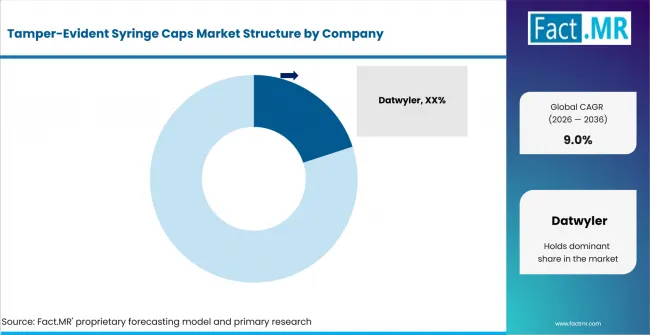
Tamper Evident Syringe Caps Market Analysis By Company | Source: Fact.MR
Tamper-evident syringe caps are supplied by component makers, syringe platform owners and pharmaceutical packaging companies. Becton, Dickinson and Company highlighted the BD Neopak XtraFlow glass prefillable syringe at Pharmapack in January 2025. That product focus shows how syringe platforms are moving toward higher-viscosity biologics.
SCHOTT Pharma, Gerresheimer connect cap selection with ready-to-fill syringe systems. Suppliers with caps that fit medical packaging workflows can secure earlier involvement in device qualification.
Datwyler and Aptar Pharma compete through elastomer and containment know-how. Competition through 2036 is likely to depend on material validation, cap readability and compatibility with medical flexible packaging used around sterile device formats.
Which companies are the key players?
Datwyler, Aptar Pharma, BD (Becton, Dickinson and Company), Gerresheimer, SCHOTT Pharma.
- Datwyler
- Aptar Pharma
- BD (Becton, Dickinson and Company)
- Gerresheimer
- SCHOTT Pharma
Bibliography
- U.S. Food and Drug Administration. (2024, March 19). UPDATE: Evaluating plastic syringes made in China for potential device failures: FDA safety communication. FDA.
- U.S. Food and Drug Administration. (2024, June 28). Essential drug delivery outputs for devices intended to deliver drugs and biological products: Draft guidance for industry. FDA.
- International Organization for Standardization. (2024, June). ISO 11040-4:2024: Prefilled syringes — Part 4: Glass barrels for injectables and sterilized subassembled syringes ready for filling. ISO.
- International Organization for Standardization. (2026, June). ISO 11040-8:2026: Prefilled syringes — Part 8: Requirements and test methods for finished prefilled syringes. ISO.
- World Health Organization & United Nations Children’s Fund. (2025, July 15). Global childhood vaccination coverage holds steady, yet over 14 million infants remain unvaccinated. WHO.
- Department of Pharmaceuticals, Ministry of Chemicals and Fertilizers, Government of India. (2026). Annual Report 2025–26. Government of India.
- BD. (2025, January 20). BD highlights the latest innovations in drug delivery at Pharmapack 2025. BD.
- SCHOTT Pharma AG & Co. KGaA. (2024, March 18). SCHOTT Pharma to expand in the U.S. with new prefillable syringe manufacturing facility. SCHOTT Pharma.
- SCHOTT Pharma AG & Co. KGaA. (2024, June 11). Expanding prefillable glass syringe output: SCHOTT Pharma opens state-of-the-art production facility in Lukácsháza, Hungary. SCHOTT Pharma.
This Report Addresses
- Strategic intelligence on tamper-evident syringe caps across cap type, material, and syringe type.
- Segment analysis covering Luer Lock, Polypropylene, Glass PFS, Biologics, and North America.
- Regional outlook covering India, China, South Korea, United States, Germany, Japan and France.
- Competitive analysis of Datwyler, Aptar Pharma, BD, Gerresheimer, SCHOTT Pharma.
- Product assessment covering tip caps, sterile barriers, seal bands, and gamma-stable materials.
- Standards assessment covering ISO 11040, FDA syringe guidance and combination product review.
- Primary interviews, provider checks, official source review and supplier validation support the forecast.
What does the tamper-evident syringe caps market cover?
Tamper-evident caps and sterile front-end closures used on prefilled syringes.
The market covers caps, tip closures and seal systems that show whether a syringe front end has been opened or disturbed before use. It includes sterile barrier caps for glass and plastic prefilled syringes. It excludes the filled drug, syringe barrel, plunger rod, and needle safety guardunless sold with the cap as a validated closure set.
What is included in the scope?
Luer lock caps, tip caps, seal bands and sterile barrier caps.
The scope includes polypropylene caps, COC plastics, and COP plastics. It also covers elastomeric seals and gamma stable materials. Syringe formats include glass prefilled syringes, plastic prefilled syringes and safety syringes. Dual chamber syringes and ophthalmic syringes are included when the cap provides opening evidence.
What is excluded from the scope?
Finished injectable drugs and standard syringe barrels without tamper evidence.
The scope excludes standard needle caps that do not provide opening evidence. It also excludes primary packaging for vials, cartridges and ampoules unless the product is specified for syringe closure use.
How was the analysis built?
100+ sources were reviewed. 40+ company portfolios were checked. 25+ countries were screened. 20+ interviews supported validation.
- Primary Research: Primary interviews covered injectable packaging buyers, fill-finish quality teams, device engineers and component distributors.
- Desk Research: Desk research reviewed FDA guidance, ISO syringe standards, WHO immunization data and supplier product portfolios.
- Market-Sizing and Forecasting: Sizing used 2025 and 2026 market value anchors and reconciled them against prefilled syringe penetration, injectable drug approvals and closure pricing bands.
- Data Validation and Update Cycle: Forecasts were validated through supplier checks, regulatory changes and recent launches from BD, SCHOTT Pharma.
What is the report’s scope and coverage?
| Attribute | Details |
|---|---|
| Quantitative Units | USD Million in 2026 to USD Million by 2036 at CAGR |
| Market Definition | Tamper-evident caps and sterile front-end closures used on prefilled syringes |
| Cap Type | Luer Lock, Tip Caps, Seal Bands, Sterile Barriers, Color Caps |
| Material | Polypropylene, COC Plastics, COP Plastics, Elastomers, Gamma-Stable Materials |
| Syringe Type | Glass PFS, Plastic PFS, Safety Syringes, Dual Chamber, Ophthalmic |
| Application | Biologics, Vaccines, Anticoagulants, Ophthalmics, Emergency Drugs |
| Regions Covered | North America, Europe, East Asia, South Asia, Latin America, Middle East and Africa |
| Countries Covered | United States, China, Germany, Japan, France, India and South Korea |
| Key Companies Profiled | Datwyler, Aptar Pharma, BD (Becton, Dickinson and Company), Gerresheimer, SCHOTT Pharma |
| Forecast Period | 2026 to 2036 |
| Approach | Hybrid top-down and bottom-up approach using market value anchors, syringe platform demand, injectable application mix and supplier validation |
How is the market segmented?
-
By Cap Type:
- Tip Caps
- Seal Bands
- Sterile Barriers
- Color Caps
-
By Material:
- Polypropylene
- COC Plastics
- COP Plastics
- Elastomers
- Gamma-Stable Materials
-
By Syringe Type:
- Glass PFS
- Plastic PFS
- Safety Syringes
- Dual Chamber
- Ophthalmic
-
By Application:
- Biologics
- Vaccines
- Anticoagulants
- Ophthalmics
- Emergency Drugs
-
By Region:
- North America
- United States
- Canada
- Mexico
- Latin America
- Brazil
- Argentina
- Rest of Latin America
- Europe
- Germany
- United Kingdom
- France
- Italy
- Spain
- Rest of Europe
- East Asia
- China
- Japan
- South Korea
- South Asia
- India
- ASEAN
- Rest of South Asia
- Middle East and Africa
- GCC Countries
- South Africa
- UAE
- Rest of Middle East and Africa
- North America