- Market Value (2025):USD 160.9 Mn
- Estimated Value (2026): USD 175.0 Mn
- Forecast Value (2036): USD 405.0 Mn
- CAGR (2026-2036): 8.8%
What is the Toolless Booth Frames Market forecast to be worth by 2036?
USD 175.0 million in 2026 to USD 405.0 million by 2036 at 8.8% CAGR.
- The toolless booth frames market crossed a valuation of USD 160.9 million in 2025 as customers increased spending on labor-cost reduction and shorter venue access windows.
- Demand is projected to increase from USD 175.0 million in 2026 to USD 405.0 million by 2036.
- The market is forecast to record 8.8% CAGR from 2026 to 2036 owing to faster setup requirements and wider use of rental and portable systems.
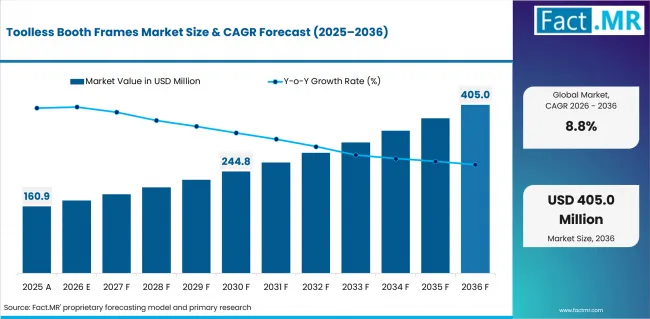
Toolless Booth Frames Market Value Analysis | Source: Fact.MR
What are the defining numbers behind Toolless Booth Frames Market growth?
USD 230.0 million absolute opportunity by 2036, led by Snap-lock connectors and Aluminum extrusion alongside Portable inline booth and Labor reduction.
- Demand Drivers in the Market
- Labor-cost reduction is expected to push customers toward frame systems that reduce manual fastening during booth assembly. The purchase case becomes clearer when lock checks are included in every event turnaround.
- Shorter venue access windows are projected to raise the value of repeatable booth structures. Event operators need frames that move from transport to installation without improvised site work.
- Small-crew installation is anticipated to favor indexed connectors that guide frame members into a fixed position. This helps agencies keep build responsibility clear when staffing is tight.
- Rental and portable systems are expected to create recurring demand because the same frames move through many shows. Providers gain an advantage when they document wear checks after each deployment.
- Key Segments Analyzed
- By Connection System: Snap-lock connectors are projected to hold 30.0% share in 2026 because they give crews a visible lock point during assembly.
- By Frame Material: Aluminum extrusion is expected to account for 46.0% share in 2026. It balances low weight with stiffness during repeated handling.
- By Booth Type: Portable inline booth is anticipated to capture 35.0% share in 2026 since small formats place the highest value on quick setup.
- By Buyer Need: Labor reduction is forecast to represent 28.0% share in 2026. Labor planning remains a direct procurement concern for event work.
- By Sales Model: Purchased kits are estimated to command 27.0% share in 2026. Repeat users prefer ownership over recurring rental decisions.
- Analyst Opinion at Fact.MR
- Shambhu Nath Jha, Senior Analyst at Fact.MR, states, “Toolless booth frames are approved when customers see how each connection locks and performs across several show cycles. Faster setup matters, but the stronger commercial proof is a documented build process that protects booth geometry after transport.”
- Strategic Implications
- Event operators need clear lock-check steps before quotations influence purchase decisions. This prevents selection from relying only on speed claims and connects the category with event planning services.
- Frame providers can document kit contents and the inspection work required after repeated use. This helps customers compare toolless frames with other booth assets that share transport cycles.
- Investors must separate portable frame systems from broad display hardware. Demand tied to modular containers becomes relevant only when transport savings improve setup reliability.
UAE is anticipated to record a 9.5% CAGR with high-throughput venues favoring quick turnover. USA is expected to post an 8.8% CAGR through labor planning and repeat exhibitor procurement. Japan is forecast at 8.7% due to compact event layouts and high service expectations. UK is estimated to record an 8.5% CAGR where rental and purchased kits support recurring shows. Germany is projected to reach an 8.2% CAGR because documentation requirements slow faster replacement.
How does the Toolless Booth Frames Market break down by segment?
Snap-lock connectors are expected to lead Connection System at 30.0% share in 2026. Aluminum extrusion is projected to lead Frame Material at 46.0% share in 2026.
Which connection system dominates?
Snap-lock connectors are projected to account for 30.0% share in 2026.
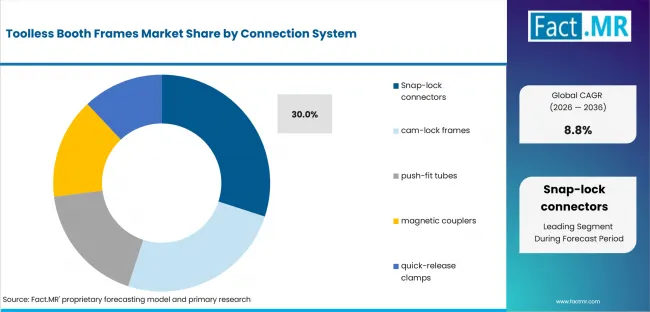
Toolless Booth Frames Market Analysis By Connection System | Source: Fact.MR
Snap-lock connectors give installers a visible fastening point that can be checked without additional tools. Cam-lock frames suit users familiar with conventional mechanical joints, while push-fit tubes support lighter display structures. Magnetic couplers and quick-release clamps remain more suitable for temporary applications where frequent reconfiguration is required.
What leads the Frame Material segment?
Aluminum extrusion is expected to hold 46.0% share in 2026.
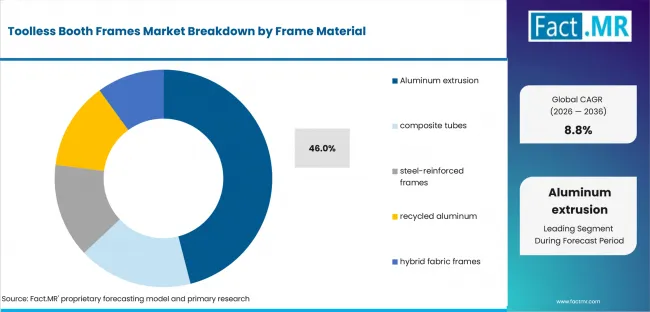
Toolless Booth Frames Market Analysis By Frame Material | Source: Fact.MR
Aluminum extrusion combines structural consistency with a lower transport burden than heavier frame materials. Its standardized profiles also make damaged sections easier to replace. Composite tubes serve weight-sensitive applications, while steel-reinforced frames address higher load requirements. Recycled aluminum and hybrid fabric structures are gaining interest in programs focused on material recovery.
How does Booth Type shape demand?
Portable inline booth is anticipated to lead with 35.0% share in 2026.
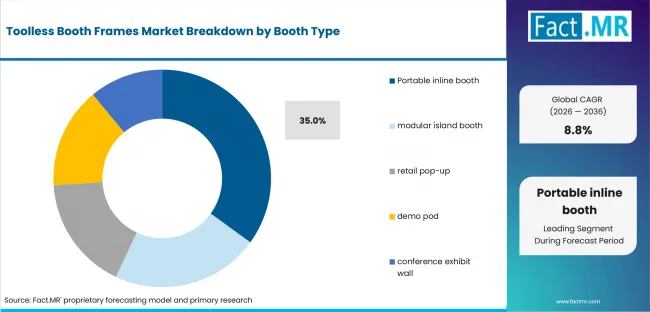
Toolless Booth Frames Market Analysis By Booth Type | Source: Fact.MR
Portable inline booths fit standard exhibition spaces and require less design planning than larger custom layouts. Their compact form also supports storage between events. Modular island booths serve open-floor locations, while demo pods create dedicated product zones. Retail pop-up formats are selected when brands need temporary promotional spaces outside conventional exhibition halls.
What supports Labor reduction within Buyer Need?
Labor reduction is estimated to represent 28.0% share in 2026.
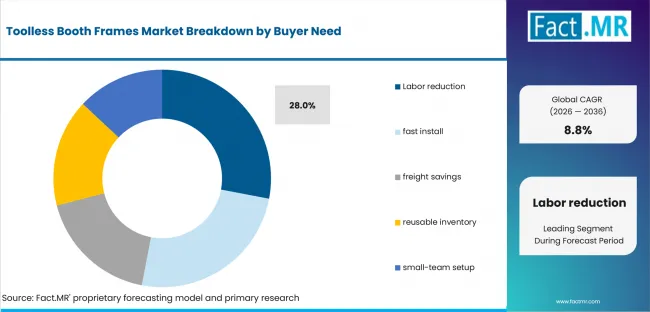
Toolless Booth Frames Market Analysis By Buyer Need | Source: Fact.MR
Labor reduction remains a major buyer need because venues often allow limited time for booth assembly. Systems with fewer components can reduce crew requirements and lower the risk of installation delays. Fast setup and small-team operation address similar scheduling pressures, while freight savings and reusable inventory relate more directly to logistics and long-term ownership costs.
What supports Purchased kits within Sales Model?
Purchased kits are forecast to hold 27.0% share in 2026.
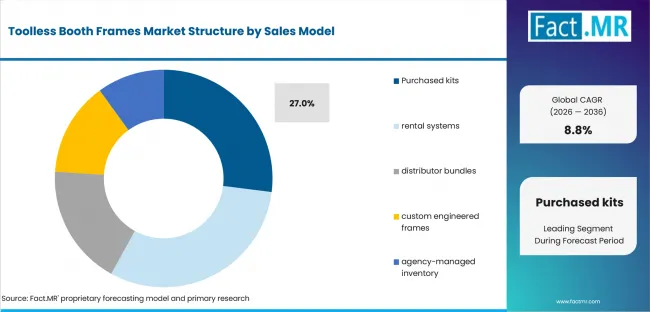
Toolless Booth Frames Market Analysis By Sales Model | Source: Fact.MR
Purchased kits appeal to exhibitors that use similar booth layouts across several events and want direct control over inventory. Rental systems offer flexibility for one-time shows or changing space requirements. Distributor bundles add local product access, while agency-managed inventory suits customers that prefer outsourced storage, maintenance and deployment support.
What is accelerating Toolless Booth Frames Market adoption, and what is holding it back?
Demand is expected to grow as companies look to reduce labor costs and complete setup within shorter venue access times. Growth may be limited by worn connectors and locking mistakes made by untrained crews.
Drivers Impact Analysis
| DRIVER | (~) % IMPACT ON CAGR | GEOGRAPHIC RELEVANCE | IMPACT TIMELINE |
|---|---|---|---|
| Labor-cost reduction | +2.4% | Mature exhibition markets | Short term (<= 2 years) |
| Shorter venue access windows | +1.8% | Global | Short term (<= 2 years) |
| Small-crew installation | +1.4% | North America and Europe | Medium term (2-4 years) |
| Growth of rental and portable systems | +1.0% | China and UAE | Medium term (2-4 years) |
Source: Fact.MR analysis. Updated Jul 28, 2026
- Labor-cost reduction: Faster frame connection is expected to improve the replacement case where customers track installation hours closely. Providers still need to show that speed does not weaken repeated assembly accuracy.
- Shorter venue access windows: Limited setup time is anticipated to raise demand for kits that arrive with a clear connection order. This driver becomes stronger when crews confirm lock status without extra tools.
- Small-crew installation: Smaller crews are expected to favor systems that reduce handoffs during buildout. Clear connector design helps supervisors assign tasks and limit mistakes during rushed installation.
- Growth of rental and portable systems: Recurring booth movement is projected to support demand for frames that survive repeated packing. Inspection routines are expected to become a larger part of service value.
Opportunity Impact Analysis
| OPPORTUNITY | (~) % IMPACT ON CAGR | GEOGRAPHIC RELEVANCE | IMPACT TIMELINE |
|---|---|---|---|
| Wear-indicator connectors | +1.6% | China and UAE | Short term (<= 2 years) |
| Mixed-frame upgrade kits | +1.1% | USA and UK | Medium term (2-4 years) |
| Certified rapid-build packages | +0.8% | Germany and Japan | Medium term (2-4 years) |
Source: Fact.MR analysis. Updated Jul 28, 2026
- Wear-indicator connectors: Visual wear indicators are expected to help customers decide when a connector needs replacement. This creates a service opening for providers that support high-use rental fleets.
- Mixed-frame upgrade kits: Upgrade kits are expected to widen demand where customers already own compatible display inventory. The opening depends on maintaining structural fit across old and new frame parts.
- Certified rapid-build packages: Certified packages are anticipated to improve acceptance at venues that need proof of safe assembly. The opening is strongest when documentation reduces approval work before the show opens.
Restraints Impact Analysis
| RESTRAINT | (~) % IMPACT ON CAGR | GEOGRAPHIC RELEVANCE | IMPACT TIMELINE |
|---|---|---|---|
| Connector wear | -1.7% | Global | Short term (<= 2 years) |
| Incorrect locking by untrained crews | -1.2% | Cost-sensitive regional markets | Medium term (2-4 years) |
| Limited adaptation outside approved geometries | -0.9% | Highly regulated venues | Short term (<= 2 years) |
Source: Fact.MR analysis. Updated Jul 28, 2026
- Connector wear: Repeated assembly reduces confidence in a fast-build promise. Customers are expected to delay purchases when inspection and replacement intervals are unclear.
- Incorrect locking by untrained crews: Toolless systems still need a defined setup process. Inexperienced crews are expected to create risk when lock status is not visible or training is skipped.
- Limited adaptation outside approved geometries: Some systems lose value when customers require unusual booth shapes. This restraint is expected to matter more in venues with strict safety review.
Which countries are scaling Toolless Booth Frames Market fastest?
The country comparison is defined by a 1.8 percentage-point spread between China and Germany. China and UAE form the upper pair because event density and venue turnover favor rapid-build systems. USA, Japan and UK create a compact middle cluster where repeat exhibitors compare setup time with service reliability. Germany records a lower listed CAGR because documentation and approved-geometry requirements create a stricter path to replacement. This pattern reflects deployment conditions and not market size alone.
- UAE remains close to China through high-throughput venues and international event programs. The market places value on quick turnaround and clear responsibility after each deployment.
- USA holds the global-average position when customers compare frame systems through labor planning and measurable operating savings. Providers that document setup steps are expected to gain stronger purchase consideration.
- Japan remains near the USA as compact booth formats and precise operating discipline support repeatable frame use. Local customers are expected to favor stable joints and simple transport handling.
- UK records a measured position as recurring exhibitions keep demand active across rental and purchased kits. Service records are expected to matter where temporary crews change from show to show.
- Germany trails the listed group due to technically demanding venues that require clearer documentation before new frame formats are accepted. The market is expected to reward providers that prove safe geometry and connector condition.
Comparable CAGRs therefore create different entry conditions across these countries. Deployment timing depends on venue approval and service depth. The same timing test depends on whether toolless assembly reduces risk during real event schedules.
The full report provides country-level CAGR analysis across North America; Latin America; Europe; East Asia; South Asia & Oceania; and the Middle East & Africa.
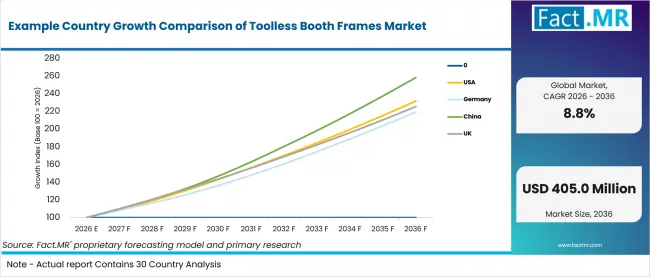
Example Country Growth Comparison Of Toolless Booth Frames Market | Source: Fact.MR
| Country | CAGR (2026-2036) |
|---|---|
| UAE | 9.5% |
| USA | 8.8% |
| Japan | 8.7% |
| UK | 8.5% |
| Germany | 8.2% |
Source: Fact.MR analysis. Updated Jul 28, 2026
How is UAE scaling demand?
9.5% CAGR, driven by high venue turnover and international event participation.
The UAE market benefits from a concentrated exhibition network in Dubai and Abu Dhabi, where international shows often follow closely scheduled setup and dismantling periods. Portable frame systems help contractors respond to late freight arrivals and strict handover deadlines. Local installation support becomes especially important when overseas exhibitors require consistent booth quality without bringing their full technical teams.
What is driving USA growth from 2026 to 2036?
8.8% CAGR, backed by labor planning and measurement-led procurement.
In the USA, adoption is closely linked to union labor charges, installation schedules and the cost of moving booth assets between regional events. Buyers are likely to assess toolless systems through recorded setup hours rather than product claims alone. Wider use will rely on measurable labor savings, dependable connector life and training materials that reduce mistakes by changing crews.
How is Japan developing demand?
8.7% CAGR, driven by compact booth formats and reliable operation.
Japan presents a strong use case for lightweight frames because exhibition space is often carefully planned and storage capacity can be limited. Buyers value systems that produce straight lines, clean joints and predictable dimensions within compact stands. Suppliers can strengthen their position by offering precise assembly guidance, low-profile connectors and replacement support that protects presentation quality over repeated use.
How does UK perform?
8.5% CAGR, led by recurring exhibitions and rental-system demand.
The UK market is shaped by exhibition contractors and rental providers that repeatedly move booth inventory between venues such as London, Birmingham and Manchester. Toolless systems can improve fleet utilization when the same components support several stand layouts. Commercial acceptance will depend on durable locking points, simple condition checks and records that help rental teams decide whether parts are ready for redeployment.
What supports Germany’s growth?
8.2% CAGR, backed by technical venue requirements and documentation-led adoption.
Germany’s large trade-fair sector places greater emphasis on structural documentation, installation discipline and venue approval than on setup speed alone. Reusable frames must fit established safety and inspection procedures before contractors add them to standard inventories. Demand is therefore more likely to favor systems with defined load limits, traceable components and assembly instructions that simplify technical review.
Who leads the Toolless Booth Frames Market?
beMatrix and Aluvision are key companies in the market. Octanorm adds modular wall systems that can be assembled without tools. Classic Exhibits and Mark Bric Display expand the market through portable booth and display products.
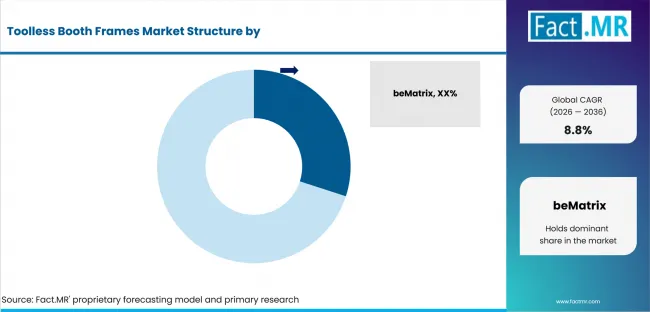
Toolless Booth Frames Market Analysis By Company | Source: Fact.MR
beMatrix offers reusable frames for exhibition and event builders. Aluvision provides modular aluminum systems for tool-free booth assembly. Octanorm supplies wall and frame systems for exhibition and retail use. Classic Exhibits focuses on portable and rental displays. Mark Bric Display offers folding display products for quick booth setup.
From 2026 to 2036, competition will focus on reliable connectors, easy transport and access to spare parts. Providers with clear instructions and strong service support are likely to attract more agencies and repeat exhibitors.
Which companies are the key providers?
Key companies include beMatrix; Aluvision; Octanorm; Classic Exhibits; and Mark Bric Display.
- beMatrix
- Aluvision
- Octanorm
- Classic Exhibits
- Mark Bric Display
Bibliography
- U.S. Geological Survey. (2025, January 31). Mineral commodity summaries 2025.
- Board of Trustees of the Tate Gallery. (2025, January 13). Tate Modern Blavatnik L2 South Gallery redesign: Creating a flexible and sustainable exhibition space. Find a Tender Service.
- European Commission, Directorate-General for Internal Market, Industry, Entrepreneurship and SMEs. (2025, January 7). New EU rules on the safety and sustainability of construction products mark a new step for the sector’s competitiveness.
- National Bureau of Statistics of China. (2026, January 20). Industrial production operation in De
- Government of Dubai Media Office. (2026, April 7). DWTC welcomes nearly 3 million participants in 2025, reinforcing Dubai’s position as a leading global business destination.
This Report Answers
- The report provides strategic intelligence on the Toolless Booth Frames Market across Connection System and Frame Material choices that shape exhibition-frame purchasing programs.
- Segment analysis covers Snap-lock connectors and Aluminum extrusion as the share leaders within the 2026 market.
- Country outlook evaluates China and UAE alongside USA and Japan. UK and Germany complete the growth comparison across the profiled markets.
- Competitive analysis profiles beMatrix and Aluvision alongside Octanorm and Classic Exhibits. Mark Bric Display completes the provider set.
- Use-case assessment separates jewelry display stands from booth frames when display props are not sold as structural frames. It explains where retail display racks remain outside this product boundary. Interactive display elements are included only when they attach to a structural booth frame.
What does the Toolless Booth Frames Market cover?
Exhibition frames are used to create temporary booth structures where faster installation and repeatable geometry matter during show setup.
The Toolless Booth Frames Market covers snap-lock and cam-lock frame systems used in exhibitions and temporary business events. Push-fit, magnetic and quick-release systems are included when they provide the booth-frame function. Coverage extends to portable inline booths and modular island booths. Retail signage is included only when the frame is sold as a structural booth system.
The market differs from broad event equipment because commercial value comes from the toolless connection function. Traditional bolted stands and general scaffolding remain outside the boundary. A standalone display device is excluded unless it is sold as part of the defined booth-frame system.
What is included in the scope?
Toolless booth frame systems are used by exhibitors and agencies. Rental providers, venues and brand-activation operators are included in the same scope.
The scope includes Connection System and Frame Material alongside Booth Type, Buyer Need and Sales Model. Coverage spans snap-lock connectors and cam-lock frames. Push-fit tubes, magnetic couplers and quick-release clamps complete the connection scope. Aluminum extrusion and composite tubes are included. Steel-reinforced frames and hybrid fabric frames follow the same product-use rule.
What is excluded from the scope?
Traditional bolted custom stands and general scaffolding remain outside the scope of this market. Venue labor and standalone metal extrusions remain outside the defined boundary.
The scope excludes unrelated venue construction, general event management and floor-space rental. It excludes display props that do not provide the defined frame function. Standalone graphics, lighting and furniture are excluded unless they are sold as part of a complete toolless booth-frame solution. Prefabricated panels remain outside scope unless the panel is integrated into a reusable frame system.
How Was the Analysis Built?
The analysis draws on 120+ sources, 35+ company portfolios, 25+ countries, and more than 20 industry interviews.
- Primary Research: Primary research includes discussions with manufacturers, service providers, technology developers, distributors, end users, procurement teams, and subject-matter experts. These conversations examine purchasing priorities, product adoption, operational challenges, approval requirements, competitive positioning, and the factors that influence wider market acceptance.
- Desk Research: Desk research covers government statistics, regulatory publications, company filings, trade data, technical studies, industry associations, standards, public policy, and other authoritative sources. Every source used in the analysis is documented in the bibliography.
- Market Sizing and Forecasting: Market estimates combine historical performance, demand indicators, pricing and volume trends, segment shares, company participation, country-level growth, adoption patterns, investment activity, and barriers to market expansion.
- Data Validation and Update Cycle: Findings are validated by comparing primary interviews with public data, company activity, regulatory changes, trade patterns, and industry developments. Regular updates review new product launches, capacity changes, partnerships, approvals, procurement trends, and shifts in commercial adoption.
Segmentation
What is the report's scope and coverage?
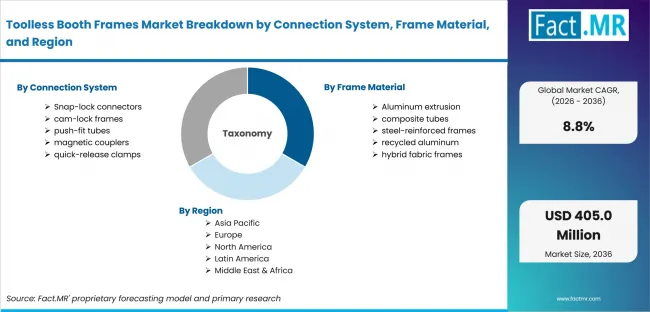
Toolless Booth Frames Market Breakdown By Connection System, Frame Material, And Region | Source: Fact.MR
| Attribute | Details |
|---|---|
| Quantitative Units | USD million in 2026 to USD million by 2036 at CAGR |
| Market Definition | Exhibition frame systems designed to assemble through locks, couplers or clamps without conventional fastening tools where lock confirmation, connector condition and repeated geometry determine commercial use |
| Connection System | Snap-lock connectors; cam-lock frames; push-fit tubes; magnetic couplers; quick-release clamps |
| Frame Material | Aluminum extrusion; composite tubes; steel-reinforced frames; recycled aluminum; hybrid fabric frames |
| Booth Type | Portable inline booth; modular island booth; retail pop-up; demo pod; conference exhibit wall |
| Buyer Need | Labor reduction; fast install; freight savings; reusable inventory; small-team setup |
| Sales Model | Purchased kits; rental systems; distributor bundles; custom engineered frames; agency-managed inventory |
| Regions Covered | North America; Latin America; Europe; East Asia; South Asia & Oceania; Middle East & Africa |
| Countries Covered | USA; Canada; Brazil; Mexico; Germany; U.K.; France; Italy; Spain; South Korea; Japan; Australia & New Zealand; GCC Countries; South Africa; UAE |
| Key Companies Profiled | beMatrix; Aluvision; Octanorm; Classic Exhibits; Mark Bric Display |
| Forecast Period | 2026 to 2036 |
| Approach | Hybrid top-down and bottom-up approach using exhibition demand indicators; segment shares; country growth; company participation; connector reliability; rental and portable system adoption; venue turnaround needs; and service-depth review |
Source: Fact.MR analysis. Updated Jul 28, 2026
How is the market segmented?
-
By Connection System:
- Snap-lock connectors
- cam-lock frames
- push-fit tubes
- magnetic couplers
- quick-release clamps
-
By Frame Material:
- Aluminum extrusion
- composite tubes
- steel-reinforced frames
- recycled aluminum
- hybrid fabric frames
-
By Booth Type:
- Portable inline booth
- modular island booth
- retail pop-up
- demo pod
- conference exhibit wall
-
By Buyer Need:
- Labor reduction
- fast install
- freight savings
- reusable inventory
- small-team setup
-
By Sales Model:
- Purchased kits
- rental systems
- distributor bundles
- custom engineered frames
- agency-managed inventory
-
By Region:
- North America
- USA
- Canada
- Latin America
- Brazil
- Mexico
- Rest of Latin America
- Europe
- Germany
- U.K.
- France
- Italy
- Spain
- Rest of Europe
- East Asia
- South Korea
- Japan
- China
- South Asia & Oceania
- India
- Australia & New Zealand
- Rest of South Asia & Oceania
- Middle East & Africa
- GCC Countries
- South Africa
- UAE
- Rest of Middle East & Africa
- North America
Frequently Asked Questions
Which Connection System leads the market?
Which Frame Material leads the market?
Which Booth Type leads the market?
Which Buyer Need leads the market?
Which Sales Model leads the market?
What is the primary driver in this market?
What is the main restraint?
Why do snap-lock connectors lead demand?
Who worked on this report


Preview the report firsthand - request a free sample
Free SampleGet the brochure for pricing and purchase details
Download PDF