- Market Value (2025): USD 46.1 Bn
- Estimated Value (2026): USD 48.3 Bn
- Forecast Value (2036): USD 76.5 Bn
- CAGR (2026-2036): 4.7%
What is the Water Borne Resins Market forecast to be worth by 2036?
USD 48.3 billion in 2026 to USD 76.5 billion by 2036, at a 4.7% CAGR.
Acrylic demand should be read beside Fact.MR's Waterborne Acrylic Resin Market, since acrylic chemistry anchors many low-VOC coating formulations.
- The water borne resins market reached USD 46.1 billion in 2025 as coatings formulators and industrial coating buyers spent against a clear use case: low-VOC resin binders that deliver film formation, adhesion, durability and application performance in water-based coatings and related systems.
- Demand is projected to increase from USD 48.3 billion in 2026 to USD 76.5 billion by 2036, at a 4.7% CAGR.
- The market is forecast to record 4.7% CAGR from 2026 to 2036 as companies prove low-VOC resin binders that deliver film formation and related systems.
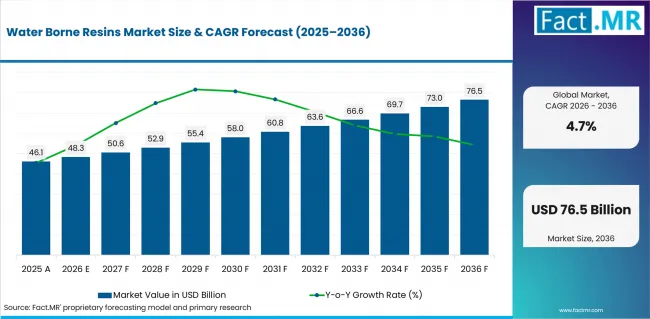
Water Borne Resins Market Value Analysis | Source: Fact.MR
What are the defining numbers behind Water Borne Resins Market growth?
USD 28.2 billion absolute opportunity is expected by 2036.
End-use pull connects with Fact.MR's Architectural Coatings Market, where builders and repaint buyers shift toward lower-odor coating systems.
- Demand Drivers in the Market
- Acrylic resins lead as architectural coatings need cost-effective binders with color retention, weatherability, adhesion and broad formulation flexibility.
- Architectural coatings lead as construction, renovation and repainting use large coating volumes and face direct VOC-content expectations.
- Building and construction leads because wall paints, primers, sealers, wood coatings and protective coatings create repeat demand for water-based resin systems.
- Direct sales lead as formulators need technical support, resin selection, pilot batches and troubleshooting around application and performance.
- Key Segments Analyzed
- By Resin Type: Acrylic Resins is projected to hold 38.3% share in 2026. Acrylic resins lead as they give architectural coatings a practical balance of weatherability, adhesion, color retention and cost.
- By End User: Building & Construction is projected to hold 29.5% share in 2026. Building and construction leads because repainting, renovation and new construction create recurring demand for water-based coating binders.
- By Distribution Channel: Direct Sales is projected to hold 30.8% share in 2026. Direct sales lead as resin choice requires formulation support, technical data, performance testing and application troubleshooting.
- By Technology: Water-Based Acrylic Technology is projected to hold 43.3% share in 2026. Water-Based Acrylic Technology leads because it is widely understood by formulators and fits mainstream architectural coating requirements.
- Analyst Opinion at Fact.MR
- Shambhu Nath Jha, Sr. Consultant at Fact.MR, opines, "Waterborne resins grow when environmental compliance and coating performance meet in the same formulation. Acrylics lead as they solve the everyday architectural-coatings job at scale."
- Strategic Implications
- Resin companies should sell validated formulation windows instead of resin chemistry alone.
- Coatings brands should link waterborne claims to VOC compliance, application performance and durability proof.
- Distributors can add value by supporting small and mid-sized formulators with technical data and sample programs.
USA continues to be a leading market and is projected to grow at a CAGR of 6.13%; other key markets include USA, Germany, Canada, UK.
How does the Water Borne Resins Market break down by segment?
Acrylic Resins leads Resin Type at 38.3%.
Polymer supply should be compared with Fact.MR's Emulsion Polymers Market, because waterborne resin performance depends on stable latex and dispersion quality.
Why does Acrylic Resins lead Resin Type?
Acrylic Resins is projected to account for 38.3% share in 2026.
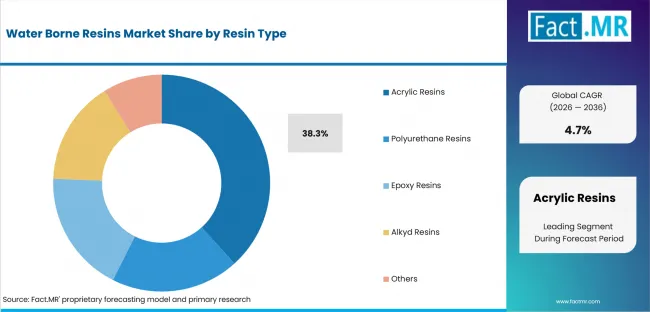
Water Borne Resins Market Analysis By Resin Type | Source: Fact.MR
Acrylic resins lead as they give architectural coatings a practical balance of weatherability, adhesion, color retention and cost.
Why does Architectural Coatings lead Application?
Architectural Coatings is projected to account for 30.8% share in 2026.

Water Borne Resins Market Analysis By Application | Source: Fact.MR
Architectural coatings lead because waterborne resins help paint producers meet VOC limits while maintaining adhesion, durability and appearance for interior and exterior coatings.
Why does Building & Construction lead End User?
Building & Construction is projected to account for 29.5% share in 2026.
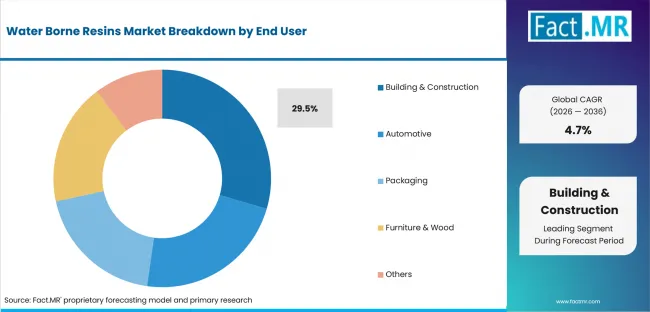
Water Borne Resins Market Analysis By End User | Source: Fact.MR
Building and construction leads because repainting, renovation and new construction create recurring demand for water-based coating binders.
Why does Direct Sales lead Distribution Channel?
Direct Sales is projected to account for 34.6% share in 2026.
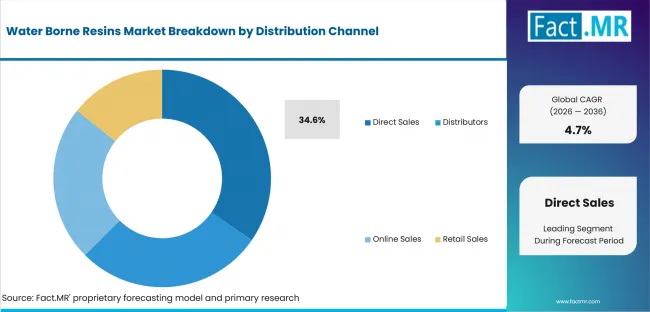
Water Borne Resins Market Analysis By Distribution Channel | Source: Fact.MR
Direct sales lead as resin choice requires formulation support, technical data, performance testing and application troubleshooting.
Why does Water-Based Acrylic Technology lead Technology?
Water-Based Acrylic Technology is projected to account for 43.3% share in 2026.
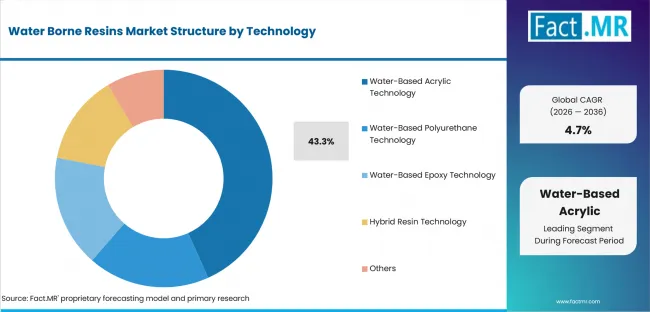
Water Borne Resins Market Analysis By Technology | Source: Fact.MR
Water-Based Acrylic Technology leads because it is widely understood by formulators and fits mainstream architectural coating requirements.
What is accelerating Water Borne Resins Market adoption, and what is holding it back?
Waterborne resin demand rises when coating formulators need lower-VOC binders that still meet adhesion, film-formation and durability requirements. Adoption slows when resin changes force reformulation work or reduce application performance in demanding coatings.
High-performance applications link to Fact.MR's Waterborne Polyurethane Dispersion Market, where abrasion resistance and flexibility matter.
Drivers Impact Analysis
| DRIVER | QUALITATIVE RELEVANCE | GEOGRAPHIC RELEVANCE | IMPACT TIMELINE |
|---|---|---|---|
| Acrylic binder performance in coatings | High | South Korea | Short term (<=2 years) |
| Architectural coating VOC pressure | High | USA | Short term (<=2 years) |
| Building renovation and repainting demand | Moderate | Germany | Medium term (2-4 years) |
| Direct formulation support | Selective | Canada | Medium term (2-4 years) |
Source: Fact.MR analysis. Updated Jul 30, 2026
- Acrylic binder performance in coatings: Acrylic resins lead as architectural coatings need cost-effective binders with color retention, weatherability, adhesion and broad formulation flexibility.
- Architectural coating VOC pressure: Architectural coatings lead as construction, renovation and repainting use large coating volumes and face direct VOC-content expectations.
- Building renovation and repainting demand: Building and construction leads because wall paints, primers, sealers, wood coatings and protective coatings create repeat demand for water-based resin systems.
- Direct formulation support: Direct sales lead as formulators need technical support, resin selection, pilot batches and troubleshooting around application and performance.
Opportunity Impact Analysis
| OPPORTUNITY | QUALITATIVE RELEVANCE | GEOGRAPHIC RELEVANCE | IMPACT TIMELINE |
|---|---|---|---|
| Low-VOC interior coating systems | High | USA | Medium term (2-4 years) |
| Industrial hybrid waterborne systems | Moderate | South Korea | Medium term (2-4 years) |
| Technical service-led resin selling | Selective | Germany | Medium term (2-4 years) |
Source: Fact.MR analysis. Updated Jul 30, 2026
- Low-VOC interior coating systems: Low-VOC and low-odor interior coatings can support premium resin demand in residential and commercial buildings.
- Industrial hybrid waterborne systems: Hybrid acrylic, epoxy and polyurethane systems can open industrial applications that previously relied on solvent-borne chemistry.
- Technical service-led resin selling: Technical service around formulation stability, coalescent reduction and application performance can help companies defend margins.
Restraints Impact Analysis
| RESTRAINT | QUALITATIVE RELEVANCE | GEOGRAPHIC RELEVANCE | IMPACT TIMELINE |
|---|---|---|---|
| Solvent-borne performance benchmark | High | South Korea | Short term (<=2 years) |
| Acrylic and additive cost swings | Moderate | USA | Medium term (2-4 years) |
| Low-VOC formulation complexity | Selective | Germany | Medium term (2-4 years) |
Source: Fact.MR analysis. Updated Jul 30, 2026
- Solvent-borne performance benchmark: Performance gaps in harsh industrial or exterior settings can slow conversion from solvent-borne systems.
- Acrylic and additive cost swings: Raw-material price swings in acrylic monomers, additives and specialty chemicals can pressure coating margins.
- Low-VOC formulation complexity: Formulation complexity rises when buyers demand lower VOC, faster dry time and higher durability in the same system.
Which countries are scaling Water Borne Resins Market fastest?
Country rates show where buying conditions and supplier proof are already stronger.
Formulation economics connect with Fact.MR's Coating Binders Market, since binders decide adhesion, film formation and durability.
- South Korea: The market is expected to grow at a CAGR of 3.32% from 2026 to 2036. South Korea's demand is supported by coatings manufacturing, construction activity and export-oriented material quality expectations.
- USA: The market is expected to grow at a CAGR of 6.13% from 2026 to 2036. USA growth is shaped by architectural coating VOC rules, renovation demand and large retail paint channels.
- Germany: The market is expected to grow at a CAGR of 5.18% from 2026 to 2036. Germany's market is guided by environmental compliance, high coating-performance expectations and strong chemical manufacturing capability.
- Canada: The market is expected to grow at a CAGR of 4.25% from 2026 to 2036. Canada follows renovation and construction demand, with VOC rules and cold-weather application performance influencing formulation choices.
- UK: The market is expected to grow at a CAGR of 4.67% from 2026 to 2036. UK adoption is tied to refurbishment, low-odor interior coatings and compliance with chemical and building-material expectations.
- Japan: The market is expected to grow at a CAGR of 5.64% from 2026 to 2036. Japan's demand is shaped by high-quality coatings, compact housing refurbishment and careful company qualification.
- Australia: The market is expected to grow at a CAGR of 3.75% from 2026 to 2036. Australia's growth is supported by construction and exterior coating needs, with UV durability and field performance important.
The full report provides country-level CAGR analysis across North America, Latin America, Europe, East Asia, South Asia and Oceania, and the Middle East and Africa.
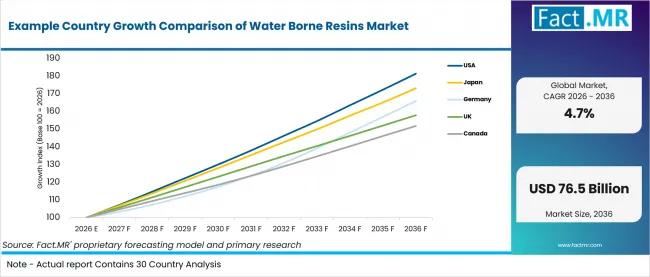
Example Country Growth Comparison Of Water Borne Resins Market | Source: Fact.MR
| Country | CAGR (2026-2036) |
|---|---|
| South Korea | 3.32% |
| USA | 6.13% |
| Germany | 5.18% |
| Canada | 4.25% |
| UK | 4.67% |
| Japan | 5.64% |
| Australia | 3.75% |
Source: Fact.MR analysis. Updated Jul 30, 2026
What is shaping South Korea's outlook through 2036?
3.32% CAGR from 2026 to 2036.
South Korea's demand is supported by coatings manufacturing, construction activity and export-oriented material quality expectations.
What is shaping USA's outlook through 2036?
6.13% CAGR from 2026 to 2036.
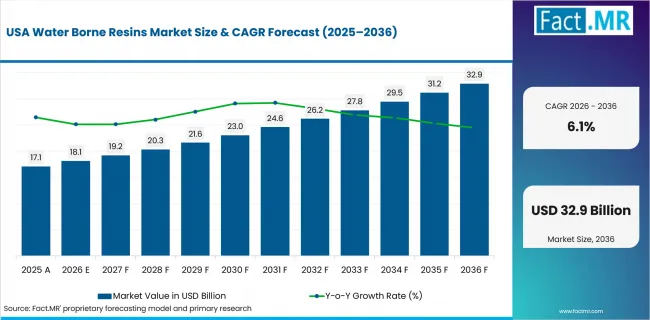
Water Borne Resins Market Country Value Analysis | Source: Fact.MR
USA growth is shaped by architectural coating VOC rules, renovation demand and large retail paint channels.
What is shaping Germany's outlook through 2036?
5.18% CAGR from 2026 to 2036.
Germany's market is guided by environmental compliance, high coating-performance expectations and strong chemical manufacturing capability.
What is shaping Canada's outlook through 2036?
4.25% CAGR from 2026 to 2036.
Canada follows renovation and construction demand, with VOC rules and cold-weather application performance influencing formulation choices.
What is shaping UK's outlook through 2036?
4.67% CAGR from 2026 to 2036.
UK adoption is tied to refurbishment, low-odor interior coatings and compliance with chemical and building-material expectations.
Who leads the Water Borne Resins Market?
BASF SE; Arkema S.A.; Covestro AG; Allnex GmbH are among the visible providers in the water borne resins market.
BASF SE and Arkema S.A. are among the most visible providers. Competition is shaped by product proof, channel access and buyer trust.
Between 2026 and 2036, market rivalry is likely to center on clearer positioning around Acrylic Resins, stronger documentation and better support at the point of purchase.
Which companies are the key providers?
Key companies include BASF SE; Arkema S.A.; Covestro AG; Allnex GmbH; Dow Inc.; DSM-Firmenich; Synthomer plc; Evonik Industries AG.
- BASF SE
- Arkema S.A.
- Covestro AG
- Allnex GmbH
- Dow Inc.
- DSM-Firmenich
- Synthomer plc
- Evonik Industries AG
Bibliography
- U.S. EPA, Architectural Coatings VOC Standards.
- eCFR, 40 CFR Part 59 Subpart D.
- Government of Canada, VOC Concentration Limits for Architectural Coatings Regulations.
- American Coatings Association, Sustainability Report.
- American Coatings Association, Current Trends in Interior Architectural Coatings.
- Fact.MR, Waterborne Acrylic Resin Market.
This Report Answers
- The report provides strategic intelligence on the Water Borne Resins Market across segment choices that shape the 2026 market structure.
- Segment analysis covers Acrylic Resins and Architectural Coatings as the share leaders within the 2026 market.
- Country outlook evaluates the listed markets by CAGR and explains the adoption conditions in each country.
- Competitive analysis profiles the named providers and evaluates competition around product proof, channel access and buyer trust.
- Related Fact.MR coverage helps readers compare waterborne resins with coating binders, emulsion polymers and waterborne polyurethane dispersions.
What does the Water Borne Resins Market cover?
The Water Borne Resins Market covers acrylic, polyurethane, epoxy, alkyd, polyester and hybrid waterborne resin systems used in architectural coatings, industrial coatings, adhesives, sealants, automotive coatings and related applications.
The Water Borne Resins Market covers acrylic, polyurethane, epoxy, alkyd, polyester and hybrid waterborne resin systems used in architectural coatings, industrial coatings, adhesives, sealants, automotive coatings and related applications.
Adjacent spending is included only when it is part of the same purchase decision or operating use case.
What is included in the scope?
The scope includes Resin Type, Application, End User, Distribution Channel, Technology and regional demand.
Coverage includes adjacent segment options only when they are purchased for the same defined market use.
What is excluded from the scope?
solvent-borne resins, powder resins, finished paints without identifiable waterborne resin supply, and unrelated polymer products not used as coating or adhesive binders.
The scope excludes solvent-borne resins, powder resins, finished paints without identifiable waterborne resin supply, and unrelated polymer products not used as coating or adhesive binders.
How Was the Analysis Built?
The analysis combines primary research with desk research focused on the water borne resins market, its segment structure and country-level demand.
- Primary Research: Interviews and validation discussions test buyer priorities, adoption barriers, pricing logic and operating requirements.
- Desk Research: The assessment reviews company disclosures, public datasets, regulatory material, technical literature and industry records relevant to the market.
- Market Sizing and Forecasting: Estimates combine top-down and bottom-up checks across demand signals, segment shares, country activity, company participation and adoption constraints.
- Data Validation and Update Cycle: Findings are validated against public evidence, company activity and country-level adoption patterns before final use.
Segmentation
What is the report's scope and coverage?
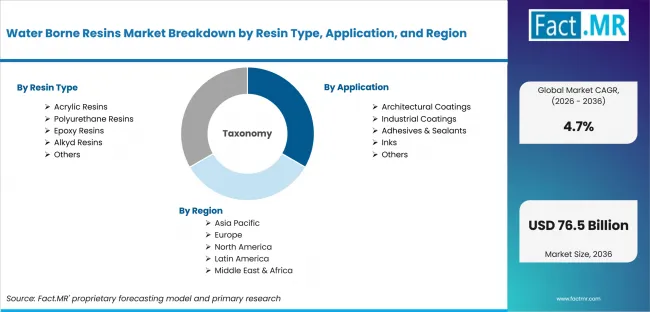
Water Borne Resins Market Breakdown By Resin Type, Application, And Region | Source: Fact.MR
| Attribute | Details |
|---|---|
| Quantitative Units | USD 48.3 billion in 2026 to USD 76.5 billion by 2036, at a 4.7% CAGR. |
| Market Definition | Water Borne Resins Market covers acrylic, polyurethane, epoxy, alkyd, polyester and hybrid waterborne resin systems used in architectural coatings, industrial coatings, adhesives, sealants, automotive coatings and related applications. |
| Resin Type | Acrylic Resins; Pure Acrylic Resins; Styrene Acrylic Resins; Polyurethane Resins; Aliphatic Polyurethane; Aromatic Polyurethane; Epoxy Resins; Water-Based Epoxy Dispersions; Epoxy Ester Resins; Alkyd Resins; Modified Alkyd Resins; Emulsified Alkyd Resins; Others; Polyester Resins; Hybrid Resins |
| Application | Architectural Coatings; Interior Coatings; Exterior Coatings; Industrial Coatings; Protective Coatings; Metal Coatings; Adhesives & Sealants; Packaging Adhesives; Construction Sealants; Inks; Flexographic Inks; Digital Printing Inks; Others; Textile Finishes; Wood Coatings |
| End User | Building & Construction; Residential Construction; Commercial Construction; Automotive; OEM Coatings; Refinishing Coatings; Packaging; Flexible Packaging; Rigid Packaging; Furniture & Wood; Wood Furniture; Modular Furniture; Others; Textiles; Electronics |
| Distribution Channel | Direct Sales; Key Account Sales; OEM Supply Agreements; Distributors; Industrial Distributors; Chemical Distributors; Online Sales; Manufacturer Portals; B2B E-commerce Platforms; Retail Sales; Specialty Chemical Stores; Building Material Stores |
| Technology | Water-Based Acrylic Technology; Thermoplastic Acrylic; Thermosetting Acrylic; Water-Based Polyurethane Technology; PUD Technology; Hybrid Polyurethane; Water-Based Epoxy Technology; Epoxy Dispersion; Epoxy Emulsion; Hybrid Resin Technology; Acrylic-Polyurethane Hybrid; Epoxy-Acrylic Hybrid; Others; Bio-Based Waterborne Resins; Nanocomposite Waterborne Resins |
| Regions Covered | North America; Latin America; Europe; East Asia; South Asia and Oceania; Middle East and Africa |
| Countries Covered | South Korea; USA; Germany; Canada; UK; Japan; Australia |
| Key Companies Profiled | BASF SE; Arkema S.A.; Covestro AG; Allnex GmbH; Dow Inc.; DSM-Firmenich; Synthomer plc; Evonik Industries AG |
| Forecast Period | 2026 to 2036 |
| Approach | Hybrid top-down and bottom-up assessment using demand indicators, segment mix, country growth, company participation and public evidence relevant to the category. |
Source: Fact.MR analysis. Updated Jul 30, 2026
How is the market segmented?
-
By Resin Type:
- Acrylic Resins
- Pure Acrylic Resins
- Styrene Acrylic Resins
- Polyurethane Resins
- Aliphatic Polyurethane
- Aromatic Polyurethane
- Epoxy Resins
- Water-Based Epoxy Dispersions
- Epoxy Ester Resins
- Alkyd Resins
- Modified Alkyd Resins
- Emulsified Alkyd Resins
- Others
- Polyester Resins
- Hybrid Resins
-
By Application:
- Architectural Coatings
- Interior Coatings
- Exterior Coatings
- Industrial Coatings
- Protective Coatings
- Metal Coatings
- Adhesives & Sealants
- Packaging Adhesives
- Construction Sealants
- Inks
- Flexographic Inks
- Digital Printing Inks
- Others
- Textile Finishes
- Wood Coatings
-
By End User:
- Building & Construction
- Residential Construction
- Commercial Construction
- Automotive
- OEM Coatings
- Refinishing Coatings
- Packaging
- Flexible Packaging
- Rigid Packaging
- Furniture & Wood
- Wood Furniture
- Modular Furniture
- Others
- Textiles
- Electronics
-
By Distribution Channel:
- Direct Sales
- Key Account Sales
- OEM Supply Agreements
- Distributors
- Industrial Distributors
- Chemical Distributors
- Online Sales
- Manufacturer Portals
- B2B E-commerce Platforms
- Retail Sales
- Specialty Chemical Stores
- Building Material Stores
-
By Technology:
- Water-Based Acrylic Technology
- Thermoplastic Acrylic
- Thermosetting Acrylic
- Water-Based Polyurethane Technology
- PUD Technology
- Hybrid Polyurethane
- Water-Based Epoxy Technology
- Epoxy Dispersion
- Epoxy Emulsion
- Hybrid Resin Technology
- Acrylic-Polyurethane Hybrid
- Epoxy-Acrylic Hybrid
- Others
- Bio-Based Waterborne Resins
- Nanocomposite Waterborne Resins
-
By Region:
- North America
- Latin America
- Europe
- East Asia
- South Asia and Oceania
- Middle East and Africa
Frequently Asked Questions
Which Resin Type leads the market?
Which Application leads the market?
Which End User leads the market?
Which Distribution Channel leads the market?
Which Technology leads the market?
Which country records the highest listed CAGR?
What is the primary driver in this market?
What is the main restraint?
Who worked on this report


Preview the report firsthand - request a free sample
Free SampleGet the brochure for pricing and purchase details
Download PDF