- Base Value(2025): 302.4 Mn
- Estimated Value(2026): 324.8 Mn
- Forecast Value (2036): 663.2 Mn
- CAGR (2026 - 2036): 7.4%
Yersinia Diagnostics Market Forecast and Outlook by Fact.MR
- The yersinia diagnostics market crossed a valuation of USD 302.4 million in 2025.
- Based on Fact.MR analysis, demand is estimated to reach USD 324.8 million in 2026 and USD 663.2 million by 2036.
- Fact.MR projects a 7.4% CAGR during the forecast period.
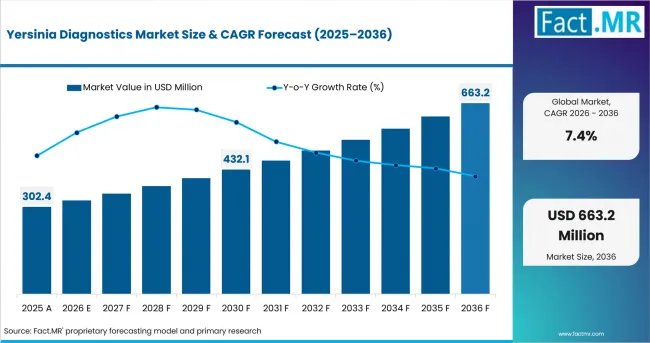
Yersinia Diagnostics Market Value Analysis | Source: Fact.MR
Summary of Yersinia Diagnostics Market
- Demand Drivers
- FoodNet surveillance is raising Yersinia diagnostic use in North American clinical and food safety labs. Hospital labs are also using multiplex gastrointestinal panels for acute gastroenteritis cases.
- European yersiniosis reporting supports steady demand for Yersinia diagnostic assays. Public health surveillance and confirmed case tracking keep routine testing active across established lab networks.
- Asia Pacific lab expansion is increasing demand for multiplex Yersinia testing. China and India are adding syndromic stool panels as hospitals and private diagnostic chains improve enteric infection workflows.
- Key Segments Analyzed
- By Disease Type: Yersiniosis is projected to account for 63.9% share in 2026 as most routine yersinia testing is tied to gastrointestinal infection workups.
- By Application: Clinical diagnostics is projected to account for 58.4% share in 2026 because stool testing forms the main revenue source.
- By Sample Type: Stool samples are projected to account for 52.1% share in 2026 as most Yersinia enterocolitica testing starts with gastrointestinal specimens.
- By Product: Kits and reagents are projected to account for 46.7% share in 2026 because recurring consumable use supports repeat revenue.
- By Technology: Multiplex PCR is projected to account for 41.8% share in 2026 as syndromic panels reduce the need for sequential testing.
- Analyst Opinion at Fact.MR
- Shambhu Nath Jha, Principal Consultant at Fact.MR, opines, “CXOs will see yersinia diagnostics move from rare standalone culture work toward stool panel menus. Suppliers can gain an edge with panels that detect Yersinia and still support culture confirmation for outbreak work.”
- Strategic Implications
- Manufacturers should keep yersinia targets in gastrointestinal panel menus as labs prefer one stool sample and one workflow.
- Food safety suppliers should position PCR kits with culture confirmation as regulators and labs still need isolates for source tracing.
- Regional distributors should prioritize hospitals and public health labs that handle acute gastroenteritis cases and foodborne outbreak checks.
The market is forecast to generate an incremental revenue opportunity of USD 338.4 million between 2026 and 2036. Hospital laboratories are moving from slow single-pathogen testing to multiplex stool panels for acute gastrointestinal illness. Food safety laboratories still use culture-based testing because isolate recovery helps outbreak tracing. High panel cost slows adoption in smaller laboratories.
China is projected to record a 9.2% CAGR through 2036 as hospital labs add syndromic testing for enteric infection workups. India follows at 8.8% CAGR from 2026 to 2036 as private diagnostic chains expand multiplex stool panels in large cities. The United States records 7.2% CAGR by 2036 as FoodNet surveillance keeps Yersinia testing within enteric pathogen monitoring. Germany advances at 6.8% CAGR from 2026 to 2036 as laboratory-confirmed yersiniosis remains tracked in public health reporting. France records 6.5% CAGR through 2036 as case reporting supports routine gastrointestinal testing. The United Kingdom posts 6.3% CAGR by 2063 as updated notification rules strengthen laboratory reporting. Japan expands at 6.1% CAGR from 2026 to 2036 as hospital labs use syndromic panels for pediatric and acute gastroenteritis testing.
Segmental Analysis
Yersinia Diagnostics Market Analysis by Disease Type
Yersiniosis is likely to hold 63.9% share in 2026 as most test demand starts with suspected foodborne gastrointestinal illness. Yersinia enterocolitica remains the main target for stool panels and culture media. A CDC FoodNet analysis recorded 294 Y. enterocolitica species-level reports in 2023. This shows why labs need species identification after first detection. [1]
- Yersiniosis Testing Outlook: Clinical labs keep yersiniosis at the center of yersinia diagnostics because symptoms often resemble other foodborne infections.
- Plague Testing Need: Public health labs retain Yersinia pestis capacity for urgent outbreak response, even though routine volume is much lower. WHO guidance says serious plague events use three notification conditions under International Health Regulations. [6]
- Pseudotuberculosis Testing Use: Reference labs use targeted tests for Yersinia pseudotuberculosis in selected cases that need species-level confirmation.
Yersinia Diagnostics Market Analysis by Application
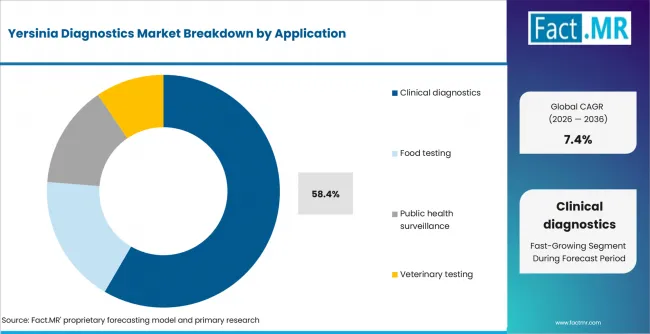
Yersinia Diagnostics Market Analysis By Application | Source: Fact.MR
Clinical diagnostics is projected to account for 58.4% share in 2026 as hospitals and reference labs handle most patient testing. Demand comes from faster results for acute gastrointestinal illness. Culture confirmation continues after molecular positives because public health agencies need isolates for typing.
- Hospital Lab Demand: Hospitals use yersinia testing mainly for acute gastrointestinal cases that need lab confirmation.
- Food Safety Testing: Food labs use PCR screening for pork and vegetable samples, then apply culture methods for isolate recovery.
- Public Health Surveillance: National labs keep yersinia testing capacity for outbreak checks and reportable disease workflows.
Yersinia Diagnostics Market Analysis by Sample Type
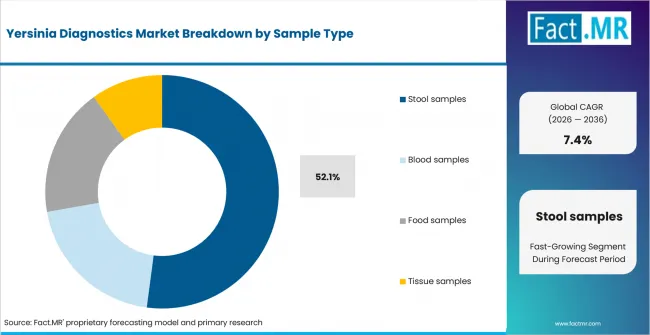
Yersinia Diagnostics Market Analysis By Sample Type | Source: Fact.MR
Stool samples are projected to hold 52.1% share in 2026 as most Yersinia enterocolitica testing starts with gastrointestinal symptoms. The QIAstat-Dx GI Panel 2 Mini B was cleared for preserved stool samples and identifies five bacterial targets including Yersinia enterocolitica. [5] This supports stool as the main sample route for revenue.
- Stool Sample Priority: Diagnostic labs favor stool-based panels because the sample matches acute gastroenteritis testing needs.
- Food Sample Demand: Food testing labs use yersinia methods for pork and produce samples that need pathogen screening.
- Blood Sample Use: Blood testing stays limited to severe disease workups and plague-related investigations that need urgent lab support.
Yersinia Diagnostics Market Analysis by Product
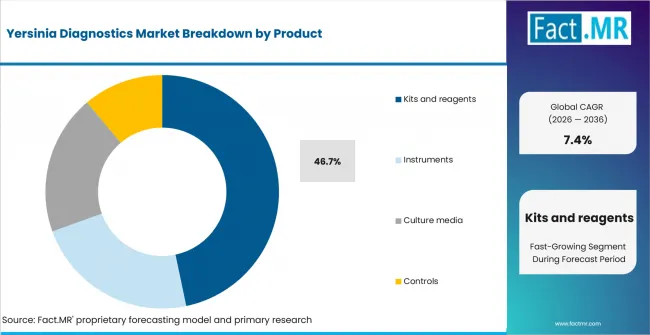
Yersinia Diagnostics Market Analysis By Product | Source: Fact.MR
Kits and reagents are likely to hold a 46.7% share in 2026 because laboratories need repeat assay supplies. Molecular kits support multiplex detection. Culture media keeps isolate recovery active DNA diagnostics also support cartridge and reagent sales in larger laboratories.
- Kit Revenue Stability: Reagent kits create repeat orders because laboratories replace consumables with every test cycle and keep stock for urgent cases.
- Culture Media Need: Culture media is needed to recover organisms after positive molecular results and support public health typing.
- Control Material Use: Quality control materials help verify PCR assays and culture workflows in regulated laboratories.
Yersinia Diagnostics Market Analysis by Technology
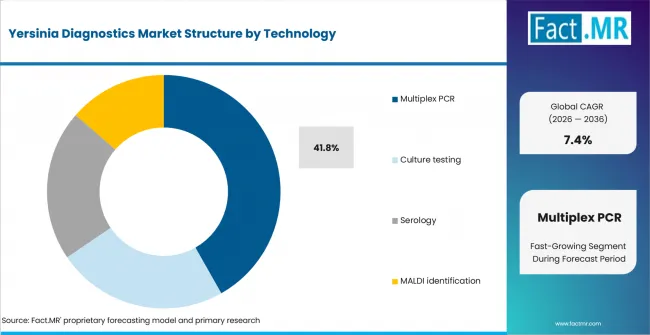
Yersinia Diagnostics Market Analysis By Technology | Source: Fact.MR
Multiplex PCR is projected to account for 41.8% share in 2026 as laboratories prefer one assay for several gastrointestinal pathogens. FDA documentation for the BioFire GI Panel Mid lists Yersinia enterocolitica and says culture is necessary for recovery and further typing [4]. This keeps molecular testing and culture active in routine work.
- PCR Menu Expansion: Multiplex PCR helps labs test for yersinia with other enteric pathogens from the same patient sample.
- Culture Testing Role: Culture testing remains important after PCR positives because laboratories need isolates for typing and outbreak source checks.
- Serology Use Limit: Serology mainly supports follow-up work and cannot replace direct detection in acute gastrointestinal illness.
Yersinia Diagnostics Market Analysis by End User
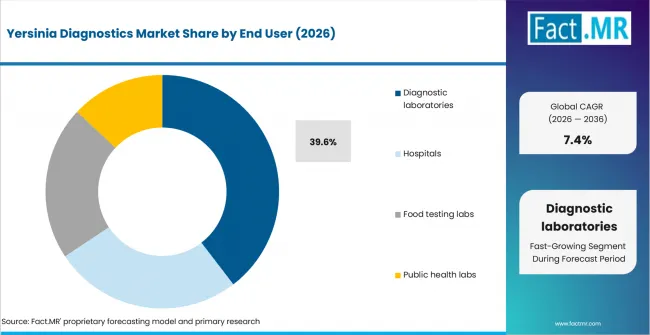
Yersinia Diagnostics Market Analysis By End User | Source: Fact.MR
Diagnostic laboratories are likely to hold a 39.6% share in 2026 because they process hospital referrals and community samples at scale. Hospitals use internal testing for urgent cases and send complex work to reference laboratories. Food testing labs create a separate revenue stream through pathogen diagnostics and rapid screening formats.
- Diagnostic Lab Volume: Reference laboratories gain test volume as hospitals centralize low-frequency yersinia requests and multiplex panel work.
- Hospital Testing Role: Hospital labs keep urgent testing access for severe gastroenteritis and suspected plague cases that need faster treatment decisions.
- Food Lab Revenue: Food testing labs buy PCR kits and culture products for routine safety checks in pork and fresh produce chains.
Drivers, Restraints, and Opportunities
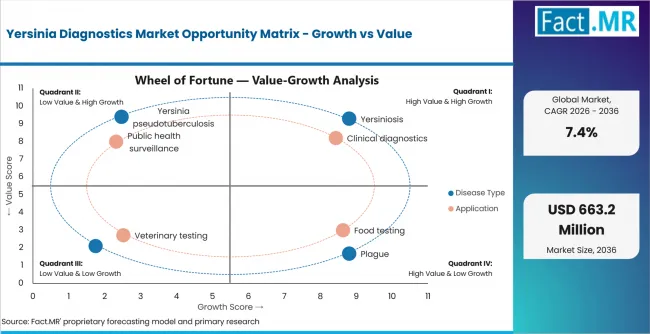
Yersinia Diagnostics Market Opportunity Matrix Growth Vs Value | Source: Fact.MR
The yersinia diagnostics market grows as gastroenteritis testing shifts toward syndromic panels and better surveillance. The European Union and European Economic Area reported 8,037 confirmed yersiniosis cases in 2022. This keeps laboratory confirmation active in national reporting systems [2]. It creates steady demand for tests that support fast screening and confirmatory culture.
Food safety testing adds another revenue stream for suppliers. The European Union reported 6,558 foodborne outbreaks in 2024. This keeps attention on pathogen testing in food chains [3]. Yersinia testing demand is smaller than Salmonella testing, but it benefits from the same food lab infrastructure. Suppliers serving point-of-care diagnostics can adapt rapid workflow knowledge for decentralized enteric testing.
- Multiplex Testing Driver: Hospital laboratories add yersinia to gastrointestinal panels because one sample workflow reduces repeat ordering and improves pathogen coverage.
- Cost Restraint: Small laboratories limit yersinia panel use as cartridge pricing and low test frequency make standalone systems harder to justify.
- Food Lab Opportunity: Food testing providers can pair PCR screening with culture confirmation for pork processors and fresh produce testing programs.
Regional Analysis
The yersinia diagnostics market is assessed across North America, Europe, East Asia, South Asia and Pacific, Latin America, and the Middle East and Africa. The assessment covers 40+ countries by disease type, application, sample type, product, technology, and end user. The full report includes market attractiveness analysis by region and country.
.webp "Top Country Growth Comparison Yersinia Diagnostics Market Cagr (2026 2036)")
Top Country Growth Comparison Yersinia Diagnostics Market Cagr (2026 2036) | Source: Fact.MR
| Country | CAGR (2026 to 2036) |
|---|---|
| China | 9.2% |
| India | 8.8% |
| United States | 7.2% |
| Germany | 6.8% |
| France | 6.5% |
| United Kingdom | 6.3% |
| Japan | 6.1% |
Source: Fact.MR analysis. Updated Jun 11, 2026
Source: Fact.MR analysis, based on proprietary forecasting model and primary research
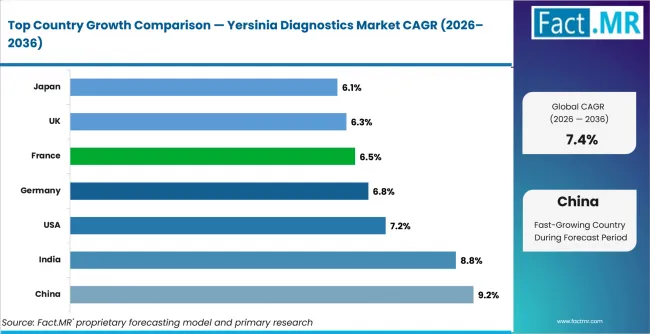
Yersinia Diagnostics Market Cagr Analysis By Country | Source: Fact.MR
North America Yersinia Diagnostics Market Analysis
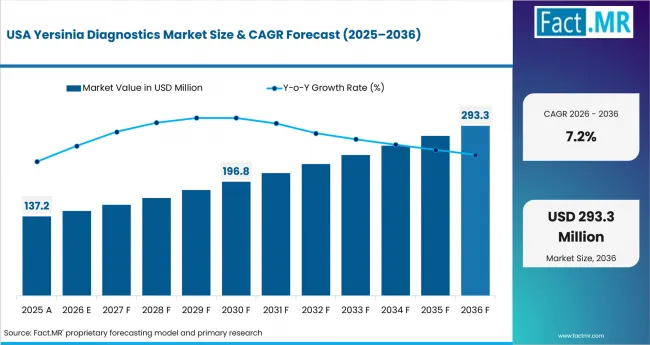
Yersinia Diagnostics Market Country Value Analysis | Source: Fact.MR
North America has a large share of yersinia diagnostics revenue because clinical laboratory networks are well developed. Multiplex gastrointestinal panels support routine detection in hospitals and reference labs. Foodborne disease surveillance and molecular stool testing keep regional demand steady.
- United States: The United States is likely to grow at 7.2% CAGR from 2026 to 2036. FoodNet surveillance keeps Yersinia under active foodborne disease monitoring. Hospital labs are using more molecular stool tests for acute gastroenteritis. Multiplex gastrointestinal panels support wider diagnostic use across clinical testing networks.
Europe Yersinia Diagnostics Market Analysis
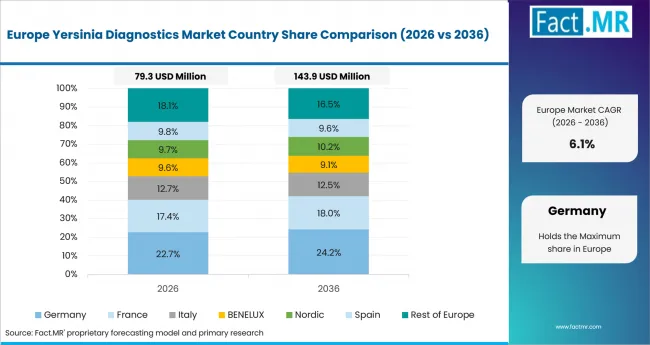
Yersinia Diagnostics Market Europe Country Market Share Analysis, 2026 & 2036 | Source: Fact.MR
Europe is a key regional market for yersinia diagnostics because yersiniosis is part of public health surveillance. Case reporting and laboratory confirmation support routine testing across national diagnostic networks. Hospitals and reference centers continue to use molecular assays for enteric infection detection.
- Germany: Germany is likely to grow at 6.8% CAGR by 2036. High confirmed yersiniosis reporting supports regular lab testing across clinical networks. Public health surveillance keeps demand steady across hospitals and reference laboratories. Routine enteric infection testing supports continued assay use.
- France: France is likely to expand at 6.5% CAGR through 2036. Case reporting supports routine lab confirmation for suspected yersiniosis. Hospital labs use enteric infection panels for gastrointestinal disease diagnosis. Public health monitoring supports steady demand for Yersinia assays.
- United Kingdom: The United Kingdom is likely to advance at 6.3% CAGR by 2036. Updated notification rules are increasing reporting needs across laboratory systems. Clinical labs are improving enteric disease testing workflows. Public health surveillance supports continued use of Yersinia diagnostic assays.
East Asia Yersinia Diagnostics Market Analysis
East Asia is likely to see faster forecast gains as hospitals invest in multiplex infectious disease testing. Large clinical networks are adding syndromic testing for gastrointestinal infections. Food safety labs support assay demand through screening of higher-risk samples.
- China: China is likely to rise at 9.2% CAGR from 2026 to 2036. Large hospital networks are adding syndromic testing for gastrointestinal infections. Food safety labs are screening higher-risk samples across major testing centers. Wider use of molecular diagnostics supports more Yersinia assay adoption.
- Japan: Japan is likely to advance at 6.1% CAGR through 2036. Pediatric gastroenteritis testing supports steady use of Yersinia diagnostics in clinical labs. Reference laboratory confirmation helps maintain assay demand. Hospital testing workflows support routine enteric infection diagnosis.
South Asia and Pacific Yersinia Diagnostics Market Analysis
South Asia and Pacific is expanding from a smaller diagnostic testing base. Private diagnostic chains are adding molecular panels across major urban centers. Food safety testing and reference laboratory workflows support steady regional assay demand.
- India: India is likely to rise at 8.8% CAGR from 2026 to 2036. Large city labs are adding stool PCR panels for enteric infection testing. Hospital groups are improving gastrointestinal diagnostic menus across major cities. Private diagnostic chains support wider access to Yersinia testing.
Competitive Aligners for Market Players
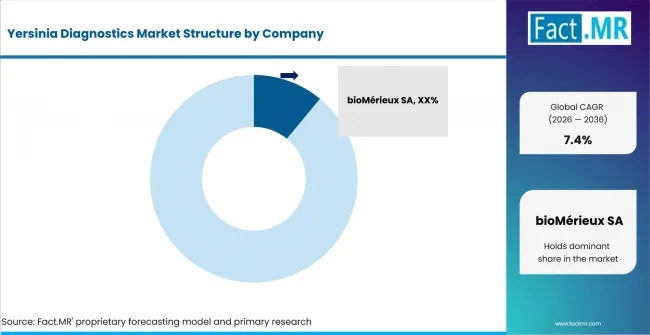
Yersinia Diagnostics Market Analysis By Company | Source: Fact.MR
Yersinia diagnostics suppliers differ by assay menu coverage and confirmatory culture support. bioMérieux and QIAGEN have prominent positions in multiplex gastrointestinal panels. Thermo Fisher Scientific and Merck KGaA support culture media and quality control workflows. Bio-Rad and Hygiena serve immunoassay or food testing needs in selected laboratory channels.
Product strategy is moving toward targeted gastrointestinal panels and automated sample-to-result workflows. QIAGEN received U.S. clearance in 2025 for a mini bacterial panel that includes Yersinia enterocolitica. This supports laboratories that need bacterial targets and shorter test menus. Suppliers active in veterinary infectious disease diagnostics can use animal health channel knowledge for zoonotic testing demand.
Culture-based suppliers continue to be important because molecular positives often need isolate recovery for source tracing. This creates demand for culture media and identification systems. Laboratory suppliers are placing more emphasis on easier sample handling as Yersinia testing remains mainly lab based.
Companies that pair molecular detection with culture confirmation can serve hospital and public health accounts more directly. Bruker supports species-level identification through MALDI systems. BD and Bio-Rad support laboratory workflows through microbiology products and assay lines. Suppliers using immunofluorescence assays can apply antibody workflow knowledge in selected follow-up testing.
Key Players
- bioMérieux SA
- QIAGEN N.V.
- Thermo Fisher Scientific Inc.
- Bio-Rad Laboratories Inc.
- Becton Dickinson and Company
- Merck KGaA
- Bruker Corporation
- Hygiena LLC
Bibliography
- Shah, H. J., Jervis, R. H., Wymore, K., Rissman, T., LaClair, B., Boyle, M. M., Smith, K., Lathrop, S., McGuire, S., Trevejo, R., McMillian, M., Harris, S., Zablotsky Kufel, J., Houck, K., Lau, C. E., Devine, C. J., Boxrud, D., & Weller, D. L. (2024, July 4). Reported incidence of infections caused by pathogens transmitted commonly through food: Impact of increased use of culture-independent diagnostic tests—Foodborne Diseases Active Surveillance Network, 1996–2023. Morbidity and Mortality Weekly Report, 73(26), 584–593.
- European Centre for Disease Prevention and Control. (2024, February 8). Yersiniosis: Annual epidemiological report for 2022. European Food Safety Authority, & European Centre for Disease Prevention and Control. (2025). The European Union One Health 2024 Zoonoses Report. EFSA Journal, 23(12), e9759.
- U.S. Food and Drug Administration. (2025, January 16). K243885: BIOFIRE FILMARRAY Gastrointestinal (GI) Panel Mid 510(k) summary. U.S. Food and Drug Administration. (2025, February 28). K250324: QIAstat-Dx GI Panel 2 Mini B 510(k) summary. Binello, N. (2025, July 23). Plague in the 21st century: An overview of global control strategies and WHO recommendations [Presentation slides]. World Health Organization.
This Report Addresses
- Strategic demand analysis for Yersinia diagnostics across clinical diagnostics, food testing, public health surveillance, veterinary testing, and research applications globally.
- Market forecast from 2026 to by 2036. The report includes segment-level analysis by disease type, application, sample type, product, technology, and end user.
- Opportunity mapping across China, India, the United States, Germany, France, the United Kingdom, and Japan based on laboratory testing expansion and public health surveillance needs.
- Segment analysis by disease type, application, sample type, product, technology, and end user with regional and country-level forecasts through 2036.
- Competitive analysis of bioMérieux SA, QIAGEN N.V., Thermo Fisher Scientific Inc., Bio-Rad Laboratories Inc., Becton Dickinson and Company, Merck KGaA, Bruker Corporation, and Hygiena LLC.
- Technology impact analysis covering multiplex PCR, culture testing, serology, MALDI identification, and sequencing across clinical and food testing workflows.
- Report delivery in PDF, Excel, and presentation formats supported by surveillance datasets, FDA clearance records, laboratory menu checks, product catalogs, and laboratory interviews.
Yersinia Diagnostics Market Definition
The yersinia diagnostics market covers tests and laboratory products used to detect Yersinia species in clinical samples, food samples and public health workflows. These diagnostics support detection of yersiniosis, plague and Yersinia pseudotuberculosis through molecular assays, culture testing, serology, MALDI identification and sequencing. The market includes products used by diagnostic laboratories, hospitals, food testing labs, public health labs and research institutes.
Yersinia Diagnostics Market Inclusions
Covers global and regional market forecasts from 2026 to 2036 by disease type, application, sample type, product, technology and end user. Includes yersiniosis, plague, Yersinia pseudotuberculosis and other Yersinia infections. Covers clinical diagnostics, food testing, public health surveillance, veterinary testing and research use across stool samples, blood samples, food samples, tissue samples and environmental swabs. Includes kits and reagents, instruments, culture media, controls and software services used in multiplex PCR, culture testing, serology, MALDI identification and sequencing workflows.
Yersinia Diagnostics Market Exclusions
Excludes general gastrointestinal diagnostics that do not include Yersinia species detection. Omits broad food safety testing products when Yersinia testing is not part of the assay menu or laboratory workflow. Excludes unrelated bacterial diagnostics, general microbiology instruments and laboratory software unless they directly support Yersinia detection, confirmation or reporting. Excludes treatment products, vaccines and clinical management services that are not part of diagnostic revenue.
Yersinia Diagnostics Market Research Methodology
- Primary Research
- Interviews with clinical laboratory managers, hospital microbiology heads, public health laboratory officials, food testing laboratory operators and diagnostic kit suppliers across the United States, Germany, France, China, India, Japan and the United Kingdom.
- Desk Research
- Analysis of public health surveillance reports, FoodNet data, European yersiniosis reporting, FDA 510(k) summaries, World Health Organization plague guidance and company product documentation from diagnostic and microbiology suppliers.
- Market-Sizing and Forecasting
- Hybrid model combining top-down infectious disease diagnostics revenue estimates with bottom-up test volume projections by application, sample type and technology. Average selling prices for kits, reagents, instruments, culture media and control materials are modeled independently and aggregated across regions.
- Data Validation and Update Cycle
- Validated through surveillance datasets, FDA clearance records, laboratory menu checks, product catalogs and interviews with clinical and food testing laboratories. Updated annually with public health reporting changes, device clearances, assay menu updates and laboratory adoption trends.
Segmentation
Scope of the Report
| Attribute | Details |
|---|---|
| Quantitative Units | USD million (2026) to USD million (2036), at CAGR |
| Market Definition | Tests and laboratory products used for Yersinia species detection in clinical samples, food samples and public health workflows globally. |
| Disease Type Segmentation | Yersiniosis, Plague, Yersinia pseudotuberculosis, Other infections |
| Application Segmentation | Clinical diagnostics, Food testing, Public health surveillance, Veterinary testing, Research use |
| Sample Type Segmentation | Stool samples, Blood samples, Food samples, Tissue samples, Environmental swabs |
| Product Segmentation | Kits and reagents, Instruments, Culture media, Controls, Software services |
| Technology Segmentation | Multiplex PCR, Culture testing, Serology, MALDI identification, Sequencing |
| End User Coverage | Diagnostic laboratories, Hospitals, Food testing labs, Public health labs, Research institutes |
| Regions Covered | North America, Europe, East Asia, South Asia and Pacific, Latin America, Middle East and Africa |
| Countries Covered | United States, Canada, Germany, France, United Kingdom, China, Japan, India, Australia, Brazil, Mexico, Saudi Arabia, South Africa |
| Key Companies Profiled | bioMérieux SA, QIAGEN N.V., Thermo Fisher Scientific Inc., Bio-Rad Laboratories Inc., Becton Dickinson and Company, Merck KGaA, Bruker Corporation, Hygiena LLC |
| Forecast Period | 2026 to 2036 |
| Approach | Hybrid top down and bottom up model using surveillance data, device clearances, laboratory menu checks and interviews with clinical and food testing laboratories. |
Source: Fact.MR analysis. Updated Jun 11, 2026
Yersinia Diagnostics Market by Segment
-
By Disease Type
- Yersiniosis
- Plague
- Yersinia pseudotuberculosis
- Other infections
-
By Application
- Clinical diagnostics
- Food testing
- Public health surveillance
- Veterinary testing
- Research use
-
By Sample Type
- Stool samples
- Blood samples
- Food samples
- Tissue samples
- Environmental swabs
-
By Product
- Kits and reagents
- Instruments
- Culture media
- Controls
- Software services
-
By Technology
- Multiplex PCR
- Culture testing
- Serology
- MALDI identification
- Sequencing
-
By End User
- Diagnostic laboratories
- Hospitals
- Food testing labs
- Public health labs
- Research institutes
-
By Region
- North America
- Europe
- East Asia
- South Asia and Pacific
- Latin America
- Middle East and Africa
- GCC Countries
- South Africa
- North America
Frequently Asked Questions
Which disease type segment leads the Yersinia diagnostics market?
Which application holds the largest Yersinia diagnostics market share?
Which country shows the fastest growth in the Yersinia diagnostics market?
Which end user accounts for the largest share of the Yersinia Diagnostics Market?
What is driving the growth of the Yersinia Diagnostics Market?
Who worked on this report


Preview the report firsthand - request a free sample
Free SampleGet the brochure for pricing and purchase details
Download PDF