- Market Value (2025): USD 1.5 Bn
- Estimated Value (2026): USD 1.8 Bn
- Forecast Value (2036): USD 7.4 Bn
- CAGR (2026-2036): 15.5%
What is the Zero-Residue Soluble Pouches Market forecast to be worth by 2036?
USD 1.8 billion in 2026 to USD 7.4 billion by 2036 at a 15.5% CAGR.
- The Zero-Residue Soluble Pouches Market reached USD 1.5 billion in 2025.
- Demand is projected to increase from USD 1.8 billion in 2026 to USD 7.4 billion by 2036.
- The market is forecast to record 15.5% CAGR from 2026 to 2036. Home-care brands and agrochemical formulators are expanding pre-measured soluble dosing.
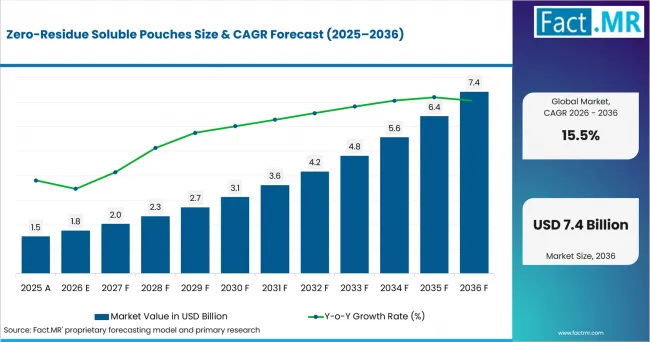
Zero Residue Soluble Pouches Value Analysis | Source: Fact.MR
What are the defining numbers behind Zero-Residue Soluble Pouches Market growth?
USD 5.7 billion absolute opportunity by 2036, led by PVOH/PVA, cold-water release and unit-dose pouches.
- Demand Drivers in the Market
- Home-care formulators need films that hold concentrated chemistry during storage but dissolve cleanly in a wash cycle, supporting compact unit-dose formats.
- Agrochemical manufacturers need closed dosing that limits direct contact with powders or concentrates, so water-soluble bags fit measured tank-mix preparation.
- Hygiene brands need films that break up after use and leave less persistent plastic. This supports interest in water-active polymers.
- Industrial chemical users need precise dosing with fewer handling steps. Soluble pouches can help when the package is designed to enter the process together with its contents.
- Key Segments Analyzed
- By Material Platform: PVOH/PVA is expected to hold 36.0% share in 2026. Its established film-forming properties support broad use in water-soluble packs.
- By Dissolution: Cold-water is projected to account for 31.0% share in 2026. Household and institutional users need reliable breakup at lower wash temperatures.
- By Application: Unit-dose pouches are anticipated to capture 29.0% share in 2026. Measured dosing reduces handling and supports compact product formats.
- By Environmental Position: Microplastic-free claim is estimated to represent 33.0% share in 2026. Brands are seeking clearer end-of-use claims for dissolvable formats.
- Analyst Opinion at Fact.MR
- S.N. Jha, Principal Consultant at Fact.MR, states, “Buyers are comparing how quickly a pouch opens, what remains in the water stream and whether the film survives filling and storage. Demand is expected to favor firms that document both use-phase fit and end-of-use behavior.”
- Strategic Implications
- Film makers should publish dissolve times for common water conditions so pouch firms can match each grade to the dose cycle.
- Pouch firms should test seals with the actual detergent or farm chemical before scale-up. Storage strength remains an important part of product fit.
- Brand owners should keep water-soluble and compostable claims separate and use proof that fits the end route. In March 2025, Aquapak Polymers announced the development of a Hydropol-based dissolvable nonwoven material for hygiene applications such as wet wipes and sanitary pads.
- Plant users should test pouch weight and fill limits with dissolve time so each dose stays steady at line speed.
France leads at 16.1% CAGR through packaging-waste pressure and household-care demand. China follows at 15.4% as daily-use goods consumption and compact dosing formats expand the addressable market. The USA reaches 14.9% through unit-dose cleaning and water-soluble agrochemical packaging. Japan also records 14.9%, supported by household spending and specialty-film capabilities, while Germany posts 14.7% as EU packaging rules and waste-reduction pressure encourage soluble dosing formats.
How does the Zero-Residue Soluble Pouches Market break down by segment?
PVOH/PVA leads Material Platform with a 36.0% share. The microplastic-free claim leads Environmental Position with a 33.0% share.
Which Material Platform dominates?
PVOH/PVA is expected to hold 36.0% share in 2026.
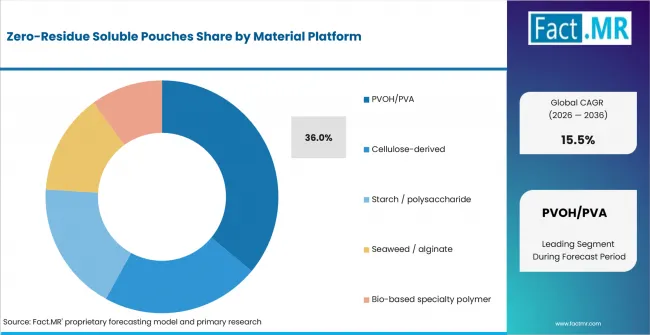
Zero Residue Soluble Pouches Analysis By Material Platform | Source: Fact.MR
PVOH/PVA is expected to lead because it pairs film strength with water solubility. Cellulose and starch routes serve selected sachets, while seaweed and niche polymers fit narrower uses. Kuraray lists water-soluble PVOH film for detergent doses, farm chemicals and food ingredients.
What leads the Dissolution segment?
Cold-water is projected to account for 31.0% share in 2026.
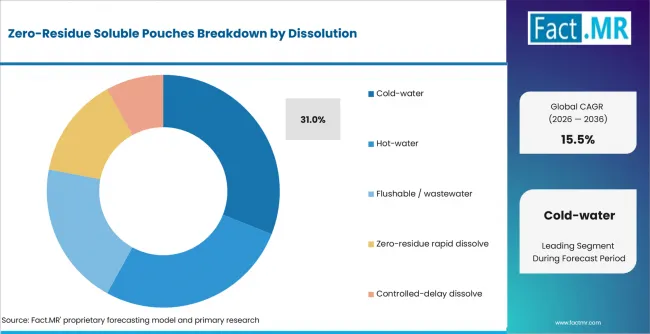
Zero Residue Soluble Pouches Analysis By Dissolution | Source: Fact.MR
Cold-water release is projected to lead because many cleaning cycles use lower temperatures. Hot-water grades serve warmer wash and process uses. Wastewater and fast-release grades fit other routes, while controlled-delay film protects the dose for a set time. Film choice depends on water conditions and the required release window.
How does Application shape demand?
Unit-dose pouches are anticipated to capture 29.0% share in 2026.
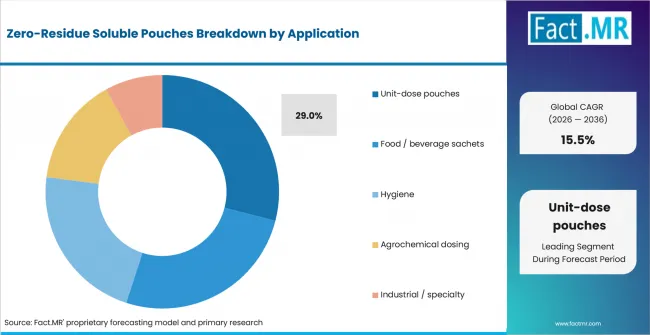
Zero Residue Soluble Pouches Analysis By Application | Source: Fact.MR
Unit-dose pouches are anticipated to lead because they wrap a measured amount of product. Food sachets need moisture control and safe contact materials. Hygiene uses extend into dissolvable nonwovens, while farm and plant dosing values closed handling and exact batch addition.
What supports the Environmental Position segment?
Microplastic-free claim is estimated to represent 33.0% share in 2026.
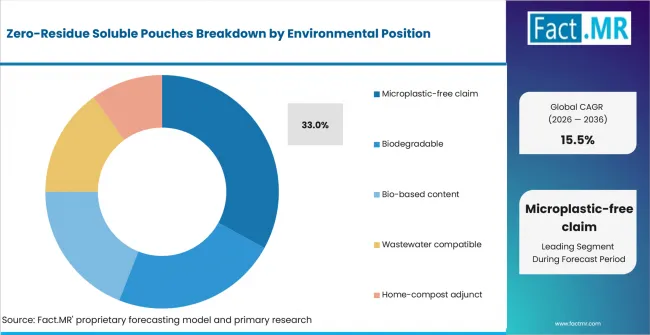
Zero Residue Soluble Pouches Analysis By Environmental Position | Source: Fact.MR
Microplastic-free claim is estimated to lead where brands want the dose wrapper to dissolve during use. Bio-based and biodegradable claims need their own proof. In October 2025, Eurostat reported 35.3 kg of plastic pack waste per EU resident in 2023.
What is accelerating Zero-Residue Soluble Pouches Market adoption, and what is holding it back?
Unit-dose convenience supports adoption across measured dosing uses. Product mix and end-of-use testing can restrain wider use.
Drivers Impact Analysis
| DRIVER | (~) % IMPACT ON CAGR | GEOGRAPHIC RELEVANCE | IMPACT TIMELINE |
|---|---|---|---|
| Expansion of measured unit-dose formats | +2.1% | North America, Europe, East Asia | Short term (<= 2 years) |
| Pressure to reduce persistent flexible-film residue | +1.7% | Europe, North America | Medium term (2-4 years) |
| Agrochemical closed-dose handling | +1.2% | North America, East Asia | Medium term (2-4 years) |
| Lower-temperature wash cycles | +0.9% | Europe, Japan | Long term (>= 4 years) |
| Water-responsive hygiene formats | +0.7% | Europe, Japan | Long term (>= 4 years) |
Source: Fact.MR analysis. Updated Sep 25, 2026
Opportunity Impact Analysis
| OPPORTUNITY | (~) % IMPACT ON CAGR | GEOGRAPHIC RELEVANCE | IMPACT TIMELINE |
|---|---|---|---|
| Specialty cold-water film grades | +1.3% | North America, Europe | Short term (<= 2 years) |
| Dissolvable hygiene structures | +1.0% | Europe, Japan | Medium term (2-4 years) |
| Food and beverage dosing sachets | +0.8% | Global | Medium term (2-4 years) |
| Industrial batch-addition pouches | +0.6% | Global | Long term (>= 4 years) |
Source: Fact.MR analysis. Updated Sep 25, 2026
Restraints Impact Analysis
| RESTRAINT | (~) % IMPACT ON CAGR | GEOGRAPHIC RELEVANCE | IMPACT TIMELINE |
|---|---|---|---|
| Moisture sensitivity during storage | -0.8% | Global | Short term (<= 2 years) |
| Formulation compatibility limits | -0.6% | Global | Medium term (2-4 years) |
| Environmental-claim scrutiny | -0.5% | Europe, North America | Medium term (2-4 years) |
| Cost and qualification burden | -0.4% | Global | Long term (>= 4 years) |
Source: Fact.MR analysis. Updated Sep 25, 2026
Which countries are scaling the Zero-Residue Soluble Pouches Market through 2036?
- The country comparison spans 1.4 percentage points across the five profiled markets through the forecast period.
- France remains 0.7 percentage point above China as pack rules and household-care use support trials of lower-residue pouch formats.
- China remains 0.5 percentage point above the USA as household spending and compact dose formats expand the addressable consumer base.
- The USA matches Japan at 14.9% CAGR, although the use mix differs between home care and regulated niche dosing.
- Japan stays 0.2 percentage point above Germany as specialty-film capability supports compact soluble formats.
- Germany closes the displayed range as packaging-waste pressure raises attention to material efficiency and controlled end-of-use behavior.
Similar CAGRs can lead to different market paths because product mix, dissolve time and local pack rules vary. Coverage includes North America, Latin America, Western Europe, Eastern Europe, East Asia, South Asia & Pacific, Middle East & Africa.
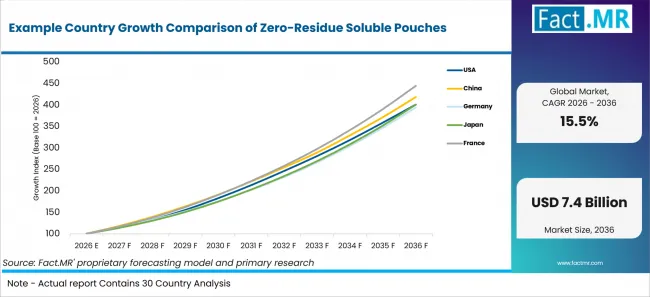
Example Country Growth Comparison Of Zero Residue Soluble Pouches | Source: Fact.MR
| Country | CAGR (2026-2036) |
|---|---|
| France | 16.1% |
| China | 15.4% |
| United States | 14.9% |
| Japan | 14.9% |
| Germany | 14.7% |
Source: Fact.MR analysis. Updated Sep 25, 2026
What is powering France’s lead?
16.1% CAGR through 2036, supported by packaging-waste pressure and household-care demand.
France combines a sizeable household-products base with tighter pack expectations. INSEE reported that French household expenditure on furnishings, household equipment and routine household maintenance reached EUR 57.0 billion in 2025. The market is expected to record 16.1% CAGR as soluble pouches target measured cleaning and niche dosing formats.
How is China scaling soluble pouch demand?
15.4% CAGR through 2036, driven by daily-use goods consumption and compact dose formats.
China offers a broad consumer-products base for measured household dosing formats. In January 2026, the National Bureau of Statistics reported 2025 per-capita spending of 1,667 yuan on household facilities, articles and services. Demand is projected to post 15.4% CAGR as home-care and niche chemical brands test compact soluble packs.
What supports the USA outlook?
14.9% CAGR through 2036, supported by unit-dose cleaning and water-soluble agrochemical packaging.
The USA has established use of soluble films in home-care and pesticide dosing formats. In January 2025, an EPA-approved U.S. pesticide label stated that water-soluble packages may take up to five minutes or longer to dissolve, depending on water temperature, water hardness, and agitation intensity The timing depends on the stated water conditions. The market is anticipated to record 14.9% CAGR as firms serve consumer and regulated dosing uses.
What underpins Japan’s growth?
14.9% CAGR through 2036, supported by household spending and specialty-film capability.
Japan combines polymer-film expertise with household spending that supports compact convenience formats. In February 2026, the Statistics Bureau reported average monthly consumption spending of 314,001 yen for two-or-more-person households in 2025. The market is estimated to advance at 14.9% CAGR as firms match release route with home-care and niche applications.
How is Germany developing demand?
14.7% CAGR through 2036, shaped by packaging-waste pressure and EU pack rules.
Germany places close attention on pack waste and end-of-use material efficiency. In November 2025, Destatis reported that Germany generated around 215 kg of packaging waste per person in 2023, compared with an EU average of just under 178 kg. The market is forecast to record 14.7% CAGR as brands evaluate soluble films for measured doses. These formats can reduce the need for a separate inner wrapper.
Who leads the Zero-Residue Soluble Pouches Market?
Kuraray anchor PVOH film coverage, while Aicello and Aquapak Polymers broaden soluble material options.
Aicello participates through its SOLUBLON water-soluble PVOH films, which are used for detergent and agricultural-chemical packaging. Aquapak Polymers supplies Hydropol, a proprietary PVOH-based material available for water-soluble film and other packaging applications. Differences in processability, sealing methods, and dissolution characteristics provide practical points of differentiation among these materials.
Cortec markets EcoSol, a water-soluble PVOH film for detergents, cleaners, agricultural products, water-treatment chemicals, and other dosing applications. Arrow GreenTech markets WATERSOL water-soluble PVA/PVOH film for applications including agrochemical and detergent packaging. Suppliers therefore compete across film performance, processing compatibility, sealing characteristics, dissolution behavior, and suitability for specific end-use applications.
Which companies are the key providers?
Key companies include Kuraray, Aicello, Aquapak Polymers, Cortec, and Arrow GreenTech.
- Kuraray
- Aicello
- Aquapak Polymers
- Cortec
- Arrow GreenTech
Bibliography
- Directorate-General for Environment. (2025, February 11). New rules enter into force for a more sustainable and competitive packaging economy. European Commission.
- Eurostat. (2025, October 22). Plastic packaging waste in the EU: 35.3 kg per person.
- National Bureau of Statistics of China. (2026, January 20). Households’ income and consumption expenditure in 2025.
- Statistics Bureau of Japan. (2026, February 6). 2025 yearly average [Family Income and Expenditure Survey].
- Institut national de la statistique et des études économiques. (2026, May 29). Consommation effective des ménages par fonction : Données annuelles 1965 et 2025.
- U.S. Environmental Protection Agency. (2025, January 10). Adept® [Pesticide product label, EPA Registration No. 70506-531].
- Statistisches Bundesamt (Destatis). (2025, November 4). Müll und Recycling: EU-Abfallstatistik 2025.
- Kuraray Co., Ltd. (2025, June 23). Held management briefing on growth opportunities of PVOH resin business.
- Aquapak Polymers. (2025, March 12). Hydropol™ set to revolutionise disposable hygiene products, making them dissolvable, fully flushable, microplastic free and preventing them forming fatbergs.
This Report Answers
- The report explains where soluble pouches are used across material platform and release type. It also covers use and end-use position.
- Segment review shows the lead shares for PVOH/PVA, cold-water release, unit-dose pouches and microplastic-free positioning.
- Country review covers France, China, the USA, Japan and Germany with official spending, pack and use data.
- Competitive review reviews Kuraray, Aicello, Aquapak Polymers, Cortec and Arrow GreeanTech across soluble film and pouch use.
What does the Zero-Residue Soluble Pouches Market cover?
The Zero-Residue Soluble Pouches Market covers water-responsive films and pouch structures that are intended to dissolve or disperse during a defined use step. Core uses include detergent and cleaner unit doses, agrochemical dosing, and selected hygiene or food sachets. In these uses, the pack forms part of the delivery method.
The assessment differs from standard flexible pack because a standard pouch remains as a separate waste item after product removal. It also differs from compostable pack when composting is the only disposal route. A product enters this scope when water-triggered release or dispersal is central to how the package is used.
What is included in the scope?
The scope includes cold-water and hot-water films for unit-dose pouches and controlled-delay grades for plant dosing. It includes cellulose-derived and starch-based options where water response is part of package design.
Related demand is assessed against water-soluble pouches and adjacent dispersible instant pouches where release is a core function. Related material context includes polyvinyl alcohol films. Hygiene and wastewater-compatible designs are included when controlled dispersion is part of the use route. Agrochemical and niche chemical packs are included when the pouch enters mixing with its contents.
What is excluded from the scope?
Conventional PE, PP and PET pouches that remain intact after use fall outside the scope.
Compostable pack also falls outside when water release is absent from the intended function. Related microplastic-free soluble films are covered only when the pouch uses water-triggered delivery. Bulk water-soluble resin sold without a pack use falls outside the report boundary.
How Was the Analysis Built?
The analysis draws on 120+ sources, 35+ company portfolios, 25+ countries, and more than 20 industry interviews.
- Primary Research: Primary research includes discussions with manufacturers, service providers, technology developers, distributors, end users, and subject-matter experts. These conversations examine purchasing priorities, product adoption, operational challenges, approval requirements, competitive positioning, and the factors that influence wider market acceptance.
- Desk Research: Desk research covers government statistics, regulatory publications, company filings, trade data, technical studies, industry associations, standards, public policy, and other authoritative sources. Every source used in the analysis is documented in the bibliography.
- Market Sizing and Forecasting: Market estimates combine historical performance, demand indicators, pricing and volume trends, segment shares, company participation, country-level growth, adoption patterns, investment activity, and barriers to market expansion.
- Data Validation and Update Cycle: Findings are validated by comparing primary interviews with public data, company activity, regulatory changes, trade patterns, and industry developments. Regular updates review new product launches, capacity changes, partnerships, approvals, and shifts in commercial adoption.
Segmentation
What is the report’s scope and coverage?
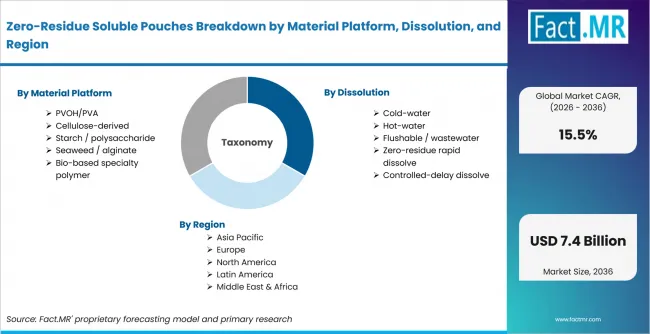
Zero Residue Soluble Pouches Breakdown By Material Platform, Dissolution, And Region | Source: Fact.MR
| Attribute | Details |
|---|---|
| Quantitative Units | USD billion |
| Market Definition | Water-soluble or rapidly dispersible pouch systems designed to deliver a measured product dose while minimizing persistent packaging residue after intended use. |
| Material Platform | PVOH/PVA; Cellulose-derived; Starch / polysaccharide; Seaweed / alginate; Bio-based specialty polymer |
| Dissolution | Cold-water; Hot-water; Flushable / wastewater; Zero-residue rapid dissolve; Controlled-delay dissolve |
| Application | Unit-dose pouches; Food / beverage sachets; Hygiene; Agrochemical dosing; Industrial / specialty |
| Environmental Position | Microplastic-free claim; Biodegradable; Bio-based content; Wastewater compatible; Home-compost adjunct |
| Regions Covered | North America; Latin America; Western Europe; Eastern Europe; East Asia; South Asia & Pacific; Middle East & Africa |
| Countries Covered | France; China; United States; Japan; Germany |
| Key Companies Profiled | Kuraray; Aicello; Aquapak Polymers; Cortec; Arrow GreenTech |
| Forecast Period | 2026 to 2036 |
| Approach | Hybrid top-down and bottom-up approach using soluble-film applications, material qualification, dissolution fit, country indicators and provider portfolio review. |
Source: Fact.MR analysis. Updated Sep 25, 2026
How is the market segmented?
-
By Material Platform:
- PVOH/PVA
- Cellulose-derived
- Starch / polysaccharide
- Seaweed / alginate
- Bio-based niche polymer
-
By Dissolution:
- Cold-water
- Hot-water
- Flushable / wastewater
- Zero-residue rapid dissolve
- Controlled-delay dissolve
-
By Application:
- Unit-dose pouches
- Food / beverage sachets
- Hygiene
- Agrochemical dosing
- Industrial / niche
-
By Environmental Position:
- Microplastic-free claim
- Biodegradable
- Bio-based content
- Wastewater compatible
- Home-compost adjunct
-
By Region:
- North America
- Latin America
- Western Europe
- Eastern Europe
- East Asia
- South Asia & Pacific
- Middle East & Africa
Frequently Asked Questions
How big is the Zero-Residue Soluble Pouches Market in 2026?
What is the CAGR of the Zero-Residue Soluble Pouches Market from 2026 to 2036?
Which material platform leads the Zero-Residue Soluble Pouches Market?
Which release type leads the Zero-Residue Soluble Pouches Market?
Who are the leading companies in the Zero-Residue Soluble Pouches Market?
Who worked on this report


Preview the report firsthand - request a free sample
Free SampleGet the brochure for pricing and purchase details
Download PDF