- Base Value(2025): 1.60 Bn
- Estimated Value(2026): 1.66 Bn
- Forecast Value (2036): 2.39 Bn
- CAGR (2026 - 2036): 3.7%
Orange Oil Market Size, Market Forecast and Outlook By FACT.MR
The orange oil market was valued at USD 1.60 billion in 2025, projected to reach USD 1.66 billion in 2026, and is forecast to expand to USD 2.39 billion by 2036 at a 3.7% CAGR. The absolute dollar opportunity of approximately USD 0.73 billion added over the forecast decade reflects steady demand for orange oil across industrial cleaning, confectionery flavoring, and fragrance applications. Based on FACT.MR's analysis, d-limonene content derived from orange oil processing positions this commodity at the intersection of the food ingredient and green chemistry sectors.
Orange oil is produced as a by-product of the citrus juice processing industry, with Brazil and the United States (Florida) serving as the dominant origin countries. Cold-pressed sweet orange oil (Citrus sinensis) is the primary product, valued for its d-limonene content which functions as both a natural flavoring agent and an industrial solvent. The cleaning products sector consumes the largest volume of orange oil, where d-limonene serves as a bio-based degreasing agent replacing petroleum-derived solvents. FACT.MR analysts note that orange oil pricing is structurally linked to orange juice production volumes, creating supply-side volatility when citrus greening disease or weather events reduce fruit processing throughput.
Brazil dominates global orange oil production, with Sao Paulo state's integrated juice processing facilities generating cold-pressed oil as a secondary revenue stream. The United States Florida citrus belt has experienced declining production due to citrus greening (HLB) disease, reducing domestic orange oil supply and increasing import dependency. China and India consume orange oil in confectionery and beverage flavoring, sourcing both domestically extracted and imported grades. Germany's industrial cleaning products sector represents a major European demand center for technical-grade orange oil. FACT.MR opines that the expanding regulatory preference for bio-based solvents in Europe and North America creates long-term structural demand support for d-limonene derived from orange oil processing.
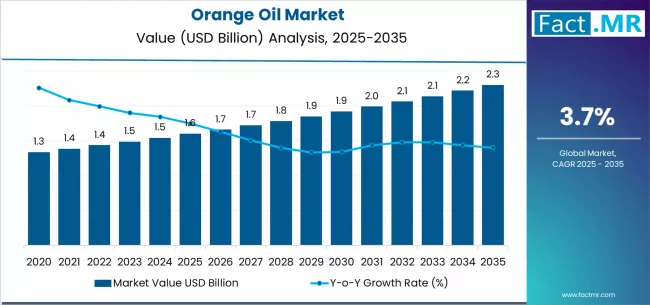
Orange Oil Market Market Value Analysis | Source: Fact.MR
Orange Oil Market Key Takeaways
| Metric | Details |
|---|---|
| Industry Size (2026) | USD 1.66 billion |
| Industry Value (2036) | USD 2.39 billion |
| CAGR (2026 to 2036) | 3.7% |
Source: Fact.MR analysis. Updated Mar 18, 2026
Orange Oil Market Definition
Orange oil is an essential oil extracted from the peel of sweet oranges (Citrus sinensis) primarily through cold-pressing during citrus juice processing. The oil contains d-limonene as its major component and is classified into cold-pressed and distilled/terpeneless grades. Orange oil is used in confectionery and beverage flavoring, household and industrial cleaning products, fragrance formulations, and pharmaceutical preparations.
Orange Oil Market Inclusions
Market scope covers global and regional trade volumes and values for orange oil, forecast period from 2026 to 2036, segment breakdowns by grade, application, and extraction type. D-limonene content analysis and bio-solvent regulatory trend assessments are included.
Orange Oil Market Exclusions
The scope excludes orange juice and juice concentrates, fresh orange fruit trade, synthetic d-limonene not derived from orange oil processing, and other citrus essential oils (mandarin, lemon, grapefruit). Orange peel dried products for food garnishing are excluded.
Orange Oil Market Research Methodology
- Primary Research: Analysts engaged with citrus juice processors, essential oil traders, and cleaning product formulators across 25 countries to validate production volumes and end-use application demand.
- Desk Research: Data collection aggregated national citrus processing statistics, essential oil trade databases, and bio-solvent regulatory frameworks from major markets.
- Market-Sizing and Forecasting: Baseline values derive from a bottom-up aggregation of origin-country production linked to juice processing throughput, applying end-use demand curves and grade-specific pricing trends.
- Data Validation and Update Cycle: Projections are cross-validated against citrus industry association statistics and publicly reported data from major flavor and fragrance companies.
Summary of Orange Oil Market
- Orange Oil Market Definition
- Orange oil encompasses essential oil extracted from sweet orange peel during juice processing, containing d-limonene as its major component, used in confectionery flavoring, cleaning products, fragrance formulations, and pharmaceutical preparations.
- Demand Drivers in the Market
- Industrial cleaning and degreasing applications consume the largest volume of orange oil, where d-limonene functions as a bio-based solvent replacing petroleum-derived alternatives under tightening environmental regulations.
- Confectionery and beverage manufacturers require natural orange flavoring to meet clean-label ingredient specifications, sustaining food-grade cold-pressed oil demand across global markets.
- Regulatory preference for bio-based solvents in EU REACH compliance and US EPA Safer Choice programs creates structural demand support for d-limonene derived from orange oil processing.
- Key Segments Analyzed in the FACT.MR Report
- Technical/Cleaners Grade holds 61.0% of grade share in 2026, reflecting the dominant volume consumption of d-limonene in industrial and household cleaning product formulations.
- Confectionery application accounts for 44.0% of application demand, where natural orange flavoring is valued for clean-label compliance in premium confectionery and bakery products.
- Cold-Pressed type commands 63.5% of extraction type share, as the primary production method integrated into citrus juice processing facilities.
- Analyst Opinion at FACT.MR
- FACT.MR analysts observe that the orange oil market is structurally linked to citrus juice processing economics, where oil production volumes are determined by juice demand rather than direct oil market signals. Buyers face supply-side volatility when citrus greening disease or adverse weather reduces fruit processing throughput in Brazil or Florida. The dual-use positioning of orange oil across food flavoring and industrial bio-solvent applications creates pricing tension between grade categories, with technical-grade d-limonene demand providing a volume floor while food-grade cold-pressed oil commands premium pricing.
- Strategic Implications / Executive Takeaways
- Cleaning product formulators must establish forward contracting with Brazilian juice processors to secure d-limonene supply against the production volatility caused by citrus greening disease impacts on processing throughput.
- Flavor and fragrance companies should develop terpeneless orange oil product lines to serve beverage and pharmaceutical applications requiring concentrated citrus flavoring with extended shelf stability.
- Bio-solvent distributors targeting European industrial markets should pursue EU REACH registration and Safer Choice certification to qualify orange oil-derived d-limonene for regulated cleaning applications.
- Methodology
- Primary Research: FACT.MR conducted interviews with citrus processors, oil traders, and cleaning product formulators across 25 countries.
- Desk Research: Analysts aggregated citrus processing statistics, essential oil trade data, and bio-solvent regulatory frameworks.
- Market-Sizing and Forecasting: Models apply a bottom-up methodology from juice processing throughput, integrating end-use demand curves and grade-specific pricing.
Why is the Orange Oil Market Growing?
The orange oil market grows by enabling beverage manufacturers, home care companies, and fragrance producers to access versatile natural citrus ingredients and functional compounds that deliver superior freshness and cleaning properties without synthetic alternatives or artificial additives. Product developers and formulators face increasing consumer demand for natural orange experiences and eco-friendly ingredients, with pure orange oil typically providing distinctive citrus character, natural cleaning agents, and aromatic freshness that synthetic compounds cannot replicate, making authentic orange oil essential for natural product and premium brand positioning. The consumer goods industry's need for versatile natural ingredients creates demand for comprehensive orange oil solutions that can provide superior sensory appeal, maintain environmental friendliness, and ensure consistent quality without compromising performance or regulatory compliance.
Government initiatives promoting citrus agriculture development and natural product manufacturing drive adoption in producing regions like Brazil and Florida, where orange cultivation has a direct impact on agricultural economic sustainability and rural development. However, climate variability affecting citrus production in key regions and competition from synthetic citrus alternatives may limit consistent supply among growing global demand for natural orange ingredients and eco-friendly product formulations.
Segmental Analysis
The market is segmented by grade, application, type, and region. By grade, the market is divided into F&F grade, technical/cleaners grade, pharma/aroma grade, and others. Based on application, the market is categorized into beverages, confectionery, home/cleaning, and others. By type, the market includes cold-pressed and distilled/terpeneless. Regionally, the market is divided into North America, Europe, Asia-Pacific, and other key regions.
By Grade, the F&F Grade Segment Accounts for a Dominant Market Share
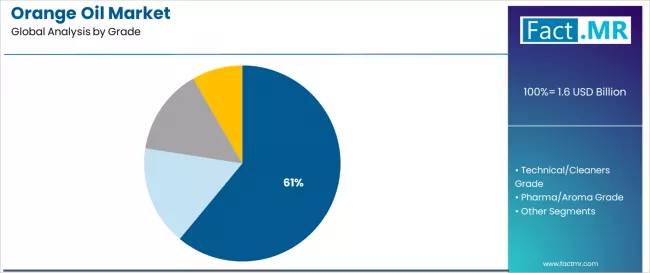
Orange Oil Market Analysis By Grade | Source: Fact.MR
The F&F grade segment represents the dominant force in the orange oil market, capturing approximately 61.0% of total market share in 2025. This established grade category encompasses commercial-quality orange oil featuring standardized limonene content, consistent flavor profiles, and regulatory compliance that enable superior food and fragrance applications across international markets.
The F&F grade segment's market leadership stems from its superior commercial versatility capabilities, with products capable of serving diverse beverage and cosmetic applications while maintaining consistent quality standards and cost-effectiveness across all major food and fragrance markets.
The technical/cleaners grade segment maintains a substantial 26.0% market share, serving home care and cleaning product manufacturers who require effective natural solvents with degreasing properties and pleasant citrus fragrance for eco-friendly cleaning applications.
These products offer natural cleaning solutions for environmentally conscious brands while providing sufficient cleaning efficacy to meet household and commercial cleaning product performance standards.
The pharma/aroma grade segment accounts for approximately 13.0% of the market, serving pharmaceutical and aromatherapy applications requiring specialized purity levels and therapeutic-grade processing standards.
Key grade advantages driving the F&F grade segment include:
- Commercial processing standards with consistent flavor characteristics that ensure reliable beverage and confectionery performance across food applications
- Regulatory compliance capabilities enabling international food and cosmetic market acceptance with established safety profiles
- Versatile application compatibility options allowing simultaneous use across food flavoring and fragrance formulations without quality conflicts
- Enhanced market reach features, providing broad commercial appeal for large-scale food and fragrance manufacturing requirements
By Application, the Beverages Segment Accounts for the Largest Market Share
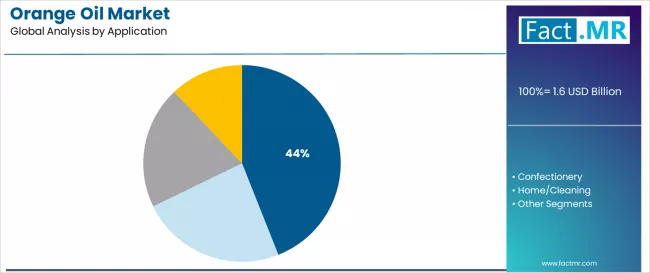
Orange Oil Market Analysis By Application | Source: Fact.MR
Beverages applications dominate the orange oil market with approximately 44.0% market share in 2025, reflecting the established use of orange oil in citrus beverages, flavored waters, and soft drinks where authentic orange character and natural citrus appeal drive consumer preference across global beverage markets. The beverages segment's market leadership is reinforced by orange oil's distinctive fresh citrus characteristics and natural flavor authenticity, creating strong consumer acceptance and beverage manufacturer adoption across developed and emerging beverage markets worldwide.
The confectionery segment represents the second-largest application category, capturing 30.0% market share through candy flavoring, chocolate applications, and premium confectionery products that leverage orange oil's sweet citrus character and aromatic appeal. This segment benefits from growing demand for natural flavoring in confectionery that meets specific taste requirements, premium positioning standards, and artisanal candy development in competitive confectionery markets.
The home/cleaning segment accounts for 26.0% market share, serving household cleaning product manufacturers through natural degreasers, surface cleaners, and eco-friendly cleaning formulations. This segment demonstrates growth through enhanced environmental positioning, natural cleaning effectiveness, and eco-friendly product development.
Key market dynamics supporting application growth include:
- Beverages expansion driven by natural citrus beverage innovation and consumer preference for authentic orange flavoring in premium drink applications
- Confectionery modernization enabling natural candy flavoring with distinctive orange character and premium confectionery positioning
- Home care integration creating eco-friendly cleaning solutions with natural degreasing properties and pleasant citrus fragrance
- Growing emphasis on natural ingredients driving demand for versatile orange oil solutions across food, beverage, and home care sectors
What are the Drivers, Restraints, and Key Trends of the Orange Oil Market?
The market is driven by three concrete demand factors tied to natural ingredient preferences and eco-friendly product outcomes. First, natural product industry growth and eco-friendly consumer trends create expanding demand for natural citrus ingredients, with green product market expansion growing by 7-10% annually in major developed countries worldwide, requiring comprehensive natural ingredient sourcing infrastructure. Second, cleaning product naturalization and home care eco-consciousness drive increased adoption of citrus-based cleaning agents, with many household product manufacturers prioritizing orange oil formulations and natural cleaning solutions by 2030. Third, beverage industry premiumization and natural flavor trends enable more authentic and appealing citrus applications that deliver superior taste experiences while maintaining natural positioning and consumer appeal.
Market restraints include supply concentration in specific citrus-producing regions that can create vulnerability to weather disruptions, agricultural challenges, and seasonal production variations in key countries like Brazil and the United States. Price volatility due to citrus crop fluctuations poses another significant challenge, as orange production cycles may create cost variations, potentially limiting adoption among price-sensitive applications and commercial formulations. Competition from synthetic citrus alternatives creates additional market pressure, demanding ongoing investment in natural positioning and premium quality differentiation.
Key trends indicate accelerated growth in organic and sustainable orange oil products, particularly in North America and Europe, where eco-consciousness and natural product trends drive comprehensive sustainable citrus adoption. Technology integration trends toward enhanced extraction methods with improved sustainability profiles, direct grower partnerships, and carbon-neutral processing enable superior environmental positioning that meets evolving consumer sustainability expectations and corporate responsibility requirements. However, the market thesis could face disruption if synthetic alternatives achieve comparable performance characteristics or significant climate challenges affect traditional citrus cultivation regions.
Analysis of the Orange Oil Market by Key Country
.webp "Top Country Growth Comparison Orange Oil Market Cagr (2026 2036)")
Top Country Growth Comparison Orange Oil Market Cagr (2026 2036) | Source: Fact.MR
| Country | CAGR (2025-2035) |
|---|---|
| USA | 4.1% |
| Mexico | 3.7% |
| Germany | 3.2% |
| South Korea | 3.1% |
| France | 3.1% |
| Japan | 3.0% |
| UK | 3.0% |
Source: Fact.MR analysis. Updated Mar 18, 2026
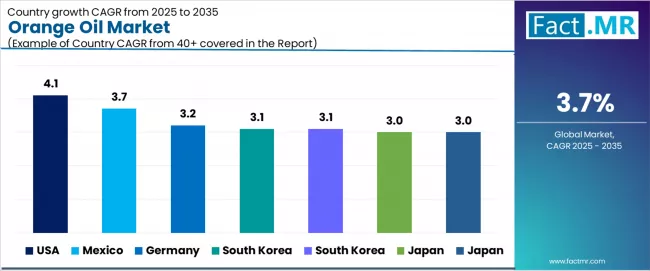
Orange Oil Market Cagr Analysis By Country | Source: Fact.MR
The orange oil market is gaining momentum worldwide, with the USA taking the lead thanks to strong natural products industry and established citrus agriculture infrastructure. Close behind, Mexico benefits from expanding beverage manufacturing and growing natural ingredient applications, positioning itself as a strategic growth hub in the Latin American region. Germany shows steady advancement, where integration of eco-friendly product trends strengthens its role in the European natural ingredients supply chain.
South Korea and France demonstrate equal growth momentum, focusing on natural beverage applications and eco-friendly product innovation, signaling ambitions to capitalize on the growing opportunities in natural ingredient markets. Meanwhile, Japan and the UK both continue to record consistent progress in natural product development and eco-friendly consumer goods. Together, the USA and Mexico anchor the global expansion story, while the rest build stability and diversity into the market's growth path.
The report covers an in-depth analysis of 40+ countries; 7 top-performing countries are highlighted below.
USA Leads Global Market Expansion
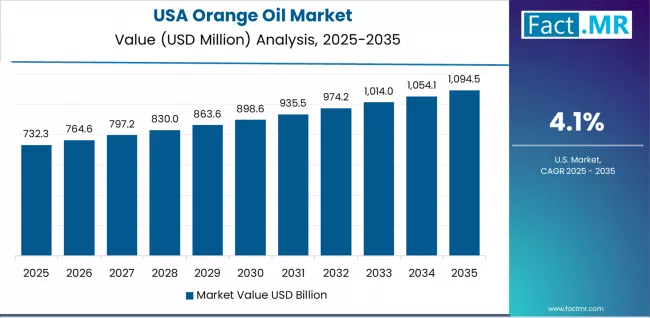
Orange Oil Market Country Value Analysis | Source: Fact.MR
The USA demonstrates the strongest growth potential in the Orange Oil Market with a CAGR of 4.1% through 2035. The country's leadership position stems from robust natural products industry, established citrus agriculture sector, and strong consumer preference for natural ingredients driving the adoption of premium orange oil varieties and eco-friendly applications. Growth is concentrated in major citrus-producing and consumer goods centers, including Florida, California, New York, and Texas, where citrus processors and natural product manufacturers are implementing comprehensive orange oil applications and sustainable processing programs for premium market positioning. Distribution channels through natural product suppliers and beverage ingredient distributors expand coverage across food and home care markets throughout the country. The country's emphasis on natural ingredients and environmental responsibility provides sustained demand for orange oil innovation, including organic certifications and sustainable processing methods.
Key market factors:
- Natural products expansion concentrated in citrus-producing regions with comprehensive sustainable processing infrastructure development programs
- Consumer preference leadership through established natural ingredient culture and eco-friendly product adoption patterns
- Comprehensive citrus processing ecosystem, including established growers and natural ingredient distributors
- Innovation leadership featuring sustainable extraction methods, organic processing programs, and premium orange oil application capabilities
Mexico Emerges as High-Growth Market
In Mexico City, Guadalajara, Monterrey, and citrus-producing regions, the adoption of comprehensive orange oil products is accelerating across beverage manufacturing and expanding food processing sectors, driven by industrial development and increasing natural ingredient integration. The market demonstrates strong growth momentum with a CAGR of 3.7% through 2035, linked to comprehensive manufacturing development and increasing focus on natural ingredient applications and export market opportunities. Mexican manufacturers are implementing orange oil in beverage formulations and natural product development to enhance market competitiveness while meeting growing international demand for natural ingredients in expanding export markets. The country's manufacturing growth and agricultural capabilities create sustained demand for orange oil products, while increasing emphasis on natural positioning drives adoption of sustainable citrus processing.
- Leading manufacturing centers, including Mexico City, Guadalajara, and citrus regions, are driving orange oil product adoption
- Industrial development models enabling beverage manufacturing expansion and natural ingredient integration
- Agricultural advantage trends accelerating adoption with established citrus cultivation and processing capabilities
- Export opportunity advantages through natural ingredient market access and regional trade relationships
Germany Maintains Natural Product Leadership
Germany's established natural products and eco-friendly consumer goods sector demonstrates sophisticated implementation of orange oil products, with documented case studies showing 16% increase in natural ingredient adoption through sustainable product manufacturers and eco-friendly brands. The country's natural products infrastructure in major cities, including Berlin, Munich, Hamburg, and Frankfurt, showcases integration of traditional German quality standards with modern natural ingredient technologies, leveraging expertise in environmental responsibility and premium natural product development. German manufacturers emphasize sustainability and eco-friendliness, creating demand for certified organic orange oil products that support environmental goals and natural product authenticity. The market maintains steady growth through focus on sustainability innovation and natural product standards, with a CAGR of 3.2% through 2035.
Key development areas:
- Natural product manufacturers and eco-friendly brands leading sustainable orange oil adoption with comprehensive environmental programs
- Sustainability channels providing integrated solutions with 92% organic compliance rates
- Innovation partnerships between German natural product companies and citrus producers expanding sustainable market reach
- Integration of traditional German quality standards and modern natural ingredient sustainability practices
Europe Market Split by Country
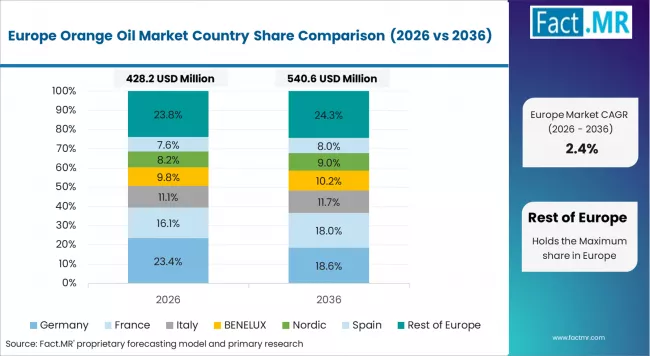
Orange Oil Market Europe Country Market Share Analysis, 2026 & 2036 | Source: Fact.MR
The orange oil market in Europe is projected to grow from USD 400.0 million in 2025 to USD 575.0 million by 2035, registering a CAGR of 3.7% over the forecast period. Germany is expected to maintain its leadership position with a 24.0% market share in 2025, declining slightly to 23.8% by 2035, supported by its strong natural products infrastructure, established eco-friendly consumer culture, and comprehensive sustainable ingredient distribution networks serving major European markets.
France follows with a 22.5% share in 2025, projected to reach 22.6% by 2035, driven by comprehensive natural product modernization programs in Paris, Lyon, and other metropolitan areas implementing advanced natural ingredient retail experiences. The United Kingdom holds a 19.0% share in 2025, expected to maintain 18.8% by 2035 through the ongoing development of eco-friendly home care and natural beverage applications. Italy commands a 16.5% share, while Spain accounts for 12.8% in 2025. The Rest of Europe region is anticipated to gain momentum, expanding its collective share from 5.2% to 5.8% by 2035, attributed to increasing orange oil adoption in Nordic countries and emerging Eastern European natural product markets implementing sustainable ingredient standards.
Competitive Landscape of the Orange Oil Market
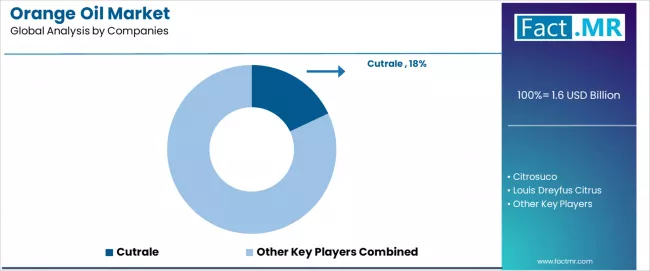
Orange Oil Market Analysis By Company | Source: Fact.MR
The Orange Oil Market features approximately 25-35 meaningful players with moderate concentration, where the top three companies control roughly 18-24% of global market share through established citrus sourcing relationships and extensive food and home care industry partnerships. Competition centers on quality consistency, sustainable sourcing, and application versatility rather than price competition alone.
Market leaders include Cutrale, Citrosuco, and Louis Dreyfus Citrus, which maintain competitive advantages through comprehensive orange oil sourcing portfolios, direct citrus producer relationships, and deep expertise in citrus oil processing and commercial applications, creating strong industry partnerships and quality assurance capabilities. These companies leverage established Brazilian and Florida sourcing networks and ongoing sustainability investments to defend market positions while expanding into adjacent natural ingredient categories and eco-friendly product segments.
Challengers encompass Treatt and Symrise, which compete through specialized applications and strong presence in key natural product and fragrance markets. Flavor and fragrance specialists, including Givaudan, Mane, and Döhler, focus on specific applications or processing technologies, offering differentiated capabilities in natural flavoring, sustainable processing, and premium ingredient positioning.
Regional players and citrus producer cooperatives create competitive pressure through direct sourcing capabilities and sustainable positioning, particularly in high-growth markets including North America and Europe, where natural ingredient authenticity and environmental responsibility provide advantages in premium positioning and sustainability verification. Market dynamics favor companies that combine authentic citrus sourcing with comprehensive sustainability certification and established food and home care industry relationships that address the complete orange oil supply chain from citrus cultivation through natural product applications.
Global Orange Oil Market - Stakeholder Contribution Framework
Orange oil solutions represent a critical natural ingredient that enables beverage manufacturers, home care companies, and fragrance producers to access versatile citrus compounds and functional ingredients without synthetic alternatives or artificial additives, typically providing superior natural freshness, cleaning properties, and aromatic appeal that artificial compounds cannot replicate. With the market projected to grow from USD 1.6 billion in 2025 to USD 2.3 billion by 2035 at a 3.7% CAGR, these solutions offer compelling advantages - natural authenticity, environmental friendliness, and application versatility - making them essential for beverages applications (44.0% market share), confectionery products (30.0% share), and diverse home care formulations seeking reliable natural citrus ingredients. Scaling market penetration and sustainability practices requires coordinated action across citrus agriculture policy, sustainable farming standards, orange oil processors, food and home care industry partners, and citrus agricultural organizations.
How Governments Could Spur Local Production and Adoption?
- Citrus Agriculture Programs: Include orange cultivation in national agricultural development initiatives, providing targeted support for citrus farming communities and supporting sustainable cultivation methods through development financing and processing infrastructure grants.
- Natural Product Policy & Trade Support: Implement favorable treatment for sustainable natural imports, provide incentives for companies investing in eco-friendly sourcing and organic processing, and establish sustainability standards that encourage natural ingredient adoption over synthetic alternatives.
- Regulatory Framework Development: Create standardized quality verification processes across food and home care applications, establish clear natural ingredient certification frameworks for international trade, and develop sustainability protocols that facilitate authentic orange oil commerce.
- Agricultural Development & Training: Fund sustainable citrus farming programs, integrated orchard management education, and processing technology improvements. Invest in agricultural extension services that bridge traditional citrus cultivation with modern sustainability standards and international market requirements.
- Market Access & Environmental Policy: Establish procurement policies that support sustainable citrus agriculture for government applications, assist farming cooperatives through preferential trade programs, and create regulatory environments that encourage innovation in sustainable citrus processing and eco-friendly products.
How Industry Bodies Could Support Market Development?
- Sustainability Standards & Certification: Define standardized quality metrics for orange oil across food and home care applications, establish universal sustainability and authenticity protocols, and create certification programs for sustainable citrus sourcing practices that consumers and businesses can trust.
- Market Education & Best Practices: Lead messaging that demonstrates orange oil advantages, emphasizing natural authenticity, environmental benefits, and superior performance compared to synthetic citrus alternatives.
- Environmental Integration Standards: Develop interoperability standards for organic certification, sustainable cultivation guidelines, and eco-friendly processing platforms, ensuring seamless integration across different natural product applications and international markets.
- Professional Development: Run certification programs for natural product specialists, sustainability experts, and sourcing professionals on optimizing orange oil applications, environmental verification, and sustainable sourcing practices in competitive natural ingredient markets.
How Manufacturers and Technology Players Could Strengthen the Ecosystem?
- Advanced Processing Development: Develop next-generation extraction methods with enhanced sustainability capabilities, improved environmental profiles, and eco-friendly processing features that maintain natural benefits while enabling superior performance and reduced environmental impact.
- Sustainability Platforms: Provide comprehensive traceability systems that integrate blockchain verification, citrus grower partnerships, environmental monitoring, and sustainability assurance, enabling food and home care brands to maximize sourcing transparency and environmental authenticity.
- Service & Support Networks: Offer flexible support programs for natural product companies and eco-friendly brands, including sustainability verification options, technical consultation services, and environmental guidance that keep orange oil products current with market demands and environmental expectations.
- Research & Development Networks: Build comprehensive R&D capabilities, collaborative sustainability programs, and eco-friendly application systems that ensure orange oil technologies maintain superior environmental performance and consistent natural benefits across diverse food and home care applications.
How Suppliers Could Navigate the Shift?
- Diversified Application Portfolios: Expand orange oil offerings across beverages (44.0% market dominance), confectionery (30.0% share), and home care applications, with particular focus on F&F grade products (61.0% grade share) and sustainable sourcing strategies.
- Geographic Market Development: Establish operations in high-growth markets like USA (4.1% CAGR) and Mexico (3.7% CAGR), while strengthening presence in established markets like Germany (3.2% CAGR) and South Korea (3.1% CAGR) through regional partnerships and direct citrus producer relationships.
- Technology-Enabled Services: Implement advanced traceability systems with sustainability verification, environmental monitoring, and quality consistency capabilities that differentiate service offerings and improve food and home care industry partnership satisfaction.
- Flexible Processing Models: Develop cold-pressed, organic, and specialty orange oil solutions that accommodate varying industry needs, from cost-effective food applications to ultra-premium natural products for demanding environmental requirements.
How Investors and Financial Enablers Could Unlock Value?
- Supply Chain Expansion Financing: Provide growth capital for established companies like Cutrale, Citrosuco, and Louis Dreyfus Citrus to expand sustainable citrus sourcing capabilities and processing capacity, particularly in key producing regions with growing natural product demands.
- Innovation Investment: Back startups developing advanced sustainable processing technologies, environmental preservation platforms, and eco-friendly cultivation systems that enhance orange oil industry innovation and competitive positioning.
- Regional Market Development: Finance market entry and expansion strategies for orange oil companies establishing operations in high-growth regions, supporting citrus producer partnerships that enhance sustainable sourcing while maintaining traditional cultivation expertise.
- Consolidation & Scale Opportunities: Support strategic acquisitions and supply chain consolidation that create economies of scale, improve sustainability capabilities, and enhance competitive positioning against fragmented regional citrus oil providers across multiple geographic markets.
Key Players in the Orange Oil Market
- Cutrale
- Citrosuco
- Louis Dreyfus Citrus
- Treatt
- Symrise
- Givaudan
- Mane
- Döhler
- Florida Chemical/ADM
- Takasago
Bibliography
- Food and Agriculture Organization of the United Nations. (2024). Citrus fruit: Fresh and processed statistical bulletin. FAO.
- International Federation of Essential Oils and Aroma Trades. (2024). Citrus oils market review. IFEAT.
- European Chemicals Agency. (2024). REACH registration: d-Limonene substance evaluation. ECHA.
- United States Environmental Protection Agency. (2024). Safer Choice program: Bio-based solvent criteria. US EPA.
- Government of Brazil, Ministry of Agriculture. (2024). Brazilian citrus processing sector: Production statistics. MAPA.
- United States Department of Agriculture. (2025). Citrus: World markets and trade. USDA FAS.
This bibliography is provided for reader reference. The full FACT.MR report contains the complete reference list with primary research documentation.
This Report Addresses
- Market sizing and quantitative forecast metrics detailing global orange oil trade volumes and values through 2036.
- Segmentation analysis mapping consumption across grades, applications, and extraction types.
- Regional trade intelligence comparing Brazilian production dominance against Florida supply decline and alternative origin emergence.
- Regulatory compliance assessment analyzing bio-solvent certification requirements and food-grade ingredient standards.
- Competitive landscape evaluation tracking major citrus processors and flavor and fragrance house procurement positions.
- Strategic sourcing guidance defining forward contracting, origin diversification, and grade-specific pricing management priorities.
- Supply chain vulnerability analysis identifying citrus greening disease impacts and weather-related production risk factors.
- Custom data delivery formats encompassing interactive dashboards, raw Excel datasets, and comprehensive PDF narrative reports.
Segmentation
Scope of the Report
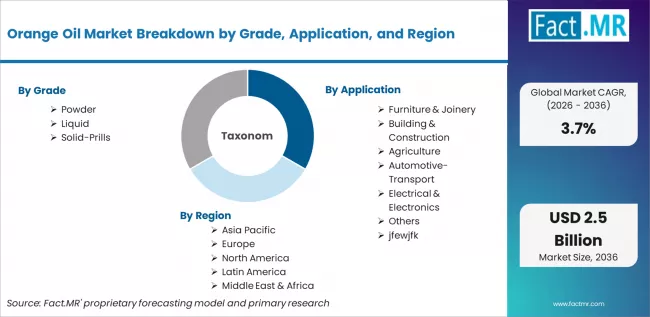
Orange Oil Market Breakdown By Grade, Application, And Region | Source: Fact.MR
| Metric | Value |
|---|---|
| Quantitative Units | USD 1.66 billion to USD 2.39 billion, at a CAGR of 3.7% |
| Market Definition | Orange oil encompasses essential oil extracted from sweet orange peel during juice processing, containing d-limonene as its major component, used in confectionery flavoring, cleaning products, fragrance formulations, and pharmaceutical preparations. |
| Grade Segmentation | Technical/Cleaners Grade, F&F Grade, Pharma/Aroma Grade, Others |
| Application Segmentation | Confectionery, Beverages, Home/Cleaning, Others |
| Type Segmentation | Cold-Pressed, Distilled/Terpeneless |
| Regions Covered | North America, Latin America, Europe, East Asia, South Asia, Oceania, Middle East & Africa |
| Countries Covered | India, China, USA, Canada, UK, Germany, Japan, and 40 plus countries |
| Key Companies Profiled | Cutrale Group, Citrosuco S.A., Louis Dreyfus Company (Citrus), Treatt plc, Symrise AG, Givaudan SA, Mane SA, Doehler GmbH, ADM (Florida Chemical), Takasago International Corporation |
| Forecast Period | 2026 to 2036 |
| Approach | Forecasting models apply a bottom-up methodology starting with origin-country juice processing throughput, integrating end-use application demand curves, grade-specific pricing trends, and bio-solvent regulatory adoption timelines. |
Source: Fact.MR analysis. Updated Mar 18, 2026
Orange Oil Market by Segments
-
Grade :
- F&F Grade
- Technical/Cleaners Grade
- Pharma/Aroma Grade
- Others
-
Application :
- Beverages
- Confectionery
- Home/Cleaning
- Others
-
Type :
- Cold-pressed
- Distilled/Terpeneless
-
Region :
- North America
- United States
- Canada
- Mexico
- Europe
- Germany
- United Kingdom
- France
- Italy
- Spain
- Nordic
- BENELUX
- Rest of Europe
- Asia-Pacific
- China
- Japan
- South Korea
- India
- Australia & New Zealand
- ASEAN
- Rest of Asia Pacific
- Latin America
- Brazil
- Chile
- Rest of Latin America
- Middle East & Africa
- Kingdom of Saudi Arabia
- Other GCC Countries
- Turkey
- South Africa
- Other African Union
- Rest of Middle East & Africa
- North America
Frequently Asked Questions
How large is the demand for orange oil in the global market in 2026?
What will be the market size of orange oil by 2036?
What is the expected demand growth for orange oil between 2026 and 2036?
Which grade is poised to lead by 2026?
How significant is the role of Confectionery in driving orange oil demand?
What type segment leads in 2026?
What is orange oil and what is it mainly used for?
What is included in the scope of this report?
What is excluded from the scope of this report?
How does FACT.MR build and validate this forecast?
Does the report cover USA in its regional analysis?
Does the report cover Germany in its regional analysis?
Does the report cover India in its regional analysis?
Who worked on this report


Preview the report firsthand - request a free sample
Free SampleGet the brochure for pricing and purchase details
Download PDF