- Base Value(2025): 11.70 Bn
- Estimated Value(2026): 12.87 Bn
- Forecast Value (2036): 33.38 Bn
- CAGR (2026 - 2036): 10.0%
Automotive Ignition System Market Size, Market Forecast and Outlook By Fact.MR
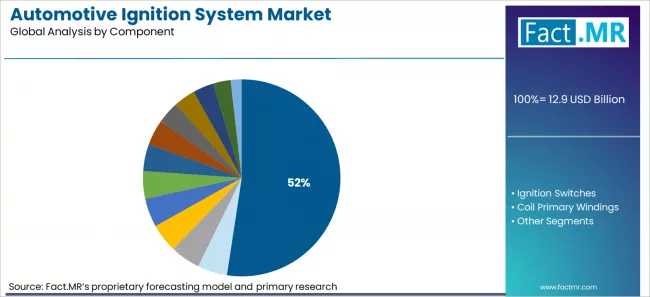
The global automotive ignition system market was valued at USD 11.70 billion in 2025, projected to reach USD 12.87 billion in 2026, and is forecast to expand to USD 33.38 billion by 2036 at a 10.0% CAGR. Secondary ignition systems hold 52.4% of the type segment in 2026, encompassing the high-voltage spark delivery components including ignition coils, spark plug wires, and spark plugs whose performance quality directly determines combustion efficiency, fuel consumption, and emission compliance across gasoline internal combustion engine platforms. Distributor-less ignition systems command 46.7% of the component segment, reflecting the near-universal adoption of coil-on-plug and wasted-spark ignition architectures that have displaced mechanical distributor configurations across modern engine platforms for their superior spark timing precision, individual cylinder misfire detection capability, and elimination of high-voltage rotary contact wear mechanisms.
The absolute dollar expansion of USD 20.51 billion over the forecast period reflects both the migration toward advanced ignition technologies required for high-pressure GDI engine combustion stability and the additive demand from hybrid vehicle powertrain configurations that deploy spark ignition engines in duty cycles requiring more frequent and precisely controlled ignition events than equivalent conventional vehicle engines. Passenger cars account for 61.8% of the vehicle type segment, consistent with the gasoline engine passenger car fleet generating the dominant share of spark plug and ignition coil replacement demand through the largest installed base of spark ignition cylinders requiring periodic maintenance.
China leads country growth at 10.7% CAGR through 2036, driven by the world's largest vehicle production base transitioning toward GDI engine configurations that require higher-specification iridium and platinum spark plugs and advanced ignition coil systems, alongside the growing hybrid vehicle production base creating demand for ignition systems validated across extended engine-on and engine-off duty cycle sequences. Japan follows at 8.5% CAGR, where domestic automotive and ignition component manufacturers supply advanced ignition system technology for hybrid vehicle platforms that are technically demanding from an ignition control perspective and carry higher per-vehicle ignition system value than conventional gasoline alternatives. The United States advances at 7.9% CAGR, supported by sustained GDI engine production in the large SUV and pickup truck segment and consistent spark plug and ignition coil replacement demand from the extensive passenger car fleet.
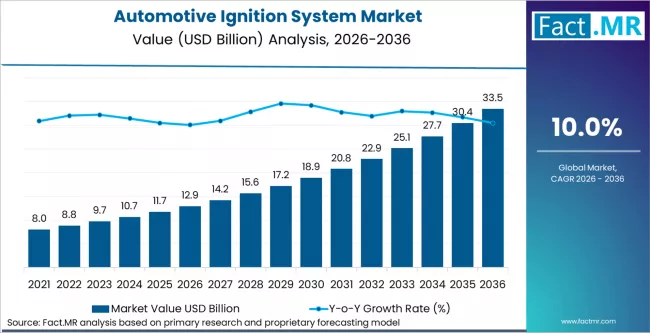
Automotive Ignition System Market Market Value Analysis | Source: Fact.MR
Automotive Ignition System Market Key Takeaways
| Metric | Details |
|---|---|
| Industry Size (2026) | USD 12.87 Billion |
| Industry Value (2036) | USD 33.38 Billion |
| CAGR (2026-2036) | 10.0% |
Source: Fact.MR analysis. Updated Mar 11, 2026
Automotive Ignition System Market Definition
The automotive ignition system market encompasses the complete set of components that generate and deliver high-voltage electrical energy to spark plugs in gasoline internal combustion engine cylinders to initiate combustion, including primary circuit components that store and switch ignition energy and secondary circuit components that step up voltage and deliver timed spark discharge. The scope covers spark plugs, ignition coils, ignition control modules, crankshaft and camshaft position sensors, distributor-less and direct ignition coil pack assemblies, and associated high-voltage wiring, supplied for OEM vehicle production and aftermarket service replacement.
Automotive Ignition System Market Inclusions
Market scope includes copper, platinum, and iridium tip spark plugs across all electrode configurations, individual coil-on-plug ignition coil assemblies, wasted-spark dual-output ignition coil packs, ignition control module and ECU ignition driver circuits, crankshaft position sensors and reluctor wheel assemblies, camshaft position sensors, and ignition high-tension lead sets for distributor-equipped legacy engines. Geographic analysis covers North America, Latin America, Europe, East Asia, South Asia, Oceania, and Middle East and Africa. Forecast scope spans 2026 to 2036 with segment breakdowns by type, component, vehicle type, and region.
Automotive Ignition System Market Exclusions
Diesel engine glow plug systems and compression ignition cold-start heating circuits, battery electric vehicle high-voltage power electronics that do not perform spark ignition functions, hydrogen internal combustion engine ignition systems classified separately under hydrogen powertrain components, industrial stationary engine ignition systems, and marine and aviation ignition systems fall outside this market scope.
Automotive Ignition System Market Research Methodology
- Primary Research: Fact.MR analysts conducted interviews with powertrain engineering managers at vehicle OEMs specifying ignition system requirements for GDI and hybrid engine platforms, ignition component product managers at tier-one suppliers, and independent automotive service technicians tracking ignition system failure modes and replacement patterns to validate spark plug service interval trends, coil-on-plug failure rate distributions, and premium spark plug adoption rates in the independent aftermarket.
- Desk Research: Secondary research aggregated emission regulation documentation specifying combustion stability requirements that drive ignition system specification, OEM service documentation for spark plug replacement intervals across major engine families, corporate product development announcements from listed ignition system manufacturers, and vehicle production statistics from automotive industry associations.
- Market-Sizing and Forecasting: Baseline market values derive from a bottom-up aggregation of ignition component unit volumes by type and vehicle category, multiplied by average unit prices across copper, platinum, and iridium spark plug tiers and standard versus advanced ignition coil configurations. Hybrid vehicle production growth was applied as an incremental demand variable for premium ignition component specifications required for hybrid duty cycle performance.
- Data Validation and Update Cycle: Segment forecasts are cross-validated against revenue disclosures from publicly listed ignition system manufacturers and vehicle production data from automotive associations. Annual updates incorporate actual GDI engine production shares and updated hybrid vehicle production volumes by market.
Summary of Automotive Ignition System Market
- Automotive Ignition System Market Definition
- The automotive ignition system market covers components generating and delivering timed high-voltage spark discharge to gasoline engine cylinders, including spark plugs, ignition coils, distributor-less and direct ignition assemblies, and ignition control electronics, supplied through OEM production and aftermarket service channels globally.
- Demand Drivers in the Market
- GDI Engine High-Pressure Combustion Requiring Premium Spark Plug Specifications: The global migration of passenger car gasoline engines toward direct injection configurations operating at higher compression ratios and combustion pressures than port fuel injection predecessors requires spark plugs with finer iridium or platinum electrode tips that maintain precise gap geometry under elevated thermal and mechanical stress conditions, increasing per-cylinder spark plug unit cost relative to the copper tip plugs that sufficed for lower-pressure port injection engine operating conditions.
- Emission Compliance Misfire Detection Requirements Driving Ignition System Quality Upgrade: On-board diagnostic misfire detection requirements under OBD-II, Euro 6, and China 6 emission regulations require ignition systems to maintain combustion reliability within defined misfire rate thresholds under all operating conditions, compelling OEM engineers to specify higher-reliability iridium spark plugs and matched coil-on-plug ignition assemblies whose tighter performance consistency reduces misfire probability below the OBD monitoring detection threshold across the full engine operating range.
- Hybrid Vehicle Ignition System Demand for Extended Engine Restart Reliability: The frequent engine start-stop cycling characteristic of hybrid vehicle operation places higher cumulative demands on spark plug electrode wear resistance and ignition coil insulation fatigue life than equivalent conventional vehicle duty cycles, requiring hybrid-validated ignition component specifications with extended service life ratings that command premium pricing in both OEM programme supply and aftermarket replacement channels.
- Key Segments Analyzed in the Fact.MR Report
- Secondary Ignition Systems Type: Commands 52.4% share in 2026 as the high-voltage spark delivery component category encompassing ignition coils, spark plugs, and associated high-tension circuit elements whose performance quality directly determines combustion efficiency, misfire rate, and emission compliance in gasoline engine platforms across all vehicle segments from entry-level to premium.
- Passenger Cars Vehicle Type: Holds 61.8% share in 2026, representing the dominant gasoline engine spark ignition cylinder population generating the largest aggregate spark plug and ignition coil replacement demand, with GDI technology adoption across the passenger car segment driving specification upgrades toward premium iridium plugs and advanced coil-on-plug assemblies that increase per-vehicle ignition system value.
- Distributor-less Ignition Systems Component Category: Accounts for 46.7% of 2026 component segment share, reflecting the near-universal adoption of coil-on-plug and wasted-spark configurations across modern engine platforms where individual cylinder ignition timing control, elimination of mechanical distributor wear, and precise misfire detection enable both higher performance and the emission compliance diagnostic capability mandated by OBD regulations.
- Analyst Opinion at Fact.MR
- Fact.MR analysis indicates that the 10.0% CAGR for the automotive ignition system market through 2036 reflects a combination of structural factors that are simultaneously expanding the market despite the long-term electrification trend that will ultimately reduce the gasoline spark ignition engine population. The near-term drivers are clearly additive: GDI engine adoption is increasing per-cylinder ignition component specification value, hybrid vehicle production is growing the spark ignition engine population even within the broader electrification trend since most hybrids retain gasoline spark ignition engines, and emission regulation misfire detection requirements are driving quality upgrades from commodity copper spark plugs to premium iridium alternatives that carry two to four times the per-plug retail price. The aftermarket ignition replacement cycle provides a remarkably stable revenue foundation, as spark plug replacement intervals of 60,000 to 100,000 kilometres for iridium plugs and 30,000 kilometres for copper plugs create a predictable cyclical demand stream from the accumulated global vehicle parc that is structurally independent of new vehicle production volumes. Ignition component manufacturers with established iridium and platinum spark plug production capabilities and validated coil-on-plug designs for high-pressure GDI engine platforms are positioned to capture the premium segment growth that is driving aggregate market revenue expansion well beyond unit volume growth alone.
- Strategic Implications / Executive Takeaways
- Iridium and Platinum Spark Plug Capacity Investment Ahead of GDI Mandate Wave: Ignition component manufacturers should invest in iridium and platinum electrode tip production capacity ahead of the volume growth from GDI engine adoption expansion in emerging markets where China 6b and BS VI emission standards are compelling engine specification upgrades that require premium spark plug specifications, as capacity constraints during peak demand transitions have historically created supply gaps that damage supplier relationships with OEM programme engineering teams.
- Hybrid-Validated Ignition Component Product Line Development: Suppliers should develop spark plug and ignition coil product lines specifically validated for the extended engine restart cycling duty cycles of hybrid vehicle operation, as OEM hybrid powertrain engineering teams are seeking ignition component suppliers who can demonstrate validated component life performance under hybrid-specific operating conditions that cannot be inferred from conventional vehicle durability test results.
- Independent Aftermarket Premium Upgrade Programme: Ignition manufacturers should develop consumer communication programmes educating independent aftermarket buyers on the measurable fuel economy and emission performance benefits of upgrading from copper to iridium spark plugs during service replacement events, as the consumer education investment required to shift aftermarket purchasing toward premium specifications generates sustained per-event revenue increases that compound across the large replacement market cycle.
What are the drivers of automotive ignition system market?
The automotive ignition system market is largely driven by the growing demand for fuel-efficient and low-emission vehicles, government regulations on emissions, and ignition technology. Another key driver of market growth is the gradual adoption of electronic ignition systems, which enhance engine efficiency and reduce vehicle maintenance costs.
The growing number of vehicles, particularly in developing nations, is positively impacting the growing acceptance of smart ignition systems. The ever increasing market for hybrid and electric vehicles (EVs) has led to demand for more efficient ignition components, resulting in innovation in ignition coil and spark plug technologies.
Demand for performance-boosting ignition systems from vehicle owners, particularly in the automotive aftermarket, is also facilitating market growth. Widespread utilization of digital control units and sensors in real-time ignition data optimization that aids in the betterment of vehicle performance and fuel economy will accelerate growth over the forecast period. Increasing emphasis on sustainability, coupled with a need for lightweight vehicles and components, is driving the design and development of the ignition systems that aid in energy efficiency in these vehicles and make them crucial in contemporary vehicle engineering systems.
What are the regional trends of automotive ignition system market?
The mature North American market has been driven by strict emission regulations and the increasing use of advanced ignition technologies, especially in hybrid and electric vehicles. This region enjoys robust automotive production and technology in electronic ignition systems.
There is increasing adoption of high-performance ignition systems for superior fuel efficiency in Europe, which is the home to some of the largest automobile manufacturers and tight regulations regarding sustainability and lower carbon emissions.
Due to rising vehicle production and growing middle-class populations with increasing disposable incomes, the Asia-Pacific region, which includes China, Japan, and India, is witnessing the fastest growth. The high demand for two-wheelers and passenger cars drives the demand for ignition systems.
Emerging markets have moderate growth in vehicle sales and aftermarket demand. However, economic ups and downs, along with regulatory challenges, could hinder market growth there. The adoption of technology varies from region to region, depending on the maturity of the local automotive industry.
What are the challenges and restraining factors of automotive ignition system market?
The market confronts several challenges, including the growing penetration of electric vehicles (EVs), which do not require traditional ignition systems, hampering its growth. Strict emission standards across the globe are driving automakers towards alternative powertrains, which is adding pressure on ICE (internal combustion engine) cars.
Changing raw material prices, such as copper and steel, affect the production of ignitor components, leading to stability issues for manufacturers. The latest ignition systems' increased complexity, with their need to integrate perfectly with electronic control units (ECUs), is highly challenging to low-volume manufacturing firms that do not possess highly developed R&D capabilities.
The aftermarket also faces issues with counterfeit ignition parts, pointing to concerns surrounding quality and safety. Laser ignition systems are an example of an advanced ignition technology that can be expensive to implement, hindering adoption and limiting growth potential in cost-sensitive markets.
Shifts in the Automotive Ignition System Market from (2020 to 2024) and Future Trends (2025 to 2035)
This report is compiled based on the data surveyed in October 2023 and focuses on the automotive ignition system market based on thorough research from 2020 to 2024. Electronic and coil-on-plug ignition systems have mostly replaced traditional ignition systems, like distributor-based setups, enhancing fuel efficiency and engine performance.
For the 2025 to 2035 period, the ignition market is forecast to show evolutionary continued development, including technologies in ignition closer integration to AI-based engine management systems, and a slow migration to BEV technology, and whether this will have an impact on the traditional ignition part demand or not.
Market growth will continue to be driven by sustainability concerns and stricter environmental policies, resulting in innovation and development of cleaner and more efficient ignition solutions among manufacturers.
| Market Shift | 2020 to 2024 |
|---|---|
| Regulatory Landscape | Stricter emission norms (Euro 6, CAFÉ standards) led to the adoption of efficient ignition systems. |
| Technological Advancements | Transition from mechanical to electronic and coil-on-plug ignition systems. Integration of ignition timing optimization via engine control units (ECUs). |
| Industry-Specific Demand | Growth is driven by internal combustion engine (ICE) vehicles, including gasoline and hybrid cars. |
| Sustainability & Circular Economy | Focus on reducing emissions through better combustion efficiency and fuel management. |
| Production & Supply Chain | Dependence on semiconductor-based ignition control units, and occasional disruptions due to chip shortages. |
| Market Growth Drivers | Increasing demand for fuel-efficient vehicles and performance-oriented ignition systems. |
Source: Fact.MR analysis. Updated Mar 11, 2026
| Market Shift | 2025 to 2035 |
|---|---|
| Regulatory Landscape | Future policies are expected to push for near-zero emissions, influencing further R&D in ignition efficiency and electrification. |
| Technological Advancements | Development of advanced ignition control through AI and machine learning. Potential innovations in plasma ignition and low-energy ignition technologies. |
| Industry-Specific Demand | Declining demand for ICE-based ignition components due to rising EV adoption. However, hybrid vehicle ignition systems will remain relevant. |
| Sustainability & Circular Economy | Greater emphasis on reducing material waste, recycling ignition system components, and producing eco-friendly alternatives. |
| Production & Supply Chain | More localized manufacturing and diversification of supply chains to reduce risks associated with semiconductor shortages. |
| Market Growth Drivers | The growth of hybrid vehicles and the need for efficient ignition solutions in transitioning markets have resulted in continued demand in regions where ICE vehicles dominate. |
Source: Fact.MR analysis. Updated Mar 11, 2026
As market share shifts toward fully electric vehicles and the number of ignition components further declines, the automotive ignition system market will see a reduction in demand for conventional ignition components. Hybrid cars that need advanced ignition systems to maintain fuel economy will contribute to the demand for new ignition technologies.
New trends, such as plasma and laser ignition, will become increasingly used in high-performance and alternative-fuel engines. A focus on sustainability will drive the development of ignition systems made of recyclable materials with a lower environmental footprint.
Although new markets where EV adoption is taking hold (like Africa, Latin America, and Southeast Asia) will keep Phytronic demand steady, the reliance on internal combustion engines assures a long-term market for ignition components in these areas. This implies a move towards hybrid technology and next-gen ignition solutions in developed markets in the US, Europe, and China.
Country-Wise Outlook
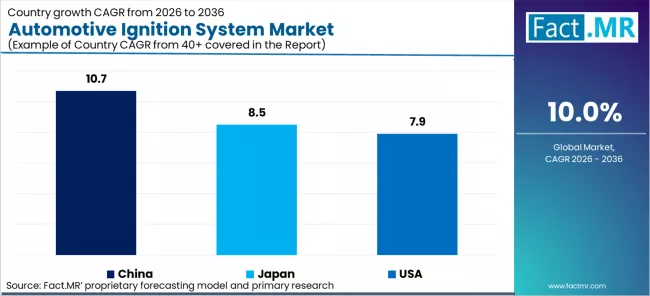
Automotive Ignition System Market Cagr Analysis By Country | Source: Fact.MR
Country-Wise Insights
| Country | Attributes |
|---|---|
| United States (CAGR) | 7.9% |
| China(CAGR) | 10.7% |
| Japan (CAGR) | 8.5% |
Source: Fact.MR analysis. Updated Mar 11, 2026
United States (U.S.)
The ignition system is an indispensable part of an automobile's internal combustion engine. It ignites the air-fuel mixture in the cylinders, which is a critical factor for the growing engine market in the transition from gas breeders to gas mixtures. Electronic ignition systems, such as coil-on-plug and distributor-less ignition systems, are also becoming popular in the market owing to their enhanced performance and lower emissions.
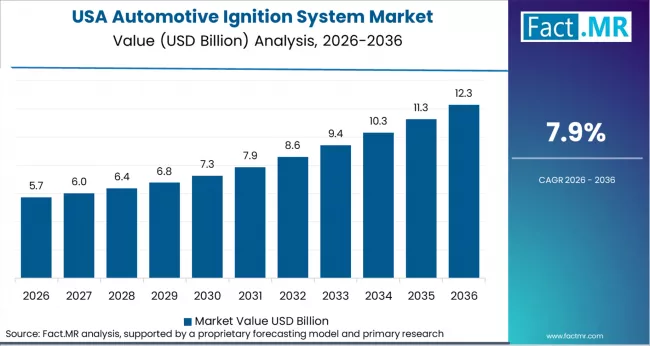
Automotive Ignition System Market Country Value Analysis | Source: Fact.MR
The surge in popularity of hybrid and electric vehicles (EVs) is also impacting ignition system developments, notably in relation to ignition control modules and sensors. The influence of large automakers such as Ford, General Motors, and Tesla encourages technological innovation and increased investment in advanced ignition systems.
Government-driven programs and policies that foster cleaner combustion technologies are compelling manufacturers to design efficient ignition systems. Another driving factor is the increasing consumer preference for high-performance vehicles and aftermarket ignition upgrades.
The market is further contributing to increasing R&D investment in smart ignition systems with higher diagnostic capabilities. Overall, a slow and steady growth trajectory is expected for the U.S. market, underwritten by regulatory policies and automotive industry developments.
China
China is the largest automotive market in the world, and ignition system technology is rapidly evolving amid growing vehicle production, stringent emissions regulations, and developments in electric mobility. Based on traditional ignition systems, high-energy ignition coils and intelligent ignition modules improve combustion efficiency and meet China VI emissions standards.
The war on emissions has also sparked new technologies in hybrid ignition systems, either by more advanced spark plugs or more effective ignition systems. Domestic companies such as BYD, Geely, and SAIC Motor are investing significantly in ignition system research and development (R&D), thereby stimulating the growth of local supply chains.
Market growth is also propelled by the rising after-market segment, prodded by a growing vehicle parc and an uptick in consumer desire for improved performance. China’s heavy push for EVs could potentially constrain the demand for conventional ignition systems in the long run. However, innovation in smart ignition technologies coupled with performance engine systems is projected to drive the market opportunities in the country.
Japan
Japan's Automotive Ignition System Market offers high levels of innovation, strict fuel efficiency regulations, and strong technological leadership from market players like Denso, Mitsubishi Electric, and Hitachi Astemo. The country’s drive for hybrid and fuel-efficient internal combustion engines (ICEs), has helped boost adoption of advanced ignition systems including direct ignition and plasma-assisted ignition technologies.
Japan’s automakers, including Toyota, Honda and Nissan, stress the adoption of ignition technologies that boost fuel economy and lower emissions to meet worldwide environmental regulations. Japan has witnessed the emergence of hybrid electric vehicles (HEVs) that accommodate specialized ignition components for hybrid powertrains.
Their in-depth R&D work with next-generation ignition systems, from laser ignition to high-energy coils, also demonstrates a strong market fit. The aftermarket sector is strong due to Japan's long-standing children's interest and sparkling modern division system upgrade. With ongoing technology advances and environmental policies, the Japan ignition system market will undergo sustainable growth.
Category-Wise Analysis
Electronic Ignition Systems - By Type
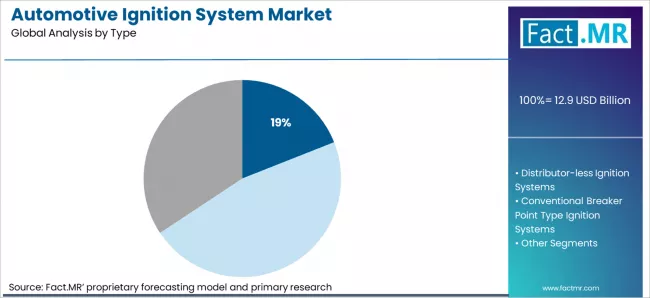
Automotive Ignition System Market Analysis By Type | Source: Fact.MR
Electronic ignition systems (EIS) have far more advantages in terms of efficiency improvement, ignition timing maintenance, decreased gas emissions, and other factors compared with mechanical systems. Electronic ignition has supplanted mechanical systems with solid-state circuits, sensors, and microprocessors that produce the ideal spark, as opposed to mechanical breaker-point systems, which can go out of adjustment and wear out over time.
This reduces maintenance needs and also improves engine performance and fuel economy. Discharge Ignition (CDI) and Transistorized Ignition Systems (TIS) provide strong, high-voltage sparks to assist complete fuel combustion and reduce harmful emissions.
Market growth is being driven by the need for Electronic ignition technology by automotive manufacturers when the emission norms are so strict, like EURO 6 and BS-VI, to comply with environmental safety. Hybrid and naturally fuel-injection-based engines are becoming more common, and with them, the need for an advanced ignition system.
Progress in vehicle electrification to promote widespread adoption of battery-powered vehicles and advancement in mobility solutions like connected vehicles and smart engine management systems will likely boost the electronic ignition market.
Ignition Switches- By Component
Automotive Ignition System Market Analysis By Component | Source: Fact.MR
The ignition switch is an important part of a vehicle’s ignition system. It is designed to activate the engine’s power-up process and manage the power distribution to crucial electrical components. Usually found on the steering column or dashboard, the ignition switch has three stages: accessory, ignition, and start.
Many modern vehicles employ keyless ignition systems with electronic push-button start systems to improve security and convenience. The advanced anti-theft features prevent access to the vehicle using immobilizers and transponder-based ignition locks.
With the increasingly popular hybrid and electric vehicles (EVs), ignition switches have transformed further, becoming part of the battery management systems (BMS). Smart ignition systems now also integrate biometric authentication and remote start features for added safety and efficiency. While vehicles continue to integrate more technology, the ignition switch remains a vital component for seamless and secure vehicle operation.
Ignition Resistors - By Component
Ignition resistors are an important part of an electrical automotive ignition system that helps control voltage to reduce damage and ultimately increase the system's life. The resistors restrict the voltage flowing to the ignition coil and distributor, which helps protect against overheating or premature wear of ignition components.
Ignition resistors are often found in modern breaker-point ignition systems to maintain constant spark intensity with each firing of the plug and ensure the efficient combustion of fuel. A common style of ignition resistor is ballast resistors, which lower the coil voltage once the engine has started, extending the life of both ignition coils and spark plugs.
Ignition resistors became less important with the introduction of electronic ignition systems (EIS) and distributor-less ignition, where a solid-state control unit replaces and regulates the voltage and current in older systems. However, these components still exist in newer designs.
In classic cars, motorcycles, and specific industrial applications, ignition resistors still play an important role in solidifying stable ignition operation. This makes them a critical component of antiquated ignition systems due to the efficiency of tuning their effectiveness to improve ignition reliability and eliminate component failure.
Competitive Analysis
Automotive Ignition System Market Analysis By Company | Source: Fact.MR
Ignition systems Conventional via distributor and coil-on-plug designs are the traditional type ignition systems, now being replaced with electronic and programmable ignition systems for enhanced performance and reduced emissions.
Hybrid and electric vehicle-compatible ignition solutions are in high demand and highly competitive. Competition is fueled by a substantial aftermarket for ignition upgrades for vehicle owners wanting more out of their copper plugs. In the meantime, regional players are competing effectively with cheaper options, while research into solid-state and plasma ignition systems could shake the market up down the line.
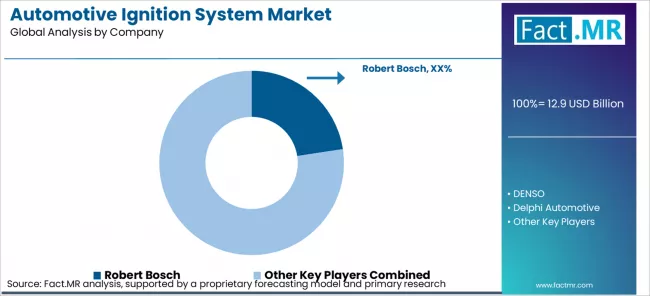
Key players are Delphi Automotive, Valeo Service, Federal-Mogul Corporation, Mitsubishi Electric Corporation, Continental AG, Hitachi Automotive Systems, Robert Bosch, DENSO, BorgWarner, and Diamond Electric and other players.
Market Share Analysis by Company
| Company Name | Estimated Market Share (%) |
|---|---|
| Top 5 Players | ~45-55% |
| Tier II Players | ~15-30% |
| Other Players | ~15-40% |
Source: Fact.MR analysis. Updated Mar 11, 2026
Key Company Offerings and Activities
| Company Name | Key Offerings/Activities |
|---|---|
| Robert Bosch | Advanced ignition coils, spark plugs, and electronic ignition systems. Focus on high-performance and fuel-efficient solutions. |
| DENSO | High-energy ignition coils, coil-on-plug (COP) systems, and aftermarket components. Strong presence in OEM and replacement markets. |
| Delphi Automotive | Ignition coils, electronic control units (ECUs), and hybrid vehicle ignition systems. Focus on next-gen ignition technologies. |
| Continental AG | Develops smart ignition systems for fuel efficiency and reduced emissions. Expanding in electrification and hybrid vehicle sectors. |
| Mitsubishi Electric Corporation | Specializes in high-voltage ignition coils for performance vehicles and hybrid powertrains. |
| Hitachi Automotive Systems | Produces ECU-controlled ignition systems with focus on engine optimization and emissions reduction. |
| BorgWarner | Supplies high-performance ignition technologies with a strong presence in turbocharged engine applications. |
| Federal-Mogul Corporation | Manufactures spark plugs, ignition coils, and aftermarket ignition components. Focus on high-durability solutions. |
| Valeo Service | Provides aftermarket ignition solutions with a focus on cost-efficient technologies for various vehicle models. |
| Diamond Electric | Specializes in compact, lightweight ignition coil technology for fuel efficiency improvements. |
Source: Fact.MR analysis. Updated Mar 11, 2026
DENSO Corporation
DENSO is a leading supplier of ignition components, including high-energy ignition coils, coil-on-plug systems and aftermarket ignition products. As one of the top automotive suppliers, DENSO has sustained its growth and increased its market presence particularly in Asia-Pacific and North America. The car manufacturer spends a fortune on rough, non-hybrid and turbocharged engine ignition technologies to meet float anchorage requirements.
DENSO ignition solutions are widely adopted in fuel-efficient and high-performance vehicles by maximizing ignition reliability, and optimizing spark timing. Through collaborations and ongoing research and development (R&D), DENSO has established itself as a leader in ignition technology innovation in the automotive industry.
- In October 2023, DENSO introduced 14 new part numbers to its ignition coil range, covering 1,649 applications and approximately 33 million passenger cars, especially high-end European models. These additions enhance DENSO's aftermarket product range, ensuring reliable ignition performance across various vehicles.
Robert Bosch
Bosch is in a unique position to help drive trends in the industry with a significant presence in both the OEM and aftermarket markets. The company specializes in high-performance and fuel-efficient ignition technologies, combining intelligent ignition control systems with hybrid and electric vehicle applications.
Its R&d campaigns aim at better engine efficiency, lower emissions and better durability. Bosch has learned the nuances of the electric vehicle market while investing in sustainable ignition technologies. Digital diagnostics and artificial intelligence driven ignition system optimization are used for better engine performance.
- In April 2023, Robert Bosch announced the release of 52 new automotive aftermarket parts in the first quarter of 2023, covering nearly 22 million vehicles across North America. The new products include ignition coils, sensors, braking parts, and fuel pumps, expanding Bosch's portfolio for domestic, European, and Asian vehicles.
Delphi Automotive
A major manufacturer and supplier of ignition systems, including ECU-integrated ignition control units, smart ignition coils and ignition technologies for hybrid vehicles. They work hand in hand with OEMs to provide tailor-made ignition solutions that improve fuel efficiency and vehicle performance.
Delphi offers cost-effective but high-performance ignition systems for both original equipment and aftermarket sectors. The firm is committed to minimize carbon emissions with an intelligent ignition control that can be incorporated in a more advanced engine management system.
Delphi’s research and development efforts are focused on next-generation ignition technologies, including high-energy ignition modules and advances in electronic ignition. Its expanding commitment to electrified powertrain ignition systems establishes it as a significant innovator driving the shift to hybrid and electric vehicles.
Market Outlook
Growing vehicle production, adoption of electronic ignition systems, and increasing emission regulations promoting fuel-efficient technologies will spur the automotive ignition system market over the time frame. This will continue to evolve our industry largely towards the change in vehicles, pushing innovation in ignition rules, in coil-on-plug (COP) and distributor-less ignition systems.
The effectiveness and longevity of an engine itself are also improving due to inventions around its spark plug composition and ignition coils. Asia-Pacific continues to be a primary market and growth region driven by increased automotive manufacturing in China and India.
High-performance ignition systems are in strong demand in North America and Europe. Market players are investing in research and development to enhance ignition efficiency, lower emissions, and cater to evolving automotive electrification trends.
Fact.MR has provided detailed information about the price points of key manufacturers of Automotive Ignition System Market positioned across regions, sales growth, production capacity, and speculative technological expansion, in the recently published report.
Bibliography
- SAE International. (2024, January). SAE J2185: Spark Plug Performance and Endurance Testing Standard for Gasoline Direct Injection Engine Applications Including Iridium and Platinum Electrode Specifications. SAE International.
- European Commission, Directorate-General for Climate Action. (2024, May). Euro 7 OBD Requirements: Misfire Detection Thresholds and Ignition System Diagnostic Performance Standards for Gasoline Passenger Vehicles. European Commission.
- Government of China, Ministry of Ecology and Environment. (2024, February). China 6b OBD II Standards: Combustion Misfire Detection Requirements and Ignition System Compliance Specifications. MEE China.
- United States Environmental Protection Agency. (2024, March). OBD-II Monitoring Requirements: Misfire Detection System Performance Standards for Light Duty Gasoline Vehicles. U.S. EPA.
- International Energy Agency. (2024, May). Global EV Outlook 2024: Hybrid Vehicle Powertrain Architecture and Ignition System Specification Requirements for Engine-Off Restart Duty Cycles. IEA.
- World Bank Group. (2024, April). Automotive Component Manufacturing Investment in East Asia: Ignition System and Powertrain Component Supply Chain Development Analysis. World Bank.
This bibliography is provided for reader reference. The full Fact.MR report contains the complete reference list with primary research documentation.
This Report Addresses
- Market sizing and quantitative forecast metrics: detailing precise revenue projections, absolute dollar growth, and compound annual growth rates across major automotive ignition system segments and geographies through 2036.
- Segmentation analysis: mapping the adoption velocity of leading product, technology, and end-use categories and evaluating structural factors driving segment share transitions over the forecast period.
- Regional deployment intelligence: comparing growth dynamics in high-momentum Asia Pacific and emerging markets against the mature replacement and upgrade demand patterns prevalent in European and North American industry hubs.
- Regulatory compliance assessment: analyzing how evolving product safety standards, environmental directives, and sector-specific mandates are reshaping procurement decisions, material specifications, and supplier qualification criteria.
- Competitive posture evaluation: tracking consolidation trends, platform integration strategies, technology differentiation investments, and the resulting competitive dynamics among established market players and emerging challengers.
- Capital project strategic guidance: defining the procurement specifications, investment thresholds, and performance benchmarks required to support next-generation product adoption and facility modernization programs.
- Supply chain vulnerability analysis: identifying sourcing concentration risks, logistics bottlenecks, raw material price dependencies, and geographic exposure scenarios that affect market participant cost structures.
- Custom data delivery formats: encompassing interactive dashboards, raw Excel datasets, and comprehensive PDF narrative reports tailored for executive decision-making and analyst reference applications.
Segmentation
Scope of the Report
| Metric | Value |
|---|---|
| Quantitative Units | USD 12.87 billion to USD 33.38 billion, at a CAGR of 10.0% |
| Market Definition | Components generating and delivering timed high-voltage spark discharge to gasoline engine cylinders, including spark plugs, ignition coils, distributor-less assemblies, and ignition control electronics, supplied through OEM production and aftermarket service channels. |
| Type Segmentation | Primary Ignition Systems, Secondary Ignition Systems |
| Component Segmentation | Spark Plugs, Ignition Coils, Distributor-less Ignition Systems, Direct Ignition Systems, Electronic Control Modules |
| Vehicle Type Segmentation | Passenger Cars, LCVs, HCVs |
| Regions Covered | North America, Latin America, Europe, East Asia, South Asia, Oceania, Middle East and Africa |
| Countries Covered | China, Japan, USA, and 40 plus countries |
| Key Companies Profiled | Robert Bosch, DENSO, Delphi Automotive, Continental AG, Mitsubishi Electric Corporation, Hitachi Automotive Systems, BorgWarner, Federal-Mogul Corporation, Valeo Service, Diamond Electric |
| Forecast Period | 2026 to 2036 |
| Approach | Bottom-up aggregation of ignition component units by type and vehicle category with GDI engine adoption and hybrid vehicle production incremental demand modeling |
Source: Fact.MR analysis. Updated Mar 11, 2026
Segmentation of Automotive Ignition System Market
-
By Type :
- Conventional Breaker Point Type Ignition Systems
- Electronic Ignition Systems
- Distributor-less Ignition Systems
-
By Component :
- Primary Ignition Systems
- Ignition Switches
- Coil primary Windings
- Distributor Contact points
- Condensers
- Ignition Resistors
- Starter Relays
- Secondary Ignition Systems
- Coil Secondary Windings
- Distributor Caps
- Rotors
- Plug Wires
- Spark Plugs
-
By Vehicle Type :
- Passenger Cars
- Commercial vehicles
- Two Wheelers
Frequently Asked Questions
How large is the automotive ignition system market in 2026?
What will the ignition system market size be by 2036?
What is the expected CAGR between 2026 and 2036?
Which system type leads the market in 2026?
Which component segment accounts for the largest share?
What is driving China's leading 10.7% CAGR?
How do GDI engines change ignition component specifications?
What is excluded from the scope of this report?
Who worked on this report


Preview the report firsthand - request a free sample
Free SampleGet the brochure for pricing and purchase details
Download PDF