- Base Value(2025): 44.2 Bn
- Estimated Value(2026): 45.9 Bn
- Forecast Value (2036): 64.3 Bn
- CAGR (2026 - 2036): 3.8%
Sodium Borohydride Market Forecast 2026 to 2036
In 2025, the sodium borohydride market was valued at USD 44.2 billion. Based on Fact MR analysis, demand for sodium borohydride is estimated to grow to USD 45.9 billion in 2026 and USD 64.3 billion by 2036. FMR projects a CAGR of 3.8% during the forecast period.
The absolute dollar growth from 2026 to 2036 is USD 18.4 billion. This growth is driven by increasing applications of sodium borohydride in various industries, such as chemicals, pharmaceuticals, and fuel cells. Its use as a reducing agent in industrial applications, particularly for water treatment and hydrogenation processes, is fueling market demand. However, challenges such as price fluctuations in raw materials and regulatory concerns could impact market expansion in some regions.
As Antti Matula, Executive Vice President of Fiber Essentials at Kemira Oyj, noted regarding demand trends in the sodium borohydride market,
‘We see increased demand from our pharma customers from India and also from Europe. With this investment we will more than double the drying capacity of the plant, enabling us to respond to our customers’ needs and strengthen the local manufacturing base in Europe.’
China leads with a CAGR of 6.2%, supported by its large manufacturing base and strong demand for sodium borohydride in chemical and industrial applications. India follows with 6.5%, fueled by expanding chemical industries and the growing demand for reducing agents in various applications. The USA grows at 5.8%, driven by steady demand in industrial and pharmaceutical applications. The UK grows at 6.1%, benefiting from increasing demand in the chemical and pharmaceutical sectors. Germany grows at 6.3%, reflecting strong market demand for sodium borohydride in chemical and energy sectors.
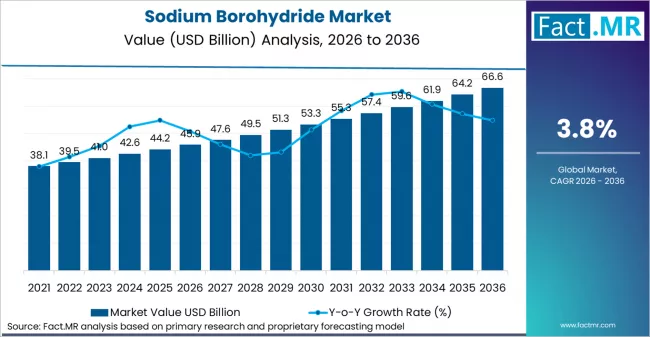
Sodium Borohydride Market Market Value Analysis | Source: Fact.MR
Sodium Borohydride Market
| Metric | Value |
|---|---|
| Estimated Value in (2026E) | USD 45.9 billion |
| Forecast Value in (2036F) | USD 64.3 billion |
| Forecast CAGR (2026 to 2036) | 3.8% |
Source: Fact.MR analysis. Updated Mar 6, 2026
Sodium Borohydride Market Definition
The Sodium Borohydride Market involves the production and sale of sodium borohydride, a powerful reducing agent used to remove oxygen, reduce metal ions, and manufacture specialty chemicals, in applications such as paper and pulp bleaching, pharmaceuticals, and hydrogen generation.
Market Inclusions
This report covers global and regional market sizes for sodium borohydride over a defined forecast period, including product grades (aqueous solutions, dry powder), application segments (pulp and paper, pharmaceuticals, chemical intermediates, hydrogen storage), and end-use industries.
Market Exclusions
The scope excludes unrelated reducing agents and chemical products not based on sodium borohydride, finished hydrogen fuel systems, and downstream consumer products that incorporate sodium borohydride without separate market data.
Research Methodology
- Primary Research: Interviews were conducted with chemical producers, formulation chemists, and industry analysts.
- Desk Research: Data was sourced from industry reports, chemical publications, and trade association statistics.
- Market-Sizing and Forecasting: A hybrid model combining top-down chemical demand forecasts with bottom-up shipment and revenue data was used.
- Data Validation and Update Cycle: Findings were validated through expert review and aligned with recent production and trade figures.
Summary of the Sodium Borohydride Market
- Market Definition
- The Sodium Borohydride Market involves the production and use of sodium borohydride, a powerful reducing agent, in industries such as pharmaceuticals, textiles, and chemical manufacturing.
- Demand Drivers
- Increased Pharmaceutical Applications: The growing use of sodium borohydride in drug synthesis and pharmaceutical manufacturing drives market growth.
- Rising Chemical Industry Demand: Sodium borohydride’s key role in chemical reactions, such as reduction processes, is fueling demand across various industries.
- Technological Advancements: Innovations in production methods and applications, especially in cleaner chemical processes, are supporting market expansion.
- Key Segments Analyzed
- Purity: 98% purity sodium borohydride is projected to capture a significant share by 2026 due to its high efficiency in chemical reduction processes.
- Form: Crystals are expected to dominate, accounting for 40% of the market share, driven by their stability and ease of handling in pharmaceutical and industrial applications.
- Geography: India leads with a CAGR of 6.5%, supported by its expanding pharmaceutical and chemical industries.
- Analyst Opinion at Fact MR
- Shambhu Nath Jha, Principal Consultant at Fact MR, noted, "The growing pharmaceutical and chemical industries, particularly in Asia, will continue to drive the demand for sodium borohydride, especially for high-purity applications in drug synthesis."
- Strategic Implications/Executive Takeaways
- Focus on Pharmaceutical Applications: Companies should prioritize the development of sodium borohydride with higher purity for pharmaceutical use to meet growing demand in drug manufacturing.
- Explore Emerging Markets: Expansion in Asia Pacific, particularly India and China, will be key to capitalizing on the increasing industrial and pharmaceutical sector growth.
- Innovate for Sustainability: Investing in more sustainable production processes and applications will help meet regulatory standards and attract environmentally-conscious customers.
- Methodology
- Primary Research: Interviews with chemical producers, formulation chemists, and industry analysts.
- Desk Research: Data sourced from industry reports, chemical publications, and trade association statistics.
- Market Sizing & Forecasting: A hybrid model combining top-down chemical demand forecasts with bottom-up shipment and revenue data.
Segmental Analysis
Sodium Borohydride Market Analysis by End Use
- Market Overview: The pharmaceutical industry is expected to capture 70% of the sodium borohydride market by 2026. Sodium borohydride is widely used in the pharmaceutical industry for its reducing properties, particularly in the synthesis of active pharmaceutical ingredients (APIs) and in various chemical reactions where selective reduction is needed.
- Demand Drivers:
- Key Role in Drug Manufacturing: Sodium borohydride is essential in the production of APIs, including the reduction of certain chemical compounds during synthesis. Its high efficiency and selectivity in reducing functional groups make it indispensable in pharmaceutical manufacturing.
- Growth in Drug Development: As drug development and production increase globally, the demand for sodium borohydride in pharmaceutical applications continues to grow, particularly in the creation of complex compounds and intermediates.
- Demand for Generic and Specialty Drugs: The increasing demand for generic drugs and the rise in the production of specialty medications is further driving the need for sodium borohydride, which is used in various processes to create these drugs.
Sodium Borohydride Market Analysis by Form
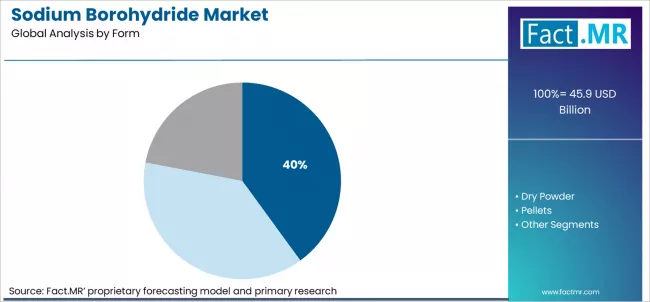
Sodium Borohydride Market Analysis By Form | Source: Fact.MR
- Market Overview: Crystal form is projected to account for 40% of the market share by 2026. Sodium borohydride in crystal form is widely used due to its stability, ease of handling, and precise application in chemical processes, particularly in industrial and pharmaceutical applications.
- Demand Drivers:
- Stability and Storage: Crystal sodium borohydride is favored for its stable nature, making it easier to store and transport compared to other forms. This stability is crucial in industrial and pharmaceutical applications where long shelf life is required.
- Ease of Handling and Precision: The crystal form allows for precise measurements in chemical reactions, providing accurate control over the reduction process. This makes it a preferred form in pharmaceutical and chemical manufacturing.
- Demand for High-Quality Reagents: As the demand for high-purity chemicals increases in pharmaceutical and industrial applications, crystal sodium borohydride is sought after for its consistency and high-quality performance in synthetic processes.
Sodium Borohydride Market Drivers, Restraints, and Opportunities
FMR analysts observe that the sodium borohydride market is a growth‑aligned, chemical‑processing segment driven by its key role as a reducing agent in industries such as chemical synthesis, pharmaceuticals, pulp & paper, and waste treatment. Historically, sodium borohydride was used mainly in niche synthesis applications; as demand for cleaner production processes and efficient reduction chemistry expanded, structural demand grew for this versatile, high‑efficiency reagent. The 2026 valuation reflects steady adoption tied to global industrial activity and regulatory focus on process efficiency and lower environmental impact.
While commodity reducing agents remain significant in cost‑sensitive processes, sodium borohydride is gaining share in applications where precise, high‑purity reduction is required. These advanced applications support higher average selling prices, contributing to net market value growth even as unit volumes grow moderately with industrial cycles. The market exists because sodium borohydride’s performance in selective reductions and environmental applications cannot be easily replaced by cheaper alternatives in many end uses.
- Industrial Processing Demand: Manufacturers in pharmaceuticals, chemicals, and pulp use sodium borohydride for efficient reduction reactions that improve yield and purity.
- Environmental Compliance Pressure: Regulations on waste treatment and greener process requirements push adoption of effective reducing agents like sodium borohydride to meet discharge standards and reduce by‑products.
- Regional Manufacturing Expansion: In Asia‑Pacific and North America, strong chemical and pharmaceutical production bases drive higher uptake compared with regions with smaller industrial output.
Regional Analysis
The market analysis covers key global regions, including East Asia, South Asia, Western Europe, and North America. It is segmented geographically, with specific market dynamics for each region. The full report provides a detailed market attractiveness analysis.
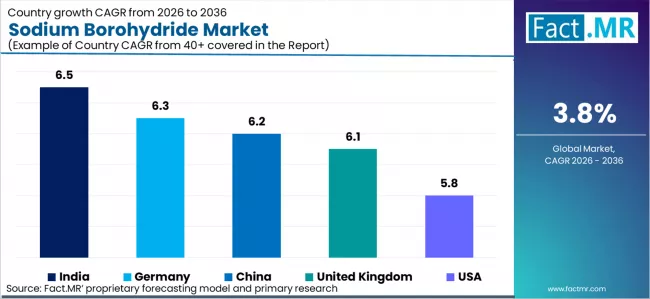
Sodium Borohydride Market Cagr Analysis By Country | Source: Fact.MR
| Country | CAGR (2026-2036) |
|---|---|
| China | 6.2% |
| India | 6.5% |
| USA | 5.8% |
| United Kingdom | 6.1% |
| Germany | 6.3% |
Source: Fact.MR analysis. Updated Mar 6, 2026
Source: Fact MR (FMR) analysis, based on proprietary forecasting model and primary research.
East Asia:
In East Asia, China is the leading market for sodium borohydride, driven by the country’s strong manufacturing base, growing demand for industrial chemicals, and expanding applications in pharmaceuticals, paper, and textiles.
- China: Demand for sodium borohydride in China is projected to rise at 6.2% CAGR through 2036. China’s increasing industrialization, growing demand in pharmaceuticals and textiles, and rising use in chemical reactions continue to drive market growth.
South Asia:
In South Asia, India is a significant market for sodium borohydride, supported by the country’s growing chemical industry, rising demand for cleaner technologies, and increasing applications in industries such as pharmaceuticals and energy.
- India: Demand for sodium borohydride in India is projected to rise at 6.5% CAGR through 2036. India’s expanding chemical industry, rising adoption in energy storage applications, and growing demand for pharmaceutical-grade chemicals continue to support market growth.
Western Europe:
In Western Europe, Germany and the United Kingdom are key markets for sodium borohydride, driven by the increasing use of sodium borohydride in the automotive and pharmaceutical industries, as well as growing demand for sustainable and energy-efficient solutions.
- Germany: Demand for sodium borohydride in Germany is projected to rise at 6.3% CAGR through 2036. Germany’s strong manufacturing sector, demand in automotive applications, and focus on sustainable chemical production continue to fuel market growth.
- United Kingdom: Demand for sodium borohydride in the UK is projected to rise at 6.1% CAGR through 2036. The UK’s growing chemical sector, rising demand for cleaner industrial technologies, and expanding applications in pharmaceuticals contribute to steady market growth.
North America:
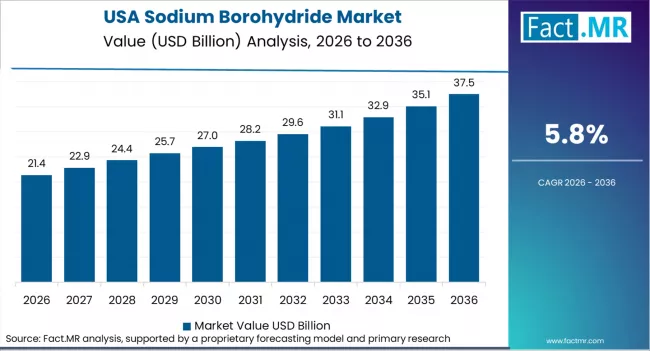
Sodium Borohydride Market Country Value Analysis | Source: Fact.MR
In North America, the USA remains a significant market for sodium borohydride, supported by the country’s strong chemical industry, rising demand for cleaner energy solutions, and growing use in various industrial applications.
- USA: Demand for sodium borohydride in the U.S. is projected to rise at 5.8% CAGR through 2036. The USA’s large industrial base, increasing demand in energy and pharmaceutical industries, and adoption of environmentally friendly technologies continue to drive market growth.
Fact MR's analysis of the Sodium Borohydride Market in East Asia, South Asia, Western Europe, North America consists of country-wise assessments that include China, India, the USA, the United Kingdom, and Germany. Readers can find detailed trends, regulatory updates, and company-specific investments shaping the market’s growth in these countries.
What is the Competitive Structure and Buyer Behavior in the Sodium Borohydride Market?
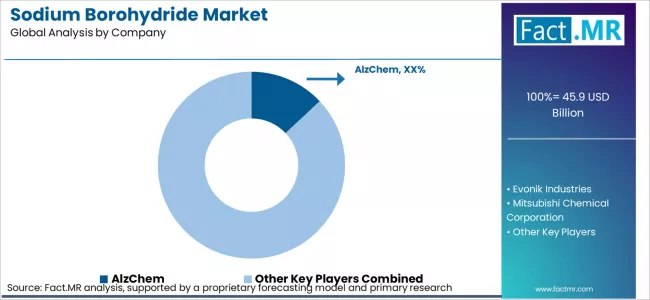
Sodium Borohydride Market Analysis By Company | Source: Fact.MR
The sodium borohydride market is moderately concentrated, with major chemical manufacturers such as AlzChem, Evonik Industries, Mitsubishi Chemical Corporation, Solvay, Ingevity, Perstorp, Merck KGaA, and UBE Corporation capturing a substantial share alongside other suppliers including Nuodex Industries, R.T. Vanderbilt Company, Clariant International, Brenntag, Atofina Chemicals, and KH Neochem. Product quality, purity levels, consistency, and application suitability across end uses such as pharmaceuticals, pulp and paper, and chemical synthesis are the primary competitive variables. Firms with integrated feedstock sourcing, global production networks, and strong R&D capabilities hold structural advantages, as they can ensure stable supply, scale efficiencies, and tailored solutions for diverse industrial requirements. Large industrial buyers, including chemical formulators and end users in regulated sectors, exert significant leverage by qualifying multiple suppliers and negotiating long‑term supply contracts tied to performance and reliability. To manage supplier dependency, these buyers maintain diversified sourcing strategies and standardised technical specifications, which constrain individual suppliers’ pricing power. Consequently, competition centres on delivering consistent product performance, technical support, and reliable logistics rather than price alone.
Recent Industry Developments
- European Production Expansion: Kemira is on track to complete a major expansion of its Äetsä manufacturing facility in Finland by Q4 2026, doubling its capacity for powdered sodium borohydride to serve the rising demand for high-purity reducing agents in the European and Indian pharmaceutical sectors.
- Safety Compliance Deadline: Under the updated OSHA Hazard Communication Standard, all manufacturers and distributors of pure substances, including sodium borohydride, must update their Safety Data Sheets (SDS) and product labels to align with GHS Revision 7 by May 19, 2026.
- Mandatory Microplastic Reporting: Effective May 31, 2026, the first mandatory annual reporting window under REACH Annex XVII closes, requiring industrial users of synthetic polymer powders like SBH to submit detailed emission estimates to the European Chemicals Agency (ECHA).
Key Players of the Sodium Borohydride Market
- AlzChem
- Evonik Industries
- Mitsubishi Chemical Corporation
- Solvay
- Ingevity
- Nuodex Industries
- Perstorp
- Merck KGaA
- UBE Corporation
- R.T. Vanderbilt Company
- Clariant International
- Brenntag
- Atofina Chemicals
- KH Neochem
Report Scope
| Metric | Value |
|---|---|
| Quantitative Units | USD 45.9 billion (2026) to USD 64.3 billion (2036), at a CAGR of 3.8% |
| Market Definition | The Sodium Borohydride Market involves the production and use of sodium borohydride across industries such as pharmaceuticals and textiles, with varying purities and forms. |
| By Purity | 12%, 95%, 97%, 98% |
| By Form | Crystal, Dry Powder, Pellets |
| By End-Use | Pharmaceutical Industry, Textile Industry |
| Regions Covered | North America, Latin America, Europe, East Asia, South Asia, Oceania, Middle East and Africa |
| Countries Covered | United States, Canada, Mexico, Brazil, Argentina, Germany, France, United Kingdom, Italy, Spain, China, India, Japan, South Korea, Indonesia, Australia, and 40+ countries |
| Key Companies Profiled | AlzChem, Evonik Industries, Mitsubishi Chemical Corporation, Solvay, Ingevity, Nuodex Industries, Perstorp, Merck KGaA, UBE Corporation, R.T. Vanderbilt Company, Clariant International, Brenntag, Atofina Chemicals, KH Neochem |
| Forecast Period | 2026 to 2036 |
| Approach | Hybrid top-down and bottom-up market modeling validated through primary interviews with manufacturers and supported by trade data benchmarking and market research. |
Source: Fact.MR analysis. Updated Mar 6, 2026
Bibliographies
- AlzChem. (2023).
- Evonik Industries. (2023). Advancing chemical reduction with sodium borohydride in pharmaceutical applications. Evonik Industries.
- Mitsubishi Chemical Corporation. (2023). Sodium borohydride as a reducing agent in industrial processes and pharmaceuticals. Mitsubishi Chemical Corporation.
- Solvay. (2023). Sodium borohydride solutions for sustainable chemical processing and pharmaceuticals. Solvay.
- Kemira. (2026). Sodium borohydride powder capacity expansion in Finland [Production update]. Kemira.
- CHEMTREC. (2026). OSHA extends HCS compliance deadlines: What you need to know [Safety compliance update]. CHEMTREC.
- REACHLaw. (2026). Microplastics restriction & reporting services: 2026 deadlines [Regulatory update]. REACHLaw.
This report addresses:
- Market intelligence enabling comprehensive assessment of leading countries and product segments across the Sodium Borohydride Market globally.
- Market volume (sales units) estimates and 10-year revenue forecasts from 2026 to 2036, validated through manufacturer shipment data, channel partner surveys, and country-level demand modeling.
- Growth opportunity mapping across purities (12%, 95%, 97%, 98%), forms (Crystal, Dry Powder, Pellets), and end-use industries (Pharmaceutical Industry, Textile Industry).
- Segment and regional revenue forecasts by purity, form, end-use industry, and geography across 40+ countries.
- Competition strategy analysis covering dealer network structure, recent developments, product portfolio, USPs, and market share analysis.
- Product and regulatory compliance tracking aligned with drug manufacturing standards, chemical processing regulations, and environmental guidelines.
- Regulatory impact analysis addressing environmental standards, chemical safety regulations, and industry-specific certifications across key markets.
- Report delivery in PDF, Excel, PowerPoint, and interactive dashboard formats for executive, procurement, and operational planning use.
Segmentation
Sodium Borohydride Market Key Segments
-
Purity :
- 12%
- 95%
- 97%
- 98%
-
Form :
- Crystal
- Dry Powder
- Pellets
-
End-Use Industry :
- Pharmaceutical Industry
- Textile Industry
-
Region :
- North America
- USA
- Canada
- Mexico
- Europe
- Germany
- UK
- France
- Italy
- Spain
- Nordic Countries
- BENELUX
- Rest of Europe
- Asia Pacific
- China
- Japan
- South Korea
- India
- Australia
- Rest of Asia Pacific
- Latin America
- Brazil
- Argentina
- Rest of Latin America
- Middle East and Africa
- Kingdom of Saudi Arabia
- United Arab Emirates
- South Africa
- Rest of Middle East and Africa
- Other Regions
- Oceania
- Central Asia
- Other Markets
- North America
Frequently Asked Questions
How large is the demand for Sodium Borohydride in the global market in 2026?
What will be the market size of Sodium Borohydride in the global market by 2036?
What is the expected demand growth for Sodium Borohydride in the global market between 2026 and 2036?
Which end-use industry is expected to dominate the market?
Which region is expected to show the highest growth rate for Sodium Borohydride?
How significant is the growth outlook for China in this market?
What is the growth outlook for the United States in the Sodium Borohydride market?
What is the growth forecast for the United Kingdom in the Sodium Borohydride market?
What is the growth forecast for Germany in the Sodium Borohydride market?
Which company is identified as a leading player in the Sodium Borohydride market?
What is Sodium Borohydride used for?
What does the Sodium Borohydride market include in this report?
How is the market forecast developed in this report?
What is meant by the Sodium Borohydride market in this report?
Who worked on this report


Preview the report firsthand - request a free sample
Free SampleGet the brochure for pricing and purchase details
Download PDF