- Market Value (2025): USD 2.9 Bn
- Estimated Value (2026): USD 3.1 Bn
- Forecast Value (2036): USD 5.4 Bn
- CAGR (2026-2036): 5.7%
What is the Mosquito Screen Door Market forecast to be worth by 2036?
USD 5.4 billion by 2036 at a CAGR of 5.7%.
- The market reached USD 2.9 billion in 2025.
- Market value is forecast to rise from USD 3.1 billion in 2026 to USD 5.4 billion in 2036.
- Demand is forecast to expand at a 5.7% CAGR from 2026 to 2036.
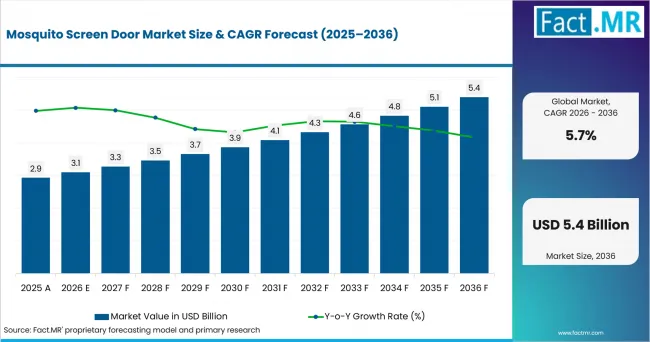
Mosquito Screen Door Market Value Analysis | Source: Fact.MR
What are the defining numbers behind Mosquito Screen Door Market growth?
The market is expected to generate an absolute opportunity of USD 2.3 billion between 2026 and 2036.
- Demand Drivers in the Market
- Household mosquito exclusion has a direct public-health rationale. The World Health Organization states that window and door screens reduce household contact with mosquitoes, while the U.S. Centers for Disease Control and Prevention advises installing, repairing and using screens on doors and windows. This keeps physical barriers relevant alongside insect repellents and other bite-prevention measures.
- Residential turnover, additions and remodeling create recurring installation points. New homes add fresh door openings, while existing homes generate replacement demand when mesh, rollers, tracks or frames wear out. Retail and contractor channels therefore tie screen-door sales closely to home improvement activity rather than relying only on new construction.
- Retractable designs reduce the visual penalty of a permanent screen. Andersen markets patio-door screens that retract when not in use and can be fitted to both new and older compatible doors, while Phantom Screens emphasizes custom housings that preserve the opening and view. This design priority overlaps with broader consumer spending on window blinds and other products that balance daylight, ventilation and visual control.
- Large-format doors and premium indoor-outdoor layouts create room for integrated and motorized concepts. Marvin offers retractable screen options on multi-slide doors spanning wide openings, while the market taxonomy also captures sensor-based and motorized screen systems. These features place screens within the same design conversation as door automation in higher-specification buildings.
- Material choice affects durability, visibility and replacement economics. Aluminum frames, fiberglass mesh, metal mesh and reinforced systems allow suppliers to trade off weight, rigidity, airflow and wear resistance. Custom sizing and mesh selection can also extend the product from basic insect exclusion toward ventilation, privacy and solar control, adjacent to privacy screens in residential and hospitality settings.
- Key Segments Analyzed
- Retractable Mosquito Screen Doors account for 43.8% of Product in 2026 because they provide insect protection when needed and retract when not in use, keeping doorways open and views unobstructed.
- Residential Buildings account for 67.4% of Application in 2026 because homes and multi-family residences generate recurring demand for ventilation, insect protection and screen replacement.
- Homeowners account for 54.9% of End Use in 2026 because purchases are often linked to damaged-screen replacement, patio-door upgrades and seasonal mosquito protection.
- Retractable Screen Technology accounts for 31.7% of Technology in 2026 because spring-assisted and track-guided systems hide the mesh when it is not required while preserving doorway access.
- Aluminum Frame Systems account for 76.2% of Formulation in 2026 because aluminum combines low weight, stiffness and corrosion resistance with compatibility across sliding and retractable screen systems.
- Analyst Opinion at Fact.MR
- Shambhu Nath Jha, Principal Consultant, Fact.MR, says, “Mosquito screen doors sit at the intersection of household protection and home improvement. Growth will depend less on a single product feature than on how well suppliers make screens easier to measure, install, operate and integrate with modern door systems. Retractable products can capture more value where buyers want clear views and fresh air, while durable frames and replacement-friendly mesh will remain important in everyday residential use.”
- Strategic Implications
- Manufacturers should design around retrofit compatibility because the installed base of patio, hinged and sliding doors is a recurring source of replacement and upgrade demand.
- Retail-ready product architecture should simplify measurement, handing, sizing and installation so homeowners can move from purchase to fit without unnecessary returns or installer visits.
- Premium ranges should combine low-visibility housings, reinforced mesh, smooth tracks and finish matching, while value ranges should focus on dependable insect exclusion and replaceable components.
- Commercial and hospitality suppliers should emphasize project sizing, serviceability and repeated opening cycles rather than repackaging residential products without application-specific support.
How does the Mosquito Screen Door Market break down by segment?
The market is segmented by Product, Application, End Use, Technology, Formulation and Distribution Channel.
Why do Retractable Mosquito Screen Doors lead Product?
Retractable Mosquito Screen Doors are projected to hold 43.8% of Product demand in 2026.
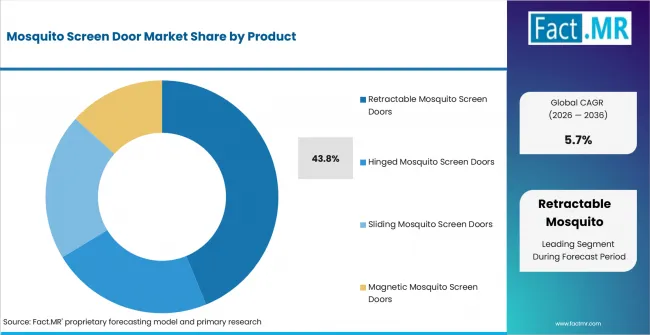
Mosquito Screen Door Market Analysis By Product | Source: Fact.MR
The format solves a basic design problem: households want airflow and insect exclusion without keeping mesh permanently across the doorway. Phantom Screens describes retractable door screens that disappear into a housing when not in use and can be configured for single, double and sliding doors. Andersen similarly offers retractable patio-door screens that can be added to compatible doors manufactured over a long installed period.
Why do Residential Buildings lead Application?
Residential Buildings are projected to hold 67.4% of Application demand in 2026.
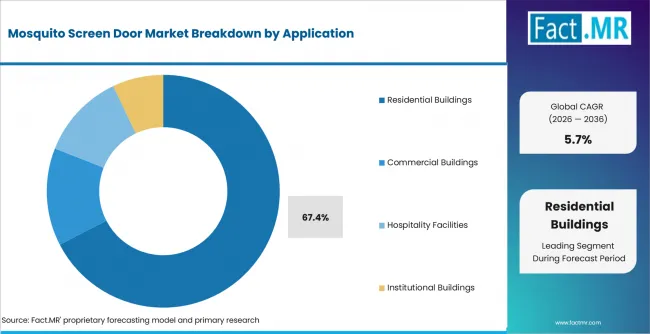
Mosquito Screen Door Market Analysis By Application | Source: Fact.MR
Households experience the use case daily: doors are opened for ventilation, garden access, pets and movement between indoor and outdoor spaces. WHO and CDC guidance both identify door and window screens as practical barriers that reduce mosquito entry or contact, which keeps screens relevant in warm seasons and in locations where mosquito-borne disease is a public-health concern.
Why do Homeowners lead End Use?
Homeowners are projected to hold 54.9% of End Use demand in 2026.
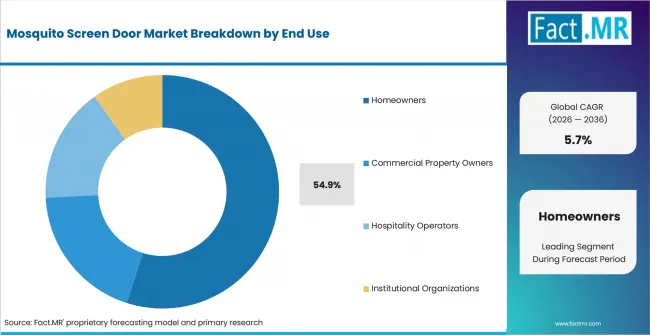
Mosquito Screen Door Market Analysis By End Use | Source: Fact.MR
The homeowner usually controls the immediate trade-off between ventilation, insect entry, view, appearance and installation cost. Products that can be measured and installed as a focused home project therefore fit a direct purchase journey. Andersen highlights DIY installation for selected retractable patio screens, while RiteScreen sells custom and adjustable patio-door screens directly around homeowner measurements.
Why does Retractable Screen Technology lead Technology?
Retractable Screen Technology is projected to hold 31.7% of Technology demand in 2026.
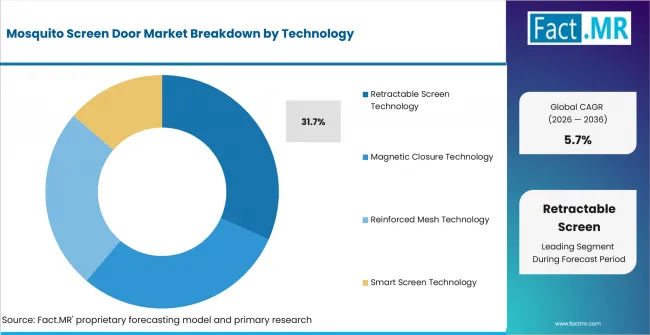
Mosquito Screen Door Market Analysis By Technology | Source: Fact.MR
Spring-assisted and track-guided designs allow the screen to be deployed only when the opening is in use. This reduces visual obstruction and protects the mesh inside a housing for part of its service life. Phantom Screens positions the technology around discreet integration, while Andersen uses a slim canister and track retention in its patio-door screen architecture.
Why do Aluminum Frame Systems lead Formulation?
Aluminum Frame Systems are projected to hold 76.2% of Formulation demand in 2026.
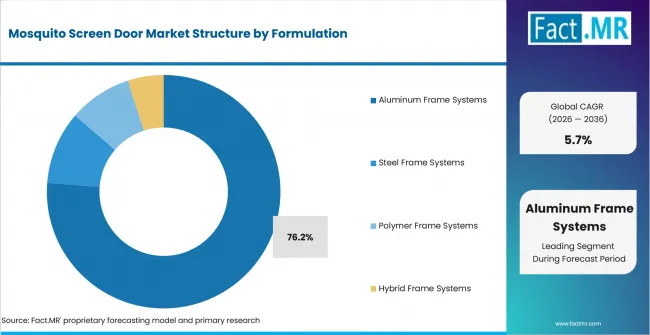
Mosquito Screen Door Market Analysis By Formulation | Source: Fact.MR
Aluminum is well suited to screen-door frames because it combines low weight with sufficient rigidity, corrosion resistance and a surface that can be finished to match common door colors. The material also works with narrow profiles, track systems and assembled frames where straightness and repeatable hardware mounting matter.
Why do Home Improvement Retailers lead Distribution Channel?
Home Improvement Retailers are projected to hold 48.5% of Distribution Channel demand in 2026.
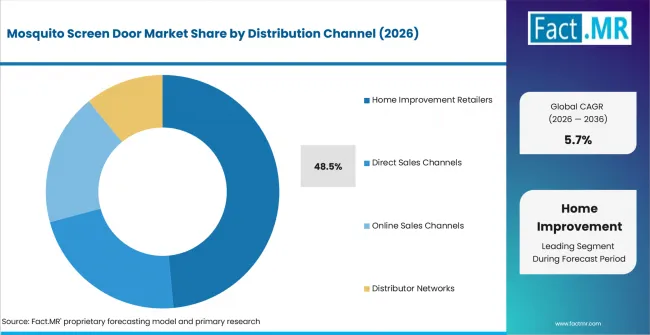
Mosquito Screen Door Market Analysis By Distribution Channel | Source: Fact.MR
Screen doors are often purchased with adjacent household projects such as patio-door repair, hardware replacement, mesh renewal or seasonal preparation. Retailers can combine physical product inspection with standard-size inventory, measuring guidance and access to installers, which reduces friction for households that do not want a fully custom purchasing process.
What is accelerating Mosquito Screen Door Market adoption, and what is holding it back?
Demand is rising with greater mosquito awareness, residential renovation and wider availability of retractable and DIY-fit screens. Growth is constrained by seasonality, installation errors, low-cost alternatives and the higher price of premium retractable systems.
Drivers Impact Analysis
| Factor | (~) % Impact on CAGR | Geographic Relevance | Impact Timeline |
|---|---|---|---|
| Household mosquito-exclusion awareness | +1.4% | Global | Short term (<=2 years) |
| Residential construction and renovation | +1.1% | Germany, USA, UK, Japan | Medium term (2-4 years) |
| Retractable and low-visibility designs | +0.8% | North America, Europe, East Asia | Medium term (2-4 years) |
| Retail availability and DIY retrofit | +0.6% | USA, Germany, UK | Short term (<=2 years) |
Source: Fact.MR analysis. Updated Aug 26, 2026
Opportunity Impact Analysis
| Factor | (~) % Impact on CAGR | Geographic Relevance | Impact Timeline |
|---|---|---|---|
| Longer mosquito seasons in temperate markets | +0.7% | Germany, UK and similar climates | Long term (>4 years) |
| Motorized and smart screen integration | +0.5% | USA, Japan, premium urban markets | Medium term (2-4 years) |
| Hospitality and institutional insect exclusion | +0.4% | Brazil, USA, warm-climate markets | Medium term (2-4 years) |
| Premium mesh and reinforced frame upgrades | +0.3% | Global | Short term (<=2 years) |
Source: Fact.MR analysis. Updated Aug 26, 2026
Restraints Impact Analysis
| Factor | (~) % Impact on CAGR | Geographic Relevance | Impact Timeline |
|---|---|---|---|
| Seasonal and climate-dependent purchasing | -0.7% | Temperate markets | Short term (<=2 years) |
| Measurement and installation complexity | -0.6% | Global | Short term (<=2 years) |
| Low-cost magnetic and portable substitutes | -0.5% | Online-led consumer markets | Short term (<=2 years) |
| Aluminum, steel and hardware cost volatility | -0.4% | Global | Medium term (2-4 years) |
Source: Fact.MR analysis. Updated Aug 26, 2026
Who Leads the Mosquito Screen Door Market?
Key players in the Mosquito Screen Door Market include Andersen Corporation, Phantom Screens, LARSON Manufacturing, Meshtec International Co., Ltd., Tata Steel, Ritescreen Company LLC, MARVIN, Champion Window, Retractable Screen Solutions and Wizard Industries Inc.
Current product portfolios show several routes to differentiation. Andersen Corporation emphasizes retrofit-compatible retractable patio screens and DIY installation, Phantom Screens focuses on custom retractable systems and professional fitting, Ritescreen Company LLC offers custom and adjustable patio-door options with multiple mesh choices, and MARVIN integrates retractable screens with wide multi-slide door systems. LARSON Manufacturing also maintains broad home-improvement retail and dealer availability for screen-door products.
Which companies are the key providers?
Key providers include Andersen Corporation, Phantom Screens, LARSON Manufacturing, Meshtec International Co., Ltd., Tata Steel, Ritescreen Company LLC, MARVIN, Champion Window, Retractable Screen Solutions and Wizard Industries Inc.
- Andersen Corporation
- Phantom Screens
- LARSON Manufacturing
- Meshtec International Co., Ltd.
- Tata Steel
- Ritescreen Company LLC
- MARVIN
- Champion Window
- Retractable Screen Solutions
- Wizard Industries Inc.
Bibliography
- World Health Organization. (2024). Vector-borne diseases. World Health Organization.
- Centers for Disease Control and Prevention. (2024). Preventing Mosquito Bites. U.S. Department of Health and Human Services.
- Robert Koch Institute. (2024). Answers to Frequently Asked Questions on Mosquito-Borne Diseases. Robert Koch Institute.
- Federal Statistical Office of Germany. (2026). 10.8% More Building Permits for Dwellings in 2025. Destatis.
- Ministry of Health of Brazil. (2026). Dengue: Prevention and Vector Control Guidance. Government of Brazil.
- U.S. Census Bureau. (2026). Monthly New Residential Construction, July 2026. U.S. Department of Commerce.
- UK Health Security Agency. (2025). Invasive Mosquito Surveillance. UK Government.
- Ministry of Housing, Communities and Local Government. (2025). Housing Supply: Net Additional Dwellings, England: 2024 to 2025. UK Government.
- Ministry of Housing, Communities and Local Government. (2026). Dwelling Stock Estimates, England: 31 March 2025. UK Government.
- Ministry of Health, Labour and Welfare. (2026). Mosquito-Borne Infectious Diseases. Government of Japan.
- Ministry of Land, Infrastructure, Transport and Tourism. (2026). Building Starts Statistics Survey Report: Calendar Year 2025. Government of Japan.
- Andersen Corporation. (2024). Andersen Expands Innovative Retractable Screen Portfolio. Andersen Corporation.
- Phantom Screens. (2026). Door Screens. Phantom Screens.
- LARSON Manufacturing. (2026). Our History. LARSON Manufacturing.
- Ritescreen Company LLC. (2026). Window Screens & Patio Door Screens. Ritescreen Company LLC.
- MARVIN. (2026). Ultimate Multi-Slide Door. MARVIN.
This Report Answers
- How large is the Mosquito Screen Door Market in 2026 and what value is forecast for 2036?
- Which Product, Application, End Use, Technology, Formulation and Distribution Channel categories account for the leading 2026 shares?
- How do mosquito-exclusion awareness, residential activity, retractable design and retail access influence demand through 2036?
- How are Germany, Brazil, USA, UK and Japan expected to develop over the forecast period?
- Which companies are active in mosquito screen doors and which product, installation and channel capabilities influence competition?
What does the Mosquito Screen Door Market cover?
The market covers commercial sales of complete mosquito screen door systems used to reduce insect entry while allowing people, airflow and light to pass through residential, commercial, hospitality and institutional door openings. It includes retractable, hinged, sliding and magnetic systems offered through the specified technology, frame and distribution categories.
What is included in the scope?
Included revenue covers complete mosquito screen doors and integrated screen-door assemblies sold for individual homes, multi-family residences, offices, retail facilities, hotels, restaurants, educational facilities and healthcare facilities.
The scope includes spring-assisted, track-guided, magnetic-closure, reinforced-mesh, sensor-based and motorized systems; aluminum, steel, polymer and hybrid frames; and sales through home improvement retailers, direct channels, online channels and distributors.
What is excluded from the scope?
The scope excludes window-only insect screens, bed nets, standalone mosquito nets, insecticides, repellents, coils, complete primary entry doors where the screen is only an incidental accessory, building facade mesh not sold as a door system, and repair services billed without a screen-door product transaction.
Replacement mesh or hardware sold alone is excluded unless it is bundled into a complete screen-door system counted within the defined market.
How Was the Analysis Built?
The analysis draws on more than 120 sources, over 35 company portfolios and more than 20 industry interviews across at least 25 countries. It combines primary market inputs with structured desk evidence to assess demand across screen manufacturers, door and window companies, retailers, distributors, installers, residential buyers, commercial property owners, hospitality operators and institutional organizations.
- Primary Research: Market checks focus on product managers, screen and door manufacturers, frame and mesh suppliers, home-improvement buyers, dealers, installers, contractors, building-product distributors and property owners. Discussion areas include product sizing, retrofit compatibility, installation time, mesh durability, track performance, seasonal ordering, channel margins and replacement behavior.
- Desk Research: The assessment uses public-health guidance on mosquito exclusion, government housing and building statistics, mosquito-surveillance information, company product documentation and current portfolio evidence for retractable, sliding, hinged and custom screen systems. These inputs are used to test the mechanisms behind segment adoption and national growth.
- Market Sizing and Forecasting: Sizing considers finished screen-door revenue, product and frame mix, residential and non-residential demand, homeowner and commercial purchasing, technology adoption, retail versus direct sales, new construction, renovation and replacement cycles. Forecasts account for mosquito awareness, household formation, building activity, retrofit frequency, product innovation and channel expansion.
- Data Validation and Updates: Findings are checked across market values, segment shares, country growth, product taxonomy, company participation, public-health recommendations and construction indicators. Updates focus on changes that materially affect household screen use, door replacement, building activity, mosquito exposure or product availability.
Segmentation
Which countries are scaling the Mosquito Screen Door Market through 2036?
- Germany: Mosquito awareness is becoming more relevant as public-health agencies track West Nile virus and invasive Aedes populations, while a recovery in residential building permits expands the future base of door openings and retrofit activity.
- Brazil: National dengue guidance explicitly recommends screens on doors and windows as part of household protection, keeping physical insect barriers relevant in a country with recurring mosquito-control campaigns.
- USA: CDC guidance directly recommends door and window screens, while ongoing residential permitting maintains a large stream of new and replacement openings for standard, retractable and patio screen products.
- UK: National surveillance for invasive mosquitoes has intensified as Aedes albopictus spreads in Europe, while a large existing dwelling stock and continuing housing additions support retrofit-led screen demand.
- Japan: Updated mosquito-borne infection guidance keeps bite prevention visible, and ongoing housing starts provide a continuing installation base for compact sliding and retractable solutions suited to residential openings.
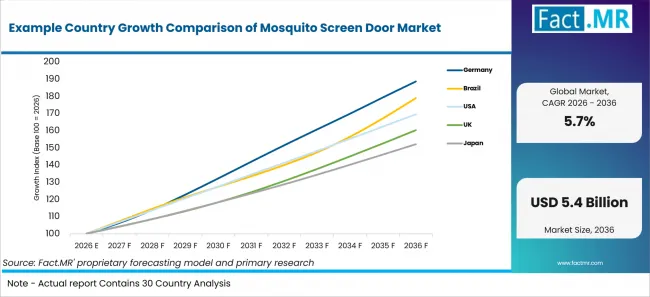
Example Country Growth Comparison Of Mosquito Screen Door Market | Source: Fact.MR
| Country | CAGR (2026-2036) |
|---|---|
| Germany | 6.6% |
| Brazil | 6.0% |
| USA | 5.4% |
| UK | 4.8% |
| Japan | 4.3% |
Source: Fact.MR analysis. Updated Aug 26, 2026
What is driving Germany's growth through 2036?
Germany is forecast to expand at a 6.6% CAGR from 2026 to 2036.
The Robert Koch Institute reports that West Nile virus has become established in parts of Germany and that populations of the Asian tiger mosquito are present in several regions. Its household protection guidance notes that fly screens on windows can help during summer months, giving physical insect barriers a clearer role in seasonal household preparedness.
Residential activity adds a second demand mechanism. Destatis reported 238,500 dwellings authorized in 2025, up 10.8% from 2024, including gains in both single-family and multi-family permits. New construction creates fresh installation points, while Germany’s much larger existing housing stock continues to support replacement, retrofit and door-upgrade demand.
What is driving Brazil's growth through 2036?
Brazil is forecast to expand at a 6.0% CAGR from 2026 to 2036.
Brazil’s Ministry of Health includes screens on doors and windows among household measures to reduce exposure to Aedes mosquitoes in areas of dengue transmission. That recommendation links the product directly to everyday vector-control behavior rather than treating screen doors as a purely decorative home feature.
What is driving USA's growth through 2036?
USA is forecast to expand at a 5.4% CAGR from 2026 to 2036.
CDC guidance advises households to use screens on windows and doors and repair holes to keep mosquitoes outdoors. This creates a straightforward maintenance cycle: worn mesh and damaged screens are not only comfort issues but also gaps in a recommended household mosquito-control barrier.
What is driving UK's growth through 2036?
UK is forecast to expand at a 4.8% CAGR from 2026 to 2036.
The UK Health Security Agency operates invasive mosquito surveillance focused on Aedes albopictus, noting its public-health relevance and spread in Europe through climate, trade and travel pathways. Even where current household use is less entrenched than in warmer markets, rising awareness broadens the case for discreet insect screens that can remain out of sight when not needed.
Housing stock supports retrofit volume. Government statistics recorded 208,600 net additional dwellings in England in 2024-25 and 25.8 million dwellings as of March 2025. The existing stock is important for this market because screens can be added during door replacement, renovation or seasonal home-improvement projects without waiting for new construction.
What is driving Japan's growth through 2036?
Japan is forecast to expand at a 4.3% CAGR from 2026 to 2036.
Japan’s Ministry of Health, Labour and Welfare updated national mosquito-borne infection prevention guidance in June 2026 and continues to highlight dengue, chikungunya, Zika, Japanese encephalitis and other mosquito-borne diseases. This supports ongoing public awareness of bite prevention and physical barriers in residential and institutional settings.
The Ministry of Land, Infrastructure, Transport and Tourism continues to track a substantial annual flow of new housing starts even though total starts declined in 2025. In a market with compact urban housing and widespread sliding-door formats, low-profile and retractable screens can fit replacement and renovation needs where buyers want ventilation without permanently obstructing the opening.
What is the report's scope and coverage?
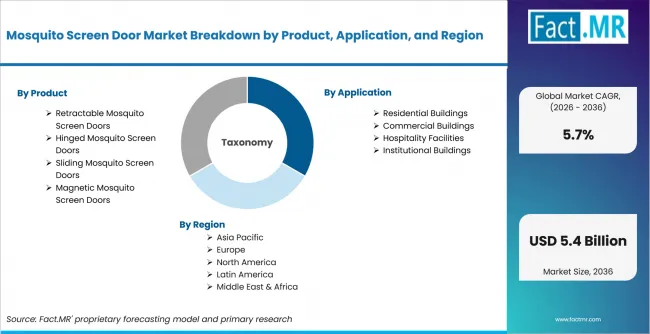
Mosquito Screen Door Market Breakdown By Product, Application, And Region | Source: Fact.MR
| Scope Item | Coverage |
|---|---|
| Quantitative Units | USD Billion |
| Market Definition | Commercial revenue from complete door-mounted insect screen systems sold through the specified product, application, end-use, technology, formulation and channel categories. |
| Segments Covered | Product; Application; End Use; Technology; Formulation; Distribution Channel |
| Regions Covered | Global market with country analysis for the selected national markets |
| Countries Covered | Germany; Brazil; USA; UK; Japan |
| Key Companies Profiled | Andersen Corporation; Phantom Screens; LARSON Manufacturing; Meshtec International Co., Ltd.; Tata Steel; Ritescreen Company LLC; MARVIN; Champion Window; Retractable Screen Solutions; Wizard Industries Inc. |
| Forecast Period | 2026-2036 |
| Base Year | 2026 |
| Market Value 2026 | USD 3.1 billion |
| Market Value 2036 | USD 5.4 billion |
| CAGR | 5.7% |
| Absolute Opportunity | USD 2.3 billion |
| Approach | Demand, product, application, end-use, screen-technology, frame-formulation, channel and country analysis supported by primary market inputs and authoritative public evidence. |
Source: Fact.MR analysis. Updated Aug 26, 2026
How is the market segmented?
-
By Product
- Retractable Mosquito Screen Doors
- Single Door Retractable Systems
- Double Door Retractable Systems
- Hinged Mosquito Screen Doors
- Aluminum Hinged Screen Doors
- Steel Hinged Screen Doors
- Sliding Mosquito Screen Doors
- Patio Sliding Screen Doors
- Balcony Sliding Screen Doors
- Magnetic Mosquito Screen Doors
- Residential Magnetic Screens
- Portable Magnetic Screens
- Retractable Mosquito Screen Doors
-
By Application
- Residential Buildings
- Individual Homes
- Multi Family Residences
- Commercial Buildings
- Office Buildings
- Retail Facilities
- Hospitality Facilities
- Hotels & Resorts
- Restaurants & Cafes
- Institutional Buildings
- Educational Facilities
- Healthcare Facilities
- Residential Buildings
-
By End Use
- Homeowners
- Urban Homeowners
- Rural Homeowners
- Commercial Property Owners
- Office Property Owners
- Retail Property Owners
- Hospitality Operators
- Hotel Operators
- Food Service Operators
- Institutional Organizations
- Educational Institutions
- Healthcare Organizations
- Homeowners
-
By Technology
- Retractable Screen Technology
- Spring Assisted Systems
- Track Guided Systems
- Magnetic Closure Technology
- Central Closure Systems
- Self Sealing Systems
- Reinforced Mesh Technology
- Fiberglass Mesh Systems
- Metal Mesh Systems
- Smart Screen Technology
- Sensor Based Systems
- Motorized Screen Systems
- Retractable Screen Technology
-
By Formulation
- Aluminum Frame Systems
- Standard Frame Configurations
- Reinforced Frame Configurations
- Steel Frame Systems
- Powder Coated Steel Configurations
- Security Grade Steel Configurations
- Polymer Frame Systems
- PVC Frame Configurations
- Composite Frame Configurations
- Hybrid Frame Systems
- Metal Polymer Hybrid Systems
- Advanced Composite Systems
- Aluminum Frame Systems
-
By Distribution Channel
- Home Improvement Retailers
- Large Format Retailers
- Independent Retailers
- Direct Sales Channels
- Manufacturer Direct Sales
- Installer Direct Sales
- Online Sales Channels
- E Commerce Platforms
- Brand Owned Platforms
- Distributor Networks
- Regional Distributors
- Wholesale Networks
- Home Improvement Retailers
Frequently Asked Questions
What is the Mosquito Screen Door Market value in 2026?
At what CAGR is the Mosquito Screen Door Market forecast to grow from 2026 to 2036?
What value is the Mosquito Screen Door Market projected to reach by 2036?
Which Product category leads the market in 2026?
Which Application category leads the market in 2026?
Which End Use category leads the market in 2026?
Which Technology category leads the market in 2026?
Which Formulation category leads the market in 2026?
Which Distribution Channel category leads the market in 2026?
What CAGR is forecast for Germany from 2026 to 2036?
Which companies are included in the competitive landscape?
Who worked on this report


Preview the report firsthand - request a free sample
Free SampleGet the brochure for pricing and purchase details
Download PDF