- Base Value(2025): 479 Mn
- Estimated Value(2026): 511 Mn
- Forecast Value (2036): 967 Mn
- CAGR (2026 - 2036): 6.6%
What is the activated carbon for pharma & healthcare market forecast to be worth by 2036?
- In 2025, the activated carbon for pharma & healthcare market was valued at USD 479 million.
- Based on Fact.MR analysis, demand for activated carbon for pharma & healthcare is estimated to grow to USD 511 million in 2026 and USD 967 million by 2036 at 6.6% CAGR from 2026 to 2036.
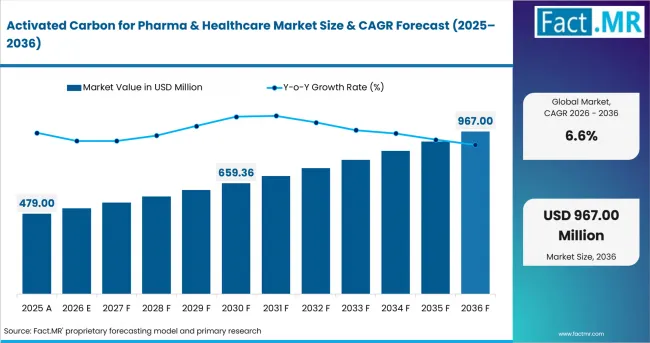
Activated Carbon For Pharma & Healthcare Market Value Analysis | Source: Fact.MR
Summary of the Activated Carbon for Pharma & Healthcare Market
- Demand Drivers
- Pharmaceutical manufacturing expansion is increasing activated carbon consumption. Demand reflects rising API production activity.
- Drug purity requirements are strengthening use of advanced purification materials. Quality standards support material adoption.
- Biopharmaceutical production growth is increasing filtration requirements. Processing complexity supports demand for high-performance adsorption materials.
- Key Segments Analyzed
- By Form: Powdered activated carbon holds 52.4% share in 2026 due to strong suitability for pharmaceutical purification.
- By Application: API production contributes 44.8% share in 2026 supported by impurity removal requirements during manufacturing.
- By Source Material: Coconut shell captures 47.2% share in 2026 due to high adsorption efficiency and low ash content.
- By Function: Purification registers 41.5% share in 2026, reflecting widespread use across pharmaceutical processing.
- By End User: Pharmaceutical Manufacturers account for 56.3% share in 2026 due to direct material consumption during production.
- By Geography: India is projected to record 7.8% CAGR from 2026 to 2036 supported by pharmaceutical manufacturing expansion.
- Analyst Opinion at Fact.MR
- Shambhu Nath Jha, Principal Consultant at Fact.MR, opines, "Activated carbon demand in pharmaceutical applications is increasingly shaped by purity standards and process efficiency. Suppliers with pharmaceutical-grade production capability are positioned to strengthen commercial access across high-value manufacturing programs."
- Strategic Implications
- Activated carbon producers should expand pharmaceutical-grade production capacity. Compliance capability improves market access.
- Suppliers should strengthen relationships with pharmaceutical manufacturers. Long-term supply agreements improve revenue stability.
- Manufacturers should invest in advanced purification solutions. Product performance supports premium positioning.
The market is forecast to add USD 456 million in revenue between 2026 and 2036. Expansion reflects rising pharmaceutical production and greater focus on impurity removal during drug manufacturing. Demand is supported by increasing API output across major pharmaceutical hubs. Raw material price fluctuations create cost pressure across activated carbon producers.
India is expected to record 7.8% CAGR from 2026 to 2036 supported by API manufacturing expansion. China is forecast to grow at 7.4% CAGR by 2036 driven by pharmaceutical production investment. South Korea is projected to expand at 6.9% CAGR through 2036 due to biologics manufacturing growth. The United States is estimated to witness 6.1% CAGR by 2036 supported by demand for high-purity pharmaceutical processing materials. Germany is likely to register 5.8% CAGR from 2026 to 2036 due to established pharmaceutical manufacturing infrastructure.
How does the activated carbon for pharma & healthcare market break down by segment?
Activated Carbon for Pharma & Healthcare Market Analysis by Form
Powdered activated carbon accounts for 52.4% share in 2026. Pharmaceutical manufacturers prefer powdered grades due to rapid adsorption performance during purification processes. Material efficiency supports segment leadership across pharmaceutical applications. Kuraray Co., Ltd. / Calgon Carbon Corporation announced expansion of its activated carbon business through environmental and purification solutions, including pharma-relevant adsorption applications for high-purity water and API processing. This strengthens supply for pharmaceutical purification and contaminant removal systems.
- Adsorption Performance: Fine particle structure improves contaminant removal efficiency. Processing effectiveness supports utilization.
- Manufacturing Compatibility: Powdered grades integrate easily into pharmaceutical production workflows. Operational flexibility supports demand.
- Purification Efficiency: Pharmaceutical producers use powdered activated carbon for impurity removal. Product quality requirements strengthen adoption.
Activated Carbon for Pharma & Healthcare Market Analysis by Application
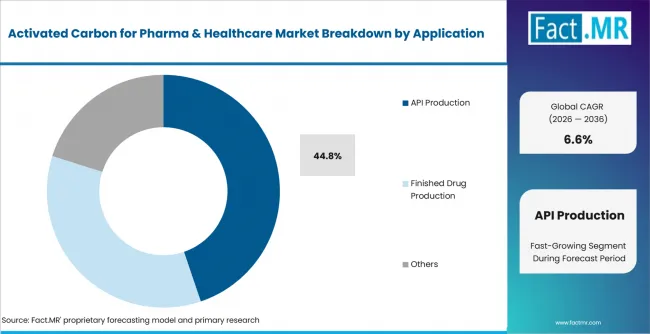
Activated Carbon For Pharma & Healthcare Market Analysis By Application | Source: Fact.MR
API production captures 44.8% share in 2026. Active pharmaceutical ingredient manufacturing requires extensive purification throughout production stages. Quality specifications support material consumption. Jacobi Carbons announced a 15–20% price increase across all coconut-shell based activated carbon grades, effective July 1, 2025, due to sustained increases in raw material and production costs. This adjustment applies across its global supply chain and directly impacts high-purity activated carbon used in pharmaceutical purification, API processing, and healthcare filtration applications.
- Impurity Removal: Activated carbon supports purification of pharmaceutical compounds. Product quality objectives strengthen demand.
- Production Volumes: API manufacturing activity is increasing across major pharmaceutical regions. Output growth supports consumption.
- Regulatory Standards: Pharmaceutical ingredients require strict quality compliance. Manufacturing standards support activated carbon utilization.
Activated Carbon for Pharma & Healthcare Market Analysis by Source Material
Coconut shell register 47.2% share in due to high adsorption capacity and low ash content support preference across pharmaceutical applications. Material performance strengthens commercial adoption.
- Product Purity: Low ash characteristics support pharmaceutical processing requirements. Quality benefits strengthen demand.
- Adsorption Capacity: Coconut shell activated carbon delivers strong contaminant removal performance. Efficiency supports utilization.
- Application Suitability: Pharmaceutical manufacturers prioritize high-performance activated carbon grades. Material properties support segment demand.
Activated Carbon for Pharma & Healthcare Market Analysis by Function
Purification holds 41.5% share in 2026. Activated carbon remains widely used for contaminant removal throughout pharmaceutical manufacturing processes. Product quality objectives support segment growth.
- Quality Control: Purification supports pharmaceutical compliance requirements. Quality standards strengthen demand.
- Process Efficiency: Effective contaminant removal improves manufacturing outcomes. Operational benefits support utilization.
- Production Consistency: Pharmaceutical producers require reliable purification performance. Process stability supports consumption.
Activated Carbon for Pharma & Healthcare Market Analysis by End User
Pharmaceutical manufacturers account for 56.3% share in 2026. Direct consumption during drug production supports segment leadership. Manufacturing activity remains concentrated within large pharmaceutical facilities.
- Production Demand: Pharmaceutical manufacturers consume activated carbon throughout production stages. Manufacturing volumes support demand.
- Quality Requirements: Product purity objectives strengthen use of advanced purification materials. Compliance standards support consumption.
- Operational Scale: Large production facilities require consistent material supply. Manufacturing activity supports segment leadership.
What is accelerating activated carbon for pharma & healthcare demand, and what is holding it back?
Drug manufacturers are strengthening impurity control practices across production facilities. Activated carbon remains an important material for purification and decolorization processes. Demand is concentrated in API production and specialty pharmaceutical manufacturing.
Healthcare and pharmaceutical companies are increasing investment in process efficiency and regulatory compliance. Material selection increasingly emphasizes adsorption performance and product consistency. High-purity activated carbon grades are gaining preference across regulated manufacturing environments.
- Pharmaceutical Production Growth: Demand is driven by expanding API manufacturing activity. Production growth increases consumption of purification materials.
- Regulatory Compliance Requirements: Growth is supported by stricter quality standards across pharmaceutical manufacturing. Compliance requirements strengthen activated carbon utilization.
- Biologics Manufacturing Expansion: Demand is concentrated in advanced drug production facilities. Processing requirements support adsorption material consumption.
Which countries are scaling activated carbon for pharma & healthcare demand fastest?
The activated carbon for pharma & healthcare market is assessed across North America, Europe, Asia Pacific, Latin America, and the Middle East & Africa. The study evaluates pharmaceutical production activity, purification material demand, healthcare processing requirements, and regulatory standards across major markets.
| Country | CAGR (2026 to 2036) |
|---|---|
| India | 7.8% |
| China | 7.4% |
| South Korea | 6.9% |
| United States | 6.1% |
| Germany | 5.8% |
Source: Fact.MR analysis based on proprietary forecasting methodology and primary research.
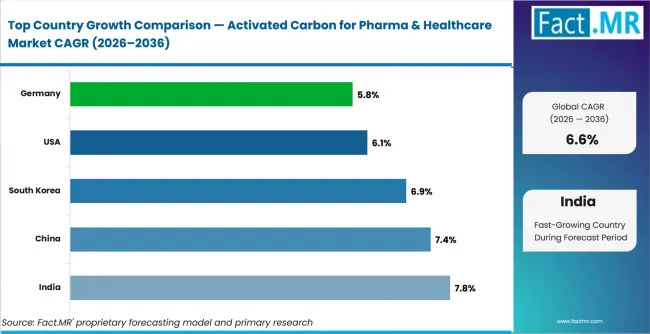
Activated Carbon For Pharma & Healthcare Market Cagr Analysis By Country | Source: Fact.MR
Asia Pacific Activated Carbon for Pharma & Healthcare Market Analysis
Asia Pacific represents a key growth region due to pharmaceutical manufacturing expansion and rising investment in healthcare production capacity. API manufacturing activity supports activated carbon consumption across major markets.
- India: India is projected to expand at 7.8% CAGR through 2036 as pharmaceutical manufacturers increase API production capacity and export activity. Domestic producers are expanding purification capabilities to meet global quality standards. Growth is attributable to strong participation in global pharmaceutical supply chains.
- China: China is expected to achieve 7.4% CAGR by 2036 supported by investment in pharmaceutical ingredient manufacturing and purification infrastructure. Large pharmaceutical companies are increasing production of specialty and high-value compounds. Growth reflects increasing production of high-value pharmaceutical compounds.
- South Korea: South Korea is forecast to witness 6.9% CAGR by 2036 driven by biologics manufacturing investment and advanced pharmaceutical processing requirements. Pharmaceutical companies are strengthening production facilities for innovative therapies and specialty medicines. Growth is attributable to expansion of specialty drug production facilities.
North America Activated Carbon for Pharma & Healthcare Market Analysis
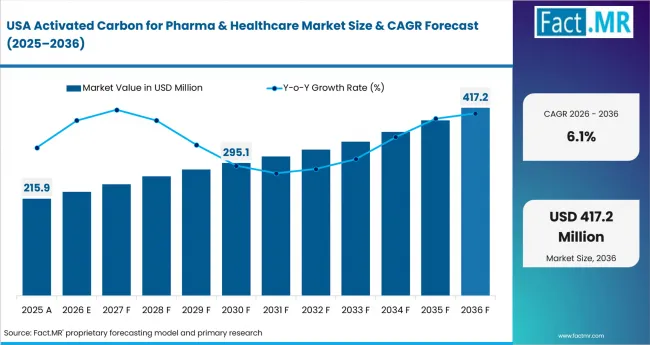
Activated Carbon For Pharma & Healthcare Market Country Value Analysis | Source: Fact.MR
North America maintains significant demand due to established pharmaceutical production capability and strong regulatory quality standards. High-purity material requirements support market development.
- United States: The United States is projected to expand at 6.1% CAGR by 2036 as pharmaceutical producers strengthen purification processes across drug manufacturing facilities. Demand is driven by high-value pharmaceutical production and quality compliance requirements.
Europe Activated Carbon for Pharma & Healthcare Market Analysis
Europe benefits from advanced pharmaceutical manufacturing infrastructure and strict product quality standards. Activated carbon remains important across regulated production environments.
- Germany: Germany is estimated to grow at 5.8% CAGR through 2036 as pharmaceutical companies increase focus on production efficiency and impurity control systems. Manufacturers are investing in process optimization and advanced purification technologies to improve product quality. Growth reflects the country's established pharmaceutical manufacturing base.
Who leads the activated carbon for pharma & healthcare market landscape?
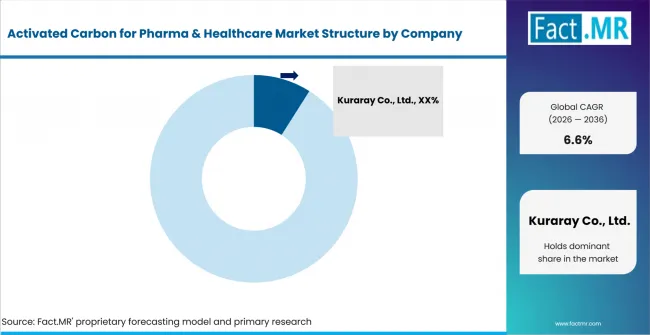
Activated Carbon For Pharma & Healthcare Market Analysis By Company | Source: Fact.MR
The competitive structure reflects a mix of activated carbon manufacturers and purification solution providers. Product purity influences supplier selection across pharmaceutical applications. Companies with pharmaceutical-grade activated carbon portfolios hold stronger positions across healthcare markets. Regulatory compliance strengthens commercial participation.
Organizations that combine material performance with consistent quality standards benefit from stronger market penetration. Pharmaceutical manufacturers prioritize product reliability and supply continuity. Production capability supports competitive differentiation across regulated applications. Purity performance remains an important purchasing criterion.
Pharmaceutical companies evaluate suppliers based on adsorption efficiency and compliance standards. CDMOs focus on process consistency and material quality. Biotechnology companies prioritize contaminant removal capability and product certification. Established supplier relationships create barriers for new participants. Commercial success is increasingly linked to pharmaceutical-grade production capability and regulatory compliance. Demand is shifting toward suppliers that deliver consistent quality and technical support. High-purity activated carbon performance is emerging as a major source of differentiation across healthcare applications.
Which companies are the key players?
- Kuraray Co., Ltd. / Calgon Carbon Corporation.
- Haycarb PLC
- Jacobi Group
- Osaka Gas Chemicals Co., Ltd.
- NORIT Activated Carbon
Bibliography
- Kuraray Co., Ltd. (2026, March 2). Kuraray to expand reactivated carbon production capacity in the United States.
- Jacobi Group. (2025, May 19). Price increase on coconut shell-based activated carbons, effective July 1, 2025.
- Jacobi Group. (2026). Pharma & medical.
- Haycarb PLC. (2026). Pharmaceutical grade carbon.
- Osaka Gas Chemicals Co., Ltd. (2026). Activated Carbon Business Division.
This Report Addresses
- Analysis of activated carbon demand across pharmaceutical manufacturing, medical devices, oral dosage formulations, injectable drug purification, and healthcare applications.
- Assessment of raw material trends, production technologies, regulatory standards, and pharmaceutical-grade activated carbon quality requirements.
- Segment analysis by product type, raw material, application, end user, and region.
- Competitive assessment of leading manufacturers including Kuraray Co., Ltd. / Calgon Carbon Corporation, Haycarb PLC, Jacobi Group, and Osaka Gas Chemicals Co., Ltd.
- Evaluation of activated carbon use in API purification, hemoperfusion, pharmaceutical filtration, toxin removal, and medical-grade adsorption applications.
- Regional analysis covering North America, Europe, Asia Pacific, Latin America, and the Middle East & Africa, with country-level demand assessment.
- Market intelligence supported by company disclosures, regulatory publications, company disclosures, regulatory publications, official standards, and primary interviews with manufacturers, distributors, pharmaceutical companies, and healthcare industry experts.
What does the activated carbon for pharma & healthcare market cover?
The activated carbon for pharma & healthcare market covers activated carbon products used in pharmaceutical manufacturing and healthcare processing applications. These materials are used to remove impurities, unwanted color compounds, and contaminants during drug production. Activated carbon supports purification processes across active pharmaceutical ingredient manufacturing and finished drug production. Demand originates from pharmaceutical manufacturers, biotechnology companies, healthcare contract manufacturing organizations, and healthcare processing facilities that require high-purity production environments.
Activated Carbon for Pharma & Healthcare Market Inclusions
The study covers global and regional forecasts from 2026 to 2036 by form, application, source material, function, and end user. It includes pharmaceutical purification activity, API production demand, activated carbon consumption trends, healthcare filtration applications, and material selection patterns across major pharmaceutical markets.
Activated Carbon for Pharma & Healthcare Market Exclusions
The study excludes activated carbon used in water treatment, food processing, air purification, and industrial emissions control applications. It omits consumer filtration products and environmental remediation activity. Revenue from non-pharmaceutical activated carbon consumption is outside the defined scope.
Activated Carbon for Pharma & Healthcare Market Research Methodology
- Primary Research
- Interviews were conducted with activated carbon manufacturers, pharmaceutical producers, CDMO executives, biotechnology specialists, and healthcare material distributors.
- Desk Research
- Analysis included company disclosures, pharmaceutical industry reports, regulatory publications, trade statistics, and manufacturing announcements released during 2024 and 2025.
- Market-Sizing and Forecasting
- Hybrid top-down and bottom-up model using pharmaceutical production volumes, activated carbon consumption rates, and end-use demand assessments.
- Data Validation and Update Cycle
- Forecast outputs were validated through manufacturer interviews, distributor assessments, pharmaceutical production data, and annual industry reviews.
What is the report’s scope and coverage?
| Attribute | Details |
|---|---|
| Quantitative Units | USD Million in 2026 to USD Million by 2036 at CAGR |
| Market Definition | Covers activated carbon products used in pharmaceutical and healthcare purification applications. |
| Form Segmentation | Powdered, Granular, Other Forms |
| Application Segmentation | API Production, Finished Drug Production, Others |
| Source Material Segmentation | Coconut Shell, Coal, Wood, Others |
| Function Segmentation | Purification, Decolorization, Filtration, Recovery |
| End User Segmentation | Pharmaceutical Manufacturers, CDMOs, Biotechnology Companies, Research Laboratories |
| Regions Covered | North America, Europe, Asia Pacific, Latin America, Middle East & Africa |
| Countries Covered | India, China, South Korea, United States, Germany |
| Key Companies Profiled | Kuraray Co., Ltd. / Calgon Carbon Corporation; Haycarb PLC; Jacobi Group; Osaka Gas Chemicals Co., Ltd;NORIT Activated Carbon |
| Forecast Period | 2026 to 2036 |
| Approach | Hybrid top-down and bottom-up model using pharmaceutical production and consumption analysis. |
How is the market segmented?
-
By Form
- Powdered
- Granular
- Other Forms
-
By Application
- API Production
- Finished Drug Production
- Others
-
By Source Material
- Coconut Shell
- Coal
- Wood
- Others
-
By Function
- Purification
- Decolorization
- Filtration
- Recovery
-
By End User
- Pharmaceutical Manufacturers
- Contract Development and Manufacturing Organizations (CDMOs)
- Biotechnology Companies
- Research Laboratories
-
By Region
- North America
- United States
- Canada
- Mexico
- Latin America
- Brazil
- Argentina
- Rest of Latin America
- Europe
- Germany
- United Kingdom
- France
- Italy
- Rest of Europe
- Asia Pacific
- China
- India
- South Korea
- Japan
- ASEAN
- Middle East & Africa
- GCC Countries
- South Africa
- UAE
- Rest of Middle East & Africa
- North America