Activated Persulfate Oxidation Systems Market

Activated Persulfate Oxidation Systems Market Size and Share Forecast Outlook 2026 to 2036

Activated persulfate oxidation systems market is projected to grow from USD 380.0 million in 2026 to USD 933.2 million by 2036, at a CAGR of 9.4%. Alkaline-Activated Persulfate will dominate with a 32.0% market share, while petroleum hydrocarbons (btex, tph) will lead the target contaminant segment with a 30.0% share.

Activated Persulfate Oxidation Systems Market Forecast and Outlook 2026 to 2036

The global market for activated persulfate oxidation systems is poised for robust expansion, driven by the need for advanced solutions to degrade persistent environmental contaminants. With an estimated value of USD 380.00 million in 2026, the market is forecast to reach USD 933.16 million by 2036, advancing at a 9.4% CAGR over the decade.

Key Takeaways from the Activated Persulfate Oxidation Systems Market

  • Market Value for 2026: USD 380.00 Million
  • Market Value for 2036: USD 933.16 Million
  • Forecast CAGR (2026-2036): 9.4%
  • Leading Activation Method Share (2026): Alkaline-Activated Persulfate (32%)
  • Leading Target Contaminant Share (2026): Petroleum Hydrocarbons (BTEX, TPH) (30%)
  • Leading Application Site Share (2026): Groundwater & Aquifer Remediation (36%)
  • Key Players in the Market: PeroxyChem (Evonik), Carus Corporation, Solvay, Regenesis, EOS Remediation
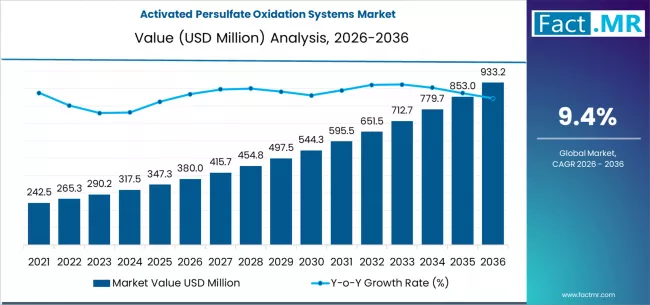
Activated Persulfate Oxidation Systems Market Market Value Analysis

Alkaline-activated persulfate systems command the largest share among activation methods, holding 32% of the market. The remediation of petroleum hydrocarbons represents the leading contaminant target, accounting for 30% of demand. Groundwater and aquifer remediation is the predominant application site, with a 36% share, underscoring the technology's critical role in subsurface cleanup.

Growth is fueled by increasingly stringent global regulations for soil and groundwater remediation, particularly for contaminants resistant to conventional treatment. Activated persulfate technology generates powerful sulfate radicals capable of destroying a wide spectrum of organic pollutants, offering a more stable and often more targeted alternative to traditional oxidants like hydrogen peroxide. Its effectiveness in complex geological settings and against emerging contaminants positions it as a key tool for achieving site closure and mitigating long-term liability.

The evolution of this market centers on optimizing activation pathways to control reaction kinetics, enhance oxidant longevity, and improve cost-effectiveness. These systems are integral to modern in-situ chemical oxidation strategies, addressing the challenge of achieving complete contaminant mass destruction in heterogeneous subsurface environments.

Metric

Metric Value
Market Value (2026) USD 380.00 Million
Market Forecast Value (2036) USD 933.16 Million
Forecast CAGR (2026-2036) 9.4%

Category

Category Segments
Activation Method Alkaline-Activated Persulfate, Iron-Activated Persulfate, Heat-Activated Persulfate, Hydrogen Peroxide/Peroxide-Assisted Activation, Catalytic & Chelated Activation Systems
Target Contaminant Petroleum Hydrocarbons (BTEX, TPH), Chlorinated Solvents (TCE, PCE, VC), PFAS & Emerging Contaminants, PAHs, PCBs & Other Organics, Mixed Organic-Inorganic Pollutants
Application Site Groundwater & Aquifer Remediation, Industrial Brownfield Sites, Oil & Gas Contaminated Land, Mining & Metallurgical Sites, Municipal & Landfill Sites
Region North America, Latin America, Western Europe, Eastern Europe, East Asia, South Asia & Pacific, MEA

Segmental Analysis

By Activation Method, Which Segment Commands the Largest Market Share?
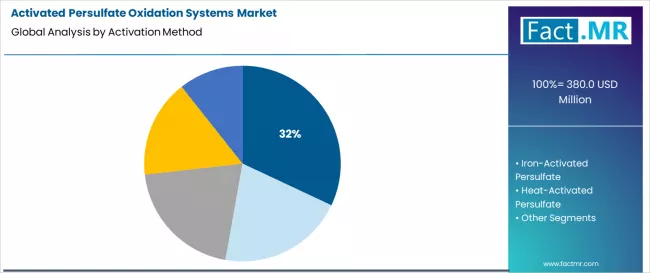
Activated Persulfate Oxidation Systems Market Analysis By Activation Method

Alkaline-activated persulfate systems lead this segment with a 32% share. Their prominence is attributed to operational simplicity and effectiveness. Raising the subsurface pH activates persulfate to generate sulfate radicals without requiring the addition of heat or metal catalysts, reducing implementation complexity.

This method is particularly valued for treating chlorinated solvents like TCE and PCE in a wide range of geochemical conditions, making it a versatile and frequently selected option for consultants and remediation contractors.

By Target Contaminant, Which Class Drives the Most Widespread Adoption?
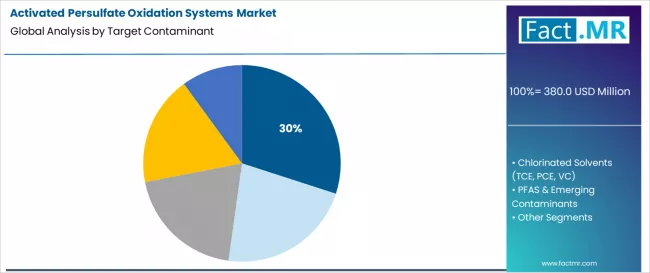
Activated Persulfate Oxidation Systems Market Analysis By Target Contaminant

Petroleum hydrocarbon contamination, including BTEX and total petroleum hydrocarbons (TPH), generates the most consistent demand, representing 30% of the market. The global prevalence of legacy spills from storage tanks, pipelines, and refineries creates a continuous pipeline of remediation projects.

Activated persulfate is increasingly favored for these sites due to its ability to degrade benzene and other aromatic compounds effectively, often showing greater subsurface persistence than hydroxyl radical-based systems, leading to more extensive plume treatment.

By Application Site, Where is Technological Precision Most Critical?
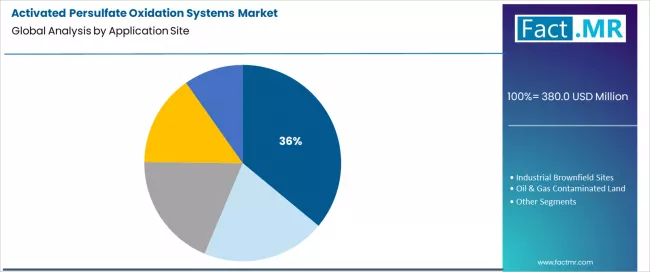
Activated Persulfate Oxidation Systems Market Analysis By Application Site

Groundwater and aquifer remediation is the leading application site, holding a 36% share. The successful application of activated persulfate in these settings is highly dependent on precise delivery and controlled activation to manage the oxidant’s lifespan and radius of influence.

Treating contaminated aquifers requires a deep understanding of subsurface hydrology and geochemistry to design effective injection strategies. The high stakes of protecting water resources and achieving regulatory closure concentrations focus significant technical demand and innovation on this complex application.

What are the Drivers, Restraints, and Key Trends of the Activated Persulfate Oxidation Systems Market?

The primary market driver is the escalating regulatory pressure to remediate sites contaminated with recalcitrant compounds like chlorinated solvents and PFAS. Activated persulfate, especially when tailored, shows promise in degrading these challenging pollutants. The technology's advantage of generating longer-lived sulfate radicals allows for broader plume coverage, improving treatment efficiency and cost-per-volume treated. The growing preference for in-situ technologies that destroy contaminants over containment methods also propels market growth.

A significant market restraint is the complexity of site-specific design and the potential for unintended geochemical impacts. The activation process can temporarily acidify or alter subsurface conditions, potentially mobilizing heavy metals. Predicting oxidant persistence and radius of influence remains challenging in heterogeneous soils, risking incomplete treatment. Higher initial chemical costs compared to some conventional oxidants can also be a barrier, necessitating clear demonstrations of total project cost savings through faster cleanup times.

Key trends include the development of catalytic and chelated activation systems that use engineered minerals or organic ligands to control radical release rates and target specific contaminants. There is intensifying research into persulfate activation for PFAS treatment, exploring synergistic activation methods to break the strong carbon-fluorine bonds. The market is also moving toward integrated treatment trains, where persulfate oxidation is strategically combined with bioremediation or other technologies to address contaminant mixtures and reduce overall chemical consumption.

Analysis of the Activated Persulfate Oxidation Systems Market by Key Countries
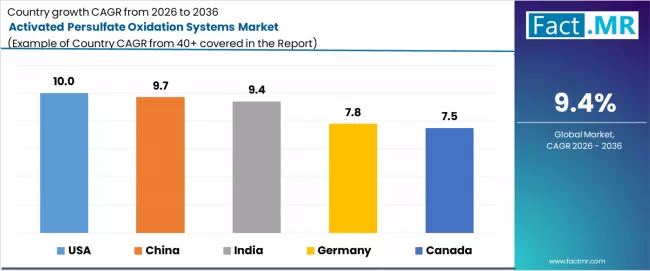
Activated Persulfate Oxidation Systems Market Cagr Analysis By Country

Country CAGR (2026-2036)
USA 10.00%
China 9.70%
India 9.40%
Germany 7.80%
Canada 7.50%

How do the USA’s Superfund and RCRA Programs Stimulate Demand for Advanced Oxidants?
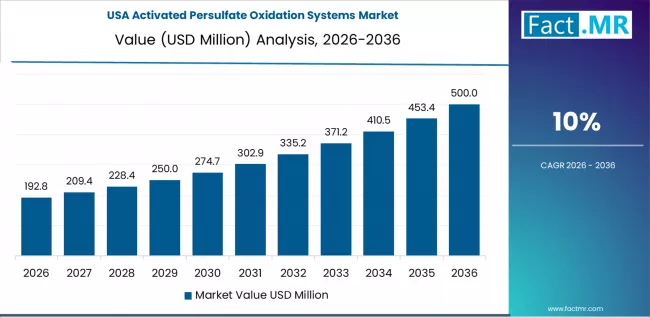
Activated Persulfate Oxidation Systems Market Country Value Analysis

The USA’s leading CAGR of 10.00% is driven by its mature regulatory framework and extensive backlog of complex contaminated sites under Superfund and RCRA. Regulators and responsible parties increasingly seek advanced in-situ destruction technologies to meet stringent cleanup goals.

The proven efficacy of activated persulfate systems against chlorinated solvent DNAPLs and its emerging application for PFAS are key factors accelerating its adoption in the world's most technically advanced remediation market.

What is the Impact of China’s Soil Pollution Law on Remediation Technology Adoption?

China’s 9.70% growth is directly linked to the enforcement of its Soil Pollution Prevention and Control Law. As the government mandates remediation of contaminated industrial land, particularly from chemical and pharmaceutical sectors, large-scale projects require effective technologies.

Activated persulfate is gaining traction as a preferred solution for treating complex organic pollutants at depth, aligning with national goals to rehabilitate land for redevelopment while managing project timelines.

How is India’s Industrial Growth and Environmental Compliance Shaping the Market?

India’s 9.40% CAGR is supported by tightening environmental compliance for industries and the remediation of legacy sites. The growing environmental consulting sector is adopting advanced international remediation practices.

Activated persulfate systems offer a compelling solution for treating industrial solvent plumes common in manufacturing zones, with their relative stability making them suitable for India’s diverse hydrogeological settings and cost-conscious project environments.

Why is Germany a Center for Precision Remediation Engineering?

Germany’s 7.80% growth reflects its stringent adherence to EU groundwater standards and a strong engineering ethos favoring controlled, effective in-situ treatments. German projects often involve sensitive urban or natural environments where precise oxidant delivery and minimal disturbance are paramount.

This drives demand for sophisticated persulfate formulations and detailed, performance-based application designs, making Germany a key market for high-end, engineered activation systems.

What Role does Canada’s Resource Sector and Cold Climate Play?

Canada’s 7.50% growth is anchored in remediating sites associated with its extensive mining, oil, and gas industries. The technology’s effectiveness in lower-temperature environments, aided by heat activation methods, is a significant advantage in colder Canadian regions.

Addressing hydrocarbon and solvent contamination at remote industrial sites favors robust in-situ technologies like activated persulfate that can be applied with reduced infrastructure compared to ex-situ methods.

Competitive Landscape of the Activated Persulfate Oxidation Systems Market
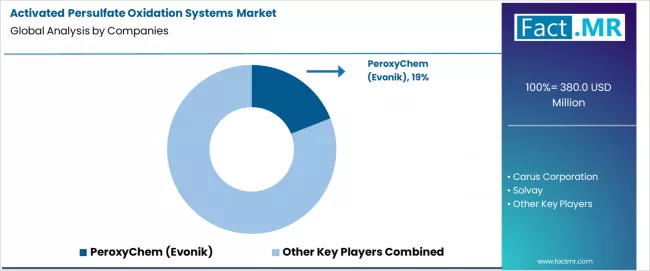
Activated Persulfate Oxidation Systems Market Analysis By Company

Specialized chemical companies with strong R&D capabilities in oxidation chemistry define the competitive landscape. Leaders like PeroxyChem and Carus Corporation compete through proprietary persulfate formulations, specialized activators, and comprehensive technical support.

Competition hinges on demonstrating superior field performance through case studies, providing robust design tools for practitioners, and offering complete solutions that include site characterization guidance and performance monitoring protocols. The ability to tailor activation strategies for specific contaminant mixtures and site challenges is a critical differentiator.

Key Players in the Activated Persulfate Oxidation Systems Market

  • PeroxyChem (Evonik)
  • Carus Corporation
  • Solvay S.A.
  • Regenesis
  • EOS Remediation

Scope of Report

Items Values
Quantitative Units USD Million
Activation Method Alkaline, Iron, Heat, Peroxide-Assisted, Catalytic & Chelated Systems
Target Contaminant Petroleum Hydrocarbons, Chlorinated Solvents, PFAS, PAHs/PCBs, Mixed Pollutants
Application Site Groundwater, Industrial Brownfields, Oil & Gas Land, Mining Sites, Municipal/Landfill Sites
Key Countries USA, China, India, Germany, Canada
Key Companies PeroxyChem (Evonik), Carus Corporation, Solvay, Regenesis, EOS Remediation
Additional Analysis Analysis of sulfate radical vs. hydroxyl radical mechanisms; oxidant stability and transport modeling; geochemical impacts assessment (e.g., metal mobilization); treatment effectiveness for DNAPL source zones; regulatory pathways for emerging oxidant use; lifecycle cost comparison with alternative technologies.

Market by Segments

  • Activation Method :

    • Alkaline-Activated Persulfate
    • Iron-Activated Persulfate
    • Heat-Activated Persulfate
    • Hydrogen Peroxide/Peroxide-Assisted Activation
    • Catalytic & Chelated Activation Systems
  • Target Contaminant :

    • Petroleum Hydrocarbons (BTEX, TPH)
    • Chlorinated Solvents (TCE, PCE, VC)
    • PFAS & Emerging Contaminants
    • PAHs, PCBs & Other Organics
    • Mixed Organic-Inorganic Pollutants
  • Application Site :

    • Groundwater & Aquifer Remediation
    • Industrial Brownfield Sites
    • Oil & Gas Contaminated Land
    • Mining & Metallurgical Sites
    • Municipal & Landfill Sites
  • Region :

    • North America
      • USA
      • Canada
    • Latin America
      • Brazil
      • Mexico
      • Argentina
      • Rest of Latin America
    • Western Europe
      • Germany
      • UK
      • France
      • Spain
      • Italy
      • BENELUX
      • Rest of Western Europe
    • Eastern Europe
      • Russia
      • Poland
      • Czech Republic
      • Rest of Eastern Europe
    • East Asia
      • China
      • Japan
      • South Korea
      • Rest of East Asia
    • South Asia & Pacific
      • India
      • ASEAN
      • Australia
      • Rest of South Asia & Pacific
    • MEA
      • Saudi Arabia
      • UAE
      • Turkiye
      • Rest of MEA

Table of Content

  1. Executive Summary
    • Global Market Outlook
    • Demand to side Trends
    • Supply to side Trends
    • Technology Roadmap Analysis
    • Analysis and Recommendations
  2. Market Overview
    • Market Coverage / Taxonomy
    • Market Definition / Scope / Limitations
  3. Market Background
    • Market Dynamics
      • Drivers
      • Restraints
      • Opportunity
      • Trends
    • Scenario Forecast
      • Demand in Optimistic Scenario
      • Demand in Likely Scenario
      • Demand in Conservative Scenario
    • Opportunity Map Analysis
    • Product Life Cycle Analysis
    • Supply Chain Analysis
    • Investment Feasibility Matrix
    • Value Chain Analysis
    • PESTLE and Porter’s Analysis
    • Regulatory Landscape
    • Regional Parent Market Outlook
    • Production and Consumption Statistics
    • Import and Export Statistics
  4. Global Market Analysis 2021 to 2025 and Forecast, 2026 to 2036
    • Historical Market Size Value (USD Million) Analysis, 2021 to 2025
    • Current and Future Market Size Value (USD Million) Projections, 2026 to 2036
      • Y to o to Y Growth Trend Analysis
      • Absolute $ Opportunity Analysis
  5. Global Market Pricing Analysis 2021 to 2025 and Forecast 2026 to 2036
  6. Global Market Analysis 2021 to 2025 and Forecast 2026 to 2036, By Activation Method
    • Introduction / Key Findings
    • Historical Market Size Value (USD Million) Analysis By Activation Method, 2021 to 2025
    • Current and Future Market Size Value (USD Million) Analysis and Forecast By Activation Method, 2026 to 2036
      • Alkaline-Activated Persulfate
      • Iron-Activated Persulfate
      • Heat-Activated Persulfate
      • Hydrogen Peroxide/Peroxide-Assisted Activation
      • Catalytic & Chelated Activation Systems
    • Y to o to Y Growth Trend Analysis By Activation Method, 2021 to 2025
    • Absolute $ Opportunity Analysis By Activation Method, 2026 to 2036
  7. Global Market Analysis 2021 to 2025 and Forecast 2026 to 2036, By Target Contaminant
    • Introduction / Key Findings
    • Historical Market Size Value (USD Million) Analysis By Target Contaminant, 2021 to 2025
    • Current and Future Market Size Value (USD Million) Analysis and Forecast By Target Contaminant, 2026 to 2036
      • Petroleum Hydrocarbons (BTEX, TPH)
      • Chlorinated Solvents (TCE, PCE, VC)
      • PFAS & Emerging Contaminants
      • PAHs, PCBs & Other Organics
      • Mixed Organic-Inorganic Pollutants
    • Y to o to Y Growth Trend Analysis By Target Contaminant, 2021 to 2025
    • Absolute $ Opportunity Analysis By Target Contaminant, 2026 to 2036
  8. Global Market Analysis 2021 to 2025 and Forecast 2026 to 2036, By Application Site
    • Introduction / Key Findings
    • Historical Market Size Value (USD Million) Analysis By Application Site, 2021 to 2025
    • Current and Future Market Size Value (USD Million) Analysis and Forecast By Application Site, 2026 to 2036
      • Groundwater & Aquifer Remediation
      • Industrial Brownfield Sites
      • Oil & Gas Contaminated Land
      • Mining & Metallurgical Sites
      • Municipal & Landfill Sites
    • Y to o to Y Growth Trend Analysis By Application Site, 2021 to 2025
    • Absolute $ Opportunity Analysis By Application Site, 2026 to 2036
  9. Global Market Analysis 2021 to 2025 and Forecast 2026 to 2036, By Region
    • Introduction
    • Historical Market Size Value (USD Million) Analysis By Region, 2021 to 2025
    • Current Market Size Value (USD Million) Analysis and Forecast By Region, 2026 to 2036
      • North America
      • Latin America
      • Western Europe
      • Eastern Europe
      • East Asia
      • South Asia and Pacific
      • Middle East & Africa
    • Market Attractiveness Analysis By Region
  10. North America Market Analysis 2021 to 2025 and Forecast 2026 to 2036, By Country
    • Historical Market Size Value (USD Million) Trend Analysis By Market Taxonomy, 2021 to 2025
    • Market Size Value (USD Million) Forecast By Market Taxonomy, 2026 to 2036
      • By Country
        • USA
        • Canada
        • Mexico
      • By Activation Method
      • By Target Contaminant
      • By Application Site
    • Market Attractiveness Analysis
      • By Country
      • By Activation Method
      • By Target Contaminant
      • By Application Site
    • Key Takeaways
  11. Latin America Market Analysis 2021 to 2025 and Forecast 2026 to 2036, By Country
    • Historical Market Size Value (USD Million) Trend Analysis By Market Taxonomy, 2021 to 2025
    • Market Size Value (USD Million) Forecast By Market Taxonomy, 2026 to 2036
      • By Country
        • Brazil
        • Chile
        • Rest of Latin America
      • By Activation Method
      • By Target Contaminant
      • By Application Site
    • Market Attractiveness Analysis
      • By Country
      • By Activation Method
      • By Target Contaminant
      • By Application Site
    • Key Takeaways
  12. Western Europe Market Analysis 2021 to 2025 and Forecast 2026 to 2036, By Country
    • Historical Market Size Value (USD Million) Trend Analysis By Market Taxonomy, 2021 to 2025
    • Market Size Value (USD Million) Forecast By Market Taxonomy, 2026 to 2036
      • By Country
        • Germany
        • UK
        • Italy
        • Spain
        • France
        • Nordic
        • BENELUX
        • Rest of Western Europe
      • By Activation Method
      • By Target Contaminant
      • By Application Site
    • Market Attractiveness Analysis
      • By Country
      • By Activation Method
      • By Target Contaminant
      • By Application Site
    • Key Takeaways
  13. Eastern Europe Market Analysis 2021 to 2025 and Forecast 2026 to 2036, By Country
    • Historical Market Size Value (USD Million) Trend Analysis By Market Taxonomy, 2021 to 2025
    • Market Size Value (USD Million) Forecast By Market Taxonomy, 2026 to 2036
      • By Country
        • Russia
        • Poland
        • Hungary
        • Balkan & Baltic
        • Rest of Eastern Europe
      • By Activation Method
      • By Target Contaminant
      • By Application Site
    • Market Attractiveness Analysis
      • By Country
      • By Activation Method
      • By Target Contaminant
      • By Application Site
    • Key Takeaways
  14. East Asia Market Analysis 2021 to 2025 and Forecast 2026 to 2036, By Country
    • Historical Market Size Value (USD Million) Trend Analysis By Market Taxonomy, 2021 to 2025
    • Market Size Value (USD Million) Forecast By Market Taxonomy, 2026 to 2036
      • By Country
        • China
        • Japan
        • South Korea
      • By Activation Method
      • By Target Contaminant
      • By Application Site
    • Market Attractiveness Analysis
      • By Country
      • By Activation Method
      • By Target Contaminant
      • By Application Site
    • Key Takeaways
  15. South Asia and Pacific Market Analysis 2021 to 2025 and Forecast 2026 to 2036, By Country
    • Historical Market Size Value (USD Million) Trend Analysis By Market Taxonomy, 2021 to 2025
    • Market Size Value (USD Million) Forecast By Market Taxonomy, 2026 to 2036
      • By Country
        • India
        • ASEAN
        • Australia & New Zealand
        • Rest of South Asia and Pacific
      • By Activation Method
      • By Target Contaminant
      • By Application Site
    • Market Attractiveness Analysis
      • By Country
      • By Activation Method
      • By Target Contaminant
      • By Application Site
    • Key Takeaways
  16. Middle East & Africa Market Analysis 2021 to 2025 and Forecast 2026 to 2036, By Country
    • Historical Market Size Value (USD Million) Trend Analysis By Market Taxonomy, 2021 to 2025
    • Market Size Value (USD Million) Forecast By Market Taxonomy, 2026 to 2036
      • By Country
        • Kingdom of Saudi Arabia
        • Other GCC Countries
        • Turkiye
        • South Africa
        • Other African Union
        • Rest of Middle East & Africa
      • By Activation Method
      • By Target Contaminant
      • By Application Site
    • Market Attractiveness Analysis
      • By Country
      • By Activation Method
      • By Target Contaminant
      • By Application Site
    • Key Takeaways
  17. Key Countries Market Analysis
    • USA
      • Pricing Analysis
      • Market Share Analysis, 2025
        • By Activation Method
        • By Target Contaminant
        • By Application Site
    • Canada
      • Pricing Analysis
      • Market Share Analysis, 2025
        • By Activation Method
        • By Target Contaminant
        • By Application Site
    • Mexico
      • Pricing Analysis
      • Market Share Analysis, 2025
        • By Activation Method
        • By Target Contaminant
        • By Application Site
    • Brazil
      • Pricing Analysis
      • Market Share Analysis, 2025
        • By Activation Method
        • By Target Contaminant
        • By Application Site
    • Chile
      • Pricing Analysis
      • Market Share Analysis, 2025
        • By Activation Method
        • By Target Contaminant
        • By Application Site
    • Germany
      • Pricing Analysis
      • Market Share Analysis, 2025
        • By Activation Method
        • By Target Contaminant
        • By Application Site
    • UK
      • Pricing Analysis
      • Market Share Analysis, 2025
        • By Activation Method
        • By Target Contaminant
        • By Application Site
    • Italy
      • Pricing Analysis
      • Market Share Analysis, 2025
        • By Activation Method
        • By Target Contaminant
        • By Application Site
    • Spain
      • Pricing Analysis
      • Market Share Analysis, 2025
        • By Activation Method
        • By Target Contaminant
        • By Application Site
    • France
      • Pricing Analysis
      • Market Share Analysis, 2025
        • By Activation Method
        • By Target Contaminant
        • By Application Site
    • India
      • Pricing Analysis
      • Market Share Analysis, 2025
        • By Activation Method
        • By Target Contaminant
        • By Application Site
    • ASEAN
      • Pricing Analysis
      • Market Share Analysis, 2025
        • By Activation Method
        • By Target Contaminant
        • By Application Site
    • Australia & New Zealand
      • Pricing Analysis
      • Market Share Analysis, 2025
        • By Activation Method
        • By Target Contaminant
        • By Application Site
    • China
      • Pricing Analysis
      • Market Share Analysis, 2025
        • By Activation Method
        • By Target Contaminant
        • By Application Site
    • Japan
      • Pricing Analysis
      • Market Share Analysis, 2025
        • By Activation Method
        • By Target Contaminant
        • By Application Site
    • South Korea
      • Pricing Analysis
      • Market Share Analysis, 2025
        • By Activation Method
        • By Target Contaminant
        • By Application Site
    • Russia
      • Pricing Analysis
      • Market Share Analysis, 2025
        • By Activation Method
        • By Target Contaminant
        • By Application Site
    • Poland
      • Pricing Analysis
      • Market Share Analysis, 2025
        • By Activation Method
        • By Target Contaminant
        • By Application Site
    • Hungary
      • Pricing Analysis
      • Market Share Analysis, 2025
        • By Activation Method
        • By Target Contaminant
        • By Application Site
    • Kingdom of Saudi Arabia
      • Pricing Analysis
      • Market Share Analysis, 2025
        • By Activation Method
        • By Target Contaminant
        • By Application Site
    • Turkiye
      • Pricing Analysis
      • Market Share Analysis, 2025
        • By Activation Method
        • By Target Contaminant
        • By Application Site
    • South Africa
      • Pricing Analysis
      • Market Share Analysis, 2025
        • By Activation Method
        • By Target Contaminant
        • By Application Site
  18. Market Structure Analysis
    • Competition Dashboard
    • Competition Benchmarking
    • Market Share Analysis of Top Players
      • By Regional
      • By Activation Method
      • By Target Contaminant
      • By Application Site
  19. Competition Analysis
    • Competition Deep Dive
      • PeroxyChem (Evonik)
        • Overview
        • Product Portfolio
        • Profitability by Market Segments (Product/Age /Sales Channel/Region)
        • Sales Footprint
        • Strategy Overview
          • Marketing Strategy
          • Product Strategy
          • Channel Strategy
      • Carus Corporation
      • Solvay
      • Regenesis
      • EOS Remediation
  20. Assumptions & Acronyms Used
  21. Research Methodology

List Of Table

  • Table 1: Global Market Value (USD Million) Forecast by Region, 2021 to 2036
  • Table 2: Global Market Value (USD Million) Forecast by Activation Method, 2021 to 2036
  • Table 3: Global Market Value (USD Million) Forecast by Target Contaminant, 2021 to 2036
  • Table 4: Global Market Value (USD Million) Forecast by Application Site, 2021 to 2036
  • Table 5: North America Market Value (USD Million) Forecast by Country, 2021 to 2036
  • Table 6: North America Market Value (USD Million) Forecast by Activation Method, 2021 to 2036
  • Table 7: North America Market Value (USD Million) Forecast by Target Contaminant, 2021 to 2036
  • Table 8: North America Market Value (USD Million) Forecast by Application Site, 2021 to 2036
  • Table 9: Latin America Market Value (USD Million) Forecast by Country, 2021 to 2036
  • Table 10: Latin America Market Value (USD Million) Forecast by Activation Method, 2021 to 2036
  • Table 11: Latin America Market Value (USD Million) Forecast by Target Contaminant, 2021 to 2036
  • Table 12: Latin America Market Value (USD Million) Forecast by Application Site, 2021 to 2036
  • Table 13: Western Europe Market Value (USD Million) Forecast by Country, 2021 to 2036
  • Table 14: Western Europe Market Value (USD Million) Forecast by Activation Method, 2021 to 2036
  • Table 15: Western Europe Market Value (USD Million) Forecast by Target Contaminant, 2021 to 2036
  • Table 16: Western Europe Market Value (USD Million) Forecast by Application Site, 2021 to 2036
  • Table 17: Eastern Europe Market Value (USD Million) Forecast by Country, 2021 to 2036
  • Table 18: Eastern Europe Market Value (USD Million) Forecast by Activation Method, 2021 to 2036
  • Table 19: Eastern Europe Market Value (USD Million) Forecast by Target Contaminant, 2021 to 2036
  • Table 20: Eastern Europe Market Value (USD Million) Forecast by Application Site, 2021 to 2036
  • Table 21: East Asia Market Value (USD Million) Forecast by Country, 2021 to 2036
  • Table 22: East Asia Market Value (USD Million) Forecast by Activation Method, 2021 to 2036
  • Table 23: East Asia Market Value (USD Million) Forecast by Target Contaminant, 2021 to 2036
  • Table 24: East Asia Market Value (USD Million) Forecast by Application Site, 2021 to 2036
  • Table 25: South Asia and Pacific Market Value (USD Million) Forecast by Country, 2021 to 2036
  • Table 26: South Asia and Pacific Market Value (USD Million) Forecast by Activation Method, 2021 to 2036
  • Table 27: South Asia and Pacific Market Value (USD Million) Forecast by Target Contaminant, 2021 to 2036
  • Table 28: South Asia and Pacific Market Value (USD Million) Forecast by Application Site, 2021 to 2036
  • Table 29: Middle East & Africa Market Value (USD Million) Forecast by Country, 2021 to 2036
  • Table 30: Middle East & Africa Market Value (USD Million) Forecast by Activation Method, 2021 to 2036
  • Table 31: Middle East & Africa Market Value (USD Million) Forecast by Target Contaminant, 2021 to 2036
  • Table 32: Middle East & Africa Market Value (USD Million) Forecast by Application Site, 2021 to 2036

List Of Figures

  • Figure 1: Global Market Pricing Analysis
  • Figure 2: Global Market Value (USD Million) Forecast 2021 to 2036
  • Figure 3: Global Market Value Share and BPS Analysis by Activation Method, 2026 and 2036
  • Figure 4: Global Market Y to o to Y Growth Comparison by Activation Method, 2026 to 2036
  • Figure 5: Global Market Attractiveness Analysis by Activation Method
  • Figure 6: Global Market Value Share and BPS Analysis by Target Contaminant, 2026 and 2036
  • Figure 7: Global Market Y to o to Y Growth Comparison by Target Contaminant, 2026 to 2036
  • Figure 8: Global Market Attractiveness Analysis by Target Contaminant
  • Figure 9: Global Market Value Share and BPS Analysis by Application Site, 2026 and 2036
  • Figure 10: Global Market Y to o to Y Growth Comparison by Application Site, 2026 to 2036
  • Figure 11: Global Market Attractiveness Analysis by Application Site
  • Figure 12: Global Market Value (USD Million) Share and BPS Analysis by Region, 2026 and 2036
  • Figure 13: Global Market Y to o to Y Growth Comparison by Region, 2026 to 2036
  • Figure 14: Global Market Attractiveness Analysis by Region
  • Figure 15: North America Market Incremental Dollar Opportunity, 2026 to 2036
  • Figure 16: Latin America Market Incremental Dollar Opportunity, 2026 to 2036
  • Figure 17: Western Europe Market Incremental Dollar Opportunity, 2026 to 2036
  • Figure 18: Eastern Europe Market Incremental Dollar Opportunity, 2026 to 2036
  • Figure 19: East Asia Market Incremental Dollar Opportunity, 2026 to 2036
  • Figure 20: South Asia and Pacific Market Incremental Dollar Opportunity, 2026 to 2036
  • Figure 21: Middle East & Africa Market Incremental Dollar Opportunity, 2026 to 2036
  • Figure 22: North America Market Value Share and BPS Analysis by Country, 2026 and 2036
  • Figure 23: North America Market Value Share and BPS Analysis by Activation Method, 2026 and 2036
  • Figure 24: North America Market Y to o to Y Growth Comparison by Activation Method, 2026 to 2036
  • Figure 25: North America Market Attractiveness Analysis by Activation Method
  • Figure 26: North America Market Value Share and BPS Analysis by Target Contaminant, 2026 and 2036
  • Figure 27: North America Market Y to o to Y Growth Comparison by Target Contaminant, 2026 to 2036
  • Figure 28: North America Market Attractiveness Analysis by Target Contaminant
  • Figure 29: North America Market Value Share and BPS Analysis by Application Site, 2026 and 2036
  • Figure 30: North America Market Y to o to Y Growth Comparison by Application Site, 2026 to 2036
  • Figure 31: North America Market Attractiveness Analysis by Application Site
  • Figure 32: Latin America Market Value Share and BPS Analysis by Country, 2026 and 2036
  • Figure 33: Latin America Market Value Share and BPS Analysis by Activation Method, 2026 and 2036
  • Figure 34: Latin America Market Y to o to Y Growth Comparison by Activation Method, 2026 to 2036
  • Figure 35: Latin America Market Attractiveness Analysis by Activation Method
  • Figure 36: Latin America Market Value Share and BPS Analysis by Target Contaminant, 2026 and 2036
  • Figure 37: Latin America Market Y to o to Y Growth Comparison by Target Contaminant, 2026 to 2036
  • Figure 38: Latin America Market Attractiveness Analysis by Target Contaminant
  • Figure 39: Latin America Market Value Share and BPS Analysis by Application Site, 2026 and 2036
  • Figure 40: Latin America Market Y to o to Y Growth Comparison by Application Site, 2026 to 2036
  • Figure 41: Latin America Market Attractiveness Analysis by Application Site
  • Figure 42: Western Europe Market Value Share and BPS Analysis by Country, 2026 and 2036
  • Figure 43: Western Europe Market Value Share and BPS Analysis by Activation Method, 2026 and 2036
  • Figure 44: Western Europe Market Y to o to Y Growth Comparison by Activation Method, 2026 to 2036
  • Figure 45: Western Europe Market Attractiveness Analysis by Activation Method
  • Figure 46: Western Europe Market Value Share and BPS Analysis by Target Contaminant, 2026 and 2036
  • Figure 47: Western Europe Market Y to o to Y Growth Comparison by Target Contaminant, 2026 to 2036
  • Figure 48: Western Europe Market Attractiveness Analysis by Target Contaminant
  • Figure 49: Western Europe Market Value Share and BPS Analysis by Application Site, 2026 and 2036
  • Figure 50: Western Europe Market Y to o to Y Growth Comparison by Application Site, 2026 to 2036
  • Figure 51: Western Europe Market Attractiveness Analysis by Application Site
  • Figure 52: Eastern Europe Market Value Share and BPS Analysis by Country, 2026 and 2036
  • Figure 53: Eastern Europe Market Value Share and BPS Analysis by Activation Method, 2026 and 2036
  • Figure 54: Eastern Europe Market Y to o to Y Growth Comparison by Activation Method, 2026 to 2036
  • Figure 55: Eastern Europe Market Attractiveness Analysis by Activation Method
  • Figure 56: Eastern Europe Market Value Share and BPS Analysis by Target Contaminant, 2026 and 2036
  • Figure 57: Eastern Europe Market Y to o to Y Growth Comparison by Target Contaminant, 2026 to 2036
  • Figure 58: Eastern Europe Market Attractiveness Analysis by Target Contaminant
  • Figure 59: Eastern Europe Market Value Share and BPS Analysis by Application Site, 2026 and 2036
  • Figure 60: Eastern Europe Market Y to o to Y Growth Comparison by Application Site, 2026 to 2036
  • Figure 61: Eastern Europe Market Attractiveness Analysis by Application Site
  • Figure 62: East Asia Market Value Share and BPS Analysis by Country, 2026 and 2036
  • Figure 63: East Asia Market Value Share and BPS Analysis by Activation Method, 2026 and 2036
  • Figure 64: East Asia Market Y to o to Y Growth Comparison by Activation Method, 2026 to 2036
  • Figure 65: East Asia Market Attractiveness Analysis by Activation Method
  • Figure 66: East Asia Market Value Share and BPS Analysis by Target Contaminant, 2026 and 2036
  • Figure 67: East Asia Market Y to o to Y Growth Comparison by Target Contaminant, 2026 to 2036
  • Figure 68: East Asia Market Attractiveness Analysis by Target Contaminant
  • Figure 69: East Asia Market Value Share and BPS Analysis by Application Site, 2026 and 2036
  • Figure 70: East Asia Market Y to o to Y Growth Comparison by Application Site, 2026 to 2036
  • Figure 71: East Asia Market Attractiveness Analysis by Application Site
  • Figure 72: South Asia and Pacific Market Value Share and BPS Analysis by Country, 2026 and 2036
  • Figure 73: South Asia and Pacific Market Value Share and BPS Analysis by Activation Method, 2026 and 2036
  • Figure 74: South Asia and Pacific Market Y to o to Y Growth Comparison by Activation Method, 2026 to 2036
  • Figure 75: South Asia and Pacific Market Attractiveness Analysis by Activation Method
  • Figure 76: South Asia and Pacific Market Value Share and BPS Analysis by Target Contaminant, 2026 and 2036
  • Figure 77: South Asia and Pacific Market Y to o to Y Growth Comparison by Target Contaminant, 2026 to 2036
  • Figure 78: South Asia and Pacific Market Attractiveness Analysis by Target Contaminant
  • Figure 79: South Asia and Pacific Market Value Share and BPS Analysis by Application Site, 2026 and 2036
  • Figure 80: South Asia and Pacific Market Y to o to Y Growth Comparison by Application Site, 2026 to 2036
  • Figure 81: South Asia and Pacific Market Attractiveness Analysis by Application Site
  • Figure 82: Middle East & Africa Market Value Share and BPS Analysis by Country, 2026 and 2036
  • Figure 83: Middle East & Africa Market Value Share and BPS Analysis by Activation Method, 2026 and 2036
  • Figure 84: Middle East & Africa Market Y to o to Y Growth Comparison by Activation Method, 2026 to 2036
  • Figure 85: Middle East & Africa Market Attractiveness Analysis by Activation Method
  • Figure 86: Middle East & Africa Market Value Share and BPS Analysis by Target Contaminant, 2026 and 2036
  • Figure 87: Middle East & Africa Market Y to o to Y Growth Comparison by Target Contaminant, 2026 to 2036
  • Figure 88: Middle East & Africa Market Attractiveness Analysis by Target Contaminant
  • Figure 89: Middle East & Africa Market Value Share and BPS Analysis by Application Site, 2026 and 2036
  • Figure 90: Middle East & Africa Market Y to o to Y Growth Comparison by Application Site, 2026 to 2036
  • Figure 91: Middle East & Africa Market Attractiveness Analysis by Application Site
  • Figure 92: Global Market - Tier Structure Analysis
  • Figure 93: Global Market - Company Share Analysis

- FAQs -

How big is the activated persulfate oxidation systems market in 2026?

The global activated persulfate oxidation systems market is estimated to be valued at USD 380.0 million in 2026.

What will be the size of activated persulfate oxidation systems market in 2036?

The market size for the activated persulfate oxidation systems market is projected to reach USD 933.2 million by 2036.

How much will be the activated persulfate oxidation systems market growth between 2026 and 2036?

The activated persulfate oxidation systems market is expected to grow at a 9.4% CAGR between 2026 and 2036.

What are the key product types in the activated persulfate oxidation systems market?

The key product types in activated persulfate oxidation systems market are alkaline-activated persulfate, iron-activated persulfate, heat-activated persulfate, hydrogen peroxide/peroxide-assisted activation and catalytic & chelated activation systems.

Which target contaminant segment to contribute significant share in the activated persulfate oxidation systems market in 2026?

In terms of target contaminant, petroleum hydrocarbons (btex, tph) segment to command 30.0% share in the activated persulfate oxidation systems market in 2026.

Activated Persulfate Oxidation Systems Market