Adaptive Learning Market Size, Share, Growth and Forecast (2026 - 2036)
The Adaptive Learning Market is segmented by Component (Platform and Services), by Application (Educational Institutes and EdTech Companies), by Deployment, by End User, by Learning Mode, and by Region. Forecast for 2026 to 2036
Fact.MR notes that the adaptive learning market is entering an AI-personalized education phase. Learning providers are shifting from standardized digital content toward adaptive platforms that continuously adjust instruction based on learner performance and engagement patterns. Educational institutions are seeking tools that improve learner engagement and knowledge retention.
Adaptive Learning Market Forecast and Outlook by Fact.MR
- In 2025, the adaptive learning market surpassed a value of USD 6.2 billion.
- Based on Fact.MR analysis, demand for adaptive learning solutions is estimated to grow to USD 7.6 billion in 2026 and USD 54.6 billion by 2036.
- Fact.MR projects a CAGR of 21.8% during the forecast period.
- The market is projected to generate approximately USD 47.0 billion in additional revenue between 2026 and 2036.
- Expansion reflects rising adoption of AI-driven education technologies across schools, universities, and enterprise training environments.
- Demand is supported by digital learning investments and growing preference for personalized learning pathways.
- Budget limitations across public education systems and data privacy concerns constrain adoption in selected regions.
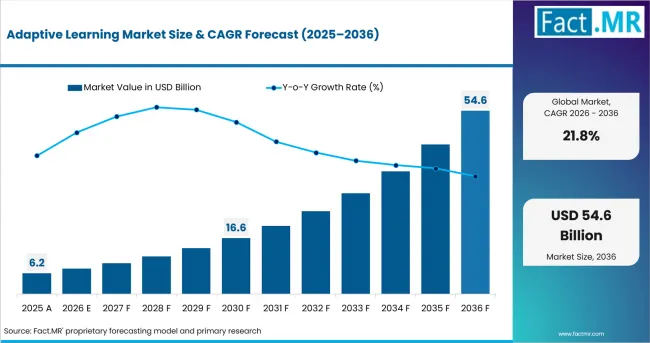
Summary of the Adaptive Learning Market
- Demand Drivers
- AI-powered personalization is improving learner engagement and educational outcomes across academic and enterprise learning environments.
- Digital education investment is increasing deployment of adaptive platforms across schools, universities, and workforce training programs.
- Cloud-based learning infrastructure is improving accessibility and scalability across distributed learning environments.
- Key Segments Analyzed
- By Component: Platform accounts for 64.8% share in 2026 due to central importance in personalization and analytics delivery.
- By Application: Educational Institutes contribute 58.2% share supported by classroom and digital learning integration.
- By Deployment: Cloud captures 72.4% share due to scalability and lower infrastructure requirements.
- By End User: Academic registers 69.1% share supported by adoption across K-12 and higher education institutions.
- By Learning Mode: Self-paced Learning holds 46.7% share due to learner preference for flexible progression.
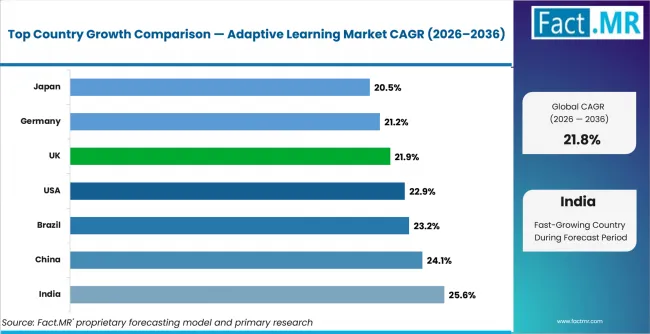
- By Geography: India is projected to record 25.6% CAGR through 2036 supported by digital education expansion.
- Analyst Opinion at Fact.MR
- Shambhu Nath Jha, Principal Consultant at Fact.MR, opines, “Competitive positioning in adaptive learning is increasingly linked to personalization quality and learner outcome measurement. Platform providers that improve engagement and retention metrics are expected to strengthen institutional adoption.”
- Strategic Implications
- Platform providers should strengthen AI-driven personalization capabilities. Improved learning outcomes support adoption across institutions.
- Education organizations should integrate adaptive learning into core curriculum delivery. Personalized instruction improves learner progression.
- Technology vendors should expand cloud-based deployment capabilities. Flexible access improves implementation across distributed learning environments.
| Metric | Value |
|---|---|
| Estimated Value in 2026 | USD 7.6 Billion |
| Forecast Value in 2036 | USD 54.6 Billion |
| Forecast CAGR (2026 to 2036) | 21.8% |
India is projected to expand at 25.6% CAGR from 2026 to 2036 supported by large-scale digital education programs. China is expected to grow at 24.1% CAGR through 2036 driven by AI integration across learning platforms. Brazil is forecast to register 23.2% CAGR by 2036 due to expansion of digital education access. The United States is anticipated to witness 22.9% CAGR by 2036 supported by strong EdTech investment. The United Kingdom is estimated to advance at 21.9% CAGR through 2036 due to higher adoption of personalized learning tools. Germany is projected to grow at 21.2% CAGR from 2026 to 2036 supported by classroom digitization initiatives. Japan is expected to record 20.5% CAGR by 2036 due to technology-led education modernization.
Segmental Analysis
Adaptive Learning Market Analysis by Component

Platform solutions are estimated to account for 64.8% share in 2026. Institutions prioritize centralized systems that combine content delivery and adaptive assessment functionality. Platform investments support long-term deployment across academic and enterprise learning environments. Udemy, Inc. announced a new AI-powered microlearning system that converts long-form courses into adaptive short-form learning experiences personalized to learner behavior and goals. The system uses AI to dynamically adjust content sequencing and delivery. [1]
- Personalization Engine: Platforms deliver individualized learning pathways based on performance data. Adaptive instruction improves learner engagement and knowledge retention.
- Analytics Capability: Learning institutions increasingly rely on performance dashboards and progress tracking tools. Data visibility supports instructional decision-making.
- Scalable Architecture: Platform-based deployment simplifies expansion across multiple campuses and training environments. Centralized management supports operational efficiency.
Adaptive Learning Market Analysis by Application
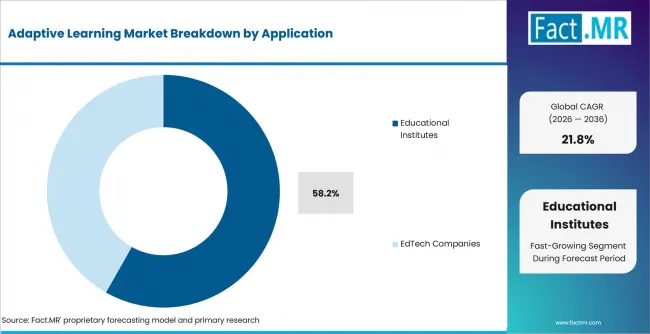
Educational institutes are estimated to capture 58.2% share in 2026. Schools and universities are integrating adaptive learning technologies into classroom and digital instruction models. Personalized education strategies support segment leadership. Pearson reported strong expansion of its AI-powered learning ecosystem, with its virtual learning segment growing 21%. The company is scaling AI-driven adaptive learning tools that personalize study paths, improve engagement, and enhance academic performance across digital education platforms. [2]
- Curriculum Integration: Adaptive platforms align with academic learning objectives. Institutional adoption reflects demand for measurable educational outcomes.
- Student Engagement: Personalized learning experiences improve participation and content completion rates. Education providers prioritize engagement improvement.
- Assessment Optimization: Adaptive assessment tools identify knowledge gaps more efficiently. Data-driven instruction supports educational performance goals.
Adaptive Learning Market Analysis by Deployment
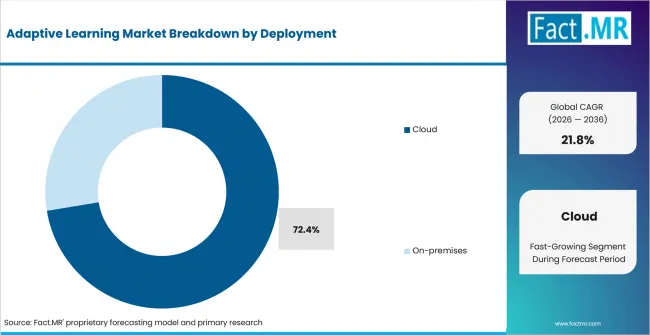
Cloud deployment is estimated to hold 72.4% share in 2026. Educational institutions increasingly prefer flexible infrastructure that reduces internal technology management requirements. Subscription-based delivery supports deployment across distributed learning environments. Classover introduced a next-generation AI tutoring system that delivers real-time adaptive instruction for K-12 students by adjusting learning content based on individual performance.
It focuses on scalable personalized learning through continuous feedback and AI-driven instruction. [3]
- Infrastructure Efficiency: Cloud deployment reduces upfront technology investment. Lower implementation barriers support adoption.
- Remote Accessibility: Students and educators access learning content from multiple locations. Accessibility strengthens platform utilization.
- Update Management: Cloud providers deliver continuous software updates and feature enhancements. Simplified maintenance improves operational performance.
Adaptive Learning Market Analysis by End User
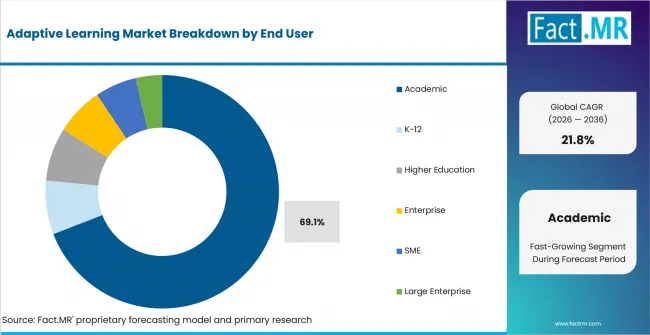
Academic institutions are estimated to register 69.1% share in 2026. K-12 schools and higher education organizations represent the primary users of adaptive learning platforms. Educational performance improvement supports demand concentration. DreamBox Learning uses AI-powered adaptive learning to personalize K-8 math education by adjusting difficulty, pacing, and content in real time based on student performance. It delivers individualized learning paths and continuous feedback through its Intelligent Adaptive Learning system. [4]
- K-12 Adoption: Schools are increasing investment in personalized instruction technologies. Adaptive learning supports differentiated teaching approaches.
- Higher Education Demand: Universities utilize adaptive platforms to improve learner progression and course completion rates. Academic performance objectives support adoption.
- Institutional Investment: Education technology spending continues expanding across academic environments. Digital transformation initiatives strengthen deployment activity.
Adaptive Learning Market Analysis by Learning Mode
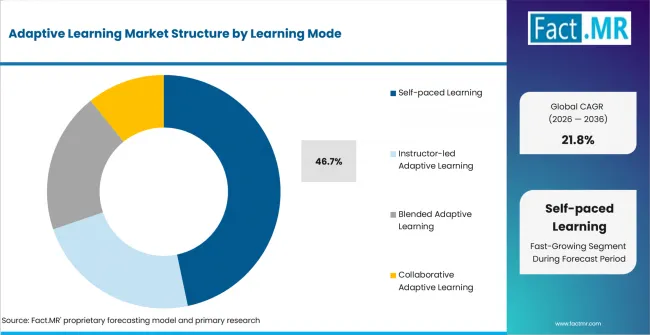
Self-paced learning is estimated to contribute 46.7% share in 2026. Learners increasingly prefer flexible educational experiences that align with individual schedules and learning speeds. Personalized progression supports segment expansion. Cornerstone OnDemand introduced an Adaptive Learning Agent™ within its Cornerstone Galaxy platform to deliver personalized workforce development and AI-driven skilling workflows. [5]
- Learning Flexibility: Self-paced environments allow learners to advance according to individual performance. Flexibility improves engagement levels.
- Content Accessibility: Digital platforms provide continuous access to educational resources. Availability supports utilization across learner groups.
- Outcome Improvement: Personalized progression paths improve knowledge retention and completion rates. Educational institutions value measurable outcomes.
Drivers, Restraints, and Opportunities
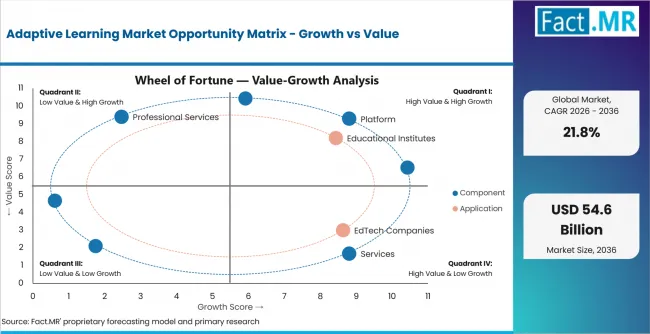
The adaptive learning market has moved beyond supplemental digital education tools into core instructional infrastructure. Early adoption was concentrated in higher education and specialized training programs.
Personalized learning is replacing uniform content delivery models across many educational environments. Institutions increasingly evaluate learning platforms based on engagement outcomes and performance improvement.
- AI-Powered Personalization: Education providers are increasing investment in adaptive technologies that tailor content according to learner performance. Demand is driven by improved educational outcomes and stronger engagement metrics.
- Digital Education Expansion: Schools, universities, and workforce training organizations are accelerating digital learning adoption. Growth is supported by modernization of instructional delivery models across developed and emerging economies.
- Data Privacy Requirements: Adoption is constrained by learner data governance obligations and cybersecurity concerns. Compliance requirements increase implementation complexity for education institutions and training providers.
Regional Analysis
The adaptive learning market is assessed across North America, Europe, Asia Pacific, Latin America, and the Middle East and Africa. The study evaluates digital education investment, personalized learning adoption, cloud learning deployment, academic technology spending, and workforce training modernization across major economies.
.webp)
| Country | CAGR (2026 to 2036) |
|---|---|
| India | 25.6% |
| China | 24.1% |
| Brazil | 23.2% |
| United States | 22.9% |
| United Kingdom | 21.9% |
| Germany | 21.2% |
| Japan | 20.5% |
Source: Fact.MR analysis based on proprietary forecasting model and primary research.
Asia Pacific Adaptive Learning Market Analysis

Asia Pacific represents a major opportunity for adaptive learning providers. Education technology investment is increasing across schools and universities. Government-backed digital learning initiatives support adoption of personalized education platforms.
- India: India is projected to expand at 25.6% CAGR from 2026 to 2036 as educational institutions increase investment in digital learning infrastructure. Schools and universities are adopting AI-enabled learning platforms to improve student performance. Demand reflects expansion of online education access across urban and semi-urban regions. Growth is attributable to national digital education initiatives and technology integration.
- China: China is forecast to grow at 24.1% CAGR by 2036 supported by investment in intelligent education technologies and digital classrooms. Educational institutions are increasing deployment of adaptive assessment and personalized learning systems. Demand is concentrated in K-12 and higher education environments. Growth reflects expansion of AI-based education solutions across academic institutions.
- Japan: Japan is expected to witness 20.5% CAGR through 2036 driven by modernization of education delivery and technology integration across learning environments. Academic institutions are utilizing adaptive platforms to improve instructional effectiveness. Learning providers are strengthening digital education content personalization capabilities. Growth is supported by education technology investment and digital transformation programs.
Latin America Adaptive Learning Market Analysis
Latin America is benefiting from expansion of digital education access and increasing adoption of cloud-based learning platforms. Educational modernization initiatives are strengthening adaptive learning demand.
- Brazil: Brazil is anticipated to register 23.2% CAGR by 2036 as schools and universities increase utilization of personalized learning technologies. Digital education programs are expanding access to online learning resources. Demand reflects improving internet connectivity across education environments. Growth is attributable to education technology adoption and digital learning expansion.
North America Adaptive Learning Market Analysis
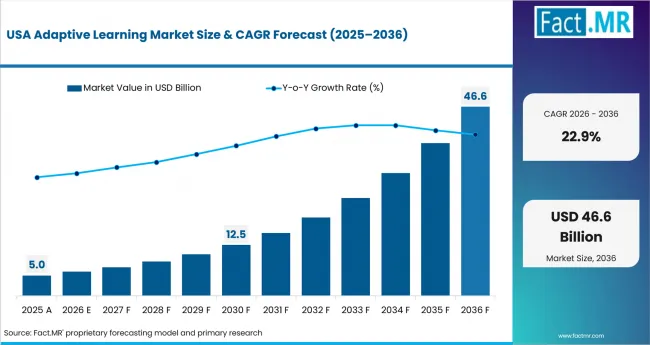
North America remains a substantial revenue-generating region for adaptive learning technology providers. Strong EdTech investment and institutional technology spending support market development.
- United States: The United States is projected to expand at 22.9% CAGR through 2036 as educational institutions increase deployment of personalized learning systems. Universities and workforce training organizations are investing in adaptive learning platforms to improve learner outcomes. Demand reflects strong digital education spending across academic and enterprise environments. Growth is driven by AI-enabled learning innovation and technology adoption.
Europe Adaptive Learning Market Analysis

Europe benefits from established digital education infrastructure and growing emphasis on personalized instruction. Academic institutions are integrating adaptive technologies into learning environments.
- United Kingdom: The United Kingdom is forecast to grow at 21.9% CAGR from 2026 to 2036 due to increasing use of adaptive learning tools across higher education and professional development programs. Universities are investing in data-driven learning platforms to improve educational performance. Demand reflects expansion of digital learning strategies. Growth is supported by education technology modernization.
- Germany: Germany is projected to witness 21.2% CAGR by 2036 supported by classroom digitization and expansion of online learning capabilities. Educational institutions are increasing investment in adaptive assessment technologies. Learning platforms are gaining adoption across academic environments. Growth reflects strengthening digital education infrastructure.
Competitive Aligners for Market Players
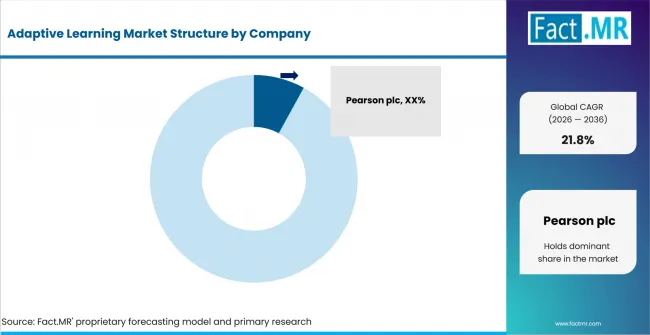
The competitive structure reflects a concentration of established education technology providers and digital learning platform developers. Platform capability influences purchasing decisions across academic and enterprise environments. Organizations with integrated learning ecosystems maintain stronger commercial positioning.
Education technology companies benefit from extensive content libraries and long-standing institutional relationships. Learning analytics capability improves differentiation across competitive environments. Platform interoperability supports wider deployment across educational systems. Subscription-based revenue models strengthen long-term commercial relationships.
Academic institutions evaluate vendors based on personalization effectiveness and learner outcome improvement. Enterprise training organizations prioritize scalability and implementation flexibility. Technology integration capability influences procurement decisions. Data security requirements shape vendor selection processes. Commercial success is increasingly linked to adaptive learning accuracy and content quality. Demand is shifting toward providers capable of combining artificial intelligence with measurable educational outcomes. Cloud deployment capability is emerging as a major competitive differentiator.
Key Players
- Pearson plc
- McGraw Hill LLC
- Udemy, Inc.
- Classover
- DreamBox Learning, Inc.
Bibliography
- [1] Udemy, Inc.. (2025, December 15). Udemy introduces AI-powered microlearning to evolve skills mastery.
- [2] digitalLEARNING Network. (2026, May 6). Pearson expands AI learning platforms as virtual segment grows 21%.
- [3] Classover. (2025). Classover advances next-generation AI tutor with real-time adaptive instruction for K-12 at scale.
- [4] Synlabs. (2024). DreamBox Learning AI: Personalized math education through adaptive learning technology.
- [5] Cornerstone OnDemand. (2025). Cornerstone redefines learning and talent management with AI-powered workforce agility platform, Cornerstone Galaxy.
This Report Addresses
- Analysis of adaptive learning demand across academic education and enterprise training applications.
- Market forecast from USD 7.6 billion in 2026 to USD 54.6 billion by 2036 at 21.8% CAGR.
- Opportunity assessment across AI-powered personalization and cloud-based learning platforms.
- Segment forecasts covering component, application, deployment, end user, and learning mode demand.
- Competitive assessment of education technology providers and adaptive learning platform developers.
- Evaluation of digital education trends and institutional technology investment activity.
- Country-level analysis across India, China, Brazil, the United States, the United Kingdom, Germany, and Japan.
- Report delivery through PDF and Excel formats supported by primary interviews and industry analysis.
Adaptive Learning Market Definition
Adaptive learning refers to education technology systems that personalize learning content, assessments, and instructional pathways based on learner performance. These platforms use analytics and artificial intelligence to identify knowledge gaps and adjust learning experiences in real time. Adaptive learning solutions are used across K-12 education, higher education, professional certification programs, and enterprise workforce training. The market includes software platforms, implementation services, learning analytics tools, and cloud-based delivery systems designed to improve learning outcomes and engagement.
Adaptive Learning Market Inclusions
The study covers global and regional forecasts from 2026 to 2036 by component, application, deployment, end user, and learning mode. It includes adaptive learning software platforms, implementation services, support services, managed services, and cloud-based learning solutions. The report evaluates adoption trends, pricing structures, institutional spending patterns, and technology deployment across education and enterprise environments.
Adaptive Learning Market Exclusions
The study excludes traditional learning management systems that lack adaptive functionality. It omits generic digital content platforms and non-personalized e-learning software. Revenue linked to hardware devices, broadband infrastructure, and general classroom technology is excluded unless directly associated with adaptive learning platform deployment.
Adaptive Learning Market Research Methodology
- Primary Research
- Interviews were conducted with education technology providers, academic administrators, corporate learning managers, digital education consultants, and software implementation specialists.
- Desk Research
- Analysis included company disclosures, investor presentations, government education initiatives, EdTech industry publications, and technology adoption reports released during 2024 and 2025.
- Market-Sizing and Forecasting
- Hybrid top-down and bottom-up model using digital learning expenditure, software subscription revenue, institutional technology spending, and user adoption analysis.
- Data Validation and Update Cycle
- Forecasts were validated through education provider interviews, technology vendor assessments, institutional spending reviews, and adaptive learning deployment analysis.
Scope of Report

| Attribute | Details |
|---|---|
| Quantitative Units | USD 7.6 Billion (2026) to USD 54.6 Billion (2036) at a CAGR of 21.8% |
| Market Definition | Covers adaptive software platforms and services that personalize learning pathways based on learner performance |
| Component Segmentation | Platform, Services |
| Application Segmentation | Educational Institutes, EdTech Companies |
| Deployment Segmentation | Cloud, On-premises |
| End User Segmentation | Academic, Enterprise |
| Learning Mode Segmentation | Self-paced Learning, Instructor-led Adaptive Learning, Blended Adaptive Learning, Collaborative Adaptive Learning |
| Regions Covered | North America, Europe, Asia Pacific, Latin America, Middle East & Africa |
| Countries Covered | India, China, Brazil, United States, United Kingdom, Germany, Japan |
| Key Companies Profiled | Pearson plc, McGraw Hill LLC, Udemy, Inc., Classover, DreamBox Learning, Inc. |
| Forecast Period | 2026 to 2036 |
| Approach | Hybrid top-down and bottom-up model using digital learning expenditure and software adoption analysis. |
Adaptive Learning Market by Segment
-
By Component
- Platform
- Services
- Professional Services
- Consulting
- Implementation
- Support and Maintenance
- Managed Services
-
By Application
- Educational Institutes
- EdTech Companies
-
By Deployment
- Cloud
- On-premises
-
By End User
- Academic
- K-12
- Higher Education
- Enterprise
- SME
- Large Enterprise
-
By Learning Mode
- Self-paced Learning
- Instructor-led Adaptive Learning
- Blended Adaptive Learning
- Collaborative Adaptive Learning
-
By Region
- North America
- United States
- Canada
- Mexico
- Latin America
- Brazil
- Argentina
- Rest of Latin America
- Europe
- United Kingdom
- Germany
- France
- Italy
- Spain
- Rest of Europe
- Asia Pacific
- China
- India
- Japan
- South Korea
- ASEAN
- Middle East & Africa
- UAE
- Saudi Arabia
- South Africa
- Rest of Middle East & Africa
- North America
- Frequently Asked Questions -
How large is the global adaptive learning market in 2025?
The global adaptive learning market is estimated at USD 6.2 billion in 2025 based on Fact.MR industry analysis.
What will the adaptive learning market size be in 2026?
Based on Fact.MR analysis, demand for adaptive learning solutions is estimated to reach USD 7.6 billion in 2026.
What is the projected adaptive learning market size by 2036?
The market is projected to reach USD 54.6 billion by 2036 supported by expanding use of AI-driven personalized learning technologies.
What is the expected CAGR for the adaptive learning market from 2026 to 2036?
Fact.MR projects the global adaptive learning market to expand at a CAGR of 21.8% during the forecast period.
Which deployment segment is poised to lead market demand?
Cloud deployment leads with 72.4% share in 2026 due to scalability advantages and lower infrastructure requirements.
Which country records the strongest growth in the market?
India records 25.6% CAGR through 2036 supported by digital education expansion and growing investment in adaptive learning platforms.
Table of Content
- Executive Summary
- Global Market Outlook
- Demand to side Trends
- Supply to side Trends
- Technology Roadmap Analysis
- Analysis and Recommendations
- Market Overview
- Market Coverage / Taxonomy
- Market Definition / Scope / Limitations
- Research Methodology
- Chapter Orientation
- Analytical Lens and Working Hypotheses
- Market Structure, Signals, and Trend Drivers
- Benchmarking and Cross-market Comparability
- Market Sizing, Forecasting, and Opportunity Mapping
- Research Design and Evidence Framework
- Desk Research Programme (Secondary Evidence)
- Company Annual and Sustainability Reports
- Peer-reviewed Journals and Academic Literature
- Corporate Websites, Product Literature, and Technical Notes
- Earnings Decks and Investor Briefings
- Statutory Filings and Regulatory Disclosures
- Technical White Papers and Standards Notes
- Trade Journals, Industry Magazines, and Analyst Briefs
- Conference Proceedings, Webinars, and Seminar Materials
- Government Statistics Portals and Public Data Releases
- Press Releases and Reputable Media Coverage
- Specialist Newsletters and Curated Briefings
- Sector Databases and Reference Repositories
- Fact.MR Internal Proprietary Databases and Historical Market Datasets
- Subscription Datasets and Paid Sources
- Social Channels, Communities, and Digital Listening Inputs
- Additional Desk Sources
- Expert Input and Fieldwork (Primary Evidence)
- Primary Modes
- Qualitative Interviews and Expert Elicitation
- Quantitative Surveys and Structured Data Capture
- Blended Approach
- Why Primary Evidence is Used
- Field Techniques
- Interviews
- Surveys
- Focus Groups
- Observational and In-context Research
- Social and Community Interactions
- Stakeholder Universe Engaged
- C-suite Leaders
- Board Members
- Presidents and Vice Presidents
- R&D and Innovation Heads
- Technical Specialists
- Domain Subject-matter Experts
- Scientists
- Physicians and Other Healthcare Professionals
- Governance, Ethics, and Data Stewardship
- Research Ethics
- Data Integrity and Handling
- Primary Modes
- Tooling, Models, and Reference Databases
- Desk Research Programme (Secondary Evidence)
- Data Engineering and Model Build
- Data Acquisition and Ingestion
- Cleaning, Normalisation, and Verification
- Synthesis, Triangulation, and Analysis
- Quality Assurance and Audit Trail
- Market Background
- Market Dynamics
- Drivers
- Restraints
- Opportunity
- Trends
- Scenario Forecast
- Demand in Optimistic Scenario
- Demand in Likely Scenario
- Demand in Conservative Scenario
- Opportunity Map Analysis
- Product Life Cycle Analysis
- Supply Chain Analysis
- Investment Feasibility Matrix
- Value Chain Analysis
- PESTLE and Porter’s Analysis
- Regulatory Landscape
- Regional Parent Market Outlook
- Production and Consumption Statistics
- Import and Export Statistics
- Market Dynamics
- Global Market Analysis 2021 to 2025 and Forecast, 2026 to 2036
- Historical Market Size Value (USD Million) Analysis, 2021 to 2025
- Current and Future Market Size Value (USD Million) Projections, 2026 to 2036
- Y to o to Y Growth Trend Analysis
- Absolute $ Opportunity Analysis
- Global Market Pricing Analysis 2021 to 2025 and Forecast 2026 to 2036
- Global Market Analysis 2021 to 2025 and Forecast 2026 to 2036, By Component
- Introduction / Key Findings
- Historical Market Size Value (USD Million) Analysis By Component , 2021 to 2025
- Current and Future Market Size Value (USD Million) Analysis and Forecast By Component , 2026 to 2036
- Platform
- Services
- Platform
- Y to o to Y Growth Trend Analysis By Component , 2021 to 2025
- Absolute $ Opportunity Analysis By Component , 2026 to 2036
- Global Market Analysis 2021 to 2025 and Forecast 2026 to 2036, By Application
- Introduction / Key Findings
- Historical Market Size Value (USD Million) Analysis By Application, 2021 to 2025
- Current and Future Market Size Value (USD Million) Analysis and Forecast By Application, 2026 to 2036
- Real-time Adaptive AI
- Offline Learning and Adaptation
- Context-aware Adaptation
- Autonomous Decision-Making
- Others
- Real-time Adaptive AI
- Y to o to Y Growth Trend Analysis By Application, 2021 to 2025
- Absolute $ Opportunity Analysis By Application, 2026 to 2036
- Global Market Analysis 2021 to 2025 and Forecast 2026 to 2036, By Technology
- Introduction / Key Findings
- Historical Market Size Value (USD Million) Analysis By Technology, 2021 to 2025
- Current and Future Market Size Value (USD Million) Analysis and Forecast By Technology, 2026 to 2036
- Machine Learning
- Deep Learning
- Reinforcement Learning
- Natural Language Processing (NLP)
- Computer Vision
- Machine Learning
- Y to o to Y Growth Trend Analysis By Technology, 2021 to 2025
- Absolute $ Opportunity Analysis By Technology, 2026 to 2036
- Global Market Analysis 2021 to 2025 and Forecast 2026 to 2036, By End Use
- Introduction / Key Findings
- Historical Market Size Value (USD Million) Analysis By End Use, 2021 to 2025
- Current and Future Market Size Value (USD Million) Analysis and Forecast By End Use, 2026 to 2036
- BFSI
- Healthcare & Life Sciences
- IT & Telecommunications
- Aerospace & Defense
- Manufacturing
- Retail & E-commerce
- Media & Entertainment
- Others
- BFSI
- Y to o to Y Growth Trend Analysis By End Use, 2021 to 2025
- Absolute $ Opportunity Analysis By End Use, 2026 to 2036
- Global Market Analysis 2021 to 2025 and Forecast 2026 to 2036, By Deployment Mode
- Introduction / Key Findings
- Historical Market Size Value (USD Million) Analysis By Deployment Mode, 2021 to 2025
- Current and Future Market Size Value (USD Million) Analysis and Forecast By Deployment Mode, 2026 to 2036
- Cloud-based
- On-premise
- Hybrid
- Cloud-based
- Y to o to Y Growth Trend Analysis By Deployment Mode, 2021 to 2025
- Absolute $ Opportunity Analysis By Deployment Mode, 2026 to 2036
- Global Market Analysis 2021 to 2025 and Forecast 2026 to 2036, By Region
- Introduction
- Historical Market Size Value (USD Million) Analysis By Region, 2021 to 2025
- Current Market Size Value (USD Million) Analysis and Forecast By Region, 2026 to 2036
- North America
- Latin America
- Western Europe
- Eastern Europe
- East Asia
- South Asia and Pacific
- Middle East & Africa
- Market Attractiveness Analysis By Region
- North America Market Analysis 2021 to 2025 and Forecast 2026 to 2036, By Country
- Historical Market Size Value (USD Million) Trend Analysis By Market Taxonomy, 2021 to 2025
- Market Size Value (USD Million) Forecast By Market Taxonomy, 2026 to 2036
- By Country
- USA
- Canada
- Mexico
- By Component
- By Application
- By Technology
- By End Use
- By Deployment Mode
- By Country
- Market Attractiveness Analysis
- By Country
- By Component
- By Application
- By Technology
- By End Use
- By Deployment Mode
- Key Takeaways
- Latin America Market Analysis 2021 to 2025 and Forecast 2026 to 2036, By Country
- Historical Market Size Value (USD Million) Trend Analysis By Market Taxonomy, 2021 to 2025
- Market Size Value (USD Million) Forecast By Market Taxonomy, 2026 to 2036
- By Country
- Brazil
- Chile
- Rest of Latin America
- By Component
- By Application
- By Technology
- By End Use
- By Deployment Mode
- By Country
- Market Attractiveness Analysis
- By Country
- By Component
- By Application
- By Technology
- By End Use
- By Deployment Mode
- Key Takeaways
- Western Europe Market Analysis 2021 to 2025 and Forecast 2026 to 2036, By Country
- Historical Market Size Value (USD Million) Trend Analysis By Market Taxonomy, 2021 to 2025
- Market Size Value (USD Million) Forecast By Market Taxonomy, 2026 to 2036
- By Country
- Germany
- UK
- Italy
- Spain
- France
- Nordic
- BENELUX
- Rest of Western Europe
- By Component
- By Application
- By Technology
- By End Use
- By Deployment Mode
- By Country
- Market Attractiveness Analysis
- By Country
- By Component
- By Application
- By Technology
- By End Use
- By Deployment Mode
- Key Takeaways
- Eastern Europe Market Analysis 2021 to 2025 and Forecast 2026 to 2036, By Country
- Historical Market Size Value (USD Million) Trend Analysis By Market Taxonomy, 2021 to 2025
- Market Size Value (USD Million) Forecast By Market Taxonomy, 2026 to 2036
- By Country
- Russia
- Poland
- Hungary
- Balkan & Baltic
- Rest of Eastern Europe
- By Component
- By Application
- By Technology
- By End Use
- By Deployment Mode
- By Country
- Market Attractiveness Analysis
- By Country
- By Component
- By Application
- By Technology
- By End Use
- By Deployment Mode
- Key Takeaways
- East Asia Market Analysis 2021 to 2025 and Forecast 2026 to 2036, By Country
- Historical Market Size Value (USD Million) Trend Analysis By Market Taxonomy, 2021 to 2025
- Market Size Value (USD Million) Forecast By Market Taxonomy, 2026 to 2036
- By Country
- China
- Japan
- South Korea
- By Component
- By Application
- By Technology
- By End Use
- By Deployment Mode
- By Country
- Market Attractiveness Analysis
- By Country
- By Component
- By Application
- By Technology
- By End Use
- By Deployment Mode
- Key Takeaways
- South Asia and Pacific Market Analysis 2021 to 2025 and Forecast 2026 to 2036, By Country
- Historical Market Size Value (USD Million) Trend Analysis By Market Taxonomy, 2021 to 2025
- Market Size Value (USD Million) Forecast By Market Taxonomy, 2026 to 2036
- By Country
- India
- ASEAN
- Australia & New Zealand
- Rest of South Asia and Pacific
- By Component
- By Application
- By Technology
- By End Use
- By Deployment Mode
- By Country
- Market Attractiveness Analysis
- By Country
- By Component
- By Application
- By Technology
- By End Use
- By Deployment Mode
- Key Takeaways
- Middle East & Africa Market Analysis 2021 to 2025 and Forecast 2026 to 2036, By Country
- Historical Market Size Value (USD Million) Trend Analysis By Market Taxonomy, 2021 to 2025
- Market Size Value (USD Million) Forecast By Market Taxonomy, 2026 to 2036
- By Country
- Kingdom of Saudi Arabia
- Other GCC Countries
- Turkiye
- South Africa
- Other African Union
- Rest of Middle East & Africa
- By Component
- By Application
- By Technology
- By End Use
- By Deployment Mode
- By Country
- Market Attractiveness Analysis
- By Country
- By Component
- By Application
- By Technology
- By End Use
- By Deployment Mode
- Key Takeaways
- Key Countries Market Analysis
- USA
- Pricing Analysis
- Market Share Analysis, 2025
- By Component
- By Application
- By Technology
- By End Use
- By Deployment Mode
- Canada
- Pricing Analysis
- Market Share Analysis, 2025
- By Component
- By Application
- By Technology
- By End Use
- By Deployment Mode
- Mexico
- Pricing Analysis
- Market Share Analysis, 2025
- By Component
- By Application
- By Technology
- By End Use
- By Deployment Mode
- Brazil
- Pricing Analysis
- Market Share Analysis, 2025
- By Component
- By Application
- By Technology
- By End Use
- By Deployment Mode
- Chile
- Pricing Analysis
- Market Share Analysis, 2025
- By Component
- By Application
- By Technology
- By End Use
- By Deployment Mode
- Germany
- Pricing Analysis
- Market Share Analysis, 2025
- By Component
- By Application
- By Technology
- By End Use
- By Deployment Mode
- UK
- Pricing Analysis
- Market Share Analysis, 2025
- By Component
- By Application
- By Technology
- By End Use
- By Deployment Mode
- Italy
- Pricing Analysis
- Market Share Analysis, 2025
- By Component
- By Application
- By Technology
- By End Use
- By Deployment Mode
- Spain
- Pricing Analysis
- Market Share Analysis, 2025
- By Component
- By Application
- By Technology
- By End Use
- By Deployment Mode
- France
- Pricing Analysis
- Market Share Analysis, 2025
- By Component
- By Application
- By Technology
- By End Use
- By Deployment Mode
- India
- Pricing Analysis
- Market Share Analysis, 2025
- By Component
- By Application
- By Technology
- By End Use
- By Deployment Mode
- ASEAN
- Pricing Analysis
- Market Share Analysis, 2025
- By Component
- By Application
- By Technology
- By End Use
- By Deployment Mode
- Australia & New Zealand
- Pricing Analysis
- Market Share Analysis, 2025
- By Component
- By Application
- By Technology
- By End Use
- By Deployment Mode
- China
- Pricing Analysis
- Market Share Analysis, 2025
- By Component
- By Application
- By Technology
- By End Use
- By Deployment Mode
- Japan
- Pricing Analysis
- Market Share Analysis, 2025
- By Component
- By Application
- By Technology
- By End Use
- By Deployment Mode
- South Korea
- Pricing Analysis
- Market Share Analysis, 2025
- By Component
- By Application
- By Technology
- By End Use
- By Deployment Mode
- Russia
- Pricing Analysis
- Market Share Analysis, 2025
- By Component
- By Application
- By Technology
- By End Use
- By Deployment Mode
- Poland
- Pricing Analysis
- Market Share Analysis, 2025
- By Component
- By Application
- By Technology
- By End Use
- By Deployment Mode
- Hungary
- Pricing Analysis
- Market Share Analysis, 2025
- By Component
- By Application
- By Technology
- By End Use
- By Deployment Mode
- Kingdom of Saudi Arabia
- Pricing Analysis
- Market Share Analysis, 2025
- By Component
- By Application
- By Technology
- By End Use
- By Deployment Mode
- Turkiye
- Pricing Analysis
- Market Share Analysis, 2025
- By Component
- By Application
- By Technology
- By End Use
- By Deployment Mode
- South Africa
- Pricing Analysis
- Market Share Analysis, 2025
- By Component
- By Application
- By Technology
- By End Use
- By Deployment Mode
- USA
- Market Structure Analysis
- Competition Dashboard
- Competition Benchmarking
- Market Share Analysis of Top Players
- By Regional
- By Component
- By Application
- By Technology
- By End Use
- By Deployment Mode
- Competition Analysis
- Competition Deep Dive
- Microsoft Corporation
- Overview
- Product Portfolio
- Profitability by Market Segments (Product/Age /Sales Channel/Region)
- Sales Footprint
- Strategy Overview
- Marketing Strategy
- Product Strategy
- Channel Strategy
- International Business Machines Corporation
- Google LLC
- Amazon Web Services, Inc.
- Oracle Corporation
- Salesforce, Inc.
- Microsoft Corporation
- Competition Deep Dive
- Assumptions & Acronyms Used
List Of Table
- Table 1: Global Market Value (USD Million) Forecast by Region, 2021 to 2036
- Table 2: Global Market Value (USD Million) Forecast by Component , 2021 to 2036
- Table 3: Global Market Value (USD Million) Forecast by Application, 2021 to 2036
- Table 4: Global Market Value (USD Million) Forecast by Technology, 2021 to 2036
- Table 5: Global Market Value (USD Million) Forecast by End Use, 2021 to 2036
- Table 6: Global Market Value (USD Million) Forecast by Deployment Mode, 2021 to 2036
- Table 7: North America Market Value (USD Million) Forecast by Country, 2021 to 2036
- Table 8: North America Market Value (USD Million) Forecast by Component , 2021 to 2036
- Table 9: North America Market Value (USD Million) Forecast by Application, 2021 to 2036
- Table 10: North America Market Value (USD Million) Forecast by Technology, 2021 to 2036
- Table 11: North America Market Value (USD Million) Forecast by End Use, 2021 to 2036
- Table 12: North America Market Value (USD Million) Forecast by Deployment Mode, 2021 to 2036
- Table 13: Latin America Market Value (USD Million) Forecast by Country, 2021 to 2036
- Table 14: Latin America Market Value (USD Million) Forecast by Component , 2021 to 2036
- Table 15: Latin America Market Value (USD Million) Forecast by Application, 2021 to 2036
- Table 16: Latin America Market Value (USD Million) Forecast by Technology, 2021 to 2036
- Table 17: Latin America Market Value (USD Million) Forecast by End Use, 2021 to 2036
- Table 18: Latin America Market Value (USD Million) Forecast by Deployment Mode, 2021 to 2036
- Table 19: Western Europe Market Value (USD Million) Forecast by Country, 2021 to 2036
- Table 20: Western Europe Market Value (USD Million) Forecast by Component , 2021 to 2036
- Table 21: Western Europe Market Value (USD Million) Forecast by Application, 2021 to 2036
- Table 22: Western Europe Market Value (USD Million) Forecast by Technology, 2021 to 2036
- Table 23: Western Europe Market Value (USD Million) Forecast by End Use, 2021 to 2036
- Table 24: Western Europe Market Value (USD Million) Forecast by Deployment Mode, 2021 to 2036
- Table 25: Eastern Europe Market Value (USD Million) Forecast by Country, 2021 to 2036
- Table 26: Eastern Europe Market Value (USD Million) Forecast by Component , 2021 to 2036
- Table 27: Eastern Europe Market Value (USD Million) Forecast by Application, 2021 to 2036
- Table 28: Eastern Europe Market Value (USD Million) Forecast by Technology, 2021 to 2036
- Table 29: Eastern Europe Market Value (USD Million) Forecast by End Use, 2021 to 2036
- Table 30: Eastern Europe Market Value (USD Million) Forecast by Deployment Mode, 2021 to 2036
- Table 31: East Asia Market Value (USD Million) Forecast by Country, 2021 to 2036
- Table 32: East Asia Market Value (USD Million) Forecast by Component , 2021 to 2036
- Table 33: East Asia Market Value (USD Million) Forecast by Application, 2021 to 2036
- Table 34: East Asia Market Value (USD Million) Forecast by Technology, 2021 to 2036
- Table 35: East Asia Market Value (USD Million) Forecast by End Use, 2021 to 2036
- Table 36: East Asia Market Value (USD Million) Forecast by Deployment Mode, 2021 to 2036
- Table 37: South Asia and Pacific Market Value (USD Million) Forecast by Country, 2021 to 2036
- Table 38: South Asia and Pacific Market Value (USD Million) Forecast by Component , 2021 to 2036
- Table 39: South Asia and Pacific Market Value (USD Million) Forecast by Application, 2021 to 2036
- Table 40: South Asia and Pacific Market Value (USD Million) Forecast by Technology, 2021 to 2036
- Table 41: South Asia and Pacific Market Value (USD Million) Forecast by End Use, 2021 to 2036
- Table 42: South Asia and Pacific Market Value (USD Million) Forecast by Deployment Mode, 2021 to 2036
- Table 43: Middle East & Africa Market Value (USD Million) Forecast by Country, 2021 to 2036
- Table 44: Middle East & Africa Market Value (USD Million) Forecast by Component , 2021 to 2036
- Table 45: Middle East & Africa Market Value (USD Million) Forecast by Application, 2021 to 2036
- Table 46: Middle East & Africa Market Value (USD Million) Forecast by Technology, 2021 to 2036
- Table 47: Middle East & Africa Market Value (USD Million) Forecast by End Use, 2021 to 2036
- Table 48: Middle East & Africa Market Value (USD Million) Forecast by Deployment Mode, 2021 to 2036
List Of Figures
- Figure 1: Global Market Pricing Analysis
- Figure 2: Global Market Value (USD Million) Forecast 2021-2036
- Figure 3: Global Market Value Share and BPS Analysis by Component , 2026 and 2036
- Figure 4: Global Market Y-o-Y Growth Comparison by Component , 2026-2036
- Figure 5: Global Market Attractiveness Analysis by Component
- Figure 6: Global Market Value Share and BPS Analysis by Application, 2026 and 2036
- Figure 7: Global Market Y-o-Y Growth Comparison by Application, 2026-2036
- Figure 8: Global Market Attractiveness Analysis by Application
- Figure 9: Global Market Value Share and BPS Analysis by Technology, 2026 and 2036
- Figure 10: Global Market Y-o-Y Growth Comparison by Technology, 2026-2036
- Figure 11: Global Market Attractiveness Analysis by Technology
- Figure 12: Global Market Value Share and BPS Analysis by End Use, 2026 and 2036
- Figure 13: Global Market Y-o-Y Growth Comparison by End Use, 2026-2036
- Figure 14: Global Market Attractiveness Analysis by End Use
- Figure 15: Global Market Value Share and BPS Analysis by Deployment Mode, 2026 and 2036
- Figure 16: Global Market Y-o-Y Growth Comparison by Deployment Mode, 2026-2036
- Figure 17: Global Market Attractiveness Analysis by Deployment Mode
- Figure 18: Global Market Value (USD Million) Share and BPS Analysis by Region, 2026 and 2036
- Figure 19: Global Market Y-o-Y Growth Comparison by Region, 2026-2036
- Figure 20: Global Market Attractiveness Analysis by Region
- Figure 21: North America Market Incremental Dollar Opportunity, 2026-2036
- Figure 22: Latin America Market Incremental Dollar Opportunity, 2026-2036
- Figure 23: Western Europe Market Incremental Dollar Opportunity, 2026-2036
- Figure 24: Eastern Europe Market Incremental Dollar Opportunity, 2026-2036
- Figure 25: East Asia Market Incremental Dollar Opportunity, 2026-2036
- Figure 26: South Asia and Pacific Market Incremental Dollar Opportunity, 2026-2036
- Figure 27: Middle East & Africa Market Incremental Dollar Opportunity, 2026-2036
- Figure 28: North America Market Value Share and BPS Analysis by Country, 2026 and 2036
- Figure 29: North America Market Value Share and BPS Analysis by Component , 2026 and 2036
- Figure 30: North America Market Y-o-Y Growth Comparison by Component , 2026-2036
- Figure 31: North America Market Attractiveness Analysis by Component
- Figure 32: North America Market Value Share and BPS Analysis by Application, 2026 and 2036
- Figure 33: North America Market Y-o-Y Growth Comparison by Application, 2026-2036
- Figure 34: North America Market Attractiveness Analysis by Application
- Figure 35: North America Market Value Share and BPS Analysis by Technology, 2026 and 2036
- Figure 36: North America Market Y-o-Y Growth Comparison by Technology, 2026-2036
- Figure 37: North America Market Attractiveness Analysis by Technology
- Figure 38: North America Market Value Share and BPS Analysis by End Use, 2026 and 2036
- Figure 39: North America Market Y-o-Y Growth Comparison by End Use, 2026-2036
- Figure 40: North America Market Attractiveness Analysis by End Use
- Figure 41: North America Market Value Share and BPS Analysis by Deployment Mode, 2026 and 2036
- Figure 42: North America Market Y-o-Y Growth Comparison by Deployment Mode, 2026-2036
- Figure 43: North America Market Attractiveness Analysis by Deployment Mode
- Figure 44: Latin America Market Value Share and BPS Analysis by Country, 2026 and 2036
- Figure 45: Latin America Market Value Share and BPS Analysis by Component , 2026 and 2036
- Figure 46: Latin America Market Y-o-Y Growth Comparison by Component , 2026-2036
- Figure 47: Latin America Market Attractiveness Analysis by Component
- Figure 48: Latin America Market Value Share and BPS Analysis by Application, 2026 and 2036
- Figure 49: Latin America Market Y-o-Y Growth Comparison by Application, 2026-2036
- Figure 50: Latin America Market Attractiveness Analysis by Application
- Figure 51: Latin America Market Value Share and BPS Analysis by Technology, 2026 and 2036
- Figure 52: Latin America Market Y-o-Y Growth Comparison by Technology, 2026-2036
- Figure 53: Latin America Market Attractiveness Analysis by Technology
- Figure 54: Latin America Market Value Share and BPS Analysis by End Use, 2026 and 2036
- Figure 55: Latin America Market Y-o-Y Growth Comparison by End Use, 2026-2036
- Figure 56: Latin America Market Attractiveness Analysis by End Use
- Figure 57: Latin America Market Value Share and BPS Analysis by Deployment Mode, 2026 and 2036
- Figure 58: Latin America Market Y-o-Y Growth Comparison by Deployment Mode, 2026-2036
- Figure 59: Latin America Market Attractiveness Analysis by Deployment Mode
- Figure 60: Western Europe Market Value Share and BPS Analysis by Country, 2026 and 2036
- Figure 61: Western Europe Market Value Share and BPS Analysis by Component , 2026 and 2036
- Figure 62: Western Europe Market Y-o-Y Growth Comparison by Component , 2026-2036
- Figure 63: Western Europe Market Attractiveness Analysis by Component
- Figure 64: Western Europe Market Value Share and BPS Analysis by Application, 2026 and 2036
- Figure 65: Western Europe Market Y-o-Y Growth Comparison by Application, 2026-2036
- Figure 66: Western Europe Market Attractiveness Analysis by Application
- Figure 67: Western Europe Market Value Share and BPS Analysis by Technology, 2026 and 2036
- Figure 68: Western Europe Market Y-o-Y Growth Comparison by Technology, 2026-2036
- Figure 69: Western Europe Market Attractiveness Analysis by Technology
- Figure 70: Western Europe Market Value Share and BPS Analysis by End Use, 2026 and 2036
- Figure 71: Western Europe Market Y-o-Y Growth Comparison by End Use, 2026-2036
- Figure 72: Western Europe Market Attractiveness Analysis by End Use
- Figure 73: Western Europe Market Value Share and BPS Analysis by Deployment Mode, 2026 and 2036
- Figure 74: Western Europe Market Y-o-Y Growth Comparison by Deployment Mode, 2026-2036
- Figure 75: Western Europe Market Attractiveness Analysis by Deployment Mode
- Figure 76: Eastern Europe Market Value Share and BPS Analysis by Country, 2026 and 2036
- Figure 77: Eastern Europe Market Value Share and BPS Analysis by Component , 2026 and 2036
- Figure 78: Eastern Europe Market Y-o-Y Growth Comparison by Component , 2026-2036
- Figure 79: Eastern Europe Market Attractiveness Analysis by Component
- Figure 80: Eastern Europe Market Value Share and BPS Analysis by Application, 2026 and 2036
- Figure 81: Eastern Europe Market Y-o-Y Growth Comparison by Application, 2026-2036
- Figure 82: Eastern Europe Market Attractiveness Analysis by Application
- Figure 83: Eastern Europe Market Value Share and BPS Analysis by Technology, 2026 and 2036
- Figure 84: Eastern Europe Market Y-o-Y Growth Comparison by Technology, 2026-2036
- Figure 85: Eastern Europe Market Attractiveness Analysis by Technology
- Figure 86: Eastern Europe Market Value Share and BPS Analysis by End Use, 2026 and 2036
- Figure 87: Eastern Europe Market Y-o-Y Growth Comparison by End Use, 2026-2036
- Figure 88: Eastern Europe Market Attractiveness Analysis by End Use
- Figure 89: Eastern Europe Market Value Share and BPS Analysis by Deployment Mode, 2026 and 2036
- Figure 90: Eastern Europe Market Y-o-Y Growth Comparison by Deployment Mode, 2026-2036
- Figure 91: Eastern Europe Market Attractiveness Analysis by Deployment Mode
- Figure 92: East Asia Market Value Share and BPS Analysis by Country, 2026 and 2036
- Figure 93: East Asia Market Value Share and BPS Analysis by Component , 2026 and 2036
- Figure 94: East Asia Market Y-o-Y Growth Comparison by Component , 2026-2036
- Figure 95: East Asia Market Attractiveness Analysis by Component
- Figure 96: East Asia Market Value Share and BPS Analysis by Application, 2026 and 2036
- Figure 97: East Asia Market Y-o-Y Growth Comparison by Application, 2026-2036
- Figure 98: East Asia Market Attractiveness Analysis by Application
- Figure 99: East Asia Market Value Share and BPS Analysis by Technology, 2026 and 2036
- Figure 100: East Asia Market Y-o-Y Growth Comparison by Technology, 2026-2036
- Figure 101: East Asia Market Attractiveness Analysis by Technology
- Figure 102: East Asia Market Value Share and BPS Analysis by End Use, 2026 and 2036
- Figure 103: East Asia Market Y-o-Y Growth Comparison by End Use, 2026-2036
- Figure 104: East Asia Market Attractiveness Analysis by End Use
- Figure 105: East Asia Market Value Share and BPS Analysis by Deployment Mode, 2026 and 2036
- Figure 106: East Asia Market Y-o-Y Growth Comparison by Deployment Mode, 2026-2036
- Figure 107: East Asia Market Attractiveness Analysis by Deployment Mode
- Figure 108: South Asia and Pacific Market Value Share and BPS Analysis by Country, 2026 and 2036
- Figure 109: South Asia and Pacific Market Value Share and BPS Analysis by Component , 2026 and 2036
- Figure 110: South Asia and Pacific Market Y-o-Y Growth Comparison by Component , 2026-2036
- Figure 111: South Asia and Pacific Market Attractiveness Analysis by Component
- Figure 112: South Asia and Pacific Market Value Share and BPS Analysis by Application, 2026 and 2036
- Figure 113: South Asia and Pacific Market Y-o-Y Growth Comparison by Application, 2026-2036
- Figure 114: South Asia and Pacific Market Attractiveness Analysis by Application
- Figure 115: South Asia and Pacific Market Value Share and BPS Analysis by Technology, 2026 and 2036
- Figure 116: South Asia and Pacific Market Y-o-Y Growth Comparison by Technology, 2026-2036
- Figure 117: South Asia and Pacific Market Attractiveness Analysis by Technology
- Figure 118: South Asia and Pacific Market Value Share and BPS Analysis by End Use, 2026 and 2036
- Figure 119: South Asia and Pacific Market Y-o-Y Growth Comparison by End Use, 2026-2036
- Figure 120: South Asia and Pacific Market Attractiveness Analysis by End Use
- Figure 121: South Asia and Pacific Market Value Share and BPS Analysis by Deployment Mode, 2026 and 2036
- Figure 122: South Asia and Pacific Market Y-o-Y Growth Comparison by Deployment Mode, 2026-2036
- Figure 123: South Asia and Pacific Market Attractiveness Analysis by Deployment Mode
- Figure 124: Middle East & Africa Market Value Share and BPS Analysis by Country, 2026 and 2036
- Figure 125: Middle East & Africa Market Value Share and BPS Analysis by Component , 2026 and 2036
- Figure 126: Middle East & Africa Market Y-o-Y Growth Comparison by Component , 2026-2036
- Figure 127: Middle East & Africa Market Attractiveness Analysis by Component
- Figure 128: Middle East & Africa Market Value Share and BPS Analysis by Application, 2026 and 2036
- Figure 129: Middle East & Africa Market Y-o-Y Growth Comparison by Application, 2026-2036
- Figure 130: Middle East & Africa Market Attractiveness Analysis by Application
- Figure 131: Middle East & Africa Market Value Share and BPS Analysis by Technology, 2026 and 2036
- Figure 132: Middle East & Africa Market Y-o-Y Growth Comparison by Technology, 2026-2036
- Figure 133: Middle East & Africa Market Attractiveness Analysis by Technology
- Figure 134: Middle East & Africa Market Value Share and BPS Analysis by End Use, 2026 and 2036
- Figure 135: Middle East & Africa Market Y-o-Y Growth Comparison by End Use, 2026-2036
- Figure 136: Middle East & Africa Market Attractiveness Analysis by End Use
- Figure 137: Middle East & Africa Market Value Share and BPS Analysis by Deployment Mode, 2026 and 2036
- Figure 138: Middle East & Africa Market Y-o-Y Growth Comparison by Deployment Mode, 2026-2036
- Figure 139: Middle East & Africa Market Attractiveness Analysis by Deployment Mode
- Figure 140: Global Market - Tier Structure Analysis
- Figure 141: Global Market - Company Share Analysis