- Base Value(2025): 19.6 Bn
- Estimated Value(2026): 20.8 Bn
- Forecast Value (2036): 37.2 Bn
- CAGR (2026 - 2036): 6.0%
What is the advanced protective gear and armor market forecast to be worth by 2036?
- In 2025, the advanced protective gear and armor market was valued at USD 19.6 billion.
- Demand for advanced protective gear and armor is estimated to grow to USD 20.8 billion in 2026 and USD 37.2 billion by 2036 with CAGR of 6.0% during the forecast period.
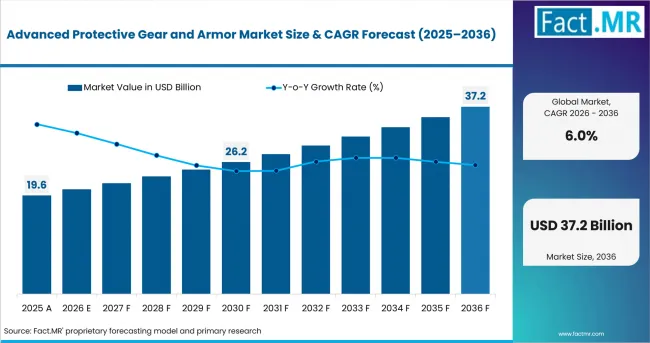
Advanced Protective Gear And Armor Market Value Analysis | Source: Fact.MR
| Metric | Value |
|---|---|
| Estimated Value in 2026 | USD 20.8 Billion |
| Forecast Value in 2036 | USD 37.2 Billion |
| Forecast CAGR (2026 to 2036) | 6.0% |
Source: Fact.MR analysis. Updated Jun 18, 2026
Summary of the Advanced Protective Gear and Armor Market
- Demand Drivers
- Defense modernization programs are increasing demand for advanced personal protection systems. Equipment replacement cycles support sourcing activity.
- Material innovation is improving mobility and comfort across protective equipment. Weight reduction supports adoption.
- Internal security spending is strengthening investment in ballistic and tactical protection solutions. Personnel safety requirements influence demand.
- Key Segments Analyzed
- By Application: Military and Defense contributes 42.0% share due to sustained protection equipment investment.
- By Material Type: Composite Materials account for 31.0% share in 2026 supported by lightweight protection performance.
- By Protection Level: Ballistic Protection generates 46.0% share due to extensive military and law enforcement deployment.
- By Product Type: Body Armor represents 38.0% share in 2026 supported by widespread operational utilization.
- By End User: Defense Forces contribute 44.0% share due to personnel protection modernization programs.
- By Geography: India is projected to register 7.1% CAGR through 2036 supported by domestic defense manufacturing initiatives.
- Analyst Opinion at Fact.MR
- Shambhu Nath Jha, Principal Consultant at Fact.MR, opines, "Protection system demand is increasingly linked to lightweight materials and operational mobility. Manufacturers that improve protection-to-weight ratios are positioned to strengthen commercial opportunities."
- Strategic Implications
- Manufacturers should prioritize lightweight armor materials. Mobility requirements influence purchasing decisions.
- Suppliers should expand participation in defense modernization programs. Government spending supports long-term opportunities.
- Protective equipment developers should focus on certification compliance and product durability. Operational performance influences contract awards.
The market is projected to create approximately USD 16.4 billion in additional revenue between 2026 and 2036. Expansion reflects rising defense modernization budgets and wider deployment of advanced personal protection systems. Material innovation is improving comfort and mobility. Product pricing remains influenced by certification requirements and specialized material costs.
India is projected to expand at 7.1% CAGR supported by soldier modernization programs and domestic defense manufacturing. China is expected to grow at 6.8% CAGR driven by military equipment upgrades. The United States is forecast to witness 5.9% CAGR due to ongoing defense sourcing activity. South Korea is anticipated to register 5.7% CAGR supported by tactical equipment investment. Israel is projected to grow at 5.5% CAGR due to demand for advanced armor technologies. Germany is estimated to expand at 5.2% CAGR driven by defense readiness initiatives and equipment replacement programs.
How does the advanced protective gear and armor market break down by segment?
Advanced Protective Gear and Armor Market Analysis by Application
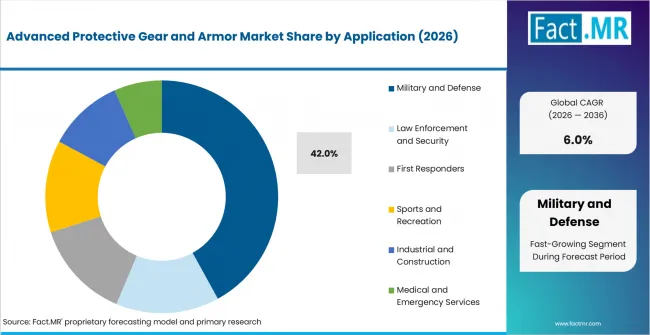
Advanced Protective Gear And Armor Market Analysis By Application | Source: Fact.MR
Military and Defense is estimated to account for 42.0% share in 2026. Defense ministries are increasing investment in soldier survivability programs and next-generation protection systems. Personnel protection remains a priority across modernization initiatives due to evolving battlefield threats. DuPont and Point Blank Enterprises partnered to introduce body armor powered by Kevlar® EXO™, a next-generation aramid fiber designed to provide enhanced ballistic protection while reducing weight and improving flexibility. The new armor platform was developed to meet evolving law-enforcement protection requirements and updated NIJ standards. [1]
- Force Modernization: Armed forces are replacing aging protection equipment with lighter systems. Mobility improvement supports sourcing activity.
- Operational Readiness: Military units require protection solutions suitable for extended deployment conditions. Equipment performance influences purchasing decisions.
- Threat Protection: Ballistic and fragmentation risks support demand for advanced armor technologies. Protection capability drives adoption.
Advanced Protective Gear and Armor Market Analysis by Material Type
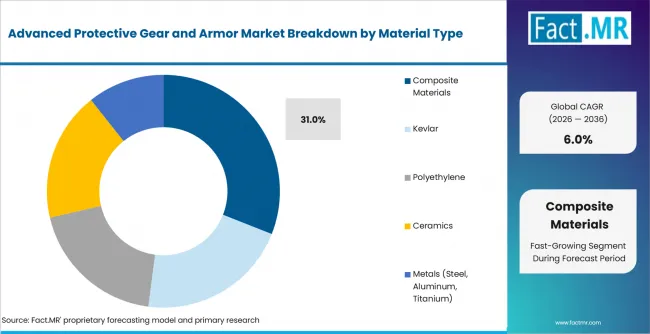
Advanced Protective Gear And Armor Market Analysis By Material Type | Source: Fact.MR
Composite Materials are estimated to hold 31.0% share in 2026. Manufacturers prefer composite structures because they reduce equipment weight while maintaining protection performance. Material innovation is improving user comfort and operational flexibility. Avon Protection launched the EXOSKIN-S1 CBRN protective suit, offering advanced protection against chemical, biological, radiological, and nuclear threats for military and first-responder personnel. The lightweight suit was engineered to improve operational mobility while maintaining high protection levels. [2]
- Weight Reduction: Composite structures lower overall equipment burden. Improved mobility supports utilization.
- Durability Benefits: Material performance supports long operational life. Service requirements decline across field environments.
- Design Flexibility: Manufacturers integrate composite materials into multiple protection products. Application diversity supports demand concentration.
Advanced Protective Gear and Armor Market Analysis by Protection Level
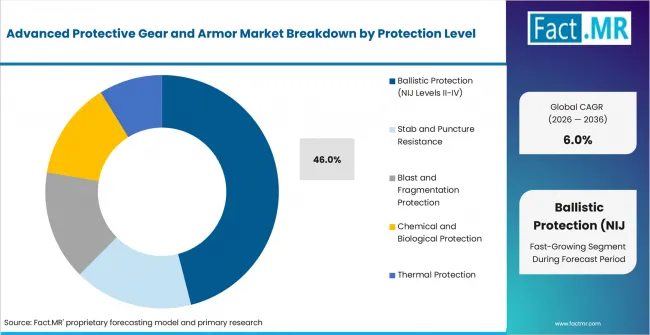
Advanced Protective Gear And Armor Market Analysis By Protection Level | Source: Fact.MR
Ballistic Protection is estimated to contribute 46.0% share in 2026. Military organizations and law enforcement agencies prioritize ballistic resistance across protection programs. Operational requirements sustain purchase of certified protection systems. Premier Graphene established a joint venture with Nevada Ballistic Armor to develop graphene-enhanced military body armor plates. The armor systems achieved NIJ certification and entered evaluation programs for military applications. [3]
- Security Demand: Ballistic threats influence equipment specifications. Protection standards shape purchasing activity.
- Certification Requirements: Agencies prioritize tested protection systems. Compliance supports product selection.
- Deployment Scale: Personnel protection programs create recurring replacement demand. Inventory renewal supports market expansion.
Advanced Protective Gear and Armor Market Analysis by Product Type
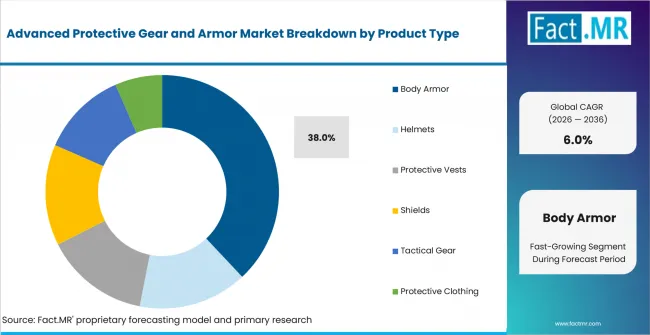
Advanced Protective Gear And Armor Market Analysis By Product Type | Source: Fact.MR
Body Armor capture 38.0% share in 2026. Defense organizations and security agencies deploy body armor across daily operations. Protection requirements support widespread utilization across multiple environments. DuPont expanded Kevlar® EXO™ technology into hard armor applications, including ballistic helmets and protective plate inserts. The development broadens the use of advanced aramid materials in next-generation personal protection systems. [4]
- Daily Utilization: Personnel use body armor across routine operational assignments. Deployment frequency supports demand.
- Upgrade Cycles: Agencies replace older systems with lighter alternatives. Modernization strengthens purchase activity.
- Protection Coverage: Body armor protects critical body areas. Operational effectiveness supports adoption.
Advanced Protective Gear and Armor Market Analysis by End User
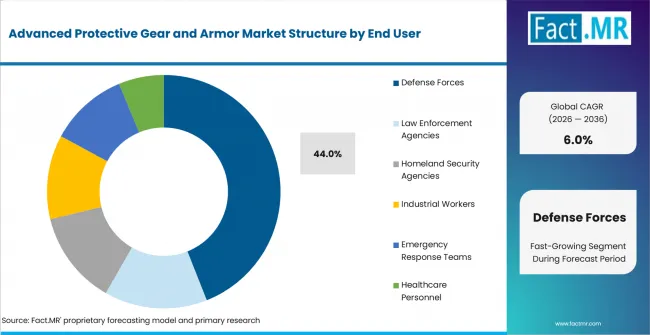
Advanced Protective Gear And Armor Market Analysis By End User | Source: Fact.MR
Defense Forces account for 44.0% share in 2026. Military organizations allocate substantial budgets toward personnel protection programs. Equipment modernization remains an important component of defense capability enhancement.
- Defense Spending: Military budgets support protective equipment purchases. Government funding influences demand.
- Personnel Safety: Armed forces prioritize survivability across operational environments. Protection requirements support investment.
- Inventory Replacement: Aging equipment creates replacement opportunities. Modernization cycles strengthen market demand.
What is accelerating advanced protective gear and armor adoption, and what is holding it back?
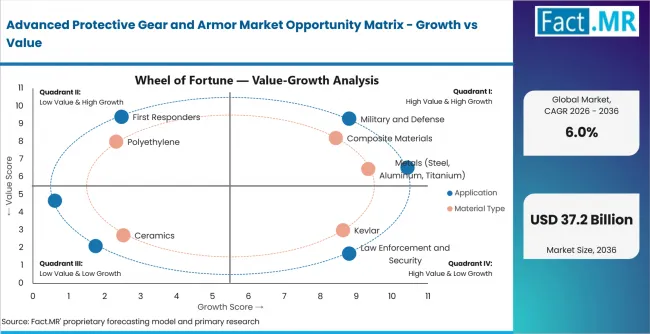
Advanced Protective Gear And Armor Market Opportunity Matrix Growth Vs Value | Source: Fact.MR
Advanced protective gear and armor market is transitioning from conventional protection equipment toward lightweight and multi-threat protection systems. Historical demand was concentrated in military sourcing programs. Current growth reflects wider adoption across law enforcement and emergency response applications. Safariland secured a position on the FBI’s Overt Armor Kit program, supplying SX HP ballistic panels under a contract worth up to $61 million. The lightweight armor solution was selected following extensive ballistic performance and user-evaluation testing. [5]
Material innovation is changing competitive positioning across the industry. Traditional heavy armor systems face replacement pressure from advanced composite and polyethylene solutions. Premium materials increase product pricing while improving mobility and operational comfort. This shift supports value growth beyond unit volume expansion.
- Defense Modernization Programs: Governments are increasing spending on soldier protection equipment and tactical readiness initiatives. Demand is driven by replacement of legacy protection systems and deployment of advanced armor technologies.
- Lightweight Material Innovation: Manufacturers are expanding use of composite structures and advanced fibers. Reduced weight improves operational mobility and supports equipment upgrades.
- Certification and Cost Pressure: Adoption is constrained by testing requirements and product qualification procedures. Advanced materials increase manufacturing costs and influence purchasing timelines.
Which countries are scaling advanced protective gear and armor demand fastest?
The advanced protective gear and armor market is assessed across North America, Europe, Asia Pacific, and the Middle East. The study evaluates defense spending trends, domestic manufacturing capability, security requirements, material innovation activity, and protection equipment modernization across major countries.
.webp "Top Country Growth Comparison Advanced Protective Gear And Armor Market Cagr (2026 2036)")
Top Country Growth Comparison Advanced Protective Gear And Armor Market Cagr (2026 2036) | Source: Fact.MR
| Country | CAGR |
|---|---|
| India | 7.1% |
| China | 6.8% |
| United States | 5.9% |
| South Korea | 5.7% |
| Israel | 5.5% |
| Germany | 5.2% |
Source: Fact.MR analysis. Updated Jun 18, 2026
Source: Fact.MR analysis based on defense expenditure trends, sourcing activity, and industry interviews.
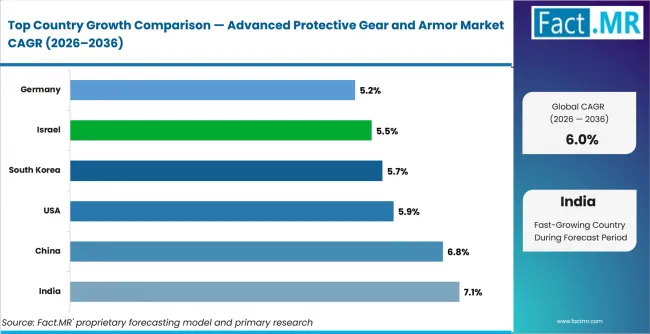
Advanced Protective Gear And Armor Market Cagr Analysis By Country | Source: Fact.MR
Sales Analysis of Advanced Protective Gear and Armor Market in India
India is projected to expand at 7.1% CAGR due to rising investment in soldier modernization programs and domestic defense production. The government continues to prioritize locally manufactured protection equipment under defense self-reliance initiatives. Military sourcing activity is creating demand for lightweight armor systems and advanced ballistic protection products. Equipment replacement cycles are increasing across multiple armed forces divisions. Growth is attributable to defense manufacturing expansion and personnel safety investment.
- Soldier modernization programs support advanced armor demand.
- Domestic defense manufacturing strengthens sourcing activity.
- Equipment replacement cycles create long-term opportunities.
Demand Outlook for Advanced Protective Gear and Armor Market in China
Supported by military capability enhancement programs, China is expected to witness 6.8% CAGR through 2036. Defense investment remains focused on improving personnel survivability and operational readiness. Domestic armor manufacturers are increasing production of advanced protection systems. Demand reflects modernization of military equipment inventories and expansion of tactical protection requirements.
- Military equipment upgrades support protection system demand.
- Domestic manufacturing capacity improves product availability.
- Personnel protection remains a focus of modernization initiatives.
Opportunity Analysis of Advanced Protective Gear and Armor Market in South Korea
South Korea is forecast to grow at 5.7% CAGR by 2036 as defense readiness programs increase demand for advanced protection equipment. Military organizations are investing in lightweight armor technologies suitable for extended operational deployment. Protection system modernization supports purchase activity across tactical units. Growth is supported by defense investment and equipment upgrade programs.
- Defense readiness initiatives support armor purchase.
- Lightweight protection systems improve operational mobility.
- Tactical modernization programs strengthen demand.
Demand Assessment of Advanced Protective Gear and Armor Market in United States
The United States is projected to expand at 5.9% CAGR supported by continuous investment in personnel protection equipment. Military agencies are replacing older armor systems with lighter and more advanced alternatives. Sourcing programs emphasize survivability and operational effectiveness across multiple environments. Growth reflects long-term defense spending and protection technology upgrades.
- Defense budgets support recurring equipment purchases.
- Armor modernization increases replacement activity.
- Material innovation improves protection performance.
In-depth Analysis of Advanced Protective Gear and Armor Market in Israel
Israel is projected to register 5.5% CAGR through 2036 supported by demand for advanced armor technologies and operational protection systems. Defense organizations prioritize lightweight solutions that improve mobility without reducing protection levels. Local expertise in protection technology supports equipment development and deployment. Growth reflects continuous investment in personnel survivability programs.
- Advanced armor development supports product innovation.
- Operational requirements drive protection equipment demand.
- Defense technology investment strengthens market growth.
Demand Outlook for Advanced Protective Gear and Armor Market in Germany
Germany reflects stable demand and is expected to expand at 5.2% CAGR by 2036. Defense readiness initiatives are increasing investment in personal protection equipment across military units. Equipment replacement programs support purchase of modern armor systems. Growth is attributable to military modernization spending and protection capability enhancement.
- Defense modernization supports equipment upgrades.
- Personnel safety requirements influence sourcing decisions.
- Replacement demand sustains market expansion.
Who leads the advanced protective gear and armor market landscape?
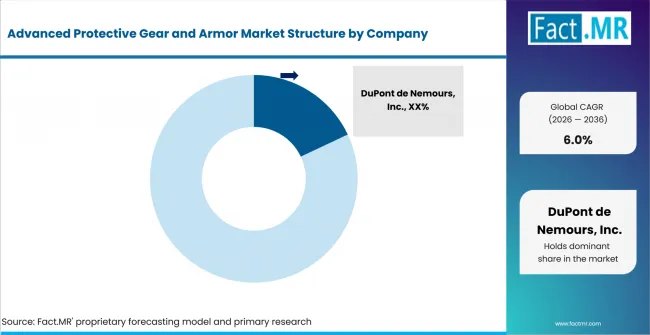
Advanced Protective Gear And Armor Market Analysis By Company | Source: Fact.MR
The advanced protective gear and armor market reflects competition among defense equipment manufacturers and protection material suppliers. Product certification influences purchasing decisions across military and security organizations. Companies with established defense relationships maintain stronger commercial positioning across government contracts and long-cycle purchase programs.
Manufacturers with advanced material expertise benefit from stronger participation in modernization programs. Lightweight protection capability influences equipment selection across armed forces and law enforcement agencies. Product testing performance remains an important differentiator across protection equipment tenders.
Military organizations evaluate suppliers based on protection performance and operational durability. Equipment standardization influences replacement purchasing activity. Long-term supply agreements strengthen supplier positioning across national defense programs. Technical support capability influences contract renewal decisions and fleet-wide deployment activity.
Commercial success is increasingly linked to protection-to-weight performance and multi-threat resistance capability. Demand is shifting toward suppliers that improve mobility without reducing protection levels. Material innovation and certification depth remain important competitive differentiators across defense and security markets.
Which companies are the key players?
- DuPont de Nemours, Inc.
- Safariland, LLC
- Ballistic Body Armor Pty Ltd.
- Avon Protection plc
Bibliography
- [1] DuPont de Nemours, Inc. (2024, January 22). DuPont and Point Blank Enterprises announce exclusive partnership for DuPont Kevlar EXO. DuPont de Nemours, Inc.
- [2] Avon Protection plc. (2024, February 26). Avon Protection launches new EXOSKIN-S1 CBRN protective suit. Avon Protection plc.
- [3] Premier Graphene Inc. (2025, June 17). Premier Graphene announces new strategic joint venture in unique, proprietary body armor protection. Premier Graphene Inc.
- [4] DuPont de Nemours, Inc. (2025, December 5). Kevlar EXO expands protection capabilities with hard armor applications. DuPont de Nemours, Inc.
- [5] Cadre Holdings, Inc. (2026, June 2). Cadre Holdings subsidiary Safariland selected as ballistic provider for FBI armor contract. Cadre Holdings, Inc.
This Report Addresses
- Analysis of advanced protective gear and armor demand across military and security applications.
- Market forecast from USD 20.8 Billion in 2026 to USD 37.2 Billion by 2036 at 6.0% CAGR.
- Opportunity assessment across ballistic protection and lightweight armor technologies.
- Segment forecasts covering application, material type, protection level, product type, and end user demand.
- Competitive assessment of protection equipment manufacturers and material suppliers.
- Evaluation of defense modernization and personnel safety investment trends.
- Country-level analysis across India, China, United States, South Korea, Israel, and Germany.
- Report delivery through PDF and Excel formats supported by primary interviews and industry analysis.
What does the advanced protective gear and armor market cover?
Advanced protective gear and armor includes personal protection systems designed to reduce injury from ballistic threats, fragmentation, stabbing attacks, blunt force impacts, thermal exposure, and hazardous environments. Products include body armor, helmets, protective clothing, shields, and tactical equipment used by military personnel, law enforcement agencies, emergency response teams, and industrial workers. Modern systems utilize advanced materials such as composite structures, ceramics, polyethylene, and aramid fibers to improve protection while reducing weight. Market demand is linked to personnel safety requirements and modernization of personal protective equipment inventories.
Advanced Protective Gear and Armor Market Inclusions
The study covers global and regional forecasts from 2026 to 2036 by application, material type, protection level, product type, and end user. It includes military protection systems, law enforcement equipment, industrial safety armor, personal ballistic protection products, material innovation trends, and demand assessment across major countries.
Advanced Protective Gear and Armor Market Exclusions
The study excludes standard industrial safety product without advanced protection capability. It omits ordinary workwear, consumer sporting accessories, and non-certified protective products. Revenue associated with armored vehicles, armored platforms, and weapon systems is excluded from market calculations.
Advanced Protective Gear and Armor Market Research Methodology
- Primary Research
- Interviews were conducted with defense equipment suppliers, military purchase specialists, law enforcement officials, protective material manufacturers, and safety equipment consultants.
- Desk Research
- Analysis included defense budget releases, company disclosures, military modernization updates, public sourcing announcements, and protective equipment developments published during 2024 and 2025.
- Market-Sizing and Forecasting
- Hybrid top-down and bottom-up model using defense expenditure trends, equipment replacement cycles, purchase activity, and material demand analysis.
- Data Validation and Update Cycle
- Forecast was validated through manufacturer interviews, defense purchase disclosures, material supplier assessments, and industry benchmarking exercises.
Segmentation
What is the report’s scope and coverage?
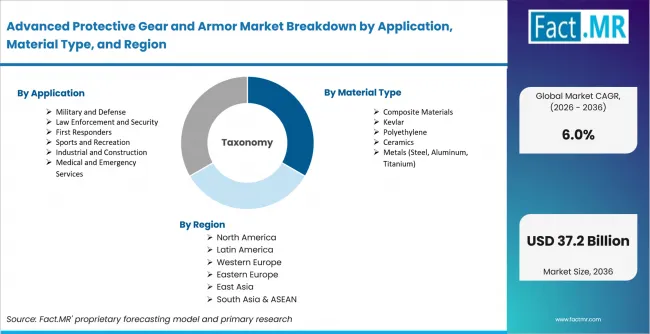
Advanced Protective Gear And Armor Market Breakdown By Application, Material Type, And Region | Source: Fact.MR
| Attribute | Details |
|---|---|
| Quantitative Units | USD 20.8 Billion (2026) to USD 37.2 Billion (2036) at a CAGR of 6.0% |
| Market Definition | Cover advanced protection equipment used against ballistic, blast, stab, thermal, and hazardous threats. |
| Application Segmentation | Military and Defense, Law Enforcement and Security, First Responders, Sports and Recreation, Industrial and Construction, Medical and Emergency Services |
| Material Type Segmentation | Kevlar, Polyethylene, Ceramics, Metals, Composite Materials |
| Protection Level Segmentation | Ballistic Protection, Stab and Puncture Resistance, Blast and Fragmentation Protection, Chemical and Biological Protection, Thermal Protection |
| Product Type Segmentation | Body Armor, Helmets, Protective Vests, Shields, Tactical Gear, Protective Clothing |
| End User Segmentation | Defense Forces, Law Enforcement Agencies, Homeland Security Agencies, Industrial Workers, Emergency Response Teams, Healthcare Personnel |
| Regions Covered | North America, Europe, Asia Pacific, Middle East |
| Countries Covered | India, China, United States, South Korea, Israel, Germany |
| Key Companies Profiled | DuPont de Nemours, Inc., Safariland, LLC, Ballistic Body Armor Pty Ltd., Avon Protection plc |
| Forecast Period | 2026 to 2036 |
| Approach | Hybrid top-down and bottom-up model using defense spending and protection equipment demand analysis. |
Source: Fact.MR analysis. Updated Jun 18, 2026
How is the market segmented?
-
By Application
- Military and Defense
- Law Enforcement and Security
- First Responders
- Sports and Recreation
- Industrial and Construction
- Medical and Emergency Services
-
By Material Type
- Kevlar
- Polyethylene
- Ceramics
- Metals (Steel, Aluminum, Titanium)
- Composite Materials
-
By Protection Level
- Ballistic Protection (NIJ Levels II-IV)
- Stab and Puncture Resistance
- Blast and Fragmentation Protection
- Chemical and Biological Protection
- Thermal Protection
-
By Product Type
- Body Armor
- Helmets
- Protective Vests
- Shields
- Tactical Gear
- Protective Clothing
-
By End User
- Defense Forces
- Law Enforcement Agencies
- Homeland Security Agencies
- Industrial Workers
- Emergency Response Teams
- Healthcare Personnel
-
By Region
- North America
- United States
- Canada
- Mexico
- Latin America
- Brazil
- Argentina
- Rest of Latin America
- Europe
- Germany
- United Kingdom
- France
- Italy
- Spain
- Rest of Europe
- Asia Pacific
- China
- India
- Japan
- South Korea
- ASEAN
- Middle East & Africa
- GCC Countries
- South Africa
- UAE
- Rest of Middle East & Africa
- North America
Frequently Asked Questions
How large is the global advanced protective gear and armor market in 2025?
What will the advanced protective gear and armor market size be in 2026?
What is the projected advanced protective gear and armor market size by 2036?
What is the expected CAGR for the advanced protective gear and armor market from 2026 to 2036?
Which application segment contributes prominent demand in 2026?
Which country records stronger growth through 2036?
Who worked on this report


Preview the report firsthand - request a free sample
Free SampleGet the brochure for pricing and purchase details
Download PDF