- Market Value (2025): USD 533.3 Mn
- Estimated Value (2026): USD 650.0 Mn
- Forecast Value (2036): USD 4700 Mn
- CAGR (2026-2036): 21.9%
What is the AI talent scouting platforms market forecast to be worth by 2036?
USD 650.0 million in 2026 to USD 4,700 million by 2036, at 21.9% CAGR.
- The AI talent scouting platforms market crossed a valuation of USD 533.3 million in 2025.
- The sector is expected to increase from USD 650.0 million in 2026 to USD 4,700 million by 2036.
- The market is forecast to record 21.9% CAGR during 2026 to 2036 as clubs use AI, video analytics and player databases to identify talent earlier.
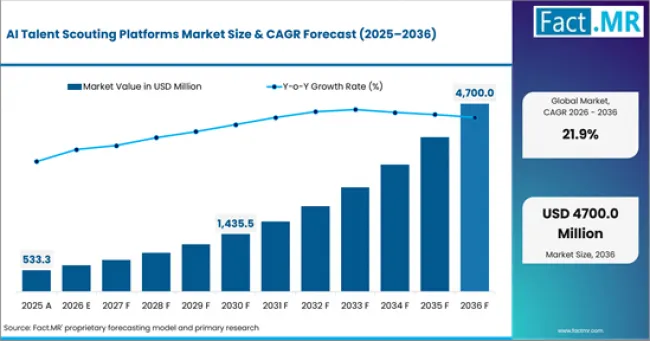
Ai Talent Scouting Platforms Market Market Value Analysis | Source: Fact.MR
What are the defining numbers behind AI talent scouting platforms growth?
USD 4.1 billion absolute opportunity by 2036, led by the United States and the United Kingdom.
- Demand Drivers in the Market
- Key Segments Analyzed
- By Platform Type: AI Video Scouting and Trial Platforms are expected to hold 37.0% share in 2026 because mobile video creates the first screening layer.
- By Sport Type: Football/Soccer leads because clubs already use data and video in recruitment. The sport is projected to capture 49.0% share in 2026.
- By Customer Type: Professional Clubs and Academies lead because they control recruitment budgets and player pathways. This group is likely to account for 42.0% share in 2026.
- By Delivery Model: SaaS Recruitment Subscriptions lead as clubs need databases and shortlist tools throughout the season. The model is projected to hold 40.0% share in 2026.
- By End Use: Player Identification and Recruitment Shortlisting is expected to hold 44.0% share in 2026 because early-stage screening is the main paid use case.
- By Geography: The United States is projected to record 26.2% CAGR through 2036 as college recruiting and academy programs adopt AI screening.
- Analyst Opinion at Fact.MR
- Shambhu Nath Jha, Senior Analyst at Fact.MR, states, “AI talent scouting platforms are changing how clubs find athletes before a live trial. We see recruitment teams asking for wider reach and better evidence at the first screening stage. Providers that combine verified video, player data and simple scout workflows will gain stronger access to academy budgets.”
- Strategic Implications
- Clubs should define how AI scores support human scout review.
- Academies need clear data consent before evaluating minors.
- Platforms should reduce false positives through verified testing protocols.
- Federations can use mobile trials to widen rural and regional discovery.
AI talent scouting platforms use computer vision, mobile trials, performance data and predictive scoring to evaluate athletes. ai.io / aiScout states that aiScout offers a data-driven approach to talent analysis and development from a mobile phone. [1] This connects with sports analytics as clubs move scouting decisions from subjective reports toward measurable player evidence.
The category also benefits from video-led player evaluation. Mobile drills and match clips can be processed through 3D machine vision methods to assess movement quality, technical execution and physical output. Clubs can widen scouting reach without sending staff to every grassroots event.
The market is expanding as recruitment workflows become more digital. Platforms that combine player data, video libraries and shortlist tools reduce early-stage screening effort. This creates a stronger role for edge analytics when clubs need faster analysis from phones, cameras and local training environments.
The United States is projected to record 26.2% CAGR through 2036 as college recruiting, MLS academies and athlete showcase platforms adopt AI screening. The United Kingdom is set to record 24.5% CAGR over the study period. Spain is likely to record 23.4% CAGR as clubs expand data-led football recruitment. France is forecast to advance at 22.7% CAGR as tracking-data providers and football academies deepen player intelligence use. India is set to record 22.1% CAGR as smartphone-first sports participation creates a wider digital scouting base.
How does the AI talent scouting platforms market break down by segment?
AI Video Scouting and Trial Platforms lead at 37.0%; Football/Soccer leads at 49.0%.
Which platform type dominates?
AI Video Scouting and Trial Platforms hold 37.0% share in 2026.
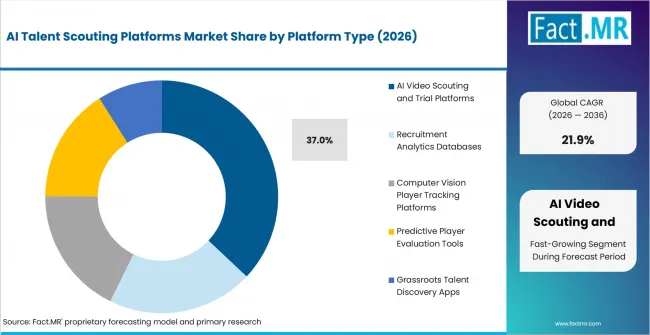
Ai Talent Scouting Platforms Market Analysis By Platform Type | Source: Fact.MR
AI Video Scouting and Trial Platforms are expected to hold 37.0% share in 2026 because mobile video creates the first screening layer. Loughborough University states that aiScout lets aspiring players record football drills on a mobile phone, with AI analysing footage against hundreds of performance metrics. [2] The platform type leads because clubs can review more players before allocating live scout time.
Which sport type dominates?
Football/Soccer capture 49.0% share because clubs already use data and video in recruitment.
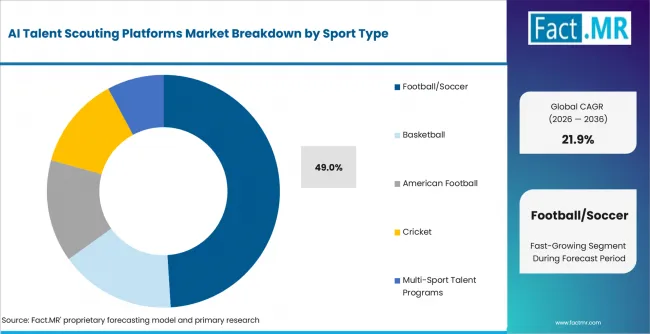
Ai Talent Scouting Platforms Market Analysis By Sport Type | Source: Fact.MR
Football/Soccer holds 49.0% share in 2026 because player recruitment is global and academy pipelines are competitive. Clubs need evidence from match video, physical profiles and technical data. The sport is projected to capture 49.0% share in 2026. Football adoption also connects with sports equipment because player testing often uses connected training tools during trials.
Which customer type dominates?
Professional Clubs and Academies account for 42.0% share in 2026 because they control recruitment budgets.
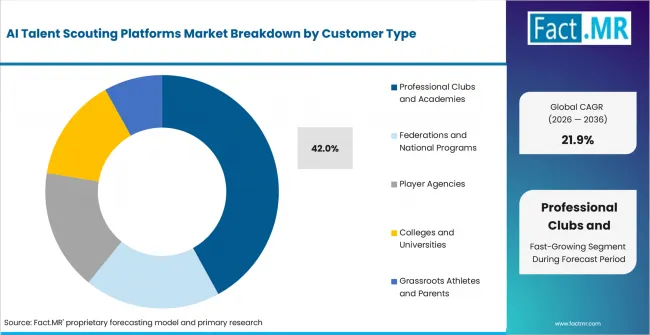
Ai Talent Scouting Platforms Market Analysis By Customer Type | Source: Fact.MR
Professional Clubs and Academies lead because they manage player pathways from youth teams to senior squads. These organizations need earlier talent signals and better shortlist quality. This customer group is likely to account for 42.0% share in 2026. Hudl Wyscout says it collects data and video from more than 1,000 competitions worldwide and allows users to flag potential targets before sending scouts. [3]
Which delivery model dominates?
SaaS Recruitment Subscriptions hold 40.0% share in 2026 because scouting is a year-round workflow.
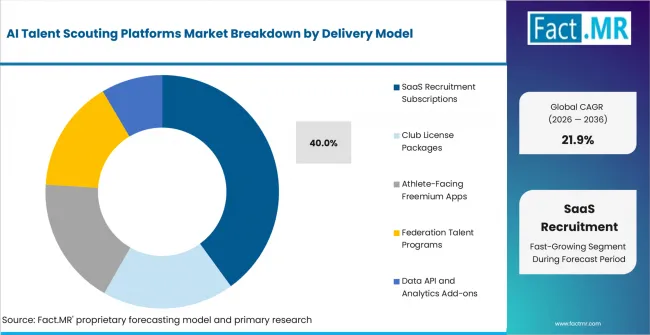
Ai Talent Scouting Platforms Market Analysis By Delivery Model | Source: Fact.MR
SaaS Recruitment Subscriptions lead because clubs need ongoing database access and shortlist tools. These subscriptions help recruitment teams compare players across leagues and age groups. The model is projected to hold 40.0% share in 2026. This delivery model also fits home fitness app behavior because mobile-first users already accept app-led performance feedback.
Which end use dominates?
Player Identification and Recruitment Shortlisting holds 44.0% share in 2026.
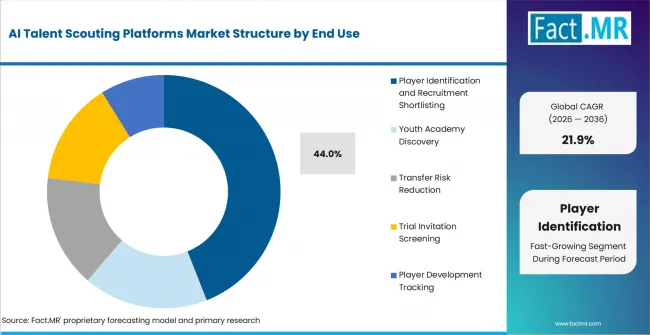
Ai Talent Scouting Platforms Market Analysis By End Use | Source: Fact.MR
Player Identification and Recruitment Shortlisting leads because early screening creates the clearest time saving. The end use is expected to hold 44.0% share in 2026. SkillCorner’s 2025 update highlights Data On Demand, tracking data beyond broadcast matches and R&D around ball tracking, body pose detection and auto event detection. [4] This use case also connects with smart fitness as athletes become more comfortable with app-based performance measurement.
What is accelerating AI talent scouting platform adoption, and what is holding it back?
Mobile video trials, recruitment analytics and youth database growth drive adoption; bias and data consent restrain use.
Mobile video trials are the main driver. Players can submit structured drills from a phone, which lets clubs screen wider talent pools. This is valuable where scouting coverage is limited.
Recruitment analytics adds a second driver. TransferLab states that its platform applies predictive metrics across over 100,000 players and launched TransferLab Emerge in 2025 with 33 new youth leagues, 568 youth teams and about 15,000 new players. [5] This supports data-led discovery at senior and academy levels.
Youth database growth also supports adoption. Clubs want to identify players earlier before transfer prices rise. Platforms that combine age curves, similarity search and verified video can improve shortlist quality.
The main restraint is trust. AI scores can reflect data gaps, camera quality and sample bias. Platforms must explain scoring logic and protect youth athlete data before federations and schools expand adoption.
Where do the biggest AI talent scouting platform opportunities sit?
Grassroots mobile trials, youth academy databases and predictive recruitment analytics.
- Grassroots Mobile Trials: Players can submit drills from a phone without traveling to a scout day.
- Youth Academy Databases: Clubs can monitor players earlier and compare age-group performance.
- Predictive Recruitment Analytics: Teams can identify undervalued players before transfer costs rise.
Which countries are scaling AI talent scouting platforms fastest?
United States 26.2%, United Kingdom 24.5%, Spain 23.4%, France 22.7%, India 22.1%.
Based on regional analysis, the AI talent scouting platforms market is segmented into North America, Western Europe, Asia Pacific, South Asia, Latin America, and Middle East and Africa.
| Country | CAGR |
|---|---|
| United States | 26.2% |
| United Kingdom | 24.5% |
| Spain | 23.4% |
| France | 22.7% |
| India | 22.1% |
Source: Fact.MR analysis. Updated Jun 23, 2026
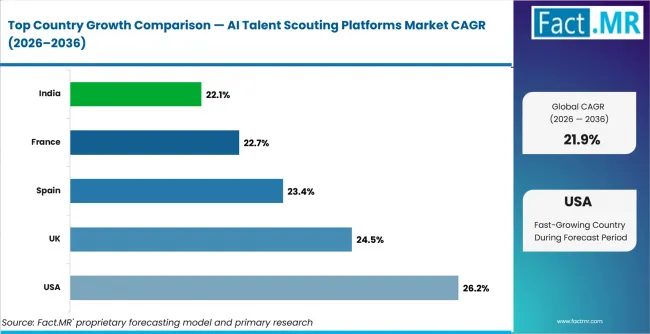
Ai Talent Scouting Platforms Market Cagr Analysis By Country | Source: Fact.MR
What is powering the United States’ lead?
26.2% CAGR, driven by Hudl and MLS academy-linked digital recruiting.
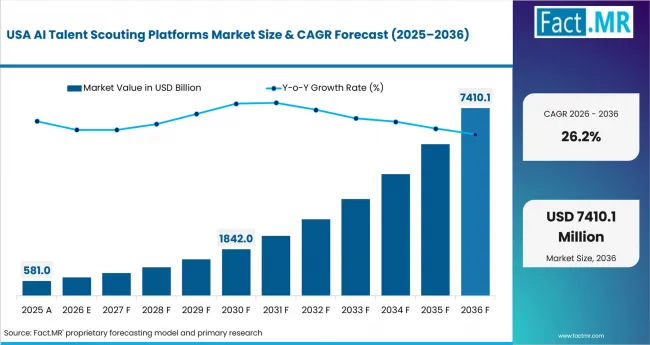
Ai Talent Scouting Platforms Market Country Value Analysis | Source: Fact.MR
The United States at a 26.2% CAGR through 2036 on college recruiting, MLS academy development and athlete showcase culture. Hudl’s video and data tools are strengthening recruitment workflows across clubs and school programs. A large base of youth athletes and scholarship-driven sport pathways is speeding up adoption of AI-backed screening tools.
How is the United Kingdom scaling AI talent scouting platform adoption?
24.5% CAGR, driven by ai.io / aiScout and Loughborough University’s computer vision support.
The United Kingdom is scaling through academy recruitment and mobile-first football trials. ai.io / aiScout and Loughborough University are supporting stronger AI evaluation of player drills from phone footage. The country is expected to post 24.5% CAGR through 2036 as clubs use digital platforms to widen access beyond traditional scout networks.
What is powering Spain’s growth?
23.4% CAGR, driven by Driblab and data-led football recruitment across club academies.
Spain is projected to grow at 23.4% CAGR through 2036 on strong football academy systems and wider use of analytics in player evaluation. Driblab is strengthening recruitment decisions through player analytics and talent evaluation support. Spanish clubs are using data-led shortlists to identify younger players before transfer value rises.
What supports France’s outlook?
22.7% CAGR, driven by SkillCorner and broadcast-video player intelligence.
France is gaining from football analytics providers and strong academy production. SkillCorner is supporting recruitment teams through automated tracking data and player intelligence from video sources. The country is forecast to advance at 22.7% CAGR through 2036 as clubs use data to compare players across domestic and international leagues.
How is India scaling AI talent scouting platforms?
22.1% CAGR, driven by AIFF pathways and smartphone-first grassroots discovery.
India is set to record 22.1% CAGR through 2036 as football and multi-sport programs seek wider reach across cities and smaller towns. AIFF-led talent identification efforts create a pathway for more structured scouting. Affordable smartphones and video-based trials are speeding up access for athletes who cannot attend frequent physical scout events.
Who leads the AI talent scouting platforms landscape?
ai.io / aiScout, Hudl Wyscout and SkillCorner lead through mobile AI trials, global football data and automated tracking intelligence.
AI talent scouting platforms are used by clubs, academies, federations and player agencies that need wider discovery reach. ai.io / aiScout provides aiScout for mobile-phone talent analysis. Hudl Wyscout gives clubs access to video and data for player evaluation. SkillCorner provides automated tracking and performance analytics for recruitment teams.
TransferLab supports predictive recruitment metrics and academy-level player discovery. Driblab states that its work focuses on advising and minimizing risk in professional football decision-making in talent detection and footballer evaluations. [6] Comparisonator, Bepro and Eyeball add further competition through football recruitment analytics, video review and player visibility tools.
Providers that combine verified video with simple shortlist workflows will be better placed. Data platforms can win professional clubs. Mobile trial apps can win grassroots athlete discovery. Computer vision providers can win academies that need scalable player assessment.
Which companies are the key players?
ai.io / aiScout, Hudl Wyscout, SkillCorner, TransferLab, Driblab and Comparisonator.
- ai.io / aiScout
- Hudl Wyscout
- SkillCorner
- TransferLab
- Driblab
- Comparisonator
Bibliography
- [1] ai.io. (n.d.). aiScout.
- [2] Loughborough University. (2025, October 16). Loughborough University and ai.io join forces to transform sports talent discovery.
- [3] Hudl. (n.d.). Football data analytics software: Hudl Wyscout.
- [4] Amorim, E. (2025, February 25). 2025 business update. SkillCorner.
- [5] Analytics FC. (n.d.). TransferLab.
- [6] Arroyo, A. (2021, October 25). Driblab, speaker at RFEF’s Advanced University Master on tactical analysis and scouting. Driblab.
This Report Addresses
- Strategic intelligence on AI talent scouting platforms across platform type, sport type and customer type.
- Segment analysis covering AI Video Scouting and Trial Platforms, Football/Soccer, Professional Clubs and Academies, SaaS Recruitment Subscriptions and Player Identification.
- Regional outlook covering the United States, United Kingdom, Spain, France and India.
- Competitive analysis of ai.io / aiScout, Hudl Wyscout, SkillCorner, TransferLab, Driblab and Comparisonator.
- Platform assessment covering mobile AI trials, recruitment analytics databases, computer vision tracking and predictive player scoring.
- Sport-type assessment covering football, basketball, American football, cricket and multi-sport programs.
- Primary interviews, provider checks, official source review and AI scouting validation support the forecast.
What does the AI talent scouting platforms market cover?
AI-enabled platforms that help clubs discover and shortlist athletes.
The AI talent scouting platforms market covers software, mobile apps and data systems used to identify athletes at professional, academy and grassroots levels. It includes video scouting, player databases, predictive ratings, movement analysis and recruitment dashboards. The category connects with smart sports equipment because scouting platforms increasingly use connected cameras and training devices.
The market differs from traditional scouting because platforms automate early screening. It also aligns with AI research services as clubs use machine learning methods to compare players across large datasets.
What is included in the scope?
AI video trials and club recruitment dashboards.
The scope includes mobile trial apps, computer vision player tracking and data-backed recruitment platforms. It covers club dashboards, scout reports, shortlist tools and player profile scoring. It includes systems connected to wireless health and fitness devices when athlete testing data supports scouting.
The scope also includes athlete-facing discovery apps and federation talent programs. It covers platforms that use wearable AI style interpretation when body-worn or video-based signals feed player assessment.
What is excluded from the scope?
Traditional scouting services with no AI or digital player assessment.
The scope excludes manual scout networks without analytics software. It excludes standard video libraries unless scouting, ranking or recruitment workflow tools are included. It excludes athlete social networks with no verified performance evaluation. It also excludes general HR recruitment software used outside sports.
How was the analysis built?
100+ sources, 40+ company portfolios, 25+ countries, 20+ interviews.
- Primary Research:
- Primary research includes interviews with club recruitment staff and academy directors. It includes input from data analysts and football technology providers.
- Desk Research:
- Desk research reviews official product pages and platform updates. It covers mobile trial apps, recruitment analytics and AI video scouting systems.
- Market-Sizing and Forecasting:
- Forecasting uses club counts, academy adoption and player database coverage. Subscription pricing and recruitment workflow use support the market assessment.
- Data Validation and Update Cycle:
- Forecasts are validated through provider checks and scouting workflow review. Product launches and club partnerships help confirm market direction.
Segmentation
What is the report’s scope and coverage?
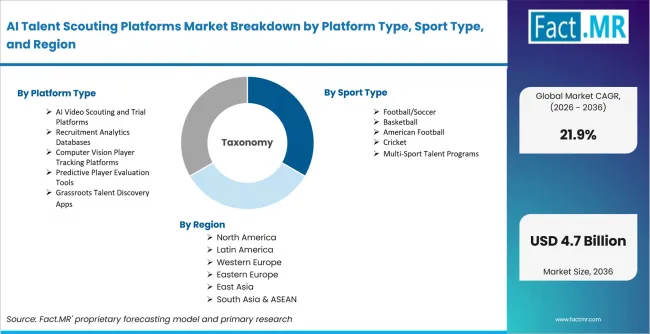
Ai Talent Scouting Platforms Market Breakdown By Platform Type, Sport Type, And Region | Source: Fact.MR
| Attribute | Details |
|---|---|
| Quantitative Units | USD Million in 2026 to USD Million by 2036 at CAGR |
| Market Definition | AI-enabled platforms that discover, evaluate and shortlist athletes through video, data and predictive scoring |
| Platform Type | AI Video Scouting and Trial Platforms, Recruitment Analytics Databases, Computer Vision Player Tracking Platforms, Predictive Player Evaluation Tools, Grassroots Talent Discovery Apps |
| Sport Type | Football/Soccer, Basketball, American Football, Cricket, Multi-Sport Talent Programs |
| Customer Type | Professional Clubs and Academies, Federations and National Programs, Player Agencies, Colleges and Universities, Grassroots Athletes and Parents |
| Delivery Model | SaaS Recruitment Subscriptions, Club License Packages, Athlete-Facing Freemium Apps, Federation Talent Programs, Data API and Analytics Add-ons |
| End Use | Player Identification and Recruitment Shortlisting, Youth Academy Discovery, Transfer Risk Reduction, Trial Invitation Screening, Player Development Tracking |
| Regions Covered | North America, Western Europe, Asia Pacific, South Asia, Latin America, Middle East and Africa |
| Countries Covered | United States, United Kingdom, Spain, France, India |
| Key Companies Profiled | ai.io / aiScout, Hudl Wyscout, SkillCorner, TransferLab, Driblab and Comparisonator |
| Forecast Period | 2026 to 2036 |
| Approach | Hybrid top-down and bottom-up approach using club counts, academy adoption, athlete app usage, subscription pricing and provider validation |
Source: Fact.MR analysis. Updated Jun 23, 2026
How is the market segmented?
-
By Platform Type:
- AI Video Scouting and Trial Platforms
- Recruitment Analytics Databases
- Computer Vision Player Tracking Platforms
- Predictive Player Evaluation Tools
- Grassroots Talent Discovery Apps
-
By Sport Type:
- Football/Soccer
- Basketball
- American Football
- Cricket
- Multi-Sport Talent Programs
-
By Customer Type:
- Professional Clubs and Academies
- Federations and National Programs
- Player Agencies
- Colleges and Universities
- Grassroots Athletes and Parents
-
By Delivery Model:
- SaaS Recruitment Subscriptions
- Club License Packages
- Athlete-Facing Freemium Apps
- Federation Talent Programs
- Data API and Analytics Add-ons
-
By End Use:
- Player Identification and Recruitment Shortlisting
- Youth Academy Discovery
- Transfer Risk Reduction
- Trial Invitation Screening
- Player Development Tracking
-
By Region:
- North America
- United States
- Canada
- Europe
- United Kingdom
- Spain
- France
- Germany
- Italy
- Asia Pacific
- Japan
- South Korea
- Australia
- China
- South Asia
- India
- Latin America
- Brazil
- Mexico
- Argentina
- Chile
- Middle East & Africa
- GCC Countries
- South Africa
- Nigeria
- Morocco
- North America
Frequently Asked Questions
Which platform type leads the AI Talent Scouting Platforms Market?
Which country expands faster in the AI Talent Scouting Platforms Market?
How does the United Kingdom perform in the AI Talent Scouting Platforms Market?
How does Spain perform in the AI Talent Scouting Platforms Market?
How does France perform in the AI Talent Scouting Platforms Market?
How does India perform in the AI Talent Scouting Platforms Market?
What is the primary driver in the AI Talent Scouting Platforms Market?
What is the main restraint in the AI Talent Scouting Platforms Market?
Why is football important in this market?
Who worked on this report


Preview the report firsthand - request a free sample
Free SampleGet the brochure for pricing and purchase details
Download PDF