- Market Value (2025): USD 68.5 Bn
- Estimated Value (2026): USD 75.1 Bn
- Forecast Value (2036): USD 189.5 Bn
- CAGR (2026-2036): 9.7%
What is the Omics Lab Services Market forecast to be worth by 2036?
USD 75.1 billion in 2026 to USD 189.5 billion by 2036, at a 9.7% CAGR.
Data interpretation should be read with Fact.MR's Bioinformatics Service Market, because omics labs need analysis capacity after sequencing or assay work.
- The omics lab services market reached USD 68.5 billion in 2025 as pharma R&D teams and translational research groups spent against a clear use case: outsourced genomics, proteomics, transcriptomics and metabolomics testing that supports discovery, biomarker validation and clinical research decisions.
- Demand is projected to increase from USD 75.1 billion in 2026 to USD 189.5 billion by 2036, at a 9.7% CAGR.
- The market is forecast to record 9.7% CAGR from 2026 to 2036 as companies prove outsourced genomics and clinical research decisions.
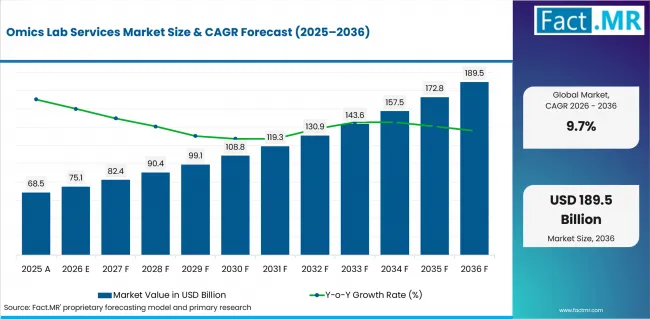
Omics Lab Services Market Value Analysis | Source: Fact.MR
What are the defining numbers behind Omics Lab Services Market growth?
USD 114.4 billion absolute opportunity is expected by 2036.
Clinical validation demand connects with Fact.MR's Omics Based Clinical Trials Market, where sponsors use multi-omics evidence to segment patients.
- Demand Drivers in the Market
- Genomics services lead as sequencing and variant analysis are now core tools in drug discovery, translational research and precision medicine programs.
- Drug discovery and development leads application demand because pharma and biotech buyers use omics data to identify targets, stratify patients, study mechanisms and de-risk pipelines.
- Pharmaceutical and biotechnology companies lead as they have recurring project volume, regulated documentation needs and budget to outsource specialized assays.
- Direct service contracts lead as scope, sample handling, data format, QA requirements and intellectual-property treatment must be agreed before work begins.
- Key Segments Analyzed
- By Service Type: Genomics Services is projected to hold 38.4% share in 2026. Genomics services lead as DNA and RNA sequencing workflows are central to target discovery, biomarker work and clinical research support.
- By End User: Pharmaceutical & Biotechnology Companies is projected to hold 30.5% share in 2026. Pharmaceutical and biotechnology companies lead as their project pipelines generate repeat outsourced demand across discovery and development stages.
- By Distribution Channel: Direct Service Contracts is projected to hold 30.6% share in 2026. Direct service contracts lead as each study requires defined sample logistics, assay scope, data deliverables and quality expectations.
- By Technology: Next-Generation Sequencing (NGS) is projected to hold 42.1% share in 2026. Next-Generation Sequencing leads because it supports high-throughput analysis across genomes, exomes, transcriptomes and targeted panels.
- Analyst Opinion at Fact.MR
- Shambhu Nath Jha, Sr. Consultant at Fact.MR, opines, "Omics lab services are valuable when they turn biological complexity into dependable project evidence. The strongest providers combine clean lab execution with interpretable data and study-level accountability."
- Strategic Implications
- Service providers should package assay design, QC metrics, turnaround time and bioinformatics deliverables together.
- Pharma buyers should qualify partners by sample handling, platform validation, data security and repeat-study consistency.
- Labs should build depth in a few high-value workflows rather than sell every omics label with shallow capability.
USA continues to be a leading market and is projected to grow at a CAGR of 12.59%; other key markets include USA, Canada, UK, Germany.
How does the Omics Lab Services Market break down by segment?
Genomics Services leads Service Type at 38.4%.
Assay readiness links to Fact.MR's Molecular Biology Enzymes, Reagents and Kits Market, since service labs depend on reliable consumables for repeatable results.
Why does Genomics Services lead Service Type?
Genomics Services is projected to account for 38.4% share in 2026.
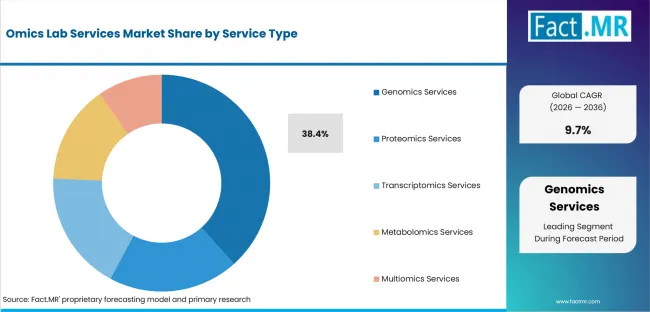
Omics Lab Services Market Analysis By Service Type | Source: Fact.MR
Genomics services lead as DNA and RNA sequencing workflows are central to target discovery, biomarker work and clinical research support.
Why does Drug Discovery & Development lead Application?
Drug Discovery & Development is projected to account for 32.4% share in 2026.
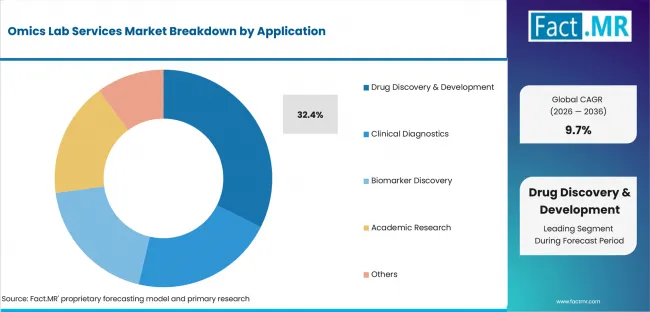
Omics Lab Services Market Analysis By Application | Source: Fact.MR
Drug discovery and development leads because omics labs help sponsors connect genomic, proteomic and metabolomic signals with target selection, biomarker work and candidate screening.
Why does Pharmaceutical & Biotechnology Companies lead End User?
Pharmaceutical & Biotechnology Companies is projected to account for 30.5% share in 2026.
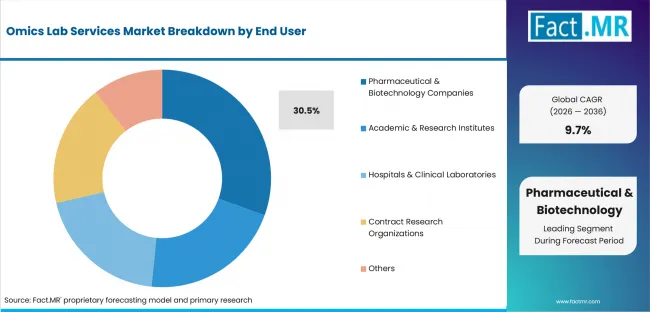
Omics Lab Services Market Analysis By End User | Source: Fact.MR
Pharmaceutical and biotechnology companies lead as their project pipelines generate repeat outsourced demand across discovery and development stages.
Why does Direct Service Contracts lead Distribution Channel?
Direct Service Contracts is projected to account for 30.6% share in 2026.
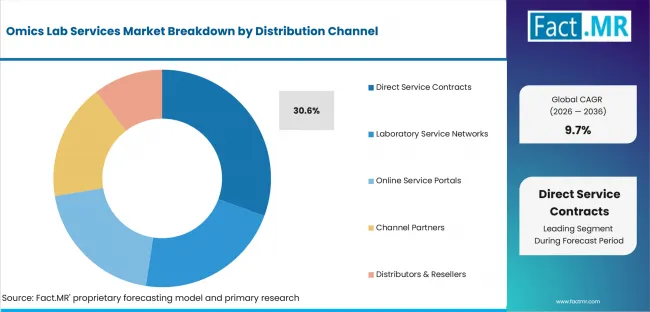
Omics Lab Services Market Analysis By Distribution Channel | Source: Fact.MR
Direct service contracts lead as each study requires defined sample logistics, assay scope, data deliverables and quality expectations.
Why does Next-Generation Sequencing (NGS) lead Technology?
Next-Generation Sequencing (NGS) is projected to account for 42.1% share in 2026.
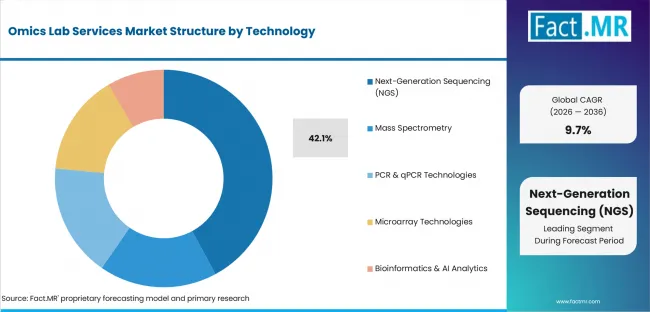
Omics Lab Services Market Analysis By Technology | Source: Fact.MR
Next-Generation Sequencing leads because it supports high-throughput analysis across genomes, exomes, transcriptomes and targeted panels.
What is accelerating Omics Lab Services Market adoption, and what is holding it back?
Omics lab service demand rises when drug developers and clinical researchers need sequencing, protein and metabolite evidence without building every analytical platform in-house. Adoption slows when turnaround time, sample quality, validation depth or data interpretation does not satisfy the study protocol.
Discovery programs should be compared with Fact.MR's Drug Discovery Technologies Market, because outsourced omics work often feeds target and biomarker decisions.
Drivers Impact Analysis
| DRIVER | QUALITATIVE RELEVANCE | GEOGRAPHIC RELEVANCE | IMPACT TIMELINE |
|---|---|---|---|
| Sequencing-led genomics demand | High | South Korea | Short term (<=2 years) |
| Drug discovery outsourcing | High | USA | Short term (<=2 years) |
| Clinical biomarker study support | Moderate | Canada | Medium term (2-4 years) |
| Bioinformatics-enabled service bundles | Selective | UK | Medium term (2-4 years) |
Source: Fact.MR analysis. Updated Jul 30, 2026
- Sequencing-led genomics demand: Genomics services lead as sequencing and variant analysis are now core tools in drug discovery, translational research and precision medicine programs.
- Drug discovery outsourcing: Drug discovery and development leads application demand because pharma and biotech buyers use omics data to identify targets, stratify patients, study mechanisms and de-risk pipelines.
- Clinical biomarker study support: Pharmaceutical and biotechnology companies lead as they have recurring project volume, regulated documentation needs and budget to outsource specialized assays.
- Bioinformatics-enabled service bundles: Direct service contracts lead as scope, sample handling, data format, QA requirements and intellectual-property treatment must be agreed before work begins.
Opportunity Impact Analysis
| OPPORTUNITY | QUALITATIVE RELEVANCE | GEOGRAPHIC RELEVANCE | IMPACT TIMELINE |
|---|---|---|---|
| Integrated omics and analytics | High | South Korea | Medium term (2-4 years) |
| Trial biomarker services | Moderate | USA | Medium term (2-4 years) |
| Single-cell and multi-omics workflows | Selective | Canada | Medium term (2-4 years) |
Source: Fact.MR analysis. Updated Jul 30, 2026
- Integrated omics and analytics: Integrated omics plus bioinformatics packages can reduce the handoff friction between wet-lab testing and interpretation.
- Trial biomarker services: Clinical-trial biomarker services can grow where sponsors need patient stratification, response markers and regulatory-grade documentation.
- Single-cell and multi-omics workflows: Single-cell and multi-omics workflows can expand premium service demand when discovery teams need higher-resolution biology.
Restraints Impact Analysis
| RESTRAINT | QUALITATIVE RELEVANCE | GEOGRAPHIC RELEVANCE | IMPACT TIMELINE |
|---|---|---|---|
| Sample quality and pre-analytics | High | South Korea | Short term (<=2 years) |
| Data interpretation burden | Moderate | USA | Medium term (2-4 years) |
| Genomic data privacy and cross-border samples | Selective | UK | Medium term (2-4 years) |
Source: Fact.MR analysis. Updated Jul 30, 2026
- Sample quality and pre-analytics: Poor sample quality or inconsistent pre-analytics can compromise results before the assay starts.
- Data interpretation burden: Data interpretation and storage burdens can slow adoption when buyers lack bioinformatics capacity.
- Genomic data privacy and cross-border samples: Regulatory and privacy expectations around human genomic data can lengthen contracting and cross-border sample movement.
Which countries are scaling Omics Lab Services Market fastest?
Country rates show where buying conditions and supplier proof are already stronger.
Throughput planning connects with Fact.MR's Lab Automation Market, where sample handling and workflow control decide service turnaround.
- South Korea: The market is expected to grow at a CAGR of 6.80% from 2026 to 2036. South Korea's growth is supported by biotech investment, precision medicine interest and advanced sequencing infrastructure.
- USA: The market is expected to grow at a CAGR of 12.59% from 2026 to 2036. USA demand is shaped by pharma R&D scale, NIH-funded science, biotech pipelines and a mature CRO and specialty lab ecosystem.
- Canada: The market is expected to grow at a CAGR of 8.69% from 2026 to 2036. Canada benefits from academic research networks, genomics programs and clinical translation activity, with project funding influencing service demand.
- UK: The market is expected to grow at a CAGR of 9.69% from 2026 to 2036. UK adoption is linked to genomics research infrastructure, clinical-trial activity and strong pharma collaboration.
- Germany: The market is expected to grow at a CAGR of 10.69% from 2026 to 2036. Germany's outlook is supported by pharma research, diagnostics quality expectations and strict data-governance requirements.
- Australia: The market is expected to grow at a CAGR of 7.72% from 2026 to 2036. Australia benefits from translational research, cancer genomics and regional service demand, though sample logistics can affect turnaround time.
- Japan: The market is expected to grow at a CAGR of 11.67% from 2026 to 2036. Japan's market is shaped by pharma R&D, aging-related disease research and demand for high-quality sequencing and interpretation.
The full report provides country-level CAGR analysis across North America, Latin America, Europe, East Asia, South Asia and Oceania, and the Middle East and Africa.
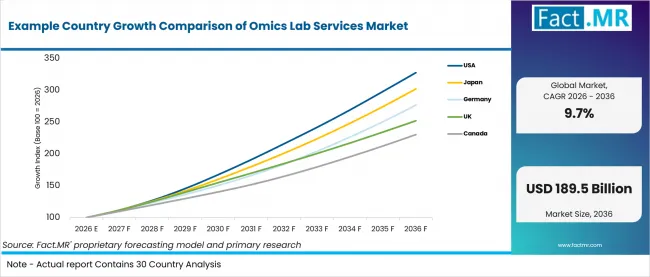
Example Country Growth Comparison Of Omics Lab Services Market | Source: Fact.MR
| Country | CAGR (2026-2036) |
|---|---|
| South Korea | 6.80% |
| USA | 12.59% |
| Canada | 8.69% |
| UK | 9.69% |
| Germany | 10.69% |
| Australia | 7.72% |
| Japan | 11.67% |
Source: Fact.MR analysis. Updated Jul 30, 2026
What is shaping South Korea's outlook through 2036?
6.80% CAGR from 2026 to 2036.
South Korea's growth is supported by biotech investment, precision medicine interest and advanced sequencing infrastructure.
What is shaping USA's outlook through 2036?
12.59% CAGR from 2026 to 2036.
USA demand is shaped by pharma R&D scale, NIH-funded science, biotech pipelines and a mature CRO and specialty lab ecosystem.
What is shaping Canada's outlook through 2036?
8.69% CAGR from 2026 to 2036.
Canada benefits from academic research networks, genomics programs and clinical translation activity, with project funding influencing service demand.
What is shaping UK's outlook through 2036?
9.69% CAGR from 2026 to 2036.
UK adoption is linked to genomics research infrastructure, clinical-trial activity and strong pharma collaboration.
What is shaping Germany's outlook through 2036?
10.69% CAGR from 2026 to 2036.
Germany's outlook is supported by pharma research, diagnostics quality expectations and strict data-governance requirements.
Who leads the Omics Lab Services Market?
Thermo Fisher Scientific; Eurofins Scientific; QIAGEN; Illumina are among the visible providers in the omics lab services market.
Thermo Fisher Scientific and Eurofins Scientific are among the most visible providers. Competition is shaped by product proof, channel access and buyer trust.
Between 2026 and 2036, market rivalry is likely to center on clearer positioning around Genomics Services, stronger documentation and better support at the point of purchase.
Which companies are the key providers?
Key companies include Thermo Fisher Scientific; Eurofins Scientific; QIAGEN; Illumina; Agilent Technologies; Charles River Laboratories; BGI Genomics; Bio-Rad Laboratories.
- Thermo Fisher Scientific
- Eurofins Scientific
- QIAGEN
- Illumina
- Agilent Technologies
- Charles River Laboratories
- BGI Genomics
- Bio-Rad Laboratories
Bibliography
- National Human Genome Research Institute.
- NIH NCATS, Collaborate with NCATS.
- U.S. FDA, Table of Pharmacogenomic Biomarkers in Drug Labeling.
- U.S. FDA, Table of Pharmacogenetic Associations.
- PMC, Next-Generation Sequencing Technology.
- Fact.MR, Bioinformatics Service Market.
This Report Answers
- The report provides strategic intelligence on the Omics Lab Services Market across segment choices that shape the 2026 market structure.
- Segment analysis covers Genomics Services and Drug Discovery & Development as the share leaders within the 2026 market.
- Country outlook evaluates the listed markets by CAGR and explains the adoption conditions in each country.
- Competitive analysis profiles the named providers and evaluates competition around product proof, channel access and buyer trust.
- Related Fact.MR coverage helps readers compare omics lab services with bioinformatics, lab automation and precision-medicine workflows.
What does the Omics Lab Services Market cover?
The Omics Lab Services Market covers genomics, transcriptomics, proteomics, metabolomics, epigenomics, single-cell and multi-omics laboratory services, including sample preparation, sequencing, assay execution and bioinformatics support.
The Omics Lab Services Market covers genomics, transcriptomics, proteomics, metabolomics, epigenomics, single-cell and multi-omics laboratory services, including sample preparation, sequencing, assay execution and bioinformatics support.
Adjacent spending is included only when it is part of the same purchase decision or operating use case.
What is included in the scope?
The scope includes Service Type, Application, End User, Distribution Channel, Technology and regional demand.
Coverage includes adjacent segment options only when they are purchased for the same defined market use.
What is excluded from the scope?
standalone research instruments, reagent-only sales, routine clinical chemistry testing and bioinformatics software sold without associated omics laboratory service work.
The scope excludes standalone research instruments, reagent-only sales, routine clinical chemistry testing and bioinformatics software sold without associated omics laboratory service work.
How Was the Analysis Built?
The analysis combines primary research with desk research focused on the omics lab services market, its segment structure and country-level demand.
- Primary Research: Interviews and validation discussions test buyer priorities, adoption barriers, pricing logic and operating requirements.
- Desk Research: The assessment reviews company disclosures, public datasets, regulatory material, technical literature and industry records relevant to the market.
- Market Sizing and Forecasting: Estimates combine top-down and bottom-up checks across demand signals, segment shares, country activity, company participation and adoption constraints.
- Data Validation and Update Cycle: Findings are validated against public evidence, company activity and country-level adoption patterns before final use.
Segmentation
What is the report's scope and coverage?
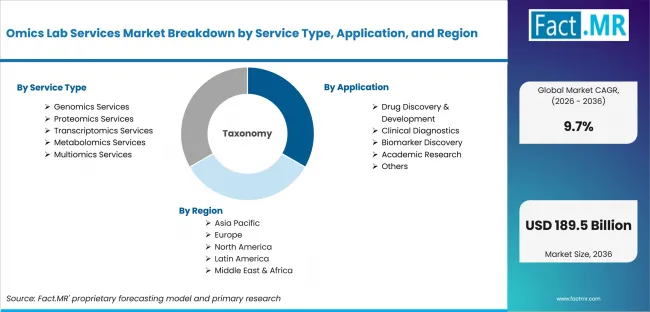
Omics Lab Services Market Breakdown By Service Type, Application, And Region | Source: Fact.MR
| Attribute | Details |
|---|---|
| Quantitative Units | USD 75.1 billion in 2026 to USD 189.5 billion by 2036, at a 9.7% CAGR. |
| Market Definition | Omics Lab Services Market covers genomics, transcriptomics, proteomics, metabolomics, epigenomics, single-cell and multi-omics laboratory services, including sample preparation, sequencing, assay execution and bioinformatics support. |
| Service Type | Genomics Services; DNA Sequencing; Genotyping; Proteomics Services; Protein Identification; Protein Quantification; Transcriptomics Services; RNA Sequencing; Gene Expression Profiling; Metabolomics Services; Metabolic Profiling; Biomarker Discovery; Multiomics Services; Integrated Omics Analysis; Systems Biology Analysis |
| Application | Drug Discovery & Development; Target Identification; Lead Optimization; Clinical Diagnostics; Precision Medicine; Disease Diagnosis; Biomarker Discovery; Companion Diagnostics; Predictive Biomarkers; Academic Research; Genomics Research; Translational Research; Others; Agricultural Biotechnology; Environmental Research |
| End User | Pharmaceutical & Biotechnology Companies; Pharmaceutical Companies; Biotechnology Companies; Academic & Research Institutes; Universities; Government Research Institutes; Hospitals & Clinical Laboratories; Hospital Laboratories; Diagnostic Centers; Contract Research Organizations; Preclinical CROs; Clinical CROs; Others; Food Testing Laboratories; Veterinary Research Centers |
| Distribution Channel | Direct Service Contracts; Long-Term Research Agreements; Project-Based Contracts; Laboratory Service Networks; Central Laboratories; Regional Laboratory Networks; Online Service Portals; Digital Booking Platforms; Sample Submission Portals; Channel Partners; Authorized Service Partners; Research Collaborators; Distributors & Resellers; Laboratory Distributors; Value-Added Resellers |
| Technology | Next-Generation Sequencing (NGS); Whole Genome Sequencing; Targeted Sequencing; Mass Spectrometry; LC-MS; GC-MS; PCR & qPCR Technologies; Real-Time PCR; Digital PCR; Microarray Technologies; DNA Microarrays; Protein Microarrays; Bioinformatics & AI Analytics; Data Interpretation; Multiomics Integration |
| Regions Covered | North America; Latin America; Europe; East Asia; South Asia and Oceania; Middle East and Africa |
| Countries Covered | South Korea; USA; Canada; UK; Germany; Australia; Japan |
| Key Companies Profiled | Thermo Fisher Scientific; Eurofins Scientific; QIAGEN; Illumina; Agilent Technologies; Charles River Laboratories; BGI Genomics; Bio-Rad Laboratories |
| Forecast Period | 2026 to 2036 |
| Approach | Hybrid top-down and bottom-up assessment using demand indicators, segment mix, country growth, company participation and public evidence relevant to the category. |
Source: Fact.MR analysis. Updated Jul 30, 2026
How is the market segmented?
-
By Service Type:
- Genomics Services
- DNA Sequencing
- Genotyping
- Proteomics Services
- Protein Identification
- Protein Quantification
- Transcriptomics Services
- RNA Sequencing
- Gene Expression Profiling
- Metabolomics Services
- Metabolic Profiling
- Biomarker Discovery
- Multiomics Services
- Integrated Omics Analysis
- Systems Biology Analysis
-
By Application:
- Drug Discovery & Development
- Target Identification
- Lead Optimization
- Clinical Diagnostics
- Precision Medicine
- Disease Diagnosis
- Biomarker Discovery
- Companion Diagnostics
- Predictive Biomarkers
- Academic Research
- Genomics Research
- Translational Research
- Others
- Agricultural Biotechnology
- Environmental Research
-
By End User:
- Pharmaceutical & Biotechnology Companies
- Pharmaceutical Companies
- Biotechnology Companies
- Academic & Research Institutes
- Universities
- Government Research Institutes
- Hospitals & Clinical Laboratories
- Hospital Laboratories
- Diagnostic Centers
- Contract Research Organizations
- Preclinical CROs
- Clinical CROs
- Others
- Food Testing Laboratories
- Veterinary Research Centers
-
By Distribution Channel:
- Direct Service Contracts
- Long-Term Research Agreements
- Project-Based Contracts
- Laboratory Service Networks
- Central Laboratories
- Regional Laboratory Networks
- Online Service Portals
- Digital Booking Platforms
- Sample Submission Portals
- Channel Partners
- Authorized Service Partners
- Research Collaborators
- Distributors & Resellers
- Laboratory Distributors
- Value-Added Resellers
-
By Technology:
- Next-Generation Sequencing (NGS)
- Whole Genome Sequencing
- Targeted Sequencing
- Mass Spectrometry
- LC-MS
- GC-MS
- PCR & qPCR Technologies
- Real-Time PCR
- Digital PCR
- Microarray Technologies
- DNA Microarrays
- Protein Microarrays
- Bioinformatics & AI Analytics
- Data Interpretation
- Multiomics Integration
-
By Region:
- North America
- Latin America
- Europe
- East Asia
- South Asia and Oceania
- Middle East and Africa
Frequently Asked Questions
Which Service Type leads the market?
Which Application leads the market?
Which End User leads the market?
Which Distribution Channel leads the market?
Which Technology leads the market?
Which country records the highest listed CAGR?
What is the primary driver in this market?
What is the main restraint?
Who worked on this report


Preview the report firsthand - request a free sample
Free SampleGet the brochure for pricing and purchase details
Download PDF