- Base Value(2025): 0.6 Bn
- Estimated Value(2026): 0.7 Bn
- Forecast Value (2036): 4.0 Bn
- CAGR (2026 - 2036): 19.0%
Agricultural Electric Tractors Market Forecast and Outlook by Fact.MR
- In 2025, the agricultural electric tractors market was valued at USD 0.6 billion.
- Demand for agricultural electric tractors is estimated to grow to USD 0.7 billion in 2026 and USD 4.0 billion by 2036.
- Fact.MR projects a CAGR of 19.0% during the forecast period.
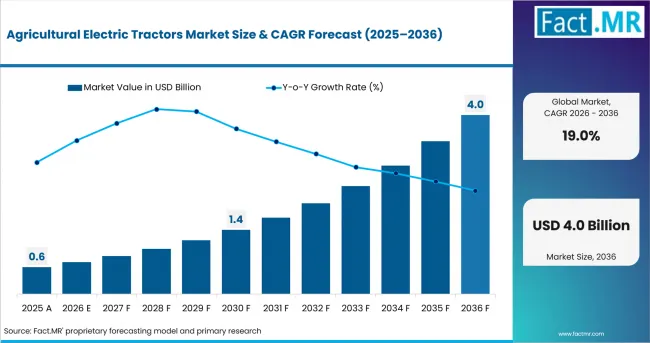
Agricultural Electric Tractors Market Value Analysis | Source: Fact.MR
| Metric | Value |
|---|---|
| Estimated Value in 2026 | USD 0.7 Billion |
| Forecast Value in 2036 | USD 4.0 Billion |
| Forecast CAGR (2026 to 2036) | 19.0% |
Source: Fact.MR analysis. Updated Jun 17, 2026
Summary of the Agricultural Electric Tractors Market
- Demand Drivers
- Farm Electrification: Agricultural producers are evaluating electric machinery to reduce operating expenses. Energy efficiency supports equipment adoption.
- Emission Targets: Agricultural decarbonization initiatives increase interest in electric tractors. Policy objectives support market expansion.
- Battery Improvements: Advancements in battery performance improve equipment capability. Technology progress supports commercial deployment.
- Key Segments Analyzed
- By Type: Battery Electric Tractors hold 61.0% share in 2026 because zero-emission operation supports adoption across agricultural applications.
- By Power Output: 31-70 HP accounts for 46.0% share reflecting suitability across medium-scale farming operations.
- By Battery Capacity: 21-50 kWh contributes 49.0% share in 2026 due to balanced operating range and equipment cost.
- By Battery Type: Lithium-ion Battery captures 74.0% share because energy density and service life support commercial utilization.
- By Drive Type: Four-wheel Drive represents 58.0% share due to field performance advantages across agricultural conditions.
- By Geography: ndia is projected to record a 21.4% CAGR through 2036, driven by agricultural modernization and electrification activity.
- Analyst Opinion at Fact.MR
- Shambhu Nath Jha, Principal Consultant at Fact.MR, opines, "Future value creation will favor manufacturers that combine battery performance with practical farm economics. Charging access and equipment reliability will shape commercial adoption."
- Strategic Implications
- Agricultural equipment manufacturers should expand electric tractor portfolios. Farm electrification supports long-term demand.
- Suppliers should strengthen battery technology partnerships. Equipment performance influences purchasing decisions.
- Producers should improve charging ecosystem access. Infrastructure availability supports broader commercial deployment.
The market is forecast to add approximately USD 3.3 billion in revenue between 2026 and 2036. Expansion reflects rising investment in low-emission agricultural machinery and farm electrification programs. Battery costs influence equipment affordability. Charging infrastructure availability affects deployment rates across agricultural regions.
Growth is led by India at 21.4% CAGR due to agricultural mechanization initiatives and electrification programs. China is projected to expand at 20.8% CAGR supported by domestic manufacturing strength. The United States is expected to witness 19.7% CAGR due to precision farming investment. Germany is forecast at 19.0% CAGR supported by agricultural decarbonization targets. France is projected to grow at 18.6% CAGR as low-emission farming equipment adoption increases.
Segmental Analysis
Agricultural Electric Tractors Market Analysis by Type
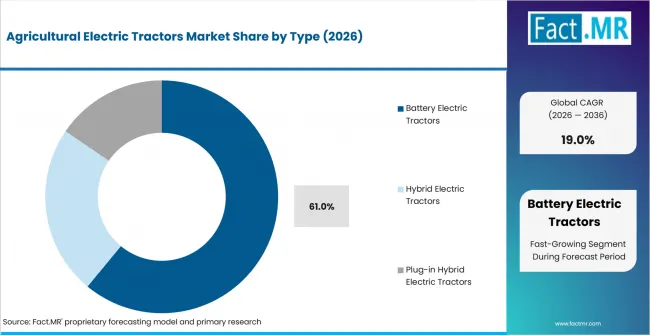
Agricultural Electric Tractors Market Analysis By Type | Source: Fact.MR
Battery Electric Tractors are estimated to account for 61.0% share in 2026. Demand is supported by lower operating costs and elimination of diesel fuel consumption. Farm electrification strategies are increasing deployment across specialty farming and utility applications.
- Zero Emissions: Battery electric systems reduce on-farm emissions. Environmental targets support demand.
- Lower Operating Cost: Electricity reduces fuel expenditure across agricultural operations. Cost efficiency supports adoption.
- Equipment Development: Manufacturers are expanding battery-powered tractor portfolios. Product availability strengthens market penetration.
Agricultural Electric Tractors Market Analysis by Power Output
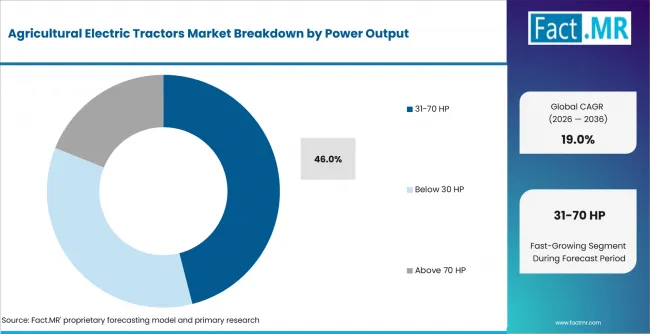
Agricultural Electric Tractors Market Analysis By Power Output | Source: Fact.MR
31-70 HP contributes 46.0% share in 2026. This power range aligns with the requirements of medium-sized farms and specialty crop operations. Equipment versatility supports segment concentration. John Deere introduced its second-generation autonomy platform and several autonomous machines at CES 2025, including an autonomous 9RX tractor and an autonomous 5ML orchard tractor. Deere also stated that a battery-electric tractor comparable to existing 5M/5ML models is planned to follow, highlighting the company's continued investment in electrified agricultural equipment. [1]
- Farm Suitability: Medium-power tractors serve multiple agricultural tasks. Operational flexibility supports utilization.
- Energy Efficiency: Power output balances performance and battery consumption. Equipment economics strengthen demand.
- Commercial Adoption: Agricultural operators prioritize practical equipment configurations. Field requirements support growth.
Agricultural Electric Tractors Market Analysis by Battery Capacity
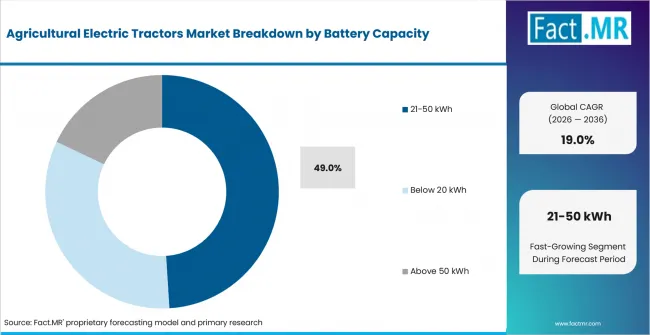
Agricultural Electric Tractors Market Analysis By Battery Capacity | Source: Fact.MR
21-50 kWh represents 49.0% share in 2026. The capacity range supports practical operating duration while maintaining manageable equipment costs. Commercial deployment is concentrated within this configuration. Bureau of Indian Standards (BIS) introduced IS 19262:2025, India's first testing standard for electric agricultural tractors, establishing benchmarks for safety, reliability, and performance. The framework is expected to promote innovation, support regulatory approval processes, and accelerate adoption of electric tractors in the agricultural sector. [2]
- Operating Range: Battery capacity supports daily agricultural activities. Performance requirements strengthen adoption.
- Cost Balance: Equipment pricing remains accessible compared with larger battery systems. Affordability supports demand.
- Technology Integration: Manufacturers focus product development within this range. Commercial availability strengthens market penetration.
Agricultural Electric Tractors Market Analysis by Battery Type
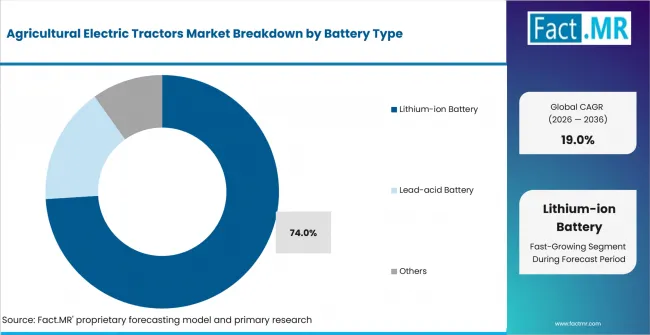
Agricultural Electric Tractors Market Analysis By Battery Type | Source: Fact.MR
Lithium-ion Battery contributes 74.0% share in 2026. Superior energy density and longer service life support utilization across electric agricultural machinery. Battery technology improvements strengthen segment leadership. Bullwork Mobility launched the BEAST 9696E, an electric tractor built on a ground-up electric platform featuring a 96 kWh battery, 60 kW dual-motor drivetrain, fast-charging capability, and autonomous-ready architecture. The company positions the tractor as a high-performance alternative to conventional diesel tractors for agricultural and heavy-duty applications. [3]
- Energy Density: Lithium-ion systems improve operating efficiency. Performance advantages support demand.
- Service Life: Extended battery durability improves equipment economics. Reliability strengthens adoption.
- Industry Preference: Manufacturers prioritize lithium-ion integration across electric tractor platforms. Product development supports growth.
Agricultural Electric Tractors Market Analysis by Drive Type
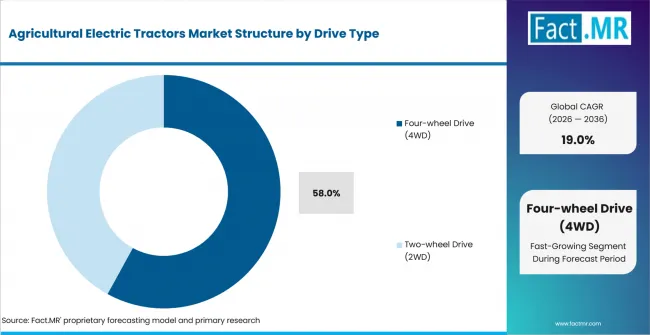
Agricultural Electric Tractors Market Analysis By Drive Type | Source: Fact.MR
Four-wheel Drive (4WD) accounts for 58.0% share in 2026. Enhanced traction and field performance support utilization across diverse agricultural environments. Commercial farms prioritize equipment capability across varying terrain conditions. The Monarch MK-V, a fully electric 70-hp tractor with autonomous capabilities, won first place in the Equipment category at the 2025 Canada's Outdoor Farm Show Innovation Awards. The recognition highlights growing industry acceptance of battery-electric tractors as viable alternatives to conventional diesel-powered farm equipment. [4]
- Traction Benefits: Four-wheel drive improves field mobility. Agricultural performance supports demand.
- Farm Productivity: Equipment capability improves operational efficiency. Utilization rates strengthen adoption.
- Commercial Preference: Agricultural operators prioritize versatile machinery. Field conditions support segment concentration.
Drivers, Restraints, and Opportunities
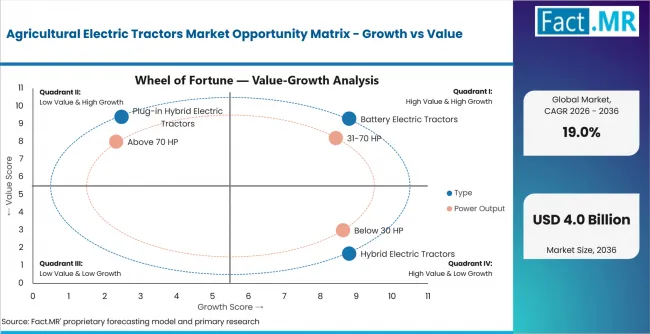
Agricultural Electric Tractors Market Opportunity Matrix Growth Vs Value | Source: Fact.MR
Fact.MR analysts observe that agricultural electric tractor demand is linked to decarbonization objectives and farm operating cost reduction. Market expansion reflects increasing investment in agricultural equipment electrification and battery-powered machinery. Demand is concentrated in regions promoting low-emission agricultural technologies and mechanization upgrades.
The industry is transitioning from demonstration projects toward commercial deployment. Diesel-powered equipment dominates installed fleets across most agricultural regions. Electric tractors offer lower operating expenses but require charging infrastructure and battery investment. Equipment performance improvements are strengthening commercial acceptance.
- Farm Decarbonization: Agricultural emission reduction programs are encouraging adoption of electric machinery. Policy support strengthens long-term demand across developed agricultural economies.
- Battery Technology Progress: Improvements in battery performance are increasing equipment capability. Technology advancement supports commercial deployment opportunities.
- Infrastructure Constraints: Adoption is constrained by charging availability and rural power access. Infrastructure limitations influence deployment timelines across agricultural regions.
Regional Analysis
The agricultural electric tractors market is assessed across Asia Pacific, North America, and Europe. The study evaluates agricultural mechanization, electrification investment, battery technology adoption, regulatory developments, and farm equipment modernization across major countries.
.webp "Top Country Growth Comparison Agricultural Electric Tractors Market Cagr (2026 2036)")
Top Country Growth Comparison Agricultural Electric Tractors Market Cagr (2026 2036) | Source: Fact.MR
| Country | CAGR |
|---|---|
| India | 21.4% |
| China | 20.8% |
| United States | 19.7% |
| Germany | 19.0% |
| France | 18.6% |
Source: Fact.MR analysis. Updated Jun 17, 2026
Source: Fact.MR analysis based on agricultural equipment electrification trends, battery technology adoption, and industry interviews.
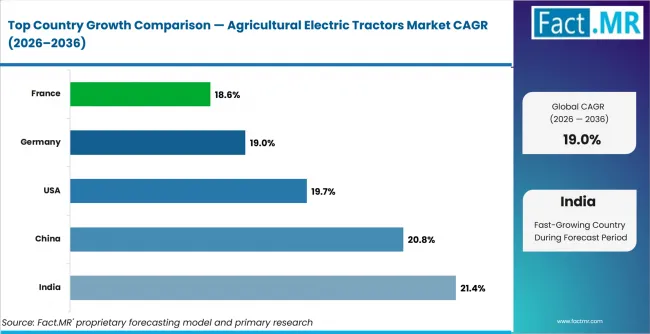
Agricultural Electric Tractors Market Cagr Analysis By Country | Source: Fact.MR
Sales Analysis of Agricultural Electric Tractors Market in India
India is projected to expand at 21.4% CAGR due to rising farm mechanization activity and government support for clean energy technologies. Agricultural modernization programs are increasing interest in electric machinery. Growth is attributable to electrification initiatives and equipment replacement demand.
- Farm modernization supports electric tractor demand.
- Electrification initiatives increase equipment adoption.
- Agricultural investment strengthens market expansion.
Demand Outlook for Agricultural Electric Tractors Market in China
China is expected to witness 20.8% CAGR through 2036 supported by domestic electric vehicle manufacturing capabilities and agricultural equipment innovation. Industrial capacity supports electric tractor development. Growth reflects technology advancement and agricultural modernization.
- Manufacturing strength supports equipment production.
- Technology development increases adoption.
- Agricultural modernization strengthens market growth.
Opportunity Analysis of Agricultural Electric Tractors Market in United States
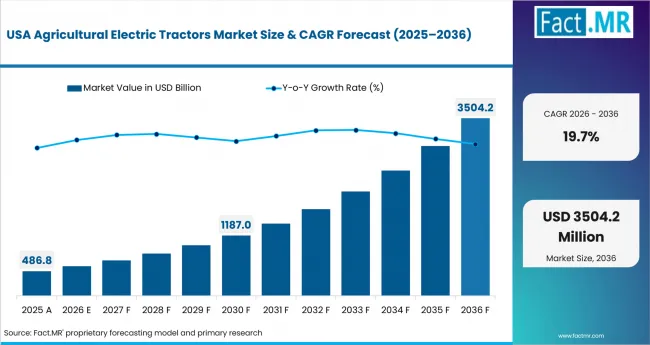
Agricultural Electric Tractors Market Country Value Analysis | Source: Fact.MR
The United States is forecast to grow at 19.7% CAGR by 2036 as precision agriculture investment supports advanced equipment adoption. Commercial farms are evaluating alternatives to diesel-powered machinery. Growth is supported by operational efficiency objectives.
- Precision farming supports equipment demand.
- Farm efficiency initiatives increase adoption.
- Technology investment strengthens market opportunity.
Demand Assessment of Agricultural Electric Tractors Market in Germany
Germany is projected to expand at 19.0% CAGR supported by agricultural decarbonization objectives and equipment electrification programs. Environmental targets are influencing machinery purchasing decisions. Growth reflects sustainability goals and technology investment.
- Decarbonization programs support demand.
- Equipment modernization increases adoption.
- Technology investment strengthens market expansion.
In-depth Analysis of Agricultural Electric Tractors Market in France
France is projected to register 18.6% CAGR through 2036 supported by low-emission agriculture initiatives and farm equipment modernization. Agricultural operators are evaluating electric machinery for specialty farming applications. Growth is attributable to environmental objectives and machinery upgrades.
- Low-emission farming supports demand.
- Equipment upgrades increase adoption.
- Agricultural investment strengthens market growth.
Competitive Aligners for Market Players
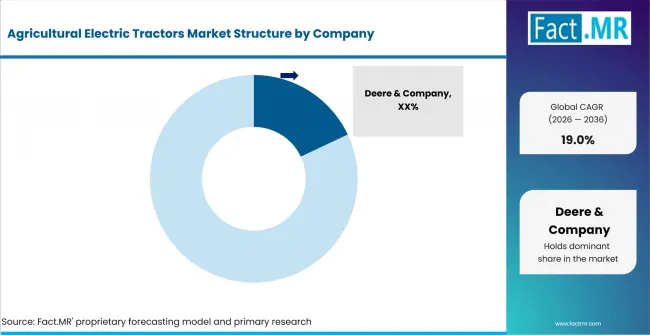
Agricultural Electric Tractors Market Analysis By Company | Source: Fact.MR
The agricultural electric tractors market reflects an emerging competitive structure led by established agricultural machinery manufacturers and specialized electric equipment developers. Product performance and battery capability influence competitive positioning. Technology integration and field reliability shape commercial acceptance across agricultural operations.
Large agricultural equipment manufacturers benefit from established dealer networks and long-standing relationships with farm operators. Distribution access improves product visibility and service support. Equipment financing capabilities strengthen commercial reach. Manufacturing scale supports production efficiency and technology investment. Agricultural producers evaluate equipment through total ownership cost and operational capability. Battery performance influences purchasing decisions. Charging accessibility affects deployment planning. Reliability and service availability influence equipment selection across commercial farming operations.
Competition is increasingly centered on battery technology and software integration. Manufacturers that improve operating range and charging efficiency strengthen market positioning. Product differentiation is shifting toward practical field performance and equipment economics. Commercial success is linked to balancing productivity with electrification benefits.
Key Players
- Deere & Company
- Escorts Kubota Limited
- Sonalika Tractors / International Tractors Ltd.
- AGCO Corporation
- CNH Industrial N.V.
Bibliography
- [1] Deere & Company. (2025, January 6). John Deere reveals new autonomous machines & technology at CES 2025. John Deere.
- [2] Press Information Bureau. (2025, December 28). Union Minister Shri Pralhad Joshi released Indian Standard IS 19262:2025 “Electric Agricultural Tractors — Test Code”. Government of India.
- [3] Tahleel, S. (2026, May 16). Bengaluru-based Bullwork launches BEAST 9696E, calls it India’s most powerful electric tractor. Startuppedia.
- [4] Farmtario. (2025, September 10). Electric tractor wins innovation award at Canada’s Outdoor Farm Show. Farmtario.
This Report Addresses
- Assessment of agricultural electric tractor demand across farm mechanization and agricultural electrification activities.
- Market forecast from USD 0.7 Billion in 2026 to USD 4.0 Billion by 2036 at 19.0% CAGR.
- Opportunity mapping across battery-powered agricultural equipment and low-emission machinery deployment.
- Segment forecasts covering type, power output, battery capacity, battery type, and drive type demand.
- Competitive assessment of agricultural equipment manufacturers and electric tractor developers.
- Evaluation of farm electrification trends and battery technology developments.
- Country-level analysis across India, China, United States, Germany, and France.
- Report delivery through PDF and Excel formats supported by primary interviews and industry analysis.
Agricultural Electric Tractors Market Definition
The agricultural electric tractors market covers battery-powered and hybrid-powered tractors used across farming operations. These machines perform cultivation, hauling, spraying, mowing, and field preparation activities while reducing fuel consumption and emissions. Agricultural electric tractors utilize battery systems and electric drivetrains to improve energy efficiency and lower operating costs. The market serves commercial farms, specialty crop producers, orchards, vineyards, and agricultural service providers seeking alternatives to conventional diesel-powered equipment.
Agricultural Electric Tractors Market Inclusions
The study covers global and regional forecasts from 2026 to 2036 by type, power output, battery capacity, battery type, and drive type. It includes agricultural equipment electrification trends, battery technology developments, charging infrastructure considerations, pricing trends, and competitive positioning across major producing and consuming countries.
Agricultural Electric Tractors Market Exclusions
The study excludes diesel tractors, autonomous farm robots, electric utility vehicles, agricultural drones, and construction equipment. It omits battery manufacturing revenue and charging equipment sales unless directly integrated into agricultural electric tractor systems. Non-agricultural electric vehicles fall outside the defined scope.
Agricultural Electric Tractors Market Research Methodology
- Primary Research
- Interviews conducted with agricultural equipment manufacturers, distributors, farm operators, battery suppliers, and industry consultants across North America, Europe, and Asia Pacific.
- Desk Research
- Analysis of company annual reports, investor presentations, government publications, industry announcements, and corporate disclosures released during 2024 and 2025.
- Market-Sizing and Forecasting
- Hybrid top-down and bottom-up model using equipment shipments, farm mechanization trends, battery adoption patterns, and agricultural equipment demand assessment.
- Data Validation and Update Cycle
- Validated through manufacturer disclosures, distributor interviews, agricultural equipment sales analysis, and annual farm machinery industry reviews.
Segmentation
Scope of Report
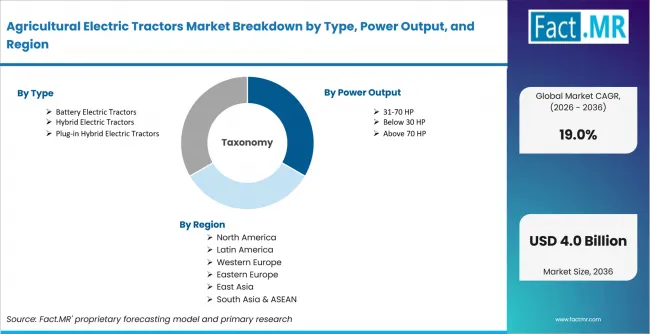
Agricultural Electric Tractors Market Breakdown By Type, Power Output, And Region | Source: Fact.MR
| Attribute | Details |
|---|---|
| Quantitative Units | USD 0.7 Billion (2026) to USD 4.0 Billion (2036) at a CAGR of 19.0% |
| Market Definition | Covers battery-powered and hybrid-powered tractors used across agricultural operations |
| Type Segmentation | Battery Electric Tractors, Hybrid Electric Tractors, Plug-in Hybrid Electric Tractors |
| Power Output Segmentation | Below 30 HP, 31-70 HP, Above 70 HP |
| Battery Capacity Segmentation | Below 20 kWh, 21-50 kWh, Above 50 kWh |
| Battery Type Segmentation | Lithium-ion Battery, Lead-acid Battery, Others |
| Drive Type Segmentation | Two-wheel Drive (2WD), Four-wheel Drive (4WD) |
| Regions Covered | North America, Europe, Asia Pacific |
| Countries Covered | India, China, United States, Germany, France |
| Key Companies Profiled | Deere & Company, Escorts Kubota Limited, Sonalika Tractors / International Tractors Ltd., AGCO Corporation, CNH Industrial N.V. |
| Forecast Period | 2026 to 2036 |
| Approach | Hybrid top-down and bottom-up model using agricultural equipment demand and electrification analysis |
Source: Fact.MR analysis. Updated Jun 17, 2026
Agricultural Electric Tractors Market by Segment
-
By Type
- Battery Electric Tractors
- Hybrid Electric Tractors
- Plug-in Hybrid Electric Tractors
-
By Power Output
- Below 30 HP
- 31-70 HP
- Above 70 HP
-
By Battery Capacity
- Below 20 kWh
- 21-50 kWh
- Above 50 kWh
-
By Battery Type
- Lithium-ion Battery
- Lead-acid Battery
- Others
-
By Drive Type
- Two-wheel Drive (2WD)
- Four-wheel Drive (4WD)
-
By Region
- North America
- United States
- Canada
- Mexico
- Latin America
- Brazil
- Argentina
- Rest of Latin America
- Europe
- Germany
- United Kingdom
- France
- Italy
- Spain
- Rest of Europe
- Asia Pacific
- China
- India
- Japan
- South Korea
- ASEAN
- Middle East & Africa
- GCC Countries
- South Africa
- UAE
- Rest of Middle East & Africa
- North America
Frequently Asked Questions
How large is the global agricultural electric tractors market in 2025?
What will the agricultural electric tractors market size be in 2026?
What is the projected agricultural electric tractors market size by 2036?
What is the expected CAGR for the agricultural electric tractors market from 2026 to 2036?
Which type segment is projected to lead agricultural electric tractors market demand?
Which battery type contributes the leading market share?
Who worked on this report


Preview the report firsthand - request a free sample
Free SampleGet the brochure for pricing and purchase details
Download PDF