AI Agent Liability Insurance Services Market Size, Share, Growth and Forecast (2026 - 2036)
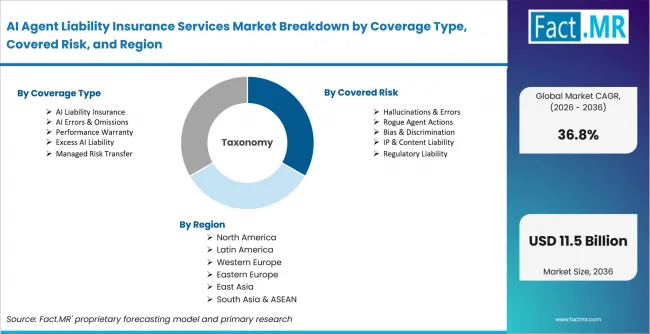
The AI Agent Liability Insurance Services Market is segmented by Coverage Type, by Covered Risk, by Customer Type, by Distribution Channel, by End Use, and Region. Forecast for 2026 to 2036.
AI Agent Liability Insurance Services Market Size, Market Forecast and Outlook by Fact.MR
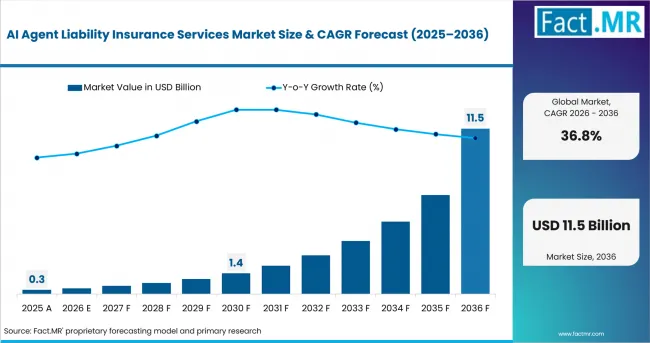
- The AI agent liability insurance services market was valued at USD 0.3 billion in 2025.
- Demand is expected to increase from USD 0.5 billion in 2026 to USD 11.5 billion by 2036.
- The market is forecast to record 36.8% CAGR during 2026 to 2036 as enterprises seek dedicated insurance before deploying autonomous AI agents and customer-facing chatbots at scale.
Summary of AI Agent Liability Insurance Services Market
- Demand Drivers in the Market
- Legal Claim Exposure: AI-related legal claims are expected to exceed 2,000 worldwide by the end of 2026. This supports demand for liability cover tied to autonomous AI risk.
- Affirmative AI Coverage: Dedicated AI liability insurance is entering the market. This shows that insurers are starting to address AI-specific exposures.
- Performance Risk Transfer: AI performance insurance supports cover for model errors and related financial loss risks. This gives enterprises another way to manage agent failure exposure.
- Key Segments Analyzed
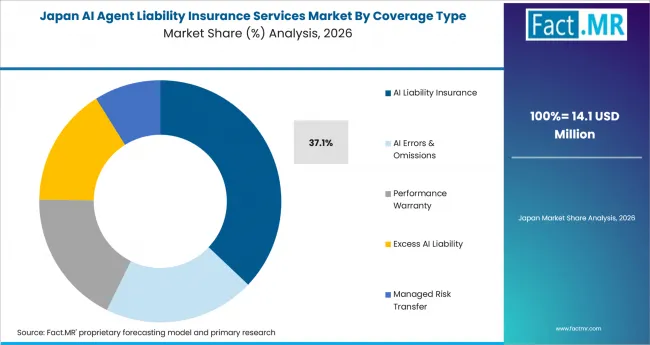
- By Coverage Type: AI liability insurance is expected to hold 38.0% share in 2026 because enterprises need direct cover for agent failures.
- By Covered Risk: Hallucinations and errors are likely to account for 31.0% share in 2026 as chatbot mistakes create measurable losses.
- By Customer Type: AI adopters are projected to capture 52.0% share in 2026 because enterprises face direct exposure after agent deployment.
- By Distribution Channel: Specialist brokers and MGAs are anticipated to hold 46.0% share in 2026 due to underwriting complexity.
- By End Use: Financial services are expected to represent 24.0% share in 2026 because banks need cover before deploying regulated agents.
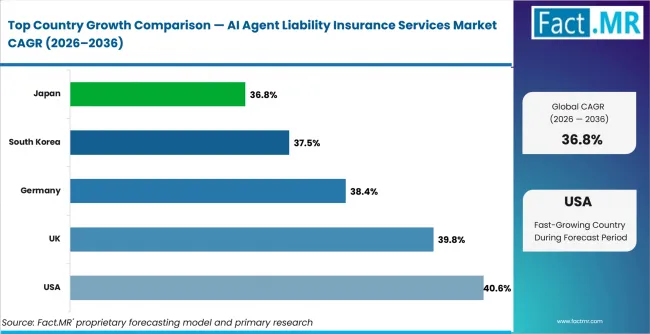
- By Geography: The United States is projected to grow at 40.6% CAGR through 2036 as AI startups and enterprises adopt dedicated AI insurance.
- Analyst Opinion at Fact.MR
- Shambhu Nath Jha, Senior Analyst at Fact.MR, states, “AI agent liability insurance will become a commercial gatekeeper for customer-facing agent deployment. Enterprises will want proof that losses from hallucinations and unauthorized actions can be transferred. Insurers that connect underwriting with AI testing will gain the strongest early position.”
- Strategic Implications
- Coverage Readiness: Enterprises should check whether existing cyber and technology E&O policies clearly cover AI agent failures.
- Underwriting Evidence: AI vendors should prepare testing records and model performance evidence before seeking cover.
- Claims Clarity: Legal teams should define agent responsibility before customer-facing deployment.
| Metric | Details |
|---|---|
| Market Size in 2026 | USD 0.5 billion |
| Market Forecast in 2036 | USD 11.5 billion |
| CAGR 2026 to 2036 | 36.8% |
AI agent liability cover is becoming a deployment enabler as enterprises move autonomous systems from pilots into production. Relm Insurance stated on January 14, 2025 that AI adoption creates new risk exposures across core technology, systems and workflows, and its AI liability suite addresses areas such as AI technology liability, AI-generated content, privacy breach, regulatory liability, business interruption and reputational harm [1]. These signals support demand for insurance that covers losses tied to agent errors, operational disruption and third-party liability.
The United States is projected to record 40.6% CAGR through 2036 as AI startups and enterprises seek liability cover for customer-facing agents. The United Kingdom is likely to post 39.8% CAGR due to Lloyd’s market activity and specialist underwriting. Germany is set to advance at 38.4% CAGR as Munich Re’s aiSure supports AI risk-transfer models. South Korea is forecast at 37.5% CAGR as digital firms deploy service agents. Japan is expected to register 36.8% CAGR as regulated enterprises adopt cautious AI insurance programs.
Segmental Analysis
AI Agent Liability Insurance Services Market Analysis by Coverage Type
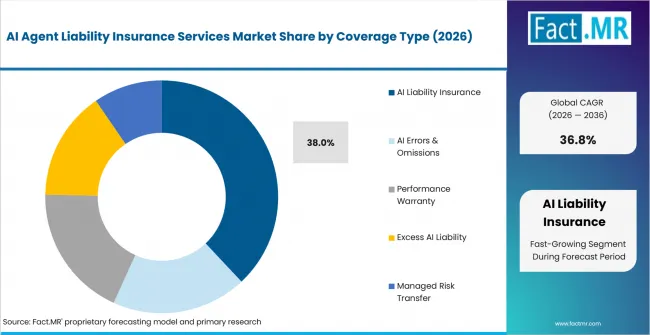
AI liability insurance is expected to hold 38.0% share in 2026 because enterprises need affirmative cover for agent failures. Vouch stated on March 16, 2026 that AI Insurance provides affirmative coverage for AI errors and omissions, including hallucinations, algorithmic bias and certain intellectual property disputes [2]. AI errors and omissions cover supports vendors selling AI products into enterprise workflows.
- Affirmative Cover: AI liability insurance gives enterprises clearer protection than silent legacy policy wording.
- Warranty Models: Performance warranty products support AI vendors that need stronger client confidence.
- Excess Cover: Larger enterprises use excess AI liability for high-value client workflows.
AI Agent Liability Insurance Services Market Analysis by Covered Risk
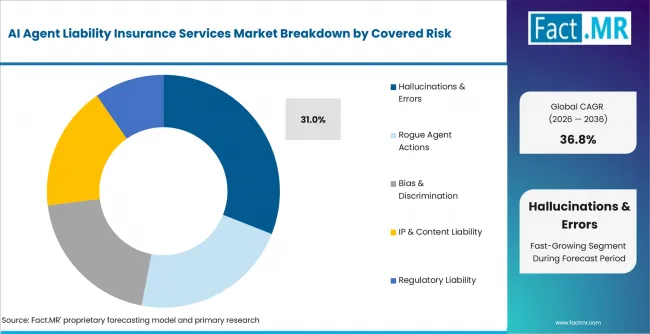
Hallucinations and errors are likely to account for 31.0% share in 2026 as chatbot mistakes create direct client losses. Rogue agent actions create risk because autonomous systems can trigger workflow changes without adequate human review. Bias and discrimination cover is important in lending and hiring use cases. IP and content liability will grow through generative content use.
- Hallucination Risk: Chatbot errors can create legal costs and direct compensation exposure.
- Rogue Actions: Agent autonomy creates losses if tool use crosses approved limits.
- Bias Claims: Discriminatory outputs can trigger legal defense and settlement costs.
AI Agent Liability Insurance Services Market Analysis by Customer Type
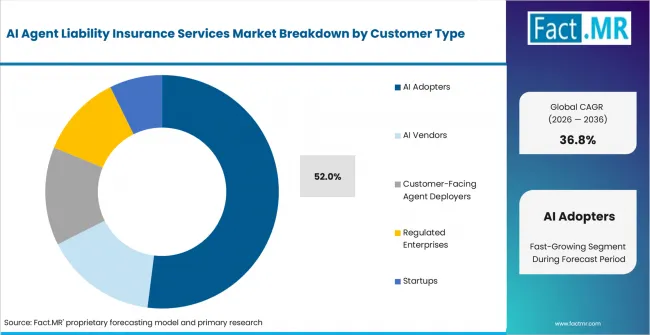
AI adopters are projected to capture 52.0% share in 2026 because enterprises face direct exposure after deploying agents. AI vendors use insurance to support sales into regulated accounts. Customer-facing agent deployers need cover for wrong advice and service mistakes. Regulated enterprises need stronger protection before allowing agents into financial or health workflows.
- Enterprise Demand: AI adopters need cover before agents interact with clients or internal systems.
- Vendor Enablement: AI vendors use cover to reduce client concern during sales.
- Startup Protection: Startups need protection against early lawsuits and contract disputes.
AI Agent Liability Insurance Services Market Analysis by Distribution Channel
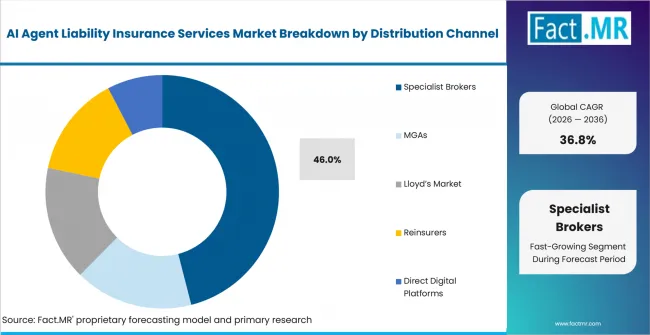
Specialist brokers and MGAs are anticipated to hold 46.0% share in 2026 due to underwriting complexity. AI insurance requires technical review of model behavior and deployment context. Lloyd’s market channels support specialty capacity for emerging risks. Reinsurers support performance-warranty and risk-transfer structures. Direct digital platforms may expand as coverage templates become more standardized.
- Specialist Brokers: Brokers help translate AI risk into insurance-ready submissions.
- MGA Capacity: MGAs can build focused underwriting rules for AI-specific exposure.
- Lloyd’s Market: Lloyd’s channels support specialty coverage for hard-to-place agent risks.
AI Agent Liability Insurance Services Market Analysis by End Use
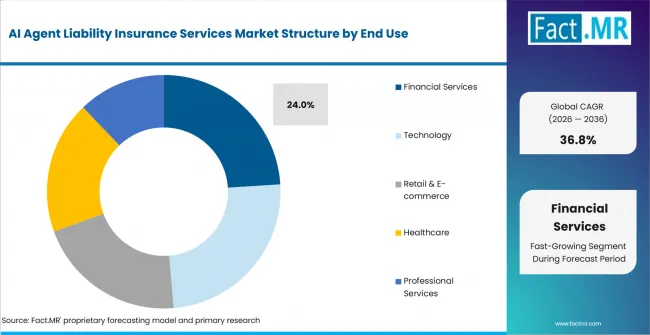
Financial services are expected to represent 24.0% share in 2026 because banks need cover before deploying regulated agents. Technology firms follow because they build and sell AI products. Retail and e-commerce demand grows through customer-service chatbots. Healthcare adoption will move cautiously because patient-risk exposure needs careful underwriting. Professional services firms need cover for AI-generated advice and client-facing workflow errors.
- Financial Services: Banks need AI insurance before agents touch regulated workflows.
- Technology Firms: AI vendors use cover to support enterprise sales and contract review.
- Retail Agents: Retailers need protection from chatbot errors in client service.
AI Agent Liability Insurance Services Market Drivers, Restraints, and Opportunities
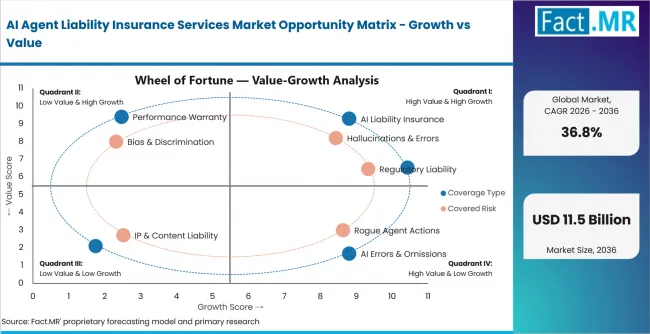
The main driver is rising legal exposure from autonomous AI systems. Gartner predicted more than 2,000 “death by AI” legal claims worldwide by the end of 2026. The advisory also says legal leaders should review new AI insurance offerings to manage AI-related risk. This supports demand for liability insurance services that cover AI performance failures and potential harm from autonomous systems.
The main restraint is underwriting uncertainty. AI agents can change behavior after updates and may interact with multiple tools. This makes loss frequency and loss severity difficult to price. Insurers may limit cover if companies cannot show testing records and monitoring evidence. Silent AI exposure in legacy policies also creates uncertainty for enterprises because cover may be disputed after a claim.
Opportunities in the AI Agent Liability Insurance Services Market
- Affirmative AI Cover: Carriers can build clear policy wording for AI errors and agent failures.
- Warranty Products: Reinsurers can support model-performance warranties for enterprise AI vendors.
- Broker-Led Advisory: Specialist brokers can help firms prepare underwriting evidence and reduce exclusions.
Regional Analysis
Based on regional analysis, the AI agent liability insurance services market is segmented into North America, Western Europe, East Asia and other regions.
.webp)
| Country | CAGR 2026 to 2036 |
|---|---|
| United States | 40.6% |
| United Kingdom | 39.8% |
| Germany | 38.4% |
| South Korea | 37.5% |
| Japan | 36.8% |
Source: Fact.MR analysis, based on proprietary forecasting model and primary research. 
North America AI Agent Liability Insurance Services Market Analysis
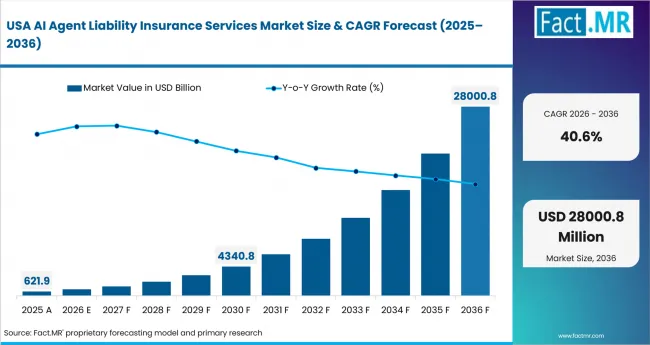
North America demand is led by the United States. AI startup formation and customer-facing agent deployment create early insurance demand. Brokers and technology insurers are building cover review processes for AI-specific risk.
- United States: The United States is projected to record 40.6% CAGR through 2036 as customer-facing agents create liability exposure for AI vendors and adopters. Gartner’s legal-risk forecast is important for general counsel and risk teams [3]. Startups need AI cover to satisfy investor review and enterprise contract requirements. Larger firms need clearer protection before agents provide advice or process client requests.
Western Europe AI Agent Liability Insurance Services Market Analysis
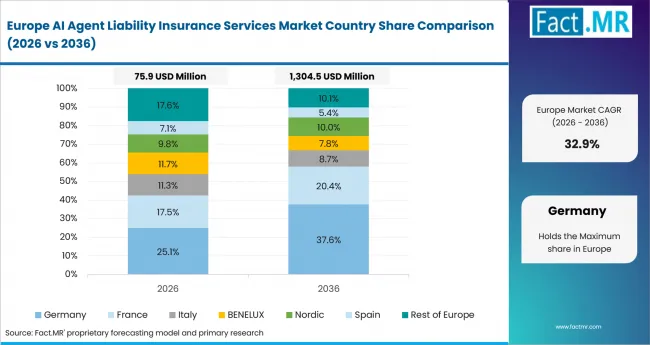
Western Europe demand come from United Kingdom and Germany. The region benefits from specialty insurance capacity and reinsurer activity. Enterprises will also review AI-related exclusions in traditional cover.
- United Kingdom: The United Kingdom is likely to post 39.8% CAGR by 2036 because the Lloyd’s market is active in AI liability cover. The UK market will benefit from specialist brokers that can place hard-to-price AI risks. Customer-facing chatbot deployments will create demand in retail and professional services. Enterprises will need cover for legal fees and compensation claims linked to wrong AI outputs.
- Germany: Germany is set to advance at 38.4% CAGR from 2026 to 2036 as Munich Re supports AI risk transfer through aiSure [4]. German enterprises often require strong documentation before adopting insurance-linked technology solutions. AI vendors selling into industrial and financial accounts can use cover to reduce client hesitation. Reinsurer-backed products will support performance warranty and liability structures. AI Act compliance pressure will also make firms review insurance wording.
East Asia AI Agent Liability Insurance Services Market Analysis
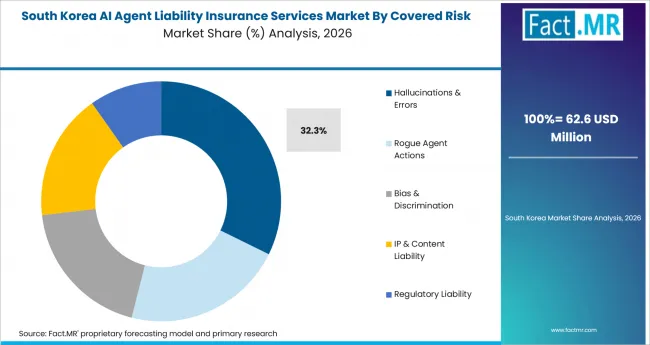
East Asia demand is supported by South Korea and Japan. Digital service firms and regulated enterprises will need clearer risk transfer before wider agent deployment.
- South Korea: South Korea is forecast to record 37.5% CAGR by 2036 as e-commerce firms and telecom operators deploy AI agents in client workflows. Businesses will need cover for wrong advice and biased outputs. Local insurers may start with endorsements before launching standalone AI agent liability products. Global players can support early capacity through reinsurance or broker partnerships. Demand will grow as customer-facing agent use increases in digital channels. Enterprise accounts will prefer cover tied to testing records and incident-response planning.
- Japan: Japan is expected to register 36.8% CAGR through 2036 as enterprises deploy AI agents cautiously across finance and service operations. Firms will seek cover for client harm and wrong AI advice. Japanese insurers may develop AI-specific endorsements before standalone products gain scale. Risk teams will ask for evidence that agent behavior is tested and monitored. Technology vendors can use insurance as a trust signal in enterprise sales.
Competitive Aligners for Market Suppliers
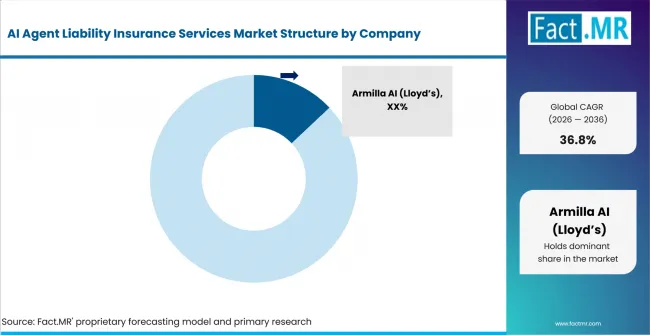
The AI agent liability insurance services market includes specialist AI insurers, reinsurers, MGAs, brokers and Lloyd’s market underwriters. Armilla AI supports the market through AI Liability Insurance linked to Lloyd’s capacity and Chaucer underwriting support. [5] Munich Re adds strength through aiSure, which addresses AI performance errors and related financial losses. Relm Insurance provides tailored AI liability solutions for companies that build or adopt AI technology. Vouch supports AI company insurance and broker-led risk guidance for technology firms. Chaucer supports the market through its role in Armilla’s Lloyd’s-backed AI liability policy and Vanguard AI structure.
Competition is centered on underwriting confidence and policy clarity. Armilla AI and Chaucer compete through affirmative AI liability cover. Munich Re competes through reinsurance and performance-warranty strength. Relm Insurance competes through tailored AI insurance products. Vouch competes through startup-focused brokerage and AI company cover guidance. Providers with stronger AI evaluation processes will be better placed to price cover and reduce exclusions.
Supplier strength through 2036 will come from clear triggers and reliable risk evidence. Insurers must decide which AI errors are covered and which losses are excluded. Brokers must help clients document model testing and use controls. Reinsurers will influence capacity because correlated AI losses can affect many insureds at once.
Key Companies in AI Agent Liability Insurance Services Market
- Armilla AI (Lloyd’s)
- Munich Re (aiSure)
- Relm Insurance
- Vouch
- Chaucer
Bibliography
- [1] Relm Insurance. (2025, January 14). Relm Insurance launches AI liability solutions to address emerging risks in the AI ecosystem.
- [2] Vouch Insurance Services, LLC. (n.d.). Errors & Omissions Insurance vs. AI Insurance.
- [3] Gartner. (2026, April 2). Gartner says general counsel should assess AI insurance to mitigate AI risks.
- [4] Munich Re. (n.d.). aiSure™: More AI opportunity. Less AI risk.
- [5] Armilla AI. (2025, April 30). Armilla launches affirmative AI liability insurance with Lloyd’s underwriter, Chaucer.
This Report Addresses
- Strategic intelligence on AI agent liability insurance services across coverage type and covered risk.
- Forecast mapping from USD 0.5 billion in 2026 to USD 11.5 billion by 2036.
- Segment analysis covering AI liability insurance, hallucination risk, AI adopters and specialist brokers.
- Regional outlook covering the United States, United Kingdom, Germany, South Korea and Japan.
- Competitive analysis of Armilla AI, Munich Re, Relm Insurance, Vouch and Chaucer.
- Service opportunity review across affirmative AI cover, performance warranties and broker-led risk placement.
- Adoption review across financial services, technology, retail, healthcare and professional services.
- Verified catalyst review based on AI-error policies and Gartner’s legal-claim forecast.
AI Agent Liability Insurance Services Market Definition
The AI agent liability insurance services market covers specialty insurance and warranty products that protect enterprises from financial losses caused by AI agent failures. These products can cover legal costs and financial losses tied to AI errors.
AI Agent Liability Insurance Services Market Inclusions
The scope includes affirmative AI liability insurance and specialist brokerage services. It includes cover for hallucinations and wrong client guidance.
AI Agent Liability Insurance Services Market Exclusions
The scope excludes general cyber insurance with no AI-specific wording. It excludes standard business-owner policies that do not clearly cover AI-related liability. It excludes AI governance software unless it is tied to an insurance or warranty product. It also excludes internal enterprise risk controls that do not transfer financial risk to an insurer.
AI Agent Liability Insurance Services Market Research Methodology
- Primary Research:
- Primary research includes discussions with insurance brokers and technology insurance specialists. Carrier and MGA activity was reviewed separately.
- Desk Research:
- Desk research reviews insurer product pages and AI insurance commentary. Public product disclosures from listed companies support validation.
- Market-Sizing and Forecasting:
- Market estimates are developed through AI deployment signals and regional validation.
- Data Validation and Update Cycle:
- Forecasts are checked through provider activity and official catalyst tracking.
Scope of the Report

| Attribute | Details |
|---|---|
| Quantitative Units | USD 0.5 billion in 2026 to USD 11.5 billion by 2036 at 36.8% CAGR |
| Market Definition | Specialty insurance and warranty products covering financial losses caused by AI agent and chatbot failures |
| Coverage Type | AI Liability Insurance / AI Errors & Omissions / Performance Warranty / Excess AI Liability / Managed Risk Transfer |
| Covered Risk | Hallucinations & Errors / Rogue Agent Actions / Bias & Discrimination / IP & Content Liability / Regulatory Liability |
| Customer Type | AI Adopters / AI Vendors / Customer-Facing Agent Deployers / Regulated Enterprises / Startups |
| Distribution Channel | Specialist Brokers / MGAs / Lloyd’s Market / Reinsurers / Direct Digital Platforms |
| End Use | Financial Services / Technology / Retail & E-commerce / Healthcare / Professional Services |
| Estimated Providers | 30 to 60 carriers and MGAs globally |
| Regions Covered | North America / Western Europe / East Asia / Other Regions |
| Countries Covered | United States / United Kingdom / Germany / South Korea / Japan |
| Key Companies Profiled | Armilla AI (Lloyd’s), Munich Re (aiSure), Relm Insurance, Vouch and Chaucer |
| Forecast Period | 2026 to 2036 |
| Approach | Hybrid top-down and bottom-up approach using AI insurance product activity, customer-facing agent adoption, carrier participation and regional validation |
AI Agent Liability Insurance Services Market Analysis by Segments
-
By Coverage Type:
- AI Liability Insurance
- AI Errors & Omissions
- Performance Warranty
- Excess AI Liability
- Managed Risk Transfer
-
By Covered Risk:
- Hallucinations & Errors
- Rogue Agent Actions
- Bias & Discrimination
- IP & Content Liability
- Regulatory Liability
-
By Customer Type:
- AI Adopters
- AI Vendors
- Customer-Facing Agent Deployers
- Regulated Enterprises
- Startups
-
By Distribution Channel:
- Specialist Brokers
- MGAs
- Lloyd’s Market
- Reinsurers
- Direct Digital Platforms
-
By End Use:
- Financial Services
- Technology
- Retail & E-commerce
- Healthcare
- Professional Services
-
By Region:
- North America
- United States
- Canada
- Western Europe
- United Kingdom
- Germany
- France
- Netherlands
- Spain
- East Asia
- Japan
- South Korea
- China
- Other Regions
- Latin America
- Middle East and Africa
- North America
- Frequently Asked Questions -
What is the AI Agent Liability Insurance Services Market size in 2026?
The AI agent liability insurance services market is estimated at USD 0.5 billion in 2026.
What will the AI Agent Liability Insurance Services Market be worth by 2036?
The market is projected to reach USD 11.5 billion by 2036 as AI liability cover becomes a regular enterprise risk-transfer product.
What CAGR is projected for the AI Agent Liability Insurance Services Market?
The market is forecast to record 36.8% CAGR during 2026 to 2036.
Which coverage type leads the market?
AI liability insurance leads with 38.0% share in 2026 because enterprises need direct cover for agent failures.
Which covered risk leads the market?
Hallucinations and errors lead with 31.0% share in 2026 because chatbot mistakes can create direct losses.
Which customer type leads the market?
AI adopters lead with 52.0% share in 2026 because enterprises face direct exposure after deploying agents.
Which distribution channel leads the market?
Specialist brokers and MGAs lead with 46.0% share in 2026 because AI risk needs technical underwriting support.
Which end use leads the market?
Financial services lead with 24.0% share in 2026 because banks need cover before deploying regulated agents.
Which country grows fastest in the market?
The United States grows fastest at 40.6% CAGR through 2036 due to AI startup activity and enterprise agent deployment.
How does the United Kingdom perform in this market?
The United Kingdom is projected to record 39.8% CAGR through 2036 as Lloyd’s market activity supports AI liability products.
How does Germany perform in this market?
Germany is expected to post 38.4% CAGR through 2036 as Munich Re’s aiSure supports AI risk-transfer adoption.
How does South Korea perform in this market?
South Korea is forecast to grow at 37.5% CAGR through 2036 as digital firms deploy customer-facing agents.
How does Japan perform in this market?
Japan is projected to grow at 36.8% CAGR through 2036 as firms adopt AI cover through cautious enterprise rollout.
What is AI agent liability insurance?
AI agent liability insurance covers financial losses linked to AI agent errors, hallucinations, biased outputs or rogue actions.
Why do enterprises need AI agent liability insurance?
Enterprises need this insurance because traditional policies may not clearly cover losses caused by autonomous AI agents.
What restrains the market?
Underwriting uncertainty restrains the market because AI agents can change behavior after updates and tool access changes.
What is the main opportunity in this market?
The main opportunity is affirmative AI cover that gives enterprises clearer protection than legacy insurance wording.
How many providers are estimated in this market?
The market has an estimated 30 to 60 carriers and MGAs globally.
Table of Content
- Executive Summary
- Global Market Outlook
- Demand to side Trends
- Supply to side Trends
- Technology Roadmap Analysis
- Analysis and Recommendations
- Market Overview
- Market Coverage / Taxonomy
- Market Definition / Scope / Limitations
- Research Methodology
- Chapter Orientation
- Analytical Lens and Working Hypotheses
- Market Structure, Signals, and Trend Drivers
- Benchmarking and Cross-market Comparability
- Market Sizing, Forecasting, and Opportunity Mapping
- Research Design and Evidence Framework
- Desk Research Programme (Secondary Evidence)
- Company Annual and Sustainability Reports
- Peer-reviewed Journals and Academic Literature
- Corporate Websites, Product Literature, and Technical Notes
- Earnings Decks and Investor Briefings
- Statutory Filings and Regulatory Disclosures
- Technical White Papers and Standards Notes
- Trade Journals, Industry Magazines, and Analyst Briefs
- Conference Proceedings, Webinars, and Seminar Materials
- Government Statistics Portals and Public Data Releases
- Press Releases and Reputable Media Coverage
- Specialist Newsletters and Curated Briefings
- Sector Databases and Reference Repositories
- Fact.MR Internal Proprietary Databases and Historical Market Datasets
- Subscription Datasets and Paid Sources
- Social Channels, Communities, and Digital Listening Inputs
- Additional Desk Sources
- Expert Input and Fieldwork (Primary Evidence)
- Primary Modes
- Qualitative Interviews and Expert Elicitation
- Quantitative Surveys and Structured Data Capture
- Blended Approach
- Why Primary Evidence is Used
- Field Techniques
- Interviews
- Surveys
- Focus Groups
- Observational and In-context Research
- Social and Community Interactions
- Stakeholder Universe Engaged
- C-suite Leaders
- Board Members
- Presidents and Vice Presidents
- R&D and Innovation Heads
- Technical Specialists
- Domain Subject-matter Experts
- Scientists
- Physicians and Other Healthcare Professionals
- Governance, Ethics, and Data Stewardship
- Research Ethics
- Data Integrity and Handling
- Primary Modes
- Tooling, Models, and Reference Databases
- Desk Research Programme (Secondary Evidence)
- Data Engineering and Model Build
- Data Acquisition and Ingestion
- Cleaning, Normalisation, and Verification
- Synthesis, Triangulation, and Analysis
- Quality Assurance and Audit Trail
- Market Background
- Market Dynamics
- Drivers
- Restraints
- Opportunity
- Trends
- Scenario Forecast
- Demand in Optimistic Scenario
- Demand in Likely Scenario
- Demand in Conservative Scenario
- Opportunity Map Analysis
- Product Life Cycle Analysis
- Supply Chain Analysis
- Investment Feasibility Matrix
- Value Chain Analysis
- PESTLE and Porter’s Analysis
- Regulatory Landscape
- Regional Parent Market Outlook
- Production and Consumption Statistics
- Import and Export Statistics
- Market Dynamics
- Global Market Analysis 2021 to 2025 and Forecast, 2026 to 2036
- Historical Market Size Value (USD Million) Analysis, 2021 to 2025
- Current and Future Market Size Value (USD Million) Projections, 2026 to 2036
- Y to o to Y Growth Trend Analysis
- Absolute $ Opportunity Analysis
- Global Market Pricing Analysis 2021 to 2025 and Forecast 2026 to 2036
- Global Market Analysis 2021 to 2025 and Forecast 2026 to 2036, By Coverage Type
- Introduction / Key Findings
- Historical Market Size Value (USD Million) Analysis By Coverage Type , 2021 to 2025
- Current and Future Market Size Value (USD Million) Analysis and Forecast By Coverage Type , 2026 to 2036
- AI Liability Insurance
- AI Errors & Omissions
- Performance Warranty
- Excess AI Liability
- Managed Risk Transfer
- AI Liability Insurance
- Y to o to Y Growth Trend Analysis By Coverage Type , 2021 to 2025
- Absolute $ Opportunity Analysis By Coverage Type , 2026 to 2036
- Global Market Analysis 2021 to 2025 and Forecast 2026 to 2036, By Covered Risk
- Introduction / Key Findings
- Historical Market Size Value (USD Million) Analysis By Covered Risk, 2021 to 2025
- Current and Future Market Size Value (USD Million) Analysis and Forecast By Covered Risk, 2026 to 2036
- Hallucinations & Errors
- Rogue Agent Actions
- Bias & Discrimination
- IP & Content Liability
- Regulatory Liability
- Hallucinations & Errors
- Y to o to Y Growth Trend Analysis By Covered Risk, 2021 to 2025
- Absolute $ Opportunity Analysis By Covered Risk, 2026 to 2036
- Global Market Analysis 2021 to 2025 and Forecast 2026 to 2036, By Customer Type
- Introduction / Key Findings
- Historical Market Size Value (USD Million) Analysis By Customer Type, 2021 to 2025
- Current and Future Market Size Value (USD Million) Analysis and Forecast By Customer Type, 2026 to 2036
- AI Adopters
- AI Vendors
- Customer-Facing Agent Deployers
- Regulated Enterprises
- Startups
- AI Adopters
- Y to o to Y Growth Trend Analysis By Customer Type, 2021 to 2025
- Absolute $ Opportunity Analysis By Customer Type, 2026 to 2036
- Global Market Analysis 2021 to 2025 and Forecast 2026 to 2036, By Distribution Channel
- Introduction / Key Findings
- Historical Market Size Value (USD Million) Analysis By Distribution Channel, 2021 to 2025
- Current and Future Market Size Value (USD Million) Analysis and Forecast By Distribution Channel, 2026 to 2036
- Specialist Brokers
- MGAs
- Lloyd’s Market
- Reinsurers
- Direct Digital Platforms
- Specialist Brokers
- Y to o to Y Growth Trend Analysis By Distribution Channel, 2021 to 2025
- Absolute $ Opportunity Analysis By Distribution Channel, 2026 to 2036
- Global Market Analysis 2021 to 2025 and Forecast 2026 to 2036, By End Use
- Introduction / Key Findings
- Historical Market Size Value (USD Million) Analysis By End Use, 2021 to 2025
- Current and Future Market Size Value (USD Million) Analysis and Forecast By End Use, 2026 to 2036
- Financial Services
- Technology
- Retail & E-commerce
- Healthcare
- Professional Services
- Financial Services
- Y to o to Y Growth Trend Analysis By End Use, 2021 to 2025
- Absolute $ Opportunity Analysis By End Use, 2026 to 2036
- Global Market Analysis 2021 to 2025 and Forecast 2026 to 2036, By Region
- Introduction
- Historical Market Size Value (USD Million) Analysis By Region, 2021 to 2025
- Current Market Size Value (USD Million) Analysis and Forecast By Region, 2026 to 2036
- North America
- Latin America
- Western Europe
- Eastern Europe
- East Asia
- South Asia and Pacific
- Middle East & Africa
- Market Attractiveness Analysis By Region
- North America Market Analysis 2021 to 2025 and Forecast 2026 to 2036, By Country
- Historical Market Size Value (USD Million) Trend Analysis By Market Taxonomy, 2021 to 2025
- Market Size Value (USD Million) Forecast By Market Taxonomy, 2026 to 2036
- By Country
- USA
- Canada
- Mexico
- By Coverage Type
- By Covered Risk
- By Customer Type
- By Distribution Channel
- By End Use
- By Country
- Market Attractiveness Analysis
- By Country
- By Coverage Type
- By Covered Risk
- By Customer Type
- By Distribution Channel
- By End Use
- Key Takeaways
- Latin America Market Analysis 2021 to 2025 and Forecast 2026 to 2036, By Country
- Historical Market Size Value (USD Million) Trend Analysis By Market Taxonomy, 2021 to 2025
- Market Size Value (USD Million) Forecast By Market Taxonomy, 2026 to 2036
- By Country
- Brazil
- Chile
- Rest of Latin America
- By Coverage Type
- By Covered Risk
- By Customer Type
- By Distribution Channel
- By End Use
- By Country
- Market Attractiveness Analysis
- By Country
- By Coverage Type
- By Covered Risk
- By Customer Type
- By Distribution Channel
- By End Use
- Key Takeaways
- Western Europe Market Analysis 2021 to 2025 and Forecast 2026 to 2036, By Country
- Historical Market Size Value (USD Million) Trend Analysis By Market Taxonomy, 2021 to 2025
- Market Size Value (USD Million) Forecast By Market Taxonomy, 2026 to 2036
- By Country
- Germany
- UK
- Italy
- Spain
- France
- Nordic
- BENELUX
- Rest of Western Europe
- By Coverage Type
- By Covered Risk
- By Customer Type
- By Distribution Channel
- By End Use
- By Country
- Market Attractiveness Analysis
- By Country
- By Coverage Type
- By Covered Risk
- By Customer Type
- By Distribution Channel
- By End Use
- Key Takeaways
- Eastern Europe Market Analysis 2021 to 2025 and Forecast 2026 to 2036, By Country
- Historical Market Size Value (USD Million) Trend Analysis By Market Taxonomy, 2021 to 2025
- Market Size Value (USD Million) Forecast By Market Taxonomy, 2026 to 2036
- By Country
- Russia
- Poland
- Hungary
- Balkan & Baltic
- Rest of Eastern Europe
- By Coverage Type
- By Covered Risk
- By Customer Type
- By Distribution Channel
- By End Use
- By Country
- Market Attractiveness Analysis
- By Country
- By Coverage Type
- By Covered Risk
- By Customer Type
- By Distribution Channel
- By End Use
- Key Takeaways
- East Asia Market Analysis 2021 to 2025 and Forecast 2026 to 2036, By Country
- Historical Market Size Value (USD Million) Trend Analysis By Market Taxonomy, 2021 to 2025
- Market Size Value (USD Million) Forecast By Market Taxonomy, 2026 to 2036
- By Country
- China
- Japan
- South Korea
- By Coverage Type
- By Covered Risk
- By Customer Type
- By Distribution Channel
- By End Use
- By Country
- Market Attractiveness Analysis
- By Country
- By Coverage Type
- By Covered Risk
- By Customer Type
- By Distribution Channel
- By End Use
- Key Takeaways
- South Asia and Pacific Market Analysis 2021 to 2025 and Forecast 2026 to 2036, By Country
- Historical Market Size Value (USD Million) Trend Analysis By Market Taxonomy, 2021 to 2025
- Market Size Value (USD Million) Forecast By Market Taxonomy, 2026 to 2036
- By Country
- India
- ASEAN
- Australia & New Zealand
- Rest of South Asia and Pacific
- By Coverage Type
- By Covered Risk
- By Customer Type
- By Distribution Channel
- By End Use
- By Country
- Market Attractiveness Analysis
- By Country
- By Coverage Type
- By Covered Risk
- By Customer Type
- By Distribution Channel
- By End Use
- Key Takeaways
- Middle East & Africa Market Analysis 2021 to 2025 and Forecast 2026 to 2036, By Country
- Historical Market Size Value (USD Million) Trend Analysis By Market Taxonomy, 2021 to 2025
- Market Size Value (USD Million) Forecast By Market Taxonomy, 2026 to 2036
- By Country
- Kingdom of Saudi Arabia
- Other GCC Countries
- Turkiye
- South Africa
- Other African Union
- Rest of Middle East & Africa
- By Coverage Type
- By Covered Risk
- By Customer Type
- By Distribution Channel
- By End Use
- By Country
- Market Attractiveness Analysis
- By Country
- By Coverage Type
- By Covered Risk
- By Customer Type
- By Distribution Channel
- By End Use
- Key Takeaways
- Key Countries Market Analysis
- USA
- Pricing Analysis
- Market Share Analysis, 2025
- By Coverage Type
- By Covered Risk
- By Customer Type
- By Distribution Channel
- By End Use
- Canada
- Pricing Analysis
- Market Share Analysis, 2025
- By Coverage Type
- By Covered Risk
- By Customer Type
- By Distribution Channel
- By End Use
- Mexico
- Pricing Analysis
- Market Share Analysis, 2025
- By Coverage Type
- By Covered Risk
- By Customer Type
- By Distribution Channel
- By End Use
- Brazil
- Pricing Analysis
- Market Share Analysis, 2025
- By Coverage Type
- By Covered Risk
- By Customer Type
- By Distribution Channel
- By End Use
- Chile
- Pricing Analysis
- Market Share Analysis, 2025
- By Coverage Type
- By Covered Risk
- By Customer Type
- By Distribution Channel
- By End Use
- Germany
- Pricing Analysis
- Market Share Analysis, 2025
- By Coverage Type
- By Covered Risk
- By Customer Type
- By Distribution Channel
- By End Use
- UK
- Pricing Analysis
- Market Share Analysis, 2025
- By Coverage Type
- By Covered Risk
- By Customer Type
- By Distribution Channel
- By End Use
- Italy
- Pricing Analysis
- Market Share Analysis, 2025
- By Coverage Type
- By Covered Risk
- By Customer Type
- By Distribution Channel
- By End Use
- Spain
- Pricing Analysis
- Market Share Analysis, 2025
- By Coverage Type
- By Covered Risk
- By Customer Type
- By Distribution Channel
- By End Use
- France
- Pricing Analysis
- Market Share Analysis, 2025
- By Coverage Type
- By Covered Risk
- By Customer Type
- By Distribution Channel
- By End Use
- India
- Pricing Analysis
- Market Share Analysis, 2025
- By Coverage Type
- By Covered Risk
- By Customer Type
- By Distribution Channel
- By End Use
- ASEAN
- Pricing Analysis
- Market Share Analysis, 2025
- By Coverage Type
- By Covered Risk
- By Customer Type
- By Distribution Channel
- By End Use
- Australia & New Zealand
- Pricing Analysis
- Market Share Analysis, 2025
- By Coverage Type
- By Covered Risk
- By Customer Type
- By Distribution Channel
- By End Use
- China
- Pricing Analysis
- Market Share Analysis, 2025
- By Coverage Type
- By Covered Risk
- By Customer Type
- By Distribution Channel
- By End Use
- Japan
- Pricing Analysis
- Market Share Analysis, 2025
- By Coverage Type
- By Covered Risk
- By Customer Type
- By Distribution Channel
- By End Use
- South Korea
- Pricing Analysis
- Market Share Analysis, 2025
- By Coverage Type
- By Covered Risk
- By Customer Type
- By Distribution Channel
- By End Use
- Russia
- Pricing Analysis
- Market Share Analysis, 2025
- By Coverage Type
- By Covered Risk
- By Customer Type
- By Distribution Channel
- By End Use
- Poland
- Pricing Analysis
- Market Share Analysis, 2025
- By Coverage Type
- By Covered Risk
- By Customer Type
- By Distribution Channel
- By End Use
- Hungary
- Pricing Analysis
- Market Share Analysis, 2025
- By Coverage Type
- By Covered Risk
- By Customer Type
- By Distribution Channel
- By End Use
- Kingdom of Saudi Arabia
- Pricing Analysis
- Market Share Analysis, 2025
- By Coverage Type
- By Covered Risk
- By Customer Type
- By Distribution Channel
- By End Use
- Turkiye
- Pricing Analysis
- Market Share Analysis, 2025
- By Coverage Type
- By Covered Risk
- By Customer Type
- By Distribution Channel
- By End Use
- South Africa
- Pricing Analysis
- Market Share Analysis, 2025
- By Coverage Type
- By Covered Risk
- By Customer Type
- By Distribution Channel
- By End Use
- USA
- Market Structure Analysis
- Competition Dashboard
- Competition Benchmarking
- Market Share Analysis of Top Players
- By Regional
- By Coverage Type
- By Covered Risk
- By Customer Type
- By Distribution Channel
- By End Use
- Competition Analysis
- Competition Deep Dive
- Armilla AI (Lloyd’s)
- Overview
- Product Portfolio
- Profitability by Market Segments (Product/Age /Sales Channel/Region)
- Sales Footprint
- Strategy Overview
- Marketing Strategy
- Product Strategy
- Channel Strategy
- Munich Re (aiSure)
- Relm Insurance
- Vouch
- Chaucer
- Armilla AI (Lloyd’s)
- Competition Deep Dive
- Assumptions & Acronyms Used
List Of Table
- Table 1: Global Market Value (USD Million) Forecast by Region, 2021 to 2036
- Table 2: Global Market Value (USD Million) Forecast by Coverage Type , 2021 to 2036
- Table 3: Global Market Value (USD Million) Forecast by Covered Risk, 2021 to 2036
- Table 4: Global Market Value (USD Million) Forecast by Customer Type, 2021 to 2036
- Table 5: Global Market Value (USD Million) Forecast by Distribution Channel, 2021 to 2036
- Table 6: Global Market Value (USD Million) Forecast by End Use, 2021 to 2036
- Table 7: North America Market Value (USD Million) Forecast by Country, 2021 to 2036
- Table 8: North America Market Value (USD Million) Forecast by Coverage Type , 2021 to 2036
- Table 9: North America Market Value (USD Million) Forecast by Covered Risk, 2021 to 2036
- Table 10: North America Market Value (USD Million) Forecast by Customer Type, 2021 to 2036
- Table 11: North America Market Value (USD Million) Forecast by Distribution Channel, 2021 to 2036
- Table 12: North America Market Value (USD Million) Forecast by End Use, 2021 to 2036
- Table 13: Latin America Market Value (USD Million) Forecast by Country, 2021 to 2036
- Table 14: Latin America Market Value (USD Million) Forecast by Coverage Type , 2021 to 2036
- Table 15: Latin America Market Value (USD Million) Forecast by Covered Risk, 2021 to 2036
- Table 16: Latin America Market Value (USD Million) Forecast by Customer Type, 2021 to 2036
- Table 17: Latin America Market Value (USD Million) Forecast by Distribution Channel, 2021 to 2036
- Table 18: Latin America Market Value (USD Million) Forecast by End Use, 2021 to 2036
- Table 19: Western Europe Market Value (USD Million) Forecast by Country, 2021 to 2036
- Table 20: Western Europe Market Value (USD Million) Forecast by Coverage Type , 2021 to 2036
- Table 21: Western Europe Market Value (USD Million) Forecast by Covered Risk, 2021 to 2036
- Table 22: Western Europe Market Value (USD Million) Forecast by Customer Type, 2021 to 2036
- Table 23: Western Europe Market Value (USD Million) Forecast by Distribution Channel, 2021 to 2036
- Table 24: Western Europe Market Value (USD Million) Forecast by End Use, 2021 to 2036
- Table 25: Eastern Europe Market Value (USD Million) Forecast by Country, 2021 to 2036
- Table 26: Eastern Europe Market Value (USD Million) Forecast by Coverage Type , 2021 to 2036
- Table 27: Eastern Europe Market Value (USD Million) Forecast by Covered Risk, 2021 to 2036
- Table 28: Eastern Europe Market Value (USD Million) Forecast by Customer Type, 2021 to 2036
- Table 29: Eastern Europe Market Value (USD Million) Forecast by Distribution Channel, 2021 to 2036
- Table 30: Eastern Europe Market Value (USD Million) Forecast by End Use, 2021 to 2036
- Table 31: East Asia Market Value (USD Million) Forecast by Country, 2021 to 2036
- Table 32: East Asia Market Value (USD Million) Forecast by Coverage Type , 2021 to 2036
- Table 33: East Asia Market Value (USD Million) Forecast by Covered Risk, 2021 to 2036
- Table 34: East Asia Market Value (USD Million) Forecast by Customer Type, 2021 to 2036
- Table 35: East Asia Market Value (USD Million) Forecast by Distribution Channel, 2021 to 2036
- Table 36: East Asia Market Value (USD Million) Forecast by End Use, 2021 to 2036
- Table 37: South Asia and Pacific Market Value (USD Million) Forecast by Country, 2021 to 2036
- Table 38: South Asia and Pacific Market Value (USD Million) Forecast by Coverage Type , 2021 to 2036
- Table 39: South Asia and Pacific Market Value (USD Million) Forecast by Covered Risk, 2021 to 2036
- Table 40: South Asia and Pacific Market Value (USD Million) Forecast by Customer Type, 2021 to 2036
- Table 41: South Asia and Pacific Market Value (USD Million) Forecast by Distribution Channel, 2021 to 2036
- Table 42: South Asia and Pacific Market Value (USD Million) Forecast by End Use, 2021 to 2036
- Table 43: Middle East & Africa Market Value (USD Million) Forecast by Country, 2021 to 2036
- Table 44: Middle East & Africa Market Value (USD Million) Forecast by Coverage Type , 2021 to 2036
- Table 45: Middle East & Africa Market Value (USD Million) Forecast by Covered Risk, 2021 to 2036
- Table 46: Middle East & Africa Market Value (USD Million) Forecast by Customer Type, 2021 to 2036
- Table 47: Middle East & Africa Market Value (USD Million) Forecast by Distribution Channel, 2021 to 2036
- Table 48: Middle East & Africa Market Value (USD Million) Forecast by End Use, 2021 to 2036
List Of Figures
- Figure 1: Global Market Pricing Analysis
- Figure 2: Global Market Value (USD Million) Forecast 2021-2036
- Figure 3: Global Market Value Share and BPS Analysis by Coverage Type , 2026 and 2036
- Figure 4: Global Market Y-o-Y Growth Comparison by Coverage Type , 2026-2036
- Figure 5: Global Market Attractiveness Analysis by Coverage Type
- Figure 6: Global Market Value Share and BPS Analysis by Covered Risk, 2026 and 2036
- Figure 7: Global Market Y-o-Y Growth Comparison by Covered Risk, 2026-2036
- Figure 8: Global Market Attractiveness Analysis by Covered Risk
- Figure 9: Global Market Value Share and BPS Analysis by Customer Type, 2026 and 2036
- Figure 10: Global Market Y-o-Y Growth Comparison by Customer Type, 2026-2036
- Figure 11: Global Market Attractiveness Analysis by Customer Type
- Figure 12: Global Market Value Share and BPS Analysis by Distribution Channel, 2026 and 2036
- Figure 13: Global Market Y-o-Y Growth Comparison by Distribution Channel, 2026-2036
- Figure 14: Global Market Attractiveness Analysis by Distribution Channel
- Figure 15: Global Market Value Share and BPS Analysis by End Use, 2026 and 2036
- Figure 16: Global Market Y-o-Y Growth Comparison by End Use, 2026-2036
- Figure 17: Global Market Attractiveness Analysis by End Use
- Figure 18: Global Market Value (USD Million) Share and BPS Analysis by Region, 2026 and 2036
- Figure 19: Global Market Y-o-Y Growth Comparison by Region, 2026-2036
- Figure 20: Global Market Attractiveness Analysis by Region
- Figure 21: North America Market Incremental Dollar Opportunity, 2026-2036
- Figure 22: Latin America Market Incremental Dollar Opportunity, 2026-2036
- Figure 23: Western Europe Market Incremental Dollar Opportunity, 2026-2036
- Figure 24: Eastern Europe Market Incremental Dollar Opportunity, 2026-2036
- Figure 25: East Asia Market Incremental Dollar Opportunity, 2026-2036
- Figure 26: South Asia and Pacific Market Incremental Dollar Opportunity, 2026-2036
- Figure 27: Middle East & Africa Market Incremental Dollar Opportunity, 2026-2036
- Figure 28: North America Market Value Share and BPS Analysis by Country, 2026 and 2036
- Figure 29: North America Market Value Share and BPS Analysis by Coverage Type , 2026 and 2036
- Figure 30: North America Market Y-o-Y Growth Comparison by Coverage Type , 2026-2036
- Figure 31: North America Market Attractiveness Analysis by Coverage Type
- Figure 32: North America Market Value Share and BPS Analysis by Covered Risk, 2026 and 2036
- Figure 33: North America Market Y-o-Y Growth Comparison by Covered Risk, 2026-2036
- Figure 34: North America Market Attractiveness Analysis by Covered Risk
- Figure 35: North America Market Value Share and BPS Analysis by Customer Type, 2026 and 2036
- Figure 36: North America Market Y-o-Y Growth Comparison by Customer Type, 2026-2036
- Figure 37: North America Market Attractiveness Analysis by Customer Type
- Figure 38: North America Market Value Share and BPS Analysis by Distribution Channel, 2026 and 2036
- Figure 39: North America Market Y-o-Y Growth Comparison by Distribution Channel, 2026-2036
- Figure 40: North America Market Attractiveness Analysis by Distribution Channel
- Figure 41: North America Market Value Share and BPS Analysis by End Use, 2026 and 2036
- Figure 42: North America Market Y-o-Y Growth Comparison by End Use, 2026-2036
- Figure 43: North America Market Attractiveness Analysis by End Use
- Figure 44: Latin America Market Value Share and BPS Analysis by Country, 2026 and 2036
- Figure 45: Latin America Market Value Share and BPS Analysis by Coverage Type , 2026 and 2036
- Figure 46: Latin America Market Y-o-Y Growth Comparison by Coverage Type , 2026-2036
- Figure 47: Latin America Market Attractiveness Analysis by Coverage Type
- Figure 48: Latin America Market Value Share and BPS Analysis by Covered Risk, 2026 and 2036
- Figure 49: Latin America Market Y-o-Y Growth Comparison by Covered Risk, 2026-2036
- Figure 50: Latin America Market Attractiveness Analysis by Covered Risk
- Figure 51: Latin America Market Value Share and BPS Analysis by Customer Type, 2026 and 2036
- Figure 52: Latin America Market Y-o-Y Growth Comparison by Customer Type, 2026-2036
- Figure 53: Latin America Market Attractiveness Analysis by Customer Type
- Figure 54: Latin America Market Value Share and BPS Analysis by Distribution Channel, 2026 and 2036
- Figure 55: Latin America Market Y-o-Y Growth Comparison by Distribution Channel, 2026-2036
- Figure 56: Latin America Market Attractiveness Analysis by Distribution Channel
- Figure 57: Latin America Market Value Share and BPS Analysis by End Use, 2026 and 2036
- Figure 58: Latin America Market Y-o-Y Growth Comparison by End Use, 2026-2036
- Figure 59: Latin America Market Attractiveness Analysis by End Use
- Figure 60: Western Europe Market Value Share and BPS Analysis by Country, 2026 and 2036
- Figure 61: Western Europe Market Value Share and BPS Analysis by Coverage Type , 2026 and 2036
- Figure 62: Western Europe Market Y-o-Y Growth Comparison by Coverage Type , 2026-2036
- Figure 63: Western Europe Market Attractiveness Analysis by Coverage Type
- Figure 64: Western Europe Market Value Share and BPS Analysis by Covered Risk, 2026 and 2036
- Figure 65: Western Europe Market Y-o-Y Growth Comparison by Covered Risk, 2026-2036
- Figure 66: Western Europe Market Attractiveness Analysis by Covered Risk
- Figure 67: Western Europe Market Value Share and BPS Analysis by Customer Type, 2026 and 2036
- Figure 68: Western Europe Market Y-o-Y Growth Comparison by Customer Type, 2026-2036
- Figure 69: Western Europe Market Attractiveness Analysis by Customer Type
- Figure 70: Western Europe Market Value Share and BPS Analysis by Distribution Channel, 2026 and 2036
- Figure 71: Western Europe Market Y-o-Y Growth Comparison by Distribution Channel, 2026-2036
- Figure 72: Western Europe Market Attractiveness Analysis by Distribution Channel
- Figure 73: Western Europe Market Value Share and BPS Analysis by End Use, 2026 and 2036
- Figure 74: Western Europe Market Y-o-Y Growth Comparison by End Use, 2026-2036
- Figure 75: Western Europe Market Attractiveness Analysis by End Use
- Figure 76: Eastern Europe Market Value Share and BPS Analysis by Country, 2026 and 2036
- Figure 77: Eastern Europe Market Value Share and BPS Analysis by Coverage Type , 2026 and 2036
- Figure 78: Eastern Europe Market Y-o-Y Growth Comparison by Coverage Type , 2026-2036
- Figure 79: Eastern Europe Market Attractiveness Analysis by Coverage Type
- Figure 80: Eastern Europe Market Value Share and BPS Analysis by Covered Risk, 2026 and 2036
- Figure 81: Eastern Europe Market Y-o-Y Growth Comparison by Covered Risk, 2026-2036
- Figure 82: Eastern Europe Market Attractiveness Analysis by Covered Risk
- Figure 83: Eastern Europe Market Value Share and BPS Analysis by Customer Type, 2026 and 2036
- Figure 84: Eastern Europe Market Y-o-Y Growth Comparison by Customer Type, 2026-2036
- Figure 85: Eastern Europe Market Attractiveness Analysis by Customer Type
- Figure 86: Eastern Europe Market Value Share and BPS Analysis by Distribution Channel, 2026 and 2036
- Figure 87: Eastern Europe Market Y-o-Y Growth Comparison by Distribution Channel, 2026-2036
- Figure 88: Eastern Europe Market Attractiveness Analysis by Distribution Channel
- Figure 89: Eastern Europe Market Value Share and BPS Analysis by End Use, 2026 and 2036
- Figure 90: Eastern Europe Market Y-o-Y Growth Comparison by End Use, 2026-2036
- Figure 91: Eastern Europe Market Attractiveness Analysis by End Use
- Figure 92: East Asia Market Value Share and BPS Analysis by Country, 2026 and 2036
- Figure 93: East Asia Market Value Share and BPS Analysis by Coverage Type , 2026 and 2036
- Figure 94: East Asia Market Y-o-Y Growth Comparison by Coverage Type , 2026-2036
- Figure 95: East Asia Market Attractiveness Analysis by Coverage Type
- Figure 96: East Asia Market Value Share and BPS Analysis by Covered Risk, 2026 and 2036
- Figure 97: East Asia Market Y-o-Y Growth Comparison by Covered Risk, 2026-2036
- Figure 98: East Asia Market Attractiveness Analysis by Covered Risk
- Figure 99: East Asia Market Value Share and BPS Analysis by Customer Type, 2026 and 2036
- Figure 100: East Asia Market Y-o-Y Growth Comparison by Customer Type, 2026-2036
- Figure 101: East Asia Market Attractiveness Analysis by Customer Type
- Figure 102: East Asia Market Value Share and BPS Analysis by Distribution Channel, 2026 and 2036
- Figure 103: East Asia Market Y-o-Y Growth Comparison by Distribution Channel, 2026-2036
- Figure 104: East Asia Market Attractiveness Analysis by Distribution Channel
- Figure 105: East Asia Market Value Share and BPS Analysis by End Use, 2026 and 2036
- Figure 106: East Asia Market Y-o-Y Growth Comparison by End Use, 2026-2036
- Figure 107: East Asia Market Attractiveness Analysis by End Use
- Figure 108: South Asia and Pacific Market Value Share and BPS Analysis by Country, 2026 and 2036
- Figure 109: South Asia and Pacific Market Value Share and BPS Analysis by Coverage Type , 2026 and 2036
- Figure 110: South Asia and Pacific Market Y-o-Y Growth Comparison by Coverage Type , 2026-2036
- Figure 111: South Asia and Pacific Market Attractiveness Analysis by Coverage Type
- Figure 112: South Asia and Pacific Market Value Share and BPS Analysis by Covered Risk, 2026 and 2036
- Figure 113: South Asia and Pacific Market Y-o-Y Growth Comparison by Covered Risk, 2026-2036
- Figure 114: South Asia and Pacific Market Attractiveness Analysis by Covered Risk
- Figure 115: South Asia and Pacific Market Value Share and BPS Analysis by Customer Type, 2026 and 2036
- Figure 116: South Asia and Pacific Market Y-o-Y Growth Comparison by Customer Type, 2026-2036
- Figure 117: South Asia and Pacific Market Attractiveness Analysis by Customer Type
- Figure 118: South Asia and Pacific Market Value Share and BPS Analysis by Distribution Channel, 2026 and 2036
- Figure 119: South Asia and Pacific Market Y-o-Y Growth Comparison by Distribution Channel, 2026-2036
- Figure 120: South Asia and Pacific Market Attractiveness Analysis by Distribution Channel
- Figure 121: South Asia and Pacific Market Value Share and BPS Analysis by End Use, 2026 and 2036
- Figure 122: South Asia and Pacific Market Y-o-Y Growth Comparison by End Use, 2026-2036
- Figure 123: South Asia and Pacific Market Attractiveness Analysis by End Use
- Figure 124: Middle East & Africa Market Value Share and BPS Analysis by Country, 2026 and 2036
- Figure 125: Middle East & Africa Market Value Share and BPS Analysis by Coverage Type , 2026 and 2036
- Figure 126: Middle East & Africa Market Y-o-Y Growth Comparison by Coverage Type , 2026-2036
- Figure 127: Middle East & Africa Market Attractiveness Analysis by Coverage Type
- Figure 128: Middle East & Africa Market Value Share and BPS Analysis by Covered Risk, 2026 and 2036
- Figure 129: Middle East & Africa Market Y-o-Y Growth Comparison by Covered Risk, 2026-2036
- Figure 130: Middle East & Africa Market Attractiveness Analysis by Covered Risk
- Figure 131: Middle East & Africa Market Value Share and BPS Analysis by Customer Type, 2026 and 2036
- Figure 132: Middle East & Africa Market Y-o-Y Growth Comparison by Customer Type, 2026-2036
- Figure 133: Middle East & Africa Market Attractiveness Analysis by Customer Type
- Figure 134: Middle East & Africa Market Value Share and BPS Analysis by Distribution Channel, 2026 and 2036
- Figure 135: Middle East & Africa Market Y-o-Y Growth Comparison by Distribution Channel, 2026-2036
- Figure 136: Middle East & Africa Market Attractiveness Analysis by Distribution Channel
- Figure 137: Middle East & Africa Market Value Share and BPS Analysis by End Use, 2026 and 2036
- Figure 138: Middle East & Africa Market Y-o-Y Growth Comparison by End Use, 2026-2036
- Figure 139: Middle East & Africa Market Attractiveness Analysis by End Use
- Figure 140: Global Market - Tier Structure Analysis
- Figure 141: Global Market - Company Share Analysis