- Market Value (2025): USD 508.2 Mn
- Estimated Value (2026): USD 620 Mn
- Forecast Value (2036): USD 4529 Mn
- CAGR (2026-2036): 22.0%
What is the AI Bioreactor Controls Market forecast to be worth by 2036?
USD 620 million in 2026 to USD 4529 million by 2036 at a 22.0% CAGR.
- The AI bioreactor controls market crossed a valuation of USD 508.2 million in 2025.
- Demand is projected to increase from USD 620 million in 2026 to USD 4529 million by 2036.
- The market is forecast to record 22.0% CAGR from 2026 to 2036 as biopharma plants, CDMOs and food fermentation operators use closed-loop control to protect yield.
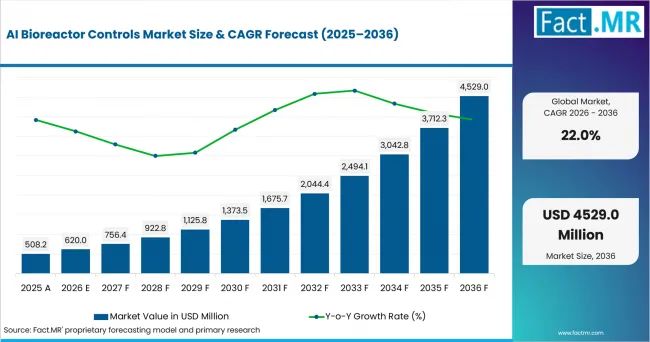
Ai Bioreactor Controls Market Value Analysis | Source: Fact.MR
What are the defining numbers behind AI Bioreactor Controls Market growth?
USD 3,909 million absolute opportunity by 2036, led by control software, feed optimization and biopharma.
- Demand Drivers in the Market
- Biopharma process teams need control software that protects batch consistency. FDA CDER reported that it approved 46 novel drugs in 2025, comprising new molecular entities and new therapeutic biologics.
- Process-development teams need feed and gas control that can work with new biomanufacturing formats. On August 28, 2025, NSF TIP announced a USD 32.4 million investment in four teams to accelerate the adoption of cell-free systems and enable new biotechnology applications.
- UK life sciences manufacturers need traceable plant data as the sector scales. The Office for Life Sciences reported in October 2025 that biopharmaceutical companies employed 163,600 people in 2023/2024.
- Digital operations teams need paperless execution linked to equipment data. Bioreactor engineers use these records to review deviations and keep model recommendations tied to batch history.
- Key Segments Analyzed
- By Offering: Control software is expected to hold 38.0% share in 2026 because it turns process data into set-point, feed and alarm actions.
- By Control Function: Feed optimization is projected to account for 50.0% share in 2026, supported by tighter nutrient dosing needs in mammalian and microbial runs.
- By Bioreactor Mode: Fed-batch is anticipated to capture 37.0% share in 2026 due to its broad use in monoclonal antibody and biosimilar production.
- By End User: Biopharma is estimated to represent 49.0% share in 2026 owing to validated biologics manufacturing and strict batch documentation needs.
- Analyst Opinion at Fact.MR
- Shambhu Nath Jha, Principal Consultant at Fact.MR, states, “Control logic is becoming a quality and yield decision, not only an equipment decision. AI bioreactor controls are expected to gain budget where plants need fewer manual corrections and cleaner batch evidence. Vendors should combine bioprocess know-how, PAT integration and secure plant connectivity.”
- Strategic Implications
- Software vendors should show how feed models change titer, deviation rates and batch-review effort in real production runs.
- Bioreactor manufacturers should keep controller interfaces open enough to work with plant historians, MES tools and PAT sensors.
- CDMOs should use common recipe libraries so control logic transfers cleanly between development, pilot and production suites.
- End users should test AI recommendations under GMP change-control rules before allowing automatic adjustments in validated batches.
South Korea is expected to record 27.4% CAGR through 2036, supported by biologics exports and CDMO scale-up. The UK is projected to post 25.6% CAGR as life sciences manufacturing support expands. Germany is anticipated to advance at 24.4% CAGR, owing to pharmaceutical export depth. Japan is estimated to hold 23.1% CAGR through domestic biomanufacturing policy and PMDA digital work. The USA is forecast to reach 21.5% CAGR, led by biotechnology R&D and process automation.
How does the AI Bioreactor Controls Market break down by segment?
Control software leads Offering at 38.0%; feed optimization leads Control Function at 50.0%.
Which Offering dominates?
Control software is expected to hold 38.0% share in 2026.
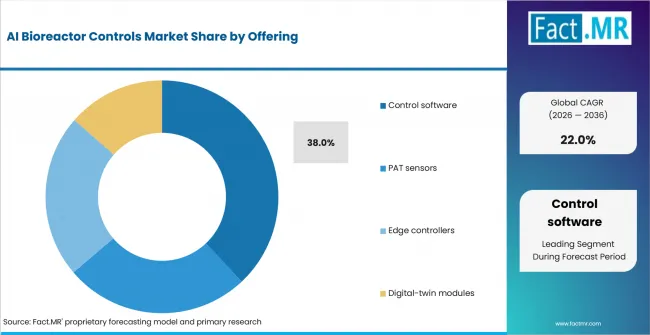
Ai Bioreactor Controls Market Analysis By Offering | Source: Fact.MR
Control software leads because it owns the interface between sensor signals and operating decisions. It manages recipes, alarms and exception handling when a culture moves away from target conditions. On April 9, 2025, Sartorius AG Stedim Biotech announced that it was working with Tulip Interfaces to develop Biobrain® Operate powered by Tulip, a suite of digital manufacturing applications designed to integrate seamlessly with Sartorius AG process equipment.
What leads the Control Function segment?
Feed optimization is projected to account for 50.0% share in 2026.
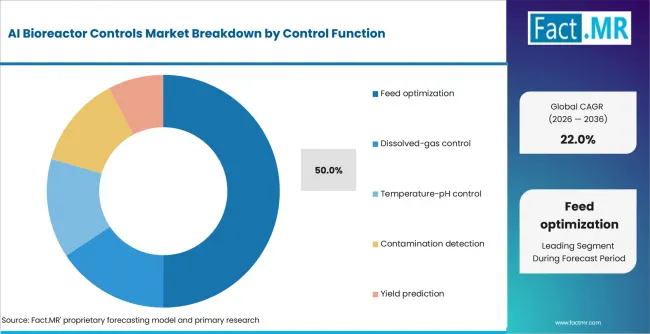
Ai Bioreactor Controls Market Analysis By Control Function | Source: Fact.MR
Feed optimization leads because nutrient delivery directly affects cell growth, product quality and batch consistency. AI tools can support feed-timing decisions when process signals move away from target conditions.
How does Bioreactor Mode shape demand?
Fed-batch is anticipated to capture 37.0% share in 2026.
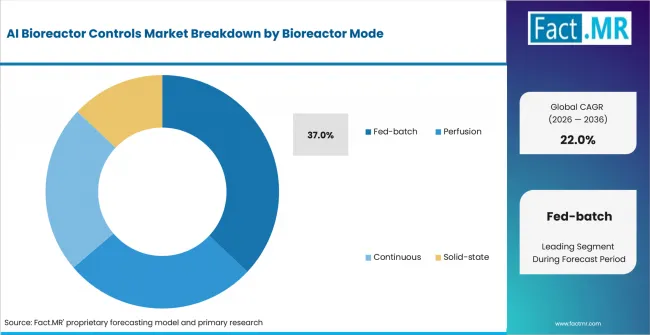
Ai Bioreactor Controls Market Analysis By Bioreactor Mode | Source: Fact.MR
Fed-batch leads because many biologics plants already run validated processes with defined feed schedules and quality limits. AI control can improve timing and deviation response without changing the full production model. Continuous and perfusion formats are gaining attention, yet fed-batch remains the practical base for near-term automation spending.
What supports demand for Biopharma within End User?
Biopharma is estimated to represent 49.0% share in 2026.
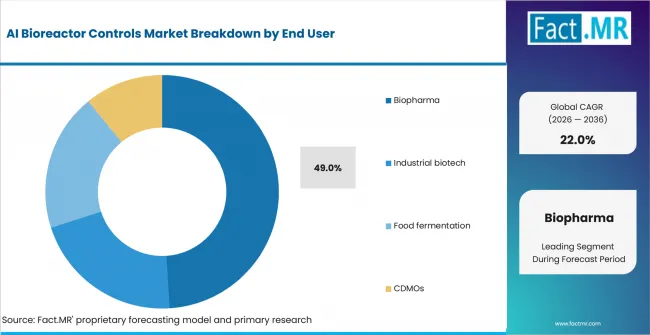
Ai Bioreactor Controls Market Analysis By End User | Source: Fact.MR
Biopharma leads because biologics production uses living cells and narrow process windows. Operators need stable pH, dissolved oxygen and feed conditions, while quality teams need records that support release review. The Office for Life Sciences reported in October 2025 that 2,960 companies operated in the UK biopharmaceutical subsector in 2023/2024.
What is accelerating AI Bioreactor Controls Market adoption, and what is holding it back?
Feed automation drives it; validation burden restrains it.
Drivers Impact Analysis
| DRIVER | (~) % IMPACT ON CAGR | GEOGRAPHIC RELEVANCE | IMPACT TIMELINE |
|---|---|---|---|
| Feed optimization in biologics production | +2.1% | Global | Short term (<= 2 years) |
| PAT sensor integration with control software | +1.7% | North America, Europe, East Asia | Medium term (2-4 years) |
| CDMO scale-up and tech transfer needs | +1.4% | USA, South Korea, Germany | Medium term (2-4 years) |
| Data-rich batch review requirements | +1.0% | Global | Long term (>= 4 years) |
Source: Fact.MR analysis. Updated Aug 24, 2026
- Feed optimization in biologics production: Better feed timing reduces manual intervention and supports predictable cell growth. AI tools are expected to gain use where operators can prove nutrient-control benefits without weakening validated recipes.
- PAT sensor integration with control software: PAT sensors make control decisions more useful when dissolved gas, metabolites and viable-cell indicators enter the control layer. Software vendors should keep sensor connections explainable for process engineers.
- CDMO scale-up and tech transfer needs: CDMOs need repeatable recipes across client programs. Control platforms are anticipated to gain use where development data can move into pilot and commercial suites with fewer manual translations.
- Data-rich batch review requirements: Quality groups increasingly ask for clear links between process readings and control actions. Platforms that preserve audit trails are expected to reduce review friction in regulated biomanufacturing.
Opportunity Impact Analysis
| OPPORTUNITY | (~) % IMPACT ON CAGR | GEOGRAPHIC RELEVANCE | IMPACT TIMELINE |
|---|---|---|---|
| Digital-twin modules for scale-up | +1.3% | Global | Medium term (2-4 years) |
| Continuous and perfusion control packages | +1.0% | USA, Germany, Japan | Long term (>= 4 years) |
| Contamination detection workflows | +0.8% | Global | Short term (<= 2 years) |
Source: Fact.MR analysis. Updated Aug 24, 2026
- Digital-twin modules for scale-up: Digital twins help teams test recipe changes before plant execution. Adoption is projected to rise where developers need faster scale-up without exposing live batches to avoidable risk.
- Continuous and perfusion control packages: Perfusion and continuous formats rely on stable long-duration control. Suppliers that combine bioreactor automation with downstream coordination are likely to gain attention from advanced plants.
- Contamination detection workflows: Early deviation signals help operators isolate process risk before a batch fails. AI models should be trained on plant-specific data so warnings remain useful and explainable.
Restraints Impact Analysis
| RESTRAINT | (~) % IMPACT ON CAGR | GEOGRAPHIC RELEVANCE | IMPACT TIMELINE |
|---|---|---|---|
| GMP validation of adaptive control | -0.8% | Global | Short term (<= 2 years) |
| Sensor calibration and data quality limits | -0.6% | North America, Europe | Medium term (2-4 years) |
| Legacy plant integration costs | -0.5% | Europe, Japan, USA | Long term (>= 4 years) |
Source: Fact.MR analysis. Updated Aug 24, 2026
- GMP validation of adaptive control: Automated recommendations must be tested under change-control procedures. Some plants are expected to limit AI to advisory mode until deviation rules are fully validated.
- Sensor calibration and data quality limits: AI control is only useful when sensor signals are stable and trusted. Poor calibration raises false alarms and weakens confidence in automated feed or gas decisions.
- Legacy plant integration costs: Older sites may use mixed controllers, historians and batch systems. Integration cost can delay projects when the expected yield gain is not documented clearly.
Which countries are scaling the AI Bioreactor Controls Market through 2036?
- The country comparison spans 5.9 percentage points and forms three practical growth bands across the forecast period.
- South Korea remains 1.8 percentage points above the UK through biologics export scale and CDMO investment logic.
- The UK remains 1.2 percentage points above Germany as life sciences manufacturing support widens the adoption base.
- Germany remains 1.3 percentage points above Japan through medicinal product exports and regulated plant depth.
- Japan remains 1.6 percentage points above the USA through domestic biomanufacturing policy and PMDA digital review work.
- The USA closes the displayed range but remains a high-value adoption base through biotechnology R&D and process automation.
Comparable CAGRs can create different entry conditions because each country has a different mix of biologics manufacturing, regulatory review pressure and automation maturity. Full report coverage includes North America, Latin America, Western Europe, Eastern Europe, East Asia, South Asia & Pacific, Middle East & Africa.
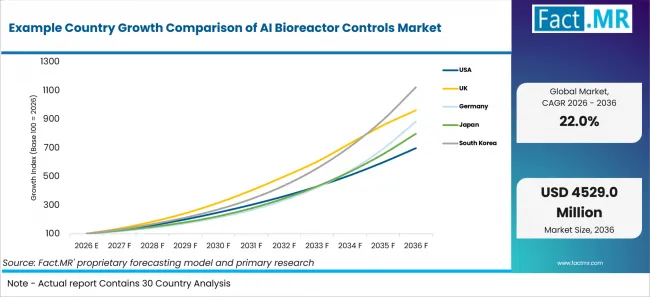
Example Country Growth Comparison Of Ai Bioreactor Controls Market | Source: Fact.MR
| Country | CAGR (2026-2036) |
|---|---|
| South Korea | 27.4% |
| United Kingdom | 25.6% |
| Germany | 24.4% |
| Japan | 23.1% |
| USA | 21.5% |
Source: Fact.MR analysis. Updated Aug 24, 2026
What supports South Korea adoption?
27.4% CAGR, supported by biologics exports and CDMO scale-up.
South Korea is projected to remain at the upper end of the profiled range as biologics exporters and CDMOs add more controlled production capacity. MOHW reported in March 2026 that biohealth exports reached USD 27.9 billion in 2025, while BIO KOREA 2026 brought 775 companies from 59 countries to Seoul in April 2026. Control vendors are expected to benefit where export programs need stable batch evidence and cleaner tech transfer.
How is the United Kingdom scaling demand?
25.6% CAGR, driven by life sciences manufacturing support.
The UK is expected to scale AI bioreactor controls as biopharmaceutical companies add digital manufacturing routines. The Office for Life Sciences reported GBP 98.9 billion in UK biopharmaceutical turnover in 2023/2024. In April 2026, DSIT announced that three companies were investing more than GBP 80 million in UK life-sciences manufacturing, with backing from the Life Sciences Innovative Manufacturing Fund.
What is supporting Germany’s adoption?
24.4% CAGR, supported by medicinal product exports and regulated plant depth.
Germany is anticipated to remain a strong Western European market because pharmaceutical exporters require repeatable process control and validated data. Eurostat reported in April 2026 that Germany exported EUR 67.9 billion of medicinal and pharmaceutical products to non-EU countries in 2025. That export base is expected to keep automation decisions tied to documentation quality and process stability.
How does Japan perform?
23.1% CAGR, led by biomanufacturing policy and PMDA digital work.
Japan is estimated to grow as domestic biopharmaceutical manufacturing policy expands. METI stated on January 1, 2025, that it would promote the building of domestic manufacturing bases for biopharmaceuticals, while PMDA formulated its Action Plan for the Use of AI in Operations on September 26, 2025.
What supports USA adoption?
21.5% CAGR, backed by biotechnology R&D and process automation.
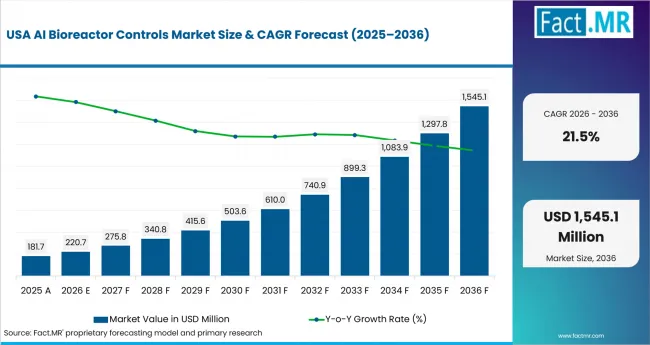
Ai Bioreactor Controls Market Country Value Analysis | Source: Fact.MR
The USA is forecast to remain a high-value market because biotechnology R&D is concentrated inside pharmaceutical and medicine manufacturing. NCSES reported in July 2025 that biotechnology business R&D accounted for 17% of U.S. business R&D in 2022, with 75% performed within pharmaceuticals and medicine manufacturing. Adoption is expected to favor systems that prove yield and documentation gains under GMP review.
Who leads the AI Bioreactor Controls Market?
Sartorius AG and Cytiva for direct bioreactor-control coverage, with Emerson Electric Co. and Siemens AG profiled as broader plant-automation participants.
Sartorius AG participates through Biobrain software, Biostat control platforms and digital manufacturing applications for single-use bioprocessing. Cytiva supports upstream and downstream control through Figurate automation and Xcellerex bioreactor workflows. Emerson Electric Co.’s DeltaV platform connects DCS, MES and scheduling data for regulated life sciences production environments.
Siemens AG provides broader industrial AI, digital-twin and automation capability, but the cited Hannover Messe announcement is not bioreactor-specific. Eppendorf SE directly supports bioprocess monitoring, control and automation through DASware, while BioNsight provides cloud-based bioprocess monitoring and analysis. Yokogawa’s Bio Pilot integrates bioreactors, PAT instruments and control systems for real-time data collection and automated bioprocess operations.
Which companies are the key providers?
Key companies include Sartorius AG, Cytiva, Emerson Electric Co., Siemens AG, Eppendorf SE, Yokogawa Electric Corporation.
- Sartorius AG
- Cytiva
- Emerson Electric Co.
- Siemens AG
- Eppendorf SE
- Yokogawa Electric Corporation
Bibliography
- U.S. Food and Drug Administration, Center for Drug Evaluation and Research. (2026, January). Advancing health through innovation: New drug therapy approvals 2025.
- U.S. National Science Foundation. (2025, August 28). NSF invests more than $32M in biotechnology, accelerating the adoption of cell-free systems.
- National Science Board, National Science Foundation. (2025, July 23). Discovery: R&D activity and research publications (Science and Engineering Indicators 2026, NSB-2025-7).
- Emerson. (2025, May 7). Emerson’s automation platform drives data mobility across life sciences value chain.
- Sartorius Stedim Biotech. (2025, April 9). Sartorius Stedim Biotech and Tulip partner to drive end-to-end biomanufacturing visibility and optimization.
- Siemens AG. (2025, March 31). Siemens accelerates path toward AI-driven industries through innovation and partnerships.
- Office for Life Sciences, Department for Science, Innovation and Technology, Department of Health and Social Care, & Department for Business and Trade. (2025, October 2). Bioscience and health technology sector statistics 2023 to 2024.
- Department for Science, Innovation and Technology. (2026, April 14). Vital medicines and new jobs in over £80 million for UK life sciences.
- Ministry of Economy, Trade and Industry. (2025, January 1). New Year Greetings 2025 - Minister of Economy, Trade and Industry.
- Pharmaceuticals and Medical Devices Agency. (2025, September 26). Action plan for the use of AI in operations at the PMDA.
This Report Answers
- The report explains where AI bioreactor controls are used across offering and control function.
- Segment analysis identifies control software and feed optimization as the main 2026 share positions.
- Country analysis examines South Korea, the UK, Germany, Japan and the USA.
- Competitive analysis reviews Sartorius AG, Cytiva, Emerson Electric Co., Siemens AG, Eppendorf SE and Yokogawa Electric Corporation.
- Application analysis assesses biopharma, industrial biotechnology, food fermentation and CDMO use cases.
What does the AI Bioreactor Controls Market cover?
The AI Bioreactor Controls Market covers software, sensors and automation modules that support bioreactor monitoring and process adjustment. It includes systems that recommend or execute feed changes, gas-control changes and alarms using real-time process data.
The assessment covers systems used in development, pilot and production bioreactors. It differs from general bioprocess equipment because the scope requires control intelligence, data supervision or automation logic tied to bioreactor operation.
What is included in the scope?
The scope includes control software, PAT sensors, edge controllers and digital-twin modules used in biopharma, industrial biotechnology, food fermentation and CDMO settings. It includes bioreactor controls linked with small-scale bioreactors, biologics manufacturing, cell culture platforms and continuous manufacturing systems. It also covers AI-assisted feed, dissolved-gas, temperature-pH, contamination and yield-prediction functions when these functions control or supervise bioreactor operation.
Conventional DCS, SCADA, MES and bioreactor-control products are included in the core market only where they provide AI-assisted, model-based or intelligent control functions tied directly to bioreactor operation. Otherwise, they are treated as adjacent enabling infrastructure rather than core AI bioreactor-controls revenue.
What is excluded from the scope?
The scope excludes base bioreactor vessels when sold without control intelligence or AI-assisted supervision. General laboratory information systems, standalone quality software and ordinary plant historians are outside the scope unless they directly manage or recommend bioreactor control actions.
How Was the Analysis Built?
The analysis draws on 120+ sources, 35+ company portfolios, 25+ countries, and more than 20 industry interviews.
- Primary Research: Primary research includes discussions with manufacturers, service providers, technology developers, distributors, end users, procurement teams, and subject-matter experts. These conversations examine purchasing priorities, product adoption, operational challenges, approval requirements, competitive positioning, and the factors that influence wider market acceptance.
- Desk Research: Desk research covers government statistics, regulatory publications, company filings, trade data, technical studies, industry associations, standards, public policy, and other authoritative sources. Every source used in the analysis is documented in the bibliography.
- Market Sizing and Forecasting: Market estimates combine historical performance, demand indicators, pricing and volume trends, segment shares, company participation, country-level growth, adoption patterns, investment activity, and barriers to market expansion.
- Data Validation and Update Cycle: Findings are validated by comparing primary interviews with public data, company activity, regulatory changes, trade patterns, and industry developments. Regular updates review new product launches, capacity changes, partnerships, approvals, procurement trends, and shifts in commercial adoption.
Segmentation
What is the report’s scope and coverage?
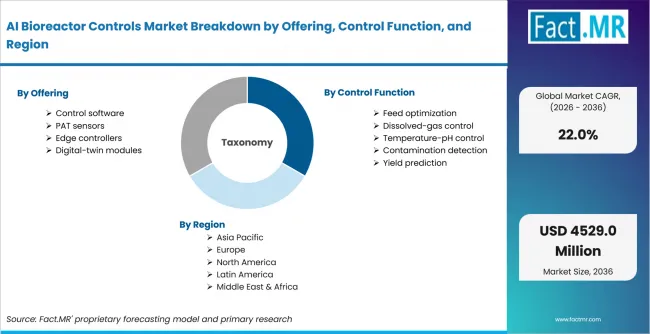
Ai Bioreactor Controls Market Breakdown By Offering, Control Function, And Region | Source: Fact.MR
| Attribute | Details |
|---|---|
| Quantitative Units | USD million |
| Market Definition | Software, sensors and control modules used to manage bioreactor conditions through AI-assisted monitoring, feed control, model-based recommendations and automated response logic. |
| Offering | Control software; PAT sensors; Edge controllers; Digital-twin modules. |
| Control Function | Feed optimization; Dissolved-gas control; Temperature-pH control; Contamination detection; Yield prediction. |
| Bioreactor Mode | Fed-batch; Perfusion; Continuous; Solid-state. |
| End User | Biopharma; Industrial biotech; Food fermentation; CDMOs. |
| Regions Covered | North America; Latin America; Western Europe; Eastern Europe; East Asia; South Asia & Pacific; Middle East & Africa. |
| Countries Covered | South Korea; United Kingdom; Germany; Japan; USA. |
| Key Companies Profiled | Sartorius AG, Cytiva, Emerson Electric Co., Siemens AG, Eppendorf SE, Yokogawa Electric Corporation. |
| Forecast Period | 2026 to 2036. |
| Approach | Hybrid top-down and bottom-up approach using bioreactor installations, control-software adoption, biologics activity, country growth and provider portfolio review. |
Source: Fact.MR analysis. Updated Aug 24, 2026
How is the market segmented?
-
By Offering:
- Control software
- PAT sensors
- Edge controllers
- Digital-twin modules
-
By Control Function:
- Feed optimization
- Dissolved-gas control
- Temperature-pH control
- Contamination detection
- Yield prediction
-
By Bioreactor Mode
- Fed-batch
- Perfusion
- Continuous
- Solid-state
-
By End User:
- Biopharma
- Industrial biotech
- Food fermentation
- CDMOs
-
By Region:
- North America
- Latin America
- Western Europe
- Eastern Europe
- East Asia
- South Asia & Pacific
- Middle East & Africa
Frequently Asked Questions
How big is the AI bioreactor controls market in 2026?
What is the CAGR of the AI bioreactor controls market from 2026 to 2036?
Which offering leads the AI bioreactor controls market?
Which control function leads the AI bioreactor controls market?
Who are the leading companies in the AI bioreactor controls market?
Who worked on this report


Preview the report firsthand - request a free sample
Free SampleGet the brochure for pricing and purchase details
Download PDF