- Market Value (2025): USD 1.9 Bn
- Estimated Value (2026): USD 2.4 Bn
- Forecast Value (2036): USD 22.4 Bn
- CAGR (2026-2036): 25.0%
What is the AI Retail Assistants Market forecast to be worth by 2036?
USD 2.4 billion in 2026 to USD 22.4 billion by 2036 at a 25.0% CAGR.
- The AI Retail Assistants Market reached USD 1.9 billion in 2025.
- Demand to increase from USD 2.4 billion in 2026 to USD 22.4 billion by 2036.
- The market is forecast to record 25.0% CAGR from 2026 to 2036, with guided selling, stock decisions and service handling incorporated into its demand outlook.
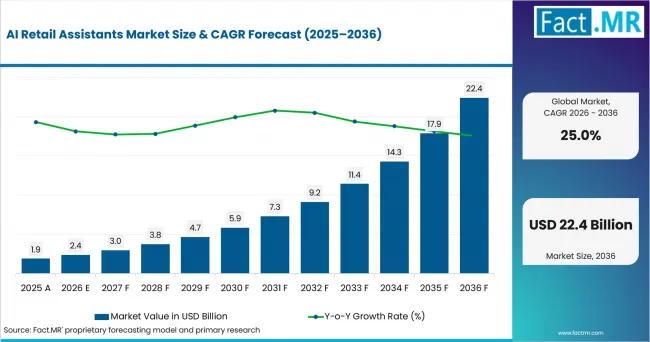
Ai Retail Assistants Market Value Analysis | Source: Fact.MR
What are the defining numbers behind AI Retail Assistants Market growth?
USD 20.0 billion in absolute opportunity from 2026 to 2036.
- Demand Drivers in the Market
- Digital commerce teams need product guidance that understands intent, since shoppers often describe needs before selecting exact SKU terms.
- Store operations teams need faster associate support because labor planning, returns and inventory checks now move across connected retail systems.
- Merchandising teams need forecast signals that link browsing patterns with stock planning, so assistants are being connected to planning dashboards.
- Customer service leaders need lower repeat-contact volume while keeping conversations useful, and agentic assistants give them a route to case deflection.
- The U.S. Census Bureau reported USD 340.2 billion in U.S. retail e-commerce sales for the second quarter of 2026.
- Key Segments Analyzed
- By Offering: Software platform is expected to hold 41.0% share in 2026 because retailers increasingly prefer a unified assistant layer connected with catalog, order and customer-service data.
- By Deployment: Cloud is projected to account for 51.0% share in 2026 as scalable model access supports AI deployment across digital stores, commerce platforms and contact centers.
- By Capability: Forecasting is anticipated to capture 44.0% share in 2026 because retailers need stronger demand visibility across online, store and marketplace channels.
- By Customer Type: Large enterprise is estimated to represent 42.0% share in 2026 owing to larger data environments, broader commerce operations and stronger budgets for AI governance and deployment.
- Analyst Opinion at Fact.MR
- Shambhu Nath Jha, Principal Consultant at Fact.MR, states, “Retail assistants are becoming more relevant as shopper intent, store execution and inventory data converge across connected workflows. Adoption is expected to broaden as retailers extend assistants across search, selling and service tasks. Suppliers are likely to compete on retail-data connectivity, governance and forecast performance as these systems move deeper into daily commerce operations.”
- Strategic Implications
- Software vendors should connect assistant outputs with product, order and inventory records so answers reflect live retail conditions.
- Cloud providers should document latency, security and data-residency controls because enterprise retailers test assistants inside high-volume customer channels.
- Retail operators should define escalation rules before launch, since assistant errors carry service cost and brand risk in customer conversations.
- Implementation partners should train associates on prompt use and exception handling so assistants improve daily work inside existing retail systems.
The United Kingdom at 27.2% CAGR through 2036, supported in its outlook by online shopping share and guided product discovery. South Korea is forecast at 25.9% CAGR based on mobile shopping depth and large online transaction pools. Germany is forecast at 24.5% CAGR, shaped by internet and mail-order retail activity. Japan is forecast at 21.0% CAGR, supported by retail scale and chain demand for multilingual assistance. The USA is forecast at 18.7% CAGR as large retailers expand assistant use across shopping and service workflows.
How does the AI Retail Assistants Market break down by segment?
Cloud at 51.0% of Deployment and Forecasting at 44.0% of Capability in 2026.
Which Offering category leads?
Software platform at 41.0% share in 2026.
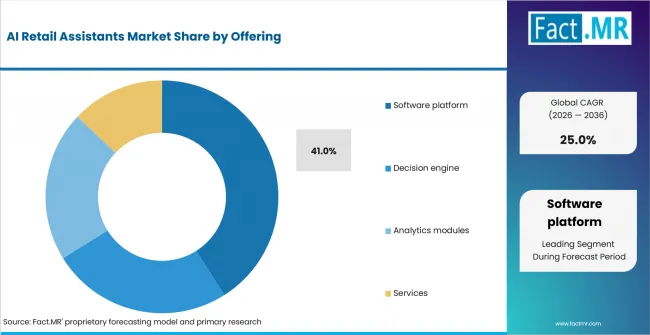
Ai Retail Assistants Market Analysis By Offering | Source: Fact.MR
Software platforms lead because retailers need one operating layer for catalog search, guided selling and service routing. A platform approach also supports governance, prompt controls and handoffs to human teams.
Microsoft Corporation announced new retail agentic AI capabilities on January 8, 2026, including Brand Agents for merchants on Shopify and a personalized shopping agent template in Copilot Studio. Microsoft Corporation said both solutions support personalized, conversational shopping across retailers’ owned digital experiences.
What leads the Deployment segment?
Cloud at 51.0% share in 2026.
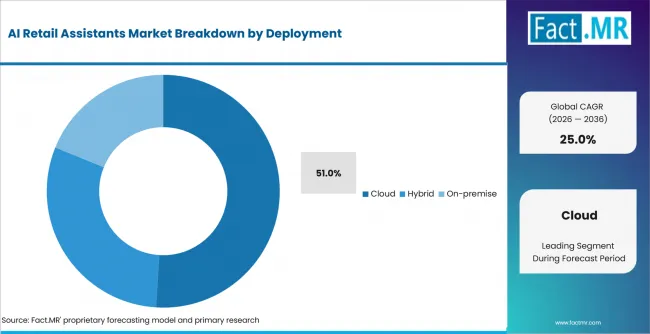
Ai Retail Assistants Market Analysis By Deployment | Source: Fact.MR
Cloud leads because retailers need access to generative AI models while avoiding separate model-hosting environments for every brand or banner. Centralized deployment helps teams update guardrails and product data faster.
Google Cloud announced general availability of its Conversational Commerce agent on September 10, 2025, with access through the Vertex AI console. Google Cloud describes the agent as guiding shoppers through natural conversations from initial intent to a completed purchase.
How does Capability shape demand?
Forecasting at 44.0% share in 2026.
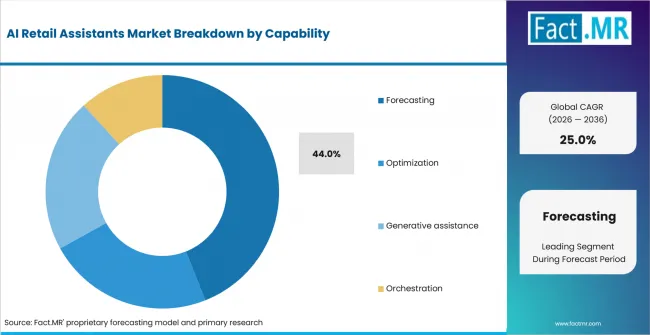
Ai Retail Assistants Market Analysis By Capability | Source: Fact.MR
Forecasting leads because retail assistants gain value when they move beyond answers and support planning decisions. Merchandising teams need signals that connect product interest with store replenishment and promotion timing.
The Office for National Statistics reported in July 2026 that online sales values in Great Britain rose 14.4% year over year in June 2026.
What supports Large enterprise within Customer Type?
Large enterprise at 42.0% share in 2026.
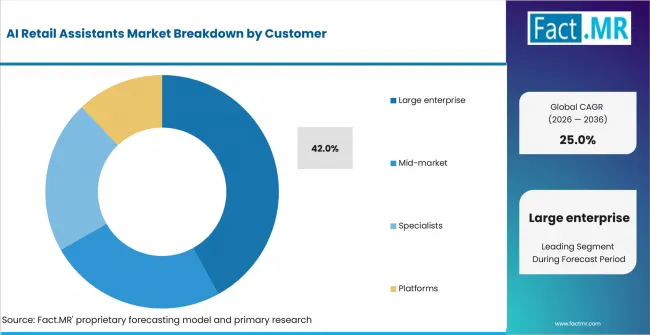
Ai Retail Assistants Market Analysis By Customer | Source: Fact.MR
Large enterprises lead because they operate more customer journeys, more stores and more data systems than smaller retailers. They also have AI governance teams that review security, response quality and data access.
IBM corporation announced the Agent Catalog in watsonx Orchestrate on May 6, 2025, designed to simplify access to 150+ agents and pre-built tools, with planned availability in June 2025. IBM corporation also described integration with more than 80 enterprise applications and support for multi-agent, multi-tool coordination.
What is accelerating AI Retail Assistants Market adoption, and what is holding it back?
Adoption as supported by digital commerce scale and constrained by data quality, integration work and trust controls.
| DRIVER | (~) % IMPACT ON CAGR |
GEOGRAPHIC RELEVANCE |
IMPACT TIMELINE |
|---|---|---|---|
| Guided product discovery across online retail journeys | +2.4% | North America, Western Europe, East Asia | Short term (<= 2 years) |
| Forecasting and replenishment support for merchandise teams | +1.8% | Global | Medium term (2-4 years) |
| Customer service deflection and associate support | +1.5% | North America, South Korea, UK | Medium term (2-4 years) |
| Agentic orchestration across commerce and service systems | +1.0% | Global | Long term (>= 4 years) |
- Guided product discovery across online retail journeys: Retailers place assistants where shoppers ask broad questions and need product choices narrowed quickly.
- Forecasting and replenishment support for merchandise teams: Assistants become more useful when they connect digital behavior with item, store and stock signals.
- Customer service deflection and associate support: Service teams use assistants to answer order questions and guide staff through repeatable tasks.
| OPPORTUNITY | (~) % IMPACT ON CAGR |
GEOGRAPHIC RELEVANCE |
IMPACT TIMELINE |
|---|---|---|---|
| Conversational commerce tied to search and checkout | +1.6% | USA, UK, Japan | Short term (<= 2 years) |
| Mobile-first assistants for marketplace and app retail | +1.3% | South Korea, Japan | Medium term (2-4 years) |
| Store associate copilots for inventory and clienteling | +0.9% | North America, Western Europe | Long term (>= 4 years) |
- Conversational commerce tied to search and checkout: Google Cloud’s September 2025 Conversational Commerce agent places assistance inside the buying journey.
- Mobile-first assistants for marketplace and app retail: South Korea’s mobile shopping share supports assistants built for app journeys and repeat purchases.
- Store associate copilots for inventory and clienteling: Store teams are likely to use assistants where staff need fast access to customer and product context.
| RESTRAINT | (~) % IMPACT ON CAGR |
GEOGRAPHIC RELEVANCE |
IMPACT TIMELINE |
|---|---|---|---|
| Poor catalog and inventory data quality | -0.8% | Global | Short term (<= 2 years) |
| Privacy and governance reviews before customer-facing use | -0.6% | North America, Europe | Medium term (2-4 years) |
| Integration burden across legacy retail systems | -0.5% | Global | Long term (>= 4 years) |
- Poor catalog and inventory data quality: Assistants lose value when item data, availability and policies differ across channels.
- Privacy and governance reviews before customer-facing use: Retailers test data access and escalation rules before assistants answer shoppers directly.
- Integration burden across legacy retail systems: Older order, loyalty and store systems increase implementation work and slow wider deployment.
Which countries are scaling the AI Retail Assistants Market through 2036?
- The displayed comparison spans 8.5 percentage points and forms three practical growth bands across the forecast period.
- The United Kingdom remains 1.3 percentage points above South Korea through online retail share and retailer demand for guided commerce.
- South Korea remains 1.4 percentage points above Germany as mobile shopping depth supports app-based assistant use.
- Germany remains 3.5 percentage points above Japan through Internet and mail-order retail resilience.
- Japan remains 2.3 percentage points above the USA because large retail chains need multilingual service and product guidance.
- The USA closes the displayed range while retail scale creates a large base for cloud assistants and enterprise deployments.
Comparable CAGRs can create different entry conditions due to digital share, mobile shopping intensity, retail-system maturity and data governance. Full report coverage includes North America, Latin America, Western Europe, Eastern Europe, East Asia, South Asia & Pacific, Middle East & Africa.
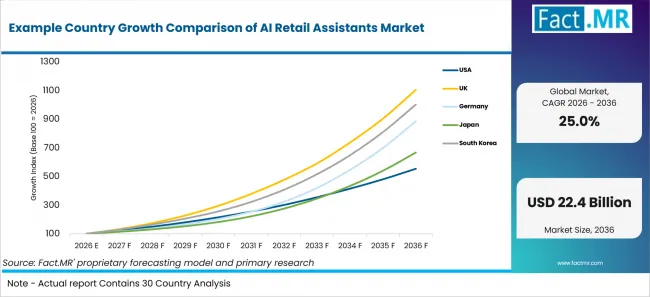
Example Country Growth Comparison Of Ai Retail Assistants Market | Source: Fact.MR
| Country | CAGR (2026-2036) |
|---|---|
| United States | 18.7% |
| United Kingdom | 27.2% |
| Germany | 24.5% |
| Japan | 21.0% |
| South Korea | 25.9% |
What supports USA adoption?
18.7% CAGR, supported in its outlook by retail scale and enterprise AI investment.
The U.S. Census Bureau reported July 2026 retail and food services sales of USD 763.6 billion, up 5.0% from July 2025. This large retail activity base to support enterprise use of assistants across product search, order support and contact-center workflows.
What supports the United Kingdom’s growth?
27.2% CAGR, supported in its outlook by online retail penetration and guided-commerce demand.
ONS initially reported in July 2026 that online sales accounted for 29.4% of Great Britain retail sales in June 2026, the highest proportion since April 2021; the June share was subsequently revised to 29.2% in August 2026. This online retail penetration supportive of assistant use for product search, comparison and service requests.
What supports Germany adoption?
24.5% CAGR, shaped in its outlook by internet-retail activity and service automation.
Destatis reported that internet and mail-order retail turnover in June 2026 increased 4.9% in real terms from June 2025. Continued internet and mail-order activity as supportive of retail-assistant use across product information and digital service workflows.
How does Japan perform?
21.0% CAGR, supported in its outlook by retail scale and chain-level service use.
METI reported in April 2026 that Japan’s 2025 retail sales increased 1.4% from the previous year. Japan’s retail scale to support selective assistant deployment for product guidance, multilingual service and store-associate workflows.
How is South Korea scaling demand?
25.9% CAGR, supported in its outlook by mobile-shopping penetration and marketplace activity.
Statistics Korea reported April 2025 online shopping transaction value of KRW 21.6858 trillion, with mobile shopping accounting for 77.4% of the total. This mobile-shopping intensity supportive of assistant use for product, delivery and promotion interactions inside app-based journeys.
Who leads the AI Retail Assistants Market?
Salesforce, Inc. offers Agentforce for Retail for retail commerce, service and store workflows. Microsoft Corporation provides retail agents built through Copilot Studio and Azure AI Foundry for access to retail data and workflows. Google Cloud provides Conversational Commerce agent through Vertex AI, while Amazon Web Services provides agent-building and multi-agent capabilities through Amazon Bedrock.
IBM corporation provides watsonx Orchestrate and its Agent Catalog, while Oracle Corporation provides Retail AI Foundation Cloud Services for retail planning, operations and analytics.
Which companies are the key providers?
Key companies include Salesforce, Inc.; Microsoft Corporation; Google Cloud; Amazon Web Services; IBM corporation; and Oracle Corporation.
- Salesforce, Inc.
- Microsoft Corporation
- Google Cloud
- Amazon Web Services
- IBM corporation
- Oracle Corporation
Bibliography
- Amazon Web Services. (2025, March 10). Amazon Bedrock now supports multi-agent collaboration.
- Federal Statistical Office (Destatis). (2026, August 3). Einzelhandelsumsatz im Juni 2026 real um 1,1 % niedriger als im Vormonat [Retail turnover in June 2026 down 1.1% in real terms from the previous month].
- IBM. (2025, May 6). IBM accelerates enterprise gen AI revolution with hybrid capabilities.
- Microsoft. (2026, January 8). Microsoft propels retail forward with agentic AI capabilities that power intelligent automation for every retail function.
- Office for National Statistics. (2026, July 24). Retail sales, Great Britain: June 2026.
- Salesforce. (2025, January 10). Salesforce unveils Agentforce for Retail to boost productivity with digital labor and Retail Cloud to unite in-store and digital shopping.
- Statistics Korea. (2025, June 2). Online shopping in April 2025.
- U.S. Census Bureau. (2026, August 14). Advance monthly sales for retail and food services.
- U.S. Census Bureau. (2026, August 18). Quarterly retail e-commerce sales: 2nd quarter 2026.
This Report Answers
- The report explains where AI retail assistants are used across offering, deployment, capability and customer type.
- Segment analysis identifies the leading subsegments and the operational reasons retailers prioritize them.
- Country analysis examines the listed markets and the digital retail mechanisms supporting assistant deployment.
- Competitive analysis reviews current providers across commerce clouds, agent platforms and enterprise orchestration.
- Application analysis assesses how guided selling, forecasting and service support influence purchase decisions.
What does the AI Retail Assistants Market cover?
The AI Retail Assistants Market covers software that supports shopper guidance, store associate assistance and retail workflow automation. It overlaps with retail analytics when assistants turn transaction data into planning signals.
The assessment also connects with AI in retail as retailers apply generative systems to search, service and merchandise decisions. Coverage includes software platforms, decision engines, analytics modules and services used across cloud, hybrid and on-premise deployment.
What is included in the scope?
The scope includes licensed AI assistant software, retail cloud assistant modules and managed services where guided interaction is part of the product. It includes agentic retail AI when agents perform retail tasks inside governed workflows.
It includes forecasting, optimization, generative assistance and orchestration tools used by retailers, marketplaces and store operations teams. It also covers recommendation software and recommendation engines when they are embedded inside a retail assistant experience.
Assistant deployments may connect to cognitive commerce systems and frictionless retail infrastructure where checkout, service and product discovery share customer context.
What is excluded from the scope?
The scope excludes general enterprise chatbots that lack retail catalog, order or merchandise data. It excludes alternative retailing technologies when the system lacks an AI assistant function.
Pure hardware, payment terminals and in-store displays are outside the scope except where assistant software is bundled as the primary value proposition. An AI kiosk is counted only when the assistant layer supports guided retail interaction.
Customer counting tools and camera analytics remain outside the scope except where they feed an assistant decision layer. Related retail audience measurement systems therefore remain adjacent unless they deliver assistant-led action recommendations.
How Was the Analysis Built?
The analysis draws on 120+ sources, 35+ company portfolios, 25+ countries, and more than 20 industry interviews.
- Primary Research: Primary research includes discussions with manufacturers, service providers, technology developers, distributors, end users, procurement teams, and subject-matter experts. These conversations examine purchasing priorities, product adoption, operational challenges, approval requirements, competitive positioning, and the factors that influence wider market acceptance.
- Desk Research: Desk research covers government statistics, regulatory publications, company filings, trade data, technical studies, industry associations, standards, public policy, and other authoritative sources. Every source used in the analysis is documented in the bibliography.
- Market Sizing and Forecasting: Market estimates combine historical performance, demand indicators, pricing and volume trends, segment shares, company participation, country-level growth, adoption patterns, investment activity, and barriers to market expansion.
- Data Validation and Update Cycle: Findings are validated by comparing primary interviews with public data, company activity, regulatory changes, trade patterns, and industry developments. Regular updates review new product launches, capacity changes, partnerships, approvals, procurement trends, and shifts in commercial adoption.
What is the report’s scope and coverage?
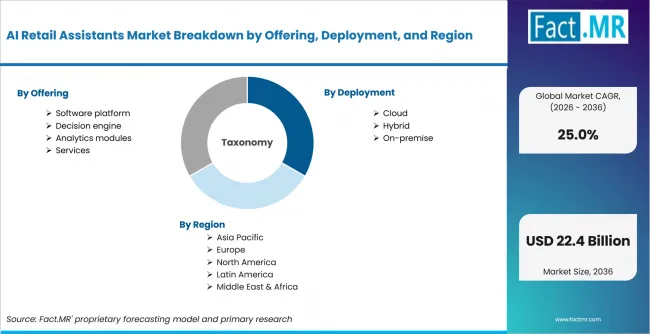
Ai Retail Assistants Market Breakdown By Offering, Deployment, And Region | Source: Fact.MR
| Attribute | Details |
|---|---|
| Quantitative Units | USD billion |
| Market Definition | Software and cloud services that help shoppers, store associates and retail teams answer questions, guide product selection, forecast demand and coordinate retail workflows. |
| Offering | Software platform; Decision engine; Analytics modules; Services |
| Deployment | Cloud; Hybrid; On-premise |
| Capability | Forecasting; Optimization; Generative assistance; Orchestration |
| Customer Type | Large enterprise; Mid-market; Specialists; Platform operators |
| Regions Covered | North America; Latin America; Western Europe; Eastern Europe; East Asia; South Asia & Pacific; Middle East & Africa |
| Countries Covered | USA; UK; Germany; Japan; South Korea |
| Key Companies Profiled | Salesforce, Inc.; Microsoft Corporation; Google Cloud; Amazon Web Services; IBM corporation; Oracle Corporation |
| Forecast Period | 2026 to 2036 |
| Approach | Hybrid top-down and bottom-up approach using retail software spending, digital commerce activity, deployment mix, segment shares, country adoption and provider portfolio review. |
How is the market segmented?
-
By Offering:
- Software platform
- Decision engine
- Analytics modules
- Services
-
By Deployment:
- Cloud
- Hybrid
- On-premise
-
By Capability:
- Forecasting
- Optimization
- Generative assistance
- Orchestration
-
By Customer Type:
- Large enterprise
- Mid-market
- Specialists
- Platform operators
-
By Region:
- North America
- Latin America
- Western Europe
- Eastern Europe
- East Asia
- South Asia & Pacific
- Middle East & Africa