- Market Value (2025): USD 293.8 Mn
- Estimated Value (2026): USD 310 Mn
- Forecast Value (2036): USD 529 Mn
- CAGR (2026-2036): 5.5%
What is the aircraft water service trucks market forecast to be worth by 2036?
USD 310 million in 2026 to USD 529 million by 2036, at 5.5% CAGR.
- The aircraft water service trucks market reached USD 293.8 million in 2025.
- Market value is projected to increase to USD 310 million in 2026 to USD 529 million by 2036.
- The market is forecast to expand at 5.5% CAGR during the forecast period as airports continue replacing aging service fleets with efficient low emission vehicles.
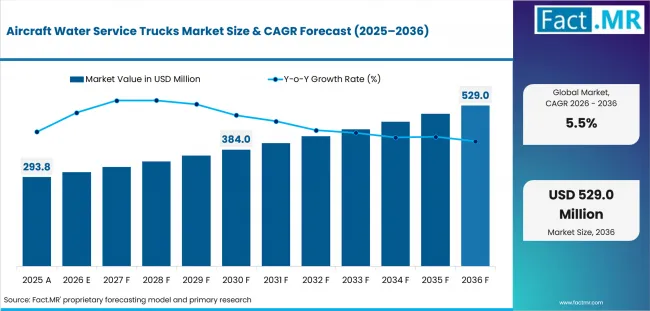
Aircraft Water Service Trucks Market Market Value Analysis | Source: Fact.MR
What are the defining numbers behind aircraft water service trucks market growth?
USD 219 million absolute opportunity by 2036, supported by airport fleet renewal and aviation infrastructure investment.
- Demand Drivers in the Market
- Airports continue replacing older ground service vehicles with modern equipment.
- Higher passenger traffic increases demand for dependable aircraft servicing.
- Electric airport vehicles improve environmental performance across airport fleets.
- Airlines seek faster turnaround through efficient ground support operations.
- Key Segments Analyzed
- By Vehicle Type: Truck mounted units are expected to account for 44.0% share in 2026 because they remain the preferred solution for commercial airport operations.
- By Capacity: Narrowbody units are projected to hold 36.0% share in 2026 as single aisle aircraft continue representing the largest global fleet.
- By Airport: Commercial airports are forecast to represent 58.0% share in 2026 because they handle the highest volume of daily aircraft movements.
- By Powertrain: Diesel powertrains are expected to account for 52.0% share in 2026.
- By Buyer Type: Ground handlers are expected to capture 37.0% share in 2026 as they operate large airport service fleets across multiple terminals.
- By Geography: The United States is projected to record 5.9% CAGR through 2036 as airport infrastructure investment continues expanding.
- Analyst Opinion at Fact.MR
- Shambhu Nath Jha, Senior Analyst at Fact.MR, states, "Aircraft water service trucks remain an essential part of airport ground operations. Suppliers that improve vehicle reliability and introduce low emission platforms will strengthen their position as airports continue modernizing support fleets."
- Strategic Implications
- Manufacturers should develop electric water service vehicles for high traffic airports.
- Airport operators should modernize aging fleets to improve operational efficiency.
- Fleet managers should adopt predictive maintenance to reduce vehicle downtime.
- Equipment suppliers should improve water tank hygiene and monitoring technology.
Aircraft water service trucks supply potable water to commercial aircraft before departure. These vehicles support passenger comfort while helping airlines maintain scheduled turnaround operations. Reliable equipment also improves service quality across busy airport environments.
Demand continues growing because passenger traffic is increasing across many regions. Airport operators are investing in modern service fleets that improve operating efficiency and reduce maintenance costs. Electric vehicle adoption is also creating new opportunities for airport support equipment suppliers.
The United States is projected to record 5.9% CAGR through 2036 because airport modernization projects continue expanding. Germany is expected to achieve 5.7% CAGR through airport fleet renewal. China is likely to register 5.6% CAGR through terminal expansion. Japan is forecast to grow at 5.4% CAGR through airport equipment upgrades. India is anticipated to record 5.2% CAGR as aviation infrastructure investment continues increasing.
How does the aircraft water service trucks market break down by segment?
Truck mounted units lead at 44.0%. Narrowbody units lead at 36.0%.
Which vehicle type dominates?
Truck mounted units hold 44.0% share in 2026.
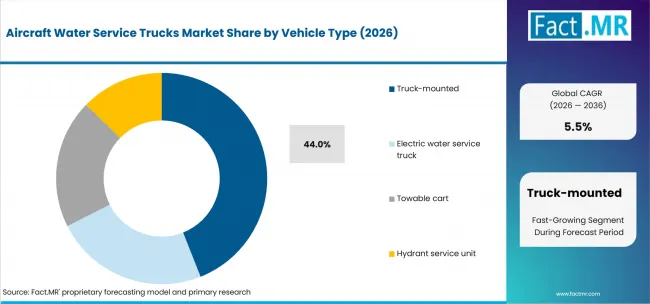
Aircraft Water Service Trucks Market Analysis By Vehicle Type | Source: Fact.MR
Truck-mounted units are expected to account for 44.0% share in 2026 because they provide dependable water delivery across high traffic airports. Their larger tanks reduce refill frequency during daily operations. Electric water service trucks gain attention through lower emissions. Towable carts remain suitable for smaller airports. Hydrant service units improve efficiency where fixed infrastructure is available. Mallaghan and dnata Catering & Retail announced the successful trial of an electric aircraft catering truck in Prague, demonstrating the viability of zero-emission aircraft servicing vehicles. During the 60-day trial, the truck covered 730 km, served 230 flights, and operated for 147 hours, maintaining reliable performance even in average temperatures of 1.6°C.
Which capacity dominates?
Narrowbody units lead with 36.0% share in 2026.
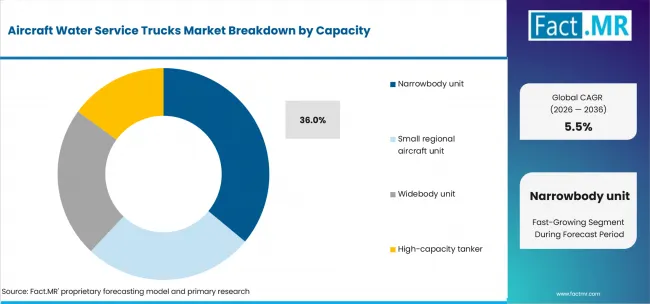
Aircraft Water Service Trucks Market Analysis By Capacity | Source: Fact.MR
Narrowbody units are projected to capture 36.0% share in 2026 because single-aisle aircraft operate the largest share of commercial flights. Frequent aircraft movements increase service demand. Small regional aircraft units remain important at regional airports. Widebody units support long haul operations. High capacity tankers serve airports with heavy international traffic. Oshkosh AeroTech announced it would showcase its latest portfolio of airport ground support equipment and technologies at the International GSE Expo 2025. The portfolio includes the AmpCart™ Towable Charging Platform, B80 Electric Tractor, B950 Electric Tractor, LEKTRO 88i Towbarless Tow Vehicle, AgileAir Cart, and Ranger Electric Cargo Loader, along with intelligent fleet management solutions.
Which powertrain dominates?
Diesel powertrains hold 52.0% share in 2026.
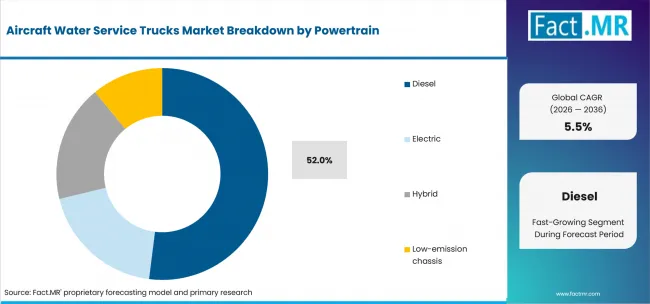
Aircraft Water Service Trucks Market Analysis By Powertrain | Source: Fact.MR
Diesel-powered vehicles remain the largest segment because they continue serving established airport fleets with proven reliability. The segment is expected to account for 52.0% share in 2026. Electric vehicles expand through airport sustainability programs. Hybrid models balance fuel efficiency with operating flexibility. Low emission chassis gain adoption through fleet replacement projects. Swissport International, the world's largest ground handler operating at ~300 airports with ~14,300 motorized GSE units, announced a procurement policy effective January 2025 mandating that all new vehicles for "fresh water supply" and "waste disposal" must be purchased in electric variants.
Which airport dominates?
Commercial airports lead with 58.0% share in 2026.
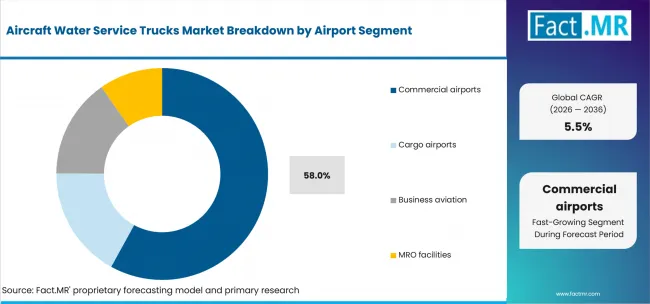
Aircraft Water Service Trucks Market Analysis By Airport Segment | Source: Fact.MR
Commercial airports are expected to account for 58.0% share in 2026 because they handle the highest number of passenger flights throughout the year. Greater aircraft activity creates consistent servicing demand. Cargo airports require dependable water service equipment. Business aviation supports premium service vehicles. MRO facilities maintain specialized servicing requirements. Mallaghan, a Northern Ireland-based GSE manufacturer, unveiled its first fully electric self-propelled toilet service truck at GSE Expo Europe 2024 in Lisbon. The vehicle features a 3,000-litre tank, 3-meter lifting platform, and 80V lithium-ion batteries compatible with standard airport chargers.
Which buyer type dominates?
Ground handlers lead with 37.0% share in 2026.
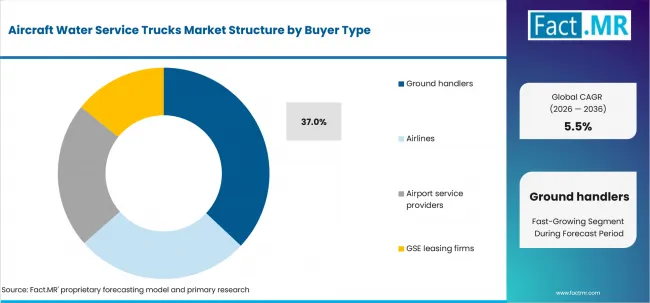
Aircraft Water Service Trucks Market Analysis By Buyer Type | Source: Fact.MR
Ground handlers remain the largest customer group because they manage aircraft servicing across multiple airlines and terminals. The segment is expected to account for 37.0% share in 2026. Airlines continue modernizing support fleets. Airport service providers improve operational capability. GSE leasing firms expand equipment availability through flexible rental models.
What is accelerating aircraft water service truck adoption, and what is holding it back?
Airport fleet modernization supports growth while high equipment costs remain a challenge.
Drivers Impact Analysis
| DRIVER | (~) % IMPACT ON CAGR | GEOGRAPHIC RELEVANCE | IMPACT TIMELINE |
|---|---|---|---|
| Airport fleet replacement | +0.8% | Global | Medium term (2-4 years) |
| Rising passenger traffic | +0.7% | Global | Long term (≥4 years) |
| Growth of electric airport vehicles | +0.5% | Europe, North America | Medium term (2-4 years) |
| Airport infrastructure expansion | +0.4% | Asia Pacific | Medium term (2-4 years) |
| Better fleet maintenance practices | +0.3% | Global | Short term (≤2 years) |
Source: Fact.MR analysis. Updated Jul 6, 2026
- Airport fleet replacement
- Many airports continue replacing older support vehicles with modern equipment. This improves service quality and operational reliability.
- Rising passenger traffic
- Higher flight activity increases the need for dependable aircraft servicing. Water service vehicles remain essential during aircraft turnaround.
- Growth of electric airport vehicles
- Electric service trucks help airports reduce emissions while lowering operating costs. Fleet electrification continues creating new opportunities.
- Airport infrastructure expansion
- New terminals require additional ground support equipment. Water service trucks remain part of every airport service fleet.
- Better fleet maintenance practices
- Predictive maintenance improves vehicle availability while reducing unexpected equipment failures. Operators also extend vehicle service life.
Opportunity Impact Analysis
| OPPORTUNITY | (~) % IMPACT ON CAGR | GEOGRAPHIC RELEVANCE | IMPACT TIMELINE |
|---|---|---|---|
| Electric water service fleets | +0.6% | Europe, North America | Long term (≥4 years) |
| Smart fleet monitoring | +0.5% | Global | Medium term (2-4 years) |
| Airport expansion projects | +0.4% | Asia Pacific, Middle East | Medium term (2-4 years) |
| Water quality monitoring systems | +0.3% | Global | Short term (≤2 years) |
Source: Fact.MR analysis. Updated Jul 6, 2026
- Electric water service fleets
- Airports continue reducing emissions through electric ground support vehicles. New fleet purchases increasingly include electric options.
- Smart fleet monitoring
- Connected fleet systems improve vehicle scheduling and maintenance planning. Operators gain better visibility across airport operations.
- Airport expansion projects
- New airport infrastructure creates demand for additional aircraft service vehicles. Equipment suppliers benefit from long-term fleet investment.
- Water quality monitoring systems
- Advanced monitoring improves hygiene standards during potable water delivery. Automated systems also simplify maintenance procedures.
Restraints Impact Analysis
| RESTRAINT | (~) % IMPACT ON CAGR | GEOGRAPHIC RELEVANCE | IMPACT TIMELINE |
|---|---|---|---|
| High equipment acquisition cost | -0.5% | Global | Medium term (2-4 years) |
| Slow fleet replacement cycles | -0.4% | Mature airports | Long term (≥4 years) |
| Maintenance requirements | -0.3% | Global | Short term (≤2 years) |
| Budget limits at smaller airports | -0.2% | Developing regions | Medium term (2-4 years) |
Source: Fact.MR analysis. Updated Jul 6, 2026
- High equipment acquisition cost
- Modern aircraft water service trucks require significant capital investment. Smaller operators often delay fleet replacement.
- Slow fleet replacement cycles
- Airport support vehicles normally remain in service for many years. Long replacement periods reduce annual equipment demand.
- Maintenance requirements
- Water tanks and pumping systems require regular inspection to maintain operational reliability. Preventive servicing remains essential.
- Budget limits at smaller airports
- Regional airports often prioritize essential infrastructure spending before replacing service fleets. Procurement decisions may therefore take longer.
Which countries are scaling aircraft water service truck fastest?
United States 5.9%; Germany 5.7%; China 5.6%; Japan 5.4%; India 5.2%.
Based on regional analysis, the aircraft water service trucks market is segmented into North America, Europe, East Asia, South Asia, Middle East and Africa and Latin America.
| Country | CAGR |
|---|---|
| United States | 5.9% |
| Germany | 5.7% |
| China | 5.6% |
| Japan | 5.4% |
| India | 5.2% |
Source: Fact.MR analysis. Updated Jul 6, 2026
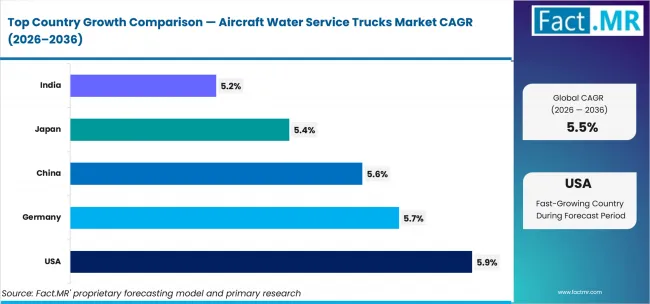
Aircraft Water Service Trucks Market Cagr Analysis By Country | Source: Fact.MR
What supports growth in the United States?
5.9% CAGR, driven by airport modernization and fleet replacement.
The United States is projected to record 5.9% CAGR from 2026 to 2036 as airports continue replacing aging ground support vehicles with modern service fleets. Higher passenger traffic increases aircraft servicing demand across major hubs. Investment in electric airport vehicles also supports gradual fleet transformation.
Why is Germany strengthening market demand?
5.7% CAGR, supported by cleaner airport operations.
Germany is expected to achieve 5.7% CAGR through 2036 because airport operators continue improving operational efficiency through low-emission ground equipment. Fleet renewal programs support demand for advanced water service trucks. Airports also continue investing in reliable service infrastructure.
What is driving China's market expansion?
5.6% CAGR, backed by airport infrastructure investment.
China is forecast to expand at 5.6% CAGR as airport construction projects continue increasing demand for ground support vehicles. Higher aircraft movements require dependable servicing equipment. Modern terminal development also supports fleet procurement.
Why does Japan maintain steady growth?
5.4% CAGR, driven by operational reliability.
Japan is likely to register 5.4% CAGR by 2036 because airport operators continue upgrading support fleets to improve turnaround efficiency. Reliable service vehicles remain important for maintaining high operational standards. Fleet modernization also supports gradual equipment replacement.
How is India creating future opportunities?
5.2% CAGR, supported by aviation infrastructure expansion.
India is expected to record 5.2% CAGR through 2036 as commercial airports continue expanding capacity across major cities. Growing passenger traffic increases demand for efficient aircraft servicing. Continued investment in airport infrastructure is expected to strengthen long term equipment demand.
Who leads the aircraft water service trucks market?
Mallaghan; Oshkosh AeroTech / JBT AeroTech; TLD; AERO Specialties shape market competition.
The market includes airport ground support equipment manufacturers and specialist airport vehicle suppliers. Mallaghan continues strengthening its position through a broad portfolio of aircraft service vehicles developed for commercial airports. Oshkosh AeroTech / JBT AeroTech maintains a strong presence by supplying integrated ground handling equipment for airline and airport operations.
TLD expands its airport service vehicle portfolio through dependable equipment designed for high utilization fleets. AeroMobiles focuses on potable water service vehicles that support aircraft turnaround activities. Albert Aviation supplies specialized airport service equipment for commercial aviation customers. AERO Specialties develops airport support vehicles with durable chassis designs. Stinar continues expanding electric airport service equipment that supports lower emission ground operations.
Competition increasingly depends on equipment reliability, operating efficiency and service support. Airport operators seek vehicles that reduce maintenance while improving daily productivity. Companies providing dependable aftersales support and modern vehicle technology are expected to strengthen their market position.
Which companies are the key providers?
Mallaghan and Oshkosh AeroTech / JBT AeroTech are leading providers. TLD and AeroMobiles remain established participants. Albert Aviation, AERO Specialties and Stinar complete the competitive landscape.
- Mallaghan
- Oshkosh AeroTech / JBT AeroTech
- TLD
- AERO Specialties
- Stinar
Bibliography
- Mallaghan. (2025, August 28). Mallaghan and dnata Catering & Retail power up innovation with successful electric catering truck trial. Mallaghan.
- Oshkosh AeroTech. (2025, September 10). Oshkosh AeroTech to showcase broad portfolio of products and technology at International GSE Expo 2025. Oshkosh AeroTech.
- Swissport International. (2024, September 13). Swissport accelerates shift to electric vehicles. Swissport International.
- Mallaghan. (2026). Water / lavatory tankers. Mallaghan.
- TLD. (2026). Lavatory and water trucks. TLD.
- Stinar. (2023, November 21). SPW-500 potable water truck. Stinar.
- AERO Specialties. (2026). AERO WC270E-WST aircraft potable water service truck. AERO Specialties.
- Oshkosh AeroTech. (2026). Airport operations maintenance & monitoring solutions. Oshkosh AeroTech.
This Report Addresses
- Strategic assessment of aircraft water service trucks across airport ground handling operations.
- Segment evaluation covering Truck-mounted Vehicles and Narrowbody Units.
- Country outlook for the United States, Germany, China, Japan and India.
- Competitive review of Mallaghan, Oshkosh AeroTech / JBT AeroTech, TLD, AeroMobiles, Albert Aviation, AERO Specialties and Stinar.
- Technology assessment covering electric water service trucks, hybrid powertrains, low-emission chassis and potable water delivery systems.
- Operational assessment covering commercial airports, cargo airports, business aviation facilities and MRO operations.
- Market estimates supported by airport modernization trends, fleet replacement analysis and primary industry interviews.
What does the aircraft water service trucks market cover?
Ground support vehicles designed to supply potable water to aircraft.
The market includes truck mounted units, electric water service trucks, towable carts and hydrant service units used across commercial airports and aviation facilities. These vehicles transport clean water safely while supporting aircraft servicing activities.
The assessment focuses on dedicated aircraft potable water service vehicles. Fuel trucks, lavatory service trucks and other airport support vehicles remain outside the market scope.
What is included in the scope?
Aircraft water servicing equipment used across airport operations.
The study covers small regional aircraft units, narrowbody units, widebody units and high-capacity tankers. It also includes diesel, electric, hybrid and low emission chassis configurations.
Applications include commercial airports, cargo airports, business aviation facilities and MRO locations. The study evaluates products supplied to ground handlers, airlines, airport service providers and GSE leasing firms.
What is excluded from the scope?
Airport vehicles without potable water servicing capability are excluded.
The assessment excludes aircraft refueling vehicles, lavatory service vehicle, airport fire vehicles, catering trucks and general airport utility vehicles. Municipal water transport equipment also remains outside the market definition.
How was the analysis built?
109+ sources, 40+ company portfolios, 28+ countries, 23+ interviews.
- Primary Research: Airport operators, ground handling companies, GSE manufacturers and maintenance specialists contributed operational and technical insights. Fleet managers also supported market validation.
- Desk Research: The assessment reviewed airport fleet replacement programs, company product portfolios, aviation infrastructure developments and airport sustainability initiatives. Public procurement announcements strengthened market analysis.
- Market Sizing and Forecasting: Forecasts were prepared using airport fleet investment, aircraft movement, GSE replacement cycles and airport infrastructure expansion across major aviation markets.
- Data Validation and Update Cycle: Forecasts were verified through supplier interviews, fleet monitoring and expert assessment. Procurement activity and airport modernization projects supported the final market estimates.
Segmentation
What is the report's scope and coverage?
| Attribute | Details |
|---|---|
| Quantitative Units | USD Million in 2026 to USD Million by 2036 at CAGR |
| Market Definition | Ground support vehicles designed to supply potable water to aircraft |
| Vehicle Type | Truck-mounted; electric water service truck; towable cart; hydrant service unit |
| Capacity | Small regional aircraft unit; narrowbody unit; widebody unit; high-capacity tanker |
| Powertrain | Diesel; electric; hybrid; low-emission chassis |
| Airport | Commercial airports; cargo airports; business aviation; MRO facilities |
| Buyer Type | Ground handlers; airlines; airport service providers; GSE leasing firms |
| Regions Covered | North America; Europe; East Asia; South Asia; Middle East and Africa; Latin America |
| Countries Covered | United States; Germany; China; Japan; India |
| Key Companies Profiled | Mallaghan; Oshkosh AeroTech / JBT AeroTech; TLD; AERO Specialties; Stinar |
| Forecast Period | 2026 to 2036 |
| Approach | Hybrid top down and bottom up approach using airport traffic, fleet replacement, infrastructure investment and expert validation |
Source: Fact.MR analysis. Updated Jul 6, 2026
How is the market segmented?
-
By Vehicle Type:
- Truck-mounted
- Electric water service truck
- Towable cart
- Hydrant service unit
-
By Capacity:
- Small regional aircraft unit
- Narrowbody unit
- Widebody unit
- High-capacity tanker
-
By Powertrain:
- Diesel
- Electric
- Hybrid
- Low-emission chassis
-
By Airport:
- Commercial airports
- Cargo airports
- Business aviation
- MRO facilities
-
By Buyer Type:
- Ground handlers
- Airlines
- Airport service providers
- GSE leasing firms
-
Region:
- North America
- United States
- Canada
- Europe
- Germany
- United Kingdom
- France
- Italy
- Spain
- Asia Pacific
- China
- Japan
- South Korea
- India
- Singapore
- Latin America
- Brazil
- Mexico
- Argentina
- Middle East & Africa
- GCC Countries
- South Africa
- Israel
- North America
Frequently Asked Questions
Which vehicle type leads the Aircraft Water Service Trucks Market?
Which capacity leads the Aircraft Water Service Trucks Market?
Which powertrain leads the Aircraft Water Service Trucks Market?
Which airport segment leads the Aircraft Water Service Trucks Market?
Which buyer type leads the Aircraft Water Service Trucks Market?
Which region leads the Aircraft Water Service Trucks Market?
Which country expands fastest in the Aircraft Water Service Trucks Market?
How does Germany perform in the Aircraft Water Service Trucks Market?
Who worked on this report


Preview the report firsthand - request a free sample
Free SampleGet the brochure for pricing and purchase details
Download PDF