- Estimated Value(2026): 1.6 Bn
- Forecast Value (2036): 5.2 Bn
- CAGR (2026 - 2036): 12.0%
Anti-Glare Coating Market Forecast and Outlook 2026 to 2036
Global demand for anti-glare coatings is projected to grow from USD 1.6 billion in 2026 to approximately USD 5.2 billion by 2036, advancing at a 12.0% CAGR.
Key Takeaways from the Anti-Glare Coating Market
- Anti-Glare Coating Market Value (2026): USD 1.6 billion
- Anti-Glare Coating Market Forecast Value (2036): USD 5.2 billion
- Anti-Glare Coating Market Forecast CAGR (2026-2036): 12.0%
- Leading Application: Consumer Displays (46%)
- Key Market Participants: Nitto Denko, 3M, Toray, Sumitomo Chemical, Covestro
- Key Growth Regions: Asia Pacific, North America, Europe, Japan
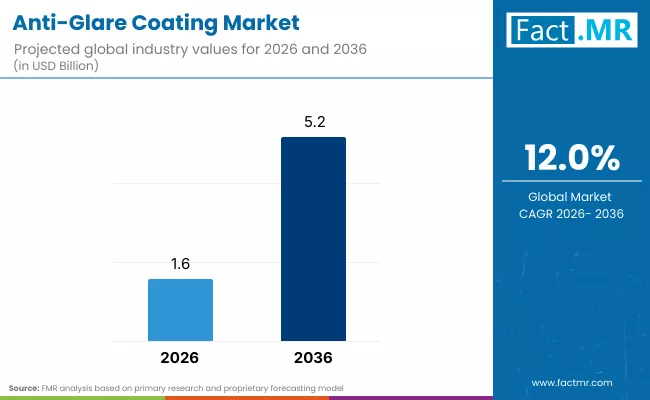
Anti Glare Coating Market By Industry | Source: Fact.MR
This upward trend reflects deeper digitization across daily life and industrial operations, where screens must perform reliably under bright, variable lighting conditions. Anti-glare coatings address a core challenge of modern displays: reducing reflection without compromising brightness, color accuracy, or resolution. As display standards progress from Full HD to 4K and 8K, coating performance has become a critical differentiator rather than a secondary feature. Manufacturers are increasingly moving beyond traditional surface diffusion toward nano-engineered architectures that control light interaction at the microscopic level.
Regulatory pressure is also shaping the market. Environmental frameworks such as the EU Green Deal 2026 are accelerating the shift toward low-VOC and water-borne coating chemistries. At the same time, Chinese standards such as GB 24789 are driving adoption of energy-efficient coated glass in public infrastructure and commercial buildings. These regulations are pushing suppliers to invest heavily in sustainable formulation science and advanced process control.
According to Dr. Akihiro Tanaka, Director of Advanced Optical Materials at Nitto Denko, “The industry is undergoing a structural transformation. Anti-glare coatings are evolving from simple matte layers into precision-engineered optical surfaces that minimize reflections while preserving color fidelity and clarity, even in challenging ambient light environments.” Growth will be reinforced by rising awareness of eye strain, increased remote work, and demand for premium viewing experiences in gaming, automotive displays, and medical imaging.
Anti-Glare Coating Market
| Metric | Value |
|---|---|
| Estimated Value in (2026) | USD 1.6 billion |
| Forecast Value in (2036) | USD 5.2 billion |
| Forecast CAGR (2026 to 2036) | 12.0 % |
Source: Fact.MR analysis. Updated Feb 7, 2026
Category
| Category | Segments |
|---|---|
| Application | Consumer Displays, Automotive Displays, Industrial HMIs, Optical Equipment, Mobile Displays |
| Coating Type | Matte Coatings, Nano Coatings, Light Diffusion Coatings, Anti-Reflection Coatings, Hard Coating |
| Base Material | PET Films, Polycarbonate, Acrylic Films, PET / PC Films, PET films |
| Region | North America; Europe; Asia Pacific; Latin America; Middle East & Africa |
Source: Fact.MR analysis. Updated Feb 7, 2026
Segmental Analysis
What drives Consumer Displays to dominate with 46% market share?
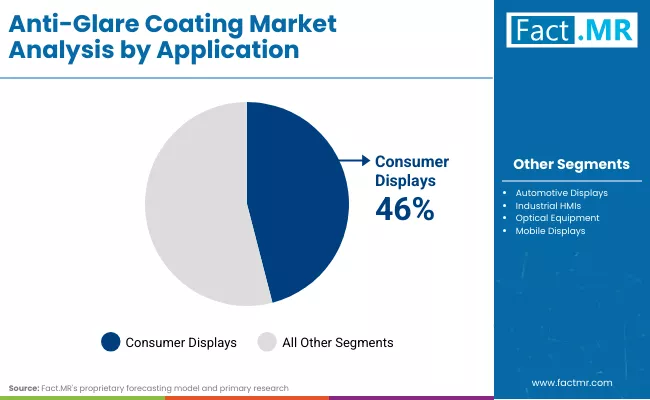
Anti Glare Coating Market By Application | Source: Fact.MR
Consumer displays hold a 46% market share due to the massive use of smartphones, tablets, laptops, monitors, and televisions. Users demand clear screen visibility across different lighting conditions. Advances in display resolution, from Full HD to 4K and 8K, increase the need for high-quality anti-glare coatings. These coatings reduce reflections while maintaining sharp image quality. Remote work habits formed during the pandemic continue to drive demand for multi-monitor setups. Longer screen time increases the need for glare reduction and visual comfort. Gaming monitors are another key driver. Manufacturers increasingly use advanced matte and nano coatings to improve clarity and performance in fast-paced visual environments.
What establishes Matte Coating leadership at 48% market share?
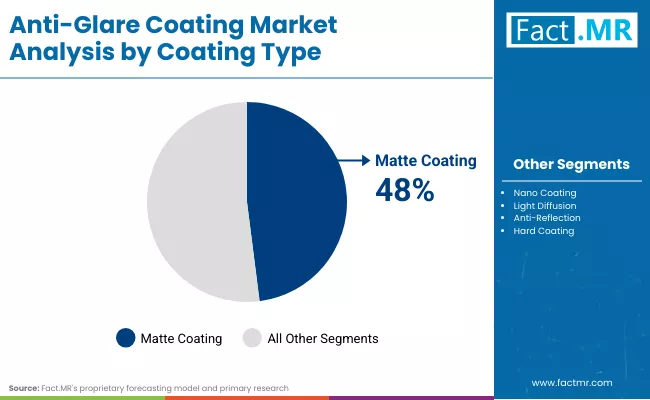
Anti Glare Coating Market By Coating Type | Source: Fact.MR
Matte coatings lead the market with a 48% share due to their scalability and cost efficiency. The technology is proven and reliable across many applications. Glare reduction is achieved through controlled surface texturing that diffuses reflected light. This does not require complex chemicals or specialized equipment. Matte coatings work well with common substrates such as PET films, polycarbonate, and glass. This enables standardized, high-volume production. Established supply chains and mature quality control systems ensure consistent optical performance. This reduces manufacturing risk for consumer electronics brands.
Market Dynamics
- Drivers: Rapid digitization across consumer electronics, automotive displays, and industrial automation is driving demand for anti-glare coatings. These coatings improve visibility in bright and challenging environments. Environmental regulations, including EU Green Deal 2026 mandates, are pushing manufacturers toward low-VOC and water-based formulations. The shift to high-resolution displays such as 4K and 8K increases the need for coatings that preserve brightness and color accuracy. Rising awareness of eye strain and blue light exposure encourages consumers to prefer devices with glare-reducing treatments for extended use.
- Restraints: Advanced coating equipment requires high upfront investment. Vacuum deposition systems and precision spray lines limit entry for smaller players. There is a technical trade-off between glare reduction and optical clarity. Strong matte finishes can reduce brightness and color saturation. Many consumers are not aware of performance differences between coating types. This limits willingness to pay for premium nano-structured solutions. Some coatings wear out due to frequent touchscreen use and cleaning. This increases replacement frequency and ownership costs.
- Trend 1: Integration of Multifunctional Properties Manufacturers are developing coatings that combine multiple features. These include anti-glare, antimicrobial protection, fingerprint resistance, and blue light filtering. Nitto Denko Virusweeper Hybrid films reflect this trend. They combine antiviral performance with high optical transmission to meet post-pandemic hygiene needs.
- Trend 2: Adoption of Nano-Structured Architectures The industry is shifting from simple surface roughening to engineered nano-structures. These designs reduce glare while preserving image clarity. Nano-patterned, moth-eye-inspired surfaces minimize reflections across wider viewing angles compared to traditional matte coatings.
Anti-Glare Coating Market Analysis by Key Country
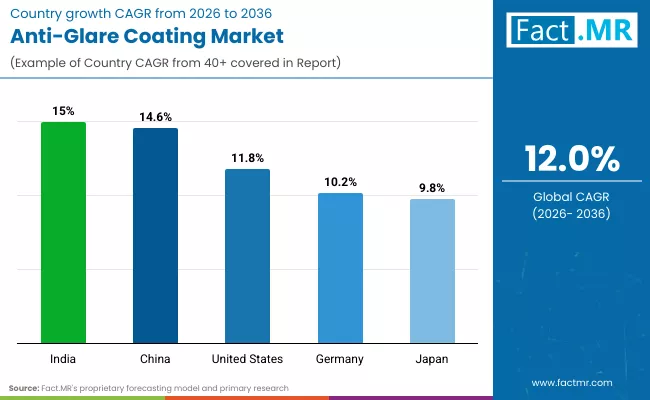
Anti Glare Coating Market By Country | Source: Fact.MR
| Country | CAGR (2026-2036) |
|---|---|
| India | 15.0% |
| China | 14.6% |
| United States | 11.8% |
| Germany | 10.2% |
| Japan | 9.8% |
Source: Fact.MR analysis. Updated Feb 7, 2026
What factors drive India's market expansion at 15.0% CAGR?
India shows the fastest growth at a 15.0% CAGR. This is driven by the national goal of building a USD 400 billion electronics industry by 2025-2026. Rapid expansion of smartphone and tablet assembly increases demand for locally applied anti-glare coatings. Cost efficiency is a key factor. Garware Hi-Tech has expanded production capacity to serve display OEMs in electronics manufacturing clusters. The Production Linked Incentive scheme supports component localization. This reduces imports and strengthens domestic supply chains.
How does China achieve 14.6% CAGR market growth?
China records a 14.6% CAGR driven by national standards mandating energy-saving glass coatings. These rules apply to public and commercial infrastructure. The solar photovoltaic sector shows widespread adoption of anti-reflection coatings. AR coatings are now standard for high-yield solar glass exports. AkzoNobel launched Interpon D2000 architectural coatings for high UV resistance in Chinese climates. Domestic manufacturers dominate the solar coating segment. Vertical integration gives them strong cost advantages in renewable energy projects.
What drives United States market development at 11.8% CAGR?
The U.S. market grows at an 11.8% CAGR due to updated Section 301 tariffs in 2025-2026. These tariffs affect imported processed glass. Manufacturers are reshoring coating operations to avoid cost penalties and ensure supply stability. Janos Technology expanded sputtering and vacuum deposition lines for medical optics. These applications require strict quality certifications. Investment is increasing across medical, aerospace, and defense sectors where localized production is preferred.
How does Germany's market progress at 10.2% CAGR?
Germany records 10.2% CAGR driven by EU Green Deal 2026 compliance. Regulations enforce low-VOC and zero-emission coating processes. Water-borne anti-glare formulations are gaining rapid adoption. Over half of the market has shifted to these chemistries. Carl Zeiss introduced DuraVision Platinum UV coatings designed for durability in harsh environments. German optics companies lead in combining environmental compliance with premium optical performance.
What shapes Japan's market trajectory at 9.8% CAGR?
Japan shows 9.8% CAGR growth driven by labor shortages in logistics from 2024 to 2026. This increases demand for outdoor-readable devices. High-contrast anti-glare coatings improve screen visibility in warehouses and outdoor settings. This reduces dependence on fixed workstations. Nitto Denko introduced Virusweeper Hybrid films with antimicrobial protection and high transparency. SIAA certification standards support adoption of multifunctional coatings. Ultra-low-sparkle coatings are also being used in 8K medical and inspection displays where image clarity is critical.
Competitive Landscape of Anti-Glare Coating Market
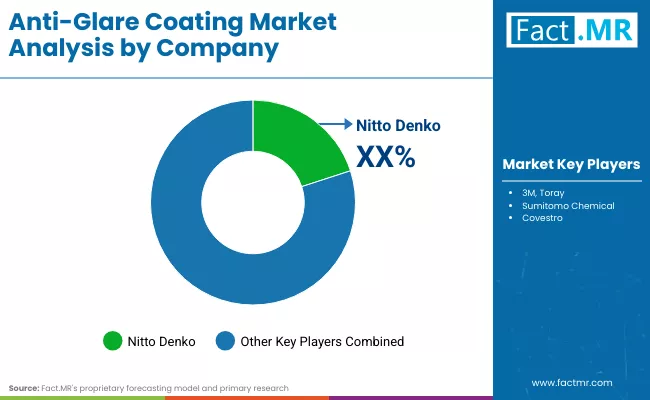
Anti Glare Coating Market By Company | Source: Fact.MR
The anti-glare coating market shows moderate to high concentration. A group of established specialty chemical and materials companies leads the space. These players benefit from strong research capabilities and global distribution networks. Nitto Denko holds a strong position through continuous innovation. The company focuses on multifunctional films that combine anti glare, antimicrobial protection, and optical enhancement for premium display applications.
3M competes across many segments. Its portfolio spans consumer electronics, automotive, and industrial markets. Scale, brand strength, and manufacturing efficiency are key advantages. Covestro focuses on polycarbonate-based solutions. These are widely used in automotive interiors and architectural glazing where material integration improves performance. Toray leverages expertise in polymer chemistry. The company supplies high-performance PET film substrates for electronics and optical equipment manufacturers. Sumitomo Chemical targets specialty coating formulations. Its solutions are designed for industrial and medical applications that require certified and consistent performance.
Competition is intensifying around environmental compliance. European regulations are accelerating the shift toward water-borne coating formulations. This transition requires heavy investment in research and process redesign. The market favors companies with vertical integration. Control over base materials and coating application helps reduce costs and maintain quality. At the same time, emerging Asia Pacific players are entering commodity segments with competitive pricing. Premium applications, however, remain dominated by Japanese and European suppliers known for superior optical performance and durability certifications.
Recent Development
- In 2025, PPG Industries announced a breakthrough anti-reflective coating for ultra-high-efficiency solar panels that significantly boosts light transmission above 98%, reflecting the expanding role of AR coatings in renewable energy applications.
- In 2025, optical materials suppliers expanded commercial availability of next-generation low-sparkle anti-reflective coatings for high-end camera modules and AR/VR headsets, reflecting rising demand for premium optical clarity and reduced glare in immersive and precision imaging applications.
Key Market Players in Anti-Glare Coating Market
- Nitto Denko
- 3M, Toray
- Sumitomo Chemical
- Covestro
Bibliography
- Nitto Denko Corporation. 2026. Advanced nano-structured and multifunctional anti-glare coating technologies for display and optical applications. Official company publications and technical white papers.
- 3M Company. 2026. Optical and display coating innovations for consumer electronics and automotive interfaces. Corporate technology briefs and product documentation.
- Carl Zeiss AG. 2026. Durable anti-reflective and anti-glare coatings for medical, industrial, and precision optics. Company press releases and optical engineering reports.
- European Union. 2026. EU Green Deal implementation guidelines for low-VOC and water-borne industrial coating formulations. Official EU regulatory publications.
- Government of China. 2025. GB 24789 standards for energy-efficient glass coatings in public infrastructure and commercial buildings. State Administration for Market Regulation documentation.
Segmentation
Scope of Report
| Items | Values |
|---|---|
| Quantitative Units (2026) | USD 1.6 Billion |
| Application | Consumer Displays, Automotive Displays, Industrial HMIs, Optical Equipment, Mobile Displays |
| Coating Type | Matte Coatings, Nano Coatings, Light Diffusion Coatings, Anti-Reflection Coatings, Hard Coating |
| Base Material | PET Films, Polycarbonate, Acrylic Films, PET / PC Films, PET films |
| Regions Covered | North America, Europe, Asia Pacific, Latin America, Middle East & Africa |
| Countries Covered | U.S., Canada, Germany, Italy, UK, France, Japan, Australia, and other countries |
| Key Companies Profiled | Nitto Denko, 3M, Toray, Sumitomo Chemical, Covestro |
| Additional Attributes | Dollar revenue in the anti-glare coating market is segmented by application (consumer displays, automotive displays, industrial HMIs, optical equipment, mobile displays), coating type (matte coatings, nano coatings, light diffusion coatings, anti-reflection coatings, hard coatings), base material (PET films, polycarbonate, acrylic films, PET/PC films), and region. |
Source: Fact.MR analysis. Updated Feb 7, 2026
Anti-Glare Coating Market by Segments
-
Application :
- Consumer Displays
- Automotive Displays
- Industrial HMIs
- Optical Equipment
- Mobile Displays
-
Coating Type :
- Matte Coating
- Nano Coating
- Light Diffusion
- Anti-Reflection
- Hard Coating
-
Base Material :
- PET Films
- Polycarbonate
- Acrylic Films
- PET/PC Films
- PET Films
-
Region :
- Asia Pacific
- China
- India
- Japan
- South Korea
- Australia
- Rest of Asia Pacific
- North America
- United States
- Canada
- Mexico
- Europe
- Germany
- France
- UK
- Italy
- Spain
- Rest of Europe
- Latin America
- Brazil
- Mexico
- Argentina
- Rest of Latin America
- Asia Pacific
Frequently Asked Questions
How big is the global anti-glare coating market in 2026?
What will be the size of the anti-glare coating market in 2036?
How fast will the anti-glare coating market grow between 2026 and 2036?
Which application dominates the anti-glare coating market?
Which coating type holds the largest share in the anti-glare coating market?
Who worked on this report


Preview the report firsthand - request a free sample
Free SampleGet the brochure for pricing and purchase details
Download PDF