- Estimated Value(2026): 1.5 Bn
- Forecast Value (2036): 5.1 Bn
- CAGR (2026 - 2036): 12.8%
Anti-Smudge Coating Market Forecast and Outlook 2026 to 2036
Global demand for anti-smudge coatings is projected to grow from USD 1.5 billion in 2026 to around USD 5.1 billion by 2036, advancing at a 12.8% CAGR.
Key Takeaways from the Anti-Smudge Coating Market
- Anti-Smudge Coating Market Value (2026): USD 1.5 billion
- Anti-Smudge Coating Market Forecast Value (2036): USD 5.1 billion
- Anti-Smudge Coating Market Forecast CAGR (2026-2036): 12.8%
- Leading Application: Consumer Electronics (46%)
- Key Market Participants: PPG Industries, AkzoNobel, Covestro, Toray, Sumitomo Chemical
- Key Growth Regions: Asia Pacific, North America, Europe, Middle East and Africa
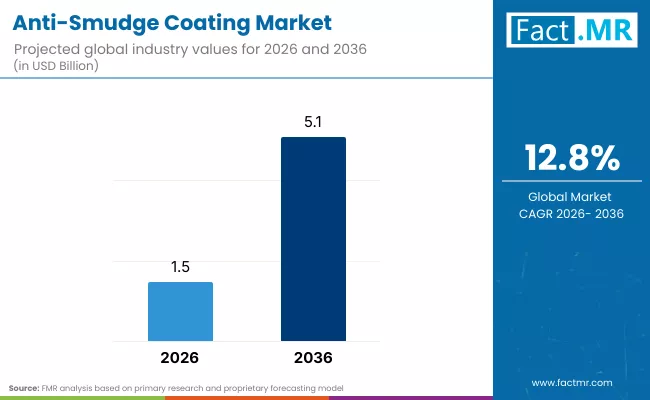
Anti Smudge Coating Market By Industry | Source: Fact.MR
This expansion reflects how frequently consumers and professionals interact with touch-enabled surfaces in daily life. From mobile devices to vehicle dashboards and hospital equipment, maintaining visual clarity has become a core product requirement rather than a premium feature.
Regulatory and structural shifts are also supporting market growth. Expanding telehealth infrastructure is increasing demand for medical-grade touchscreens that withstand repeated disinfection without losing performance. In transportation and renewable energy, smudge-resistant coatings help prevent efficiency losses on photovoltaic and control surfaces. Meanwhile, India’s Production Linked Incentive scheme is accelerating localization of premium display manufacturing, boosting domestic demand for advanced surface coatings.
According to Dr. Elena Schmidt, Vice President of Surface Technologies at PPG Industries, anti-smudge technology has moved beyond basic surface treatments. Modern solutions are designed to maintain pristine visual clarity while resisting oils, fingerprints, and pollutants across diverse operating environments. Innovation remains continuous. Manufacturers are investing in nano-textured architectures, hybrid antiviral features, and bio-compatible formulations. These coatings are engineered to survive frequent cleaning cycles, which is especially critical for medical devices and public-use touchscreens.
Anti-Smudge Coating Market
| Metric | Value |
|---|---|
| Estimated Value in (2026) | USD 1.5 billion |
| Forecast Value in (2036) | USD 5.1 billion |
| Forecast CAGR (2026 to 2036) | 12.8% |
Source: Fact.MR analysis. Updated Feb 7, 2026
Category
| Category | Segments |
|---|---|
| Application | Consumer Electronics, Automotive Interiors, Optical Components, Medical Displays, Wearable Devices |
| Coating Function | Anti-Fingerprint, Smudge-Resistant, Self-Cleaning, Nano-Textured, Tough Coatings |
| Base Material | PET Films, Polycarbonate, Acrylic Films, PET / PC Films, PET films |
| Region | North America; Europe; Asia Pacific; Latin America; Middle East & Africa |
Source: Fact.MR analysis. Updated Feb 7, 2026
Segmental Analysis
What drives Consumer Electronics to dominate with 46% market share?
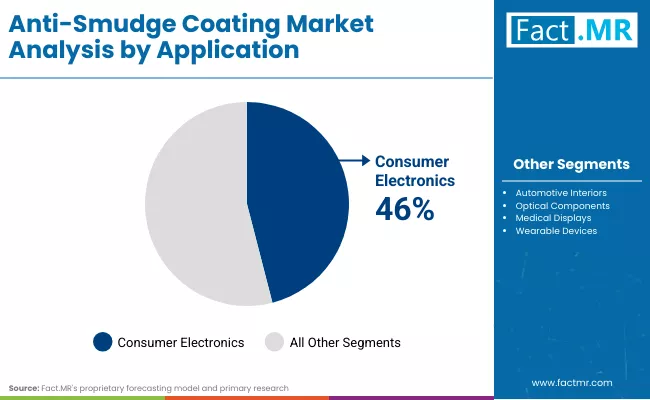
Anti Smudge Coating Market By Application | Source: Fact.MR
Consumer electronics lead with a 46% market share because touchscreens are everywhere. Smartphones, tablets, laptops, smartwatches, and gaming devices all rely on clean, responsive screens. Oleophobic and anti-smudge coatings help maintain screen clarity despite constant finger contact and exposure to oils, dust, and moisture. Premium device brands use these coatings to differentiate products through smoother touch feel and cleaner visuals. Foldable smartphones add another layer of demand. These devices require coatings that work on flexible substrates and survive repeated bending without cracking or peeling. Gaming devices also play a role. Manufacturers specify ultra-smooth anti-smudge coatings that reduce finger drag while maintaining optical transmission above 92%. This ensures accurate color reproduction in competitive gaming environments.
What establishes Anti-Fingerprint coating leadership at 48% market share?
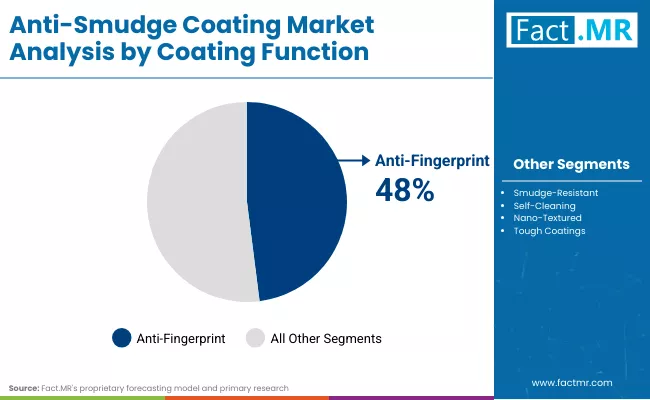
Anti Smudge Coating Market By Coating Function | Source: Fact.MR
Anti-fingerprint coatings dominate with a 48% market share because they effectively reduce visible smudges. Low surface-energy formulations prevent oils from sticking to the screen. These coatings strike a strong balance between performance and scalability. Fluoropolymer-based chemistries can be applied using vapor deposition or solution coating methods suitable for high-volume production. Anti-fingerprint coatings work across many substrates, including glass, polycarbonate, and polymer films. This allows manufacturers to standardize coating processes across product lines. Consumer familiarity also helps. The term “anti-fingerprint” directly communicates value, especially in premium electronics where visible smudges hurt perceived quality during retail display and daily use.
Market Dynamics
- Drivers: Touchscreen adoption continues to expand across electronics, vehicles, medical devices, and industrial systems. This drives steady demand for anti-smudge coatings that improve visibility and user comfort. Consumers are more aware of device hygiene. Easy-to-clean surfaces that stay visually clean are increasingly preferred. Growth in premium smartphones and tablets pushes brands to compete on surface quality. Better oleophobic treatments reduce cleaning frequency and enhance perceived value. Telehealth expansion is another driver. Medical-grade touchscreens require bio-compatible coatings that tolerate frequent disinfection without degrading.
- Restraints: Advanced coating processes require costly vacuum deposition equipment. This limits entry for smaller manufacturers. Repeated touch interaction and chemical exposure can wear down coatings over time. This increases replacement or maintenance costs. Environmental concerns around fluoropolymer and PFAS chemistries are rising. Regulatory scrutiny is forcing a shift toward alternative materials. Consumer awareness of performance differences remains limited. Many buyers are unwilling to pay extra for advanced coatings if basic options seem sufficient.
- Trend 1: Development of Multifunctional Hybrid Coatings Manufacturers are creating coatings that do more than resist smudges. New formulations combine anti-fingerprint performance with antimicrobial protection, scratch resistance, and blue light filtering. Nitto Denko Virusweeper Hybrid films reflect this shift. They combine SIAA-certified antiviral properties with oleophobic performance while maintaining touch sensitivity and optical clarity.
- Trend 2: Transition to PFAS-Free Formulations The industry is moving away from PFAS-based chemistries. Silicone-based and hydrocarbon-modified alternatives are gaining attention. These next-generation coatings aim to deliver similar smudge resistance without environmental persistence. However, matching the durability and water repellency of fluoropolymer systems remains a technical challenge.
Anti-Smudge Coating Market Analysis by Country
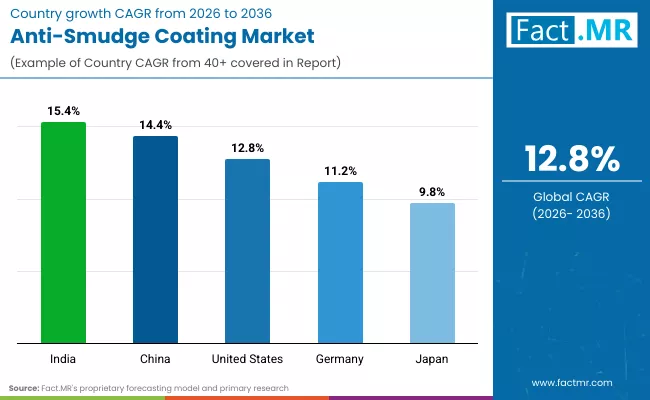
Anti Smudge Coating Market By Country | Source: Fact.MR
| Country | CAGR (2026-2036) |
|---|---|
| India | 15.4% |
| China | 14.4% |
| United States | 12.8% |
| Germany | 11.2% |
| Japan | 9.8% |
Source: Fact.MR analysis. Updated Feb 7, 2026
What is accelerating the growth of the anti-smudge coating market in India?
India shows the fastest growth at a 15.4% CAGR. Government support is the main driver. The Production Linked Incentive scheme targets USD 400 billion in domestic electronics manufacturing. Rapid growth in nanotechnology is adding momentum. Demand for anti-fingerprint coatings is rising as premium smartphone assembly shifts to India. Electric two-wheeler displays are also being localized. Domestic sourcing of surface treatments is becoming a priority. Garware Hi-Tech has expanded sputtering lines for anti-smudge display protection films. These facilities serve OEMs setting up in electronics manufacturing clusters. Invest India incentives support component localization. New coating facilities reduce imports and strengthen supply chains for consumer electronics and automotive displays.
What regulatory and infrastructure factors are supporting market growth in China?
China is witnessing strong expansion, with the anti-smudge coating market growing at around 14.4% CAGR. This growth is driven by transportation safety regulations targeting glare and smudge-related efficiency losses in solar installations near airports and highways. The rules promote dual-process solutions. Glass texturing is combined with low-reflective coatings to reduce visual interference for pilots and drivers. JinkoSolar released low-reflection, anti-glare photovoltaic modules designed for transport hubs. These products meet TÜV Rheinland reflectivity requirements. Ongoing large-scale infrastructure expansion is increasing demand for anti-smudge solar glass. Coatings must preserve energy output while preventing hazardous reflections, supporting sustained market growth.
What factors are driving demand for anti-smudge coatings in the United States?
The U.S. market is expanding at approximately 12.8% CAGR, driven by rapid healthcare digitization. Growth in telehealth is increasing demand for medical-grade tablets and diagnostic touchscreens across hospitals and clinics. These devices require coatings that tolerate frequent cleaning. Bio-compatible anti-smudge surfaces must withstand alcohol, bleach, and disinfectants without losing oleophobic performance. Aculon has integrated easy-to-clean coatings for medical optics and surgical lenses that meet strict biocompatibility standards. SDC Technologies reports rising demand for formulations that maintain performance after repeated exposure to hospital-grade disinfectants, reinforcing steady market expansion.
What is supporting market expansion in Germany’s anti-smudge coating sector?
Germany’s anti-smudge coating market is progressing at about 11.2% CAGR, supported by modernization of medical instruments and diagnostic equipment. Hospitals increasingly demand tools that are easier to sterilize and maintain. Thin-film oleophobic coatings are gaining traction. Vacuum-deposited layers provide high chemical resistance and withstand repeated autoclave sterilization cycles. EuropCoating has introduced advanced coating systems for medical and luxury applications. Carl Zeiss continues expanding optical coating capacity for medical imaging, surgical microscopy, and premium eyewear, where coating durability directly impacts lifetime costs.
What structural and workforce trends are influencing Japan’s market development?
Japan’s market is developing at roughly 9.8% CAGR, shaped by Industry 5.0 automation initiatives and severe labor shortages. These challenges are accelerating adoption of rugged, always-on digital devices. Ports and logistics centers increasingly rely on outdoor-readable tablets. Such environments demand smudge-resistant and antimicrobial surfaces to maintain usability. Nitto Denko deployed Virusweeper Hybrid films with ultra-low sparkle for high-traffic touchscreens. These coatings combine smudge resistance with SIAA-certified antimicrobial performance. Toyobo has expanded multifunctional coating film production, focusing on hygiene, durability, and optical clarity for automated logistics and industrial systems.
Competitive Landscape for Anti-Smudge Coating Market
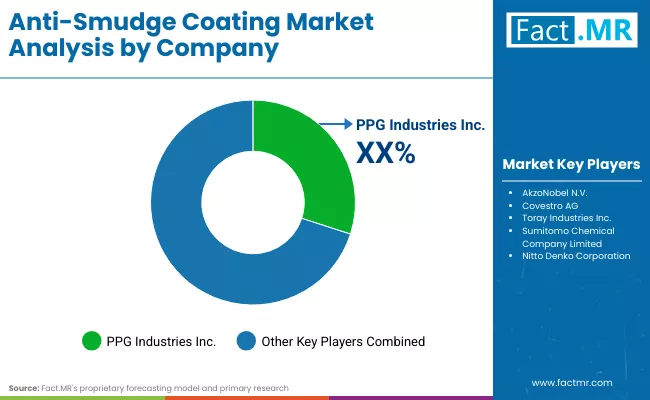
Anti Smudge Coating Market By Company | Source: Fact.MR
The anti-smudge coating market is moderately concentrated. Established chemical and materials companies dominate through strong R&D and global reach. PPG Industries leads through innovation in fluoropolymer and silicone-based formulations. Environmental compliance is a key focus. AkzoNobel competes across architectural glass, transportation, and industrial coatings. Sustainability is central to its strategy. Covestro focuses on polycarbonate-integrated coating solutions. Material and coating synergy improves performance.
Competition is intensifying around PFAS-free formulations. Environmental rules are forcing a shift away from fluoropolymers. Matching performance with new chemistries requires heavy R&D investment. Vertical integration offers an advantage. Control over substrates and coating processes lowers costs and ensures quality. Competition is intensifying around the transition to PFAS-free formulations. Regulatory pressure in Europe, North America, and parts of Asia is accelerating the shift away from traditional fluoropolymers. However, replicating the durability, water repellency, and low surface energy of fluoropolymer-based systems remains technically challenging. This is driving significant investment in alternative chemistries, including silicone hybrids and hydrocarbon-modified coatings. Vertical integration is becoming a critical competitive advantage.
Companies that control substrate production, coating formulation, and application processes can better manage costs, ensure quality consistency, and accelerate product customization for OEM requirements. At the same time, manufacturers from the Asia Pacific region are entering commodity segments with aggressive pricing strategies. While this increases competitive pressure in high-volume, price-sensitive applications, premium segments such as medical devices, automotive displays, and industrial interfaces remain dominated by Japanese, European, and U.S. suppliers. These players retain an edge through certified performance, long service life, and strict compliance with medical and automotive qualification standards.
Recent Development
- In 2025, ZEISS introduced its DuraVision Gold UV lens coating, featuring a new CleanGuard technology that significantly improves oil and water repellence on optical surfaces, making lenses easier to clean and more resistant to smudges and dirt in everyday use.
- In 2025, PPG Industries unveiled a new advanced oleophobic coating for automotive and mobile displays, designed to dramatically reduce fingerprint marks and smudges while enhancing touch responsiveness. The new coating also improves resistance to environmental contaminants such as sweat and UV exposure, supporting longer device life and cleaner screens in everyday use.
Key Market Players in Anti-Smudge Coating Market
- PPG Industries Inc.
- AkzoNobel N.V.
- Covestro AG
- Toray Industries Inc.
- Sumitomo Chemical Company Limited
- Nitto Denko Corporation
Bibliography
- PPG Industries. 2026. Advanced oleophobic and anti-fingerprint coating technologies for consumer electronics, medical devices, and automotive displays. Official company publications and surface technology white papers.
- AkzoNobel. 2026. Sustainable surface coatings and easy-to-clean technologies for architectural, transportation, and industrial applications. Corporate sustainability and innovation reports.
- Nitto Denko Corporation. 2026. Virusweeper Hybrid and multifunctional anti-smudge film technologies for high-touch display applications. Technical documentation and SIAA certification materials.
- Toyobo Co., Ltd. 2026. Multifunctional coating films for hygiene-critical and automated industrial environments. Corporate product announcements and materials science briefs.
- European Union. 2026. Regulatory guidance on PFAS reduction, low-VOC surface coatings, and sustainable chemistry adoption in industrial and consumer products. Official EU regulatory publications.
- United States Food and Drug Administration. 2025. Biocompatibility and surface durability requirements for medical-grade touchscreen and optical devices. FDA guidance documents and compliance frameworks.
Segmentation
Scope of Report
| Items | Values |
|---|---|
| Quantitative Units (2026) | USD 1.5 Billion |
| Application | Consumer Electronics, Automotive Interiors, Optical Components, Medical Displays, Wearable Devices |
| Coating Function | Anti-Fingerprint, Smudge-Resistant, Self-Cleaning, Nano-Textured, Tough Coatings |
| Base Material | PET Films, Polycarbonate, Acrylic Films, PET / PC Films, PET films |
| Regions Covered | North America, Europe, Asia Pacific, Latin America, Middle East & Africa |
| Countries Covered | U.S., Canada, Germany, Italy, UK, France, Japan, Australia, and other countries |
| Key Companies Profiled | PPG Industries, AkzoNobel, Covestro, Toray, Sumitomo Chemical |
| Additional Attributes | Dollar revenue in the anti-smudge coating market is segmented by application (consumer electronics, automotive displays, industrial touchscreens, medical devices, optical equipment), coating type (anti-fingerprint coatings, oleophobic coatings, hydrophobic coatings, hybrid multifunctional coatings), base material (glass, PET films, polycarbonate, PET/PC films), and region. |
Source: Fact.MR analysis. Updated Feb 7, 2026
Anti-Smudge Coating Market by Segments
-
Application :
- Consumer Electronics
- Automotive Interiors
- Optical Components
- Medical Displays
- Wearable Devices
-
Coating Function :
- Anti-Fingerprint
- Smudge-Resistant
- Self-Cleaning
- Nano-Textured
- Tough Coatings
-
Base Material :
- PET Films
- Polycarbonate
- Acrylic Films
- PET/PC Films
- PET Films
-
Region :
- Asia Pacific
- China
- India
- Japan
- South Korea
- Australia
- Rest of Asia Pacific
- North America
- United States
- Canada
- Mexico
- Europe
- Germany
- France
- UK
- Italy
- Spain
- Rest of Europe
- Latin America
- Brazil
- Mexico
- Argentina
- Rest of Latin America
- Asia Pacific
Frequently Asked Questions
How big is the global anti-smudge coating market in 2026?
What will be the size of the anti-smudge coating market in 2036?
How fast will the anti-smudge coating market grow between 2026 and 2036?
Which application dominates the anti-smudge coating market?
Which coating type holds the largest share in the anti-smudge coating market?
Who worked on this report


Preview the report firsthand - request a free sample
Free SampleGet the brochure for pricing and purchase details
Download PDF