Behavioral Biomarker Software Market Size, Share, Growth and Forecast (2026 - 2036)

The Behavioral Biomarker Software Market is segmented by Biomarker Type, Software Functionality, Data Source, Application, End User and Region. Forecast for 2026 to 2036.

Behavioral Biomarker Software Market Overview, Growth Outlook, and Forecast by Fact.MR

  • The behavioral biomarker software market was valued at USD 0.5 billion in 2025 and is estimated to reach about USD 0.6 billion in 2026. It is forecast to reach USD 4.3 billion by 2036 at a 21.6% CAGR from 2026 to 2036.
  • This market is set to expand about 7.1x from 2026 to 2036, adding USD 3.7 billion in absolute opportunity.
  • The increasing adoption of digital health technologies, AI-driven diagnostics, and remote patient monitoring solutions is emerging as a primary growth driver for the behavioral biomarker software market.
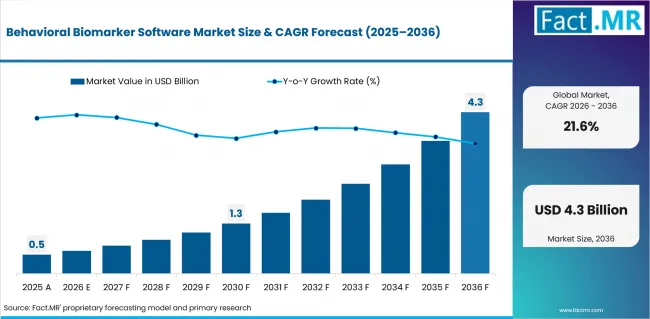
Behavioral Biomarker Software Market  Value Analysis

Summary of the Behavioral Biomarker Software Market

  • Market Snapshot
    • Global behavioral biomarker software market revenue stood at USD 0.5 billion in 2025 and is forecast to reach USD 4.3 billion by 2036.
    • The market is forecast to grow at a 21.6% CAGR from 2026 to 2036, this market is set to expand ~7.1x in value, adding USD 3.7 billion in absolute opportunity.
    • Growth is being driven by increasing adoption of digital health technologies, AI-powered behavioral analytics, and remote patient monitoring platforms.
    • Rising demand for objective behavioral health assessment and continuous monitoring solutions is reinforcing market expansion.
    • Advances in machine learning, wearable technologies, and multimodal data analytics are accelerating software innovation across healthcare and research applications.
  • Demand and Growth Drivers
    • Increasing prevalence of mental health, neurological, and cognitive disorders requiring continuous monitoring
    • Rising adoption of digital therapeutics, remote patient monitoring, and precision healthcare platforms
    • Growing use of AI-driven behavioral analytics for early disease detection and intervention
    • Expansion of wearable devices, mobile health applications, and digital biomarker ecosystems
    • Need for solutions that provide:
      • Objective behavioral health assessment and monitoring
      • Real-time patient insights and predictive analytics
      • Personalized treatment optimization and outcome tracking
      • Scalable remote monitoring and clinical research support
  • Product and Segment View
    • Speech & Voice Biomarkers hold 24% of biomarker type share in 2026, emerging as the leading segment.
    • Cognitive biomarkers account for 20% share, while facial & visual biomarkers represent 18% share.
    • Movement & motor biomarkers contribute 16%, followed by digital interaction biomarkers at 14% and physiological-behavioral biomarkers at 8%.
    • Data analytics software accounts for 31% of software functionality share in 2026, positioning it as the dominant segment.
    • Data acquisition software represents 22% share, patient monitoring software 20%, clinical decision support software 18%, and research & trial software 9%.
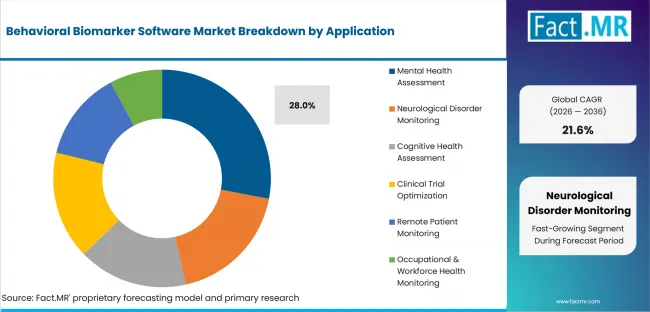
    • Mental health assessment leads application share with 28%, reflecting increasing demand for behavioral health analytics and monitoring solutions.
  • Geography and Competitive Outlook
    • Growth is supported across North America, Europe, and Asia Pacific.
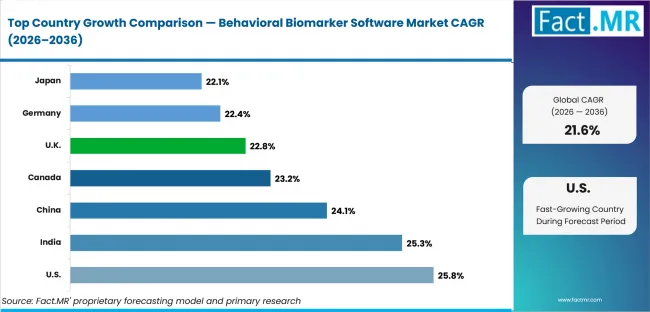
    • Key growth markets and CAGR: Japan 22.1%, Germany 22.4%, U.K. 22.8%, Canada 23.2%, China 24.1%, India 25.3%, U.S. 25.8%.
    • Market expansion is closely tied to:
      • Increasing deployment of AI-powered behavioral health assessment platforms
      • Rising investments in digital therapeutics and precision healthcare solutions
      • Growing adoption of remote patient monitoring and digital biomarker technologies
      • Key companies active in this market include: Mindstrong Health, Kintsugi, Sonde Health, Ellipsis Health, Neurotrack, Cogstate, and Winterlight Labs.
  • Analyst Opinion
    • Shambhu Nath Jha, Principal Consultant at Fact.MR, says, “Behavioral biomarker software has a clear clinical role in measuring patient function through digital signals. Healthcare teams are paying for passive monitoring, validated scoring and workflow-ready tools that help detect behavioral change before routine visits."

Behavioral Biomarker Software Market - At a Glance

Attribute Details
Market Value 2025 USD 0.5 billion
Market Value 2036 USD 4.3 billion
Absolute Dollar Opportunity 2026–2036 USD 3.7 billion
Total Growth 2026–2036 760.0%
CAGR 2026–2036 21.6%
Growth Multiple ~7.1x
Key Demand Theme Increasing adoption of AI-powered behavioral health assessment and digital biomarker solutions
Leading Segment by Biomarker Type (2026) Speech & Voice Biomarkers
Segment Share (2026) 24%
Leading Segment by Software Functionality (2026) Data Analytics Software
Segment Share (2026) 31%
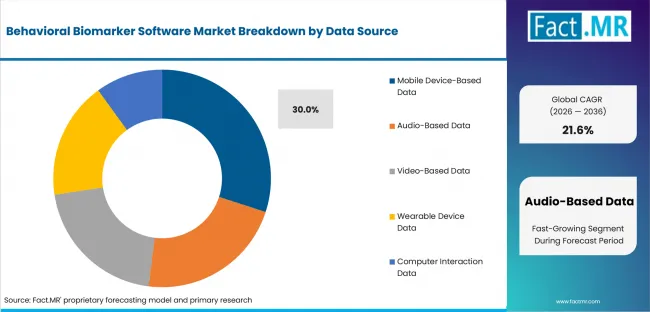
Leading Segment by Data Source (2026) Mobile Device-Based Data
Segment Share (2026) 30%
Leading Segment by Application (2026) Mental Health Assessment
Segment Share (2026) 28%
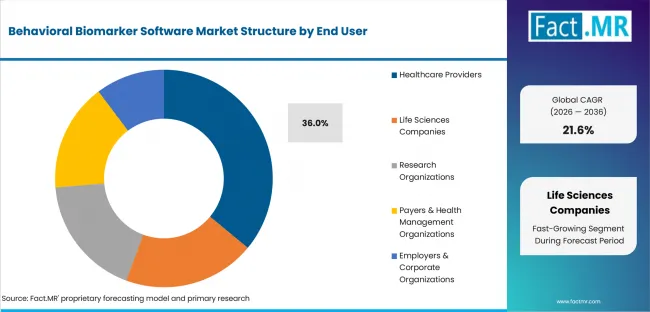
Leading Segment by End User (2026) Healthcare Providers
Segment Share (2026) 36%
Key Growth Regions North America, Europe, Asia Pacific
Country CAGRs Japan 22.1%, Germany 22.4%, U.K. 22.8%, Canada 23.2%, China 24.1%, India 25.3%, U.S. 25.8%
Top Companies Mindstrong Health, Kintsugi, Sonde Health, Ellipsis Health, Neurotrack, Cogstate, Winterlight Labs
Segmentation by Biomarker Type Speech & Voice Biomarkers, Facial & Visual Biomarkers, Movement & Motor Biomarkers, Cognitive Biomarkers, Digital Interaction Biomarkers, Physiological-Behavioral Biomarkers
Segmentation by Software Functionality Data Acquisition Software, Data Analytics Software, Clinical Decision Support Software, Patient Monitoring Software, Research & Trial Software
Segmentation by Data Source Mobile Device-Based Data, Audio-Based Data, Video-Based Data, Wearable Device Data, Computer Interaction Data
Segmentation by Application Mental Health Assessment, Neurological Disorder Monitoring, Cognitive Health Assessment, Clinical Trial Optimization, Remote Patient Monitoring, Occupational & Workforce Health Monitoring
Segmentation by End User Healthcare Providers, Life Science Companies, Research Organizations, Payers & Health Management Organizations, Employers & Corporate Organizations
Segmentation by Region North America, Latin America, Europe, Asia Pacific, Middle East & Africa

Behavioral biomarker platforms are gaining demand for their ability to continuously assess speech patterns, cognitive function, movement behavior, and digital interactions to support early disease detection and personalized care. Demand is being reinforced by the rising prevalence of mental health and neurological disorders, expanding telehealth utilization, and growing emphasis on objective, non-invasive health assessment methods. The market is further benefiting from advancements in machine learning algorithms, digital phenotyping technologies, multimodal data analytics, and cloud-based monitoring platforms designed to enhance clinical decision-making, improve patient outcomes, and enable scalable healthcare delivery.

Key Growth Drivers, Constraints, and Opportunities
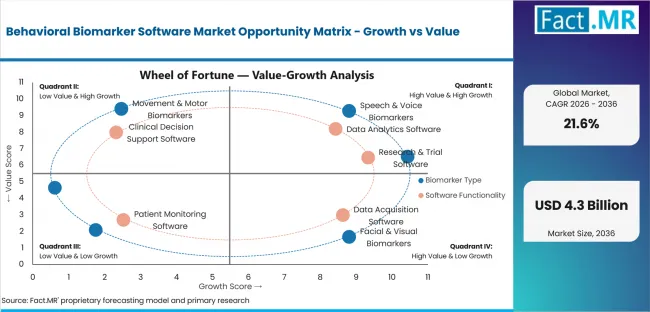
Behavioral Biomarker Software Market Opportunity Matrix Growth Vs Value

Key Factors Driving Growth

  • Due to the increasing adoption of digital healthcare tools, telemedicine applications, and AI-based healthcare solutions, the need for software that assesses behavioral biomarkers is likely to increase.
  • Due to the growing burden of neurological conditions and behavioral problems, medical care institutions have shifted towards the development of continuous behavioral tracking solutions.
  • The application of behavioral biomarkers in clinical trials, remote patient monitoring services, and personalized healthcare programs will further facilitate steady market growth.
Growth Driver Demand Impact Time Horizon Key Impact Area Fact.MR Insight
Rising adoption of digital health and remote patient monitoring solutions High Short-Mid Term Healthcare digitization and patient monitoring Growing demand for continuous, non-invasive health assessment is accelerating software adoption
Increasing prevalence of mental health and neurological disorders High Short-Mid Term Clinical demand and disease management Rising disease burden is strengthening demand for objective behavioral biomarkers
Expansion of decentralized clinical trials and digital endpoints High Mid-Long Term Clinical research and pharmaceutical adoption Drug developers are increasingly leveraging behavioral biomarkers for evidence generation
Advancements in AI, machine learning, and digital phenotyping technologies Medium-High Mid-Long Term Product innovation and analytical capabilities Advanced analytics are enhancing biomarker accuracy and clinical utility
Growing investments in digital health infrastructure and healthcare analytics Medium Short-Mid Term Market expansion and technology deployment Healthcare organizations are increasing investments in data-driven patient care solutions

Key Market Constraints

  • High expenses on the integration of such software into existing systems may hamper the growth of this market.
  • Potential concerns about patients' rights and ethical treatment of their data may reduce the likelihood of adopting the solution among some medical facilities.
  • The limited clinical validity, reimbursement capabilities, and interoperability of digital biomarkers may delay market entry.

Key Opportunity Areas

  • Increasing levels of healthcare digitization in emerging markets create many opportunities for software providers operating in this niche.
  • The growing potential of multimodal AI algorithms, speech analytics systems, and digital phenotyping solutions is opening up avenues for innovative technologies.
  • Demand for predictive analysis, precision medicine, remote patient monitoring, and other digital solutions may present many new opportunities in this sphere.

Segment-wise Analysis of the Behavioral Biomarker Software Market

  • By 2026, Mobile Device-Based Data accounts for a 30% market share of the data source segment due to the widespread adoption of smartphones, increasing utilization of digital health applications, and the ability to continuously capture behavioral signals such as activity patterns, screen interactions, communication behavior, and cognitive engagement, supporting scalable remote monitoring and real-world health assessment across diverse patient populations.
  • Data Analytics Software represents a 31% market share of the software functionality segment by 2026, driven by growing demand for AI-powered behavioral pattern recognition, predictive health insights, risk stratification, and clinical decision support capabilities. The segment benefits from increasing adoption of machine learning and advanced analytics technologies across healthcare providers, pharmaceutical companies, and research organizations seeking actionable behavioral health intelligence.

The segmentation of the behavioral biomarker software market includes Biomarker Type, Software Functionality, Data Source, Application, End User, and Region.

Which Biomarker Type Dominates the Behavioral Biomarker Software Market?
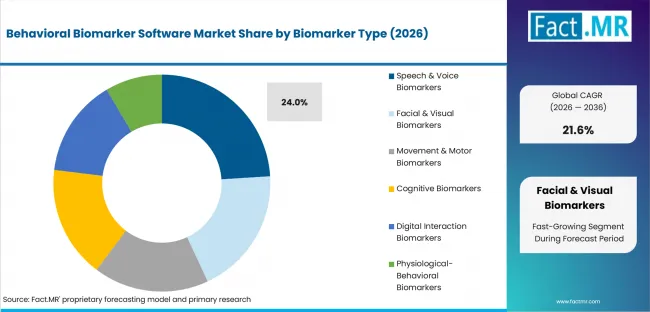
Behavioral Biomarker Software Market Analysis By Biomarker Type

The market share of major biomarker type segments consists of 24% for Speech & Voice Biomarkers. The reason behind such a high market share of this segment includes its use in mental health assessment and cognitive impairment, neurological disease monitoring, and remote patient evaluation. Thanks to recent advances in artificial intelligence, natural language processing, and speech analytics technologies, many healthcare professionals are starting to utilize this biomarker type as a tool for continuous and non-invasive behavioral health monitoring.

Which Software Functionality Dominates the Behavioral Biomarker Software Market?
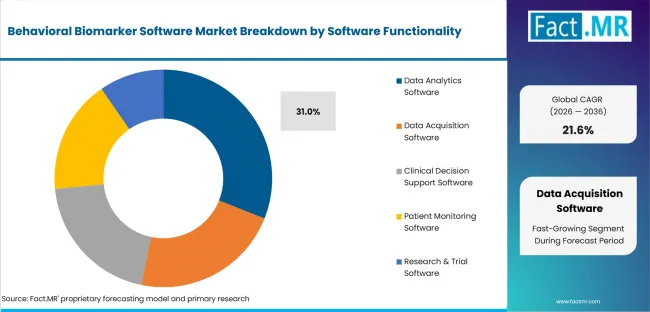
Behavioral Biomarker Software Market Analysis By Software Functionality

Another major market segment that holds a dominant position is Data Analytics Software which accounts for 31% of market share. One of the main reasons for such high market share is the increasing need for behavioral pattern recognition and predictive analytics capabilities. With the help of powerful data analytics software, healthcare organizations can conduct risk assessments and clinical decision-making processes.

Which Data Source Dominates the Behavioral Biomarker Software Market?
Behavioral Biomarker Software Market Analysis By Data Source

The market share of the major data source type segment consists of 30% of Mobile Device-Based Data. One of the reasons behind this high market share is the increasing popularity of mobile applications for monitoring and managing patients' behavioral problems, as well as digital phenotyping technologies and remote monitoring devices. Thanks to such innovations, mobile devices have become one of the major sources of behavioral biomarkers generation.

Which Application Dominates the Behavioral Biomarker Software Market?
Behavioral Biomarker Software Market Analysis By Application

The market share of the major application segment includes 28% for Mental Health Assessment. The high market share is caused by the increasing number of people suffering from depression, anxiety, mood disorder, and other behavioral health conditions around the world. Due to these factors, more and more healthcare providers start using behavioral biomarker software for conducting mental health assessments and providing treatment to their patients.

Which End User Dominates the Behavioral Biomarker Software Market?
Behavioral Biomarker Software Market Analysis By End User

The market share of the major end user segment consists of 36% of Healthcare Providers. The market share is dominated by hospitals, specialty clinics, and behavioral health centers that are implementing behavioral biomarker software into their work process. More and more behavioral healthcare organizations want to adopt this innovative solution because of data-driven clinical decision-making, remote patient monitoring, and personalized care management capabilities.

Regional Outlook Across Key Markets

The market analysis covers key global regions, including South Asia and Pacific, Middle East & Africa, North America, Latin America, Western Europe, and Eastern Europe. It is segmented geographically, with specific market dynamics for each region. The full report provides a detailed market attractiveness analysis.

Top Country Growth Comparison Behavioral Biomarker Software Market Cagr (2026 2036)

CAGR Table

Country CAGR (%)
Japan 22.1%
Germany 22.4%
U.K. 22.8%
Canada 23.2%
China 24.1%
India 25.3%
U.S. 25.8%

Source: Fact.MR analysis, based on proprietary forecasting model and primary research.
Behavioral Biomarker Software Market Cagr Analysis By Country

North America

North America serves as the global commercial launchpad and regulatory benchmark for behavioral biomarker software. Key regional players include Cogstate, Inc. (leader in clinical trial cognitive testing) and Cambridge Cognition (strong foothold in U.S. academic medical centers). Their competitive advantage rests on FDA alignment and partnerships with large payer networks.

  • U.S.: Demand for behavioral biomarker software in the U.S. is projected to rise at 25.8% CAGR through 2036. Strong digital health innovation ecosystem, extensive clinical research activity, increasing adoption of decentralized clinical trials, growing behavioral health demand, and significant AI healthcare investments fuel market leadership.

Western Europe
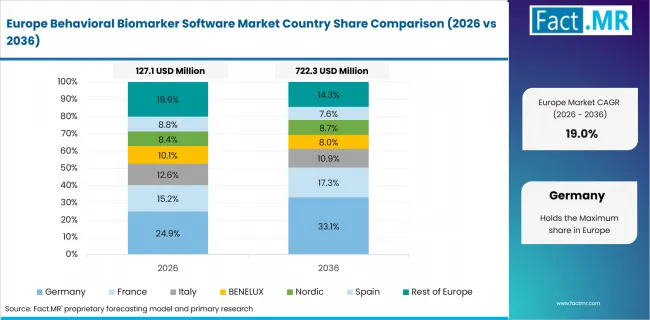
Behavioral Biomarker Software Market Europe Country Market Share Analysis, 2026 & 2036

Western Europe acts as the data privacy‑driven validation hub for behavioral biomarkers, with strict GDPR compliance shaping software design. Key players are Siemens Healthineers (integrating biomarkers into neuroimaging platforms) and Compumedics Limited (strong sleep‑behavior analytics presence in Germany and UK).

  • Germany: Demand for behavioral biomarker software in Germany is projected to rise at 22.4% CAGR through 2036. Strong digital health infrastructure, expanding healthcare digitization initiatives, growing mental health monitoring requirements, and increasing investment in AI-driven clinical decision support platforms are driving market growth.
  • U.K.: Demand for behavioral biomarker software in the U.K. is projected to rise at 22.8% CAGR through 2036. NHS digital transformation programs, growing adoption of remote patient monitoring, increased focus on behavioral health management, and expanding use of digital biomarkers in clinical research support market expansion.

East Asia
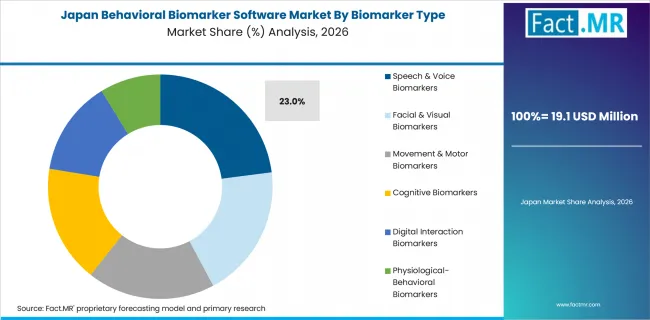
Behavioral Biomarker Software Market Japan Market Share Analysis By Biomarker Type

East Asia is the high‑throughput clinical trial and sensor integration epicenter for behavioral biomarkers. Key regional players are Hitachi High‑Tech (facial expression biomarker algorithms) and NEC Corporation (behavioral analytics for elder care). Their competitive edge lies in government‑funded aging‑society digital health mandates.

  • Japan: Demand for behavioral biomarker software in Japan is projected to rise at 22.1% CAGR through 2036. Rising demand for AI-enabled cognitive assessment, aging population management, neurological disease monitoring, and digital health integration is accelerating adoption of behavioral biomarker software across healthcare providers and research institutions.
  • China: Demand for behavioral biomarker software in China is projected to rise at 24.1% CAGR through 2036. Rapid healthcare digitalization, widespread AI adoption, increasing neurological disease burden, expanding precision medicine initiatives, and strong government support for digital health technologies are accelerating market demand.

South Asia & Pacific

South Asia & Pacific is the low‑cost, high‑scale behavioral biomarker validation ground, driven by mobile‑first digital health. Key players include Wipro GE Healthcare (AI‑based worker stress biomarker platforms) and MindMeld (behavioral analytics for rural telehealth), competing on affordability and multilingual deployment.

  • India: Demand for behavioral biomarker software in India is projected to rise at 25.3% CAGR through 2036. Growing smartphone penetration, expanding telemedicine adoption, increasing mental health care accessibility, rising healthcare technology investments, and demand for scalable patient monitoring solutions are driving rapid growth.

Fact.MR’s complete behavioral biomarker software market study (forecast period 2026–2036) delivers regional deep-dives across North America, Western Europe, East Asia, and South Asia & Pacific. The analysis quantifies the impact of 2025–2026 regulatory updates, reimbursement code changes, public procurements, and national deployment mandates on market share for the top seven countries: U.S., Canada, Germany, U.K., Japan, China, and India, providing actionable intelligence for product registration, tender bidding, and payer negotiation strategies.

Competitive Benchmarking and Company Positioning
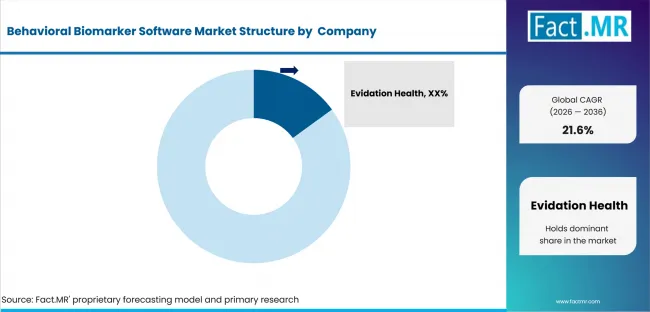
Behavioral Biomarker Software Market Analysis By Company

Leading Companies Shaping the Behavioral Biomarker Software Market

The behavioral biomarker software market is somewhat fragmented with leading companies such as Evidation Health, Verily Health, NeuroFlow, Altoida, Empatica, and Ellipsis Health compete through clinical validation, AI capability, behavioral data quality, and healthcare interoperability. Competitive pressures stem from clinical validation, artificial intelligence, behavioral data quality, regulation, and interoperability within healthcare applications. Companies with well-established digital health platforms, proprietary data sets, strategic pharmaceutical collaborations, and robust analytical software platforms possess structural and barrier advantages. Healthcare providers and life science companies, generally pursue multi-vendor strategies to mitigate vendor dependencies, giving rise to moderate pricing power and clinical effectiveness focus.

Key Players of the Behavioral Biomarker Software Market

  • Evidation Health
  • Verily Health
  • NeuroFlow
  • Behavidence, Inc.
  • Cognivia
  • Altoida
  • Ellipsis Health®, Inc.
  • KeyWise
  • Empatica Inc.

Recent Industry Developments

  • BostonGene - Johnson & Johnson Collaboration for AI-Driven Biomarker Evaluation (March 2025)
    • BostonGene announced a collaboration with Johnson & Johnson to evaluate biomarkers in colorectal cancer and multiple myeloma trials. The work uses AI-driven molecular profiling to support patient selection and predictive biomarker discovery.
  • Agenus and Noetik - AI-Enabled Predictive Biomarker Collaboration (June 2025)
    • Agenus partnered with Noetik to develop AI-enabled predictive biomarkers for BOT/BAL immuno-oncology therapy. Noetik’s OCTO virtual cell model will analyze tumor data to identify patients more likely to respond.
  • Oura - AI-Powered Meals and Glucose Features (May 2025)
    • Oura launched Meals and Glucose features in its app to connect nutrition, sleep, stress, activity, and glucose data. The update strengthens wearable-based behavioral analytics for personalized health monitoring.

Scope of Analysis
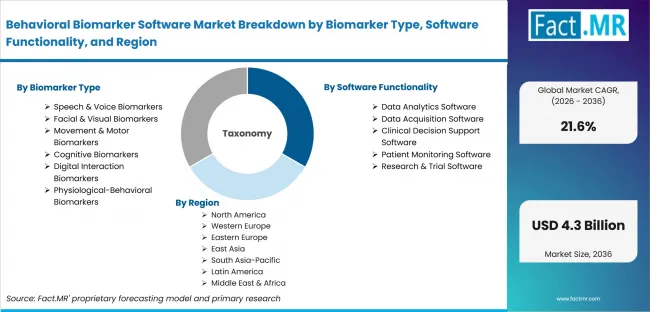
Behavioral Biomarker Software Market Breakdown By Biomarker Type, Software Functionality, And Region

Parameter Details
Quantitative Units USD 0.5 billion in 2025 to USD 4.3 billion in 2036, at a CAGR of 21.6%
Market Definition Behavioral biomarker software market comprises AI-powered platforms that analyze speech, cognition, movement, facial expressions, and digital interactions to generate measurable health indicators for disease detection, patient monitoring, and clinical research applications.
Regions Covered North America, Latin America, Europe, East Asia, South Asia and Pacific, MiddleEastand Africa
Countries Covered USA, Canada, UK, Germany, China, India, 30 plus countries
Key Companies Evidation Health, Verily Health, NeuroFlow, Behavidence, Inc., Cognivia, Altoida, Ellipsis Health®, Inc., KeyWise, Empatica Inc.
Forecast Period 2026 to 2036
Approach Hybrid demand-side and top-downmethodologybuilt on country-level application demand, product benchmarking, pricing analysis, shipment validation, and primary interviews across manufacturers, distributors, retailers, and end users

Sources and Research References

  • Agenus Inc. (2025, June 17). Agenus and Noetik enter collaboration to develop AI-enabled predictive biomarkers for BOT/BAL using foundation models of virtual cell biology. Agenus Inc.
  • BostonGene. (2025, March 26). BostonGene announces collaboration to evaluate biomarkers for colorectal cancer and multiple myeloma using AI-driven molecular profiling in clinical trials. BostonGene.
  • Oura. (2025, May 6). ŌURA redefines metabolic health tracking with two new AI-driven features: Meals and Glucose. Business Wire.
  • Takeda Pharmaceutical Company Limited. (2016, November 7). Takeda and Koneksa Health announce strategic collaboration to use digital health tools in clinical trials. Takeda Pharmaceutical Company Limited.
  • Koneksa Health. (2024, March 20). Koneksa announces Merck joins data syndication partnership program around Parkinson’s digital biomarkers observational study. Koneksa Health.

Behavioral Biomarker Software Market Definition

The behavioral biomarker software market is defined as the collection of software tools for gathering, analyzing, and processing behavioral data of humans including voice patterns, cognitive responses, facial expressions, movements, and digital behavior to detect health-related biomarkers. They employ machine learning techniques to assist healthcare providers in their diagnosis and management activities using disease screening, risk prediction, patient monitoring, and treatment decision making. Behavioral biomarkers software is used extensively in mental health screening, neurology condition management, remote patient monitoring, and clinical research to objectively evaluate the health status of patients.

Behavioral Biomarker Software Market Inclusions

The global, regional, and country-level size estimates and forecasts of the behavioral biomarker software market during 2026 – 2036 are provided in this report. Segmentation includes analyses of different biomarker types, functions of the software tools, sources of behavioral data, application fields, end-user type, and region. Market size by volume, revenue, and other metrics are included in addition to trend and growth analyses, competitiveness studies, competitive positioning analysis, price dynamics, technological advancements, funding, regulations, and adoption rates in healthcare, life sciences, and R&D institutions.

Behavioral Biomarker Software Market Exclusions

The report scope does not cover any physiological biomarker measuring instruments, wearable sensors manufacture, medical image analysis software, laboratory diagnostic equipment, and standard electronic health record systems that do not involve behavioral biomarker software functionalities. The scope further excludes digital therapies, pharmacological treatments, health and wellness applications which are not utilizing behavioral biomarker software, and downstream healthcare services.

Behavioral Biomarker Software Market Research Methodology

  • Primary Research
    • Interviews were carried out by Fact.MR with the help of executives, product managers, digital health experts, healthcare providers, pharma firms, clinical researchers, and tech vendors active within the behavioral biomarker software ecosystem. Views of experts from the industry were considered while estimating adoption trends, demand trends, and growth potential.
  • Desk Research
    • For secondary research, various company annual reports, investors’ presentations, regulatory bodies’ documents, healthcare databases, peer-reviewed scientific journals, clinical trials registries, industry bodies, and market research for digital health were referred. Secondary sources of information were analyzed for evaluating market dynamics and competitive scenario.
  • Market-Sizing and Forecasting
    • Top-down and bottom-up approaches were applied for hybrid market-sizing strategy. Revenue estimates were prepared considering factors such as company-level analysis, end-users’ adoption trends, healthcare expenditure, and regional demand dynamics by means of statistical modeling and trend evaluation.
  • Data Validation and Update Cycle
    • All market estimates have been validated by means of triangulation of both primary and secondary data sources. Data were cross-referenced from multiple sources, and market estimates were reviewed periodically on account of any technological innovation or development, regulatory environment, and investment trends.

Analysis by Biomarker Type, by Software Functionality, by Data Source, by Application, by End User and by Region

  • Behavioral Biomarker Software Market by Biomarker Type

    • Speech & Voice Biomarkers
      • Acoustic Features
      • Linguistic Features
    • Facial & Visual Biomarkers
      • Facial Expression Analysis
      • Eye Tracking & Gaze Analysis
    • Movement & Motor Biomarkers
      • Gait Analysis
      • Fine Motor Activity Analysis
    • Cognitive Biomarkers
      • Memory Performance Indicators
      • Attention & Executive Function Indicators
    • Digital Interaction Biomarkers
      • Typing & Keystroke Dynamics
      • Smartphone Usage Patterns
    • Physiological-Behavioral Biomarkers
      • Sleep Behavior Metrics
      • Stress & Emotional Response Metrics
  • Behavioral Biomarker Software Market by Software Functionality

    • Data Acquisition Software
    • Data Analytics Software
    • Clinical Decision Support Software
    • Patient Monitoring Software
    • Research & Trial Software
  • Behavioral Biomarker Software Market by Data Source

    • Mobile Device-Based Data
    • Audio-Based Data
    • Video-Based Data
    • Wearable Device Data
    • Computer Interaction Data
  • Behavioral Biomarker Software Market by Application

    • Mental Health Assessment
    • Neurological Disorder Monitoring
    • Cognitive Health Assessment
    • Clinical Trial Optimization
    • Remote Patient Monitoring
    • Occupational & Workforce Health Monitoring
  • Behavioral Biomarker Software Market by End User

    • Healthcare Providers
    • Life Sciences Companies
    • Research Organizations
    • Payers & Health Management Organizations
    • Employers & Corporate Organizations
  • Behavioral Biomarker Software Market by Region

    • North America
      • USA
      • Canada
      • Mexico
    • Latin America
      • Brazil
      • Chile
      • Rest of LATAM
    • East Asia
      • China
      • Japan
      • South Korea
    • Western Europe
      • Germany
      • Italy
      • France
      • U.K.
      • Spain
      • BENELUX
      • Nordic
      • Rest of W. Europe
    • Eastern Europe
      • Russia
      • Hungary
      • Poland
      • Balkan & Baltics
      • Rest of E. Europe
    • South Asia & Pacific
      • India
      • ASEAN
      • ANZ
      • Rest of SAP
    • Middle East and Africa
      • Kingdom of Saudi Arabia
      • United Arab Emirates
      • South Africa
      • Rest of Middle East and Africa

- Frequently Asked Questions -

How large is the demand for Behavioral Biomarker Software in the global market in 2026?

Demand for Behavioral Biomarker Software in the global market is estimated to be valued at USD 0.6 billion in 2026.

What will be the market size of Behavioral Biomarker Software in the global market by 2036?

The market size for Behavioral Biomarker Software is projected to reach USD 4.3 billion by 2036.

What is the expected demand growth for Behavioral Biomarker Software in the global market between 2026 and 2036?

Demand for Behavioral Biomarker Software in the global market is expected to grow at a CAGR of 21.6% between 2026 and 2036, driven by increasing adoption of digital health technologies, AI-enabled diagnostics, and remote patient monitoring solutions.

Which biomarker type is expected to dominate the market?

Speech & Voice Biomarkers are expected to dominate the market, accounting for 24% of the market share in 2026, supported by their growing application in mental health assessment, neurological disorder detection, and cognitive monitoring.

Which region is expected to show the highest growth rate for Behavioral Biomarker Software?

The United States is projected to show the highest regional CAGR at 25.8%, supported by strong investments in digital therapeutics, precision medicine, and AI-driven healthcare analytics.

How significant is the growth outlook for India in this market?

India is expected to grow at a CAGR of 25.3%, reflecting increasing adoption of digital healthcare platforms, telemedicine services, and AI-based patient monitoring solutions.

What is the growth outlook for China in this report?

China is anticipated to grow at a CAGR of 24.1%, supported by rapid healthcare digitalization, expansion of AI healthcare applications, and growing investments in precision medicine.

What is the growth outlook for Canada in this market?

Canada is expected to grow at a CAGR of 23.2%, driven by increased use of digital biomarkers in clinical research and growing focus on remote healthcare delivery.

What is the growth outlook for the United Kingdom in the Behavioral Biomarker Software market?

The United Kingdom is expected to grow at a CAGR of 22.8%, influenced by advancements in digital mental health platforms and broader integration of AI into healthcare services.

Which company is identified as a leading player in the Behavioral Biomarker Software market?

Evidation Health is recognized as a leading player in this market, offering digital health platforms that leverage behavioral data and biomarker analytics for healthcare insights and patient monitoring.

Table of Content

  1. Behavioral Biomarker Software Market – Executive Summary
  2. Market Overview
    • Market Definition & Introduction
    • Market Taxonomy & Research Scope
  3. Global Behavioral Biomarker Software Market Demand (in Value or Size in USD Billion) Analysis 2021-2025 and Forecast, 2026–2036
    • Historical Market Value (USD Billion) Analysis, 2021-2025
    • Current and Future Market Value (USD Billion) Projections, 2026–2036
      • Y-o-Y Growth Trend Analysis
      • Absolute $ Opportunity Analysis
  4. Market Background and Foundational Data Points
    • Mental Health Disorder Prevalence
    • Neurological Disease Incidence
    • Digital Health Adoption Rate
    • Healthcare IT Expenditure
    • AI & Machine Learning Adoption
    • Clinical Trial Volume Utilizing Digital Biomarkers
    • Regulatory Approval Rate for Digital Biomarkers
    • Remote Patient Monitoring Adoption
    • Healthcare Provider Software Adoption Rate
    • Digital Biomarker R&D Investment Levels
    • Behavioral Biomarker Software Market Opportunity Assessment
      • Total Available Market (USD Billion)
      • Serviceable Addressable Market (USD Billion)
      • Serviceable Obtainable Market (USD Billion)
    • Porter’s Five Forces and PESTEL Analysis
    • Investment Feasibility Analysis
    • Macro-Economic Factors & Forecast Factors - Relevance & Impact
    • Industry Value and Supply Chain Analysis
      • List of Key Channel Partners
      • Profit Margin & Operating Margin at Each Node of Supply Chain.
      • Notes on Value Added at Each Node in the Value Chain
      • Factors Influencing Value Chain
    • Market Dynamics
      • Drivers
      • Restraints
      • Opportunity Analysis
    • Key Regulations & Certifications
  5. Behavioral Biomarker Software Market Analysis 2021-2025 and Forecast 2026–2036, By Biomarker Type
    • Introduction / Key Findings
    • Historical Market Size (USD Billion) Trend Analysis By Biomarker Type, 2021-2025
    • Current and Future Market Size (USD Billion) Analysis and Forecast By Biomarker Type, 2026-2036
      • Speech & Voice Biomarkers
        • Acoustic Features
        • Linguistic Features
      • Facial & Visual Biomarkers
        • Facial Expression Analysis
        • Eye Tracking & Gaze Analysis
      • Movement & Motor Biomarkers
        • Gait Analysis
        • Fine Motor Activity Analysis
      • Cognitive Biomarkers
        • Memory Performance Indicators
        • Attention & Executive Function Indicators
      • Digital Interaction Biomarkers
        • Typing & Keystroke Dynamics
        • Smartphone Usage Patterns
      • Physiological-Behavioral Biomarkers
        • Sleep Behavior Metrics
        • Stress & Emotional Response Metrics
    • Market Attractiveness Analysis By Biomarker Type
  6. Behavioral Biomarker Software Market Analysis 2021-2025 and Forecast 2026–2036, By Software Functionality
    • Introduction / Key Findings
    • Historical Market Size (USD Billion) Trend Analysis By Software Functionality, 2021-2025
    • Current and Future Market Size (USD Billion) Analysis and Forecast By Software Functionality, 2026-2036
      • Data Acquisition Software
      • Data Analytics Software
      • Clinical Decision Support Software
      • Patient Monitoring Software
      • Research & Trial Software
    • Market Attractiveness Analysis By Software Functionality
  7. Behavioral Biomarker Software Market Analysis 2021-2025 and Forecast 2026–2036, By Data Source
    • Introduction / Key Findings
    • Historical Market Size (USD Billion) Trend Analysis By Data Source, 2021-2025
    • Current and Future Market Size (USD Billion) Analysis and Forecast By Data Source, 2026-2036
      • Mobile Device-Based Data
      • Audio-Based Data
      • Video-Based Data
      • Wearable Device Data
      • Computer Interaction Data
    • Market Attractiveness Analysis By Data Source
  8. Behavioral Biomarker Software Market Analysis 2021-2025 and Forecast 2026–2036, By Application
    • Introduction / Key Findings
    • Historical Market Size (USD Billion) Trend Analysis By Application, 2021-2025
    • Current and Future Market Size (USD Billion) Analysis and Forecast By Application, 2026-2036
      • Mental Health Assessment
      • Neurological Disorder Monitoring
      • Cognitive Health Assessment
      • Clinical Trial Optimization
      • Remote Patient Monitoring
      • Occupational & Workforce Health Monitoring
    • Market Attractiveness Analysis By Application
  9. Behavioral Biomarker Software Market Analysis 2021-2025 and Forecast 2026–2036, By End User
    • Introduction / Key Findings
    • Historical Market Size (USD Billion) Trend Analysis By End User, 2021-2025
    • Current and Future Market Size (USD Billion) Analysis and Forecast By End User, 2026-2036
      • Healthcare Providers
      • Life Sciences Companies
      • Research Organizations
      • Payers & Health Management Organizations
      • Employers & Corporate Organizations
    • Market Attractiveness Analysis By End User
  10. Global Behavioral Biomarker Software Market Analysis and Forecast, by Region
    • Introduction / Key Findings
    • Historical Market Size (USD Billion) Trend Analysis by Region, 2021-2025
    • Current and Future Market Size (USD Billion) Analysis and Forecast by Region, 2026-2036
      • North America
      • Latin America
      • Western Europe
      • Eastern Europe
      • East Asia
      • South Asia & Pacific
      • Middle East & Africa
    • Market Attractiveness Analysis by Region
  11. North America Behavioral Biomarker Software Market Analysis and Forecast
    • Introduction / Key Findings
    • Historical Market Size (USD Billion) Trend Analysis by Market Taxonomy, 2021-2025
    • Current and Future Market Size (USD Billion) Analysis & Forecast by Market Taxonomy, 2026-2036
    • By Country
      • United States
      • Canada
      • Mexico
    • By Taxonomy
    • Market Attractiveness Analysis By Country & Taxonomy
    • Market Trends
    • Key Market Participants – Intensity Mapping
    • Drivers and Restraints - Impact Analysis
  12. Latin America Behavioral Biomarker Software Market Analysis and Forecast
    • Introduction / Key Findings
    • Historical Market Size (USD Billion) Trend Analysis by Market Taxonomy, 2021-2025
    • Current and Future Market Size (USD Billion) Analysis & Forecast by Market Taxonomy, 2026-2036
    • By Country
      • Brazil
      • Chile
      • Rest of LATAM
    • By Taxonomy
    • Market Attractiveness Analysis By Country & Taxonomy
    • Market Trends
    • Key Market Participants – Intensity Mapping
    • Drivers and Restraints - Impact Analysis
  13. Western Europe Behavioral Biomarker Software Market Analysis and Forecast
    • Introduction / Key Findings
    • Historical Market Size (USD Billion) Trend Analysis by Market Taxonomy, 2021-2025
    • Current and Future Market Size (USD Billion) Analysis & Forecast by Market Taxonomy, 2026-2036
    • By Country
      • Germany
      • Italy
      • France
      • United Kingdom
      • Spain
      • BENELUX
      • Nordics
      • Rest of Western Europe
    • By Taxonomy
    • Market Attractiveness Analysis By Country & Taxonomy
    • Market Trends
    • Key Market Participants – Intensity Mapping
    • Drivers and Restraints - Impact Analysis
  14. Eastern Europe Behavioral Biomarker Software Market Analysis and Forecast
    • Introduction / Key Findings
    • Historical Market Size (USD Billion) Trend Analysis by Market Taxonomy, 2021-2025
    • Current and Future Market Size (USD Billion) Analysis & Forecast by Market Taxonomy, 2026-2036
    • By Country
      • Russia
      • Hungary
      • Poland
      • Balkan & Baltics
      • Rest of Eastern Europe
    • By Taxonomy
    • Market Attractiveness Analysis By Country & Taxonomy
    • Market Trends
    • Key Market Participants – Intensity Mapping
    • Drivers and Restraints - Impact Analysis
  15. East Asia Behavioral Biomarker Software Market Analysis and Forecast
    • Introduction / Key Findings
    • Historical Market Size (USD Billion) Trend Analysis by Market Taxonomy, 2021-2025
    • Current and Future Market Size (USD Billion) Analysis & Forecast by Market Taxonomy, 2026-2036
    • By Country
      • China
      • Japan
      • South Korea
    • By Taxonomy
    • Market Attractiveness Analysis By Country & Taxonomy
    • Market Trends
    • Key Market Participants – Intensity Mapping
    • Drivers and Restraints - Impact Analysis
  16. South Asia & Pacific Behavioral Biomarker Software Market Analysis and Forecast
    • Introduction / Key Findings
    • Historical Market Size (USD Billion) Trend Analysis by Market Taxonomy, 2021-2025
    • Current and Future Market Size (USD Billion) Analysis & Forecast by Market Taxonomy, 2026-2036
    • By Country
      • India
      • ASEAN
      • Australia & New Zealand
      • Rest of South Asia & Pacific
    • By Taxonomy
    • Market Attractiveness Analysis By Country & Taxonomy
    • Market Trends
    • Key Market Participants – Intensity Mapping
    • Drivers and Restraints - Impact Analysis
  17. Middle East & Africa Behavioral Biomarker Software Market Analysis and Forecast
    • Introduction / Key Findings
    • Historical Market Size (USD Billion) Trend Analysis by Market Taxonomy, 2021-2025
    • Current and Future Market Size (USD Billion) Analysis & Forecast by Market Taxonomy, 2026-2036
    • By Country
      • Kingdom of Saudi Arabia
      • Other GCC Countries
      • Turkiye
      • South Africa
      • Other African Union
    • By Taxonomy
    • Market Attractiveness Analysis By Country & Taxonomy
    • Market Trends
    • Key Market Participants – Intensity Mapping
    • Drivers and Restraints - Impact Analysis
  18. Country-level Behavioral Biomarker Software Market Analysis and Forecast
    • Introduction
    • Market Value Proportion Analysis, By Key Countries
    • Global Vs. Country Growth Comparison
      • United States Behavioral Biomarker Software Market Analysis
        • Market Size (USD Billion) Analysis by Market Taxonomy, 2021–2036
        • By Biomarker Type
        • By Software Functionality
        • By Data Source
        • By Application
        • By End User
        • Canada Behavioral Biomarker Software Market Analysis
        • Mexico Behavioral Biomarker Software Market Analysis
        • Brazil Behavioral Biomarker Software Market Analysis
        • Chile Behavioral Biomarker Software Market Analysis
        • Germany Behavioral Biomarker Software Market Analysis
        • France Behavioral Biomarker Software Market Analysis
        • Italy Behavioral Biomarker Software Market Analysis
        • Spain Behavioral Biomarker Software Market Analysis
        • United Kingdom Behavioral Biomarker Software Market Analysis
        • BENELUX Behavioral Biomarker Software Market Analysis
        • Nordics Behavioral Biomarker Software Market Analysis
        • Poland Behavioral Biomarker Software Market Analysis
        • Russia Behavioral Biomarker Software Market Analysis
        • Hungary Behavioral Biomarker Software Market Analysis
        • Balkan & Baltics Behavioral Biomarker Software Market Analysis
        • China Behavioral Biomarker Software Market Analysis
        • Japan Behavioral Biomarker Software Market Analysis
        • South Korea Behavioral Biomarker Software Market Analysis
        • India Behavioral Biomarker Software Market Analysis
        • ASEAN Behavioral Biomarker Software Market Analysis
        • ANZ Behavioral Biomarker Software Market Analysis
        • KSA Behavioral Biomarker Software Market Analysis
        • Other GCC Countries Behavioral Biomarker Software Market Analysis
        • South Africa Behavioral Biomarker Software Market Analysis
        • Turkiye Behavioral Biomarker Software Market Analysis
    • Behavioral Biomarker Software Market Structure Analysis
      • Market Analysis by Tier of Companies
      • Market Concentration
      • Market Share Analysis of Top Players
      • Market Space for New Brands and Dollar Opportunity
      • Market Presence Analysis
        • Regional Footprint of Players
        • Product Footprint by Players
    • Mobile Optical Pluggable Competition Analysis
      • Competition Dashboard
      • Pricing Analysis by Competition
      • Competition Benchmarking
      • Competition Deep Dive
        • Evidation Health
          • Overview
          • Product Portfolio
          • Sales Footprint
          • Key Developments
          • SWOT Analysis
          • Strategy Overview
          • Key Financials
        • Verily Health
        • NeuroFlow
        • Behavidence, Inc.
        • Cognivia
        • Altoida
        • Ellipsis Health®, Inc.
        • KeyWise
        • Empatica Inc.
        • Other Prominent Players
    • Primary insights
    • Assumptions & Acronyms Used
    • Research Methodology & Data Sources

List Of Table

  • Table 1: Global Market Value (USD Billion) Forecast by Region, 2021 to 2036
  • Table 2: Global Market Value (USD Billion) Forecast by Biomarker Type, 2021 to 2036
  • Table 3: Global Market Value (USD Billion) Forecast by Software Functionality, 2021 to 2036
  • Table 4: Global Market Value (USD Billion) Forecast by Data Source, 2021 to 2036
  • Table 5: Global Market Value (USD Billion) Forecast by Application, 2021 to 2036
  • Table 6: Global Market Value (USD Billion) Forecast by End User, 2021 to 2036
  • Table 7: North America Market Value (USD Billion) Forecast by Country, 2021 to 2036
  • Table 8: North America Market Value (USD Billion) Forecast by Biomarker Type, 2021 to 2036
  • Table 9: North America Market Value (USD Billion) Forecast by Software Functionality, 2021 to 2036
  • Table 10: North America Market Value (USD Billion) Forecast by Data Source, 2021 to 2036
  • Table 11: North America Market Value (USD Billion) Forecast by Application, 2021 to 2036
  • Table 12: North America Market Value (USD Billion) Forecast by End User, 2021 to 2036
  • Table 13: Latin America Market Value (USD Billion) Forecast by Country, 2021 to 2036
  • Table 14: Latin America Market Value (USD Billion) Forecast by Biomarker Type, 2021 to 2036
  • Table 15: Latin America Market Value (USD Billion) Forecast by Software Functionality, 2021 to 2036
  • Table 16: Latin America Market Value (USD Billion) Forecast by Data Source, 2021 to 2036
  • Table 17: Latin America Market Value (USD Billion) Forecast by Application, 2021 to 2036
  • Table 18: Latin America Market Value (USD Billion) Forecast by End User, 2021 to 2036
  • Table 19: Western Europe Market Value (USD Billion) Forecast by Country, 2021 to 2036
  • Table 20: Western Europe Market Value (USD Billion) Forecast by Biomarker Type, 2021 to 2036
  • Table 21: Western Europe Market Value (USD Billion) Forecast by Software Functionality, 2021 to 2036
  • Table 22: Western Europe Market Value (USD Billion) Forecast by Data Source, 2021 to 2036
  • Table 23: Western Europe Market Value (USD Billion) Forecast by Application, 2021 to 2036
  • Table 24: Western Europe Market Value (USD Billion) Forecast by End User, 2021 to 2036
  • Table 25: Eastern Europe Market Value (USD Billion) Forecast by Country, 2021 to 2036
  • Table 26: Eastern Europe Market Value (USD Billion) Forecast by Biomarker Type, 2021 to 2036
  • Table 27: Eastern Europe Market Value (USD Billion) Forecast by Software Functionality, 2021 to 2036
  • Table 28: Eastern Europe Market Value (USD Billion) Forecast by Data Source, 2021 to 2036
  • Table 29: Eastern Europe Market Value (USD Billion) Forecast by Application, 2021 to 2036
  • Table 30: Eastern Europe Market Value (USD Billion) Forecast by End User, 2021 to 2036
  • Table 31: East Asia Market Value (USD Billion) Forecast by Country, 2021 to 2036
  • Table 32: East Asia Market Value (USD Billion) Forecast by Biomarker Type, 2021 to 2036
  • Table 33: East Asia Market Value (USD Billion) Forecast by Software Functionality, 2021 to 2036
  • Table 34: East Asia Market Value (USD Billion) Forecast by Data Source, 2021 to 2036
  • Table 35: East Asia Market Value (USD Billion) Forecast by Application, 2021 to 2036
  • Table 36: East Asia Market Value (USD Billion) Forecast by End User, 2021 to 2036
  • Table 37: South Asia and Pacific Market Value (USD Billion) Forecast by Country, 2021 to 2036
  • Table 38: South Asia and Pacific Market Value (USD Billion) Forecast by Biomarker Type, 2021 to 2036
  • Table 39: South Asia and Pacific Market Value (USD Billion) Forecast by Software Functionality, 2021 to 2036
  • Table 40: South Asia and Pacific Market Value (USD Billion) Forecast by Data Source, 2021 to 2036
  • Table 41: South Asia and Pacific Market Value (USD Billion) Forecast by Application, 2021 to 2036
  • Table 42: South Asia and Pacific Market Value (USD Billion) Forecast by End User, 2021 to 2036
  • Table 43: Middle East & Africa Market Value (USD Billion) Forecast by Country, 2021 to 2036
  • Table 44: Middle East & Africa Market Value (USD Billion) Forecast by Biomarker Type, 2021 to 2036
  • Table 45: Middle East & Africa Market Value (USD Billion) Forecast by Software Functionality, 2021 to 2036
  • Table 46: Middle East & Africa Market Value (USD Billion) Forecast by Data Source, 2021 to 2036
  • Table 47: Middle East & Africa Market Value (USD Billion) Forecast by Application, 2021 to 2036
  • Table 48: Middle East & Africa Market Value (USD Billion) Forecast by End User, 2021 to 2036

List Of Figures

  • Figure 1: Global Market Pricing Analysis
  • Figure 2: Global Market Value (USD Billion) Forecast 2021–2036
  • Figure 3: Global Market Value Share and BPS Analysis by Biomarker Type, 2026 and 2036
  • Figure 4: Global Market Y-o-Y Growth Comparison by Biomarker Type, 2026 to 2036
  • Figure 5: Global Market Attractiveness Analysis by Biomarker Type
  • Figure 6: Global Market Value Share and BPS Analysis by Software Functionality, 2026 and 2036
  • Figure 7: Global Market Y-o-Y Growth Comparison by Software Functionality, 2026 to 2036
  • Figure 8: Global Market Attractiveness Analysis by Software Functionality
  • Figure 9: Global Market Value Share and BPS Analysis by Data Source, 2026 and 2036
  • Figure 10: Global Market Y-o-Y Growth Comparison by Data Source, 2026 to 2036
  • Figure 11: Global Market Attractiveness Analysis by Data Source
  • Figure 12: Global Market Value Share and BPS Analysis by Application, 2026 and 2036
  • Figure 13: Global Market Y-o-Y Growth Comparison by Application, 2026 to 2036
  • Figure 14: Global Market Attractiveness Analysis by Application
  • Figure 15: Global Market Value Share and BPS Analysis by End User, 2026 and 2036
  • Figure 16: Global Market Y-o-Y Growth Comparison by End User, 2026 to 2036
  • Figure 17: Global Market Attractiveness Analysis by End User
  • Figure 18: Global Market Value (USD Billion) Share and BPS Analysis by Region, 2026 and 2036
  • Figure 19: Global Market Y-o-Y Growth Comparison by Region, 2026 to 2036
  • Figure 20: Global Market Attractiveness Analysis by Region
  • Figure 21: North America Market Incremental $ Opportunity, 2026 to 2036
  • Figure 22: Latin America Market Incremental $ Opportunity, 2026 to 2036
  • Figure 23: Western Europe Market Incremental $ Opportunity, 2026 to 2036
  • Figure 24: Eastern Europe Market Incremental $ Opportunity, 2026 to 2036
  • Figure 25: East Asia Market Incremental $ Opportunity, 2026 to 2036
  • Figure 26: South Asia and Pacific Market Incremental $ Opportunity, 2026 to 2036
  • Figure 27: Middle East & Africa Market Incremental $ Opportunity, 2026 to 2036
  • Figure 28: North America Market Value Share and BPS Analysis by Country, 2026 and 2036
  • Figure 29: North America Market Value Share and BPS Analysis by Biomarker Type, 2026 and 2036
  • Figure 30: North America Market Y-o-Y Growth Comparison by Biomarker Type, 2026 to 2036
  • Figure 31: North America Market Attractiveness Analysis by Biomarker Type
  • Figure 32: North America Market Value Share and BPS Analysis by Software Functionality, 2026 and 2036
  • Figure 33: North America Market Y-o-Y Growth Comparison by Software Functionality, 2026 to 2036
  • Figure 34: North America Market Attractiveness Analysis by Software Functionality
  • Figure 35: North America Market Value Share and BPS Analysis by Data Source, 2026 and 2036
  • Figure 36: North America Market Y-o-Y Growth Comparison by Data Source, 2026 to 2036
  • Figure 37: North America Market Attractiveness Analysis by Data Source
  • Figure 38: North America Market Value Share and BPS Analysis by Application, 2026 and 2036
  • Figure 39: North America Market Y-o-Y Growth Comparison by Application, 2026 to 2036
  • Figure 40: North America Market Attractiveness Analysis by Application
  • Figure 41: North America Market Value Share and BPS Analysis by End User, 2026 and 2036
  • Figure 42: North America Market Y-o-Y Growth Comparison by End User, 2026 to 2036
  • Figure 43: North America Market Attractiveness Analysis by End User
  • Figure 44: Latin America Market Value Share and BPS Analysis by Country, 2026 and 2036
  • Figure 45: Latin America Market Value Share and BPS Analysis by Biomarker Type, 2026 and 2036
  • Figure 46: Latin America Market Y-o-Y Growth Comparison by Biomarker Type, 2026 to 2036
  • Figure 47: Latin America Market Attractiveness Analysis by Biomarker Type
  • Figure 48: Latin America Market Value Share and BPS Analysis by Software Functionality, 2026 and 2036
  • Figure 49: Latin America Market Y-o-Y Growth Comparison by Software Functionality, 2026 to 2036
  • Figure 50: Latin America Market Attractiveness Analysis by Software Functionality
  • Figure 51: Latin America Market Value Share and BPS Analysis by Data Source, 2026 and 2036
  • Figure 52: Latin America Market Y-o-Y Growth Comparison by Data Source, 2026 to 2036
  • Figure 53: Latin America Market Attractiveness Analysis by Data Source
  • Figure 54: Latin America Market Value Share and BPS Analysis by Application, 2026 and 2036
  • Figure 55: Latin America Market Y-o-Y Growth Comparison by Application, 2026 to 2036
  • Figure 56: Latin America Market Attractiveness Analysis by Application
  • Figure 57: Latin America Market Value Share and BPS Analysis by End User, 2026 and 2036
  • Figure 58: Latin America Market Y-o-Y Growth Comparison by End User, 2026 to 2036
  • Figure 59: Latin America Market Attractiveness Analysis by End User
  • Figure 60: Western Europe Market Value Share and BPS Analysis by Country, 2026 and 2036
  • Figure 61: Western Europe Market Value Share and BPS Analysis by Biomarker Type, 2026 and 2036
  • Figure 62: Western Europe Market Y-o-Y Growth Comparison by Biomarker Type, 2026 to 2036
  • Figure 63: Western Europe Market Attractiveness Analysis by Biomarker Type
  • Figure 64: Western Europe Market Value Share and BPS Analysis by Software Functionality, 2026 and 2036
  • Figure 65: Western Europe Market Y-o-Y Growth Comparison by Software Functionality, 2026 to 2036
  • Figure 66: Western Europe Market Attractiveness Analysis by Software Functionality
  • Figure 67: Western Europe Market Value Share and BPS Analysis by Data Source, 2026 and 2036
  • Figure 68: Western Europe Market Y-o-Y Growth Comparison by Data Source, 2026 to 2036
  • Figure 69: Western Europe Market Attractiveness Analysis by Data Source
  • Figure 70: Western Europe Market Value Share and BPS Analysis by Application, 2026 and 2036
  • Figure 71: Western Europe Market Y-o-Y Growth Comparison by Application, 2026 to 2036
  • Figure 72: Western Europe Market Attractiveness Analysis by Application
  • Figure 73: Western Europe Market Value Share and BPS Analysis by End User, 2026 and 2036
  • Figure 74: Western Europe Market Y-o-Y Growth Comparison by End User, 2026 to 2036
  • Figure 75: Western Europe Market Attractiveness Analysis by End User
  • Figure 76: Eastern Europe Market Value Share and BPS Analysis by Country, 2026 and 2036
  • Figure 77: Eastern Europe Market Value Share and BPS Analysis by Biomarker Type, 2026 and 2036
  • Figure 78: Eastern Europe Market Y-o-Y Growth Comparison by Biomarker Type, 2026 to 2036
  • Figure 79: Eastern Europe Market Attractiveness Analysis by Biomarker Type
  • Figure 80: Eastern Europe Market Value Share and BPS Analysis by Software Functionality, 2026 and 2036
  • Figure 81: Eastern Europe Market Y-o-Y Growth Comparison by Software Functionality, 2026 to 2036
  • Figure 82: Eastern Europe Market Attractiveness Analysis by Software Functionality
  • Figure 83: Eastern Europe Market Value Share and BPS Analysis by Data Source, 2026 and 2036
  • Figure 84: Eastern Europe Market Y-o-Y Growth Comparison by Data Source, 2026 to 2036
  • Figure 85: Eastern Europe Market Attractiveness Analysis by Data Source
  • Figure 86: Eastern Europe Market Value Share and BPS Analysis by Application, 2026 and 2036
  • Figure 87: Eastern Europe Market Y-o-Y Growth Comparison by Application, 2026 to 2036
  • Figure 88: Eastern Europe Market Attractiveness Analysis by Application
  • Figure 89: Eastern Europe Market Value Share and BPS Analysis by End User, 2026 and 2036
  • Figure 90: Eastern Europe Market Y-o-Y Growth Comparison by End User, 2026 to 2036
  • Figure 91: Eastern Europe Market Attractiveness Analysis by End User
  • Figure 92: East Asia Market Value Share and BPS Analysis by Country, 2026 and 2036
  • Figure 93: East Asia Market Value Share and BPS Analysis by Biomarker Type, 2026 and 2036
  • Figure 94: East Asia Market Y-o-Y Growth Comparison by Biomarker Type, 2026 to 2036
  • Figure 95: East Asia Market Attractiveness Analysis by Biomarker Type
  • Figure 96: East Asia Market Value Share and BPS Analysis by Software Functionality, 2026 and 2036
  • Figure 97: East Asia Market Y-o-Y Growth Comparison by Software Functionality, 2026 to 2036
  • Figure 98: East Asia Market Attractiveness Analysis by Software Functionality
  • Figure 99: East Asia Market Value Share and BPS Analysis by Data Source, 2026 and 2036
  • Figure 100: East Asia Market Y-o-Y Growth Comparison by Data Source, 2026 to 2036
  • Figure 101: East Asia Market Attractiveness Analysis by Data Source
  • Figure 102: East Asia Market Value Share and BPS Analysis by Application, 2026 and 2036
  • Figure 103: East Asia Market Y-o-Y Growth Comparison by Application, 2026 to 2036
  • Figure 104: East Asia Market Attractiveness Analysis by Application
  • Figure 105: East Asia Market Value Share and BPS Analysis by End User, 2026 and 2036
  • Figure 106: East Asia Market Y-o-Y Growth Comparison by End User, 2026 to 2036
  • Figure 107: East Asia Market Attractiveness Analysis by End User
  • Figure 108: South Asia and Pacific Market Value Share and BPS Analysis by Country, 2026 and 2036
  • Figure 109: South Asia and Pacific Market Value Share and BPS Analysis by Biomarker Type, 2026 and 2036
  • Figure 110: South Asia and Pacific Market Y-o-Y Growth Comparison by Biomarker Type, 2026 to 2036
  • Figure 111: South Asia and Pacific Market Attractiveness Analysis by Biomarker Type
  • Figure 112: South Asia and Pacific Market Value Share and BPS Analysis by Software Functionality, 2026 and 2036
  • Figure 113: South Asia and Pacific Market Y-o-Y Growth Comparison by Software Functionality, 2026 to 2036
  • Figure 114: South Asia and Pacific Market Attractiveness Analysis by Software Functionality
  • Figure 115: South Asia and Pacific Market Value Share and BPS Analysis by Data Source, 2026 and 2036
  • Figure 116: South Asia and Pacific Market Y-o-Y Growth Comparison by Data Source, 2026 to 2036
  • Figure 117: South Asia and Pacific Market Attractiveness Analysis by Data Source
  • Figure 118: South Asia and Pacific Market Value Share and BPS Analysis by Application, 2026 and 2036
  • Figure 119: South Asia and Pacific Market Y-o-Y Growth Comparison by Application, 2026 to 2036
  • Figure 120: South Asia and Pacific Market Attractiveness Analysis by Application
  • Figure 121: South Asia and Pacific Market Value Share and BPS Analysis by End User, 2026 and 2036
  • Figure 122: South Asia and Pacific Market Y-o-Y Growth Comparison by End User, 2026 to 2036
  • Figure 123: South Asia and Pacific Market Attractiveness Analysis by End User
  • Figure 124: Middle East & Africa Market Value Share and BPS Analysis by Country, 2026 and 2036
  • Figure 125: Middle East & Africa Market Value Share and BPS Analysis by Biomarker Type, 2026 and 2036
  • Figure 126: Middle East & Africa Market Y-o-Y Growth Comparison by Biomarker Type, 2026 to 2036
  • Figure 127: Middle East & Africa Market Attractiveness Analysis by Biomarker Type
  • Figure 128: Middle East & Africa Market Value Share and BPS Analysis by Software Functionality, 2026 and 2036
  • Figure 129: Middle East & Africa Market Y-o-Y Growth Comparison by Software Functionality, 2026 to 2036
  • Figure 130: Middle East & Africa Market Attractiveness Analysis by Software Functionality
  • Figure 131: Middle East & Africa Market Value Share and BPS Analysis by Data Source, 2026 and 2036
  • Figure 132: Middle East & Africa Market Y-o-Y Growth Comparison by Data Source, 2026 to 2036
  • Figure 133: Middle East & Africa Market Attractiveness Analysis by Data Source
  • Figure 134: Middle East & Africa Market Value Share and BPS Analysis by Application, 2026 and 2036
  • Figure 135: Middle East & Africa Market Y-o-Y Growth Comparison by Application, 2026 to 2036
  • Figure 136: Middle East & Africa Market Attractiveness Analysis by Application
  • Figure 137: Middle East & Africa Market Value Share and BPS Analysis by End User, 2026 and 2036
  • Figure 138: Middle East & Africa Market Y-o-Y Growth Comparison by End User, 2026 to 2036
  • Figure 139: Middle East & Africa Market Attractiveness Analysis by End User
  • Figure 140: Global Market – Tier Structure Analysis
  • Figure 141: Global Market – Company Share Analysis

Behavioral Biomarker Software Market

Buy Report Now