- Market Value (2025): USD 800.0 Mn
- Estimated Value (2026): USD 920.0 Mn
- Forecast Value (2036): USD 3722.0 Mn
- CAGR (2026-2036): 15.0%
What is the Bio-Based Barrier Resins Market forecast to be worth by 2036?
USD 920.0 million in 2026 to USD 3,722.0 million by 2036 at a 15.0% CAGR.
- The bio-based barrier resins market was valued at USD 800.0 million in 2025.
- Demand is projected to increase from USD 920.0 million in 2026 to USD 3,722.0 million by 2036.
- The market is forecast to record 15.0% CAGR from 2026 to 2036 as food brands and converters qualify lower-fossil barrier layers for packaged produce, snacks and foodservice wraps.
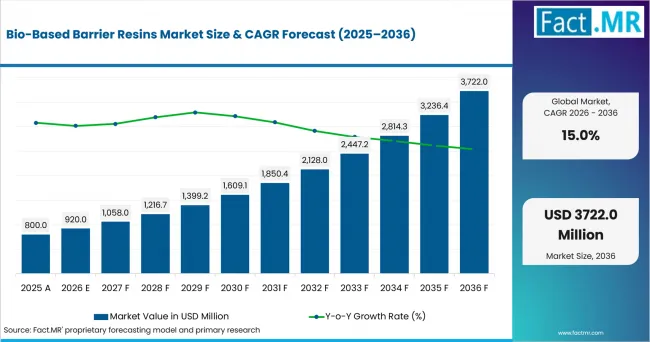
Bio Based Barrier Resins Market Value Analysis | Source: Fact.MR
What are the defining numbers behind Bio-Based Barrier Resins Market growth?
USD 2,802.0 million absolute opportunity is expected between 2026 and 2036.
- Demand Drivers in the Market
- Packaging converters serving the EU market need to align packaging designs with Regulation (EU) 2025/40, which entered into force on 11 February 2025 and generally applies from 12 August 2026, with specific design-for-recycling requirements phased in thereafter.
- Fiber packaging mills need coating resins that add grease control to paper wraps and trays while keeping a practical route into fiber recovery streams.
- Foodservice operators need bio-based barrier formats for sachets and wraps where oil resistance, seal integrity and disposal instructions affect daily pack choices.
- Export-focused snack and prepared-food brands need aroma and moisture protection that holds through longer distribution cycles and retailer shelf checks.
- Key Segments Analyzed
- By Material: Bio-polymer blends are expected to hold 39.0% share in 2026 because blend design balances film formation, toughness and barrier performance for flexible packaging.
- By Format: Flexible film is projected to account for 37.0% share in 2026 supported by its fit with snacks, produce packs and lightweight foodservice wraps.
- By Barrier Function: Moisture is anticipated to capture 36.0% share in 2026 since produce and dry snack applications require water-vapor control before other properties are approved.
- By Application: Produce is estimated to represent 41.0% share in 2026 owing to short shelf-life windows and a high need for breathable moisture-management films.
- Analyst Opinion at Fact.MR
- Shambhu Nath Jha, Principal Consultant at Fact.MR, states, “Barrier resins are being judged by line performance first. Food brands are expected to approve bio-based options when converters prove moisture control, seal strength and recovery fit together. The better suppliers combine resin chemistry, food-contact support and film-processing guidance in one qualification package.”
- Strategic Implications
- Resin developers should document barrier performance across humidity ranges so food brands are able to compare bio-based grades with existing polyolefin and coated-paper structures.
- Converters should test sealing, slip behavior and coating weight early because line stoppages are expected to outweigh the benefit of a lighter material claim.
- Retail packaging teams should connect bio-based barrier decisions with EPR fee exposure and customer disposal instructions before approving national rollouts.
- Food manufacturers should prioritize one application family at a time so sensory testing, shelf-life evidence and packaging artwork updates move together.
The UK is projected to post 17.1% CAGR through 2036 supported by pEPR implementation and packaged-food converter pressure. South Korea is anticipated to advance at 16.2% where K-food exports increase shelf-life scrutiny. Japan is forecast to record 14.9% as food-loss reduction keeps freshness packaging visible. Germany is estimated to reach 14.3% with recycling discipline shaping resin approval. The USA is expected to reach 10.7% as grocery scale supports selective qualification.
How does the Bio-Based Barrier Resins Market break down by segment?
Bio-polymer blends lead Material at 39.0%; Produce leads Application at 41.0%.
Which Material dominates?
Bio-polymer blends are expected to hold 39.0% share in 2026.
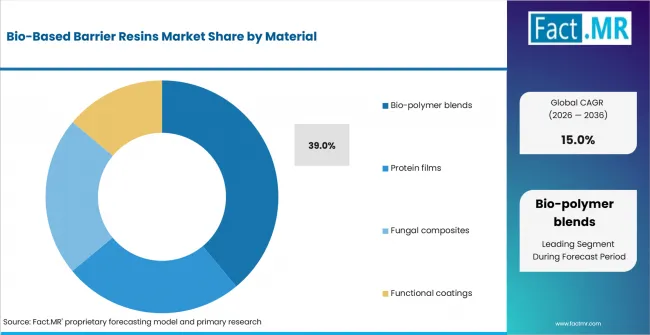
Bio Based Barrier Resins Market Analysis By Material | Source: Fact.MR
Bio-polymer blends lead the material mix because converters need a practical balance between barrier performance and machinability. Blends let formulators tune stiffness, seal response and moisture behavior across flexible films and coated structures. TotalEnergies Corbion published an updated life-cycle assessment for Luminy® PLA in June 2025, providing third-party-verified environmental-impact data across 16 impact categories for material evaluation. The strongest commercial path is therefore tied to resin packages that arrive with processing data and environmental records.
What leads the Format segment?
Flexible film is projected to account for 37.0% share in 2026.
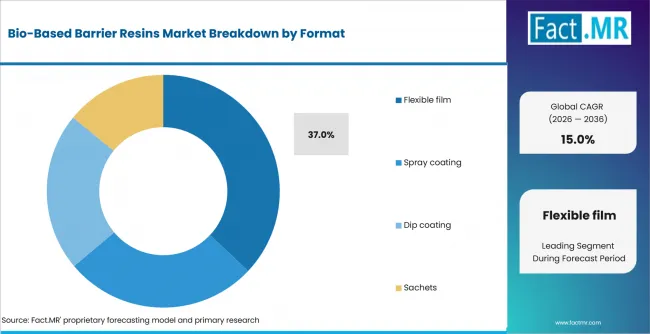
Bio Based Barrier Resins Market Analysis By Format | Source: Fact.MR
Flexible film leads because food brands are able to apply bio-based barrier resins to existing pack types before changing the full packaging system. Snack pouches, produce bags and foodservice wrappers already rely on thin structures with clear performance targets. BASF expanded its certified compostable ecovio portfolio in April 2026 with grades for extrusion coating or film lamination on paper and plastic substrates. That type of format support helps converters test barrier designs within familiar equipment settings.
How does Barrier Function shape demand?
Moisture is anticipated to lead with 36.0% share in 2026.
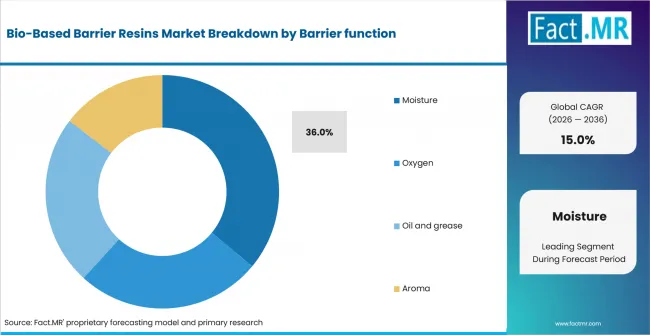
Bio Based Barrier Resins Market Analysis By Barrier Function | Source: Fact.MR
Moisture control leads because fresh produce, dry snacks and bakery products lose value quickly when water-vapor behavior is poorly matched to the pack. Bio-based barrier resins must therefore protect texture and appearance while keeping sealing stable.
What supports Produce within Application?
Produce is estimated to represent 41.0% share in 2026.
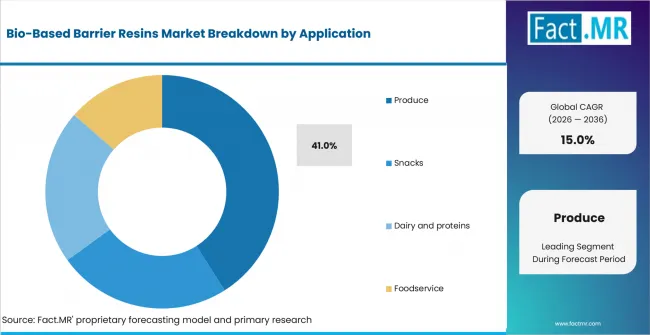
Bio Based Barrier Resins Market Analysis By Application | Source: Fact.MR
Produce leads application demand because fruits and vegetables need moisture balance and visible freshness in short retail cycles. The format gives food brands a clear route to test lighter packaging before wider prepared-food use. Destatis reported in February 2026 that Germany’s vegetable harvest reached 4.5 million tonnes in 2025, highlighting the scale of domestic fresh-vegetable production in one of Europe’s major food markets. Packaging teams are expected to favor films that protect shelf display and fit packhouse speed.
What is accelerating Bio-Based Barrier Resins Market adoption, and what is holding it back?
Demand is expected to rise through food-packaging qualification and recovery-linked material review.
Drivers Impact Analysis
| DRIVER | (~) % IMPACT ON CAGR | GEOGRAPHIC RELEVANCE | IMPACT TIMELINE |
|---|---|---|---|
| Fresh-food shelf-life protection | +1.9% | North America, Western Europe, East Asia | Short term (<= 2 years) |
| EPR-linked packaging redesign | +1.5% | UK, European Union, Japan | Medium term (2-4 years) |
| Flexible-film lightweighting | +1.1% | Global | Medium term (2-4 years) |
| Foodservice grease and sachet applications | +0.8% | North America, East Asia | Long term (>= 4 years) |
Source: Fact.MR analysis. Updated Aug 27, 2026
- Fresh-food shelf-life protection: Produce packers place value on films that manage moisture and avoid thick laminate layers.
- EPR-linked packaging redesign: EPR systems are expected to shift attention toward material weight, recovery evidence and end-of-life cost. Bio-based barrier resins gain relevance where brands document performance and disposal fit together.
- Flexible-film lightweighting: Thin films remain attractive where pack weight and line speed affect unit economics. Bio-based blends are expected to advance when they match sealing and stiffness requirements on existing equipment.
Opportunity Impact Analysis
| OPPORTUNITY | (~) % IMPACT ON CAGR | GEOGRAPHIC RELEVANCE | IMPACT TIMELINE |
|---|---|---|---|
| Paper and board barrier coatings | +1.2% | Western Europe, Japan | Medium term (2-4 years) |
| Produce film conversion | +1.0% | USA, Germany, South Korea | Short term (<= 2 years) |
| Compostable foodservice formats | +0.7% | UK, Japan, South Korea | Long term (>= 4 years) |
Source: Fact.MR analysis. Updated Aug 27, 2026
- Paper and board barrier coatings: Food brands are expected to use coated paper where grease or oxygen protection is required in a fiber-based pack. This supports resin systems that coat evenly and pass food-contact review.
- Produce film conversion: Packhouses need films that hold appearance through transport and retail display. Demand is anticipated to center on grades that combine moisture management with enough toughness for automated packing lines.
- Compostable foodservice formats: Foodservice operators are expected to test sachets, wraps and coated trays where residue and oil resistance affect consumer handling. Certified grades gain an advantage when disposal guidance is clear.
Restraints Impact Analysis
| RESTRAINT | (~) % IMPACT ON CAGR | GEOGRAPHIC RELEVANCE | IMPACT TIMELINE |
|---|---|---|---|
| Higher resin and coating cost | -0.8% | Global | Short term (<= 2 years) |
| Food-contact and migration review | -0.6% | North America, Europe, Japan | Medium term (2-4 years) |
| Moisture sensitivity during storage | -0.4% | East Asia, North America | Long term (>= 4 years) |
Source: Fact.MR analysis. Updated Aug 27, 2026
- Higher resin and coating cost: Premium bio-based grades face closer review in private-label food packs. Procurement teams are expected to approve them faster where shelf-life gains or EPR savings offset material cost.
- Food-contact and migration review: Barrier resin changes require documentation before launch. Timelines often stretch when brands use the same pack across several countries and need aligned regulatory files.
- Moisture sensitivity during storage: Some bio-based film and coating systems require careful handling before conversion. Suppliers that specify humidity limits and storage windows are better placed for repeat orders.
Which countries are scaling the Bio-Based Barrier Resins Market through 2036?
- The country comparison spans 6.4 percentage points between the UK and the USA across the forecast period.
- The UK remains 0.9 percentage point above South Korea as pEPR shifts cost visibility toward packaging material choice.
- South Korea remains 1.3 percentage points above Japan where export food channels add pressure for shelf-life validation.
- Japan remains 0.6 percentage point above Germany with food-loss reduction and plastic design review shaping barrier formats.
- Germany remains 3.6 percentage points above the USA because recycling discipline keeps mixed-material approval demanding.
- The USA closes the displayed range while grocery scale keeps it central for large-volume qualification programs.
Comparable CAGRs create different entry conditions due to food retail concentration, packaging recovery rules, converter readiness and food-contact approval timing. Full report coverage includes North America, Latin America, Western Europe, Eastern Europe, East Asia, South Asia & Pacific, Middle East & Africa.
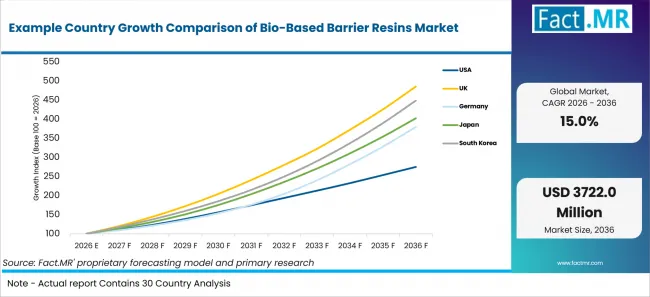
Example Country Growth Comparison Of Bio Based Barrier Resins Market | Source: Fact.MR
| Country | CAGR (2026-2036) |
|---|---|
| UK | 17.1% |
| South Korea | 16.2% |
| Japan | 14.9% |
| Germany | 14.3% |
| USA | 10.7% |
Source: Fact.MR analysis. Updated Aug 27, 2026
What supports the United Kingdom’s growth?
17.1% CAGR, backed by pEPR implementation and food-retail packaging pressure.
PackUK formally launched on 21 January 2025 to implement the UK Extended Producer Responsibility for packaging program after the EPR statutory instrument came into force on 1 January 2025. HMRC reported that 38% of total plastic packaging tonnage manufactured in or imported into the UK in 2024 to 2025 was declared taxable under the Plastic Packaging Tax. These policy and tax signals are expected to make bio-based barrier resin trials more practical for packaged produce, snack wraps and foodservice formats where material choice affects fee exposure and retailer approval.
How is South Korea scaling demand?
16.2% CAGR, led by K-food exports and food manufacturing qualification.
MAFRA reported on 20 January 2026 that South Korea’s agri-food exports reached USD 10.41 billion in 2025, while total K-Food Plus exports reached USD 13.62 billion. Export food brands need barrier films that protect flavor, aroma and moisture across longer shipping cycles. South Korea’s food manufacturers are therefore expected to test bio-based resin systems first in snacks, sauces and compact foodservice packs where pack integrity carries a direct bearing on overseas shelf quality.
How does Japan perform?
14.9% CAGR, supported by food-loss reduction and plastic design review.
Japan’s Ministry of the Environment placed FY2023 food loss and waste at 4.64 million tonnes in June 2025, including 2.31 million tonnes from businesses. METI then published design certification criteria for four plastic product fields in July 2025 under the plastic resource circulation system. Freshness protection and design-for-circulation review are expected to support bio-based moisture, oxygen and grease barriers in convenience food packs and prepared-meal formats.
What is supporting Germany’s adoption?
14.3% CAGR, shaped by packaging recycling discipline and produce demand.
The German Environment Agency placed packaging waste recycled from dual-system collections at around 5.5 million tonnes in 2024 in its January 2026 update. Destatis placed Germany’s 2025 vegetable harvest at 4.5 million tonnes in February 2026. These figures point to a market where produce packaging volume and recycling evidence are reviewed together, giving bio-based barrier resins a route into films and coatings that preserve freshness while passing converter qualification checks.
What supports USA adoption?
10.7% CAGR, supported by grocery scale and selective packaging trials.
USDA ERS placed total U.S. food spending at USD 2.51 trillion in 2025 in its June 2026 Food Expenditure Series update. That spending base gives food brands a wide field for trials, yet customer qualification remains selective because state packaging rules and retailer specifications differ by channel. Bio-based barrier resin adoption is expected to begin in produce films, snack packs and foodservice wraps where performance value is clearer than in commodity dry-goods packaging.
Who leads the Bio-Based Barrier Resins Market?
NatureWorks, TotalEnergies Corbion, BASF, Arkema, and Danimer Scientific.
NatureWorks is active in PLA-based packaging materials and film platforms, with Ingeo™ Extend 4950D supporting biaxially oriented PLA films for small-format food-packaging applications. TotalEnergies Corbion supplies Luminy® PLA grades and published an updated 2025 life-cycle assessment for Luminy® PLA, providing third-party-verified environmental-impact data for material evaluation.
BASF participates through certified compostable ecovio® grades for flexible barrier structures, while Arkema participates through Bostik flexible-packaging laminating adhesives and related packaging solutions.
Danimer Scientific, acquired by Teknor Apex in June 2025, continues to supply biodegradable biopolymer materials including PHA-based solutions. Across these portfolios, barrier performance, food-contact compliance, processing support and alignment with intended recycling or composting routes are relevant competitive considerations.
Which companies are the key providers?
Key companies include NatureWorks; TotalEnergies Corbion; BASF; Arkema; and Danimer Scientific.
- NatureWorks
- TotalEnergies Corbion
- BASF
- Arkema
- Danimer Scientific
Bibliography
- Arkema. (2026, May 21). 2025 annual and sustainable performance report.
- BASF SE. (2026, April 29). New ecovio® portfolio for flexible packaging: Multiple barrier options combined with organic or paper recycling.
- Department for Environment, Food & Rural Affairs, Department of Agriculture, Environment and Rural Affairs (Northern Ireland), Scottish Government, & Welsh Government. (2025, January 21). PackUK – pEPR scheme administrator launched. GOV.UK.
- Directorate-General for Environment. (2025, February 11). New rules enter into force for a more sustainable and competitive packaging economy. European Commission.
- Federal Statistical Office (Destatis). (2026, February 26). Gemüseernte erreicht 2025 neuen Höchststand [Vegetable harvest reaches a new record high in 2025].
- German Environment Agency. (2026, January 27). Facts against myths: Packaging waste recycling in Germany is working.
- Ministry of Agriculture, Food and Rural Affairs. (2026, January 20). Exports of K-Food Plus reached USD 13.6 billion in 2025, up 5.1% year-over-year.
- Ministry of the Environment, Government of Japan. (2025, June 27). MOE Japan discloses the estimated amount of Japan’s food loss and waste generated in FY2023.
- NatureWorks LLC. (2025, March 18). Ingeo™ Extend: An exceptional solution offering unprecedented manufacturing efficiency and faster biodegradability of BOPLA films.
- Teknor Apex Company. (2025, June 10). Teknor Apex acquires Danimer Scientific to further diversify sustainable materials portfolio.
This Report Answers
- The report explains where bio-based barrier resins are used across material and format. It covers barrier function and application within the same segmentation view.
- Segment analysis identifies the leading subsegments and the operational reasons packaging teams prioritize them.
- Country analysis examines the listed markets and the policy or food-channel mechanisms supporting adoption.
- Competitive analysis reviews active providers across PLA, PHA, coating, gas-barrier and packaging resin portfolios.
- Application analysis assesses how moisture control, grease resistance and oxygen protection influence purchase decisions.
What does the Bio-Based Barrier Resins Market cover?
The Bio-Based Barrier Resins Market covers resins and coating systems used to improve food-packaging barrier performance with a renewable or biodegradable material route.
The assessment covers flexible films, spray coatings, dip coatings and sachet formats across moisture, oxygen, oil, grease and aroma protection. Demand is assessed across produce, snack, dairy, protein and foodservice applications alongside relevant links to sustainable packaging and oxygen barrier paper wraps used in food-contact formats.
What is included in the scope?
The scope includes commercial bio-based barrier resins, functional coatings and blends used in food packaging where barrier performance is a core purchase reason. It includes materials used in flexible films, paperboard coatings and laminated formats aligned with bio-based laminate packaging materials and bio-based paperboard laminates where resin chemistry supports package function.
It includes bio-polymer blends, protein films, fungal composites and functional coatings used by food brands, converters and packaging developers. The scope includes formats linked to bio-based cartonboard coatings and sustainable food packaging when the resin layer provides measurable barrier value.
What is excluded from the scope?
The scope covers bio-based or biodegradable positioning; conventional fossil-only commodity resins are outside scope. General packaging films are excluded when barrier function is incidental to the purchase decision.
The scope excludes finished packaging outside the barrier-resin value chain and waste-management services sold separately from resin formulation. Adjacent packaging categories such as biodegradable packaging material, waste bioplastics resins and sustainable plastic packaging are considered only when they intersect with barrier resin selection.
How Was the Analysis Built?
The analysis draws on 120+ sources, 35+ company portfolios, 25+ countries, and more than 20 industry interviews.
- Primary Research: Primary research includes discussions with manufacturers, converters, resin producers, brand owners, packaging engineers, procurement teams and subject-matter experts. These conversations examine purchasing priorities, product adoption, operational constraints, approval requirements, competitive positioning and the factors that influence wider market acceptance.
- Desk Research: Desk research covers government statistics, regulatory publications, company filings, trade data, technical studies, industry associations, standards, public policy and other authoritative references. Each reference used in the analysis is documented in the bibliography.
- Market Sizing and Forecasting: Market estimates combine historical performance, demand indicators, pricing and volume trends, segment shares, company participation, country-level growth, adoption patterns, investment activity and barriers to market expansion.
- Data Validation and Update Cycle: Findings are validated by comparing primary interviews with public data, company activity, regulatory changes, trade patterns and industry developments.
Segmentation
What is the report’s scope and coverage?
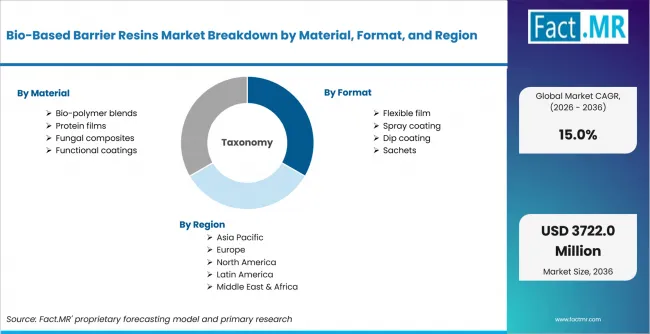
Bio Based Barrier Resins Market Breakdown By Material, Format, And Region | Source: Fact.MR
| Attribute | Details |
|---|---|
| Quantitative Units | USD million |
| Market Definition | Bio-based barrier resins are polymer and coating materials derived fully or partly from renewable feedstocks and used to provide moisture, oxygen, oil, grease or aroma protection in packaging structures. |
| Material | Bio-polymer blends; Protein films; Fungal composites; Functional coatings |
| Format | Flexible film; Spray coating; Dip coating; Sachets |
| Barrier Function | Moisture; Oxygen; Oil and grease; Aroma |
| Application | Produce; Snacks; Dairy and proteins; Foodservice |
| Regions Covered | North America; Latin America; Western Europe; Eastern Europe; East Asia; South Asia & Pacific; Middle East & Africa |
| Countries Covered | United States; United Kingdom; Germany; Japan; South Korea |
| Key Companies Profiled | NatureWorks; TotalEnergies Corbion; BASF; Arkema; Danimer Scientific |
| Forecast Period | 2026 to 2036 |
| Approach | Hybrid top-down and bottom-up approach using food-packaging demand, resin qualification activity, converter adoption, country policy signals and provider portfolio review. |
Source: Fact.MR analysis. Updated Aug 27, 2026
How is the market segmented?
-
By Material:
- Bio-polymer blends
- Protein films
- Fungal composites
- Functional coatings
-
By Format:
- Flexible film
- Spray coating
- Dip coating
- Sachets
-
By Barrier Function:
- Moisture
- Oxygen
- Oil and grease
- Aroma
-
By Application:
- Produce
- Snacks
- Dairy and proteins
- Foodservice
-
By Region:
- North America
- Latin America
- Western Europe
- Eastern Europe
- East Asia
- South Asia & Pacific
- Middle East & Africa
Frequently Asked Questions
How big is the Bio-Based Barrier Resins Market in 2026?
What is the CAGR of the Bio-Based Barrier Resins Market from 2026 to 2036?
Which material leads the Bio-Based Barrier Resins Market?
Which application leads the Bio-Based Barrier Resins Market?
Which companies are profiled in the Bio-Based Barrier Resins Market?
Who worked on this report


Preview the report firsthand - request a free sample
Free SampleGet the brochure for pricing and purchase details
Download PDF