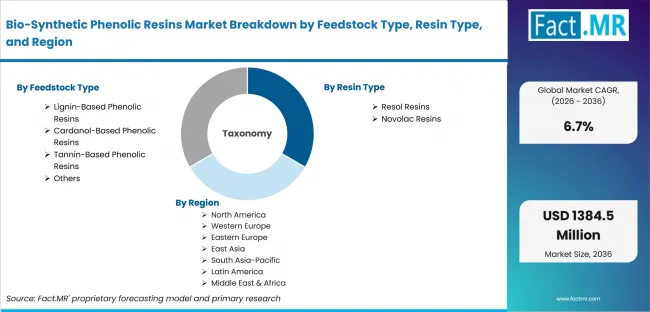
Bio-Synthetic Phenolic Resins Market Size, Share, Growth and Forecast (2026 - 2036)

The global Bio-Synthetic Phenolic Resins market is segmented by Feedstock Type, by Resin Type, by Application, by Bio-Based Raw Material Source, and by Region. Forecast for 2026 to 2036.

Bio-Synthetic Phenolic Resins Market Overview, Growth Outlook, and Forecast by Fact.MR

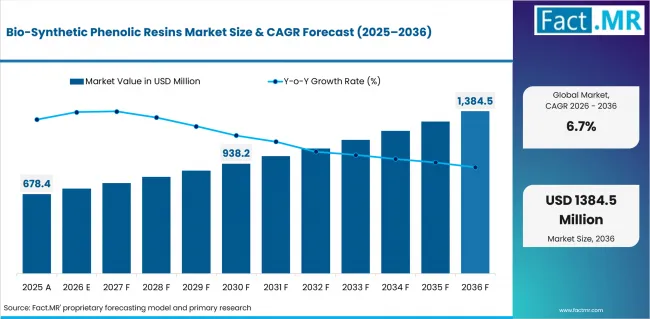
  • In 2025, the global bio-synthetic phenolic resins market was valued at approximately USD 678.4 million.
  • Based on Fact.MR analysis, demand for Bio-Synthetic Phenolic Resins is projected to grow to around USD 723.9 million in 2026 and reach approximately USD 1,384.5 million by 2036.
  • The market is anticipated to expand at a CAGR of 6.7% during the forecast period.
Bio Synthetic Phenolic Resins Market Value Analysis

Summary of the Bio-Synthetic Phenolic Resins Market

  • Market Snapshot
    • In 2025, the global bio-synthetic phenolic resins market was valued at approximately USD 678.4 million.
    • The market is estimated to reach around USD 723.9 million in 2026 and is projected to attain nearly USD 1,384.5 million by 2036.
    • The bio-synthetic phenolic resins market is expected to expand at a CAGR of 6.7% during the forecast period.
    • The market is anticipated to create an absolute dollar opportunity of approximately USD 660.6 million between 2026 and 2036.
    • In terms of feedstock type, Lignin-Based Phenolic Resins hold the largest share of approximately 56.80% in 2026, driven by increasing utilization of lignin as a renewable substitute for fossil-based phenol, growing investments in lignin valorization technologies, expanding commercial-scale production, and rising demand for sustainable resin systems across wood adhesives and industrial applications.
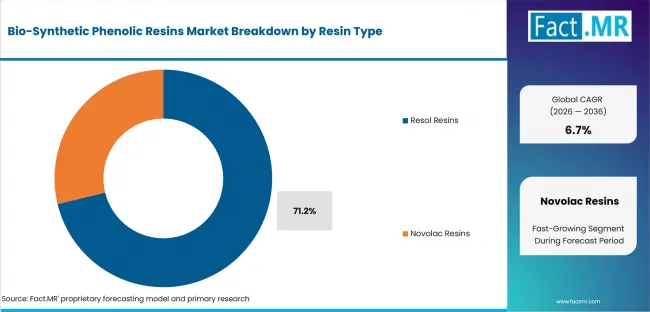
    • Based on resin type, Resol Resins represent approximately 71.20% share in 2026, driven by their extensive use in wood adhesives, engineered wood products, and construction-related applications, along with growing demand for bio-based adhesive formulations.
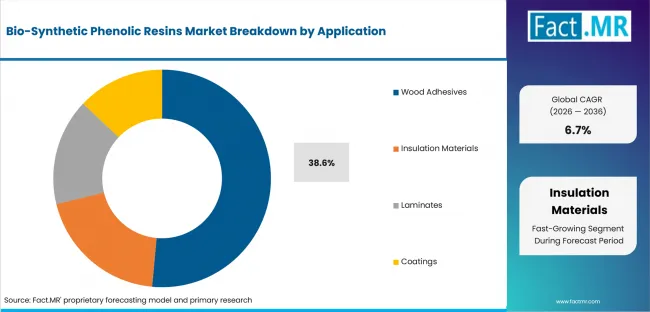
    • In terms of application, Wood Adhesives account for approximately 38.60% share in 2026, supported by increasing demand for sustainable plywood, particleboard, OSB, and laminated veneer lumber products, particularly in the building and construction sector.
  • Demand and Growth Drivers
    • The rise in focus on sustainability and the rising necessity to decrease reliance on petrochemicals as raw materials in the production process have led to a surge in demand for Bio-Synthetic Phenolic Resins in applications like adhesives, laminates, insulating materials, and other industrial uses.
    • The growing number of investments in lignin recovery, biorefineries, and renewable feedstocks will lead to the development of alternative phenolic resin technologies that can allow producers to substitute phenol with more sustainable options without compromising performance.
    • The growth in the construction industry and engineered wood markets is resulting in an increasing demand for bio-based adhesives and insulating products, leading to the growing demand for Bio-Synthetic Phenolic Resins.
  • Product and Segment View
    • Lignin-based phenolic resins have 56.80% market share, due to the increased utilization of lignin as an environmentally friendly substitute of phenol made from fossil fuels, growing investments in the technology of lignin utilization, increased production capacity, and growing demand for environmentally friendly resin systems in wood adhesives, construction materials, and industrial applications.
    • The share of resol resins is 71.20%, based on their extensive use in wood adhesives, engineered wood panels, insulation material, and construction applications, where there is a growing demand for bio-based resins and advanced resin systems.
    • Wood adhesives have 38.60% market share, as they are in demand due to their usage in plywood, particleboard, oriented strand board, LVL wood, and other engineered wood products, based on growing activities in the area of sustainable construction and furniture manufacturing.
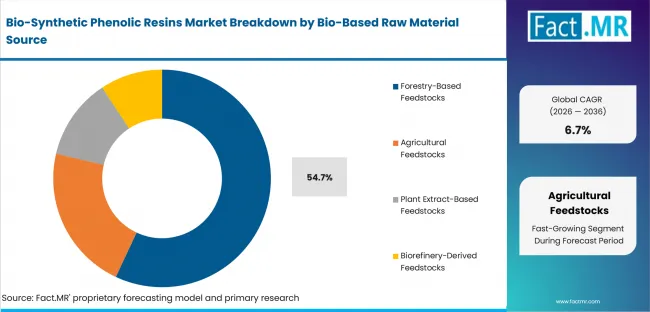
    • Feedstocks based on forestry biomass are estimated to have 54.70% market share, as there is a lot of lignin and lignosulfonate available in the pulp and paper industry, investments in forest-based biorefineries, and increased use of renewable aromatic feedstocks in the production of phenolic resins.
  • Geography and Competitive Outlook
    • The North American region dominates the world market for Bio-Synthetic Phenolic Resins due to its advanced phenolic resin industry, presence of significant players, high investment in sustainable materials, and demand for bio-based adhesives, insulation materials, and industrial binders.
    • The Asia Pacific region is expected to record some of the highest CAGRs attributed to industrial growth, construction activity, manufacture of engineered wood products, and sustainable materials and increased investments in bio-based chemicals.
    • The industry maintains a relatively consolidated structure characterized by such companies as Hexion, Prefere Resins, Sumitomo Bakelite, SI Group, and Cardolite Corporation. The competition in the market is focused on innovations in bio-based resins, lignin replacement techniques, incorporation of sustainable sources, product performance improvement, collaborations, and investments in renewable materials.
  • Analyst Opinion
    • Shambhu Nath Jha, Principal Consultant at Fact.MR, says, “Market growth in the Global Bio-Synthetic Phenolic Resins Market could be attributed to the growing need for bio-synthetic substitutes for petro-phenolic resins, growing usage of bio-synthetic material in building and industrial sectors, and investments in lignin technology and biorefineries. Adoption will be supported by manufacturers working to reduce carbon emissions and increase renewable raw material use in adhesives and binders."

Bio-Synthetic Phenolic Resins Market - At a Glance

Metric Value
Market Value 2025 USD 678.4 Million
Market Value 2026 USD 723.9 Million
Market Value 2036 USD 1,384.5 Million
Absolute Dollar Opportunity USD 660.6 Million
CAGR (2026–2036) 6.70%
Growth Multiple 1.9x
Key Demand Theme Growing demand for sustainable and renewable alternatives to petroleum-based phenol, increasing adoption of bio-based adhesives and binders, rising investments in lignin valorization technologies, and expanding use of environmentally friendly resin systems across construction, and industrial applications.
Leading Feedstock Type Lignin-Based Phenolic Resins
Feedstock Type Share 56.80%
Leading Resin Type Resol Resins
Resin Type Share 71.20%
Leading Application Wood Adhesives
Application Share 38.60%
Leading Bio-Based Raw Material Source Forestry-Based Feedstocks
Bio-Based Raw Material Source Share 54.70%
Key Growth Regions North America, Europe, Asia Pacific
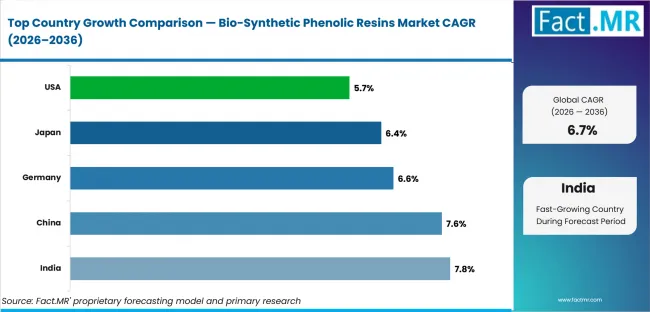
Fastest Growing Countries India (7.8%), China (7.6%), Germany (6.6%), Japan (6.4%), USA (5.7%)
Key Companies Hexion, Prefere Resins, Sumitomo Bakelite, SI Group, Cardolite Corporation, Stora Enso, UPM
Feedstock Type Segmentation Lignin-Based Phenolic Resins, Cardanol-Based Phenolic Resins, Tannin-Based Phenolic Resins, Others
Resin Type Segmentation Resol Resins, Novolac Resins
Application Segmentation Wood Adhesives, Insulation Materials, Laminates, Coatings, Foundry Binders, Friction Materials, Composites, Others
Bio-Based Raw Material Source Segmentation Forestry-Based Feedstocks, Agricultural Feedstocks, Plant Extract-Based Feedstocks, Biorefinery-Derived Feedstocks, Hybrid Feedstocks
Regions North America, Latin America, Europe, Middle East & Africa, Asia Pacific

Key Growth Drivers, Constraints, and Opportunities
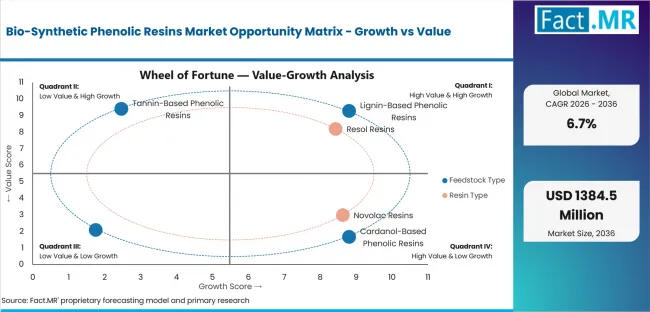
Bio Synthetic Phenolic Resins Market Opportunity Matrix Growth Vs Value

Key Factors Driving Growth

  • With industries relying more and more on sustainable and renewable materials in their use of adhesives, laminates, insulation, and industrial applications, there will be an increase in demand for Bio-Synthetic Phenolic Resins. The increasing demand for products not based on petroleum chemicals will aid in driving the markets in the coming years.
  • Rising investment in biorefineries, lignin-based technologies, and renewable raw material development will support demand for bio-synthetic phenolic resins. These investments support manufacturer adoption of bio-resins for sustainability-focused applications.
  • The trend towards low carbon materials and sustainable production processes will lead to growth in the market. Bio-Synthetic Phenolic Resins would serve to be one solution to incorporate renewable raw materials into resins.
Growth Driver Demand Impact Time Horizon Key Impact Area Fact.MR Insight
Growing adoption of sustainable and renewable materials across industries High Short–Mid Term Sustainable materials demand The increasing need to reduce dependence on petroleum-derived chemicals is driving higher demand for Bio-Synthetic Phenolic Resins in adhesives, laminates, insulation materials, and industrial applications.
Rising investments in lignin valorization and biorefinery technologies High Short–Mid Term Feedstock development Expanding investments in renewable feedstock processing and lignin commercialization are supporting the production and adoption of bio-based phenolic resin formulations.
Expansion of green construction and engineered wood industries High Mid Term Construction applications Growing demand for sustainable wood panels, plywood, particleboard, and insulation products is increasing consumption of Bio-Synthetic Phenolic Resins, particularly in adhesive applications.
Technological advancements in bio-based resin formulations High Mid–Long Term Product innovation Innovations in renewable feedstock integration, resin chemistry, and process optimization are improving resin performance, enabling broader adoption across industrial and specialty applications.
Increasing environmental regulations and corporate sustainability commitments Medium–High Mid–Long Term Regulatory compliance Stricter environmental standards and sustainability initiatives are encouraging manufacturers to adopt bio-based resin systems and invest in renewable raw material alternatives.

Key Market Constraints

  • bio-synthetic phenolic resins lack commercially viable sources of biomass and have existing competitors like conventional phenolic resins, their manufacturers find it difficult to penetrate the market effectively.
  • Bio-synthetic phenolic resins might suffer from high manufacturing cost issues owing to the higher prices of biomass processing, lignin extraction, formulating, technology improvements, and optimizing manufacturing processes.
  • The low level of knowledge concerning the capabilities of bio-synthetic phenolic resins, coupled with worries about feedstock reliability, scalability, and availability, remain major obstacles in their widespread adoption.

Key Opportunity Areas

  • Increasing attention towards sustainable and renewable chemicals in China, India, Germany, Japan, and the United States provides great scope for expanding the market by promoting more use of bio-synthetic phenolic resins in various end-use industries.
  • Increasing demand for low carbon emission materials and progress in lignin value addition, biorefining processes, and production of bio-based feedstocks creates many opportunities for the producers to introduce new products made using bio-synthetic phenolic resins.

Segment-wise Analysis of the Bio-Synthetic Phenolic Resins Market

  • Lignin-Based Phenolic Resins hold a 56.80% share in the feedstock type segment, driven by increasing utilization of lignin as a renewable substitute for petroleum-based phenol and growing investments in lignin valorization technologies.
  • Resol Resins hold a 71.20% share in the resin type segment, supported by their extensive use in wood adhesives, insulation materials, and engineered wood products requiring high-performance resin systems.
  • Wood Adhesives account for a 38.60% share in the application segment, driven by strong demand from plywood, particleboard, OSB, and other engineered wood products used in construction and furniture manufacturing.

The global Bio-Synthetic Phenolic Resins market is segmented by feedstock type, resin type, application, bio-based raw material source, and region.

Which Feedstock Type Segment Dominates the Market?
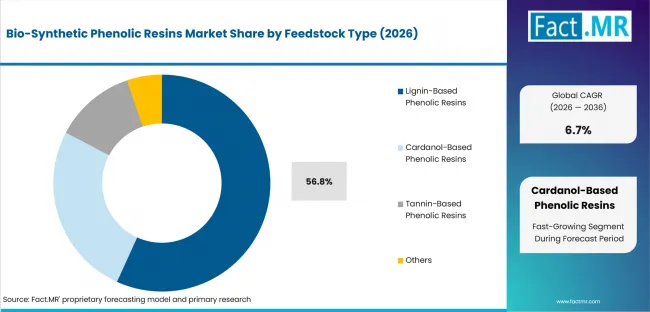
Bio Synthetic Phenolic Resins Market Analysis By Feedstock Type

Industry segment of Bio-Synthetic Phenolic Resins, Lignin-Based Phenolic Resins sub-segment holds the largest market share, which is 56.80%. As per forecasts, Lignin-Based Phenolic Resins are anticipated to dominate the market in the future as well due to growing application of lignin as renewable alternative to phenol made from oil and increasing preference for sustainable phenolic resins.

Which Resin Type Segment Dominates the Market?
Bio Synthetic Phenolic Resins Market Analysis By Resin Type

Resol Resins hold the largest resin type share at 71.2% in 2026. Growth in this segment is supported by large-scale use in wood adhesives, insulation materials, and engineered wood products.

Which Application Segment Dominates the Market?
Bio Synthetic Phenolic Resins Market Analysis By Application

Wood Adhesives account for the leading application share at 38.6% in 2026. Based on forecasted growth trends, it is anticipated that the Wood Adhesives segment would maintain its leadership position in the market during the forecast period due to rising demands for plywood, particleboards, OSB boards, and LVL products.

Which Bio-Based Raw Material Source Segment Dominates the Market?
Bio Synthetic Phenolic Resins Market Analysis By Bio Based Raw Material Source

Forestry-Based Feedstocks holds the largest market share at 54.70%. As per projections, Forestry-Based Feedstocks is projected to dominate the market in the forecasted period, considering its wide availability in the pulp and paper industry, investment in forest-based biorefinery operations, and the usage of renewable aromatic feedstocks for manufacturing bio-synthetic phenolic resins.

Regional Outlook Across Key Markets

The market analysis covers key global regions, including South Asia and Pacific, Middle East & Africa, North America, Latin America, Western Europe, and Eastern Europe. It is segmented geographically, with specific market dynamics for each region. The full report provides a detailed market attractiveness analysis.

Top Country Growth Comparison Bio Synthetic Phenolic Resins Market Cagr (2026 2036)

CAGR Table

Country CAGR (%)
U.S. 5.7%
Germany 6.6%
Japan 6.4%
China 7.6%
India 7.8%
Canada 7.0%
France 7.8%

Source: Fact.MR analysis, based on proprietary forecasting model and primary research.
Bio Synthetic Phenolic Resins Market Cagr Analysis By Country

North America – Leading Market for Bio-Synthetic Phenolic Resins

Bio-Synthetic Phenolic Resins are becoming more popular in North America with growing demands for sustainable products, increasing usage of bio-based adhesives and binders, and increasing investments made in feedstock technologies based on renewable energy sources. The advantages that North America holds in terms of its chemicals industry, research and development activities, and decreasing usage of petrochemical-based raw material are driving the growth of the market.

  • U.S.: Demand for Bio-Synthetic Phenolic Resins in the U.S. is projected to grow at a CAGR of 5.7%, supported by increasing adoption of sustainable construction materials, growing utilization of bio-based wood adhesives, and expanding demand for renewable resin systems across industrial and manufacturing applications.

Western Europe – A Key Growth Region for Bio-Synthetic Phenolic Resins
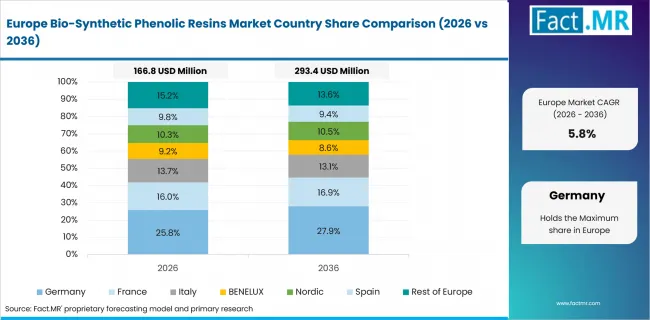
Bio Synthetic Phenolic Resins Market Europe Country Market Share Analysis, 2026 & 2036

The rising trend toward sustainability, increasing popularity of bio-based products, strict environmental laws, and advances in renewable feedstock technologies have been major factors behind the rising demand for Bio-Synthetic Phenolic Resins in Western Europe.

  • Germany: Demand for Bio-Synthetic Phenolic Resins in Germany is projected to grow at a CAGR of 6.6%, supported by the country's strong chemicals industry, increasing adoption of sustainable resin solutions, growing investments in renewable feedstock development, and emphasis on reducing carbon emissions through the use of bio-based materials across industrial and construction applications.

East Asia – A Major Growth Center for Bio-Synthetic Phenolic Resins

The use of sustainable materials, increased activities related to industrial manufacturing, investment in renewable chemicals, and the rising demand for bio-resin have been driving the fast-paced growth of the Bio-Synthetic Phenolic Resins market in East Asia.

  • China: Demand for Bio-Synthetic Phenolic Resins in China is projected to grow at a CAGR of 7.6%, supported by the country's expanding construction and manufacturing sectors, increasing adoption of sustainable materials, growing investments in bio-based chemical technologies, and rising utilization of renewable feedstocks in adhesive, laminate, insulation, and industrial resin applications.

South Asia & Pacific – An Emerging Hub for Bio-Synthetic Phenolic Resins

The growth of the industry due to increased industrial manufacturing and construction activities, sustainability focus, and investment in bio-based chemical technologies has driven the development of the Bio-Synthetic Phenolic Resins market in the South Asia & Pacific region.

  • India: Demand for Bio-Synthetic Phenolic Resins in India is projected to grow at a CAGR of 7.8%, supported by the country's expanding construction and wood processing industries, increasing availability of renewable feedstocks such as cardanol, growing adoption of sustainable resin solutions, and rising investments in bio-based materials across industrial and manufacturing applications.

Latin America – Emerging Opportunity for Bio-Synthetic Phenolic Resins

The Latam market for Bio-synthetic phenolic resins is forecast to experience steady growth, fueled by the rising demand for eco-friendly materials, growth in the construction and wood processing industries, and the growing inclination toward renewable feedstock-based products. Furthermore, the availability of extensive biomass sources in the region and the growing emphasis on eco-friendly manufacturing techniques are likely to favor the usage of bio-synthetic phenolic resins in the region.

  • Brazil: Demand for Bio-Synthetic Phenolic Resins in Brazil is projected to grow at a steady 7.6% CAGR through 2036, supported by the country's strong forestry and agricultural resources, increasing adoption of bio-based materials, expanding wood panel and construction industries, and growing utilization of renewable feedstocks in resin production.

Middle East & Africa – A Rising Market for Bio-Synthetic Phenolic Resins

The MEA market for bio-synthetic phenolic resins is projected to register steady growth, propelled by increasing industrial development in the region, rising demand for sustainable building products, rising investments in the field of bio-based and renewable chemicals, and growing environmental consciousness among manufacturers.

  • KSA: Demand for Bio-Synthetic Phenolic Resins in Saudi Arabia is projected to grow at around 7.6% CAGR through 2036, supported by the country's industrial diversification initiatives, growing construction sector, and rising investments in advanced manufacturing and renewable chemical technologies.

Fact.MR analysis provides a comprehensive regional outlook across North America, Latin America, Western Europe, Eastern Europe, East Asia, South Asia & Pacific, and the Middle East & Africa. It offers detailed country-wise insights, highlighting growth trends, demand patterns, and adoption across key industries in both developed and emerging markets.

Competitive Benchmarking and Company Positioning
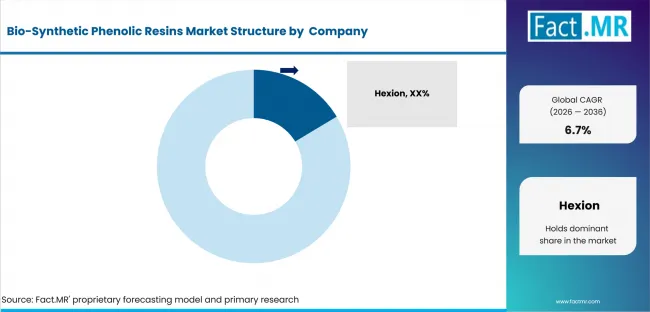
Bio Synthetic Phenolic Resins Market Analysis By Company

Leading Companies Shaping the Bio-Synthetic Phenolic Resins Market

The Bio-Synthetic Phenolic Resins industry comprises a number of resin suppliers, as well as bio-based materials firms. The industry is somewhat fragmented owing to the market shares held by the leading firms such as Hexion, Prefere Resins, Sumitomo Bakelite, and Cardolite Corporation, which make up about 40% to 45% of the industry’s total market share. The growth prospects of the industry are expected to be positive considering the increased interest in sustainability, renewable raw materials like lignin and cardanol, investments in the bio-based material sector, and application of the resins in construction, wood processing, and industrial purposes.

Key Players of the Bio-Synthetic Phenolic Resins Market

  • Hexion
  • Prefere Resins
  • Bakelite Synthetics
  • Stora Enso
  • Borregaard

Recent Industry Developments

  • Latvijas Finieris - Lignin-Based Resin Mill Construction in Riga (January 2025)
    • In January 2025, Latvijas Finieris started construction of a new resin mill in Riga’s Bolderāja district. The facility is designed to scale lignin-phenol-formaldehyde resin production and reduce reliance on fossil-based phenol and formaldehyde in plywood, insulation, sandpaper, and related applications.
  • Sumitomo Bakelite - Commercial Sales of Lignin-Modified Novolac Phenolic Resin (June 2025)
    • In June 2025, Sumitomo Bakelite launched commercial sales of solid novolac-type lignin-modified phenolic resin made with lignin from non-edible biomass. The company reported adoption in resin-coated sand binder applications used for selected automotive cast parts.
  • UPM - Leuna Biorefinery Commercial Production Milestone (December 2025)
    • In December 2025, UPM started commercial production of wood-based chemicals at its Leuna biorefinery in Germany. The development supports the wider lignin value chain and strengthens upstream availability for bio-based resin and binder applications.

Sources and Research References

  • Latvijas Finieris. (2025, January 15). Latvijas Finieris is starting the construction of a new resin mill with the placement of messages in the foundations.
  • Investment and Development Agency of Latvia. (2025, January 22). Latvijas Finieris starts construction of a natural resin factory in Riga.
  • VIOBOND. (2025, March 21). Foundation slab constructed for the future resin mill of AS Latvijas Finieris.
  • Sumitomo Bakelite Co., Ltd. (2025, June 16). Commercialization of the world’s first biomass-derived solid novolac-type lignin-modified phenolic resin.
  • UPM. (2025, December 19). UPM unlocks new bio-based markets as Leuna biorefinery produces its first commercial product.

Bio-Synthetic Phenolic Resins Market Definition

Bio-Synthetic Phenolic Resins Market can be referred to as an industry which includes phenolic resins products obtained from renewable resources like lignin, cardanol, tannin, and many others. This category of bio-synthetic phenolic resins is used as an adhesive material, insulating materials, laminate, coating material, and many more applications which can serve as the alternative for petroleum-based phenolic resins.

Bio-Synthetic Phenolic Resins Market Inclusions

The industry is made up of manufacturers and suppliers involved in the production and commercialization of phenolic resins derived from renewable feedstocks. The industry focuses on developing sustainable resin solutions for adhesives, insulation materials, laminates, coatings, foundry binders, friction materials, and composites while supporting the transition from petroleum-based to bio-based raw materials.

Bio-Synthetic Phenolic Resins Market Exclusions

The following are not included in the market under discussion: conventional petroleum-based phenolic resins, non-renewable synthetic resins, generic thermosetting resins, biopolymers other than phenolic resins, unprocessed lignin or biomass companies that do not process the bio-synthetic phenolic resins, and wooden building products that don't incorporate bio-synthetic phenolic resin formulation.

Bio-Synthetic Phenolic Resins Market Research Methodology

  • Primary Research
    • The current analysis report on the industry only covers its market dynamics, whereby the bio-synthetic phenolic resins industry refers to the market for phenolic resins that are produced using sustainable raw material sources such as lignin, cardanol, tannins, and others. The analysis includes the latest developments in the bio-resin technology industry, developments in the area of sustainable raw material sources, commercialization efforts, and consumer demand.
  • Desk Research
    • Secondary Research holds great significance for this particular study, and it was carried out through review of publicly available data from chemical companies, bio-based materials manufacturing firms, industry groups, corporate literature, technical magazines, research articles, among others, relating to the industry of interest. This includes annual reports of corporations, sustainability reports, investor presentations, websites, patents, whitepapers, news stories, scientific journal articles, and others.
  • Market-Sizing and Forecasting
    • The sizing of the market for Bio-Synthetic Phenolic Resins has been undertaken using both top-down and bottom-up methodologies for the global market. In the bottom-up method of market sizing, it is the assessment of the production capacity, sales performance, and financials of companies producing bio-synthetic phenolic resins such as lignin, cardanol, tannin, and other types of bio-phenolic resins that have been taken into consideration.
  • Data Validation and Update Cycle
    • Cross-validation for the validation of the global Bio-Synthetic Phenolic Resins market data has been carried out in order to arrive at a valid figure. Cross-validation of figures in the Bio-Synthetic Phenolic Resins market was carried out with the help of the analysis of various types of documents made available by the major players in the Bio-Synthetic Phenolic Resins market ecosystem, including their annual reports, investor presentations, sustainability reports, etc.

Scope of Analysis

Bio Synthetic Phenolic Resins Market Breakdown By Feedstock Type, Resin Type, And Region

Parameter Details
Quantitative Units USD 678.4 million in 2025 to USD 1,384.5 million in 2036, at a CAGR of 6.7%
Market Definition The Bio-Synthetic Phenolic Resins market comprises phenolic resin products manufactured using renewable feedstocks such as lignin, cardanol, tannins, and other biomass-derived materials for applications across adhesives, insulation materials, laminates, friction materials, and composites.
Regions Covered North America, Latin America, Western Europe, Eastern Europe, East Asia, South Asia & Pacific, Middle East & Africa
Countries Covered USA, China, Germany, UK, Japan, India, Brazil, KSA, and 30+ countries
Key Companies Hexion, Prefere Resins, Sumitomo Bakelite, Cardolite Corporation, Stora Enso, UPM
Forecast Period 2026 to 2036
Approach Hybrid demand-side and top-down methodology based on increasing adoption of sustainable materials, growing demand for bio-based adhesives and binders, rising investments in lignin valorization and biorefinery technologies, expanding utilization of renewable feedstocks, and increasing demand for low-carbon resin solutions across construction, and industrial applications.

Analysis by Feedstock Type, Resin Type, Application, Bio-Based Raw Material Source, and Region

  • Bio-Synthetic Phenolic Resins Market By Feedstock Type

    • Lignin-Based Phenolic Resins
      • Kraft Lignin-Based
      • Lignosulfonate-Based
      • Organosolv Lignin-Based
    • Cardanol-Based Phenolic Resins
      • Straight Cardanol-Based
      • Cardanol-Modified Phenolic Resins
    • Tannin-Based Phenolic Resins
      • Condensed Tannin-Based
      • Hydrolysable Tannin-Based
    • Others
  • Bio-Synthetic Phenolic Resins Market By Resin Type

    • Resol Resins
      • Wood Adhesive Grade
      • Insulation Grade
      • Binder Grade
    • Novolac Resins
      • Friction Material Grade
      • Molding Compound Grade
      • Coating Grade
  • Bio-Synthetic Phenolic Resins Market By Application

    • Wood Adhesives
    • Insulation Materials
    • Laminates
    • Coatings
    • Foundry Binders
    • Friction Materials
    • Composites
    • Others
  • Bio-Synthetic Phenolic Resins Market By Bio-Based Raw Material Source

    • Forestry-Based Feedstocks
      • Lignin
      • Lignosulfonates
      • Wood-Derived Aromatics
    • Agricultural Feedstocks
    • Plant Extract-Based Feedstocks
    • Biorefinery-Derived Feedstocks
      • Bio-Phenol
      • Bio-Benzene Derivatives
      • Renewable Aromatic Compounds
    • Hybrid Feedstocks
  • Bio-Synthetic Phenolic Resins Market By Region

    • North America
      • USA
      • Canada
      • Mexico
    • Latin America
      • Brazil
      • Chile
      • Rest of LATAM
    • East Asia
      • China
      • Japan
      • South Korea
    • Western Europe
      • Germany
      • Italy
      • France
      • U.K.
      • Spain
      • BENELUX
      • Nordic
      • Rest of W. Europe
    • Eastern Europe
      • Russia
      • Hungary
      • Poland
      • Balkan & Baltics
      • Rest of E. Europe
    • Middle East and Africa
      • Kingdom of Saudi Arabia
      • United Arab Emirates
      • South Africa
      • Rest of Middle East and Africa

- Frequently Asked Questions -

How large is the demand for Bio-Synthetic Phenolic Resins in the global market in 2025?

Demand for Bio-Synthetic Phenolic Resins in the global market is estimated to be valued at USD 678.4 million in 2025.

What will be the market size of the Bio-Synthetic Phenolic Resins market in the global market by 2036?

The market size for Bio-Synthetic Phenolic Resins is projected to reach USD 1,384.5 million by 2036.

What is the expected demand growth for the Bio-Synthetic Phenolic Resins market between 2026 and 2036?

Demand for Bio-Synthetic Phenolic Resins in the global market is expected to grow at a CAGR of 6.7% between 2026 and 2036.

Which feedstock type segment is expected to dominate the Bio-Synthetic Phenolic Resins market?

Lignin-Based Phenolic Resins are expected to dominate the market, accounting for 56.80% share in 2026, driven by increasing utilization of lignin as a renewable substitute for petroleum-based phenol, growing investments in lignin valorization technologies, and rising demand for sustainable resin systems across industrial and construction applications.

How significant is the growth outlook for the India in this market?

India is expected to grow at a CAGR of 7.8% through 2036, supported by expanding construction and wood processing industries, increasing availability of renewable feedstocks such as cardanol, growing adoption of sustainable materials, and rising investments in bio-based chemical technologies.

Which company is identified as a leading player in the Bio-Synthetic Phenolic Resins market?

Hexion is identified as a leading player in the market, supported by its strong position in phenolic resin manufacturing, ongoing development of sustainable resin technologies, broad industrial customer base, and focus on advancing bio-based and renewable feedstock solutions for high-performance resin applications.

Table of Content

  1. Bio-Synthetic Phenolic Resins Market – Executive Summary
  2. Market Overview
    • Market Definition & Introduction
    • Market Taxonomy & Research Scope
  3. Global Bio-Synthetic Phenolic Resins Market Demand Analysis 2021-2025 and Forecast, 2026–2036
    • Historical Market Volume (Tons) Analysis, 2021-2025
    • Current and Future Market Volume (Tons) Projections, 2026–2036
    • Y-o-Y Growth Trend Analysis
  4. Global Bio-Synthetic Phenolic Resins Market - Pricing Analysis
    • Product Category and Country-Level Pricing Analysis
    • Region Average Pricing Analysis Benchmark
    • Price Trends and Forecasts
      • Historical price trends
      • Future price forecasts
    • Factors Influencing Pricing
    • Competitive Pricing Strategies
    • Cost Structure Analysis
  5. Global Bio-Synthetic Phenolic Resins Market Demand (in Value or Size in US$ Mn) Analysis 2021-2025 and Forecast, 2026–2036
    • Historical Market Value (US$ Mn) Analysis, 2021-2025
    • Current and Future Market Value (US$ Mn) Projections, 2026–2036
      • Y-o-Y Growth Trend Analysis
      • Absolute $ Opportunity Analysis
  6. Market Background and Foundational Data Points
    • Share of bio-based phenolic resins in the total global phenolic resins market (%)
    • Annual growth rate of global bio-based resin consumption (%)
    • Share of lignin utilization in phenol substitution applications (%)
    • Global production capacity of lignin available for industrial valorization (Tons)
    • Annual growth rate of renewable feedstock adoption in thermosetting resins (%)
    • Share of wood adhesives in total phenolic resin consumption (%)
    • Global demand growth rate for engineered wood products (%)
    • Share of forestry-derived feedstocks in the bio-based chemicals industry (%)
    • Annual growth rate of sustainable construction materials demand (%)
    • Global consumption growth rate of bio-based adhesives and binders (%)
    • Share of renewable feedstocks used in phenolic resin manufacturing relative to conventional phenol consumption (%)
    • Bio-Synthetic Phenolic Resins Market Opportunity Assessment
      • Total Available Market (US$ Mn)
      • Serviceable Addressable Market (US$ Mn)
      • Serviceable Obtainable Market (US$ Mn)
    • Porter’s Five Forces and PESTEL Analysis
    • Investment Feasibility Analysis
    • Macro-Economic Factors & Forecast Factors - Relevance & Impact
    • Industry Value and Supply Chain Analysis
      • List of Key Channel Partners
      • Profit Margin & Operating Margin at Each Node of Supply Chain.
      • Notes on Value Added at Each Node in the Value Chain
      • Factors Influencing Value Chain
    • Market Dynamics
      • Drivers
      • Restraints
      • Opportunity Analysis
    • Key Regulations & Certifications
  7. Bio-Synthetic Phenolic Resins Market Analysis 2021-2025 and Forecast 2026–2036, By Feedstock Type
    • Introduction / Key Findings
    • Historical Market Size (US$ Mn) & Volume (Tons) Trend Analysis By Feedstock Type, 2021-2025
    • Current and Future Market Size (US$ Mn) & Volume (Tons) Analysis and Forecast By Feedstock Type, 2026-2036
      • Lignin-Based Phenolic Resins
        • Kraft Lignin-Based
        • Lignosulfonate-Based
        • Organosolv Lignin-Based
      • Cardanol-Based Phenolic Resins
        • Straight Cardanol-Based
        • Cardanol-Modified Phenolic Resins
      • Tannin-Based Phenolic Resins
        • Condensed Tannin-Based
        • Hydrolysable Tannin-Based
      • Others
    • Market Attractiveness Analysis By Feedstock Type
  8. Bio-Synthetic Phenolic Resins Market Analysis 2021-2025 and Forecast 2026–2036, By Resin Type
    • Introduction / Key Findings
    • Historical Market Size (US$ Mn) & Volume (Tons) Trend Analysis By Resin Type, 2021-2025
    • Current and Future Market Size (US$ Mn) & Volume (Tons) Analysis and Forecast By Resin Type, 2026-2036
      • Resol Resins
        • Wood Adhesive Grade
        • Insulation Grade
        • Binder Grade
      • Novolac Resins
        • Friction Material Grade
        • Molding Compound Grade
        • Coating Grade
    • Market Attractiveness Analysis By Resin Type
  9. Bio-Synthetic Phenolic Resins Market Analysis 2021-2025 and Forecast 2026–2036, By Application
    • Introduction / Key Findings
    • Historical Market Size (US$ Mn) & Volume (Tons) Trend Analysis By Application, 2021-2025
    • Current and Future Market Size (US$ Mn) & Volume (Tons) Analysis and Forecast By Application, 2026-2036
        • Wood Adhesives
        • Insulation Materials
        • Laminates
        • Coatings
        • Foundry Binders
        • Friction Materials
        • Composites
        • Others
    • Market Attractiveness Analysis By Application
  10. Bio-Synthetic Phenolic Resins Market Analysis 2021-2025 and Forecast 2026–2036, By Bio-Based Raw Material Source
    • Introduction / Key Findings
    • Historical Market Size (US$ Mn) & Volume (Tons) Trend Analysis By Bio-Based Raw Material Source, 2021-2025
    • Current and Future Market Size (US$ Mn) & Volume (Tons) Analysis and Forecast By Bio-Based Raw Material Source, 2026-2036
      • Forestry-Based Feedstocks
        • Lignin
        • Lignosulfonates
        • Wood-Derived Aromatics
      • Agricultural Feedstocks
      • Plant Extract-Based Feedstocks
      • Biorefinery-Derived Feedstocks
        • Bio-Phenol
        • Bio-Benzene Derivatives
        • Renewable Aromatic Compounds
      • Hybrid Feedstocks
    • Market Attractiveness Analysis By Bio-Based Raw Material Source
  11. Global Bio-Synthetic Phenolic Resins Market Analysis and Forecast, by Region
    • Introduction / Key Findings
    • Historical Market Size (US$ Mn) & Volume (Tons) Trend Analysis by Region, 2021-2025
    • Current and Future Market Size (US$ Mn) & Volume (Tons) Analysis and Forecast by Region, 2026-2036
      • North America
      • Latin America
      • Western Europe
      • Eastern Europe
      • East Asia
      • South Asia & Pacific
      • Middle East & Africa
    • Market Attractiveness Analysis by Region
  12. North America Bio-Synthetic Phenolic Resins Market Analysis and Forecast
    • Introduction / Key Findings
    • Pricing Analysis
    • Historical Market Size (US$ Mn) & Volume (Tons) Trend Analysis by Market Taxonomy, 2021-2025
    • Current and Future Market Size (US$ Mn) and Volume (Tons) Analysis & Forecast by Market Taxonomy, 2026-2036
    • By Country
      • United States
      • Canada
      • Mexico
    • By Taxonomy
    • Market Attractiveness Analysis By Country & Taxonomy
    • Market Trends
    • Key Market Participants – Intensity Mapping
    • Drivers and Restraints - Impact Analysis
  13. Latin America Bio-Synthetic Phenolic Resins Market Analysis and Forecast
    • Introduction / Key Findings
    • Pricing Analysis
    • Historical Market Size (US$ Mn) & Volume (Tons) Trend Analysis by Market Taxonomy, 2021-2025
    • Current and Future Market Size (US$ Mn) and Volume (Tons) Analysis & Forecast by Market Taxonomy, 2026-2036
    • By Country
      • Brazil
      • Chile
      • Rest of LATAM
    • By Taxonomy
    • Market Attractiveness Analysis By Country & Taxonomy
    • Market Trends
    • Key Market Participants – Intensity Mapping
    • Drivers and Restraints - Impact Analysis
  14. Western Europe Bio-Synthetic Phenolic Resins Market Analysis and Forecast
    • Introduction / Key Findings
    • Pricing Analysis
    • Historical Market Size (US$ Mn) & Volume (Tons) Trend Analysis by Market Taxonomy, 2021-2025
    • Current and Future Market Size (US$ Mn) and Volume (Tons) Analysis & Forecast by Market Taxonomy, 2026-2036
    • By Country
      • Germany
      • Italy
      • France
      • United Kingdom
      • Spain
      • BENELUX
      • Nordics
      • Rest of Western Europe
    • By Taxonomy
    • Market Attractiveness Analysis By Country & Taxonomy
    • Market Trends
    • Key Market Participants – Intensity Mapping
    • Drivers and Restraints - Impact Analysis
  15. Eastern Europe Bio-Synthetic Phenolic Resins Market Analysis and Forecast
    • Introduction / Key Findings
    • Pricing Analysis
    • Historical Market Size (US$ Mn) & Volume (Tons) Trend Analysis by Market Taxonomy, 2021-2025
    • Current and Future Market Size (US$ Mn) and Volume (Tons) Analysis & Forecast by Market Taxonomy, 2026-2036
    • By Country
      • Russia
      • Hungary
      • Poland
      • Balkan & Baltics
      • Rest of Eastern Europe
    • By Taxonomy
    • Market Attractiveness Analysis By Country & Taxonomy
    • Market Trends
    • Key Market Participants – Intensity Mapping
    • Drivers and Restraints - Impact Analysis
  16. East Asia Bio-Synthetic Phenolic Resins Market Analysis and Forecast
    • Introduction / Key Findings
    • Pricing Analysis
    • Historical Market Size (US$ Mn) & Volume (Tons) Trend Analysis by Market Taxonomy, 2021-2025
    • Current and Future Market Size (US$ Mn) and Volume (Tons) Analysis & Forecast by Market Taxonomy, 2026-2036
    • By Country
      • China
      • Japan
      • South Korea
    • By Taxonomy
    • Market Attractiveness Analysis By Country & Taxonomy
    • Market Trends
    • Key Market Participants – Intensity Mapping
    • Drivers and Restraints - Impact Analysis
  17. South Asia & Pacific Bio-Synthetic Phenolic Resins Market Analysis and Forecast
    • Introduction / Key Findings
    • Pricing Analysis
    • Historical Market Size (US$ Mn) & Volume (Tons) Trend Analysis by Market Taxonomy, 2021-2025
    • Current and Future Market Size (US$ Mn) and Volume (Tons) Analysis & Forecast by Market Taxonomy, 2026-2036
    • By Country
      • India
      • ASEAN
      • Australia & New Zealand
      • Rest of South Asia & Pacific
    • By Taxonomy
    • Market Attractiveness Analysis By Country & Taxonomy
    • Market Trends
    • Key Market Participants – Intensity Mapping
    • Drivers and Restraints - Impact Analysis
  18. Middle East & Africa Bio-Synthetic Phenolic Resins Market Analysis and Forecast
    • Introduction / Key Findings
    • Pricing Analysis
    • Historical Market Size (US$ Mn) & Volume (Tons) Trend Analysis by Market Taxonomy, 2021-2025
    • Current and Future Market Size (US$ Mn) and Volume (Tons) Analysis & Forecast by Market Taxonomy, 2026-2036
    • By Country
      • Kingdom of Saudi Arabia
      • Other GCC Countries
      • Turkiye
      • South Africa
      • Other African Union
    • By Taxonomy
    • Market Attractiveness Analysis By Country & Taxonomy
    • Market Trends
    • Key Market Participants – Intensity Mapping
    • Drivers and Restraints - Impact Analysis
  19. Country-level Bio-Synthetic Phenolic Resins Market Analysis and Forecast
    • Introduction
    • Market Value Proportion Analysis, By Key Countries
    • Global Vs. Country Growth Comparison
      • United States Bio-Synthetic Phenolic Resins Market Analysis
        • Market Size (US$ Mn) & Volume (Tons) Analysis by Market Taxonomy, 2021–2036
        • By Feedstock Type
        • By Resin Type
        • By Bio-Based Raw Material Source
        • By Application
        • Canada Bio-Synthetic Phenolic Resins Market Analysis
        • Mexico Bio-Synthetic Phenolic Resins Market Analysis
        • Brazil Bio-Synthetic Phenolic Resins Market Analysis
        • Chile Bio-Synthetic Phenolic Resins Market Analysis
        • Germany Bio-Synthetic Phenolic Resins Market Analysis
        • France Bio-Synthetic Phenolic Resins Market Analysis
        • Italy Bio-Synthetic Phenolic Resins Market Analysis
        • Spain Bio-Synthetic Phenolic Resins Market Analysis
        • United Kingdom Bio-Synthetic Phenolic Resins Market Analysis
        • BENELUX Bio-Synthetic Phenolic Resins Market Analysis
        • Nordics Bio-Synthetic Phenolic Resins Market Analysis
        • Poland Bio-Synthetic Phenolic Resins Market Analysis
        • Russia Bio-Synthetic Phenolic Resins Market Analysis
        • Hungary Bio-Synthetic Phenolic Resins Market Analysis
        • Balkan & Baltics Bio-Synthetic Phenolic Resins Market Analysis
        • China Bio-Synthetic Phenolic Resins Market Analysis
        • Japan Bio-Synthetic Phenolic Resins Market Analysis
        • South Korea Bio-Synthetic Phenolic Resins Market Analysis
        • India Bio-Synthetic Phenolic Resins Market Analysis
        • ASEAN Bio-Synthetic Phenolic Resins Market Analysis
        • ANZ Bio-Synthetic Phenolic Resins Market Analysis
        • KSA Bio-Synthetic Phenolic Resins Market Analysis
        • Other GCC Countries Bio-Synthetic Phenolic Resins Market Analysis
        • South Africa Bio-Synthetic Phenolic Resins Market Analysis
        • Turkiye Bio-Synthetic Phenolic Resins Market Analysis
    • Bio-Synthetic Phenolic Resins Market Structure Analysis
      • Market Analysis by Tier of Companies
      • Market Concentration
      • Market Share Analysis of Top Players
      • Market Space for New Brands and Dollar Opportunity
      • Market Presence Analysis
        • Regional Footprint of Players
        • Product Footprint by Players
    • Bio-Synthetic Phenolic Resins Competition Analysis
      • Competition Dashboard
      • Pricing Analysis by Competition
      • Competition Benchmarking
      • Competition Deep Dive
        • Hexion
          • Overview
          • Product Portfolio
          • Sales Footprint
          • Key Developments
          • SWOT Analysis
          • Strategy Overview
          • Key Financials
        • Prefere Resins
        • Bakelite Synthetics
        • Stora Enso
        • Borregaard
        • Other Prominent Players
    • Primary insights
    • Assumptions & Acronyms Used
    • Research Methodology & Data Forms

List Of Table

  • Table 1: Global Market Value (USD Mn) Forecast by Region, 2021 to 2036
  • Table 2: Global Market Volume (Tons) Forecast by Region, 2021 to 2036
  • Table 3: Global Market Value (USD Mn) Forecast by Feedstock Type, 2021 to 2036
  • Table 4: Global Market Volume (Tons) Forecast by Feedstock Type, 2021 to 2036
  • Table 5: Global Market Value (USD Mn) Forecast by Resin Type, 2021 to 2036
  • Table 6: Global Market Volume (Tons) Forecast by Resin Type, 2021 to 2036
  • Table 7: Global Market Value (USD Mn) Forecast by Application, 2021 to 2036
  • Table 8: Global Market Volume (Tons) Forecast by Application, 2021 to 2036
  • Table 9: Global Market Value (USD Mn) Forecast by Bio-Based Raw Material Source, 2021 to 2036
  • Table 10: Global Market Volume (Tons) Forecast by Bio-Based Raw Material Source, 2021 to 2036
  • Table 11: North America Market Value (USD Mn) Forecast by Country, 2021 to 2036
  • Table 12: North America Market Volume (Tons) Forecast by Country, 2021 to 2036
  • Table 13: North America Market Value (USD Mn) Forecast by Feedstock Type, 2021 to 2036
  • Table 14: North America Market Volume (Tons) Forecast by Feedstock Type, 2021 to 2036
  • Table 15: North America Market Value (USD Mn) Forecast by Resin Type, 2021 to 2036
  • Table 16: North America Market Volume (Tons) Forecast by Resin Type, 2021 to 2036
  • Table 17: North America Market Value (USD Mn) Forecast by Application, 2021 to 2036
  • Table 18: North America Market Volume (Tons) Forecast by Application, 2021 to 2036
  • Table 19: North America Market Value (USD Mn) Forecast by Bio-Based Raw Material Source, 2021 to 2036
  • Table 20: North America Market Volume (Tons) Forecast by Bio-Based Raw Material Source, 2021 to 2036
  • Table 21: Latin America Market Value (USD Mn) Forecast by Country, 2021 to 2036
  • Table 22: Latin America Market Volume (Tons) Forecast by Country, 2021 to 2036
  • Table 23: Latin America Market Value (USD Mn) Forecast by Feedstock Type, 2021 to 2036
  • Table 24: Latin America Market Volume (Tons) Forecast by Feedstock Type, 2021 to 2036
  • Table 25: Latin America Market Value (USD Mn) Forecast by Resin Type, 2021 to 2036
  • Table 26: Latin America Market Volume (Tons) Forecast by Resin Type, 2021 to 2036
  • Table 27: Latin America Market Value (USD Mn) Forecast by Application, 2021 to 2036
  • Table 28: Latin America Market Volume (Tons) Forecast by Application, 2021 to 2036
  • Table 29: Latin America Market Value (USD Mn) Forecast by Bio-Based Raw Material Source, 2021 to 2036
  • Table 30: Latin America Market Volume (Tons) Forecast by Bio-Based Raw Material Source, 2021 to 2036
  • Table 31: Western Europe Market Value (USD Mn) Forecast by Country, 2021 to 2036
  • Table 32: Western Europe Market Volume (Tons) Forecast by Country, 2021 to 2036
  • Table 33: Western Europe Market Value (USD Mn) Forecast by Feedstock Type, 2021 to 2036
  • Table 34: Western Europe Market Volume (Tons) Forecast by Feedstock Type, 2021 to 2036
  • Table 35: Western Europe Market Value (USD Mn) Forecast by Resin Type, 2021 to 2036
  • Table 36: Western Europe Market Volume (Tons) Forecast by Resin Type, 2021 to 2036
  • Table 37: Western Europe Market Value (USD Mn) Forecast by Application, 2021 to 2036
  • Table 38: Western Europe Market Volume (Tons) Forecast by Application, 2021 to 2036
  • Table 39: Western Europe Market Value (USD Mn) Forecast by Bio-Based Raw Material Source, 2021 to 2036
  • Table 40: Western Europe Market Volume (Tons) Forecast by Bio-Based Raw Material Source, 2021 to 2036
  • Table 41: Eastern Europe Market Value (USD Mn) Forecast by Country, 2021 to 2036
  • Table 42: Eastern Europe Market Volume (Tons) Forecast by Country, 2021 to 2036
  • Table 43: Eastern Europe Market Value (USD Mn) Forecast by Feedstock Type, 2021 to 2036
  • Table 44: Eastern Europe Market Volume (Tons) Forecast by Feedstock Type, 2021 to 2036
  • Table 45: Eastern Europe Market Value (USD Mn) Forecast by Resin Type, 2021 to 2036
  • Table 46: Eastern Europe Market Volume (Tons) Forecast by Resin Type, 2021 to 2036
  • Table 47: Eastern Europe Market Value (USD Mn) Forecast by Application, 2021 to 2036
  • Table 48: Eastern Europe Market Volume (Tons) Forecast by Application, 2021 to 2036
  • Table 49: Eastern Europe Market Value (USD Mn) Forecast by Bio-Based Raw Material Source, 2021 to 2036
  • Table 50: Eastern Europe Market Volume (Tons) Forecast by Bio-Based Raw Material Source, 2021 to 2036
  • Table 51: East Asia Market Value (USD Mn) Forecast by Country, 2021 to 2036
  • Table 52: East Asia Market Volume (Tons) Forecast by Country, 2021 to 2036
  • Table 53: East Asia Market Value (USD Mn) Forecast by Feedstock Type, 2021 to 2036
  • Table 54: East Asia Market Volume (Tons) Forecast by Feedstock Type, 2021 to 2036
  • Table 55: East Asia Market Value (USD Mn) Forecast by Resin Type, 2021 to 2036
  • Table 56: East Asia Market Volume (Tons) Forecast by Resin Type, 2021 to 2036
  • Table 57: East Asia Market Value (USD Mn) Forecast by Application, 2021 to 2036
  • Table 58: East Asia Market Volume (Tons) Forecast by Application, 2021 to 2036
  • Table 59: East Asia Market Value (USD Mn) Forecast by Bio-Based Raw Material Source, 2021 to 2036
  • Table 60: East Asia Market Volume (Tons) Forecast by Bio-Based Raw Material Source, 2021 to 2036
  • Table 61: South Asia and Pacific Market Value (USD Mn) Forecast by Country, 2021 to 2036
  • Table 62: South Asia and Pacific Market Volume (Tons) Forecast by Country, 2021 to 2036
  • Table 63: South Asia and Pacific Market Value (USD Mn) Forecast by Feedstock Type, 2021 to 2036
  • Table 64: South Asia and Pacific Market Volume (Tons) Forecast by Feedstock Type, 2021 to 2036
  • Table 65: South Asia and Pacific Market Value (USD Mn) Forecast by Resin Type, 2021 to 2036
  • Table 66: South Asia and Pacific Market Volume (Tons) Forecast by Resin Type, 2021 to 2036
  • Table 67: South Asia and Pacific Market Value (USD Mn) Forecast by Application, 2021 to 2036
  • Table 68: South Asia and Pacific Market Volume (Tons) Forecast by Application, 2021 to 2036
  • Table 69: South Asia and Pacific Market Value (USD Mn) Forecast by Bio-Based Raw Material Source, 2021 to 2036
  • Table 70: South Asia and Pacific Market Volume (Tons) Forecast by Bio-Based Raw Material Source, 2021 to 2036
  • Table 71: Middle East & Africa Market Value (USD Mn) Forecast by Country, 2021 to 2036
  • Table 72: Middle East & Africa Market Volume (Tons) Forecast by Country, 2021 to 2036
  • Table 73: Middle East & Africa Market Value (USD Mn) Forecast by Feedstock Type, 2021 to 2036
  • Table 74: Middle East & Africa Market Volume (Tons) Forecast by Feedstock Type, 2021 to 2036
  • Table 75: Middle East & Africa Market Value (USD Mn) Forecast by Resin Type, 2021 to 2036
  • Table 76: Middle East & Africa Market Volume (Tons) Forecast by Resin Type, 2021 to 2036
  • Table 77: Middle East & Africa Market Value (USD Mn) Forecast by Application, 2021 to 2036
  • Table 78: Middle East & Africa Market Volume (Tons) Forecast by Application, 2021 to 2036
  • Table 79: Middle East & Africa Market Value (USD Mn) Forecast by Bio-Based Raw Material Source, 2021 to 2036
  • Table 80: Middle East & Africa Market Volume (Tons) Forecast by Bio-Based Raw Material Source, 2021 to 2036

List Of Figures

  • Figure 1: Global Market Volume (Tons) Forecast 2021–2036
  • Figure 2: Global Market Pricing Analysis
  • Figure 3: Global Market Value (USD Mn) Forecast 2021–2036
  • Figure 4: Global Market Value Share and BPS Analysis by Feedstock Type, 2026 and 2036
  • Figure 5: Global Market Y-o-Y Growth Comparison by Feedstock Type, 2026 to 2036
  • Figure 6: Global Market Attractiveness Analysis by Feedstock Type
  • Figure 7: Global Market Value Share and BPS Analysis by Resin Type, 2026 and 2036
  • Figure 8: Global Market Y-o-Y Growth Comparison by Resin Type, 2026 to 2036
  • Figure 9: Global Market Attractiveness Analysis by Resin Type
  • Figure 10: Global Market Value Share and BPS Analysis by Application, 2026 and 2036
  • Figure 11: Global Market Y-o-Y Growth Comparison by Application, 2026 to 2036
  • Figure 12: Global Market Attractiveness Analysis by Application
  • Figure 13: Global Market Value Share and BPS Analysis by Bio-Based Raw Material Source, 2026 and 2036
  • Figure 14: Global Market Y-o-Y Growth Comparison by Bio-Based Raw Material Source, 2026 to 2036
  • Figure 15: Global Market Attractiveness Analysis by Bio-Based Raw Material Source
  • Figure 16: Global Market Value (USD Mn) Share and BPS Analysis by Region, 2026 and 2036
  • Figure 17: Global Market Y-o-Y Growth Comparison by Region, 2026 to 2036
  • Figure 18: Global Market Attractiveness Analysis by Region
  • Figure 19: North America Market Incremental $ Opportunity, 2026 to 2036
  • Figure 20: Latin America Market Incremental $ Opportunity, 2026 to 2036
  • Figure 21: Western Europe Market Incremental $ Opportunity, 2026 to 2036
  • Figure 22: Eastern Europe Market Incremental $ Opportunity, 2026 to 2036
  • Figure 23: East Asia Market Incremental $ Opportunity, 2026 to 2036
  • Figure 24: South Asia and Pacific Market Incremental $ Opportunity, 2026 to 2036
  • Figure 25: Middle East & Africa Market Incremental $ Opportunity, 2026 to 2036
  • Figure 26: North America Market Value Share and BPS Analysis by Country, 2026 and 2036
  • Figure 27: North America Market Value Share and BPS Analysis by Feedstock Type, 2026 and 2036
  • Figure 28: North America Market Y-o-Y Growth Comparison by Feedstock Type, 2026 to 2036
  • Figure 29: North America Market Attractiveness Analysis by Feedstock Type
  • Figure 30: North America Market Value Share and BPS Analysis by Resin Type, 2026 and 2036
  • Figure 31: North America Market Y-o-Y Growth Comparison by Resin Type, 2026 to 2036
  • Figure 32: North America Market Attractiveness Analysis by Resin Type
  • Figure 33: North America Market Value Share and BPS Analysis by Application, 2026 and 2036
  • Figure 34: North America Market Y-o-Y Growth Comparison by Application, 2026 to 2036
  • Figure 35: North America Market Attractiveness Analysis by Application
  • Figure 36: North America Market Value Share and BPS Analysis by Bio-Based Raw Material Source, 2026 and 2036
  • Figure 37: North America Market Y-o-Y Growth Comparison by Bio-Based Raw Material Source, 2026 to 2036
  • Figure 38: North America Market Attractiveness Analysis by Bio-Based Raw Material Source
  • Figure 39: Latin America Market Value Share and BPS Analysis by Country, 2026 and 2036
  • Figure 40: Latin America Market Value Share and BPS Analysis by Feedstock Type, 2026 and 2036
  • Figure 41: Latin America Market Y-o-Y Growth Comparison by Feedstock Type, 2026 to 2036
  • Figure 42: Latin America Market Attractiveness Analysis by Feedstock Type
  • Figure 43: Latin America Market Value Share and BPS Analysis by Resin Type, 2026 and 2036
  • Figure 44: Latin America Market Y-o-Y Growth Comparison by Resin Type, 2026 to 2036
  • Figure 45: Latin America Market Attractiveness Analysis by Resin Type
  • Figure 46: Latin America Market Value Share and BPS Analysis by Application, 2026 and 2036
  • Figure 47: Latin America Market Y-o-Y Growth Comparison by Application, 2026 to 2036
  • Figure 48: Latin America Market Attractiveness Analysis by Application
  • Figure 49: Latin America Market Value Share and BPS Analysis by Bio-Based Raw Material Source, 2026 and 2036
  • Figure 50: Latin America Market Y-o-Y Growth Comparison by Bio-Based Raw Material Source, 2026 to 2036
  • Figure 51: Latin America Market Attractiveness Analysis by Bio-Based Raw Material Source
  • Figure 52: Western Europe Market Value Share and BPS Analysis by Country, 2026 and 2036
  • Figure 53: Western Europe Market Value Share and BPS Analysis by Feedstock Type, 2026 and 2036
  • Figure 54: Western Europe Market Y-o-Y Growth Comparison by Feedstock Type, 2026 to 2036
  • Figure 55: Western Europe Market Attractiveness Analysis by Feedstock Type
  • Figure 56: Western Europe Market Value Share and BPS Analysis by Resin Type, 2026 and 2036
  • Figure 57: Western Europe Market Y-o-Y Growth Comparison by Resin Type, 2026 to 2036
  • Figure 58: Western Europe Market Attractiveness Analysis by Resin Type
  • Figure 59: Western Europe Market Value Share and BPS Analysis by Application, 2026 and 2036
  • Figure 60: Western Europe Market Y-o-Y Growth Comparison by Application, 2026 to 2036
  • Figure 61: Western Europe Market Attractiveness Analysis by Application
  • Figure 62: Western Europe Market Value Share and BPS Analysis by Bio-Based Raw Material Source, 2026 and 2036
  • Figure 63: Western Europe Market Y-o-Y Growth Comparison by Bio-Based Raw Material Source, 2026 to 2036
  • Figure 64: Western Europe Market Attractiveness Analysis by Bio-Based Raw Material Source
  • Figure 65: Eastern Europe Market Value Share and BPS Analysis by Country, 2026 and 2036
  • Figure 66: Eastern Europe Market Value Share and BPS Analysis by Feedstock Type, 2026 and 2036
  • Figure 67: Eastern Europe Market Y-o-Y Growth Comparison by Feedstock Type, 2026 to 2036
  • Figure 68: Eastern Europe Market Attractiveness Analysis by Feedstock Type
  • Figure 69: Eastern Europe Market Value Share and BPS Analysis by Resin Type, 2026 and 2036
  • Figure 70: Eastern Europe Market Y-o-Y Growth Comparison by Resin Type, 2026 to 2036
  • Figure 71: Eastern Europe Market Attractiveness Analysis by Resin Type
  • Figure 72: Eastern Europe Market Value Share and BPS Analysis by Application, 2026 and 2036
  • Figure 73: Eastern Europe Market Y-o-Y Growth Comparison by Application, 2026 to 2036
  • Figure 74: Eastern Europe Market Attractiveness Analysis by Application
  • Figure 75: Eastern Europe Market Value Share and BPS Analysis by Bio-Based Raw Material Source, 2026 and 2036
  • Figure 76: Eastern Europe Market Y-o-Y Growth Comparison by Bio-Based Raw Material Source, 2026 to 2036
  • Figure 77: Eastern Europe Market Attractiveness Analysis by Bio-Based Raw Material Source
  • Figure 78: East Asia Market Value Share and BPS Analysis by Country, 2026 and 2036
  • Figure 79: East Asia Market Value Share and BPS Analysis by Feedstock Type, 2026 and 2036
  • Figure 80: East Asia Market Y-o-Y Growth Comparison by Feedstock Type, 2026 to 2036
  • Figure 81: East Asia Market Attractiveness Analysis by Feedstock Type
  • Figure 82: East Asia Market Value Share and BPS Analysis by Resin Type, 2026 and 2036
  • Figure 83: East Asia Market Y-o-Y Growth Comparison by Resin Type, 2026 to 2036
  • Figure 84: East Asia Market Attractiveness Analysis by Resin Type
  • Figure 85: East Asia Market Value Share and BPS Analysis by Application, 2026 and 2036
  • Figure 86: East Asia Market Y-o-Y Growth Comparison by Application, 2026 to 2036
  • Figure 87: East Asia Market Attractiveness Analysis by Application
  • Figure 88: East Asia Market Value Share and BPS Analysis by Bio-Based Raw Material Source, 2026 and 2036
  • Figure 89: East Asia Market Y-o-Y Growth Comparison by Bio-Based Raw Material Source, 2026 to 2036
  • Figure 90: East Asia Market Attractiveness Analysis by Bio-Based Raw Material Source
  • Figure 91: South Asia and Pacific Market Value Share and BPS Analysis by Country, 2026 and 2036
  • Figure 92: South Asia and Pacific Market Value Share and BPS Analysis by Feedstock Type, 2026 and 2036
  • Figure 93: South Asia and Pacific Market Y-o-Y Growth Comparison by Feedstock Type, 2026 to 2036
  • Figure 94: South Asia and Pacific Market Attractiveness Analysis by Feedstock Type
  • Figure 95: South Asia and Pacific Market Value Share and BPS Analysis by Resin Type, 2026 and 2036
  • Figure 96: South Asia and Pacific Market Y-o-Y Growth Comparison by Resin Type, 2026 to 2036
  • Figure 97: South Asia and Pacific Market Attractiveness Analysis by Resin Type
  • Figure 98: South Asia and Pacific Market Value Share and BPS Analysis by Application, 2026 and 2036
  • Figure 99: South Asia and Pacific Market Y-o-Y Growth Comparison by Application, 2026 to 2036
  • Figure 100: South Asia and Pacific Market Attractiveness Analysis by Application
  • Figure 101: South Asia and Pacific Market Value Share and BPS Analysis by Bio-Based Raw Material Source, 2026 and 2036
  • Figure 102: South Asia and Pacific Market Y-o-Y Growth Comparison by Bio-Based Raw Material Source, 2026 to 2036
  • Figure 103: South Asia and Pacific Market Attractiveness Analysis by Bio-Based Raw Material Source
  • Figure 104: Middle East & Africa Market Value Share and BPS Analysis by Country, 2026 and 2036
  • Figure 105: Middle East & Africa Market Value Share and BPS Analysis by Feedstock Type, 2026 and 2036
  • Figure 106: Middle East & Africa Market Y-o-Y Growth Comparison by Feedstock Type, 2026 to 2036
  • Figure 107: Middle East & Africa Market Attractiveness Analysis by Feedstock Type
  • Figure 108: Middle East & Africa Market Value Share and BPS Analysis by Resin Type, 2026 and 2036
  • Figure 109: Middle East & Africa Market Y-o-Y Growth Comparison by Resin Type, 2026 to 2036
  • Figure 110: Middle East & Africa Market Attractiveness Analysis by Resin Type
  • Figure 111: Middle East & Africa Market Value Share and BPS Analysis by Application, 2026 and 2036
  • Figure 112: Middle East & Africa Market Y-o-Y Growth Comparison by Application, 2026 to 2036
  • Figure 113: Middle East & Africa Market Attractiveness Analysis by Application
  • Figure 114: Middle East & Africa Market Value Share and BPS Analysis by Bio-Based Raw Material Source, 2026 and 2036
  • Figure 115: Middle East & Africa Market Y-o-Y Growth Comparison by Bio-Based Raw Material Source, 2026 to 2036
  • Figure 116: Middle East & Africa Market Attractiveness Analysis by Bio-Based Raw Material Source
  • Figure 117: Global Market – Tier Structure Analysis
  • Figure 118: Global Market – Company Share Analysis

Bio-Synthetic Phenolic Resins Market

Buy Report Now