- Base Value(2026): 3.2 Bn
- Estimated Value(2026): 3.2 Bn
- Forecast Value (2036): 7.2 Bn
- CAGR (2026 - 2036): 8.6%
Bio-PE Film Ethylene Derivatives Market Forecast and Outlook By Fact.MR
The global market for bio-PE film ethylene derivatives is transitioning from a niche sustainability initiative to a core materials strategy for decarbonizing the plastics industry, projected to expand from USD 3.15 billion in 2026 to USD 7.19 billion by 2036, advancing at an 8.6% CAGR.
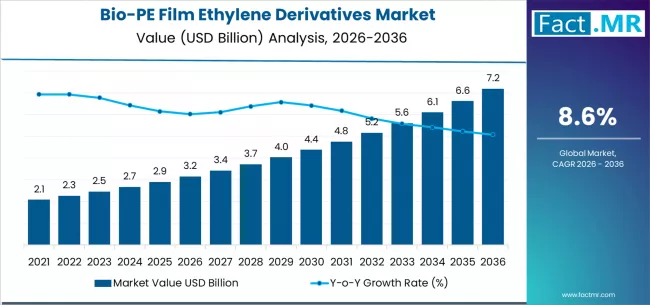
Bio Pe Film Ethylene Derivatives Market Market Value Analysis | Source: Fact.MR
Summary of Bio-PE Film Ethylene Derivatives Market
- Market Snapshot
- Global bio-PE film ethylene derivatives market revenue stood at approximately USD 2.90 billion in 2025 and is forecast to reach USD 7.19 billion by 2036.
- At an 8.6% CAGR from 2026 to 2036, this market is set to expand 2.3x in value, adding USD 4.04 billion in absolute opportunity as drop-in bioplastics transition from a niche sustainability initiative to a core decarbonisation strategy for the plastics industry.
- Corporate net-zero commitments, government plastic packaging taxes exempting bio-based content, and brand owner demand for certified renewable content are collectively converting bio-PE film adoption from voluntary sustainability positioning into a supply chain compliance requirement.
- Demand and Growth Drivers
- Proliferation of corporate commitments to incorporate recycled or renewable content in plastic packaging — backed by consumer preference and brand accountability — is generating structural demand for bio-PE films that deliver identical performance to fossil-based equivalents while carrying verified lower carbon credentials.
- Government policies including plastic taxes exempting bio-based content, mandatory renewable content regulations, and circular economy legislation across Europe, China, and India are creating regulatory pull that supplements brand-driven voluntary adoption and expands the commercially viable price gap between bio and fossil feedstock costs.
- Mass balance certification frameworks under ISCC PLUS and RSB standards are enabling cost-effective market penetration by allowing bio and fossil feedstocks to be efficiently combined in production, with bio-based content credited to final products and verified through digital chain of custody tracing.
- Product and Segment View
- Bio-PE derivative type holds 54% of market share in 2026 at USD 1.701 billion, forecast to reach USD 3.883 billion by 2036, dominant by virtue of its chemical identity to fossil-PE that enables direct drop-in substitution across all existing film conversion infrastructure without process re-engineering or capital expenditure.
- Agricultural and mulch films hold 32% of film type share in 2026 at USD 1.008 billion, forecast to reach USD 2.301 billion by 2036, driven by direct environmental benefits in farming where plastic soil contamination is a significant concern, and functional demand for durable, UV-stable films in controlled and open-field agricultural applications.
- Packaging and retail films represent the largest end-use segment at 38% of market in 2026 at USD 1.197 billion, forecast to reach USD 2.732 billion by 2036, driven by high-volume consumption and intense brand pressure to incorporate renewable content across food packaging, e-commerce mailers, and consumer goods flexible packaging that must meet stringent seal strength, clarity, and barrier performance requirements.
- Geography and Competitive Outlook
- United States market stood at approximately USD 567 million in 2026, forecast to reach USD 1.390 billion by 2036 at a 9.4% CAGR, anchored by major brand and retailer sustainability commitments, a large technologically advanced agricultural sector with early bio-input adoption, and a well-established corn ethanol industry providing a scalable domestic feedstock pathway for bio-ethylene production.
- India advances at a 9.8% CAGR from approximately USD 220.5 million in 2026 to USD 564.4 million by 2036, fuelled by a large agricultural film market, stringent plastic waste management rules encouraging bio-based alternatives, and government circular economy initiatives supporting domestic sugarcane and agro-waste feedstock utilisation.
- Germany market stood at approximately USD 283.5 million in 2026, forecast to reach USD 641.1 million by 2036 at an 8.5% CAGR, reflecting strict packaging legislation, strong consumer willingness to pay a sustainability premium, and brand owner and converter leadership in specifying ISCC PLUS certified mass-balanced bio-PE films for premium packaging applications.
- Key companies active in this market include Braskem, SABIC Bio-PE Business, Dow Inc., LyondellBasell Industries, TotalEnergies, and Corbion.
Bio-PE Film Ethylene Derivatives Market -At a Glance
| Attribute | Details |
|---|---|
| Market Value 2025 | USD 2.90 billion |
| Market Value 2026 | USD 3.15 billion |
| Market Value 2036 | USD 7.19 billion |
| Absolute Dollar Opportunity 2026-2036 | USD 4.04 billion |
| Total Growth 2026-2036 | 128.3% |
| CAGR 2026-2036 | 8.6% |
| Growth Multiple | 2.3x |
| Key Demand Theme | Corporate net-zero commitments, plastic packaging regulations exempting bio-based content, and mass balance certification frameworks converting bio-PE film adoption from voluntary sustainability positioning into a supply chain compliance requirement |
| Leading Segment by Film Type (2026) | Agricultural and Mulch Films |
| Film Type Segment Share (2026) | 32.0% |
| Leading Segment by Derivative Type (2026) | Bio-PE |
| Derivative Type Segment Share (2026) | 54.0% |
| Leading Segment by End-Use Industry (2026) | Packaging and Retail Films |
| End-Use Segment Share (2026) | 38.0% |
| Fastest Growing Country | China |
| China CAGR (2026-2036) | 10.1% |
| Key Growth Countries | China 10.1%, India 9.8%, USA 9.4%, Germany 8.5%, Brazil 8.2% |
| Key Growth Regions | East Asia, South Asia and Pacific, North America, Western Europe, Latin America |
| Top Companies | Braskem, SABIC Bio-PE Business, Dow Inc., LyondellBasell Industries, TotalEnergies, Corbion |
| Segmentation by Film Type | Agricultural and Mulch Films, Packaging Films, Industrial Films, Consumer Goods Films, Others |
| Segmentation by Derivative Type | Bio-PE, Bio-Ethylene Vinyl Acetate (EVA), Bio-Linear Low-Density PE (LLDPE), Bio-High Density PE (HDPE), Others |
| Segmentation by End-Use Industry | Packaging and Retail Films, Agriculture and Horticulture, Consumer Goods, Construction and Industrial, Others |
| Segmentation by Region | North America, Latin America, Western Europe, Eastern Europe, East Asia, South Asia and Pacific, Middle East and Africa |
Source: Fact.MR analysis. Updated Mar 26, 2026
Key Takeaways from the Bio-PE Film Ethylene Derivatives Market
- Market Value for 2026: USD 3.15 Billion
- Market Value for 2036: USD 7.19 Billion
- Forecast CAGR (2026-2036): 8.6%
- Leading Film Type Segment (2026): Agricultural & Mulch Films (32%)
- Leading Derivative Type Segment (2026): Bio-PE (54%)
- Leading End-Use Industry Segment (2026): Packaging & Retail Films (38%)
- Key Growth Countries: China (10.1% CAGR), USA (9.4% CAGR), India (9.8% CAGR), Germany (8.5% CAGR), Brazil (8.2% CAGR)
- Key Players in the Market: Braskem, SABIC (Bio-PE Business), Dow Inc., LyondellBasell Industries N.V, TotalEnergies, Corbion
This growth is directly tied to the escalating demand for drop-in bioplastics that offer identical performance to fossil-based counterparts while reducing carbon footprint. Bio-PE itself constitutes the foundational derivative, holding a dominant 54% share, as its production from bio-ethanol enables a direct, seamless substitution in existing polyethylene film manufacturing infrastructure.
Packaging and retail films lead end-use industries (38%), driven by brand commitments to incorporate renewable content. Agricultural and mulch films represent the leading film type (32%), a sector where the biodegradability of certain bio-PE blends and the sustainable narrative hold particular value.
Market progression is centered on scaling the upstream supply of bio-ethylene and developing a diversified portfolio of derivatives like bio-EVA and bio-LLDPE to meet specific functional needs across applications.
The evolution of mass balance certification is crucial for enabling cost-effective market penetration, allowing chemically identical bio-based molecules to be integrated into conventional supply chains and credited to final products. This market is becoming integral to corporate net-zero strategies, transforming agricultural feedstocks into certified low-carbon plastic films for a circular economy.
Metric
| Metric | Value |
|---|---|
| Market Value (2026) | USD 3.15 Billion |
| Market Forecast Value (2036) | USD 7.19 Billion |
| Forecast CAGR (2026-2036) | 8.6% |
Source: Fact.MR analysis. Updated Mar 26, 2026
Category
| Category | Segments |
|---|---|
| Film Type | Agricultural & Mulch Films, Packaging Films, Industrial Films, Consumer Goods Films, Others |
| Derivative Type | Bio-PE, Bio-Ethylene Vinyl Acetate (EVA), Bio-Linear Low-Density PE (LLDPE), Bio-High Density PE (HDPE), Others |
| End-Use Industry | Packaging & Retail Films, Agriculture & Horticulture, Consumer Goods, Construction & Industrial, Others |
| Region | North America, Latin America, Western Europe, Eastern Europe, East Asia, South Asia & Pacific, MEA |
Source: Fact.MR analysis. Updated Mar 26, 2026
Segmental Analysis
By Film Type, Which Segment Leverages Sustainability and Functional Need?
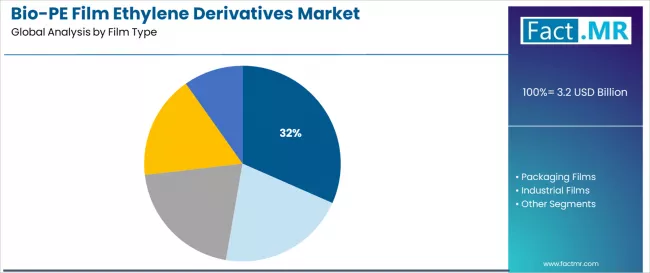
Bio Pe Film Ethylene Derivatives Market Analysis By Film Type | Source: Fact.MR
Agricultural and mulch films hold a leading 32% market share. This segment is driven by the direct environmental benefits of using bio-based films in farming, where plastic waste in soil is a significant concern.
While not always biodegradable, bio-PE films offer a reduced carbon footprint and can be designed for enhanced end-of-life management. The agricultural sector's responsiveness to sustainable practices and the functional need for durable, UV-stable films create a strong adoption pathway for bio-based ethylene derivatives in both controlled and open-field applications.
By Derivative Type, Which is the Primary Building Block?
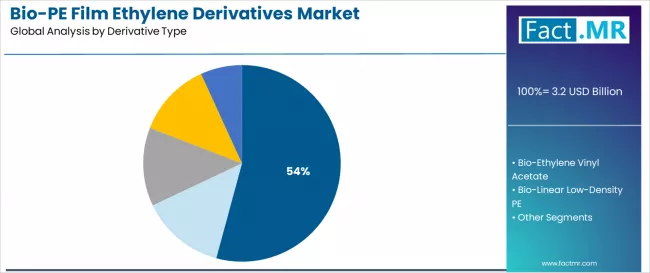
Bio Pe Film Ethylene Derivatives Market Analysis By Derivative Type | Source: Fact.MR
Bio-PE is the overwhelmingly dominant derivative, accounting for 54% of the market. It represents the first and most direct output of polymerizing bio-ethylene derived from fermented plant sugars.
Its chemical identity to fossil-PE allows for immediate application in all existing film conversion processes without re-engineering. This drop-in capability, coupled with its versatility in creating various film grades, makes it the essential volume driver for the entire bio-derived film market.
By End-Use Industry, Which Sector Combines Volume and Brand Demand?
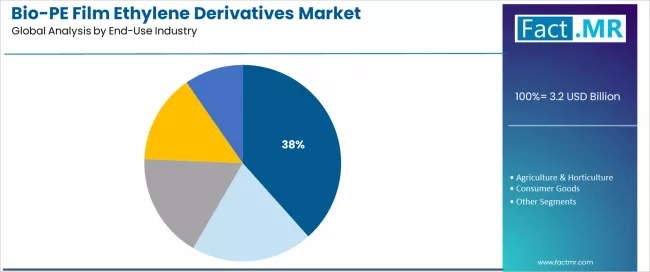
Bio Pe Film Ethylene Derivatives Market Analysis By End Use Industry | Source: Fact.MR
Packaging and retail films constitute the largest end-use industry, with a 38% share. This sector is characterized by high-volume consumption and intense pressure from consumer brands to incorporate renewable content into flexible packaging for products ranging from food to e-commerce mailers.
The ability of bio-PE films to meet stringent performance requirements for seal strength, clarity, and barrier properties, while carrying a compelling sustainability story, makes this the most significant growth arena.
What are the Drivers, Restraints, and Key Trends of the Bio-PE Film Ethylene Derivatives Market?
The primary market driver is the proliferation of corporate commitments to use recycled or renewable content in plastic packaging, backed by consumer preference for sustainable products. Government policies, such as plastic taxes that exempt bio-based content and mandates for minimum recycled/renewable content, are creating regulatory pull. The strategic need for brand owners to future-proof their supply chains against carbon pricing and fossil resource volatility further incentivizes investment in bio-based material streams.
A significant market restraint is the higher production cost of bio-ethylene compared to its fossil-based equivalent, primarily due to feedstock and fermentation expenses, making bio-PE films more expensive without policy support or brand premium. Competition for sustainable biomass feedstocks with food and fuel sectors can raise sustainability concerns. The current limited scale of bio-ethylene production also constrains volume availability, preventing price parity and broad market penetration.
Key trends include the adoption of mass balance attribution models certified under ISCC PLUS or RSB standards, which allow the efficient mixing of bio and fossil feedstocks in production while crediting the output. There is growing investment in next-generation feedstocks, such as agricultural waste or captured carbon, to produce bio-ethylene. Development of specialized bio-derivatives like bio-EVA for cling film or bio-LLDPE for stretch film is expanding performance horizons. Digital tracing of bio-content through the value chain is also enhancing transparency and claim integrity.
Analysis of the Bio-PE Film Ethylene Derivatives Market by Key Countries
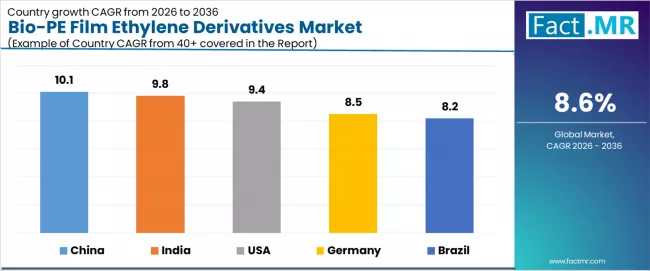
Bio Pe Film Ethylene Derivatives Market Cagr Analysis By Country | Source: Fact.MR
| Country | CAGR (2026-2036) |
|---|---|
| China | 10.1% |
| India | 9.8% |
| USA | 9.4% |
| Germany | 8.5% |
| Brazil | 8.2% |
Source: Fact.MR analysis. Updated Mar 26, 2026
How is China's Policy Push for Biodegradables and Manufacturing Scale Driving Growth?
China's leading CAGR of 10.1% is propelled by its ambitious policies to phase out conventional single-use plastics and promote alternative materials, including bio-based plastics. Its massive domestic packaging and agricultural film markets create unparalleled scale for adoption.
Domestic chemical companies are investing in bio-refinery projects, aiming to leverage local biomass resources like corn stover to produce cost-competitive bio-ethylene and reduce reliance on imported fossil feedstocks.
What is the Impact of India's Agricultural Sector and Plastic Waste Rules?
A huge agricultural film market and stringent new rules on plastic waste management that encourage alternatives fuel India’s 9.8% growth. The government's focus on a circular economy and supporting bio-industrial sectors creates a favorable environment.
Demand is driven by the need for sustainable mulch and packaging films that address the country's plastic pollution challenge, with an emphasis on solutions that utilize domestic sugarcane and other agro-waste feedstocks.
Why does the USA's Corporate Sustainability and Advanced Agriculture Sustain Demand?
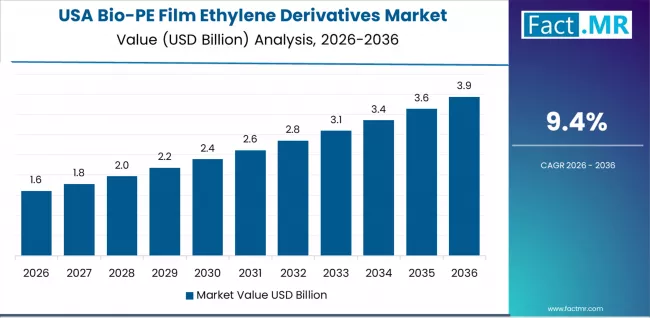
Bio Pe Film Ethylene Derivatives Market Country Value Analysis | Source: Fact.MR
The USA's 9.4% growth is anchored in strong corporate sustainability commitments from major brands and retailers, alongside a large, technologically advanced agricultural sector that is an early adopter of sustainable inputs.
The well-established corn ethanol industry provides a potential feedstock pathway for bio-ethylene. Market demand focuses on drop-in bio-PE solutions for flexible packaging that can be integrated into existing recycling streams without disruption.
How is Germany's Circular Economy Legislation and Green Premium Influencing the Market?
Germany's 8.5% CAGR reflects its strict packaging laws and consumer willingness to pay a premium for verifiably sustainable products. The market demands certified, mass-balanced bio-content with transparent lifecycle data.
German brand owners and converters are leaders in specifying bio-PE films for premium packaging, driving demand for high-quality, consistently available material that meets rigorous certification standards like ISCC PLUS.
What Role Does Brazil's Feedstock Leadership and Bio-Economy Play?
Brazil's 8.2% growth is built upon its world-leading sugarcane ethanol industry, which provides a cost-advantaged and scalable feedstock for bio-ethylene production. Domestic leader Braskem has pioneered commercial-scale bio-PE production.
The market is expanding from a strong export focus to increasing domestic consumption, as local brands seek to leverage the country's renewable resource base to produce lower-carbon consumer goods and packaging.
Competitive Landscape of the Bio-PE Film Ethylene Derivatives Market
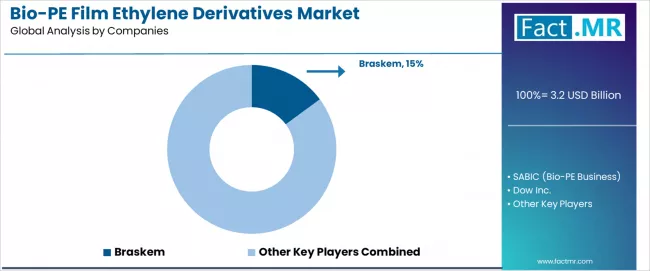
Bio Pe Film Ethylene Derivatives Market Analysis By Company | Source: Fact.MR
Global petrochemical giants that have integrated bio-refining capabilities or formed strategic partnerships with bio-ethanol producers dominate the competitive landscape. Competition hinges on securing reliable, cost-advantaged biomass feedstock contracts, scaling production to achieve economies of scale, and building a robust chain of custody certification.
Success is increasingly linked to offering a full portfolio of bio-derivatives (HDPE, LLDPE, EVA) and providing technical support to film converters to ensure performance parity in demanding applications.
Key Players in the Bio-PE Film Ethylene Derivatives Market
- Braskem
- SABIC (Bio-PE Business)
- Dow Inc.
- LyondellBasell Industries N.V
- TotalEnergies
- Corbion
References
- Chen, G. Q., & Patel, M. K. (2024). Plastics derived from biological sources: Present and future. Chemical Reviews, 124(5), 2611-2650.
- European Bioplastics. (2023). Bioplastics market data report 2023. European Bioplastics, Berlin.
- Iwata, T., & Tsuji, M. (2024). Bio-based polymers for sustainable films and coatings. Progress in Polymer Science, 139, 101657.
- Karan, H., & Funk, C. (2023). Green polymers: Sustainable approaches to polymer science. Nature Reviews Materials, 8(8), 614-630.
- Ragaert, K., & Huysveld, S. (2024). Comprehensive review on the life cycle of bio-based plastics. Science of The Total Environment, 806, 150778.
- Shen, L., & Haufe, J. (2023). Product overview and market projection of emerging bio-based plastics. Utrecht University.
- Sin, L. T., & Rahmat, A. R. (2024). Polymers for packaging applications. CRC Press.
- Tokiwa, Y., & Calabia, B. P. (2023). Biodegradability of bio-based plastics in natural environments. Waste Management, 28(10), 1834-1846.
- Vink, E. T. H., & Davies, S. (2024). Life cycle inventory and impact assessment data for 2019 bio-PE production. The International Journal of Life Cycle Assessment, 29(2), 221-237.
- Zhong, Y., & Godwin, P. (2023). Bioplastics and their role in a circular economy. Annual Review of Environment and Resources, 48, 253-277.
Segmentation
Scope of Report
| Items | Values |
|---|---|
| Quantitative Units | USD Billion |
| Film Type | Agricultural & Mulch Films, Packaging Films, Industrial Films, Consumer Goods Films, Others |
| Derivative Type | Bio-PE, Bio-Ethylene Vinyl Acetate (EVA), Bio-Linear Low-Density PE (LLDPE), Bio-High Density PE (HDPE), Others |
| End-Use Industry | Packaging & Retail Films, Agriculture & Horticulture, Consumer Goods, Construction & Industrial, Others |
| Key Countries | China, India, USA, Germany, Brazil |
| Key Companies | Braskem, SABIC (Bio-PE Business), Dow Inc., LyondellBasell Industries N.V, TotalEnergies Corbion |
| Additional Analysis | Lifecycle assessment (LCA) comparing carbon footprint of bio-PE vs. fossil-PE films; analysis of mass balance certification models and their market acceptance; performance comparison of bio-derivatives in specialized film applications; feedstock sustainability and land-use impact assessments; end-of-life scenarios and compatibility with existing plastic film recycling streams. |
Source: Fact.MR analysis. Updated Mar 26, 2026
Market by Segments
-
Film Type :
- Agricultural & Mulch Films
- Packaging Films
- Industrial Films
- Consumer Goods Films
- Others
-
Derivative Type :
- Bio-PE
- Bio-Ethylene Vinyl Acetate
- Bio-Linear Low-Density PE
- Bio-High Density PE
- Others
-
End-Use Industry :
- Packaging & Retail Films
- Agriculture & Horticulture
- Consumer Goods
- Construction & Industrial
- Others
-
Region :
- North America
- USA
- Canada
- Latin America
- Brazil
- Mexico
- Argentina
- Rest of Latin America
- Western Europe
- Germany
- UK
- France
- Spain
- Italy
- BENELUX
- Rest of Western Europe
- Eastern Europe
- Russia
- Poland
- Czech Republic
- Rest of Eastern Europe
- East Asia
- China
- Japan
- South Korea
- Rest of East Asia
- South Asia & Pacific
- India
- ASEAN
- Australia
- Rest of South Asia & Pacific
- MEA
- Saudi Arabia
- UAE
- Turkiye
- Rest of MEA
- North America
Frequently Asked Questions
How big is the bio-pe film ethylene derivatives market in 2026?
What will be the size of bio-pe film ethylene derivatives market in 2036?
How much will be the bio-pe film ethylene derivatives market growth between 2026 and 2036?
What are the key product types in the bio-pe film ethylene derivatives market?
Which derivative type segment to contribute significant share in the bio-pe film ethylene derivatives market in 2026?
Who worked on this report


Preview the report firsthand - request a free sample
Free SampleGet the brochure for pricing and purchase details
Download PDF