- Market Value (2025): USD 2.1 Bn
- Estimated Value (2026): USD 2.2 Bn
- Forecast Value (2036): USD 3.9 Bn
- CAGR (2026-2036): 5.8%
What is the Blow Molding Tools Market forecast to be worth by 2036?
USD 2.2 billion in 2026 to USD 3.9 billion by 2036 at 5.8% CAGR.
- The blow molding tools market reached USD 2.1 billion in 2025.
- Demand is projected to increase from USD 2.2 billion in 2026 to USD 3.9 billion by 2036.
- The market is forecast to record 5.8% CAGR from 2026 to 2036 owing to packaging changeovers, direct sales support, and higher scrutiny of tool steel life in repeat production.
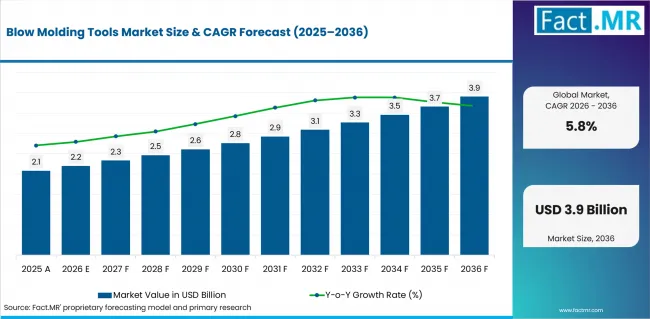
Blow Molding Tools Market Value Analysis | Source: Fact.MR
What are the defining numbers behind Blow Molding Tools Market growth?
USD 1.7 billion absolute opportunity is expected by 2036.
- Demand Drivers in the Market
- Packaging converters require tooling that holds bottle shape and wall distribution across long production runs.
- Food, beverage, personal care, and household product lines place pressure on mold-change timing. Plastic bottles and containers programs keep packaging tooling active when customers require repeat approvals.
- Automotive duct, fuel-tank, and industrial container programs need tools that manage complex shapes and production release checks.
- Direct sales channels are expected to remain important because tooling orders need engineering discussion before approval.
- Key Segments Analyzed
- By Product Type: Extrusion Blow Molding Tools are expected to hold 36.5% share in 2026 because the process supports high-volume bottles, containers, ducts, and technical hollow parts.
- By Application: Packaging is projected to account for 31.6% share in 2026 as recurring bottle and container formats create steady replacement and refurbishment demand.
- By End User: Packaging Manufacturers are anticipated to capture 30.0% share in 2026 since converters must keep production molds ready for customer audits and line changeovers.
- By Distribution Channel: Direct Sales are estimated to represent 31.3% share in 2026 due to the engineering review needed before tool acceptance and commissioning.
- By Material: Tool Steel is forecast to hold 36.9% share in 2026 as customers prioritize wear resistance, repairability, and dimensional stability for repeated production cycles.
- Analyst Opinion at Fact.MR
- Shambhu Nath Jha, Sr. Consultant at Fact.MR, opines, “Blow molding tool purchases are expected to depend on machine fit, resin behavior, service response, and replacement timing. Customers are less likely to approve tools on price alone when downtime and late launches carry higher cost.”
- Strategic Implications
- Packaging-focused tool makers should link design proposals to downstream container demand.
- Equipment providers should bundle tooling, spares, and service. Demand around blow moulding shows why machine uptime affects renewal.
- Investors should separate broad plastics exposure from repeat-program tooling. Demand around molded plastics matters when molds control approval.
Germany is expected to record 7.5% CAGR from 2026 to 2036. Brazil is projected at 7.0% CAGR, followed by Canada at 4.6%, Mexico at 4.0%, the USA at 6.4%, the UK at 5.8%, and Japan at 5.2%.
How does the Blow Molding Tools Market break down by segment?
Extrusion Blow Molding Tools are expected to lead Product Type at 36.5% share in 2026. Packaging is projected to lead Application at 31.6% share in 2026.
Which product type dominates?
Extrusion Blow Molding Tools are projected to account for 36.5% share in 2026.
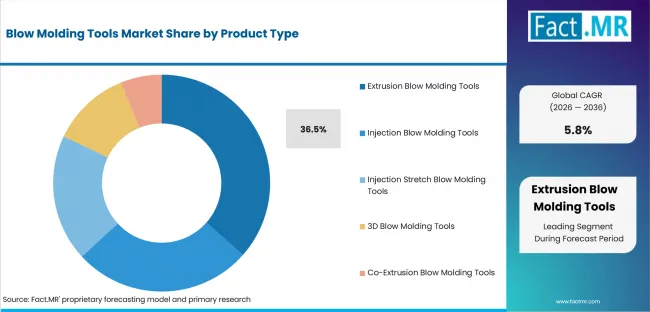
Blow Molding Tools Market Analysis By Product Type | Source: Fact.MR
Extrusion tools lead because they suit high-volume bottles, containers, ducts, and technical hollow parts. Continuous, accumulator-head, injection, and stretch variants remain relevant where geometry, resin, or neck-finish requirements differ.
Why does Packaging lead Application?
Packaging is expected to hold 31.6% share in 2026.
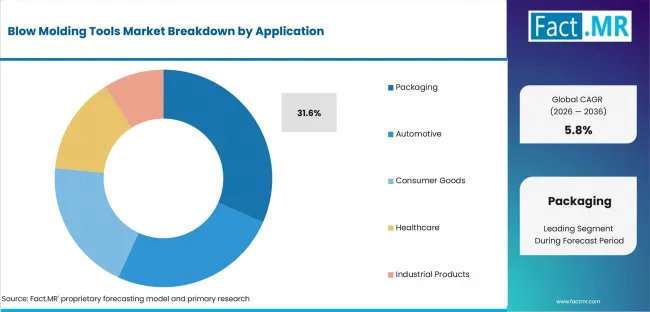
Blow Molding Tools Market Analysis By Application | Source: Fact.MR
Packaging leads because bottles and containers require frequent mold upkeep. Demand linked with plastic caps supports tighter closure fit. Use of blow molded containers adds renewal work where shape control affects acceptance.
What supports Packaging Manufacturers within End User?
Packaging Manufacturers are anticipated to represent 30.0% share in 2026.
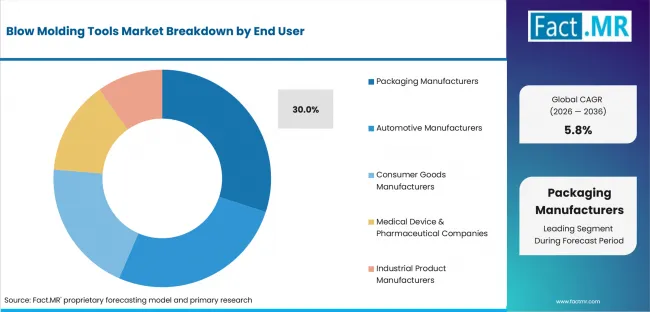
Blow Molding Tools Market Analysis By End User | Source: Fact.MR
Packaging manufacturers lead because converters buy tools for bottle, container, and closure-adjacent programs. Food, beverage, automotive, OEM, and medical accounts create selective demand when approval cycles are longer.
Why does Direct Sales lead Distribution Channel?
Direct Sales are estimated to capture 31.3% share in 2026.
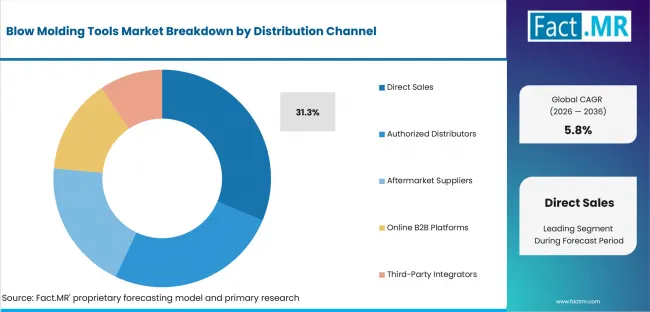
Blow Molding Tools Market Analysis By Distribution Channel | Source: Fact.MR
Direct sales lead because quotations require drawings, resin selection, machine-fit checks, and sampling support. Other channels serve repeat components when specifications are already clear.
What makes Tool Steel the leading Material?
Tool Steel is forecast to hold 36.9% share in 2026.
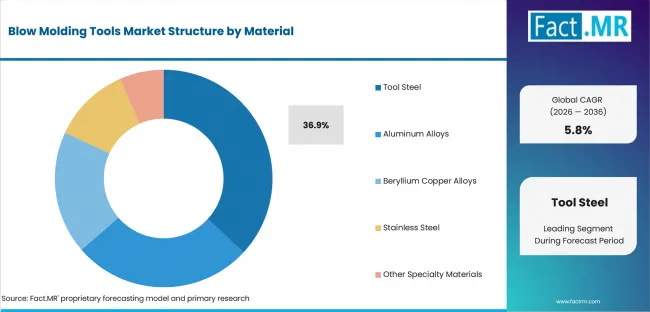
Blow Molding Tools Market Analysis By Material | Source: Fact.MR
Tool steel leads because converters need durability, polish retention, repair options, and stable thermal behavior. H13 steel, P20 steel, aluminum alloys, and copper inserts serve specific cooling needs. Demand around injection molding offers a useful comparison because material choice affects cycle control.
What is accelerating Blow Molding Tools Market adoption, and what is holding it back?
Demand is expected to rise as companies upgrade packaging, confirm tool life and seek engineering support. Growth may be limited by changing material costs and slow approval processes.
Drivers Impact Analysis
| DRIVER | (~) % IMPACT ON CAGR | GEOGRAPHIC RELEVANCE | IMPACT TIMELINE |
|---|---|---|---|
| Packaging tool replacement | +1.6% | Germany, Brazil, Mexico | Short term (<= 2 years) |
| Extrusion mold specification pull | +1.3% | Europe and North America | Short term (<= 2 years) |
| Direct engineering support | +1.0% | Germany, Canada, USA | Medium term (2-4 years) |
| Tool steel durability needs | +0.8% | Industrial and packaging clusters | Medium term (2-4 years) |
| Complex hollow-part programs | +0.6% | Japan, UK, Mexico | Long term (>= 4 years) |
Source: Fact.MR analysis. Updated Jul 30, 2026
- Packaging tool replacement: Repeated container formats are expected to raise demand for refurbishing, replacement inserts, and new mold sets.
- Extrusion mold specification pull: Demand is expected to improve where customers need wall-distribution control and fewer stoppages.
- Direct engineering support: Providers that join design review and sampling are expected to reduce approval friction before commercial production begins.
Opportunity Impact Analysis
| OPPORTUNITY | (~) % IMPACT ON CAGR | GEOGRAPHIC RELEVANCE | IMPACT TIMELINE |
|---|---|---|---|
| Mold refurbishment packages | +0.9% | Germany and USA | Medium term (2-4 years) |
| Packaging format changeovers | +0.8% | Brazil and Mexico | Medium term (2-4 years) |
| Thermal management inserts | +0.6% | Japan and Europe | Long term (>= 4 years) |
| Digital procurement for repeat tools | +0.4% | Canada and UK | Long term (>= 4 years) |
Source: Fact.MR analysis. Updated Jul 30, 2026
- Mold refurbishment packages: Opportunity is expected to improve when repair, inserts, polishing, and inspection are sold as planned service.
- Packaging format changeovers: New bottle and container formats are expected to create openings for faster quotation, sample testing, and commissioning support.
- Thermal management inserts: Better cooling layouts are expected to attract customers that need shorter cycles without sacrificing wall distribution.
Restraints Impact Analysis
| RESTRAINT | (~) % IMPACT ON CAGR | GEOGRAPHIC RELEVANCE | IMPACT TIMELINE |
|---|---|---|---|
| Raw-material cost movement | -1.0% | Global | Short term (<= 2 years) |
| Long tool approval cycles | -0.8% | Packaging and automotive accounts | Short term (<= 2 years) |
| Machine-to-tool compatibility risk | -0.6% | Mixed installed-base markets | Medium term (2-4 years) |
| Limited local service depth | -0.4% | Brazil, Mexico, dispersed sites | Medium term (2-4 years) |
Source: Fact.MR analysis. Updated Jul 30, 2026
- Raw-material cost movement: Steel, aluminum, copper, machining time, and polishing labor are expected to keep quotation discipline important for custom tools.
- Long tool approval cycles: Sampling, dimensional checks, and customer sign-off can extend the time between quotation and repeat orders.
- Machine-to-tool compatibility risk: Older blow molding machines may require additional engineering work before a new mold performs as expected.
Which countries are scaling Blow Molding Tools Market fastest?
Germany and Brazil lead the country comparison. Canada, Mexico, and the USA form the middle group, while the UK and Japan remain quality-led slower-growth markets.
- Germany leads because engineering-led customers require mold-life evidence, sampling records, and repair planning before wider use.
- Brazil remains above the global average where packaging converters need tooling support, local service, and practical financing routes.
- Canada follows the global rate because customers value service dependability across dispersed production sites.
- Mexico stays close to the global rate because packaging and automotive programs support replacement demand.
- The USA remains below the global average in this list, but customers still require documented tool performance.
- The UK and Japan grow more slowly as customers approve tools through quality and life-cycle evidence.
Comparable CAGRs can hide different approval routes. Commercial readiness depends on testing, machine fit, service depth, and price discipline.
The full report provides country-level CAGR analysis across the listed regions.
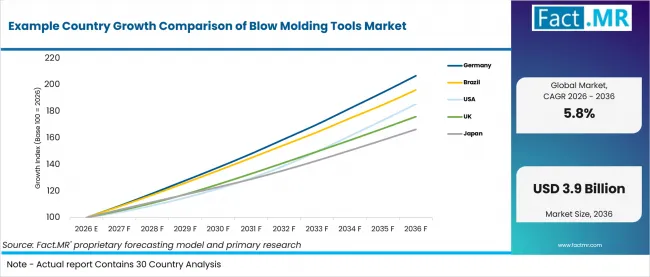
Example Country Growth Comparison Of Blow Molding Tools Market | Source: Fact.MR
| Country | CAGR (2026-2036) |
|---|---|
| Germany | 7.5% |
| Brazil | 7.0% |
| Canada | 4.6% |
| Mexico | 4.0% |
| USA | 6.4% |
| UK | 5.8% |
| Japan | 5.2% |
Source: Fact.MR analysis. Updated Jul 30, 2026
What supports Germany adoption?
7.5% CAGR, supported by engineering-led purchasing and stronger tool validation.
Germany’s growth reflects customers that expect mold-life proof before scale-up. Providers must connect design, sampling, and service support to approval requirements.
How is Brazil scaling demand?
7.0% CAGR, driven by packaging conversion and service availability.
Brazil’s demand is tied to packaging converters that value local support and dependable replacement access.
What is shaping Canada’s outlook?
4.6% CAGR, aligned with the global trajectory and supported by service coverage.
Canada’s growth reflects packaging and industrial product demand across dispersed sites. Maintenance access is expected to guide approval.
How is Mexico developing demand?
4.0% CAGR, supported by nearshoring and packaging-linked manufacturing.
Mexico’s growth is shaped by manufacturing programs that need localized tooling support and faster response.
How does the USA perform?
6.4% CAGR, supported by documentation-heavy purchasing and replacement demand.
The USA outlook reflects a large installed base where replacement tools and service contracts guide demand.
What supports the UK outlook?
4.6% CAGR, led by life-cycle value review and quality-sensitive procurement.
The UK market is expected to grow more slowly because customers compare tooling cost with long-term production value.
How is Japan positioned?
5.2% CAGR, supported by precision, compact production, and reliability standards.
Japan’s outlook reflects a quality-led customer base that values tool accuracy and stable production behavior.
Who leads the Blow Molding Tools Market?
Kautex Maschinenbau and Uniloy show direct relevance, while Bekum Maschinenfabriken strengthens the wider blow molding equipment and tooling landscape.
Kautex Maschinenbau contributes blow molding equipment and technical support for packaging and industrial applications. Uniloy adds extrusion and injection blow molding expertise across bottles, containers and technical parts. Bekum Maschinenfabriken strengthens the field through extrusion blow molding systems. Jomar Corporation and Aoki Technical Laboratory extend the market through injection blow molding and container mold capabilities. Magic MP S.p.A. adds equipment and tooling support for specialized production requirements.
Which companies are the key providers?
Key companies include Kautex Maschinenbau, Uniloy, Bekum Maschinenfabriken, Jomar Corporation, Magic MP S.p.A., and Aoki Technical Laboratory.
- Kautex Maschinenbau
- Uniloy
- Bekum Maschinenfabriken
- Jomar Corporation
- Magic MP S.p.A.
- Aoki Technical Laboratory
Bibliography
- Aoki Technical Laboratory, Inc. (2026, April 27). Thanks for visiting Aoki at Chinaplas 2026.
- Bekum Maschinenfabriken GmbH. (2026, February). SmartLine - The new fully electric extrusion blow moulding machine series combines lower machine investment with energy and material savings.
- Bureau of Labor Statistics. (2026, June 24). Productivity and costs by industry: Manufacturing and mining industries news release - 2025 A01 results.
- Jomar Corporation. (2025, April 23). Jomar adds in-house moldmaking operations.
This Report Answers
- The report provides strategic intelligence on the Blow Molding Tools Market across Product Type and Application choices.
- Segment analysis covers Extrusion Blow Molding Tools and Packaging as the 2026 share leaders.
- Country outlook evaluates Germany and Brazil alongside Canada, Mexico, the USA, the UK, and Japan.
- Competitive analysis profiles Kautex Maschinenbau, Uniloy, Bekum, Jomar, Magic MP, and Aoki.
What does the Blow Molding Tools Market cover?
Blow molding tools form hollow plastic parts where mold fit, cooling behavior, release, and finish determine acceptance.
The market covers tools for bottles, food containers, air ducts, fuel tanks, medical bottles, and industrial containers.
What is included in the scope?
Scope covers packaging, food and beverage packaging, automotive, OEM, consumer goods, medical device, and industrial product customers.
What is excluded from the scope?
General plastic machinery, unrelated molds, resin procurement, and finished plastic container sales remain outside the scope of this market.
How Was the Analysis Built?
The analysis draws on 120+ sources, 35+ company portfolios, 25+ countries, and more than 20 industry interviews.
- Primary Research: Interviews tested buying criteria, tool approval, replacement timing, and after-sales support.
- Desk Research: Research reviewed government statistics, company releases, technical literature, trade information, standards, and industry records.
- Market Sizing and Forecasting: Estimates combine historical demand, pricing signals, segment shares, country CAGRs, company participation, and adoption barriers.
- Data Validation and Update Cycle: Findings are validated against interviews, public data, company activity, and material developments.
Segmentation
What is the report’s scope and coverage?
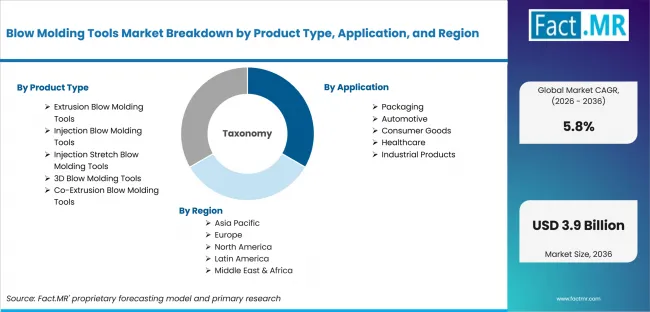
Blow Molding Tools Market Breakdown By Product Type, Application, And Region | Source: Fact.MR
| Attribute | Details |
|---|---|
| Quantitative Units | USD 2.2 billion in 2026 to USD 3.9 billion by 2036, at a 5.8% CAGR. |
| Market Definition | Molds, tooling sets, inserts, trim tools, die heads and related service packages used to produce hollow plastic parts through extrusion, injection, stretch and co-extrusion blow molding |
| Product Type | Extrusion Blow Molding Tools; Continuous Extrusion Blow Molds; Accumulator Head Blow Molds; Injection Blow Molding Tools; Single Stage Injection Blow Molds; Multi-Cavity Injection Blow Molds; Injection Stretch Blow Molding Tools; One-Step Stretch Blow Molds; Two-Step Stretch Blow Molds; 3D Blow Molding Tools; Automotive Duct Molds; Complex Geometry Molds; Co-Extrusion Blow Molding Tools; Multi-Layer Blow Molds; Barrier Packaging Molds |
| Application | Packaging; Beverage Bottles; Food Containers; Automotive; Fuel Tanks; Air Ducts; Consumer Goods; Household Products; Toys; Healthcare; Medical Bottles; Pharmaceutical Containers; Industrial Products; Chemical Containers; Lubricant Containers |
| End User | Packaging Manufacturers; Food Packaging Companies; Beverage Packaging Companies; Automotive Manufacturers; OEMs; Tier-1 Suppliers; Consumer Goods Manufacturers; Household Product Manufacturers; Personal Care Product Manufacturers; Medical Device & Pharmaceutical Companies; Pharmaceutical Packaging; Medical Consumables; Industrial Product Manufacturers; Chemical Packaging Companies; Agricultural Product Manufacturers |
| Distribution Channel | Direct Sales; OEM Sales; Key Account Contracts; Authorized Distributors; Regional Distributors; Industrial Equipment Dealers; Aftermarket Suppliers; Replacement Tool Suppliers; Maintenance Providers; Online B2B Platforms; E-Commerce Portals; Digital Procurement Platforms; Third-Party Integrators; System Integrators; Engineering Consultants |
| Material | Tool Steel; H13 Steel; P20 Steel; Aluminum Alloys; Cast Aluminum; High Strength Aluminum; Beryllium Copper Alloys; Copper Inserts; Thermal Conductivity Components; Stainless Steel; Corrosion Resistant Grades; High Precision Components; Other Specialty Materials; Carbide Inserts; Hybrid Composite Materials |
| Regions Covered | North America; Latin America; Europe; East Asia; South Asia and Pacific; Middle East and Africa |
| Countries Covered | Germany; Brazil; Canada; Mexico; USA; UK; Japan |
| Key Companies Profiled | Kautex Maschinenbau; Uniloy; Bekum Maschinenfabriken; Jomar Corporation; Magic MP S.p.A.; Aoki Technical Laboratory |
| Forecast Period | 2026 to 2036 |
| Approach | Hybrid top-down and bottom-up approach using product type demand, application mix, end-user replacement cycles, distribution channel behavior, material selection, country-level growth, company portfolio review and public evidence relevant to plastics tooling demand |
Source: Fact.MR analysis. Updated Jul 30, 2026
How is the market segmented?
-
By Product Type:
- Extrusion Blow Molding Tools
- Continuous Extrusion Blow Molds
- Accumulator Head Blow Molds
- Injection Blow Molding Tools
- Single Stage Injection Blow Molds
- Multi-Cavity Injection Blow Molds
- Injection Stretch Blow Molding Tools
- One-Step Stretch Blow Molds
- Two-Step Stretch Blow Molds
- 3D Blow Molding Tools
- Automotive Duct Molds
- Complex Geometry Molds
- Co-Extrusion Blow Molding Tools
- Multi-Layer Blow Molds
- Barrier Packaging Molds
-
By Application:
- Packaging
- Beverage Bottles
- Food Containers
- Automotive
- Fuel Tanks
- Air Ducts
- Consumer Goods
- Household Products
- Toys
- Healthcare
- Medical Bottles
- Pharmaceutical Containers
- Industrial Products
- Chemical Containers
- Lubricant Containers
-
By End User:
- Packaging Manufacturers
- Food Packaging Companies
- Beverage Packaging Companies
- Automotive Manufacturers
- OEMs
- Tier-1 Suppliers
- Consumer Goods Manufacturers
- Household Product Manufacturers
- Personal Care Product Manufacturers
- Medical Device & Pharmaceutical Companies
- Pharmaceutical Packaging
- Medical Consumables
- Industrial Product Manufacturers
- Chemical Packaging Companies
- Agricultural Product Manufacturers
-
By Distribution Channel:
- Direct Sales
- OEM Sales
- Key Account Contracts
- Authorized Distributors
- Regional Distributors
- Industrial Equipment Dealers
- Aftermarket Suppliers
- Replacement Tool Suppliers
- Maintenance Providers
- Online B2B Platforms
- E-Commerce Portals
- Digital Procurement Platforms
- Third-Party Integrators
- System Integrators
- Engineering Consultants
-
By Material:
- Tool Steel
- H13 Steel
- P20 Steel
- Aluminum Alloys
- Cast Aluminum
- High Strength Aluminum
- Beryllium Copper Alloys
- Copper Inserts
- Thermal Conductivity Components
- Stainless Steel
- Corrosion Resistant Grades
- High Precision Components
- Other Specialty Materials
- Carbide Inserts
- Hybrid Composite Materials
-
By Region:
- North America
- Latin America
- Europe
- East Asia
- South Asia and Pacific
- Middle East and Africa
Frequently Asked Questions
Which Product Type leads the market?
Which Application leads the market?
Which End User leads the market?
Which Distribution Channel leads the market?
Which Material leads the market?
Which country records the highest listed CAGR?
What is the primary driver in this market?
What is the main restraint?
Why do Packaging Manufacturers lead demand?
Who worked on this report


Preview the report firsthand - request a free sample
Free SampleGet the brochure for pricing and purchase details
Download PDF