- Market Value (2025): USD 3.0 Bn
- Estimated Value (2026): USD 3.0 Bn
- Forecast Value (2036): USD 5.8 Bn
- CAGR (2026-2036): 6.2%
What is the Carpet Back Coating Market forecast to be worth by 2036?
USD 3.2 billion in 2026 to USD 5.8 billion by 2036, at 6.2% CAGR.
- The carpet back coating market reached USD 3.0 billion in 2025.
- Demand is projected to rise from USD 3.2 billion in 2026 to USD 5.8 billion by 2036.
- The market is forecast to expand at a 6.2% CAGR from 2026 to 2036 as manufacturers qualify low-emission, durable, and circular backing systems without disrupting coating-line economics.
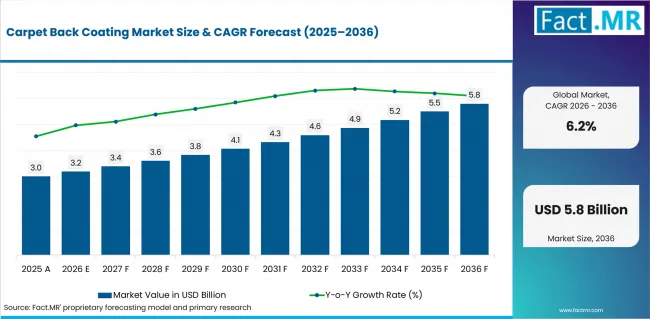
Carpet Back Coating Market Value Analysis | Source: Fact.MR
What are the defining numbers behind Carpet Back Coating Market growth?
USD 2.8 billion in absolute opportunity between 2025 and 2036, led by Latex Back Coating, Residential Carpets; and Nylon Carpets.
- Demand Drivers in the Market
- Carpet manufacturers need back coatings that maintain tuft dimensional stability after repeated use.
- Low-emission specifications are raising the value of documented formulations that control odor and volatile emissions without reducing line speed or adhesion.
- Residential replacement and refurbishment demand creates recurring volume across broadloom carpets and modular formats with different applied-cost targets.
- Flooring and automotive-interior buyers prefer suppliers that can reproduce compound mixing and final-product tests before a plant conversion.
- Key Segments Analyzed
- By Coating Type: Latex Back Coating is projected to hold 46.0% share in 2026 as installed water-based processing and familiar application economics reduce switching risk.
- By Application: Residential Carpets are projected to hold 42.0% share in 2026, supported by modular product volumes alongside recurring replacement demand.
- By Carpet Material: Nylon Carpets are projected to hold 38.0% share in 2026 as coating systems are repeatedly qualified around nylon tuft bind and dimensional control.
- By Technology: The technology scope covers Water-based Coating, Low VOC Coating, Acrylic Dispersion; and Latex Dispersion routes; with selection determined by line fit and finished-product performance.
- By End Use: The end-use scope covers Flooring Manufacturers and Residential, Commercial, and Modular Flooring programs that apply different cost; emissions; and service requirements.
- Analyst Opinion at Fact.MR
- Shambhu Nath Jha, Principal Consultant at Fact.MR, states: "Revenue capture depends on reducing switching risk; not on presenting a longer chemistry catalog. Suppliers need application laboratories that reproduce compound mixing; coating weight; drying; lamination; and end-use testing. Circular content will gain approval only when adhesion; dimensional stability; odor; and production yield remain within the buyer's operating window."
- Strategic Implications
- Coating suppliers should validate formulations on representative carpet constructions before making durability, low-emission, or circular-content claims.
- Flooring manufacturers should compare total applied cost, drying demand, scrap; odor; and line yield instead of evaluating binder price alone.
- Material developers should separate residential, commercial, modular; and automotive-interior qualification programs because the failure modes and approval cycles differ.
- Regional commercial teams should provide auditable emissions documents and local technical service before seeking multi-plant approvals.
How does the Carpet Back Coating Market break down by segment?
Latex Back Coating leads at 46.0%, Residential Carpets lead at 42.0%, and Nylon Carpets lead at 38.0% in 2026.
Why does Latex Back Coating lead Coating Type?
Latex Back Coating is projected to hold 46.0% share in 2026.
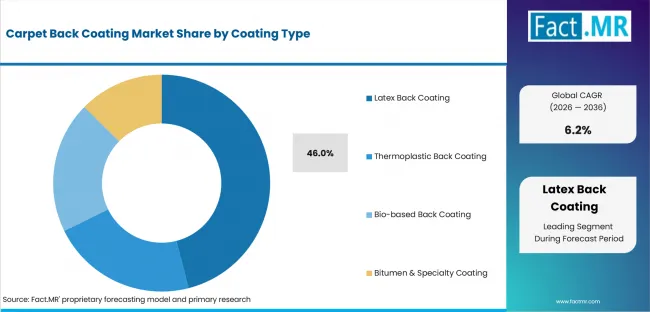
Carpet Back Coating Market Analysis By Coating Type | Source: Fact.MR
Latex systems remain the practical reference for manufacturers with installed water-based mixing, coating, and drying assets. Styrene butadiene and related dispersions accept mineral fillers; wet carpet structures consistently; and provide the adhesion needed to lock primary and secondary backing layers. Their process familiarity also lowers the cost of plant trials; operator retraining; and production-scale troubleshooting. Carboxylated and acrylic-modified latex alternatives remain relevant where buyers need a different balance of tuft bind; aging; flexibility; or emissions performance. The same qualification burden appears in the carpet and coating binders markets.
Why do Residential Carpets lead Application?
Residential Carpets are projected to account for 42.0% share in 2026.
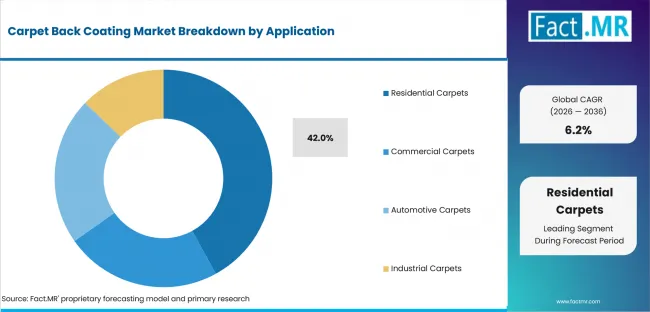
Carpet Back Coating Market Analysis By Application | Source: Fact.MR
Residential demand spans broadloom carpets, area rugs, and modular products sold across new housing; renovation; and replacement cycles. The back coating must support handling; cutting; installation; underfoot use; and acceptable indoor odor at a cost that works across high-volume retail programs. Commercial and modular applications remain important; but they often require longer specification cycles; tighter dimensional tolerances; and more project-specific testing before the same formulation can scale.
Why do Nylon Carpets lead Carpet Material?
Nylon Carpets are projected to hold 38.0% share in 2026.
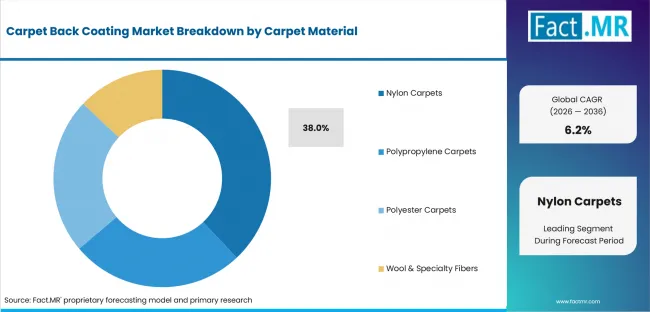
Carpet Back Coating Market Analysis By Carpet Material | Source: Fact.MR
Nylon carpet constructions give coating suppliers a broad and technically demanding application base. The coating must secure the tufted structure while preserving flexibility and dimensional stability through finishing and installation. Nylon 6, Nylon 6,6; and blended nylon constructions can respond differently to heat; moisture; filler loading; and lamination pressure; which keeps formulation support close to the manufacturing line. Alternative face fibers remain addressable; but they require their own adhesion and process validation rather than a direct transfer of the nylon recipe.
How does Technology shape coating qualification?
Technology selection is governed by line compatibility, emissions requirements, and the performance of the finished carpet.
Water-based and latex-dispersion routes fit established coating operations and support controlled application of binder and filler systems. Low VOC programs add documentation and formulation constraints because a lower-emission claim must remain compatible with drying time, adhesion, odor; and storage behavior. Acrylic dispersions provide another route when buyers need a different balance of aging; flexibility; or resistance. Qualification therefore occurs at the compound and production-line level; not from a chemistry label alone.
How does End Use shape supplier selection?
Flooring Manufacturers are the main qualification gate across Residential, Commercial, and Modular Flooring programs.
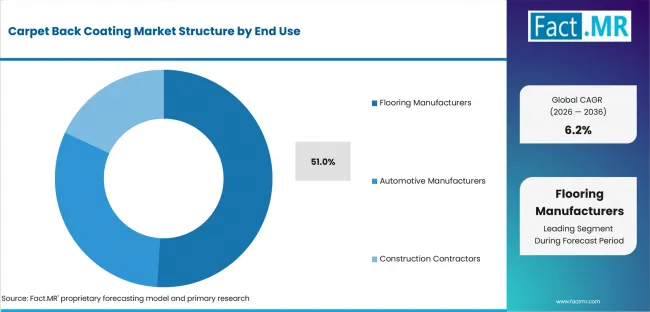
Carpet Back Coating Market Analysis By End Use | Source: Fact.MR
Flooring manufacturers control the process window, finished-product tests, and change-management documents used to approve a back coating. Residential programs emphasize applied cost; odor; and broad production reliability. Commercial flooring adds specification; maintenance; and traffic-performance requirements; while modular flooring places greater weight on tile flatness; dimensional stability; edge behavior; and compatibility with installation systems. Suppliers that support these separate approval routes are better positioned than those offering one undifferentiated formulation.
What is accelerating Carpet Back Coating Market adoption, and what is holding it back?
Low-emission and durable-carpet requirements support demand, formulation qualification and applied cost restrain switching, and circular or bio-based backing systems create the clearest product opportunity.
Drivers Impact Analysis
| DRIVER | QUALITATIVE RELEVANCE | GEOGRAPHIC RELEVANCE | IMPACT TIMELINE |
|---|---|---|---|
| Low-emission flooring specifications and indoor-air documentation | High | USA, Germany, and France | Current forecast period |
| Durability, tuft-bind, and dimensional-stability requirements | High | Global manufacturing base | Current forecast period |
| Residential replacement and refurbishment activity | Medium | USA and UK | Current forecast period |
Source: Fact.MR analysis. Updated Aug 3, 2026
- Low-emission specification: Buyers increasingly treat emissions information as part of product approval. Suppliers must connect the coating formulation with the installed carpet system and provide documents that procurement and specifiers can audit. Material selection connects this demand with the latex binders and mineral fillers markets.
- Finished-carpet durability: A formulation creates value only when it preserves adhesion, dimensions, edge integrity; and appearance after plant processing and field use. This requirement supports recurring testing and technical-service demand.
Opportunity Impact Analysis
| OPPORTUNITY | QUALITATIVE RELEVANCE | GEOGRAPHIC RELEVANCE | IMPACT TIMELINE |
|---|---|---|---|
| Circular or bio-based backing systems with preserved performance | High | Germany and wider Europe | Current forecast period |
| Recycled-monomer and mass-balance feedstock pathways | Medium | Europe and North America | Current forecast period |
| Application laboratories and local qualification support | High | USA, UK, Germany; and Japan | Current forecast period |
Source: Fact.MR analysis. Updated Aug 3, 2026
- Circular backing systems: The strongest opportunity is to combine lower fossil input or recycled content with the same adhesion, dimensional stability, odor; and production yield expected from the incumbent formulation. Claims without plant-scale proof will not clear buyer qualification.
- Qualification as a service: Suppliers can shorten conversion time by reproducing mixing, coating weight, drying; lamination; and finished-carpet tests before the customer commits production capacity.
Restraints Impact Analysis
| RESTRAINT | QUALITATIVE RELEVANCE | GEOGRAPHIC RELEVANCE | IMPACT TIMELINE |
|---|---|---|---|
| Formulation qualification and process disruption | High | UK, USA, and Japan | Current forecast period |
| Applied cost, drying demand, and production-yield risk | High | Global manufacturing base | Current forecast period |
| Trade-offs among adhesion, odor, flexibility; and specialty functions | Medium | Commercial and modular flooring markets | Current forecast period |
Source: Fact.MR analysis. Updated Aug 3, 2026
- Qualification cost: A coating change can require laboratory work, pilot runs, line trials; product testing; and customer reapproval. Manufacturers therefore retain established systems unless the new formulation provides a measurable operating or commercial benefit.
- Multi-property trade-offs: Lower emissions, circular content, flame resistance; or anti-slip behavior can alter viscosity; drying; adhesion; flexibility; or cost. The technical team must protect the full performance envelope rather than optimize one claim in isolation.
Which countries are scaling Carpet Back Coating Market fastest?
UK leads the listed country outlook at 6.9% CAGR, followed by USA at 6.6%, Japan at 6.3%; Germany at 6.0%; and France at 5.7% through 2036.
Regional analysis covers North America, Latin America, Western Europe; Eastern Europe; East Asia; South Asia and Pacific; and the Middle East and Africa. Processing constraints also shape the polyurethane and polyolefin markets.
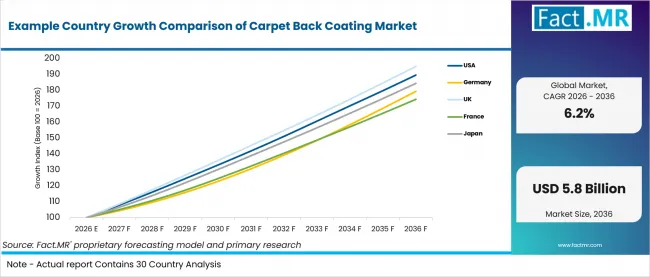
Example Country Growth Comparison Of Carpet Back Coating Market | Source: Fact.MR
| COUNTRY | CAGR, 2026 TO 2036 |
|---|---|
| USA | 6.6% |
| Germany | 6.0% |
| UK | 6.9% |
| France | 5.7% |
| Japan | 6.3% |
Source: Fact.MR analysis. Updated Aug 3, 2026
What is shaping USA's outlook through 2036?
6.6% CAGR through 2036, supported by applied-cost discipline, emissions documentation; and national technical-service coverage.
U.S. flooring manufacturers and institutional specifiers compare backing systems on total applied cost, line reliability, emissions information; and the supplier's ability to support multiple plants. Institutional projects also place carpet selection within broader indoor-air-quality programs; which raises the commercial value of clear product documentation. Demand for Carpet Back Coating in the USA is forecast to rise at 6.6% CAGR from 2026 to 2036.
What is shaping Germany's outlook through 2036?
6.0% CAGR through 2036, driven by low-emission product expectations and detailed flooring-system documentation.
German carpet and flooring buyers place strong weight on indoor-air performance and on the contribution of each layer in the installed system. The Blue Angel framework for low-emission textile floor coverings makes documentation, formulation control, and repeatable test performance commercially visible. Demand for Carpet Back Coating in Germany is forecast to expand at 6.0% CAGR from 2026 to 2036.
What is shaping the UK's outlook through 2036?
6.9% CAGR through 2036, supported by refurbishment demand and short execution windows in commercial and public interiors.
UK suppliers serve refurbishment and repair programs where flooring replacement may need to fit short production and installation windows. Buyers therefore value formulations that are already qualified, available through dependable channels, and supported by rapid technical response. Demand for Carpet Back Coating in the UK is forecast to expand at 6.9% CAGR from 2026 to 2036; the highest rate among the listed countries.
What is shaping France's outlook through 2036?
5.7% CAGR through 2036, shaped by visible construction-product emissions labeling and specification-led purchasing.
French specifiers and manufacturers operate within an emissions-label environment that makes product documentation part of commercial selection. Coating suppliers must show how the backing formulation supports the finished floor-covering declaration without compromising adhesion, processing, or use performance. Demand for Carpet Back Coating in France is forecast to rise at 5.7% CAGR from 2026 to 2036.
What is shaping Japan's outlook through 2036?
6.3% CAGR through 2036, supported by controlled process change and detailed validation in flooring and automotive interiors.
Japanese flooring and automotive customers favor long supplier relationships, precise process control, and documented validation before changing an approved material. Local technical support matters because a formulation adjustment can affect odor; appearance; dimensions; lamination; and downstream assembly. Demand for Carpet Back Coating in Japan is forecast to expand at 6.3% CAGR from 2026 to 2036.
Who leads the Carpet Back Coating Market?
Competition is distributed across latex and dispersion suppliers, thermoplastic and polyurethane specialists, and adhesive companies with flooring or automotive-interior application support.
BASF SE, Synthomer plc, Wacker Chemie AG; Trinseo PLC; and Arkema S.A. compete through water-based latex and dispersion platforms that can be adjusted for adhesion; filler loading; flexibility; and emissions requirements. Their commercial position depends on formulation breadth and on the ability to translate polymer chemistry into a repeatable carpet-coating process.
Dow Inc., Lubrizol Corporation, and Coim Group address polyolefin; polyurethane; vinyl; flame-resistant; or hot-melt positions within the broader backing system. H.B. Fuller Company and Henkel AG & Co. KGaA connect adhesive chemistry with flooring and automotive-interior processing requirements. Competition is based on formulation breadth; process support; and access to flooring and automotive-interior accounts rather than a single chemistry platform. Supplier approval conditions remain relevant to the anti slip coatings and bio based coatings markets.
In September 2024, Dow Inc. introduced its first bio-circular attributed product for carpet tile backing within the ENGAGE REN polyolefin elastomer portfolio. The material uses mass-balance feedstocks derived from biological residues and responsibly sourced waste while targeting dimensional stability and fiber adhesion.
In January 2024, Trinseo PLC detailed a development pathway for latex binders containing recycled methyl methacrylate produced through chemical recycling. The company stated that recycled monomer could be incorporated while maintaining performance associated with durability and reduced delamination.
In May 2024, Coim Group announced a EUR 10 million expansion of its research center in Offanengo, Italy. The program includes laboratories for new adhesive generations used in flooring-material production and a prepolymer laboratory focused on low-free-monomer; low-emission products.
Which companies are the key providers?
BASF SE and Dow Inc. are leading companies in the market.
- BASF SE
- Dow Inc.
- Synthomer plc
- Arkema S.A.
- Lubrizol Corporation
- Wacker Chemie AG
- Trinseo PLC
- Coim Group
- H.B. Fuller Company
- Henkel AG & Co. KGaA
Bibliography
- U.S. Environmental Protection Agency. (2026, February 18). Recommended Action Checklists for Improving Indoor Air Quality in Schools.
- German Environment Agency, Blue Angel. (2026, July 29). The Blue Angel for Low-Emission Textile Floor Coverings (DE-UZ 128).
- Office for National Statistics. (2026, July 16). Construction Output in Great Britain: May 2026.
- French Ministry for Ecological Transition. (2026, July 29). Etiquetage des produits de construction.
- Ministry of Economy, Trade and Industry, Japan. (2025, June 9). Mobility Digital Transformation Strategy Updated.
This Report Addresses
- What is the Carpet Back Coating Market worth in 2026, and what value is forecast for 2036?
- Which operating and purchasing pressures shape demand for carpet back-coating materials?
- Why do Latex Back Coating, Residential Carpets, and Nylon Carpets lead their segment axes?
- How do country growth rates and qualification conditions differ across USA, Germany, UK; France; and Japan?
- Which companies are profiled, and what determines competitive credibility?
- What scope boundary, segmentation, evidence base; and methodology support the market assessment?
What does the Carpet Back Coating Market cover?
Carpet back-coating materials and formulated binder systems sold for carpet manufacturing within the defined coating, application, material; technology; end-use; and regional universe.
The market covers latex dispersions, thermoplastic and polyurethane systems, bio-based or recycled polymer coatings; bitumen; and specialty fire-resistant or anti-slip coatings used on the back of carpet constructions. Application labels identify the receiving carpet category; while reported revenue remains limited to the coating material or formulated binder system.
What is included in the scope?
In-scope revenue covers carpet back-coating materials used across the defined taxonomy and sold to qualified manufacturing or supply-chain participants.
The scope includes Latex Back Coating and its listed styrene butadiene, carboxylated, and acrylic-modified categories. It covers Residential Carpets; Broadloom Carpets; Area Rugs; and Modular Carpet Tiles across Nylon Carpets; Nylon 6; Nylon 6;6; and Blend Nylon constructions. Technology coverage includes Water-based Coating; Low VOC Coating; Acrylic Dispersion; and Latex Dispersion. End-use coverage includes Flooring Manufacturers and Residential; Commercial; and Modular Flooring programs.
What is excluded from the scope?
Finished carpets and adjacent product or service revenue are outside the market boundary.
The scope excludes finished carpets, rugs, carpet tiles; vehicle floor systems; installation-only services; pile fibers; and backing fabrics sold separately. It also excludes downstream finished-product value and adjacent or substitute product revenue that does not arise from an in-scope carpet back-coating material or formulated binder system. Performance testing also influences the performance coatings and fillers and coating markets.
How was the analysis built?
Primary interviews, desk research, hybrid market sizing; and cross-checking were applied within the defined revenue and segmentation boundary.
- Primary Research
- Fact.MR engages carpet back-coating manufacturers, polymer and additive suppliers, distributors; flooring manufacturers; automotive-interior participants; contractors; procurement teams; and subject-matter experts. Discussions test application requirements; qualification cycles; applied cost; service expectations; and switching behavior.
- Desk Research
- The analysis reviews official construction and industrial statistics, environmental labeling and indoor-air requirements, company filings and first-party technical documents; product data sheets; public investment announcements; and relevant standards or government guidance.
- Market-Sizing and Forecasting
- Sizing starts with the reported 2025, 2026, and 2036 market values and reconciles supplier participation with demand across Coating Type; Application; Carpet Material; Technology; End Use; and Region. Forecasting also considers qualification time; product replacement; formulation change; and country-specific adoption conditions.
- Data Validation and Update Cycle
- Figures and conclusions are checked across the market values, segmentation universe, company evidence; country-specific operating conditions; and the stated exclusions. Regulatory; technical; and first-party company developments are reviewed to maintain scope and narrative consistency.
Segmentation
What is the report’s scope and coverage?
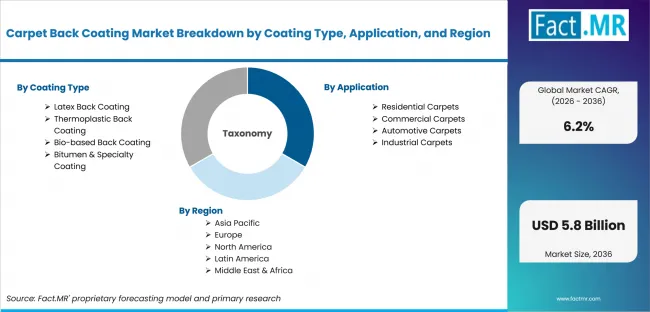
Carpet Back Coating Market Breakdown By Coating Type, Application, And Region | Source: Fact.MR
| Attribute | Details |
|---|---|
| Quantitative Units | USD 3.2 Billion in 2026 to USD 5.8 Billion by 2036 at 6.2% CAGR |
| Market Definition | Revenue from carpet back-coating materials and formulated binder systems sold within the defined segmentation universe, including latex dispersions, thermoplastic and polyurethane systems; bio-based or recycled polymer coatings; bitumen; and specialty fire-resistant or anti-slip coatings. |
| Coating Type | Latex Back Coating; Styrene Butadiene Latex; Carboxylated Latex; Acrylic Modified Latex |
| Application | Residential Carpets; Broadloom Carpets; Area Rugs; Modular Carpet Tiles |
| Carpet Material | Nylon Carpets; Nylon 6; Nylon 6,6; Blend Nylon |
| Technology | Water-based Coating; Low VOC Coating; Acrylic Dispersion; Latex Dispersion |
| End Use | Flooring Manufacturers; Residential Flooring; Commercial Flooring; Modular Flooring |
| Regions Covered | North America; Latin America; Western Europe; Eastern Europe; East Asia; South Asia and Pacific; Middle East and Africa |
| Countries Covered | USA; Germany; UK; France; Japan; and more than twenty-five additional countries in the full report |
| Key Companies Profiled | BASF SE; Dow Inc.; Synthomer plc; Arkema S.A.; Lubrizol Corporation; Wacker Chemie AG; Trinseo PLC; Coim Group; H.B. Fuller Company; Henkel AG & Co. KGaA |
| Forecast Period | 2026 to 2036 |
| Approach | Fact.MR applies a hybrid bottom-up and top-down sizing approach that reconciles supplier participation, coating-system demand by application, manufacturing and construction indicators; and country-level adoption conditions within the defined revenue boundary. |
Source: Fact.MR analysis. Updated Aug 3, 2026
How is the market segmented?
-
By Coating Type
- Latex Back Coating
- Styrene Butadiene Latex
- Carboxylated Latex
- Acrylic Modified Latex
- Thermoplastic Back Coating
- Polyolefin Coating
- Polyurethane Coating
- PVC Coating
- Bio-based Back Coating
- Natural Rubber Coating
- Bio-based Polyurethane
- Recycled Polymer Coating
- Bitumen & Specialty Coating
- Bitumen Back Coating
- Fire-resistant Coating
- Anti-slip Coating
- Latex Back Coating
-
By Carpet Material
- Residential Carpets
- Broadloom Carpets
- Area Rugs
- Modular Carpet Tiles
- Commercial Carpets
- Office Buildings
- Hospitality
- Retail Spaces
- Automotive Carpets
- Passenger Vehicles
- Commercial Vehicles
- Electric Vehicles
- Industrial Carpets
- Exhibition Carpets
- Marine Carpets
- Aviation Carpets
- Residential Carpets
-
By End Use
- Nylon Carpets
- Nylon 6
- Nylon 6,6
- Blend Nylon
- Polypropylene Carpets
- BCF Polypropylene
- Staple Fiber Polypropylene
- Recycled Polypropylene
- Polyester Carpets
- PET Polyester
- Recycled PET
- Triexta Polyester
- Wool & Specialty Fibers
- Wool Carpets
- Blend Wool
- Natural Fiber Carpets
- Nylon Carpets
-
By Region
- North America
- Latin America
- Western Europe
- Eastern Europe
- East Asia
- South Asia and Pacific
- Middle East and Africa
- USA
- Germany
- UK
- France
- Japan
- and more than twenty-five additional countries in the full report
- North America
Frequently Asked Questions
What is the Carpet Back Coating Market forecast for 2036?
Which Coating Type leads the Carpet Back Coating Market?
Which Application leads the Carpet Back Coating Market?
Which Carpet Material leads the Carpet Back Coating Market?
How does Technology affect carpet back-coating demand?
Which country records the highest listed CAGR?
How does the USA perform in the Carpet Back Coating Market?
How does Germany perform in the Carpet Back Coating Market?
How does Japan perform in the Carpet Back Coating Market?
What is the primary driver in the Carpet Back Coating Market?
What is the main restraint in the Carpet Back Coating Market?
What is the clearest opportunity in the Carpet Back Coating Market?
Which companies are profiled in the Carpet Back Coating Market?
What revenue is excluded from the Carpet Back Coating Market?
Who worked on this report


Preview the report firsthand - request a free sample
Free SampleGet the brochure for pricing and purchase details
Download PDF