- Market Value (2025): USD 20.6 Bn
- Estimated Value (2026): USD 21.7 Bn
- Forecast Value (2036): USD 36.1 Bn
- CAGR (2026-2036): 5.2%
What is the Casting & Release Paper Market forecast to be worth by 2036?
USD 21.7 billion in 2026 to USD 36.1 billion by 2036 at a 5.2% CAGR.
- Fact.MR estimates that the casting & release paper market reached USD 20.6 billion in 2025, with label liners taking the bulk of tonnage.
- Revenue is set to rise from USD 21.7 billion in 2026 to USD 36.1 billion by 2036 as medical, electronics and recyclable liner grades add to label volumes.
- Value will expand at a 5.2% CAGR from 2026 to 2036, since each new label, tape or patch needs a liner that is used once and then discarded.
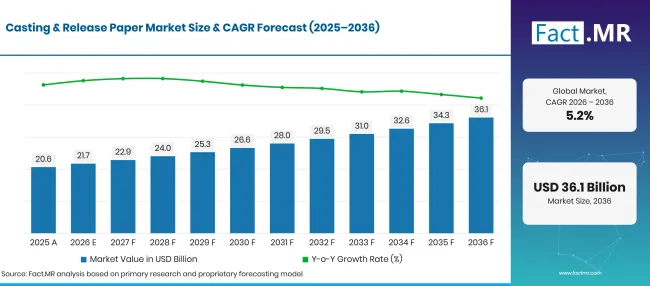
Factmr Casting And Release Paper Market Forecast Global | Source: Fact.MR
| Year | Basis | Market Value (USD billion) |
|---|---|---|
| 2025 | Actual | 20.6 |
| 2026 | Estimate | 21.7 |
| 2036 | Forecast | 36.1 |
| CAGR 2026 to 2036 | Forecast period | 5.2% |
Source: Fact.MR analysis. Updated Oct 19, 2026
What are the defining numbers behind Casting & Release Paper Market growth?
The decade to 2036 will add USD 14.4 billion in new value, with label and medical liners taking the bulk.
- Demand Drivers in the Market
- Pressure-sensitive labels cannot reach a dispensing line without a liner. Every roll of labels sold for food, beverage and shipping packs carries a release paper that is used once. Wider packaged goods trade and parcel volumes will keep liner tonnage climbing.
- Healthcare products need release surfaces that peel cleanly and leave no residue. Wound dressings, transdermal patches and electrode pads use release papers that converters qualify against skin-contact adhesives. Once approved, a grade tends to stay in a product for years.
- Packaging law is pushing liner suppliers toward recyclable grades. Regulation (EU) 2025/40 on packaging and packaging waste entered into force in February 2025 and has applied since 12 August 2026 [1]. Brand owners selling into Europe now review label components for recyclability, which favors liners that can return to paper mills.
- Electronics makers rely on release carriers when they cast and laminate thin functional layers. Display films, conductive tapes and insulating sheets require smooth paper free of contaminants so that defects do not transfer into finished parts.
- Synthetic leather for car interiors keeps casting paper lines busy. In August 2025, Lintec announced new coating equipment at its Komatsushima Plant with planned capacity of about 1.5 times its conventional lines, aimed at wide-width casting papers for vehicle interiors [2].
- Key Segments Analyzed
- By Type: Release will account for 62.3% share in 2026, as label, tape and patch output turns over liner stock continuously.
- By Application: Label and Stickers will capture 38.2% share in 2026 on the back of high-speed label dispensing, which needs a liner with uniform release force.
- Analyst Opinion at Fact.MR
- Shambhu Nath Jha, Principal Consultant at Fact.MR, states, “Converters judge a release paper by what happens on their press: release force, lay-flat behavior and how cleanly it dispenses at speed. Those trials make an approved supplier hard to replace. The next round of growth will go to mills that match today’s release performance in a liner that paper mills can recycle, and to casting papers that survive more passes on a coating line.”
- Strategic Implications
- Release base paper mills should certify liner grades under recognized paper recyclability test methods, since label buyers in Europe now ask for proof before switching.
- Label converters should qualify glassine and SCK liners from two mills, given that a single-source liner exposes them to price revisions and mill outages.
- Medical device makers should fix release grades in their technical files early, because a liner change after approval means fresh validation work.
- Synthetic leather producers should work with casting paper suppliers on reusable textures, which lower cost per meter when a sheet survives more passes.
Germany will set the pace at 6.0% CAGR, where label converters and tape plants work under strict packaging recycling rules. Brazil follows at 5.5% as packaged goods and a large footwear cluster draw on liners and casting papers. At 4.9%, the United States will grow on parcel labels and a deep medical device base. The United Kingdom will post 4.4% with packaging reform steering buyers toward recyclable liners. Japan rounds off the list at 3.9%, held up by precision electronics and medical grades.
How does the Casting & Release Paper Market break down by segment?
Release will lead Type at 62.3%; Label and Stickers will top Application at 38.2%.
What leads the Type segment?
Release takes 62.3% of 2026 revenue.
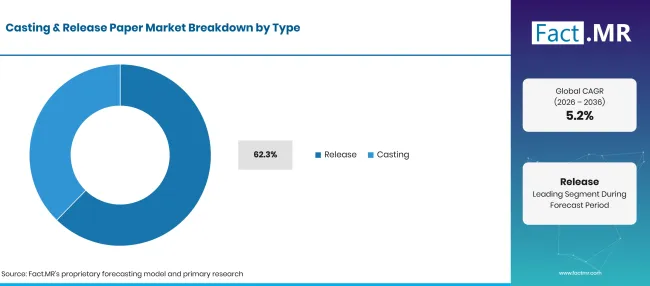
Factmr Casting And Release Paper Market Breakdown Type | Source: Fact.MR
| Type | Share (2026) |
|---|---|
| Release (Leading segment) | 62.3% |
| Other segments combined | 37.7%* |
| Total | 100.0% |
Source: Fact.MR analysis. Updated Oct 19, 2026
Every self-adhesive product needs a liner until the moment of use, so release paper tracks label, tape and medical output closely. Glassine and super calendered kraft papers form the main base stocks, coated with silicone to set a controlled peel force. Converters buy large reels on repeat orders once a grade passes press trials. Recyclability is now the deciding test for new liner grades. In February 2026, Ahlstrom launched Acti-V RRF Natural, a double-sided silicone-coated liner for PSA tapes rated “Recyclable with Paper” under the CEPI test method [3]. Casting paper serves a different buyer: coaters of PU and PVC synthetic leather, laminates and carbon fiber composites who need a texture transferred to their surface. Its value lies in how many times a sheet can be reused before the grain wears.
How does Application shape demand?
Label and Stickers hold 38.2% of 2026 demand.
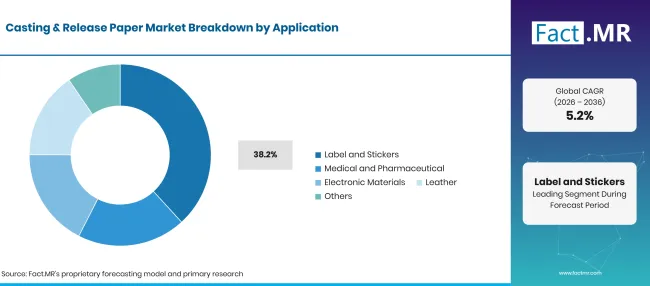
Factmr Casting And Release Paper Market Breakdown Application | Source: Fact.MR
| Application | Share (2026) |
|---|---|
| Label and Stickers (Leading segment) | 38.2% |
| Other segments combined | 61.8%* |
| Total | 100.0% |
Source: Fact.MR analysis. Updated Oct 19, 2026
Food, beverage and retail packs carry self-adhesive labels that peel from a liner on high-speed applicators. Shipping labels add a second stream tied to parcel volumes, and industrial labels for equipment and chemicals add steady tonnage. Spent liners have become a disposal issue for label users. In September 2025, Fedrigoni Self-Adhesives launched RE-SHUFFLE with Soprema to collect glassine liner waste and turn it into cellulose wadding or label facestock [4]. Medical and Pharmaceutical buyers use release papers in wound care, patches and electrode products where residue-free peel forms part of product safety. Electronic Materials draw on smooth carriers for casting films and tapes. Leather relies on embossed casting papers for footwear, bags and car seats, while Others include construction tapes and composite prepregs. Linerless labels remain a narrow alternative in some logistics uses.
What is accelerating Casting & Release Paper Market adoption, and what is holding it back?
Label volumes, medical device output and the shift to recyclable liners will keep orders rising across all five applications. Pulp, silicone and energy costs remain the main brake on margins and pricing. Lintec cited higher raw material and fuel costs when it announced increases of 10% or more on release and casting paper prices for shipments from April 2026 [5].
Drivers Impact Analysis
| DRIVER | (~) % IMPACT ON CAGR | GEOGRAPHIC RELEVANCE | IMPACT TIMELINE |
|---|---|---|---|
| Sustained expansion of pressure-sensitive labeling and stickers | +1.5% | Global | Short term (<= 2 years) |
| Rising adoption in medical and pharmaceutical products | +1.2% | North America, Western Europe, East Asia | Medium term (2-4 years) |
| Growing demand for electronic materials and precision films | +0.9% | East Asia, North America | Medium term (2-4 years) |
| Expanding synthetic leather output across footwear, automotive and furniture | +0.7% | East Asia, South Asia & Pacific, Latin America | Long term (>= 4 years) |
Source: Fact.MR analysis. Updated Oct 19, 2026
Opportunity Impact Analysis
| OPPORTUNITY | (~) % IMPACT ON CAGR | GEOGRAPHIC RELEVANCE | IMPACT TIMELINE |
|---|---|---|---|
| Commercialization of recyclable and silicone-free release grades | +0.8% | Western Europe, North America | Medium term (2-4 years) |
| Development of high-performance grades for medical and electronic uses | +0.6% | Global | Long term (>= 4 years) |
| Rising converter capacity in emerging economies | +0.4% | Latin America, South Asia & Pacific | Long term (>= 4 years) |
Source: Fact.MR analysis. Updated Oct 19, 2026
Restraints Impact Analysis
| RESTRAINT | (~) % IMPACT ON CAGR | GEOGRAPHIC RELEVANCE | IMPACT TIMELINE |
|---|---|---|---|
| Volatility in pulp, silicone and resin input costs | -0.4% | Global | Short term (<= 2 years) |
| Competitive pressure from film liners and direct coating methods | -0.3% | Global | Medium term (2-4 years) |
| Tightening environmental regulation and liner waste disposal costs | -0.2% | Western Europe, North America | Long term (>= 4 years) |
Source: Fact.MR analysis. Updated Oct 19, 2026
Which countries are scaling the Casting & Release Paper Market through 2036?
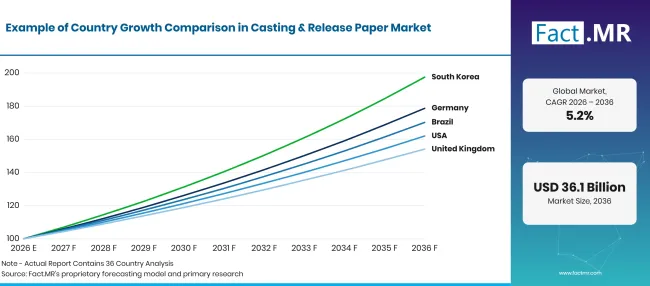
Factmr Casting And Release Paper Market Growth Index | Source: Fact.MR
| Country | CAGR (2026–2036) |
|---|---|
| Germany | 6.0% |
| Brazil | 5.5% |
| United States | 4.9% |
| United Kingdom | 4.4% |
| Japan | 3.9% |
Source: Fact.MR analysis. Updated Oct 19, 2026
What supports Germany’s adoption?
6.0% CAGR, backed by a deep converter base and strict packaging recycling rules.
German label converters, tape makers and medical technology firms buy release papers in volume. The Umweltbundesamt reported packaging consumption of 17.92 million tonnes in Germany in 2023, down 5.8% from the year before [6]. Paper and paperboard packaging reached a recycling rate of 86.6% in 2023, according to the federal environment ministry [7]. Liners that pass paper recycling tests fit neatly into this collection system, and EU packaging rules add further pressure to adopt them.
How is Brazil scaling demand?
5.5% CAGR, driven by packaged goods labeling and a large footwear cluster.
IBGE reported that industrial production in Rio Grande do Sul grew 2.4% in 2025, ahead of 0.6% for Brazil as a whole [8]. The state government ranks Rio Grande do Sul second among Brazil’s footwear producing states and first in leather [9], a base that draws on synthetic leather made on casting paper. Local supply of release base is also widening. In July 2026, Ahlstrom introduced MaxLiner, a high-density release paper made at its Jacareí plant for the South American PSA label market [10].
What supports United States adoption?
4.9% CAGR, helped by parcel labeling and a large medical device base.
Online retail keeps shipping label demand high. The Census Bureau estimated seasonally adjusted U.S. retail e-commerce sales at USD 340.2 billion in the second quarter of 2026, or 17.1% of total retail sales [11]. Each parcel carries at least one pressure-sensitive label on a release liner. Medical device and pharmaceutical producers add steady demand for higher-grade papers that meet skin-contact and cleanliness requirements.
How does the United Kingdom perform?
4.4% CAGR, reflecting packaging reform and steady healthcare demand.
Defra’s provisional figures show that 70.5% of UK packaging waste was recycled in 2025, from about 11.06 million tonnes of packaging waste arising [12]. Extended producer responsibility fees for packaging give brand owners a reason to review every component, liners included. Online sales made up 28.8% of retail sales in Great Britain in August 2026, according to the ONS [13]. Pharmaceutical and life sciences labeling keeps a steady base under these packaging volumes.
How is Japan developing demand?
3.9% CAGR, on the back of electronics laminating and medical grades.
Japanese electronic materials makers use clean, smooth release carriers to cast films for displays and semiconductor packaging. The Statistics Bureau reported that people aged 65 and over numbered 36.24 million in 2026, a record 29.6% of the population [14]. An older population lifts use of patches, dressings and other medical products made on release paper. Lintec’s new coating line at Komatsushima in Tokushima Prefecture also adds domestic casting paper output [2].
Who leads the Casting & Release Paper Market?
Suppliers fall into three groups. Specialty paper groups such as Ahlstrom, UPM and Fedrigoni compete on release base papers for labels and tapes, where glassine and SCK quality decides how fast a converter can run. In April 2025, Fedrigoni announced a slitting center near Cologne for self-adhesive label materials, with a target of 90 million square meters a year [15].
Casting specialists form the second group. Sappi supplies casting and release papers from its Westbrook mill in Maine for synthetic leather and laminates, FAVINI offers embossed release papers for fashion and automotive interiors, and Lintec is adding wide-width casting capacity in Japan [2]. Loparex coats paper and film liners for healthcare, composites and tape customers. Texture libraries, recyclable liner grades and stable release values across mills will separate the stronger suppliers through 2036.
Which companies are the key providers?
Key companies include Sappi Limited; Ahlstrom Oyj; Lintec Corporation; FAVINI Srl; Fedrigoni S.p.A. (including Fedrigoni Self-Adhesives); UPM-Kymmene Corporation; and Loparex.
- Sappi Limited
- Ahlstrom Oyj
- Lintec Corporation
- FAVINI Srl
- Fedrigoni S.p.A. (including Fedrigoni Self-Adhesives)
- UPM-Kymmene Corporation
- Loparex
Bibliography
- [1] European Parliament and Council of the European Union. (2025, January 22). Regulation (EU) 2025/40 of the European Parliament and of the Council of 19 December 2024 on packaging and packaging waste, amending Regulation (EU) 2019/1020 and Directive (EU) 2019/904, and repealing Directive 94/62/EC.
- [2] LINTEC Corporation. (2025, August 28). LINTEC Introduces New Coating Equipment.
- [3] Ahlstrom. (2026, February 11). Ahlstrom launches next-generation Acti-V® RRF Natural for PSA tapes: double-sided silicone-coated release liners are now recyclable with paper.
- [4] Fedrigoni Self-Adhesives. (2025, September 16). RE-SHUFFLE: A New Circular Journey for Glassine Waste.
- [5] LINTEC Corporation. (2025, November 17). LINTEC Announces Price Revisions on Release Papers, Release Films, Casting Papers, and Other Products.
- [6] Umweltbundesamt. (2026, April). Aufkommen und Verwertung von Verpackungsabfällen in Deutschland im Jahr 2023 [Generation and recovery of packaging waste in Germany in 2023].
- [7] Bundesministerium für Umwelt, Klimaschutz, Naturschutz und nukleare Sicherheit. (2025, December 19). Aufkommen und Recyclingquoten von Verpackungen [Packaging volumes and recycling rates].
- [8] Instituto Brasileiro de Geografia e Estatística (IBGE). (2026, February 10). Produção industrial fecha 2025 com avanço em 10 dos 18 locais pesquisados [Industrial production closes 2025 with gains in 10 of 18 locations surveyed].
- [9] Governo do Estado do Rio Grande do Sul. (2025, August 4). Vice-governador se reúne com setor calçadista para tratar das tarifas dos EUA [Vice governor meets footwear sector on US tariffs].
- [10] Ahlstrom. (2026, July 8). Ahlstrom expands its global offering for Pressure Sensitive Adhesive (PSA) labeling with new release paper manufactured in Brazil.
- [11] U.S. Census Bureau. (2026, August 18). Quarterly Retail E-Commerce Sales: 2nd Quarter 2026.
- [12] Department for Environment, Food & Rural Affairs. (2026, September 23). UK statistics on waste.
- [13] Office for National Statistics. (2026, September 18). Retail sales, Great Britain: August 2026.
- [14] Statistics Bureau of Japan. (2026, September 20).[Japan’s elderly population in statistics: For Respect for the Aged Day].
- [15] Fedrigoni. (2025, April 10). Fedrigoni Announces New Slitting Center for Self-Adhesive Labels in Germany in Q4 2025.
This Report Answers
- Casting and release paper revenue is split by type and application for each year from 2026 to 2036.
- For release paper and label uses, readers see the buyer needs that hold up each leading share.
- The five listed countries are compared on converter base, end-use demand and packaging rules.
- Company profiles separate specialty paper mills from casting specialists and liner coaters.
- Recyclable liner grades and solvent-free coating are tracked as the main shifts in product development.
What does the Casting & Release Paper Market cover?
Paper substrates coated to release an adhesive or to transfer a surface texture make up the Casting & Release Paper Market. Release paper shields the adhesive layer of labels, tapes and medical products until use, while casting paper acts as a carrier that gives grain or gloss to coated materials such as synthetic leather.
Sales are tracked for labels and stickers, medical and pharmaceutical products, electronic materials, leather and other uses. Revenue is counted at the point where the coated paper is sold to a converter or manufacturer.
What is included in the scope?
Release papers and casting papers with silicone or non-silicone release layers are in scope, along with recyclable and heat-resistant grades. Papers sold as liners, carriers and process sheets to converters count as well.
Release base stocks drawn from the wider specialty papers range are counted once they carry a release coating. Paper liners paired with deinkable label adhesives also belong in the total.
What is excluded from the scope?
Film-based release liners made from polyester or polyolefin with no paper base are out of scope. Standard printing, writing and packaging papers without a release function are also left out.
Labels, tapes, medical devices and synthetic leather goods made with these papers are not counted at their finished value. Uncoated base paper sold before release or casting coatings are applied is excluded, as are grease-resistant grades made with paper barrier coatings.
How Was the Analysis Built?
The analysis draws on 120+ sources, 35+ company portfolios, 25+ countries, and more than 20 industry interviews.
- Primary Research: Primary research includes discussions with manufacturers, service providers, technology developers, distributors, end users, and subject-matter experts. These conversations examine purchasing priorities, product adoption, operational challenges, approval requirements, competitive positioning, and the factors that influence wider market acceptance.
- Desk Research: Desk research covers government statistics, regulatory publications, company filings, trade data, technical studies, industry associations, standards, public policy, and other authoritative sources. Every source used in the analysis is documented in the bibliography.
- Market Sizing and Forecasting: Market estimates combine historical performance, demand indicators, pricing and volume trends, segment shares, company participation, country-level growth, adoption patterns, investment activity, and barriers to market expansion.
- Data Validation and Update Cycle: Findings are validated by comparing primary interviews with public data, company activity, regulatory changes, trade patterns, and industry developments. Regular updates review new product launches, capacity changes, partnerships, approvals, and shifts in commercial adoption.
Segmentation
What is the report’s scope and coverage?
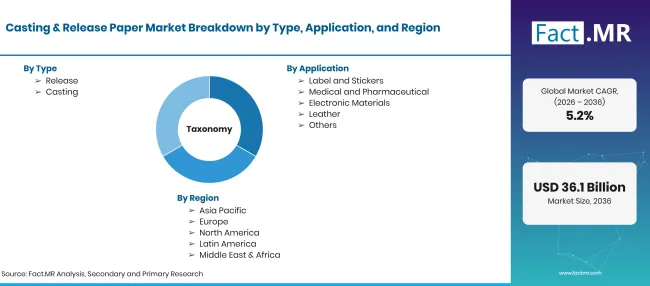
Factmr Casting And Release Paper Market Taxonomy | Source: Fact.MR
| Attribute | Details |
|---|---|
| Quantitative Units | USD billion in 2026 to USD billion by 2036 at CAGR |
| Market Definition | Paper-based casting and release substrates, coated with silicone or non-silicone release layers, used as liners and surface carriers for labels, medical products, electronic materials, synthetic leather and other applications. |
| Type | Release; Casting |
| Application | Label and Stickers; Medical and Pharmaceutical; Electronic Materials; Leather; Others |
| Regions Covered | North America; Latin America; Western Europe; Eastern Europe; East Asia; South Asia & Pacific; Middle East & Africa |
| Countries Covered | Germany; Brazil; United States; United Kingdom; Japan |
| Companies Profiled | Sappi Limited; Ahlstrom Oyj; Lintec Corporation; FAVINI Srl; Fedrigoni S.p.A.; UPM-Kymmene Corporation; Loparex |
| Forecast Period | 2026 to 2036 |
| Approach | Hybrid top-down and bottom-up approach using label, tape and medical product output; release base and casting paper capacity; application split; country growth; and supplier portfolio review. |
Source: Fact.MR analysis. Updated Oct 19, 2026
How is the market segmented?
-
By Type
- Release
- Casting
-
By Application
- Label and Stickers
- Medical and Pharmaceutical
- Electronic Materials
- Leather
- Others
-
By Region
- North America
- Latin America
- Western Europe
- Eastern Europe
- East Asia
- South Asia & Pacific
- Middle East & Africa
Frequently Asked Questions
How big is the casting & release paper market in 2026?
What is the CAGR of the casting & release paper market from 2026 to 2036?
Which type leads the casting & release paper market?
Which application leads the casting & release paper market?
Which country will grow the most in the casting & release paper market?
Who are the main companies in the casting & release paper market?
Who worked on this report


Preview the report firsthand - request a free sample
Free SampleGet the brochure for pricing and purchase details
Download PDF