What is the child-safe vial closures market forecast to be worth by 2036?
USD 755 million in 2026 to USD 1,290 million by 2036, at 5.5% CAGR.
- The child-safe vial closures market crossed a valuation of USD 710 million in 2025.
- Demand is estimated to increase from USD 755 million in 2026 to USD 1,290 million by 2036.
- The market is forecast to record 5.5% CAGR from 2026 to 2036 due to prescription refill volume, poison-prevention rules and pharmacy packaging checks.
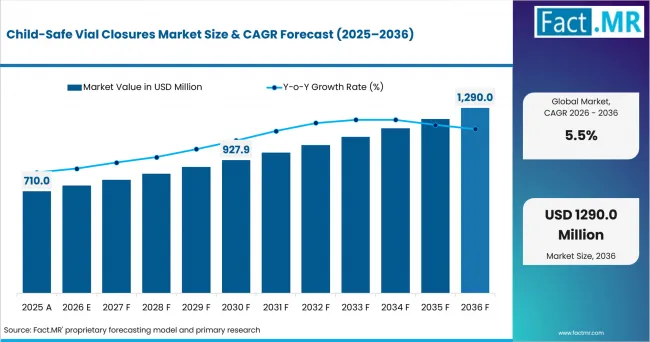
Child Safe Vial Closures Market Market Value Analysis | Source: Fact.MR
What are the defining numbers behind child-safe vial closures growth?
USD 535 million absolute opportunity by 2036, led by India and China.
- Demand Drivers in the Market
- Pharma companies need child-resistant closures before medicines enter homes through retail or OTC channels.
- Retail pharmacies need vial closures that fit refill workflows and reduce handling errors at counters.
- Contract packagers need closure documentation because regulated customers review fit, torque and opening behavior.
- Suppliers need adult-friendly designs because senior patients must open repeat-use medicine containers safely.
- Key Segments Analyzed
- By Closure Type: Push-turn caps are estimated to hold 36.5% share in 2026 due to broad pharmacy familiarity.
- By Material: Polypropylene is projected to secure 47.0% share in 2026 owing to thread strength and molding repeatability.
- By Container Type: Plastic vials are forecast to account for 44.0% share in 2026 supported by refill workflows.
- By End User: Retail pharmacies are anticipated to represent 38.0% share in 2026 attributable to daily prescription dispensing.
- By Sales Channel: Direct supply is expected to hold 52.0% share in 2026 due to documentation and account traceability.
- By Geography: India is projected to record 6.7% CAGR through 2036 due to regulated-market medicine exports.
- Analyst Opinion at Fact.MR
- Shambhu Nath Jha, Senior Analyst at Fact.MR, states, “Child-safe vial closures are becoming a packaging-control decision for pharma buyers. I see customers asking whether a closure can protect children without making adult use difficult. Suppliers that can show test records, vial fit and repeatable molding are better placed to keep regulated accounts.”
- Strategic Implications
- Closure suppliers should build validation records before approaching pharma and retail pharmacy accounts.
- Pharma brands need container-closure checks before changing vial formats or resin systems.
- Contract packagers should qualify closure families that work across oral solids and liquids.
- Distributors need product files that show child resistance, senior usability and pack compatibility.
Child-resistant closures for pharmaceutical vials, syrup bottles, dropper packs, nasal spray bottles, and oral-liquid packs form the core of this market. The United States Consumer Product Safety Commission defines special packaging as difficult for children under five to open and not difficult for adults to use properly. This connects closure demand to regulated pharmaceutical packaging decisions rather than general cap replacement.
India is projected to record 6.7% CAGR through 2036 due to export-led medicine production. China is expected to expand at 6.3% CAGR through 2036 because domestic medicine approvals increase package qualification work. The United States is forecast to grow at 5.7% CAGR through 2036 due to high prescription use and recall enforcement. The United Kingdom is expected to advance at 5.5% CAGR through 2036 because community dispensing keeps closure replacement steady. Germany is projected to rise at 5.2% CAGR through 2036 due to reimbursement-led pharmacy dispensing. France is forecast at 5.0% CAGR through 2036 because public health spending supports medicine distribution. Japan is expected to post 4.8% CAGR through 2036 due to slower volume expansion and strict pack usability review.
How does the child-safe vial closures market break down by segment?
Push-turn caps lead at 36.5%; polypropylene leads at 47.0%.
Which closure type dominates?
Push-turn caps hold 36.5% share in 2026.
Push-turn caps lead because the motion is familiar to pharmacists and patients. The format works across common prescription vial sizes and supports repeat use. Pharma packaging teams compare plastic caps by child resistance, adult opening, and tamper evidence before approving supply.
Which material dominates?
Polypropylene accounts for 47.0% share in 2026.
Polypropylene leads because it supports cap threads, hinge features, and repeat molding. It also allows closure makers to manage weight without weakening opening performance. The segment connects with pharmaceutical plastic packaging lines that need stable resin and batch documentation.
Which container type dominates?
Plastic vials hold 44.0% share in 2026.
Plastic vials lead because retail pharmacies need containers that handle counting, labeling and transport without breakage. Their position is linked to plastic bottles and containers used in pharmaceutical and healthcare channels. Glass vials remain important where drug compatibility and premium pack perception matter.
Which end user dominates?
Retail pharmacies lead with 38.0% share in 2026.
Retail pharmacies lead because they dispense repeat prescriptions and OTC medicines into household containers. Their buyers need closures that are easy to stock and compatible with common vial formats. Demand is reinforced by refill volume and patient safety checks at dispensing counters.
Which sales channel dominates?
Direct supply holds 52.0% share in 2026.
Direct supply leads because pharma companies and contract packagers need documentation before using closures in regulated production. The channel also gives suppliers better control over specifications and change records. Broader plastic caps and closures supply supports volume scale, but child-safe vial closures require tighter account control.
What is accelerating child-safe vial closure demand, and what is holding it back?
Poison-prevention packaging rules drive demand; usability and retesting burden restrain supplier switching.
The main driver is regulation. The Poison Prevention Packaging Act requires special packaging for covered substances, and the Electronic Code of Federal Regulations places these requirements in 16 CFR Part 1700. Related medical suppliers face similar buyer scrutiny when packs move into hospital and home-care channels.
The main restraint is usability testing. Child-resistant closures must stop young children without creating daily access problems for adults. A resin change or thread redesign can trigger retesting, which slows supplier switching and keeps approved formats in place longer.
Where do the biggest child-safe vial closure opportunities sit?
Senior-friendly caps, OTC liquid packs and contract packaging qualification.
- Senior-Friendly Closures: Suppliers can improve adult usability while preserving child-resistant performance.
- OTC Liquid Packs: Recall activity keeps brands focused on child-resistant bottles and dropper formats.
- Contract Packaging Qualification: Packagers can standardize closure families for small batches and refill formats. Suppliers that serve rigid plastic packaging accounts can use tooling scale, but medicine closures require stronger documentation.
Which countries are scaling child-safe vial closures fastest?
India 6.7%, China 6.3%, USA 5.7%, United Kingdom 5.5%, Germany 5.2%, France 5.0%, Japan 4.8%.
Based on regional analysis, the child-safe vial closures market is segmented into North America, Latin America, Europe, East Asia, South Asia and Pacific, and Middle East and Africa. Country-level closure demand also connects with cold form blister packaging because pharma buyers compare vial formats with other child-protective dose packs during packaging decisions.
| Country | CAGR |
|---|---|
| India | 6.7% |
| China | 6.3% |
| United States | 5.7% |
| United Kingdom | 5.5% |
| Germany | 5.2% |
| France | 5.0% |
| Japan | 4.8% |
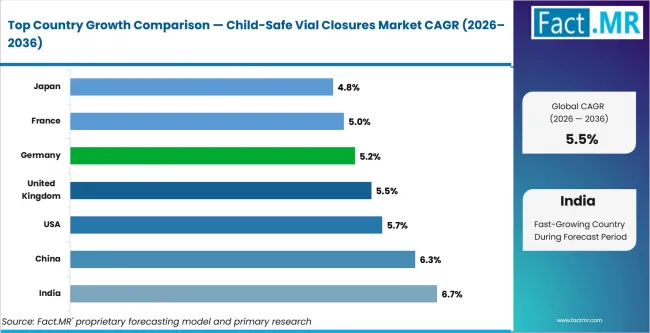
Child Safe Vial Closures Market Cagr Analysis By Country | Source: Fact.MR
What is powering India’s lead?
6.7% CAGR, supported by export-led medicine production and regulated-market packaging needs.
India is projected to record 6.7% CAGR through 2036 due to export-oriented medicine production and regulated packaging demand. The Press Information Bureau reported that drugs and pharmaceutical exports rose to USD 2.66 billion in January 2026. Closure suppliers can target exporters that need child-resistant pack records for regulated-market shipments.
How is China scaling closure demand?
6.3% CAGR, driven by medicine approvals and local package qualification.
China’s packaging need starts with domestic medicine approvals and faster review pathways. China is expected to expand at 6.3% CAGR through 2036 because new products require qualified container-closure formats. The National Medical Products Administration reported approval of 48 first-in-class medicines in 2025. Chinese suppliers also watch medical flexible packaging because oral liquids and clinical packs often move through the same pharma account teams.
What supports the USA outlook?
5.7% CAGR, supported by prescription use and recall enforcement.
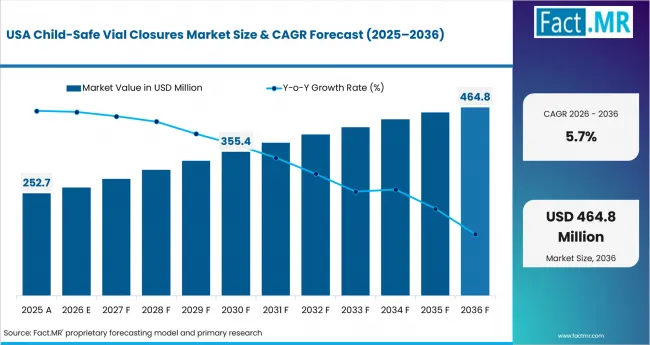
Child Safe Vial Closures Market Country Value Analysis | Source: Fact.MR
Retail medicine buyers in the United States specify closures around liability, refill handling and consumer safety. The United States is forecast to grow at 5.7% CAGR through 2036 because retail pharmaceutical spending and enforcement visibility keep closure checks active. Bayer’s Afrin recall covered about 786,100 units after the Consumer Product Safety Commission reported a child-resistant packaging violation.
Why does the United Kingdom remain important?
5.5% CAGR, backed by community dispensing and pharmacy replacement demand.
The United Kingdom has a pharmacy-led prescription channel that keeps closure demand close to daily patient use. The United Kingdom is expected to advance at 5.5% CAGR through 2036 due to stable community dispensing. NHS Business Services Authority reported 1.30 billion prescription items dispensed in the community in England in 2025/26. Buyers need closures that reduce misuse without slowing pharmacy handling.
What underpins Germany’s growth?
5.2% CAGR, driven by high medicine spending and reimbursement-led dispensing.
Germany is projected to rise at 5.2% CAGR through 2036 due to reimbursement-led pharmacy dispensing and high retail medicine spending. The Organisation for Economic Co-operation and Development reported German retail pharmaceutical expenditure at USD 1,158 per person in 2023. Suppliers that support documentation and pharmacy usability can defend larger accounts.
How does France sustain demand?
5.0% CAGR, supported by public health spending and medicine distribution.
France is forecast at 5.0% CAGR through 2036 because public reimbursement supports steady medicine distribution. Eurostat reported French current healthcare expenditure at EUR 325 billion in 2023. Closure demand is steadier than faster Asian markets because pharmacy channels are established and specification changes remain controlled.
Why is Japan a measured closure market?
4.8% CAGR, due to quality review and slower volume expansion.
Japan’s buyers work in a careful approval culture where usability and quality records matter more than fast product change. Japan is expected to post 4.8% CAGR through 2036 due to slower prescription volume expansion and strict pack evaluation. The U.S. International Trade Administration reported Japan’s prescription and nonprescription pharmaceutical shipment value at Yen 12.4 trillion in 2023. Channel demand favors suppliers that can support smaller batches and detailed documentation.
Who leads the child-safe vial closures landscape?
Aptar, Amcor / Berry Global and Gerresheimer lead through healthcare closure portfolios and pharma packaging access.
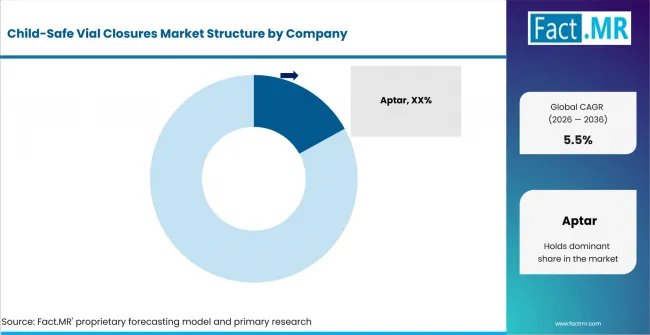
Child Safe Vial Closures Market Analysis By Company | Source: Fact.MR
Child-safe vial closures are used by pharma companies, contract packagers and pharmacies that need trusted packaging evidence before medicines reach homes. Aptar supports child-resistant senior-friendly closure solutions and expanded its Congers site for healthcare closure capacity. Amcor / Berry Global competes through pharmaceutical packaging scale and child-resistant closure formats for vials and bottles.
Gerresheimer completed the acquisition of Blitz LuxCo Sàrl, the holding company of Bormioli Pharma Group, in December 2024. This means Bormioli Pharma should be treated as part of Gerresheimer in the competitive set rather than a separate independent supplier. SGD Pharma competes where vial systems and closure compatibility matter to pharma customers.
Origin Pharma Packaging competes through child-resistant bottles, closures and dropper systems for healthcare and lifestyle products. Suppliers serving nutraceutical packaging accounts can enter OTC programs, but medicine closures require stronger proof than supplement packaging.
Which companies are the key players?
Aptar, Amcor / Berry Global, Gerresheimer with Bormioli Pharma, SGD Pharma and Origin Pharma Packaging.
- Aptar
- Amcor / Berry Global
- Gerresheimer with Bormioli Pharma
- SGD Pharma
- Origin Pharma Packaging
Bibliography
- U.S. Consumer Product Safety Commission. (2026). Poison Prevention Packaging Act business guidance. CPSC. Retrieved July 4, 2026.
- U.S. Consumer Product Safety Commission. (2025, March 17). Annual report on pediatric poisoning fatalities and injuries: March 2025. CPSC.
- Electronic Code of Federal Regulations. (2026). 16 CFR Part 1700: Poison prevention packaging. eCFR. Retrieved July 4, 2026.
- U.S. Consumer Product Safety Commission. (2026, April 30). Bayer recalls 6 mL size Afrin Original Nasal Spray bottles due to risk of serious injury or illness from child poisoning. CPSC.
- Press Information Bureau. (2026, March 21). India’s pharmaceuticals in global healthcare. Government of India.
- National Medical Products Administration. (2025, March 21). Measures facilitate approval of 48 first-in-class innovative drugs. NMPA.
- NHS Business Services Authority. (2026, June 4). Prescription Cost Analysis: England 2025/26. NHSBSA.
- Organisation for Economic Co-operation and Development. (2025, November 13). Pharmaceutical expenditure. In Health at a Glance 2025. OECD Publishing.
- Eurostat. (2026). Healthcare expenditure statistics: Overview. European Commission. Retrieved July 4, 2026.
- U.S. International Trade Administration. (2025, November 20). Japan – pharmaceuticals. U.S. Department of Commerce.
- Aptar Pharma. (2024, September 24). Aptar Pharma celebrates North America capacity expansion. Aptar Pharma.
- Gerresheimer AG. (2024, December 11). Gerresheimer successfully completes acquisition of Blitz LuxCo Sàrl, the holding company of the Bormioli Pharma Group. Gerresheimer.
- Amcor. (2025, April 30). Amcor completes combination with Berry Global. Amcor.
- Origin Pharma Packaging. (2026). Pharmaceutical closures and dispensers. Origin Pharma Packaging. Retrieved July 4, 2026.
This Report Addresses
- Strategic intelligence on child-safe pharmaceutical closures across closure type, material, and container type.
- Segment analysis covering push-turn caps, polypropylene, plastic vials, retail pharmacies and direct supply.
- Regional outlook covering India, China, the United States, the United Kingdom, Germany, France, and Japan.
- Competitive analysis of Aptar, Amcor / Berry Global, Gerresheimer with Bormioli Pharma, SGD Pharma and Origin Pharma Packaging.
- Regulatory assessment covering child-resistant packaging requirements, recall risk and special packaging rules.
- Service assessment covering closure fit, senior-friendly use, tamper evidence and batch documentation.
- Primary interviews, supplier checks, official source review and company portfolio validation support the forecast.
What does the child-safe vial closures market cover?
Child-resistant pharmaceutical closure systems for vials, syrup bottles and oral-liquid packs.
The child-safe vial closures market covers caps and closure systems that restrict access to medicines by young children. It includes formats used on prescription vials, OTC liquids and dropper packs. The market differs from general closure supply because the focus is tested child resistance, adult usability, and medicine-container fit.
What is included in the scope?
Push-turn caps, squeeze-turn caps and senior-friendly child-resistant closures.
The scope includes push-turn caps and squeeze-turn caps. It covers snap-on child-resistant caps, tamper-evident child-resistant caps and senior-friendly child-resistant closures. It includes polypropylene, high-density polyethylene, liners and aluminum-plastic combinations used on glass vials, plastic vials, syrup bottles and dropper packs.
What is excluded from the scope?
Vial bodies without child-resistant closure supply and household-only closures.
The scope excludes vial bodies sold without closure supply. It excludes household chemical closures unless they are supplied for medicine packaging. It also excludes dosing cups, loose droppers and software-only compliance tools that do not cover physical closure performance.
How was the analysis built?
100+ sources, 40+ company portfolios, 25+ countries, 20+ interviews.
- Primary Research: Primary research includes interviews with closure suppliers and pharmacy packaging buyers. It includes input from contract packagers and pharma procurement teams.
- Desk Research: Desk research reviews poison-prevention packaging rules and special packaging guidance. It covers child-resistant closure portfolios and pharmaceutical packaging account activity.
- Market-Sizing and Forecasting: Forecasting uses market value anchors, medicine dispensing volume, and regulated packaging intensity. Closure replacement and new pack qualification support the market assessment.
- Data Validation and Update Cycle: Forecasts are validated through supplier checks and official source review. Recall activity and company capacity developments help confirm market direction.
What is the report’s scope and coverage?
| Attribute | Details |
|---|---|
| Quantitative Units | USD Million in 2026 to USD Million by 2036 at CAGR |
| Market Definition | Child-resistant closure systems supplied for pharmaceutical vials, syrup bottles, dropper bottles, nasal spray bottles, and oral-liquid medicine packs. |
| Closure Type | Push-turn caps, squeeze-turn caps, snap-on CR caps, tamper-evident CR caps, senior-friendly CR closures |
| Material | PP, HDPE, LDPE liners, elastomeric liners, aluminum-plastic combinations |
| Container Type | Glass vials, plastic vials, syrup bottles, dropper bottles, oral liquid packs |
| End User | Pharma companies, compounding pharmacies, hospitals, retail pharmacies, and contract packagers |
| Sales Channel | Direct supply, distributor supply, contract packaging supply, pharmacy supply, e-commerce replacement supply |
| Regions Covered | North America, Latin America, Europe, East Asia, South Asia and Pacific, Middle East and Africa |
| Countries Covered | India, China, United States, United Kingdom, Germany, France, Japan |
| Key Companies Profiled | Aptar, Amcor / Berry Global, Gerresheimer with Bormioli Pharma, SGD Pharma and Origin Pharma Packaging |
| Forecast Period | 2026 to 2036 |
| Approach | Hybrid top-down and bottom-up approach using medicine dispensing volumes, regulated packaging rules, supplier portfolio checks and buyer validation. |
How is the market segmented?
-
By Closure Type:
- Push-turn caps
- Squeeze-turn caps
- Snap-on CR caps
- Tamper-evident CR caps
- Senior-friendly CR closures
-
By Material:
- PP
- HDPE
- LDPE liners
- Elastomeric liners
- Aluminum-plastic combinations
-
By Container Type:
- Glass vials
- Plastic vials
- Syrup bottles
- Dropper bottles
- Oral liquid packs
-
By End User:
- Pharma companies
- Compounding pharmacies
- Hospitals
- Retail pharmacies
- Contract packagers
-
By Sales Channel:
- Direct supply
- Distributor supply
- Contract packaging supply
- Pharmacy supply
- E-commerce replacement supply
-
By Region:
- North America
- United States
- Canada
- Mexico
- Latin America
- Brazil
- Argentina
- Rest of Latin America
- Europe
- Germany
- United Kingdom
- France
- Italy
- Spain
- Rest of Europe
- East Asia
- China
- Japan
- South Korea
- South Asia and Pacific
- India
- ASEAN
- Rest of South Asia and Pacific
- Middle East & Africa
- GCC Countries
- South Africa
- UAE
- Rest of Middle East & Africa
- North America