- Base Value(2025): 0.3 Bn
- Forecast Value (2036): 1.9 Bn
- CAGR (2036): 16.9%
What is the gene therapy vials market forecast to be worth by 2036?
USD 0.4 billion in 2026 to USD 1.9 billion by 2036 at 16.9% CAGR.
- The Gene Therapy Vials Market was valued at USD 0.3 billion in 2025.
- The market is estimated at USD 0.4 billion in 2026. It is projected to reach USD 1.9 billion by 2036.
- The market is forecast to expand at 16.9% CAGR during the forecast period as gene therapy commercialization, viral vector manufacturing and clinical development continue expanding.
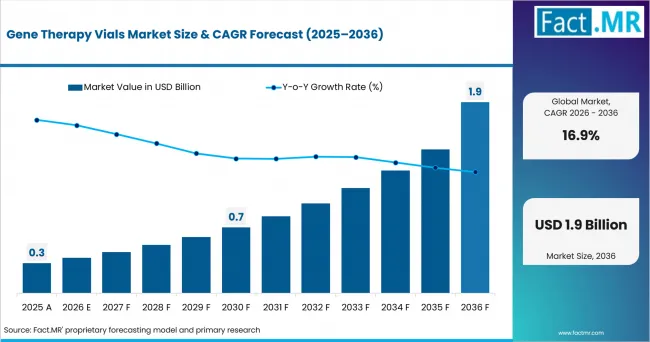
Gene Therapy Vials Market Market Value Analysis | Source: Fact.MR
What are the defining numbers behind gene therapy vial growth?
USD 1.5 billion absolute opportunity by 2036 led by the United States and Germany.
- Demand Drivers in the Market
- Gene therapy commercialization continues expanding worldwide.
- Viral vector production is increasing.
- Clinical trial activity continues rising.
- Advanced biologic manufacturing requires specialized sterile packaging.
- Key Segments Analyzed
- By Vial Material: Type I Borosilicate Glass is expected to hold 42.0% share in 2026 because it provides excellent chemical stability.
- By Capacity: 2-5 ml is projected to account for 36.0% share in 2026 because it suits most commercial gene therapy products.
- By Thermal Profile: Frozen Storage is expected to hold 34.0% share in 2026 because many gene therapies require controlled cold storage.
- By Application: AAV Vectors are projected to account for 38.0% share in 2026 because they remain the leading gene delivery platform.
- By Geography: The United States is projected to record 17.5% CAGR through 2036.
- Analyst Opinion at Fact.MR
- Shambhu Nath Jha, Senior Analyst at Fact.MR, states, "Gene therapy vials have become essential for protecting high-value biologic products. Advanced vial technologies improve product stability throughout manufacturing, storage and distribution. Growing commercialization of gene therapies will continue supporting demand for high-performance pharmaceutical packaging."
- Strategic Implications
- Expand production of ready-to-use sterile vials.
- Develop packaging with improved cold storage performance.
- Strengthen partnerships with gene therapy manufacturers.
Gene therapy vials are sterile primary packaging containers designed to preserve sensitive biologic products. They maintain product stability during storage, transportation and clinical administration.
The United States is projected to record 17.5% CAGR through 2036 because gene therapy manufacturing continues expanding. Germany is expected to grow at 17.1% CAGR due to strong pharmaceutical packaging capabilities. China is forecast to expand at 16.7% CAGR as biotechnology investment increases. Japan is projected to register 16.3% CAGR through 2036 because advanced therapy development continues growing. South Korea is expected to grow at 15.9% CAGR due to increasing investment in viral vector manufacturing.
How does the gene therapy vials market break down by segment?
Type I Borosilicate Glass leads at 42.0%. AAV Vectors lead at 38.0%.
Which vial material dominates?
Type I Borosilicate Glass holds 42.0% share in 2026.
Type I borosilicate glass leads because it provides excellent chemical resistance and high thermal stability. It protects sensitive gene therapy products during storage and transportation. Manufacturers prefer this material because it minimizes product interaction. It also supports long-term pharmaceutical stability. Demand remains strong across commercial gene therapy manufacturing. West Pharmaceutical introduced Daikyo Crystal Zenith® (CZ) Ready-to-Use Nested Vials at the ISCT Annual Meeting. The polymer vials were specifically promoted for cell and gene therapies, offering cryogenic-temperature container closure integrity, viral vector compatibility, and break resistance. [1]
Which capacity dominates?
2-5 ml accounts for 36.0% share in 2026.
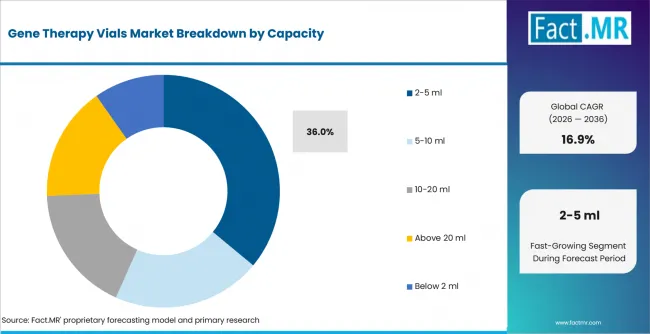
Gene Therapy Vials Market Analysis By Capacity | Source: Fact.MR
The 2-5 ml segment accounts for the largest share because it matches the dosage requirements of many gene therapy products. It also supports efficient clinical handling. Manufacturers select this size because it reduces product waste. It also improves dosing accuracy during administration. Demand continues increasing across commercial production. Stevanato Group launched the EZ-fill® Kit, providing ready-to-use vial formats for clinical and commercial development of advanced injectable therapies, including gene therapies. The solution is designed to accelerate fill-finish activities and reduce time-to-market. [2]
Which thermal profile dominates?
Frozen Storage holds 34.0% share in 2026.
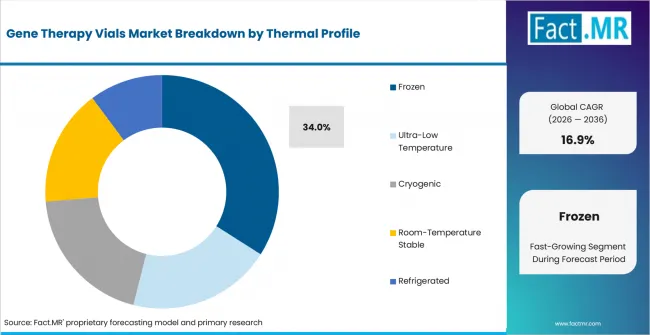
Gene Therapy Vials Market Analysis By Thermal Profile | Source: Fact.MR
Frozen storage leads because many viral vectors require controlled low-temperature preservation. Stable storage conditions help maintain therapeutic performance. Manufacturers depend on frozen storage throughout distribution. It also supports longer product shelf life. Demand remains high across regulated manufacturing facilities. Nipro PharmaPackaginglaunched D2F™ (Direct-to-Fill) glass vials utilizing Stevanato Group's EZ-fill® technology. The ready-to-use vial platform is intended for sterile injectable drugs, including advanced biologics and gene therapy products requiring high-quality containment systems. [3]
Which application dominates?
AAV Vectors lead with 38.0% share in 2026.
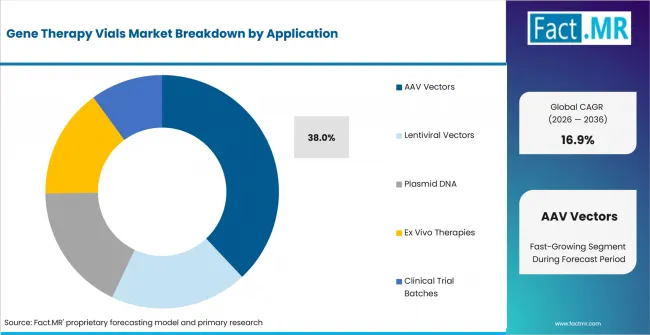
Gene Therapy Vials Market Analysis By Application | Source: Fact.MR
AAV vectors remain the leading application because they are widely used in commercial gene therapies. Their strong clinical adoption supports continuous vial demand. High-value biologic products require reliable sterile packaging. Specialized vials help maintain product quality during storage and transport. Commercial approvals continue supporting market expansion. West introduced Daikyo PLASCAP® Ready-to-Use Validated (RUV) closures in a new nested format compatible with 13 mm and 20 mm vial formats. The company stated the launch was intended to support advanced therapies, including rapidly growing cell and gene therapy applications. [4]
What is accelerating gene therapy vial demand and what is holding it back?
Gene therapy commercialization drives demand while packaging qualification restrains adoption.
The primary growth driver is expanding commercial gene therapy production. Manufacturers continue increasing investment in viral vector manufacturing. Clinical trial activity also creates strong demand for sterile vial systems. Growth in advanced biologics continues supporting market expansion.
Ready-to-use packaging improves manufacturing efficiency. It also reduces contamination risk. The primary restraint is higher packaging cost. Advanced sterile vial systems require specialized manufacturing processes. Qualification and regulatory approval also increase development time. Smaller developers may delay adoption because of budget limitations.
Where do the biggest gene therapy vial opportunities sit?
- Commercial Gene Therapy
- Commercial manufacturing continues expanding across global biotechnology companies. This creates strong demand for sterile vial systems.
- Viral Vector Manufacturing
- AAV and lentiviral production continue increasing. High-performance packaging remains essential for product stability.
- Clinical Trial Supply
- Clinical development continues expanding worldwide. Sterile vials support reliable storage and transportation.
- CDMO Manufacturing
- Contract manufacturers continue increasing production capacity. Ready-to-use vials improve manufacturing flexibility.
Which countries are scaling gene therapy vial adoption fastest?
United States 17.5%, Germany 17.1%, China 16.7%, Japan 16.3%, South Korea 15.9%.
Based on regional analysis the gene therapy vials market is segmented into North America, Western Europe, Asia Pacific, Latin America and Middle East & Africa.
| Country | CAGR (2026-2036) |
|---|---|
| United States | 17.5% |
| Germany | 17.1% |
| China | 16.7% |
| Japan | 16.3% |
| South Korea | 15.9% |
Source: Fact.MR analysis. Updated Jun 26, 2026
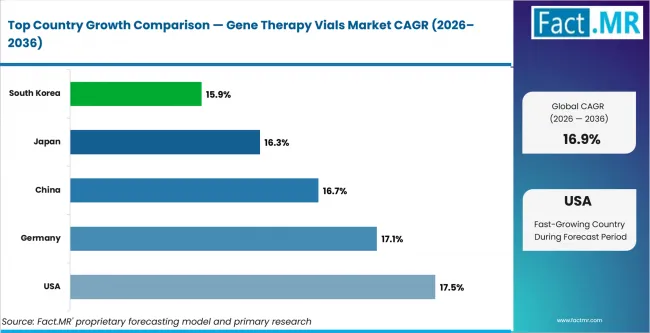
Gene Therapy Vials Market Cagr Analysis By Country | Source: Fact.MR
What makes the United States the largest market for gene therapy vials?
17.5% CAGR, supported by commercial gene therapy manufacturing
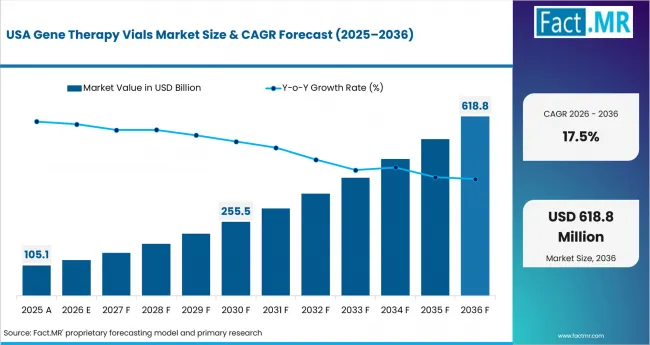
Gene Therapy Vials Market Country Value Analysis | Source: Fact.MR
The United States is projected to record 17.5% CAGR through 2036 because commercial gene therapy manufacturing continues expanding. Companies are increasing investment in viral vector production and sterile fill-finish capacity. Clinical trial activity also continues growing. Demand for high-performance pharmaceutical packaging is increasing across approved gene therapy products.
How is Germany strengthening pharmaceutical vial manufacturing?
17.1% CAGR, driven by pharmaceutical packaging expertise
Germany is expected to post 17.1% CAGR by 2036 because pharmaceutical packaging technology continues advancing. Manufacturers are expanding production of high-quality sterile vial systems. Gene therapy developers continue increasing commercial manufacturing. CDMOs also continue investing in sterile packaging capacity. Germany remains a leading pharmaceutical packaging hub.
Why is China becoming a major hub for gene therapy packaging?
16.7% CAGR, backed by biotechnology investment
China is forecast to advance at 16.7% CAGR through 2036 because biotechnology investment continues increasing. Manufacturers are expanding viral vector production and advanced therapy facilities. Demand for sterile pharmaceutical vials is rising. Growth in domestic gene therapy programs also supports market expansion. The country remains an important market for advanced biologics.
What factors are supporting Japan's market expansion?
16.3% CAGR, supported by regenerative medicine innovation
Japan is projected to register 16.3% CAGR through 2036 because regenerative medicine research continues expanding. Companies are increasing investment in advanced gene therapy development. Commercial manufacturing capacity continues growing. High-quality vial systems remain essential for product stability. The country continues strengthening its position in advanced therapies.
How is South Korea accelerating demand for sterile vial systems?
15.9% CAGR, driven by biologics investment
South Korea is expected to grow at 15.9% CAGR by 2036 because biotechnology manufacturing continues expanding. Companies are increasing production of viral vectors and advanced biologics. Demand for sterile vial systems continues rising. Government support also encourages innovation across advanced therapy manufacturing. The country continues strengthening its global biotechnology industry.
Who leads the Gene Therapy Vials landscape?
SCHOTT Pharma, Gerresheimer, Stevanato Group, SGD Pharma and Nipro PharmaPackaginglead through pharmaceutical packaging expertise and sterile vial manufacturing capabilities.
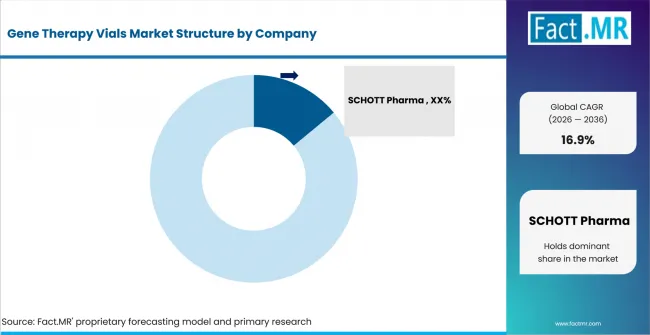
Gene Therapy Vials Market Analysis By Company | Source: Fact.MR
The market remains moderately consolidated. Competition focuses on container integrity and pharmaceutical compatibility. Manufacturers continue improving vial materials to enhance product stability. They are also introducing ready-to-use sterile formats that simplify filling operations and reduce contamination risk.
Gene therapy manufacturers account for the largest share of demand. CDMOs continue increasing purchases as commercial manufacturing and clinical development expand. Rising investment in viral vector production is also supporting demand for high-performance primary packaging. AAV vector manufacturing remains the leading application. Lentiviral vector production also generates steady demand across commercial facilities and research organizations. Expansion of advanced therapy pipelines continues creating new opportunities for sterile vial suppliers. West Pharmaceutical Services continue expanding their sterile packaging portfolios through material innovation and production capacity investment.
SCHOTT Pharma and Gerresheimer maintain strong positions through advanced pharmaceutical glass technologies. Competition will increasingly depend on product quality and regulatory compliance. Companies that provide validated sterile vial systems, reliable global supply and strong technical support are expected to strengthen their market position.
Which companies are the key players?
SCHOTT Pharma, Gerresheimer, Stevanato Group, SGD Pharma, Nipro PharmaPackaging
- SCHOTT Pharma
- Gerresheimer
- Stevanato Group
- SGD Pharma
- Nipro PharmaPackaging
- West Pharmaceutical Services
Bibliography
- [1] West Pharmaceutical Services, Inc. (2024, May 29). West introduces Daikyo Crystal Zenith® Ready-to-Use Nested Vials in Tub at the International Society for Cell & Gene Therapy. West Pharmaceutical Services.
- [2] Stevanato Group. (2024, January 24). Stevanato Group launches EZ-fill® Kit and laboratory fill and finish service to support small batch drug development and commercialization. Stevanato Group.
- [3] Nipro Corporation. (2024, October 7). Nipro launches D2F™ glass vials powered by Stevanato Group’s EZ-fill® technology. Nipro Corporation.
- [4] West Pharmaceutical Services, Inc. (2025, January 22). West introduces Daikyo PLASCAP® RUV closures in new nested format at Pharmapack. West Pharmaceutical Services.
This Report Addresses
- Strategic intelligence on sterile vial technologies for gene therapy.
- Segment analysis covering vial materials, capacities and thermal profiles.
- Assessment of viral vector applications and packaging demand.
- Regional outlook covering the United States, Germany, China, Japan and South Korea.
- Competitive assessment of leading pharmaceutical packaging manufacturers.
- Analysis of gene therapy manufacturing and commercial production trends.
- Evaluation of sterile fill-finish and cold chain packaging requirements.
- Primary interviews and supplier benchmarking supporting market estimates.
- Assessment of packaging innovation for advanced biologic products.
- Analysis of opportunities across commercial gene therapy manufacturing.
What does the gene therapy vials market cover?
Sterile vial systems designed for gene therapy storage and delivery.
The market covers pharmaceutical vials used for viral vectors, plasmid DNA, and advanced gene therapy products. These vials support commercial manufacturing and clinical development.
What is included in the scope?
High-performance sterile vial technologies.
The scope includes Type I borosilicate glass, coated glass, polymer vials, COC/COP vials and ready-to-use sterile vials.
What is excluded from the scope?
Conventional pharmaceutical bottles and laboratory containers.
The scope excludes standard medicine bottles, diagnostic sample containers and non-sterile laboratory glassware.
How was the analysis built?
100+ sources, 30+ company assessments, 25+ countries and industry interviews.
- Primary Research:
- Interviews with pharmaceutical packaging suppliers, gene therapy manufacturers and life science specialists.
- Desk Research:
- Analysis of gene therapy development, viral vector manufacturing and pharmaceutical packaging trends.
- Market Sizing and Forecasting:
- Estimates based on commercial gene therapy production, clinical pipeline activity and sterile packaging demand.
- Data Validation and Update Cycle:
- Forecasts validated through supplier benchmarking and industry interviews.
Segmentation
What is the report's scope and coverage?
| Attribute | Details |
|---|---|
| Quantitative Units | USD Billion in 2026 to USD Billion by 2036 |
| Market Definition | Covers sterile pharmaceutical vials designed for gene therapy manufacturing and storage |
| Vial Materials Covered | Type I Borosilicate Glass, Coated Glass, Polymer Vials, COC/COP Vials, Ready-to-Use Vials |
| Capacities Covered | Below 2 ml, 2-5 ml, 5-10 ml, 10-20 ml, Above 20 ml |
| Thermal Profiles Covered | Refrigerated, Frozen, Ultra-Low Temperature, Cryogenic, Room-Temperature Stable |
| Applications Covered | AAV Vectors, Lentiviral Vectors, Plasmid DNA, Ex Vivo Therapies, Clinical Trial Batches |
| Regions Covered | North America, Western Europe, Asia Pacific, Latin America, Middle East & Africa |
| Key Countries Covered | United States, Germany, China, Japan, South Korea |
| Companies Covered | SCHOTT Pharma, Gerresheimer, Stevanato Group, SGD Pharma, Nipro PharmaPackaging, West Pharmaceutical Services |
| Forecast Period | 2026 to 2036 |
| Research Approach | Hybrid top-down and bottom-up methodology using gene therapy manufacturing, sterile packaging demand and pharmaceutical production analysis. |
Source: Fact.MR analysis. Updated Jun 26, 2026
How is the market categorized?
-
By Vial Material
- Type I Borosilicate Glass
- Coated Glass
- Polymer Vials
- COC/COP Vials
- Ready-to-Use Vials
-
By Capacity
- Below 2 ml
- 2-5 ml
- 5-10 ml
- 10-20 ml
- Above 20 ml
-
By Thermal Profile
- Refrigerated
- Frozen
- Ultra-Low Temperature
- Cryogenic
- Room-Temperature Stable
-
By Application
- AAV Vectors
- Lentiviral Vectors
- Plasmid DNA
- Ex Vivo Therapies
- Clinical Trial Batches
-
Region:
- North America
- United States
- Canada
- Europe
- Germany
- United Kingdom
- France
- Italy
- Spain
- Asia Pacific
- China
- Japan
- South Korea
- India
- Singapore
- Latin America
- Brazil
- Mexico
- Argentina
- Middle East & Africa
- GCC Countries
- South Africa
- Israel
- North America
Frequently Asked Questions
What is the leading vial material?
Why does the 2-5 ml capacity segment account for the largest share?
What factors are driving market growth?
Which country is projected to grow the fastest?
What is the biggest challenge facing manufacturers?
Which application generates the highest demand?
Why are ready-to-use sterile vials gaining popularity?
Who worked on this report


Preview the report firsthand - request a free sample
Free SampleGet the brochure for pricing and purchase details
Download PDF