- Market Value (2025): USD 2945.4 Mn
- Estimated Value (2026): USD 3066.2 Mn
- Forecast Value (2036): USD 4804.7 Mn
- CAGR (2026-2036): 4.1%
What is the Crab Sticks Market forecast to be worth by 2036?
USD 3066.2 million in 2026 to USD 4804.7 million by 2036, at a 4.1% CAGR.
- The market reached USD 2945.4 million in 2025.
- Demand is projected to increase from USD 3066.2 million in 2026 to USD 4804.7 million by 2036.
- The market is forecast to record a 4.1% CAGR from 2026 to 2036, creating an absolute opportunity of USD 1738.5 million.
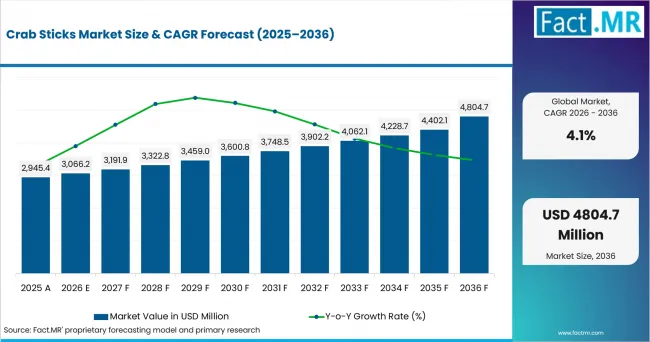
Crab Sticks Market Value Analysis | Source: Fact.MR
What are the defining numbers behind Crab Sticks Market growth?
USD 1738.5 million absolute opportunity is expected between 2026 and 2036.
- Demand Drivers in the Market
- Ready-to-use seafood formats help foodservice operators add seafood taste to sushi rolls, salads, sandwiches and buffet lines without handling whole crab.
- Surimi-based products give buyers a lower-cost alternative to shellfish while still delivering a familiar seafood colour, texture, and portion shape.
- Chilled and frozen distribution helps crab sticks reach retailers, caterers, and quick-service food outlets with fewer preparation steps.
- Raw material availability, freezing performance, labelling clarity and cold-chain discipline still decide supplier preference because texture loss or poor thaw stability is visible to the end user.
- Key Segments Analyzed
- By Type: Fresh Food is the leading type, accounting for 32.2% share in 2026.
- By Sales Channel: Online Retail leads with 56.6% share in 2026.
- Analyst Opinion at Fact.MR
- Crab sticks are bought for practical reasons: predictable cost, ready-to-use handling, consistent texture and a seafood profile that works in high-throughput food preparation. The winning suppliers will be the ones that make surimi quality, allergen labelling, pack sizing and chilled or frozen logistics easier for caterers and retailers to trust. Shambhu Nath Jha, Sr. Consultant, Fact.MR.
- Strategic Implications
- Foodservice buyers should treat thaw stability, slice integrity, and yield as purchasing criteria as well as not just price per kilogram.
- Suppliers can differentiate by giving clear usage guidance for sushi, salads, ready meals as well as catering trays and retail chilled packs.
- Retail and catering expansion depends on cold-chain reliability and honest labelling because crab sticks are often purchased as a convenient seafood substitute.
The UK and Australia jointly record the highest country CAGR at 6.2%. The USA is projected at 5.0%, while Canada advances at 5.3%, while Germany expands at 3.9% through 2036.
How does the Crab Sticks Market break down by segment?
Fresh Food leads Type with 32.2% share and Online Retail leads Sales Channel with 56.6% share in 2026.
Why does Fresh Food lead Type?
Fresh Food is projected to account for 32.2% share in 2026.
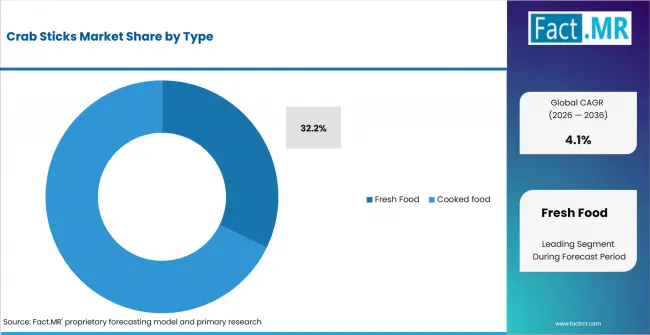
Crab Sticks Market Analysis By Type | Source: Fact.MR
Fresh Food leads because crab sticks are often bought for immediate use in chilled counters, sushi cabinets, deli salads as well as seafood mixes and ready-to-assemble meals. The product already carries the shape, colour, and cooked seafood profile buyers need. Retailers and caterers can sell it without asking consumers to cook or prepare shellfish. Frozen and cooked formats still matter, especially for inventory control, but fresh and chilled presentation keeps the product visible in the parts of the store and foodservice menu where convenience drives the purchase.
Why does Online Retail lead Sales Channel?
Online Retail is projected to account for 56.6% share in 2026.
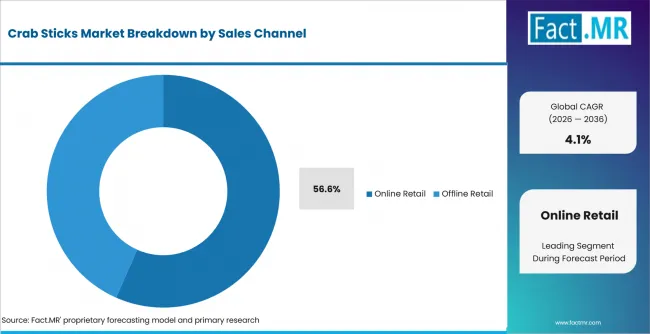
Crab Sticks Market Analysis By Sales Channel | Source: Fact.MR
Online Retail accounts for the largest share within the assessed sales-channel split. It gives buyers access to pack-size comparisons, product information, and home delivery. Offline Retail remains relevant through supermarkets, chilled counters, and physical specialty stores.
What is accelerating Crab Sticks Market adoption, and what is holding it back?
Adoption is being supported by the shift toward convenient seafood proteins, but growth is still checked by raw fish supply, cold-chain cost as well as allergen concerns and price competition from other prepared proteins.
Drivers Impact Analysis
| DRIVER | (~) % IMPACT ON CAGR | GEOGRAPHIC RELEVANCE | IMPACT TIMELINE |
|---|---|---|---|
| Prepared seafood demand | +1.0% | Australia, UK and Canada | Short term (<= 2 years) |
| Price accessibility | +0.8% | Global sourcing and import-dependent markets | Short term (<= 2 years) |
| Foodservice utility | +0.6% | Australia, UK and Canada | Medium term (2-4 years) |
| Distribution readiness | +0.5% | Australia, UK and Canada | Medium term (2-4 years) |
Source: Fact.MR analysis. Updated Aug 5, 2026
- Prepared seafood demand: Crab sticks let operators add seafood flavour to menus without whole-shellfish preparation.
- Price accessibility: Surimi-based products make crab-style applications possible at a lower and more predictable cost than real crab.
- Foodservice utility: The product works across sushi, salads, sandwiches as well as catering trays and ready meals.
- Distribution readiness: Chilled and frozen packs allow suppliers to serve both retail shelves and high-volume kitchens.
Opportunity Impact Analysis
| OPPORTUNITY | (~) % IMPACT ON CAGR | GEOGRAPHIC RELEVANCE | IMPACT TIMELINE |
|---|---|---|---|
| Foodservice performance proof | +0.7% | Australia, UK and Canada | Medium term (2-4 years) |
| Convenience retail formats | +0.5% | Australia, UK and Canada | Medium term (2-4 years) |
| Market-specific expansion | +0.4% | Canada, USA and Germany | Long term (>= 4 years) |
Source: Fact.MR analysis. Updated Aug 5, 2026
- Suppliers can build stronger foodservice accounts by proving yield, thaw performance, slice integrity and allergen controls.
- Retail growth remains open in meal kits, chilled prepared meals, seafood snack packsand sushi-at-home formats.
- Country expansion can lean on Asian-food retail, convenience seafood, and lower-cost protein positioning rather than treating crab sticks as a premium shellfish product.
Restraints Impact Analysis
| RESTRAINT | (~) % IMPACT ON CAGR | GEOGRAPHIC RELEVANCE | IMPACT TIMELINE |
|---|---|---|---|
| Surimi supply and pricing | -0.7% | Global sourcing and import-dependent markets | Short term (<= 2 years) |
| Allergen-control complexity | -0.6% | UK, Canada and USA | Short term (<= 2 years) |
| Imitation-seafood perception | -0.5% | Established and price-sensitive markets | Medium term (2-4 years) |
| Cold-chain and shelf-life risk | -0.3% | USA, Germany and Australia | Medium term (2-4 years) |
Source: Fact.MR analysis. Updated Aug 5, 2026
- Surimi raw material availability and whitefish pricing can tighten margins.
- Fish, shellfish, egg as well as wheat and starch-related allergen issues require careful labelling and supplier discipline.
- Consumers who equate crab sticks with imitation seafood may trade down only when the price and convenience case is clear.
- Cold-chain and shelf-life management are critical because texture loss quickly weakens repeat purchasing.
Which countries are scaling the Crab Sticks Market fastest?
Country growth rates differ from the global 4.1% CAGR. The UK and Australia share the fastest listed pace, while the USA and Canada sit comfortably above the global rate. Germany is closer to the global average because processed seafood is already well established there.
- The UK records 6.2% CAGR.
- Australia also records 6.2% CAGR.
- The USA records 5.0% CAGR.
- Canada advances at 5.3% CAGR.
- Germany expands at 3.9% CAGR.
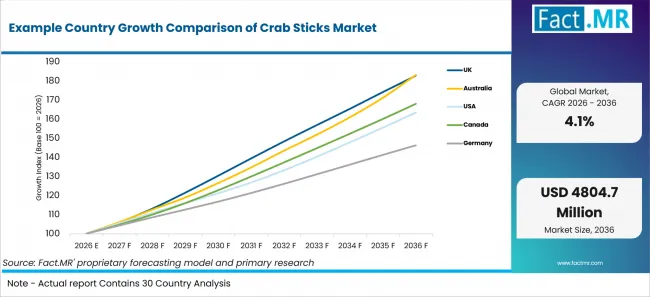
Example Country Growth Comparison Of Crab Sticks Market | Source: Fact.MR
| Country | CAGR, 2026 to 2036 |
|---|---|
| UK | 6.2% |
| Australia | 6.2% |
| USA | 5.0% |
| Canada | 5.3% |
| Germany | 3.9% |
Source: Fact.MR analysis. Updated Aug 5, 2026
What is driving the UK's growth through 2036?
The UK is forecast to grow at 6.2% CAGR through 2036.
Growth is supported by chilled retail, sushi counters, sandwich fillings as well as seafood salads and prepared-meal usage rather than by fresh crab demand alone. Seafish has continued to frame UK seafood consumption around affordability, ease of use, and the need to keep seafood relevant in everyday meals. Crab sticks fit that brief because they offer a low-preparation seafood option that can be sold through supermarkets, convenience chilled cabinets, and caterers serving cold platters or sushi-style formats.
What is driving Australia's growth through 2036?
Australia is also forecast to grow at 6.2% CAGR through 2036.
The key point is import dependence. The Australian Government has estimated that 62% of edible seafood consumed in Australia by weight is imported, with Asia an important source region. That matters for crab sticks because surimi and imitation crab products travel well as frozen or chilled processed seafood. Australia therefore has room for growth through sushi retail, Asian grocery, takeaway food and catering channels without needing local crab supply to scale at the same rate.
What is driving the USA's growth through 2036?
The USA is projected to expand at 5.0% CAGR through 2036.
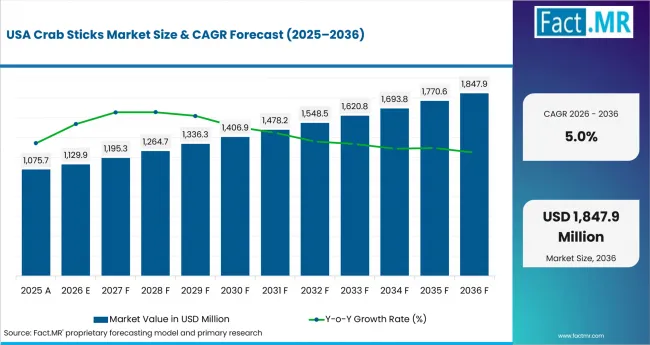
Crab Sticks Market Country Value Analysis | Source: Fact.MR
Growth is helped by a large seafood market, established Alaska pollock and surimi supply routes, and broad foodservice use in sushi as well as seafood salads as well as deli cases and prepared meals. NOAA Fisheries tracks U.S. seafood trade and consumption through its Fisheries of the United States reporting, and the scale of the U.S. market gives crab sticks more channel depth than smaller countries. The growth rate is below the UK and Australia because the product is already familiar and competes against a wide set of seafood and protein options.
What is driving Canada's growth through 2036?
Canada is forecast to grow at 5.3% CAGR through 2036.
The country has strong seafood awareness, but crab sticks grow through convenience and price positioning rather than through premium seafood occasions. Statistics Canada reported annual sales of food services and drinking places at CAD 101.4 billion in 2025, up 5.6% from 2024, which supports repeat demand from restaurants as well as caterers and prepared-food operators. Fish and seafood demand also benefits from population growth and foodservice recovery, giving imitation crab a route into sushi, salads and cold meal components.
What is driving Germany's growth through 2036?
Germany is forecast to expand at 3.9% CAGR through 2036.
The market is steady because Germany is one of Europe’s major processed seafood consumers. EUMOFA has identified Germany as a large market within EU processed fish and seafood consumption, but this also means the category is mature. Crab sticks can keep growing through chilled retail and convenience seafood, yet the pace is lower because household seafood demand is more price-sensitive and established alternatives already occupy shelf space.
Who leads the Crab Sticks Market?
Tesco is the largest named company in the assessed set, with 10.1% share. Other listed participants are ASDA, Hokkaido, Asian Star Ichiban and Kibun Sea Stix.
Competition is shaped by processing reliability, surimi sourcing, cold-chain reach as well as pack formats and foodservice relationships. Buyers compare suppliers on texture consistency, allergen management, slice or stick integrity and whether the product performs in sushi as well as salads as well as buffets and ready meals.
Which companies are the key providers?
Key companies include Tesco; ASDA; Hokkaido; Asian Star Ichiban; Kibun Sea Stix; Sevensea; Smartcrab; Takeda; Tokai; Sajo; Liray; Lohaco; Morefood; Shimanto; and Osaki Suisan.
- Tesco
- ASDA
- Hokkaido
- Asian Star Ichiban
- Kibun Sea Stix
- Sevensea
- Smartcrab
- Takeda
- Tokai
- Sajo
- Liray
- Lohaco
- Morefood
- Shimanto
- Osaki Suisan
Bibliography
- Australian Government Department of Agriculture, Fisheries and Forestry. (2023, May 24). Australia’s seafood trade.
- Codex Alimentarius Commission. (2020). Code of practice for fish and fishery products. Codex Alimentarius.
- European Commission. (2024, December 12). EU Fish Market report 2024 reveals trends and insights.
- European Market Observatory for Fisheries and Aquaculture Products. (n.d.). Case study: Surimi in the EU.
- Fisheries and Oceans Canada. (2018, November 7). Outlook to 2027 for Canadian fish and seafood.
- NOAA Fisheries. (2026, March 3). Fisheries of the United States, 2023.
- OECD and FAO. (2025). Fish and other aquatic products: OECD-FAO Agricultural Outlook 2025-2034.
- Seafish. (2024). Fish as Food 2024 Update.
- Statistics Canada. (2026, February 25). Food services and drinking places, December 2025.
This Report Answers
- The report provides strategic intelligence on the Crab Sticks Market across Type and Sales Channel choices that shape prepared-seafood selection and retail placement.
- Segment analysis covers Fresh Food and Online Retail as the share leaders within the 2026 market.
- Country outlook evaluates the UK and Australia alongside the USA and Canada. Germany completes the growth comparison across the profiled markets.
- Competitive analysis profiles Tesco and ASDA alongside Hokkaido and Asian Star Ichiban. Kibun Sea Stix completes the provider view.
- Channel assessment covers Online Retail and Offline Retail. Product-format review covers Fresh Food and Cooked food.
What does the Crab Sticks Market cover?
The market covers crab sticks and related surimi-based seafood products sold across the defined type, sales-channel, and regional categories.
What is included in the scope?
The scope includes fresh and cooked crab stick formats, plus Online Retail and Offline Retail sales channels where the product is sold as a ready-to-use seafood ingredient or finished prepared-food component.
What is excluded from the scope?
Whole crab, live shellfish, unrelated fish fillets and products outside the defined type as well as sales-channel and regional categories are excluded.
How Was the Analysis Built?
The analysis combines desk research, company and product mapping, expert validation. Demand-side checks across major regions.
- Primary Research: Interviews with buyers, suppliers, foodservice users as well as distributors and category specialists test purchasing criteria as well as operating constraints as well as adoption barriers and replacement behavior.
- Desk Research: Public fisheries data, food standards, trade information as well as company literature and official seafood-market publications establish market boundaries and demand context.
- Market Sizing and Forecasting: Demand indicators, channel participation, foodservice use as well as retail placement and supplier presence are reconciled across top-down and bottom-up views.
- Data Validation and Update Cycle: Findings are cross-checked across independent evidence routes and reviewed when material market, regulatory, or company changes occur.
Segmentation
What is the report's scope and coverage?
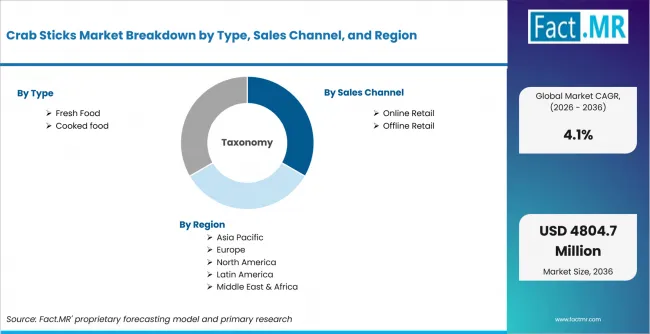
Crab Sticks Market Breakdown By Type, Sales Channel, And Region | Source: Fact.MR
| Attribute | Details |
|---|---|
| Quantitative Units | USD Million |
| Market Definition | Crab sticks and related surimi-based seafood products across the assessed categories |
| Type | Fresh Food; Cooked food |
| Sales Channel | Online Retail; Offline Retail |
| Regions Covered | North America; Latin America; Europe; East Asia; South Asia & Oceania; Middle East & Africa |
| Countries Covered | UK; Australia; USA; Canada; Germany |
| Key Companies Profiled | Tesco; ASDA; Hokkaido; Asian Star Ichiban; Kibun Sea Stix; Sevensea; and others |
| Forecast Period | 2026 to 2036 |
| Approach | Hybrid top-down and bottom-up market assessment |
Source: Fact.MR analysis. Updated Aug 5, 2026
How is the market segmented?
-
By Type:
- Fresh Food
- Cooked food
-
By Sales Channel:
- Online Retail
- Offline Retail
-
By Region:
- North America
- USA
- Canada
- Latin America
- Europe
- Germany
- UK
- East Asia
- South Asia & Oceania
- Australia
- Middle East & Africa
- North America
Frequently Asked Questions
How big is the Crab Sticks Market in 2026?
What is the CAGR of the Crab Sticks Market from 2026 to 2036?
Which type leads the Crab Sticks Market?
How much will the Crab Sticks Market add between 2026 and 2036?
Who are the leading companies in the Crab Sticks Market?
Who worked on this report


Preview the report firsthand - request a free sample
Free SampleGet the brochure for pricing and purchase details
Download PDF