- Base Value(2026): 16.2 Bn
- Forecast Value (2036): 26.8 Bn
- CAGR (2036): 5.1%
Destination Wedding Market Forecast and Outlook By Fact.MR
The destination wedding market reached USD 15.4 billion in 2025. Fact MR estimates the market will expand to USD 16.2 billion in 2026 and attain USD 26.8 billion by 2036. The market is forecast to register a CAGR of 5.1% across the assessment period.
A CAGR of 5.1% indicates steady, incremental expansion with moderate variability linked to discretionary spending sensitivity and cyclical travel demand patterns. Growth remains supported by increasing preference for experiential ceremonies and bundled hospitality services, while volatility persists due to macroeconomic uncertainty, foreign exchange exposure, and regulatory requirements related to international event documentation and venue compliance.
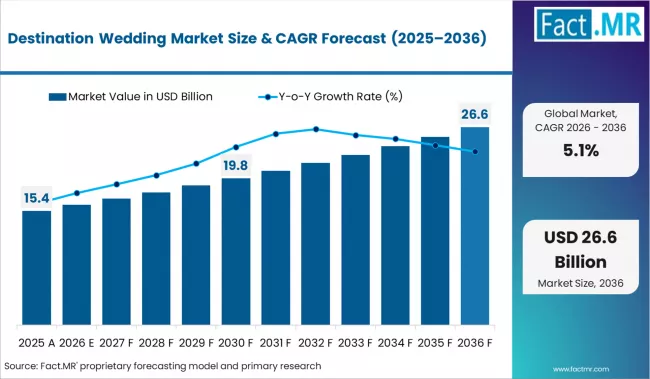
Destination Wedding Market Market Value Analysis | Source: Fact.MR
| Metric | Details |
|---|---|
| Industry Size (2026E) | USD 16.2 billion |
| Industry Value (2036F) | USD 26.8 billion |
| CAGR (2026 to 2036) | 5.1% |
Source: Fact.MR analysis. Updated Mar 30, 2026
India leads with a projected CAGR of 6.4%, supported by rising preference for experiential wedding formats across heritage and resort venues. Mexico follows with a CAGR of 5.8%, driven by strong availability of coastal wedding venues and established event service ecosystems. The United Kingdom records a CAGR of 5.3%, reflecting steady demand for international ceremony locations among outbound couples. Italy shows a CAGR of 5.1%, supported by consistent selection of historical venues for premium wedding events. The United States records the slowest growth at 4.2%, reflecting a mature market where demand is largely tied to replacement planning cycles within established wedding service networks. Mature markets generate a significant share of replacement demand as event expenditure remains stable and venue selection patterns show limited structural change across developed wedding service industries.
Summary of the Destination Wedding Market
- Market Definition
- The market includes wedding ceremonies conducted outside the couple residence location, typically organized in travel destinations such as beach resorts, heritage venues, mountain locations, and vineyards. Destination wedding services include venue booking, accommodation arrangements, catering, photography, planning coordination, and guest management, combining hospitality services with event management.
- Demand Drivers
- Increasing preference for experience oriented wedding formats combining travel and ceremonial events
- Expansion of resort infrastructure offering integrated wedding service packages
- Growth in professional wedding planning services supporting logistics coordination across international venues
- Rising demand for customized wedding experiences including themed ceremonies and multi day event itineraries
- Key Segments Analyzed
- Guest Size: Medium sized weddings lead with approximately 45% share supported by balanced cost allocation and manageable logistics
- Venue Type: Beach resorts account for nearly 35% share due to availability of integrated hospitality infrastructure
- Service Category: Venue and accommodation services represent core spending components across destination wedding planning
- Geography: Asia Pacific demonstrates relatively higher growth supported by expansion of resort and heritage venue infrastructure
- Analyst Opinion at Fact MR
- Shambhu Nath Jha, Principal Consultant, Fact MR, opines, "In this updated edition of the Destination Wedding Market report, industry participants will observe stable demand linked to integration of hospitality services and event planning capabilities across travel destinations. Destination weddings continue to combine ceremony arrangements with tourism experiences across resort and heritage venues. Companies that strengthen service integration, venue partnerships, and customized event coordination capabilities are expected to maintain competitive positioning through 2036."
- Strategic Implications/Executive Takeaways
- Strengthen partnerships with resort operators and hospitality providers supporting bundled wedding service offerings
- Expand customized planning capabilities aligned with themed ceremonies and multi day event formats
- Optimize pricing structures balancing guest size, venue selection, and service package integration
- Improve coordination across travel agencies, event planners, and accommodation providers supporting streamlined logistics
- Methodology
- Primary interviews conducted with wedding planners, hospitality providers, travel agencies, and event coordinators
- Desk research based on tourism publications, hospitality datasets, company reports, and travel industry statistics
- Market sizing derived using a hybrid approach combining bottom up service revenue analysis with top down wedding tourism demand assessment
- Data validation performed through cross verification with tourism and hospitality datasets and internal peer review aligned with Fact MR standards
Segmental Analysis
Destination Wedding Market Analysis by Guest Size
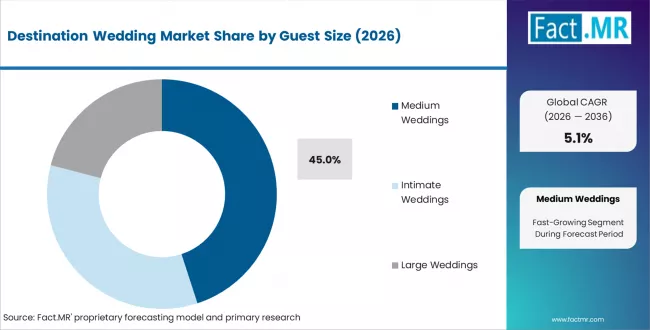
Destination Wedding Market Analysis By Guest Size | Source: Fact.MR
- Market Overview: Based on Fact MR assessment, medium sized weddings are projected to account for 45% share of the destination wedding market in 2026. Guest counts within medium scale events are typically structured to balance event personalization requirements with manageable logistics planning complexity. Event planners and hospitality providers allocate resources toward venue coordination, catering services, and accommodation blocks suited for moderately sized guest groups. Demand concentration is influenced by cost allocation efficiency across travel arrangements, venue booking capacity, and event service customization requirements aligned with structured wedding itineraries.
- Demand Drivers:
- Budget Allocation Efficiency: Medium sized wedding formats enable structured distribution of expenditure across venue services, hospitality arrangements, and event management coordination requirements.
- Guest Management Practicality: Event organizers prefer manageable attendee volumes allowing coordination of accommodation, transportation, and scheduling logistics across destination locations.
- Venue Capacity Alignment: Hospitality venues frequently structure event packages optimized for mid range guest volumes supporting operational efficiency across catering and event staffing allocation.
Destination Wedding Market Analysis by Venue Type
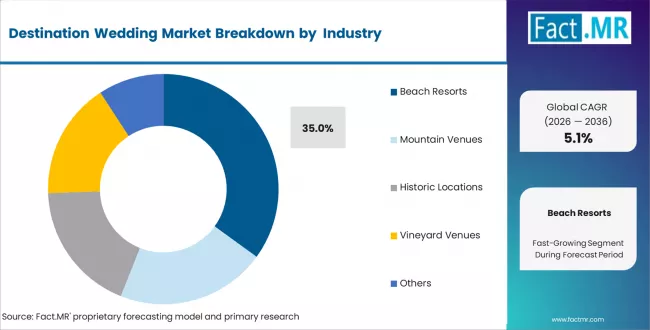
Destination Wedding Market Analysis By Venue Type | Source: Fact.MR
- Market Overview: Beach resort venues are estimated to hold 35% share of the destination wedding market in 2026, supported by preference for coastal locations offering integrated accommodation and event hosting infrastructure. Beach resort properties provide bundled event service capabilities including ceremony arrangements, guest lodging, catering services, and leisure facilities within a single location framework. Venue selection patterns are influenced by climate conditions, scenic coastal settings, and availability of indoor and outdoor event spaces supporting multi day wedding itineraries.
- Demand Drivers:
- Integrated Hospitality Infrastructure: Beach resort venues provide combined accommodation and event hosting facilities reducing coordination complexity across multi vendor event planning structures.
- Location Preference Trends: Coastal destinations are selected for wedding ceremonies due to availability of open air event spaces supporting photography and guest gathering arrangements.
- Event Package Standardization: Resort operators structure bundled wedding service packages supporting catering coordination, guest room allocation, and event scheduling within unified service agreements.
Key Dynamics
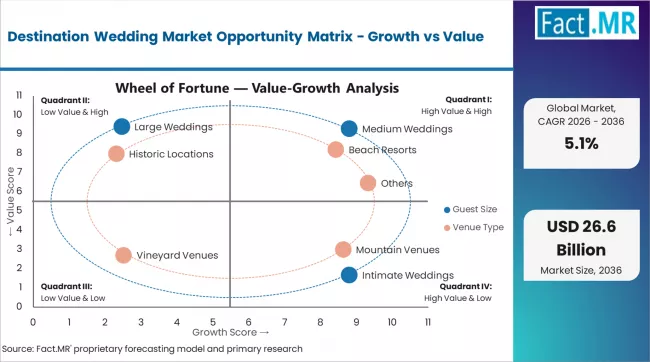
Destination Wedding Market Opportunity Matrix Growth Vs Value | Source: Fact.MR
Destination Wedding Market Drivers, Restraints, and Opportunities
Fact MR analysis indicates that the destination wedding market developed from the convergence of tourism services and event management industries where wedding ceremonies are organized at travel locations rather than local venues. Early destination weddings were concentrated in resort locations offering integrated accommodation and event services for international guests. The current market valuation reflects the expansion of specialized wedding planning services, resort partnerships, and travel packages tailored for multi-day wedding events. Demand persists because destination weddings combine ceremonial events with travel experiences, supporting higher per-event spending across hospitality, catering, and event services.
A structural shift is occurring as traditional large-scale local weddings transition toward smaller guest lists combined with extended travel-based celebrations. Conventional wedding venues remain widely used where cultural practices emphasize local ceremonies with larger attendance. Destination weddings involve higher per-guest expenditure on travel, accommodation, and curated event experiences despite lower guest counts. Wedding planners increasingly offer customized event itineraries that include hospitality services, themed ceremonies, and tourism activities. Higher service pricing offsets smaller event sizes, supporting gradual market value expansion.
- Experience Oriented Events: Couples increasingly select destination venues that combine wedding ceremonies with travel experiences such as resort stays and curated group activities.
- Travel and Event Regulation: Tourism visa policies, event permits, and hospitality regulations influence destination wedding planning and venue selection across international markets.
- Asia Pacific Wedding Tourism: Thailand, Indonesia, and India maintain strong destination wedding demand supported by resort infrastructure and established event planning services.
Regional Analysis
The destination wedding market is assessed across North America, Europe, Asia Pacific, Latin America, and Middle East & Africa, segmented by country-level wedding tourism demand, hospitality infrastructure, and event service availability. Regional demand reflects travel trends, venue capacity, and luxury hospitality development. The full report offers market attractiveness analysis.
.webp "Top Country Growth Comparison Destination Wedding Market Cagr (2026 2036)")
Top Country Growth Comparison Destination Wedding Market Cagr (2026 2036) | Source: Fact.MR
| Country | CAGR (2026-2036) |
|---|---|
| India | 6.4% |
| Mexico | 5.8% |
| UK | 5.3% |
| Italy | 5.1% |
| USA | 4.2% |
Source: Fact.MR analysis. Updated Mar 30, 2026
Source: Fact MR analysis, based on proprietary forecasting model and primary research
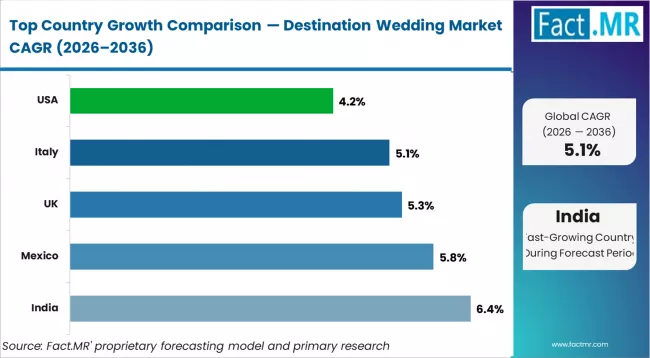
Destination Wedding Market Cagr Analysis By Country | Source: Fact.MR
North America
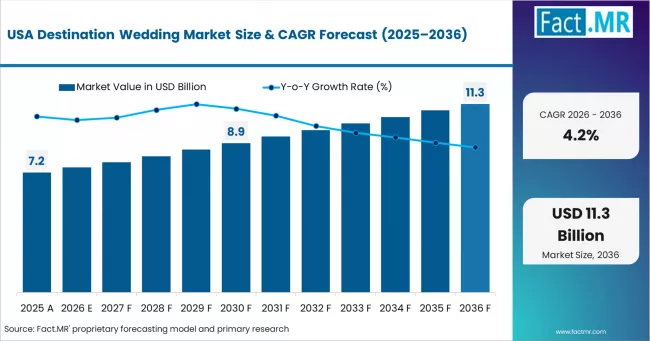
Destination Wedding Market Country Value Analysis | Source: Fact.MR
North America functions as the premium wedding tourism and luxury venue services hub, supported by established hospitality infrastructure and specialized event planning services. Marriott International, Inc. maintains leadership in destination wedding venues. Hilton Worldwide Holdings Inc. strengthens luxury event property offerings. Hyatt Hotels Corporation expands wedding-focused resort services.
- USA: Demand for destination wedding in USA is projected to rise at 4.2% CAGR through 2036. Growth is supported by National Travel and Tourism Strategy initiatives (U.S. Department of Commerce, updated 2022), promoting leisure travel demand. Marriott International, Inc. expanded wedding event services at resort locations (March 2023), supporting market growth.
Europe
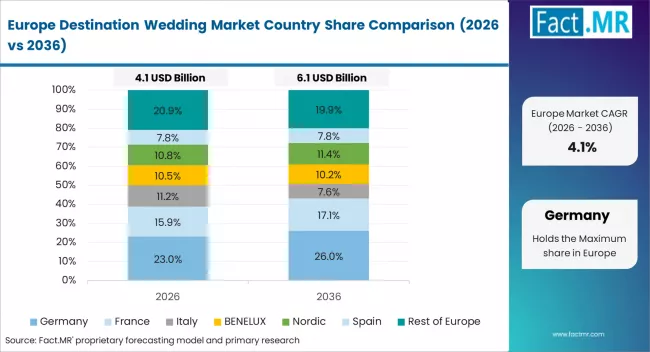
Destination Wedding Market Europe Country Market Share Analysis, 2026 & 2036 | Source: Fact.MR
Europe operates as the heritage venue and luxury wedding tourism base, shaped by historic locations and strong international travel demand. Accor S.A. leads in destination wedding properties. InterContinental Hotels Group PLC strengthens premium wedding venues. Belmond Ltd. expands luxury wedding destinations.
- UK: Demand for destination wedding in UK is projected to rise at 5.3% CAGR through 2036. The UK Tourism Recovery Plan (Department for Digital, Culture, Media and Sport, updated 2022) supports wedding tourism demand. InterContinental Hotels Group PLC expanded destination wedding offerings (February 2023), supporting adoption.
- Italy: Demand for destination wedding in Italy is projected to rise at 5.1% CAGR through 2036. The Strategic Tourism Plan (Ministry of Tourism, updated 2022) supports heritage venue tourism. Belmond Ltd. expanded luxury destination wedding venues (January 2023), supporting demand.
Asia Pacific
Asia Pacific serves as the high-growth wedding tourism and resort destination market, supported by expanding hospitality infrastructure and rising travel expenditure. Indian Hotels Company Limited strengthens premium wedding venue portfolio. Shangri-La Group expands luxury event destinations. Oberoi Group supports high-end wedding tourism offerings.
- India: Demand for destination wedding in India is projected to rise at 6.4% CAGR through 2036. The Swadesh Darshan Scheme (Ministry of Tourism, ongoing) supports destination tourism infrastructure. Indian Hotels Company Limited expanded wedding destination venues (May 2023), supporting domestic growth.
Latin America
Latin America functions as the coastal resort and leisure wedding destination hub, supported by strong hospitality investment and scenic venue availability. Grupo Posadas, S.A.B. de C.V. supports resort wedding venues. AMResorts (Hyatt Inclusive Collection) expands all-inclusive wedding destinations. Grupo Xcaret strengthens destination event services.
- Mexico: Demand for destination wedding in Mexico is projected to rise at 5.8% CAGR through 2036. The National Tourism Development Programme (Secretariat of Tourism, updated 2022) supports resort tourism growth. AMResorts (Hyatt Inclusive Collection) expanded destination wedding resort services (April 2023), supporting market expansion.
Fact MR's analysis of destination wedding market in global regions consists of country-wise assessment that includes India, Mexico, UK, Italy, and USA. Readers can find tourism trends, venue development patterns, travel demand shifts, and competitive positioning across key markets.
Competitive Landscape
Competitive Structure and Buyer Dynamics in the Destination Wedding Market
The competitive structure of the Destination Wedding Market is moderately fragmented, with global hospitality brands and resort operators competing across luxury and all inclusive segments. Companies such as Sandals Resorts International Ltd., Hyatt Hotels Corporation, Iberostar Group, Barceló Hotel Group, Palace Resorts, S.A. de C.V., and Excellence Group Luxury Hotels & Resorts maintain strong positions through established resort properties located in popular wedding destinations. These firms provide bundled wedding packages that combine venue arrangements, accommodation, catering, and event coordination services. Competition is primarily influenced by location appeal, service quality, package customization options, and brand reputation among international travelers. Resort operators differentiate offerings through tailored wedding planning services, exclusive venue settings, and integrated guest accommodation options that support group travel arrangements.
Several companies maintain structural advantages through integrated resort operations and established partnerships with travel planners and event coordinators. Firms such as Sandals Resorts International Ltd. and Iberostar Group benefit from extensive resort portfolios in coastal locations that attract international wedding demand. Hyatt Hotels Corporation maintains advantages through global brand recognition and loyalty program networks that support customer acquisition. Excellence Group Luxury Hotels & Resorts and Palace Resorts, S.A. de C.V. maintain strong positioning through all inclusive service packages designed for group events. Customers typically compare multiple resorts and wedding packages before finalizing bookings, reducing dependence on a single provider. Promotional pricing structures and bundled service offerings moderate supplier pricing leverage, while companies with premium locations and established event planning capabilities retain stronger negotiating influence.
Key Players of the Destination Wedding Market
- Sandals Resorts International Ltd.
- Excellence Group Luxury Hotels & Resorts
- Hyatt Hotels Corporation
- Palace Resorts, S.A. de C.V.
- Sandals Resorts International Ltd.
- Iberostar Group
- Barceló Hotel Group
Bibliographies
- [1] Condor Ferries / Travel Insights. (2025). 50+ destination wedding statistics 2025: Market size, budgets, and demographic trends. Condor Ferries. Retrieved March 24, 2026.
- [2] The Business Research Company. (2025). Destination wedding market size and industry forecast report 2035: Tourism and events sector analysis. The Business Research Company. Retrieved March 24, 2026.
- [3] Dataintelo. (2025, September 30). Destination wedding tourism market outlook 2025–2033. Dataintelo. Retrieved March 24, 2026.
- [4] Government of the United Kingdom. (2023). Planning a wedding in Italy: Guidance on legal requirements, residency, and documentation for UK citizens. GOV.UK. Retrieved March 24, 2026.
- [5] Ministry of Tourism (Government of India). (2023). Swadesh Darshan Scheme and destination wedding infrastructure development: Policy and tourism-development framework. Ministry of Tourism, Government of India. Retrieved March 24, 2026.
This Report Addresses
-
Market size estimation and revenue forecasts for the Destination Wedding Market from 2026 to 2036, supported by wedding tourism demand trends and hospitality service expenditure benchmarks across international event destinations.
-
Growth opportunity mapping across beach resorts, historic venues, vineyard locations, and mountain wedding destinations, reflecting demand for experience based ceremonial event formats.
-
Segment and regional revenue forecasts covering venue types, guest size categories, service segments, and key markets including India, Mexico, United Kingdom, Italy, and United States.
-
Competition strategy assessment of leading companies such as Hyatt Hotels Corporation, Iberostar Group, Sandals Resorts International Ltd., Barceló Hotel Group, and Palace Resorts, S.A. de C.V., including venue portfolio strength and service integration benchmarking.
-
Regulatory impact analysis covering international travel documentation requirements, marriage registration regulations, and hospitality compliance frameworks influencing cross border wedding event planning.
-
Market report delivery in PDF, Excel, PPT, and interactive dashboard formats designed for event planning strategy, hospitality investment evaluation, and wedding tourism demand assessment.
-
Supply chain vulnerability assessments examining foreign exchange exposure, seasonal travel demand variability, and dependency on integrated hospitality and travel service networks impacting event cost structures.
Destination Wedding Market Definition
The Destination Wedding Market includes wedding ceremonies and related events organized at locations away from the couple’s place of residence. These weddings are typically held at tourist destinations such as beaches, resorts, heritage sites, and scenic venues. Services in this market include venue arrangements, accommodation, catering, event planning, decoration, photography, and guest management. Destination weddings are often chosen for unique experiences and integrated travel arrangements for attendees. The primary function of this market is to provide wedding planning and hospitality services at travel destinations that combine ceremony, celebration, and accommodation.
Destination Wedding Market Inclusions
This report covers global and regional market sizes for destination wedding services with forecast analysis for the study period. The market is segmented by service type including venue booking, event planning, catering services, decoration services, and travel arrangements. Location segmentation includes beach destinations, resort venues, heritage locations, and other tourist sites. End users include wedding planners, hospitality providers, travel agencies, and couples organizing weddings. The report also evaluates pricing trends, service demand patterns, and selected trade flow analysis across major wedding tourism markets.
Destination Wedding Market Exclusions
The report excludes local weddings conducted within the place of residence without travel arrangements. Standalone wedding services such as photography or catering provided independently of destination planning are not included. The scope also excludes honeymoon travel services that are not connected to wedding ceremonies. Corporate event planning and social event management services unrelated to weddings are outside the defined market scope, as the analysis focuses strictly on weddings organized at travel destinations.
Destination Wedding Market Research Methodology
- Primary Research
- Interviews were conducted with wedding planners, hospitality providers, travel agencies, event coordinators, and venue operators.
- Desk Research
- Public information was collected from tourism publications, company reports, hospitality industry data, and travel statistics.
- Market-Sizing and Forecasting
- A hybrid model combining bottom up service revenue analysis with top down demand assessment across wedding tourism sectors was applied.
- Data Validation and Update Cycle
- Findings were cross verified using multiple tourism and event industry data sources and expert inputs, with periodic updates conducted as new market information becomes available.
Segmentation
Report Scope
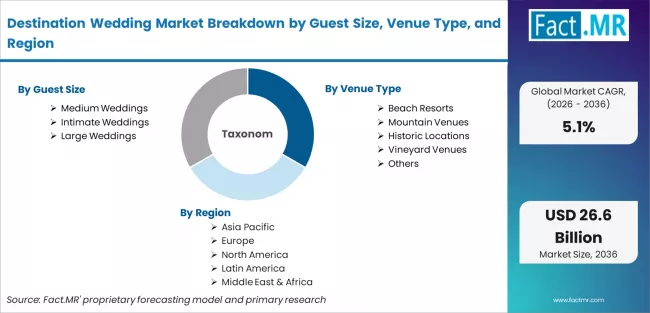
Destination Wedding Market Breakdown By Guest Size Venue Type And Region | Source: Fact.MR
| Metric | Value |
|---|---|
| Quantitative Units | USD 16.2 billion (2026) to USD 26.8 billion (2036), at a CAGR of 5.1% |
| Market Definition | The destination wedding market includes global spending on wedding ceremonies conducted outside the couple’s place of residence, incorporating venue booking, travel arrangements, hospitality services, event planning, catering, and related wedding services. |
| Venue Type Segmentation | Beach Resorts, Mountain Venues, Historic Locations, Vineyard Venues, Others |
| Guest Size Segmentation | Intimate Weddings, Medium Weddings, Large Weddings |
| Service Category Segmentation | Venue & Accommodation, Planning & Coordination, Photography & Videography, Catering & Entertainment, Others |
| Regions Covered | North America, Latin America, Europe, East Asia, South Asia, Oceania, Middle East and Africa |
| Countries Covered | United States, Canada, Mexico, Brazil, Argentina, United Kingdom, France, Italy, Spain, Greece, India, Thailand, Indonesia, Australia, United Arab Emirates, and 40+ countries |
| Key Companies Profiled | Sandals Resorts International Ltd., Excellence Group Luxury Hotels & Resorts, Hyatt Hotels Corporation, Palace Resorts, S.A. de C.V., Iberostar Group, Barceló Hotel Group |
| Forecast Period | 2026 to 2036 |
| Approach | Hybrid top-down and bottom-up market modeling based on wedding tourism trends, hospitality booking volumes, average destination wedding expenditure patterns, and validation through primary interviews with resort operators, wedding planners, and travel service providers. |
Source: Fact.MR analysis. Updated Mar 30, 2026
Destination Wedding Market Key Segments
-
Venue Type :
- Beach Resorts
- Mountain Venues
- Historic Locations
- Vineyard Venues
- Others
-
Guest Size :
- Intimate Weddings
- Medium Weddings
- Large Weddings
-
Service Category :
- Venue and Accommodation
- Planning and Coordination
- Photography and Videography
- Catering and Entertainment
- Others
-
Region :
- North America
- USA
- Canada
- Mexico
- Europe
- Germany
- UK
- France
- Italy
- Spain
- Nordic Countries
- BENELUX
- Rest of Europe
- Asia Pacific
- China
- Japan
- South Korea
- India
- Australia
- Rest of Asia Pacific
- Latin America
- Brazil
- Argentina
- Rest of Latin America
- Middle East and Africa
- Kingdom of Saudi Arabia
- United Arab Emirates
- South Africa
- Rest of Middle East and Africa
- Other Regions
- Oceania
- Central Asia
- Other Markets
- North America
Frequently Asked Questions
How large is the demand for Destination Wedding services in the global market in 2026?
What will be the market size of the Destination Wedding market by 2036?
What is the expected demand growth for the Destination Wedding market between 2026 and 2036?
Which company is identified as a leading participant in the Destination Wedding market?
Which guest size category is projected to dominate Destination Wedding bookings by 2026?
Why are medium sized destination weddings widely preferred?
What is driving demand for Destination Weddings in India?
What is the growth outlook for the Destination Wedding market in India?
Why is Mexico considered a strategic destination in the global Destination Wedding market?
What is the expected growth outlook for Destination Wedding demand in Mexico?
How is demand for Destination Weddings evolving in the United Kingdom?
What is the growth outlook for the Destination Wedding market in the United Kingdom?
Why is Italy an established location for Destination Weddings?
What is the growth outlook for the Destination Wedding market in Italy?
How is the United States positioned in the Destination Wedding market?
What is the expected growth outlook for the Destination Wedding market in the United States?
What is a Destination Wedding and what does it include?
What services are included in the scope of the Destination Wedding market?
What is excluded from the scope of the Destination Wedding market report?
What does market forecast mean in the Destination Wedding market report?
How is the Destination Wedding market forecast developed in this report?
What does primary validation indicate in the Destination Wedding market analysis?
Who worked on this report


Preview the report firsthand - request a free sample
Free SampleGet the brochure for pricing and purchase details
Download PDF