Drone Interceptors Market Size, Share, Growth and Forecast (2026 - 2036)
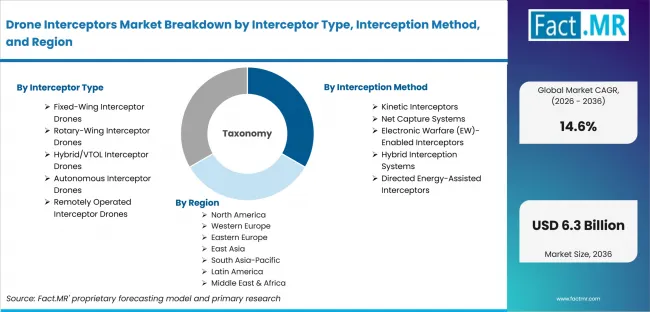
The global Drone Interceptors market is segmented by Interceptor Type, by Interception Method, by Launch Platform, by Application, by Component, and by Region. Forecast for 2026 to 2036.
Drone Interceptors Market Overview, Growth Outlook, and Forecast by Fact.MR
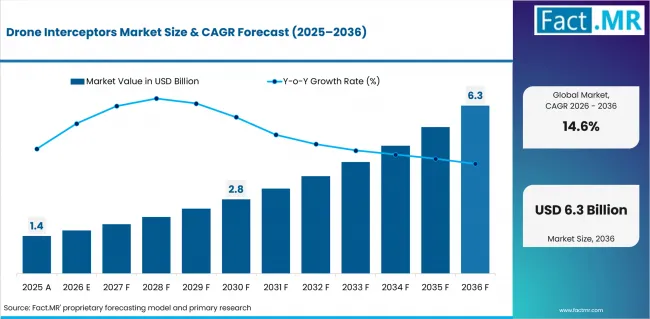
- In 2025, the global Drone Interceptors market was valued at approximately USD 1.4 billion.
- Based on Fact.MR analysis, market is estimated to reach USD 1.6 billion in 2026 and is projected to grow to USD 6.3 billion by 2036.
- The market is expected to expand at a CAGR of 14.6% during the forecast period.
Summary of the Drone Interceptors Market
- Market Snapshot
- In 2025, the global Drone Interceptors market was valued at approximately USD 1.4 billion.
- The market is estimated to reach around USD 1.6 billion in 2026 and is projected to attain nearly USD 6.3 billion by 2036.
- The Drone Interceptors market is expected to expand at a CAGR of 14.6% during the forecast period.
- The market is anticipated to create an absolute dollar opportunity of approximately USD 4.7 billion between 2026 and 2036.
- In terms of interceptor type, Fixed-Wing Interceptor Drones hold the largest share of approximately 34.50% in 2026, driven by their high-speed interception capabilities, extended operational range, and increasing deployment in military counter-UAS operations.
- Based on interception method, Kinetic Interceptors represent approximately 38.00% share in 2026, driven by their proven effectiveness in neutralizing hostile drones and growing adoption across defense and security applications.
- Demand and Growth Drivers
- The increasing risk of attacks by drones, loitering weapons, and swarming drones is fueling the need for Drone Interceptors which can quickly detect, track, and neutralize any such hostile aerial vehicles.
- The rising budgets of defense services along with the efforts to enhance their capabilities against UAS technology is motivating the military organizations to utilize advanced interceptors drones.
- The increasing use of drones in military and civilian sectors has increased the need for Drone Interceptors as security agencies and government authorities are looking for an efficient way to protect themselves from any aerial attacks.
- Product and Segment View
- Fixed-Wing Interceptor Drones hold a 34.50% share, driven by their superior speed, extended operational range, and ability to engage hostile drones at greater distances, making them highly effective for military counter-UAS operations and battlefield protection missions.
- Kinetic Interceptors account for a 38.00% share, supported by their proven effectiveness in physically neutralizing hostile drones, increasing deployment in defense applications, and growing demand for hard-kill counter-drone solutions against evolving aerial threats.
- Ground-Launched platforms represent a 52.00% share, owing to their operational flexibility, ease of deployment, and widespread adoption across military bases, border security installations, critical infrastructure facilities, and fixed-site defense applications.
- Battlefield Protection holds a 32.00% share, driven by increasing concerns over drone swarms, loitering munitions, and reconnaissance UAVs, along with rising investments in advanced interceptor drone systems designed to protect troops, military assets, and strategic locations in combat environments.
- Geography and Competitive Outlook
- The market of Drone Interceptors grows rapidly in North America, Europe, and the Middle East because of increasing investments in technologies to counter unmanned aircraft systems, as well as increased awareness of potential risks associated with unapproved drone flights and airspace security threats.
- North America is a promising market due to its large investments in the defense sector, as well as its involvement in military upgrades and the development of interceptors that would secure the battlefield, borders, and other crucial areas from attacks of the adversary.
- The Drone Interceptors market experiences competition between producers of specialized interceptor drones, developers of UAS countermeasures, and defense contractors creating high-performance UAV interceptors to detect, track, and neutralize enemy aircraft.
- Analyst Opinion
- Shambhu Nath Jha, Principal Consultant at Fact.MR, says, “The worldwide market for Drone Interceptors is anticipated to witness tremendous growth due to the growing threats from hostile drones, loitering missiles, and drone swarms in both military and non-military surroundings. The mounting expenditure on counter-drone technologies, along with the increasing need for efficient and speedy drone-neutralization technologies, will prompt security agencies and defense agencies globally to invest in interceptor drone systems."
Drone Interceptors Market — At a Glance
| Metric | Value |
|---|---|
| Market Value 2025 | USD 1.4 billion |
| Market Value 2026 | USD 1.6 billion |
| Market Value 2036 | USD 6.3 billion |
| Absolute Dollar Opportunity | USD 4.7 billion |
| CAGR | 14.60% |
| Growth Multiple | 3.9x |
| Key Demand Theme | Rising demand for counter-UAS capabilities, increasing deployment of interceptor drones for battlefield protection and critical infrastructure security, and growing investments in advanced drone-neutralization technologies to counter hostile UAVs and drone swarms. |
| Leading Interceptor Type | Fixed-Wing Interceptor Drones |
| Interceptor Type Share | 34.50% |
| Leading Interception Method | Kinetic Interceptors |
| Interception Method Share | 38.00% |
| Leading Launch Platform | Ground-Launched |
| Launch Platform Share | 52.00% |
| Leading Component | Hardware |
| Component Share | 78.00% |
| Leading Application | Battlefield Protection |
| Application Share | 32.00% |
| Key Growth Regions | North America, Europe, Middle East & Africa, Asia Pacific |
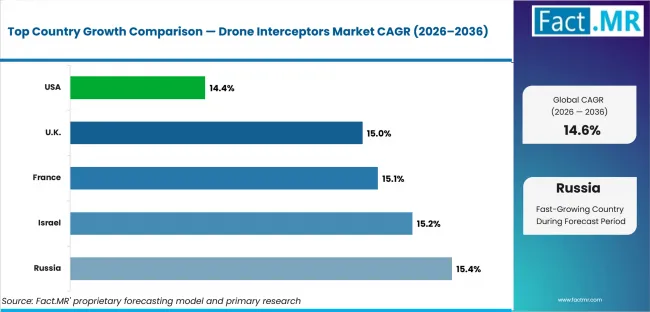
| Fastest Growing Countries | Russia (15.4%), Israel (15.2%), France (15.1%), U.K. (15.0%), USA (14.4%) |
| Key Companies | TRL Drones, Fortem Technologies, MARSS Group, Alta Ares, Tytan Technologies |
| Interceptor Type Segmentation | Fixed-Wing Interceptor Drones, Rotary-Wing Interceptor Drones, Hybrid/VTOL Interceptor Drones, Autonomous Interceptor Drones, Remotely Operated Interceptor Drones |
| Interception Method Segmentation | Kinetic Interceptors, Net Capture Systems, Electronic Warfare (EW)-Enabled Interceptors, Directed Energy-Assisted Interceptors, Hybrid Interception Systems |
| Launch Platform Segmentation | Ground-Launched, Vehicle-Mounted, Air-Launched, Shipborne/Naval |
| Component Segmentation | Hardware, Software |
| Application Segmentation | Battlefield Protection, Border Surveillance & Protection, Critical Infrastructure Security, Airport Protection, Government Facility Protection, Event & VIP Security, Counter-Terrorism Operations, Maritime Security |
| Regions | North America, Latin America, Europe, Middle East & Africa, Asia Pacific |
Key Growth Drivers, Constraints, and Opportunities
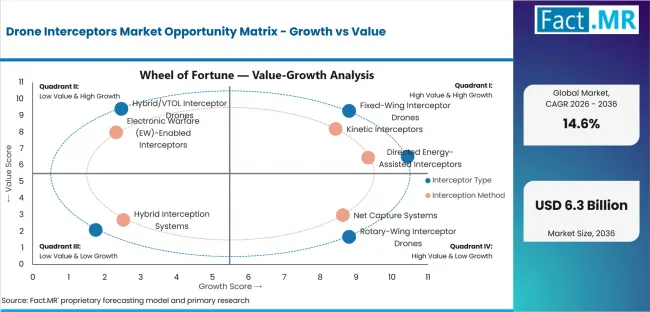
Key Factors Driving Growth
- The escalating threat posed by rogue drones, loitering ammunition, and swarming drone attacks has resulted in an increased demand for drone interceptor technologies that can efficiently detect and eliminate any enemy air threats.
- The increase in defense budgets and investment in new military equipment for UAS defenses has been fueling growth in the drone interceptor market as a result.
- As drones become increasingly popular in military, civilian, and commercial applications, there is an increased need for airspace security, leading many nations to invest in drone interceptors to protect their vital installations and assets.
| Growth Driver | Demand Impact | Time Horizon | Key Impact Area | Fact.MR Insight |
|---|---|---|---|---|
| Rising drone threats, loitering munitions, and drone swarm attacks | High | Short–Mid Term | Airspace security | The increasing use of drones in military and civilian environments is driving demand for drone interceptor systems capable of rapidly detecting, tracking, and neutralizing hostile UAVs. |
| Growing investments in counter-UAS technologies and military modernization programs | High | Short–Mid Term | Defense modernization | Armed forces are increasingly deploying advanced drone interceptor solutions to strengthen battlefield protection, border security, and strategic asset defense capabilities. |
| Technological advancements in AI, autonomous navigation, and target tracking systems | High | Mid Term | Technology advancement | Innovations in autonomous interception, sensor fusion, machine learning, and real-time target recognition are enhancing interceptor drone effectiveness and operational efficiency. |
| Expansion of critical infrastructure protection and airport security programs | High | Mid–Long Term | Market expansion | Governments and infrastructure operators are increasing investments in drone interception systems to safeguard airports, energy facilities, transportation networks, and government installations from unauthorized UAV activities. |
| Rising geopolitical tensions and border security requirements | Medium–High | Mid–Long Term | Defense investment | Growing regional conflicts, cross-border drone incursions, and national security concerns are encouraging greater adoption of drone interceptor technologies for surveillance, protection, and counter-drone operations. |
Key Market Constraints
- The implementation of advanced interceptor drone systems entails significant financial investments in their development, procurement, integration, and deployment, thus restricting its usage primarily to defense agencies and governmental authorities with sufficient budgets allocated to ensure their security.
- The overall cost of ownership is comprised of both the cost of the initial acquisition and additional costs connected to the maintenance of such systems, software updates, training of drone pilots, etc.
- The technological issues connected to automatic interception, tracking of targets, and the ability to counteract increasingly sophisticated drones can be considered as potential obstacles to the quick deployment of interceptor drones.
Key Opportunity Areas
- The increased requirement for the deployment of counter-UAS systems in military applications, homeland security, airport security, and protecting critical infrastructures is an opportunity for companies in the drone interceptor market.
- Investments in defense manufacturing, local counter-drone systems, and military modernization are generating opportunities to enter into strategic alliances and collaborations for technology development and manufacturing.
- The increasing threat of drone swarms, UAVs, and other aerial threats is driving the demand for advanced and autonomous drone interceptors.
Segment-wise Analysis of the Drone Interceptors Market
- Kinetic Interceptors account for a 38.00% share in the interception method segment, supported by their proven effectiveness in physically neutralizing hostile drones and growing adoption across defense and security operations.
- Ground-Launched platforms hold a 52.00% share in the launch platform segment, owing to their operational flexibility, ease of deployment, and widespread use for military base protection, border security, and critical infrastructure defense.
- Hardware holds a 78.00% share in the component segment, driven by substantial investments in airframes, propulsion systems, sensors, tracking technologies, and interception mechanisms required for effective drone neutralization.
- Battlefield Protection accounts for a 32.00% share in the application segment, supported by increasing concerns over drone swarms, loitering munitions, and hostile UAV incursions across modern combat environments.
The global Drone Interceptors market is segmented by interceptor type, interception method, launch platform, application, and component.
Which Interceptor Type Segment Dominates the Market?
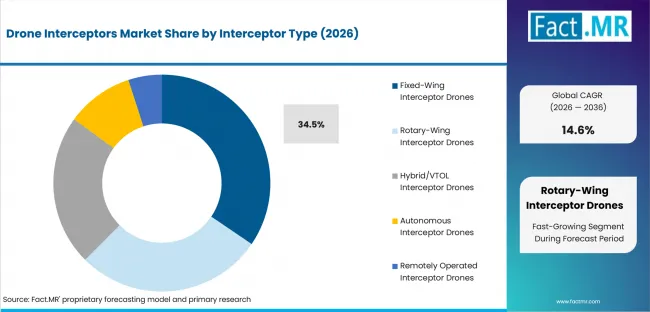
Fixed-wing Interceptor Drones hold the leading interceptor type share of 34.50%. This dominance will be sustained over the forecast period owing to the greater speed and range of operations offered by them, apart from being able to attack any enemy drone at a distance.
Which Launch Platform Segment Dominates the Market?
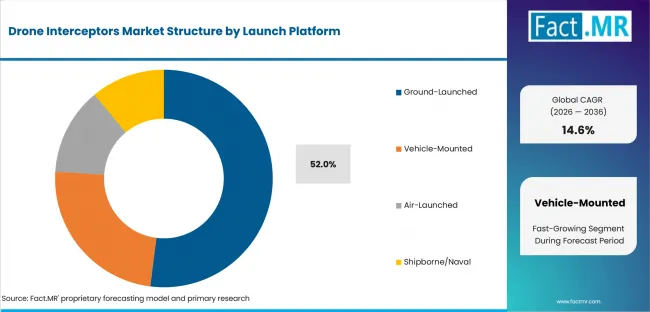
Drone Interceptors Launched from the Ground constitute a market share of 52.00% in the Drone Interceptors industry, and their supremacy is predicted to endure throughout the forecast period. This trend can be credited to the ease of operation and rapid deployment capacity along with the cost efficiency offered by these systems.
Which Application Segment Dominates the Market?
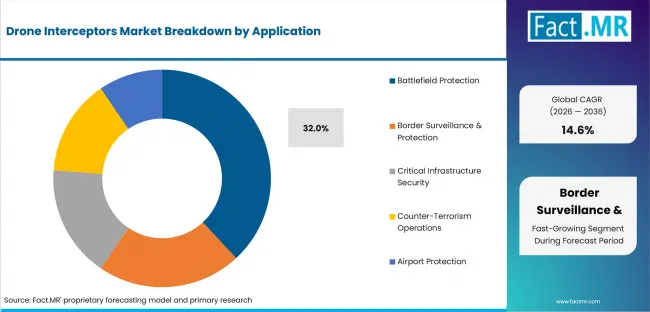
Battlefield Protection holds the leading position in the Drone Interceptors Market, with a market share of 32.00%. This is because there has been a significant rise in the risk of hostile drones, loitering ammunition, and drones swarms in contemporary battlefields. There have also been rising investments in counter-drone technologies and the requirement to safeguard personnel and assets from such threats in warfare.
Which Interception Method Segment Dominates the Market?
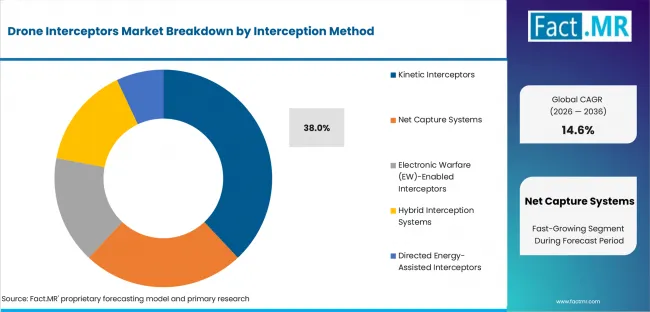
Kinetic Interceptors represent the largest category in the Drone Interceptors market, holding a share of 38.00%, and are anticipated to continue dominating during the forecast period. The key factor fueling their domination in the market is the effective performance of kinetic interception techniques, which enable them to be very efficient in physically eliminating hostile drones. The application of kinetic interceptors in military defense and security operations has been widespread on account of their efficiency in eliminating the threat, accurate interception rate, and efficient response to both individual drones and a swarm of drones.
Which Component Segment Dominates the Market?
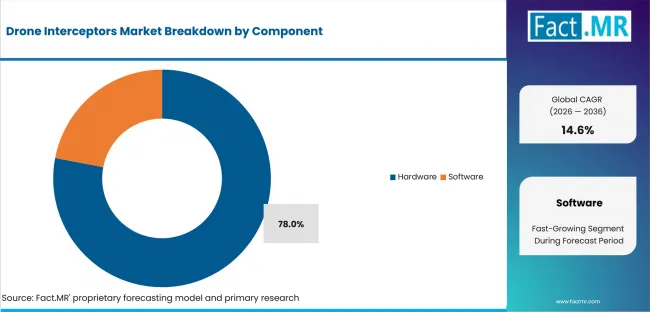
The Hardware category leads the Drone Interceptors market by holding 78.00% of the market share. It is estimated that it will retain its supremacy in the coming years. The main reason behind the domination of this category in the market is because of the huge capital investment that is required for building interceptors.
Regional Outlook Across Key Markets
The market analysis covers key global regions, including South Asia and Pacific, Middle East & Africa, North America, Latin America, Western Europe, and Eastern Europe. It is segmented geographically, with specific market dynamics for each region. The full report provides a detailed market attractiveness analysis.
.webp)
CAGR Table
| Country | CAGR (%) |
|---|---|
| United States | 14.4% |
| Russia | 15.4% |
| Israel | 15.2% |
| France | 15.1% |
| U.K. | 15.0% |
| Germany | 14.5% |
Source: Fact.MRanalysis, based on proprietary forecasting model and primary research.
North America – The Drone Interceptors Hub
Drone interceptor systems have been seeing a rise in usage in North America with countries developing countermeasures against the rising number of UAV threats, drone swarms, and loitering munitions.
- United States: Demand for Drone Interceptors in the United Statesis projected to grow at a CAGR of 14.4%, supported by increasing investments in counter-UAS programs, military modernization initiatives, and the growing deployment of interceptor drones for battlefield protection, border security, airport defense, and critical infrastructure protection.
Western Europe – The Drone Interceptors Hub
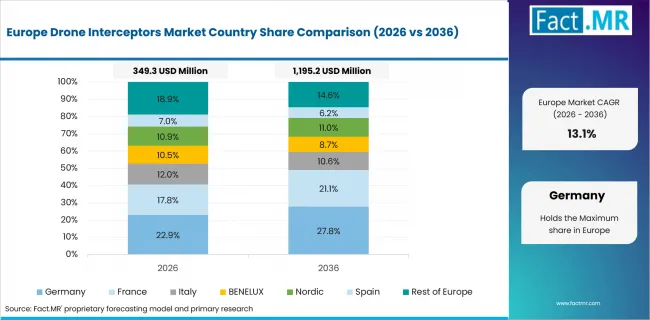
Drone interceptor systems have seen increased use in Western Europe as nations bolster their counter UAS defenses against aerial threats.
- France: Demand for Drone Interceptors in France is projected to grow at a CAGR of 15.1%, supported by increasing investments in counter-drone programs, growing deployment of interceptor drones for military and homeland security applications, and rising requirements for protecting critical infrastructure, government facilities, and strategic assets from unauthorized UAV activities.
East Asia – A Growing Center for Drone Interceptor Innovation
With growing defense modernization initiatives, investments in counter UAV technology, and concerns about the misuse of drones, the Drone Interceptor market is anticipated to witness high growth rates in the East Asian region. The development of military capabilities, border security needs, and protection against aerial threats to critical assets will create positive environments for the deployment of such technologies in the region.
- China: Demand for Drone Interceptors in China is projected to grow at a CAGR of 15.5%, supported by extensive investments in military modernization, a rapidly expanding defense technology ecosystem, and increasing deployment of counter-drone solutions across military and security applications.
South Asia & Pacific – An Emerging Market for Drone Interceptors
The speedy progress made by defense modernization initiatives, increased spending on counter-UAS technology, and rising apprehensions about border security have been major driving factors behind the increased usage of drone interceptors in the South Asia & Pacific region. The rising requirement of protecting airspace from hostile drone attacks will offer several lucrative prospects to drone interceptors.
- India: Demand for Drone Interceptors in India is projected to grow at a CAGR of 15.2%, supported by the country's ongoing defense modernization initiatives, increasing focus on indigenous counter-drone capabilities, and rising requirements for border security and critical infrastructure protection.
Latin America – An Emerging Opportunity for Drone Interceptors
There will be considerable growth in the Drone Interceptors market in Latin America owing to the growing investments made in improving defense systems, strengthening border security, and securing critical infrastructure.
- Brazil: Demand for Drone Interceptors in Brazil is projected to grow at a CAGR of 15.0% through 2036, supported by the country's expanding defense modernization programs, increasing focus on border security, and growing need to protect critical infrastructure and strategic assets from unauthorized UAV activities.
Middle East & Africa – A Rising Market for Drone Interceptors
There will be considerable growth in the Drone Interceptors market in Latin America owing to the growing investments made in improving defense systems, strengthening border security, and securing critical infrastructure.
- Israel: Demand for Drone Interceptors in Israel is projected to grow at a CAGR of 15.2% through 2036, supported by the country's strong focus on defense innovation, advanced counter-drone capabilities, and continuous investments in next-generation air defense systems.
Fact.MR analysis provides a comprehensive regional outlook across North America, Latin America, Western Europe, Eastern Europe, East Asia, South Asia & Pacific, and the Middle East & Africa. It offers detailed country-wise insights, highlighting growth trends, demand patterns, and adoption across key industries in both developed and emerging markets.
Competitive Benchmarking and Company Positioning
Leading Companies Shaping the Drone Interceptors Market
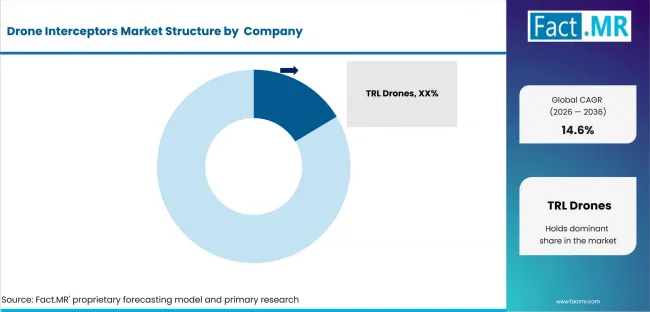
The Drone Interceptors market has moderate consolidation in that the major players in this space include TRL Drones, Fortem Technologies, MARSS Group, Alta Ares, and Tytan Technologies, who account major market share globally. The aforementioned companies strive to develop intercepting drones, autonomy in the interception process, artificial intelligence systems for tracking targets, among others, to solve the issue of hostile drone attacks.
Key Players of the Drone Interceptors Market
- TRL Drones
- Anduril Industries
- Fortem Technologies
- MARSS Group
- Alta Ares
- Tytan Technologies
- Wild Hornets
- Nordic Air Defence
- Tron Future Tech
- Dedrone by Axon
- Israel Aerospace Industries
- SpearUAV
- DroneShield
Recent Industry Developments
- French startup Alta Ares raises €50 million for AI-guided drone interceptors (2026), French defense technology startup Alta Ares has raised €50 million to expand production of its AI-guided interceptor drones, as European investors continue to back lower-cost air defense systems shaped by the war in Ukraine. (Alta Ares) [1]
- MBDA showcases hybrid high-energy laser, interceptor counter-drone system (2026): The laser is specifically intended to neutralize close-range targets, including drone swarms, as depicted in an infographic presented by company officials during a press briefing. (MBDA) [2]
- Ukraine unveils 450 km/h drone interceptor to hunt Russian UAVs (2026): Ukrainian company Yartura has unveiled a new interceptor drone with a maximum speed of 450 km/h and built-in protection against enemy electronic warfare (EW) systems, according to the company’s press service. (Yartura) [3]
- Ukraine Showcases New 350 km/h LITAVR Interceptor Drone (2026): F-Drones has developed the LITAVR interceptor drone, a high-speed system designed to destroy aerial and ground targets. (F-Drone) [4]
- Terra Drone Invests in Ukraine-Based Interceptor Drone Company, Launches Terra A1 (2026): Partnership aims to scale low-cost defense solutions and expand global unmanned systems capabilities. (Terra Drone) [5]
Sources and Research References
- Alta Ares. (2026, June 8). Alta Ares raises €50M to become a leading European player in air defense. Alta Ares.
- MBDA. (2026, June 9). MBDA at ILA 2026: New anti-drone, deep precision strike and space solutions. MBDA.
- Ministry of Defence of Ukraine. (2026, June 8). Intercepting targets at 350 km/h: F-Drones’ Ukrainian LITAVR counter-drone. Ministry of Defence of Ukraine.
- RBC-Ukraine. (2026, June 11). Ukraine unveils 450 km/h drone interceptor to hunt Russian UAVs. RBC-Ukraine.
- Terra Drone Corporation. (2026, March 31). Terra Drone announces strategic investment in Amazing Drones, a Ukraine-based interceptor drone company, and the launch of new interceptor drone “Terra A1”. Terra Drone Corporation.
Drone Interceptors Market Definition
The Drone Interceptor Market can be defined as the market for the portion of the unmanned aerial system (UAS) industry that deals with drones intended to identify, chase, follow, and destroy any unauthorized or threatening drones. The drone interceptors use different methods to accomplish their mission, which include impact, netting, electromagnetic interference through electronic warfare, directed energy technology, and a combination of both impact and electromagnetic interference.
Drone Interceptors Market Inclusions
Drone Interceptor Systems Market involves interceptor drones, interceptor systems, and technologies that are capable of detecting, tracking, pursuing, and neutralizing any illegal or hostile UAV. The drone interceptors market involves fixed-wing interceptors, rotary-wing interceptors, hybrid/Vtol interceptors, net capture interceptors, electronic warfare enabled interceptors, directed energy assisted interceptors, and hybrid interceptor systems.
Drone Interceptors Market Exclusions
Drone Interceptors Market does not consider conventional surveillance drones, commercial unmanned aerial vehicles (UAVs) that do not have interception capabilities, standalone radar and detection systems without drone interception capabilities, land-based jamming-only systems, anti-aircraft missile systems, interception carried out using manned airplanes, and individual drone parts that lack drone interception and neutralization capabilities.
Drone Interceptors Market Research Methodology
- Primary Research
- In this analysis report, there is the evaluation of the Global Drone Interceptors Market that consists of drones that intercept other UAVs by detecting, tracking, chasing, and eliminating those that are considered either hostile or unauthorized. This report encompasses several aspects such as market trends, technological innovations, deployments strategies, procurement, regulatory factors, competition, and end user considerations.
- Desk Research
- The secondary research was an integral part of the study that was conducted using publicly accessible data from the defense, government, security, and industry organizations, as well as papers and periodicals. Secondary data sources included defense procurement papers, military modernization papers, annual papers, counter-UAS technology papers, aerospace & defense periodicals, drone security periodicals, and other related sources pertaining to the Drone Interceptors Market.
- Market-Sizing and Forecasting
- Size estimation of the Drone Interceptors Market around the globe has been carried out with the help of bottom-up and top-down methods. The bottom-up approach includes estimating revenues earned by key players in the segments of drone interceptors, counter-UAS systems, and other defense technologies. Additionally, market sizing includes consideration of procurement programs and spends on different deployments of such drones by various end users.
- Data Validation and Update Cycle
- Validation of data associated with the Drone Interceptors Market across the globe was done by conducting rigorous verification from various industry sources. The figures and forecasts regarding this market were verified on the basis of records pertaining to defense procurement, annual reports of companies, investors' presentations, government publications, product catalogs, security technology literature, journals related to aerospace & defense industry, and many more.
Scope of Analysis

| Parameter | Details |
|---|---|
| Quantitative Units | USD 1.4 billion in 2025 to USD 6.3 billion in 2036, at a CAGR of 14.6% |
| Market Definition | The Drone Interceptors market comprises fixed-wing interceptor drones, rotary-wing interceptor drones, hybrid/VTOL interceptor drones, autonomous interceptor drones, and remotely operated interceptor drones designed to detect, track, directed-energy-assisted, and hybrid interception methods across military and civilian security applications. |
| Regions Covered | North America, Latin America, Western Europe, Eastern Europe, East Asia, South Asia & Pacific, Middle East & Africa |
| Countries Covered | USA, China, Russia, Israel, India, and 30+ other countries |
| Key Companies | TRL Drones, Fortem Technologies, MARSS Group, Alta Ares, Tytan Technologies |
| Forecast Period | 2026 to 2036 |
| Approach | Hybrid demand-side and top-down methodology based on increasing deployment of counter-UAS technologies, growing adoption of drone interceptor systems for battlefield protection, border security, airport security, and critical infrastructure defense, along with rising investments in autonomous interception capabilities, and advanced drone-neutralization technologies. |
Analysis by Interceptor Type, by Interception Method, by Launch Platform, by Application, by Component, and by Region
-
Drone Interceptors Market By Interceptor Type
- Fixed-Wing Interceptor Drones
- Rotary-Wing Interceptor Drones
- Hybrid/VTOL Interceptor Drones
- Autonomous Interceptor Drones
- Remotely Operated Interceptor Drones
-
Drone Interceptors Market By Interception Method
- Kinetic Interceptors
- Collision-based
- Projectile-based
- Net Capture Systems
- Electronic Warfare (EW)-Enabled Interceptors
- Directed Energy-Assisted Interceptors
- Hybrid Interception Systems
- Kinetic Interceptors
-
Drone Interceptors Market By Launch Platform
- Ground-Launched
- Vehicle-Mounted
- Shipborne/Naval
- Air-Launched
-
Drone Interceptors Market By Application
- Battlefield Protection
- Border Surveillance & Protection
- Critical Infrastructure Security
- Airport Protection
- Government Facility Protection
- Event & VIP Security
- Counter-Terrorism Operations
- Maritime Security
-
Drone Interceptors Market By Component
- Hardware
- Airframe
- Sensors
- Cameras
- Radar
- Propulsion Systems
- Software
- AI Target Recognition
- Autonomous Navigation
- Mission Management
- Hardware
-
Drone Interceptors Market By Region
- North America
- USA
- Canada
- Mexico
- Latin America
- Brazil
- Chile
- Rest of LATAM
- East Asia
- China
- Japan
- South Korea
- Western Europe
- Germany
- Italy
- France
- U.K.
- Spain
- BENELUX
- Nordic
- Rest of W. Europe
- Eastern Europe
- Russia
- Hungary
- Poland
- Balkan & Baltics
- Rest of E. Europe
- Middle East and Africa
- Kingdom of Saudi Arabia
- United Arab Emirates
- South Africa
- Rest of Middle East and Africa
- North America
- Frequently Asked Questions -
How large is the demand for Drone Interceptors in the global market in 2025?
Demand for Drone Interceptors in the global market is estimated to be valued at USD 1.4 billion in 2025.
What will be the market size of Drone Interceptors in the global market by 2036?
The market size for Drone Interceptors is projected to reach USD 6.3 billion by 2036.
What is the expected demand growth for Drone Interceptors in the global market between 2026 and 2036?
Demand for Drone Interceptors in the global market is expected to grow at a CAGR of 14.6% between 2026 and 2036.
Which interceptor type segment is expected to dominate the Drone Interceptors market?
Fixed-Wing Interceptor Drones are expected to dominate the market, accounting for 34.50% share in 2026, driven by their superior speed, extended operational range, and effectiveness in engaging hostile UAVs at greater distances.
How significant is the growth outlook for the USA in this market?
USA is expected to grow at a CAGR of 14.4% through 2036, supported by increasing investments in counter-UAS technologies, military modernization programs, and rising deployment of drone interceptor systems for battlefield protection, critical infrastructure security, airport defense, and border surveillance applications.
Which company is identified as a leading player in the Drone Interceptors Market?
Fortem Technologies is identified as a leading player in the market, supported by its portfolio of advanced drone interception solutions, autonomous counter-UAS technologies, and growing presence across defense, homeland security, and critical infrastructure protection applications.
Table of Content
- Drone Interceptors Market – Executive Summary
- Market Overview
- Market Definition & Introduction
- Market Taxonomy & Research Scope
- Global Drone Interceptors Market Demand Analysis 2021-2025 and Forecast, 2026–2036
- Historical Market Volume (Units) Analysis, 2021-2025
- Current and Future Market Volume (Units) Projections, 2026–2036
- Y-o-Y Growth Trend Analysis
- Global Drone Interceptors Market - Pricing Analysis
- Product Category and Country-Level Pricing Analysis
- Region Average Pricing Analysis Benchmark
- Price Trends and Forecasts
- Historical price trends
- Future price forecasts
- Factors Influencing Pricing
- Competitive Pricing Strategies
- Cost Structure Analysis
- Global Drone Interceptors Market Demand (in Value or Size in US$ Mn) Analysis 2021-2025 and Forecast, 2026–2036
- Historical Market Value (US$ Mn) Analysis, 2021-2025
- Current and Future Market Value (US$ Mn) Projections, 2026–2036
- Y-o-Y Growth Trend Analysis
- Absolute $ Opportunity Analysis
- Market Background and Foundational Data Points
- Share of drone interceptors in the total Counter-UAS (C-UAS) market (%)
- Annual growth rate of global Counter-UAS procurement and deployment (%)
- Share of hard-kill interception systems in total Counter-UAS deployments (%)
- Penetration rate of drone interceptor systems across military and defense organizations (%)
- Share of fixed-wing interceptor drones in total drone interceptor deployments (%)
- Share of rotary-wing interceptor drones in total drone interceptor deployments (%)
- Annual growth rate of defense spending on counter-drone and airspace security technologies (%)
- Share of military installations equipped with counter-UAS capabilities (%)
- Annual growth rate of autonomous drone interception technology adoption (%)
- Share of AI-enabled target tracking systems in drone interceptor platforms (%)
- Annual growth rate of drone swarm defense system deployment (%)
- Share of battlefield protection applications in total drone interceptor deployments (%)
- Share of border surveillance and protection applications in total drone interceptor deployments (%)
- Annual growth rate of military modernization spending related to counter-UAS technologies (%)
- Share of indigenous counter-drone system manufacturing in total counter-UAS procurement (%)
- Annual growth rate of investments in advanced drone interception and neutralization technologies (%)
- Drone Interceptors Market Opportunity Assessment
- Total Available Market (US$ Mn)
- Serviceable Addressable Market (US$ Mn)
- Serviceable Obtainable Market (US$ Mn)
- Porter’s Five Forces and PESTEL Analysis
- Investment Feasibility Analysis
- Macro-Economic Factors & Forecast Factors - Relevance & Impact
- Industry Value and Supply Chain Analysis
- List of Key Channel Partners
- Profit Margin & Operating Margin at Each Node of Supply Chain.
- Notes on Value Added at Each Node in the Value Chain
- Factors Influencing Value Chain
- Market Dynamics
- Drivers
- Restraints
- Opportunity Analysis
- Key Regulations & Certifications
- Drone Interceptors Market Analysis 2021-2025 and Forecast 2026–2036, By Interceptor Type
- Introduction / Key Findings
- Historical Market Size (US$ Mn) & Volume (Units) Trend Analysis By Interceptor Type, 2021-2025
- Current and Future Market Size (US$ Mn) & Volume (Units) Analysis and Forecast By Interceptor Type, 2026-2036
- Fixed-Wing Interceptor Drones
- Rotary-Wing Interceptor Drones
- Hybrid/VTOL Interceptor Drones
- Autonomous Interceptor Drones
- Remotely Operated Interceptor Drones
- Market Attractiveness Analysis By Interceptor Type
- Drone Interceptors Market Analysis 2021-2025 and Forecast 2026–2036, By Interception Method
- Introduction / Key Findings
- Historical Market Size (US$ Mn) & Volume (Units) Trend Analysis By Interception Method, 2021-2025
- Current and Future Market Size (US$ Mn) & Volume (Units) Analysis and Forecast By Interception Method, 2026-2036
- Kinetic Interceptors
- Collision-based
- Projectile-based
- Net Capture Systems
- Electronic Warfare (EW)-Enabled Interceptors
- Directed Energy-Assisted Interceptors
- Hybrid Interception Systems
- Kinetic Interceptors
- Market Attractiveness Analysis By Interception Method
- Drone Interceptors Market Analysis 2021-2025 and Forecast 2026–2036, By Launch Platform
- Introduction / Key Findings
- Historical Market Size (US$ Mn) & Volume (Units) Trend Analysis By Launch Platform, 2021-2025
- Current and Future Market Size (US$ Mn) & Volume (Units) Analysis and Forecast By Launch Platform, 2026-2036
- Ground-Launched
- Vehicle-Mounted
- Shipborne/Naval
- Air-Launched
- Market Attractiveness Analysis By Launch Platform
- Drone Interceptors Market Analysis 2021-2025 and Forecast 2026–2036, By Component
- Introduction / Key Findings
- Historical Market Size (US$ Mn) & Volume (Units) Trend Analysis By Component, 2021-2025
- Current and Future Market Size (US$ Mn) & Volume (Units) Analysis and Forecast By Component, 2026-2036
- Hardware
- Airframe
- Sensors
- Cameras
- Radar
- Propulsion Systems
- Software
- AI Target Recognition
- Autonomous Navigation
- Mission Management
- Hardware
- Market Attractiveness Analysis By Component
- Drone Interceptors Market Analysis 2021-2025 and Forecast 2026–2036, By Application
- Introduction / Key Findings
- Historical Market Size (US$ Mn) & Volume (Units) Trend Analysis By Application, 2021-2025
- Current and Future Market Size (US$ Mn) & Volume (Units) Analysis and Forecast By Application, 2026-2036
- Battlefield Protection
- Border Surveillance & Protection
- Critical Infrastructure Security
- Airport Protection
- Government Facility Protection
- Event & VIP Security
- Counter-Terrorism Operations
- Maritime Security
- Market Attractiveness Analysis By Application
- Global Drone Interceptors Market Analysis and Forecast, by Region
- Introduction / Key Findings
- Historical Market Size (US$ Mn) & Volume (Units) Trend Analysis by Region, 2021-2025
- Current and Future Market Size (US$ Mn) & Volume (Units) Analysis and Forecast by Region, 2026-2036
- North America
- Latin America
- Western Europe
- Eastern Europe
- East Asia
- South Asia & Pacific
- Middle East & Africa
- Market Attractiveness Analysis by Region
- North America Drone Interceptors Market Analysis and Forecast
- Introduction / Key Findings
- Pricing Analysis
- Historical Market Size (US$ Mn) & Volume (Units) Trend Analysis by Market Taxonomy, 2021-2025
- Current and Future Market Size (US$ Mn) and Volume (Units) Analysis & Forecast by Market Taxonomy, 2026-2036
- By Country
- United States
- Canada
- Mexico
- By Taxonomy
- Market Attractiveness Analysis By Country & Taxonomy
- Market Trends
- Key Market Participants – Intensity Mapping
- Drivers and Restraints - Impact Analysis
- Latin America Drone Interceptors Market Analysis and Forecast
- Introduction / Key Findings
- Pricing Analysis
- Historical Market Size (US$ Mn) & Volume (Units) Trend Analysis by Market Taxonomy, 2021-2025
- Current and Future Market Size (US$ Mn) and Volume (Units) Analysis & Forecast by Market Taxonomy, 2026-2036
- By Country
- Brazil
- Chile
- Rest of LATAM
- By Taxonomy
- Market Attractiveness Analysis By Country & Taxonomy
- Market Trends
- Key Market Participants – Intensity Mapping
- Drivers and Restraints - Impact Analysis
- Western Europe Drone Interceptors Market Analysis and Forecast
- Introduction / Key Findings
- Pricing Analysis
- Historical Market Size (US$ Mn) & Volume (Units) Trend Analysis by Market Taxonomy, 2021-2025
- Current and Future Market Size (US$ Mn) and Volume (Units) Analysis & Forecast by Market Taxonomy, 2026-2036
- By Country
- Germany
- Italy
- France
- United Kingdom
- Spain
- BENELUX
- Nordics
- Rest of Western Europe
- By Taxonomy
- Market Attractiveness Analysis By Country & Taxonomy
- Market Trends
- Key Market Participants – Intensity Mapping
- Drivers and Restraints - Impact Analysis
- Eastern Europe Drone Interceptors Market Analysis and Forecast
- Introduction / Key Findings
- Pricing Analysis
- Historical Market Size (US$ Mn) & Volume (Units) Trend Analysis by Market Taxonomy, 2021-2025
- Current and Future Market Size (US$ Mn) and Volume (Units) Analysis & Forecast by Market Taxonomy, 2026-2036
- By Country
- Russia
- Hungary
- Poland
- Balkan & Baltics
- Rest of Eastern Europe
- By Taxonomy
- Market Attractiveness Analysis By Country & Taxonomy
- Market Trends
- Key Market Participants – Intensity Mapping
- Drivers and Restraints - Impact Analysis
- East Asia Drone Interceptors Market Analysis and Forecast
- Introduction / Key Findings
- Pricing Analysis
- Historical Market Size (US$ Mn) & Volume (Units) Trend Analysis by Market Taxonomy, 2021-2025
- Current and Future Market Size (US$ Mn) and Volume (Units) Analysis & Forecast by Market Taxonomy, 2026-2036
- By Country
- China
- Japan
- South Korea
- By Taxonomy
- Market Attractiveness Analysis By Country & Taxonomy
- Market Trends
- Key Market Participants – Intensity Mapping
- Drivers and Restraints - Impact Analysis
- South Asia & Pacific Drone Interceptors Market Analysis and Forecast
- Introduction / Key Findings
- Pricing Analysis
- Historical Market Size (US$ Mn) & Volume (Units) Trend Analysis by Market Taxonomy, 2021-2025
- Current and Future Market Size (US$ Mn) and Volume (Units) Analysis & Forecast by Market Taxonomy, 2026-2036
- By Country
- India
- ASEAN
- Australia & New Zealand
- Rest of South Asia & Pacific
- By Taxonomy
- Market Attractiveness Analysis By Country & Taxonomy
- Market Trends
- Key Market Participants – Intensity Mapping
- Drivers and Restraints - Impact Analysis
- Middle East & Africa Drone Interceptors Market Analysis and Forecast
- Introduction / Key Findings
- Pricing Analysis
- Historical Market Size (US$ Mn) & Volume (Units) Trend Analysis by Market Taxonomy, 2021-2025
- Current and Future Market Size (US$ Mn) and Volume (Units) Analysis & Forecast by Market Taxonomy, 2026-2036
- By Country
- Kingdom of Saudi Arabia
- Other GCC Countries
- Turkiye
- South Africa
- Other African Union
- By Taxonomy
- Market Attractiveness Analysis By Country & Taxonomy
- Market Trends
- Key Market Participants – Intensity Mapping
- Drivers and Restraints - Impact Analysis
- Country-level Drone Interceptors Market Analysis and Forecast
- Introduction
- Market Value Proportion Analysis, By Key Countries
- Global Vs. Country Growth Comparison
- United States Drone Interceptors Market Analysis
- Market Size (US$ Mn) & Volume (Units) Analysis by Market Taxonomy, 2021–2036
- By Interceptor Type
- By Interception Method
- By Component
- By Application
- By Launch Platform
- United States Drone Interceptors Market Analysis
-
-
- Canada Drone Interceptors Market Analysis
- Mexico Drone Interceptors Market Analysis
- Brazil Drone Interceptors Market Analysis
- Chile Drone Interceptors Market Analysis
- Germany Drone Interceptors Market Analysis
- France Drone Interceptors Market Analysis
- Italy Drone Interceptors Market Analysis
- Spain Drone Interceptors Market Analysis
- United Kingdom Drone Interceptors Market Analysis
- BENELUX Drone Interceptors Market Analysis
- Nordics Drone Interceptors Market Analysis
- Poland Drone Interceptors Market Analysis
- Russia Drone Interceptors Market Analysis
- Hungary Drone Interceptors Market Analysis
- Balkan & Baltics Drone Interceptors Market Analysis
- China Drone Interceptors Market Analysis
- Japan Drone Interceptors Market Analysis
- South Korea Drone Interceptors Market Analysis
- India Drone Interceptors Market Analysis
- ASEAN Drone Interceptors Market Analysis
- ANZ Drone Interceptors Market Analysis
- KSA Drone Interceptors Market Analysis
- Other GCC Countries Drone Interceptors Market Analysis
- South Africa Drone Interceptors Market Analysis
- Turkiye Drone Interceptors Market Analysis
-
- Drone Interceptors Market Structure Analysis
- Market Analysis by Tier of Companies
- Market Concentration
- Market Share Analysis of Top Players
- Market Space for New Brands and Dollar Opportunity
- Market Presence Analysis
- Regional Footprint of Players
- Product Footprint by Players
- Drone Interceptors Competition Analysis
- Competition Dashboard
- Pricing Analysis by Competition
- Competition Benchmarking
- Competition Deep Dive
- TRL Drones
- Overview
- Product Portfolio
- Sales Footprint
- Key Developments
- SWOT Analysis
- Strategy Overview
- Key Financials
- Anduril Industries
- Fortem Technologies
- MARSS Group
- Alta Ares
- Tytan Technologies
- Wild Hornets
- Nordic Air Defence
- Tron Future Tech
- Dedrone by Axon
- Israel Aerospace Industries
- SpearUAV
- DroneShield
- Other Prominent Players
- TRL Drones
- Primary insights
- Assumptions & Acronyms Used
- Research Methodology & Data Forms
List Of Table
- Table 1: Global Market Value (USD Mn) Forecast by Region, 2021 to 2036
- Table 2: Global Market Volume (Units) Forecast by Region, 2021 to 2036
- Table 3: Global Market Value (USD Mn) Forecast by Interceptor Type, 2021 to 2036
- Table 4: Global Market Volume (Units) Forecast by Interceptor Type, 2021 to 2036
- Table 5: Global Market Value (USD Mn) Forecast by Interception Method, 2021 to 2036
- Table 6: Global Market Volume (Units) Forecast by Interception Method, 2021 to 2036
- Table 7: Global Market Value (USD Mn) Forecast by Launch Platform, 2021 to 2036
- Table 8: Global Market Volume (Units) Forecast by Launch Platform, 2021 to 2036
- Table 9: Global Market Value (USD Mn) Forecast by Application, 2021 to 2036
- Table 10: Global Market Volume (Units) Forecast by Application, 2021 to 2036
- Table 11: Global Market Value (USD Mn) Forecast by Component, 2021 to 2036
- Table 12: Global Market Volume (Units) Forecast by Component, 2021 to 2036
- Table 13: North America Market Value (USD Mn) Forecast by Country, 2021 to 2036
- Table 14: North America Market Volume (Units) Forecast by Country, 2021 to 2036
- Table 15: North America Market Value (USD Mn) Forecast by Interceptor Type, 2021 to 2036
- Table 16: North America Market Volume (Units) Forecast by Interceptor Type, 2021 to 2036
- Table 17: North America Market Value (USD Mn) Forecast by Interception Method, 2021 to 2036
- Table 18: North America Market Volume (Units) Forecast by Interception Method, 2021 to 2036
- Table 19: North America Market Value (USD Mn) Forecast by Launch Platform, 2021 to 2036
- Table 20: North America Market Volume (Units) Forecast by Launch Platform, 2021 to 2036
- Table 21: North America Market Value (USD Mn) Forecast by Application, 2021 to 2036
- Table 22: North America Market Volume (Units) Forecast by Application, 2021 to 2036
- Table 23: North America Market Value (USD Mn) Forecast by Component, 2021 to 2036
- Table 24: North America Market Volume (Units) Forecast by Component, 2021 to 2036
- Table 25: Latin America Market Value (USD Mn) Forecast by Country, 2021 to 2036
- Table 26: Latin America Market Volume (Units) Forecast by Country, 2021 to 2036
- Table 27: Latin America Market Value (USD Mn) Forecast by Interceptor Type, 2021 to 2036
- Table 28: Latin America Market Volume (Units) Forecast by Interceptor Type, 2021 to 2036
- Table 29: Latin America Market Value (USD Mn) Forecast by Interception Method, 2021 to 2036
- Table 30: Latin America Market Volume (Units) Forecast by Interception Method, 2021 to 2036
- Table 31: Latin America Market Value (USD Mn) Forecast by Launch Platform, 2021 to 2036
- Table 32: Latin America Market Volume (Units) Forecast by Launch Platform, 2021 to 2036
- Table 33: Latin America Market Value (USD Mn) Forecast by Application, 2021 to 2036
- Table 34: Latin America Market Volume (Units) Forecast by Application, 2021 to 2036
- Table 35: Latin America Market Value (USD Mn) Forecast by Component, 2021 to 2036
- Table 36: Latin America Market Volume (Units) Forecast by Component, 2021 to 2036
- Table 37: Western Europe Market Value (USD Mn) Forecast by Country, 2021 to 2036
- Table 38: Western Europe Market Volume (Units) Forecast by Country, 2021 to 2036
- Table 39: Western Europe Market Value (USD Mn) Forecast by Interceptor Type, 2021 to 2036
- Table 40: Western Europe Market Volume (Units) Forecast by Interceptor Type, 2021 to 2036
- Table 41: Western Europe Market Value (USD Mn) Forecast by Interception Method, 2021 to 2036
- Table 42: Western Europe Market Volume (Units) Forecast by Interception Method, 2021 to 2036
- Table 43: Western Europe Market Value (USD Mn) Forecast by Launch Platform, 2021 to 2036
- Table 44: Western Europe Market Volume (Units) Forecast by Launch Platform, 2021 to 2036
- Table 45: Western Europe Market Value (USD Mn) Forecast by Application, 2021 to 2036
- Table 46: Western Europe Market Volume (Units) Forecast by Application, 2021 to 2036
- Table 47: Western Europe Market Value (USD Mn) Forecast by Component, 2021 to 2036
- Table 48: Western Europe Market Volume (Units) Forecast by Component, 2021 to 2036
- Table 49: Eastern Europe Market Value (USD Mn) Forecast by Country, 2021 to 2036
- Table 50: Eastern Europe Market Volume (Units) Forecast by Country, 2021 to 2036
- Table 51: Eastern Europe Market Value (USD Mn) Forecast by Interceptor Type, 2021 to 2036
- Table 52: Eastern Europe Market Volume (Units) Forecast by Interceptor Type, 2021 to 2036
- Table 53: Eastern Europe Market Value (USD Mn) Forecast by Interception Method, 2021 to 2036
- Table 54: Eastern Europe Market Volume (Units) Forecast by Interception Method, 2021 to 2036
- Table 55: Eastern Europe Market Value (USD Mn) Forecast by Launch Platform, 2021 to 2036
- Table 56: Eastern Europe Market Volume (Units) Forecast by Launch Platform, 2021 to 2036
- Table 57: Eastern Europe Market Value (USD Mn) Forecast by Application, 2021 to 2036
- Table 58: Eastern Europe Market Volume (Units) Forecast by Application, 2021 to 2036
- Table 59: Eastern Europe Market Value (USD Mn) Forecast by Component, 2021 to 2036
- Table 60: Eastern Europe Market Volume (Units) Forecast by Component, 2021 to 2036
- Table 61: East Asia Market Value (USD Mn) Forecast by Country, 2021 to 2036
- Table 62: East Asia Market Volume (Units) Forecast by Country, 2021 to 2036
- Table 63: East Asia Market Value (USD Mn) Forecast by Interceptor Type, 2021 to 2036
- Table 64: East Asia Market Volume (Units) Forecast by Interceptor Type, 2021 to 2036
- Table 65: East Asia Market Value (USD Mn) Forecast by Interception Method, 2021 to 2036
- Table 66: East Asia Market Volume (Units) Forecast by Interception Method, 2021 to 2036
- Table 67: East Asia Market Value (USD Mn) Forecast by Launch Platform, 2021 to 2036
- Table 68: East Asia Market Volume (Units) Forecast by Launch Platform, 2021 to 2036
- Table 69: East Asia Market Value (USD Mn) Forecast by Application, 2021 to 2036
- Table 70: East Asia Market Volume (Units) Forecast by Application, 2021 to 2036
- Table 71: East Asia Market Value (USD Mn) Forecast by Component, 2021 to 2036
- Table 72: East Asia Market Volume (Units) Forecast by Component, 2021 to 2036
- Table 73: South Asia and Pacific Market Value (USD Mn) Forecast by Country, 2021 to 2036
- Table 74: South Asia and Pacific Market Volume (Units) Forecast by Country, 2021 to 2036
- Table 75: South Asia and Pacific Market Value (USD Mn) Forecast by Interceptor Type, 2021 to 2036
- Table 76: South Asia and Pacific Market Volume (Units) Forecast by Interceptor Type, 2021 to 2036
- Table 77: South Asia and Pacific Market Value (USD Mn) Forecast by Interception Method, 2021 to 2036
- Table 78: South Asia and Pacific Market Volume (Units) Forecast by Interception Method, 2021 to 2036
- Table 79: South Asia and Pacific Market Value (USD Mn) Forecast by Launch Platform, 2021 to 2036
- Table 80: South Asia and Pacific Market Volume (Units) Forecast by Launch Platform, 2021 to 2036
- Table 81: South Asia and Pacific Market Value (USD Mn) Forecast by Application, 2021 to 2036
- Table 82: South Asia and Pacific Market Volume (Units) Forecast by Application, 2021 to 2036
- Table 83: South Asia and Pacific Market Value (USD Mn) Forecast by Component, 2021 to 2036
- Table 84: South Asia and Pacific Market Volume (Units) Forecast by Component, 2021 to 2036
- Table 85: Middle East & Africa Market Value (USD Mn) Forecast by Country, 2021 to 2036
- Table 86: Middle East & Africa Market Volume (Units) Forecast by Country, 2021 to 2036
- Table 87: Middle East & Africa Market Value (USD Mn) Forecast by Interceptor Type, 2021 to 2036
- Table 88: Middle East & Africa Market Volume (Units) Forecast by Interceptor Type, 2021 to 2036
- Table 89: Middle East & Africa Market Value (USD Mn) Forecast by Interception Method, 2021 to 2036
- Table 90: Middle East & Africa Market Volume (Units) Forecast by Interception Method, 2021 to 2036
- Table 91: Middle East & Africa Market Value (USD Mn) Forecast by Launch Platform, 2021 to 2036
- Table 92: Middle East & Africa Market Volume (Units) Forecast by Launch Platform, 2021 to 2036
- Table 93: Middle East & Africa Market Value (USD Mn) Forecast by Application, 2021 to 2036
- Table 94: Middle East & Africa Market Volume (Units) Forecast by Application, 2021 to 2036
- Table 95: Middle East & Africa Market Value (USD Mn) Forecast by Component, 2021 to 2036
- Table 96: Middle East & Africa Market Volume (Units) Forecast by Component, 2021 to 2036
List Of Figures
- Figure 1: Global Market Volume (Units) Forecast 2021–2036
- Figure 2: Global Market Pricing Analysis
- Figure 3: Global Market Value (USD Mn) Forecast 2021–2036
- Figure 4: Global Market Value Share and BPS Analysis by Interceptor Type, 2026 and 2036
- Figure 5: Global Market Y-o-Y Growth Comparison by Interceptor Type, 2026 to 2036
- Figure 6: Global Market Attractiveness Analysis by Interceptor Type
- Figure 7: Global Market Value Share and BPS Analysis by Interception Method, 2026 and 2036
- Figure 8: Global Market Y-o-Y Growth Comparison by Interception Method, 2026 to 2036
- Figure 9: Global Market Attractiveness Analysis by Interception Method
- Figure 10: Global Market Value Share and BPS Analysis by Launch Platform, 2026 and 2036
- Figure 11: Global Market Y-o-Y Growth Comparison by Launch Platform, 2026 to 2036
- Figure 12: Global Market Attractiveness Analysis by Launch Platform
- Figure 13: Global Market Value Share and BPS Analysis by Application, 2026 and 2036
- Figure 14: Global Market Y-o-Y Growth Comparison by Application, 2026 to 2036
- Figure 15: Global Market Attractiveness Analysis by Application
- Figure 16: Global Market Value Share and BPS Analysis by Component, 2026 and 2036
- Figure 17: Global Market Y-o-Y Growth Comparison by Component, 2026 to 2036
- Figure 18: Global Market Attractiveness Analysis by Component
- Figure 19: Global Market Value (USD Mn) Share and BPS Analysis by Region, 2026 and 2036
- Figure 20: Global Market Y-o-Y Growth Comparison by Region, 2026 to 2036
- Figure 21: Global Market Attractiveness Analysis by Region
- Figure 22: North America Market Incremental $ Opportunity, 2026 to 2036
- Figure 23: Latin America Market Incremental $ Opportunity, 2026 to 2036
- Figure 24: Western Europe Market Incremental $ Opportunity, 2026 to 2036
- Figure 25: Eastern Europe Market Incremental $ Opportunity, 2026 to 2036
- Figure 26: East Asia Market Incremental $ Opportunity, 2026 to 2036
- Figure 27: South Asia and Pacific Market Incremental $ Opportunity, 2026 to 2036
- Figure 28: Middle East & Africa Market Incremental $ Opportunity, 2026 to 2036
- Figure 29: North America Market Value Share and BPS Analysis by Country, 2026 and 2036
- Figure 30: North America Market Value Share and BPS Analysis by Interceptor Type, 2026 and 2036
- Figure 31: North America Market Y-o-Y Growth Comparison by Interceptor Type, 2026 to 2036
- Figure 32: North America Market Attractiveness Analysis by Interceptor Type
- Figure 33: North America Market Value Share and BPS Analysis by Interception Method, 2026 and 2036
- Figure 34: North America Market Y-o-Y Growth Comparison by Interception Method, 2026 to 2036
- Figure 35: North America Market Attractiveness Analysis by Interception Method
- Figure 36: North America Market Value Share and BPS Analysis by Launch Platform, 2026 and 2036
- Figure 37: North America Market Y-o-Y Growth Comparison by Launch Platform, 2026 to 2036
- Figure 38: North America Market Attractiveness Analysis by Launch Platform
- Figure 39: North America Market Value Share and BPS Analysis by Application, 2026 and 2036
- Figure 40: North America Market Y-o-Y Growth Comparison by Application, 2026 to 2036
- Figure 41: North America Market Attractiveness Analysis by Application
- Figure 42: North America Market Value Share and BPS Analysis by Component, 2026 and 2036
- Figure 43: North America Market Y-o-Y Growth Comparison by Component, 2026 to 2036
- Figure 44: North America Market Attractiveness Analysis by Component
- Figure 45: Latin America Market Value Share and BPS Analysis by Country, 2026 and 2036
- Figure 46: Latin America Market Value Share and BPS Analysis by Interceptor Type, 2026 and 2036
- Figure 47: Latin America Market Y-o-Y Growth Comparison by Interceptor Type, 2026 to 2036
- Figure 48: Latin America Market Attractiveness Analysis by Interceptor Type
- Figure 49: Latin America Market Value Share and BPS Analysis by Interception Method, 2026 and 2036
- Figure 50: Latin America Market Y-o-Y Growth Comparison by Interception Method, 2026 to 2036
- Figure 51: Latin America Market Attractiveness Analysis by Interception Method
- Figure 52: Latin America Market Value Share and BPS Analysis by Launch Platform, 2026 and 2036
- Figure 53: Latin America Market Y-o-Y Growth Comparison by Launch Platform, 2026 to 2036
- Figure 54: Latin America Market Attractiveness Analysis by Launch Platform
- Figure 55: Latin America Market Value Share and BPS Analysis by Application, 2026 and 2036
- Figure 56: Latin America Market Y-o-Y Growth Comparison by Application, 2026 to 2036
- Figure 57: Latin America Market Attractiveness Analysis by Application
- Figure 58: Latin America Market Value Share and BPS Analysis by Component, 2026 and 2036
- Figure 59: Latin America Market Y-o-Y Growth Comparison by Component, 2026 to 2036
- Figure 60: Latin America Market Attractiveness Analysis by Component
- Figure 61: Western Europe Market Value Share and BPS Analysis by Country, 2026 and 2036
- Figure 62: Western Europe Market Value Share and BPS Analysis by Interceptor Type, 2026 and 2036
- Figure 63: Western Europe Market Y-o-Y Growth Comparison by Interceptor Type, 2026 to 2036
- Figure 64: Western Europe Market Attractiveness Analysis by Interceptor Type
- Figure 65: Western Europe Market Value Share and BPS Analysis by Interception Method, 2026 and 2036
- Figure 66: Western Europe Market Y-o-Y Growth Comparison by Interception Method, 2026 to 2036
- Figure 67: Western Europe Market Attractiveness Analysis by Interception Method
- Figure 68: Western Europe Market Value Share and BPS Analysis by Launch Platform, 2026 and 2036
- Figure 69: Western Europe Market Y-o-Y Growth Comparison by Launch Platform, 2026 to 2036
- Figure 70: Western Europe Market Attractiveness Analysis by Launch Platform
- Figure 71: Western Europe Market Value Share and BPS Analysis by Application, 2026 and 2036
- Figure 72: Western Europe Market Y-o-Y Growth Comparison by Application, 2026 to 2036
- Figure 73: Western Europe Market Attractiveness Analysis by Application
- Figure 74: Western Europe Market Value Share and BPS Analysis by Component, 2026 and 2036
- Figure 75: Western Europe Market Y-o-Y Growth Comparison by Component, 2026 to 2036
- Figure 76: Western Europe Market Attractiveness Analysis by Component
- Figure 77: Eastern Europe Market Value Share and BPS Analysis by Country, 2026 and 2036
- Figure 78: Eastern Europe Market Value Share and BPS Analysis by Interceptor Type, 2026 and 2036
- Figure 79: Eastern Europe Market Y-o-Y Growth Comparison by Interceptor Type, 2026 to 2036
- Figure 80: Eastern Europe Market Attractiveness Analysis by Interceptor Type
- Figure 81: Eastern Europe Market Value Share and BPS Analysis by Interception Method, 2026 and 2036
- Figure 82: Eastern Europe Market Y-o-Y Growth Comparison by Interception Method, 2026 to 2036
- Figure 83: Eastern Europe Market Attractiveness Analysis by Interception Method
- Figure 84: Eastern Europe Market Value Share and BPS Analysis by Launch Platform, 2026 and 2036
- Figure 85: Eastern Europe Market Y-o-Y Growth Comparison by Launch Platform, 2026 to 2036
- Figure 86: Eastern Europe Market Attractiveness Analysis by Launch Platform
- Figure 87: Eastern Europe Market Value Share and BPS Analysis by Application, 2026 and 2036
- Figure 88: Eastern Europe Market Y-o-Y Growth Comparison by Application, 2026 to 2036
- Figure 89: Eastern Europe Market Attractiveness Analysis by Application
- Figure 90: Eastern Europe Market Value Share and BPS Analysis by Component, 2026 and 2036
- Figure 91: Eastern Europe Market Y-o-Y Growth Comparison by Component, 2026 to 2036
- Figure 92: Eastern Europe Market Attractiveness Analysis by Component
- Figure 93: East Asia Market Value Share and BPS Analysis by Country, 2026 and 2036
- Figure 94: East Asia Market Value Share and BPS Analysis by Interceptor Type, 2026 and 2036
- Figure 95: East Asia Market Y-o-Y Growth Comparison by Interceptor Type, 2026 to 2036
- Figure 96: East Asia Market Attractiveness Analysis by Interceptor Type
- Figure 97: East Asia Market Value Share and BPS Analysis by Interception Method, 2026 and 2036
- Figure 98: East Asia Market Y-o-Y Growth Comparison by Interception Method, 2026 to 2036
- Figure 99: East Asia Market Attractiveness Analysis by Interception Method
- Figure 100: East Asia Market Value Share and BPS Analysis by Launch Platform, 2026 and 2036
- Figure 101: East Asia Market Y-o-Y Growth Comparison by Launch Platform, 2026 to 2036
- Figure 102: East Asia Market Attractiveness Analysis by Launch Platform
- Figure 103: East Asia Market Value Share and BPS Analysis by Application, 2026 and 2036
- Figure 104: East Asia Market Y-o-Y Growth Comparison by Application, 2026 to 2036
- Figure 105: East Asia Market Attractiveness Analysis by Application
- Figure 106: East Asia Market Value Share and BPS Analysis by Component, 2026 and 2036
- Figure 107: East Asia Market Y-o-Y Growth Comparison by Component, 2026 to 2036
- Figure 108: East Asia Market Attractiveness Analysis by Component
- Figure 109: South Asia and Pacific Market Value Share and BPS Analysis by Country, 2026 and 2036
- Figure 110: South Asia and Pacific Market Value Share and BPS Analysis by Interceptor Type, 2026 and 2036
- Figure 111: South Asia and Pacific Market Y-o-Y Growth Comparison by Interceptor Type, 2026 to 2036
- Figure 112: South Asia and Pacific Market Attractiveness Analysis by Interceptor Type
- Figure 113: South Asia and Pacific Market Value Share and BPS Analysis by Interception Method, 2026 and 2036
- Figure 114: South Asia and Pacific Market Y-o-Y Growth Comparison by Interception Method, 2026 to 2036
- Figure 115: South Asia and Pacific Market Attractiveness Analysis by Interception Method
- Figure 116: South Asia and Pacific Market Value Share and BPS Analysis by Launch Platform, 2026 and 2036
- Figure 117: South Asia and Pacific Market Y-o-Y Growth Comparison by Launch Platform, 2026 to 2036
- Figure 118: South Asia and Pacific Market Attractiveness Analysis by Launch Platform
- Figure 119: South Asia and Pacific Market Value Share and BPS Analysis by Application, 2026 and 2036
- Figure 120: South Asia and Pacific Market Y-o-Y Growth Comparison by Application, 2026 to 2036
- Figure 121: South Asia and Pacific Market Attractiveness Analysis by Application
- Figure 122: South Asia and Pacific Market Value Share and BPS Analysis by Component, 2026 and 2036
- Figure 123: South Asia and Pacific Market Y-o-Y Growth Comparison by Component, 2026 to 2036
- Figure 124: South Asia and Pacific Market Attractiveness Analysis by Component
- Figure 125: Middle East & Africa Market Value Share and BPS Analysis by Country, 2026 and 2036
- Figure 126: Middle East & Africa Market Value Share and BPS Analysis by Interceptor Type, 2026 and 2036
- Figure 127: Middle East & Africa Market Y-o-Y Growth Comparison by Interceptor Type, 2026 to 2036
- Figure 128: Middle East & Africa Market Attractiveness Analysis by Interceptor Type
- Figure 129: Middle East & Africa Market Value Share and BPS Analysis by Interception Method, 2026 and 2036
- Figure 130: Middle East & Africa Market Y-o-Y Growth Comparison by Interception Method, 2026 to 2036
- Figure 131: Middle East & Africa Market Attractiveness Analysis by Interception Method
- Figure 132: Middle East & Africa Market Value Share and BPS Analysis by Launch Platform, 2026 and 2036
- Figure 133: Middle East & Africa Market Y-o-Y Growth Comparison by Launch Platform, 2026 to 2036
- Figure 134: Middle East & Africa Market Attractiveness Analysis by Launch Platform
- Figure 135: Middle East & Africa Market Value Share and BPS Analysis by Application, 2026 and 2036
- Figure 136: Middle East & Africa Market Y-o-Y Growth Comparison by Application, 2026 to 2036
- Figure 137: Middle East & Africa Market Attractiveness Analysis by Application
- Figure 138: Middle East & Africa Market Value Share and BPS Analysis by Component, 2026 and 2036
- Figure 139: Middle East & Africa Market Y-o-Y Growth Comparison by Component, 2026 to 2036
- Figure 140: Middle East & Africa Market Attractiveness Analysis by Component
- Figure 141: Global Market – Tier Structure Analysis
- Figure 142: Global Market – Company Share Analysis