- Base Value(2025): 228.1 Bn
- Estimated Value(2026): 263.2 Bn
- Forecast Value (2036): 1102.5 Bn
- CAGR (2026 - 2036): 15.4%
Drone Laser Scanning Market Analysis and Forecast by Fact.MR
- The global market for drone laser scanning is estimated to be around US$ 228.1 billion in 2025 and has been forecast to expand at a CAGR of 15.4% to end up at US$ 1102.5 {us} by 2036.
- Drone laser scanning encompasses commercial services and systems that use unmanned aerial vehicles equipped with LiDAR, photogrammetry, thermal, and multispectral sensors to capture high-accuracy geospatial data for survey, mapping, inspection, and monitoring applications.
- Service types include LiDAR scanning for 3D point cloud generation, photogrammetry for orthomosaic and elevation mapping, thermal scanning for infrastructure and energy assessment, multispectral scanning for agricultural and environmental monitoring, and hybrid solutions combining multiple sensor technologies.
- Growth is driven by infrastructure development requiring accurate survey data, mining and resource sector demand for volumetric measurement, agricultural adoption of aerial crop monitoring, energy sector inspection needs, and the declining cost of LiDAR sensor technology.
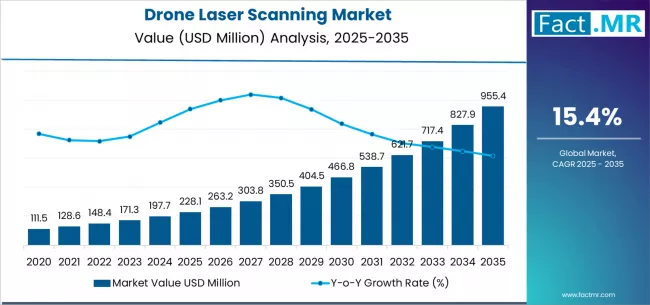
Drone Laser Scanning Market Market Value Analysis | Source: Fact.MR
Summary of Drone Laser Scanning Market
- Market Snapshot
- In 2025, the global Drone Laser Scanning Market was valued at approximately USD 228.1 billion.
- The market is estimated to reach USD 263.2 billion in 2026 and is projected to attain USD 1102.5 billion by 2036.
- The drone laser scanning market is likely to expand at a CAGR of 15.4% during the forecast period.
- The market is anticipated to create an absolute dollar opportunity of USD 839.3 billion between 2026 and 2036.
- LiDAR Scanning Services account for 50% of product share in 2026.
- USA (21%) and Mexico (20%) are the key growth markets during the forecast period.
- Demand and Growth Drivers
- Infrastructure development and construction projects requiring high accuracy topographic survey and monitoring data.
- Volume measurement, stockpile analysis and site monitoring for the mining and resources industry.
- Declining costs of LiDAR sensors are expanding the market for drone-based laser scanning to more commercial applications.
- Technology upgrades in lidar scanning services are improving performance and expanding the range of commercially viable applications.
- Online and direct channels are increasing availability and market access is improving in all price sensitive regions.
- Product and Segment View
- LiDAR Scanning Services will be 50% of market share in 2026 supported by their entrenched position within core applications.
- Construction & Infrastructure will become the dominant use case with a 55% share by 2026.
- Key segmentation includes:
- Product: LiDAR Scanning Services, Photogrammetry Scanning Services, Thermal Laser Scanning Services, Multispectral Scanning Services, Hybrid Scanning Solutions
- Application: Construction and Infrastructure, Mining and Exploration, Agriculture, Energy and Utilities
- End Use: Industrial Sector, Agriculture Sector, Energy Sector, Government Sector
- These systems enable:
- Application-specific performance across diverse operating conditions.
- Integration with monitoring, control, and automation platforms.
- Reliable operation in environments requiring continuous or unattended use.
- Geography and Competitive Outlook
- North America remains a leading regional market, supported by established end-use industries and strong distribution infrastructure.
- Europe maintains steady demand driven by regulatory standards and technology adoption.
- Asia Pacific is emerging as a high-growth region, supported by industrialization and expanding capacity.
- USA (21%) and Mexico (20%) are the key growth markets, with Germany and France also contributing.
- Key companies include Leica Geosystems AG (part of Hexagon AB), RIEGL Laser Measurement Systems GmbH, Trimble Inc., Topcon Corporation, DJI Innovations, FARO Technologies, Inc., Teledyne Optech, Hexagon AB, Velodyne Lidar, Inc., Quantum-Systems GmbH, GeoSLAM Ltd..
- Analyst Opinion
- Shambhu Nath Jha, Principal Consultant at Fact.MR, says 'The drone laser scanning market is a technology-led service category where competitive advantage is built on sensor capability, data processing expertise, and application domain knowledge. The market is expanding rapidly as LiDAR sensor costs decline and commercial awareness of drone-based scanning productivity advantages increases. The growth opportunity spans multiple industries, with construction, mining, agriculture, and energy each representing substantial addressable segments. Companies that combine high-quality sensor hardware with efficient data processing software and deep application domain expertise will capture the most value. The trend toward subscription-based monitoring services tied to recurring site assessment needs offers the most attractive revenue model for service providers seeking predictable income streams.'
Key Growth Drivers, Constraints, and Opportunities
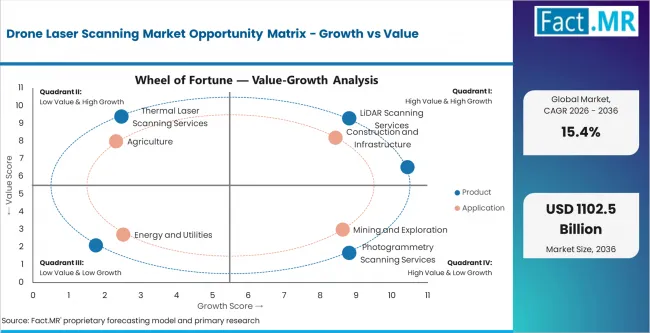
Drone Laser Scanning Market Opportunity Matrix Growth Vs Value | Source: Fact.MR
Key Factors Driving Growth
- Infrastructure development and construction projects requiring high-accuracy topographic survey and progress monitoring data.
- Mining and resource sector demand for volumetric measurement, stockpile analysis, and site monitoring.
- Declining LiDAR sensor costs making drone-based laser scanning accessible to a broader range of commercial applications.
Key Market Constraints
- Data processing complexity and large file sizes require specialized software and skilled operators.
- Regulatory restrictions on drone operations in certain airspace categories limit service coverage in some areas.
- Competition from satellite and manned aircraft remote sensing for large-area survey applications.
Key Opportunity Areas
- Agricultural monitoring adoption using multispectral drone scanning for crop health and yield estimation.
- Energy infrastructure inspection using LiDAR-equipped drones for transmission line and pipeline corridor assessment.
- Subscription-based scanning services providing recurring revenue through regular site monitoring contracts.
Segment-wise Analysis of the Drone Laser Scanning Market
- LiDAR Scanning Services hold 50% of the product type segment in 2026.
- Construction and Infrastructure represents 55% of the application segment in 2026.
- Photogrammetry Scanning Services are growing faster in percentage terms, with share projected to rise as the market diversifies.
The drone laser scanning market is segmented by product, application, end use, technology, formulation, distribution channel, and region. By product type, the market covers lidar scanning services, photogrammetry scanning services, thermal laser scanning services, multispectral scanning services, hybrid scanning solutions. By application, coverage includes construction and infrastructure, mining and exploration, agriculture, energy and utilities.
Which Product Type Segment Dominates the Drone Laser Scanning Market?
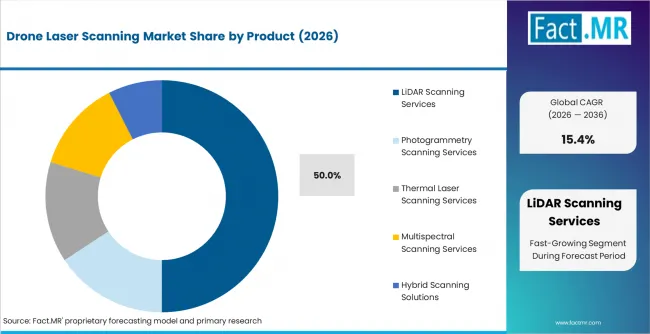
Drone Laser Scanning Market Analysis By Product | Source: Fact.MR
LiDAR Scanning Services account for 50% of the total market value in 2026. Their leadership is supported by established use across mainstream applications, broad availability, and consistent demand.
The category continues to see broad adoption across construction and infrastructure and mining and exploration applications.
Which Application Segment Dominates the Drone Laser Scanning Market?
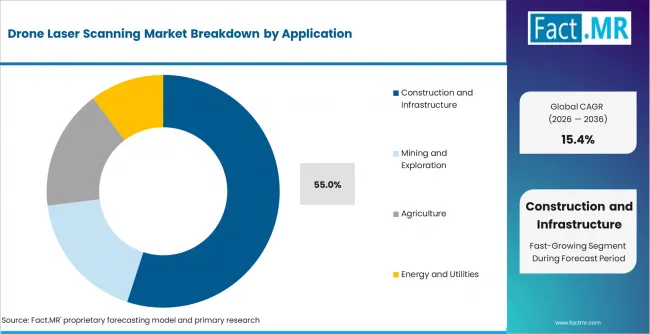
Drone Laser Scanning Market Analysis By Application | Source: Fact.MR
Construction and Infrastructure is expected to be the dominant application segment with 55% of the total market value in 2026.
The segment is expected to consolidate its leadership over the forecast period. Mining and Exploration will remain meaningful but is expected to see its relative contribution stabilize.
Which Product Trend is Shaping the Next Phase of Growth in the Drone Laser Scanning Market?
Hybrid scanning solutions that combine LiDAR with photogrammetry and thermal sensors on a single drone platform are gaining share as end users seek comprehensive geospatial data from a single survey flight. Hybrid platforms reduce the number of separate flights required to capture complete site data, lowering total survey cost and improving data registration accuracy across different sensor modalities.
The shift toward hybrid scanning reflects the growing sophistication of end-user requirements, where construction companies, mining operators, and infrastructure managers need 3D point clouds, orthomosaic imagery, and thermal assessment data delivered as an integrated dataset rather than separate deliverables from multiple survey flights. Service providers and system manufacturers that offer multi-sensor drone platforms with unified data processing workflows are capturing higher contract values and building competitive differentiation against single-sensor operators.
Regional Outlook Across Key Markets
.webp "Top Country Growth Comparison Drone Laser Scanning Market Cagr (2026 2036)")
Top Country Growth Comparison Drone Laser Scanning Market Cagr (2026 2036) | Source: Fact.MR
- USA leads growth at 21%, supported by a large installed base, established distribution channels, and strong end-use industry activity.
- Mexico shows steady demand at 20%, supported by industrial expansion, proximity to North American supply chains, and growing domestic demand.
- Germany shows steady demand at 19%, supported by engineering-grade procurement standards, export manufacturing, and steady replacement cycles.
- France shows steady demand at 18.5%, supported by industrial modernization programs and energy infrastructure investment.
CAGR Table
| Country | CAGR (%) |
|---|---|
| USA | 21% |
| Mexico | 20% |
| Germany | 19% |
| France | 18.5% |
| South Korea | 18.2% |
| UK | 18% |
| Japan | 17.5% |
Source: Fact.MR analysis. Updated May 22, 2026
Source: Fact MR (FMR) analysis, based on proprietary forecasting model and primary research.
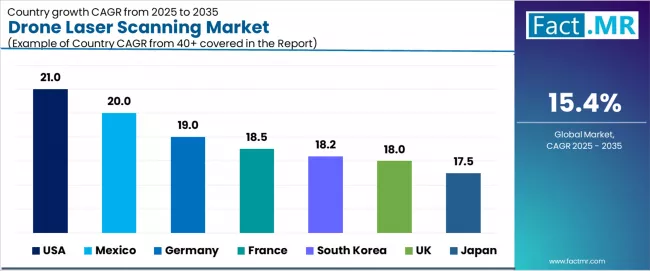
Drone Laser Scanning Market Cagr Analysis By Country | Source: Fact.MR
Market Outlook for Drone Laser Scanning in the United States
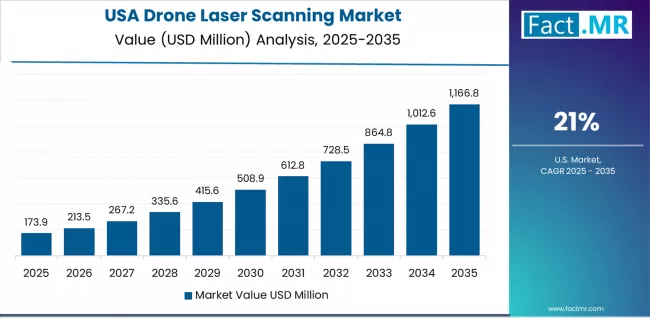
Drone Laser Scanning Market Country Value Analysis | Source: Fact.MR
The U.S. drone laser scanning market is projected to grow at a CAGR of 21% through 2036. Demand is supported by a large installed base, established distribution channels, and strong end-use industry activity.
- Large installed base supports steady replacement demand.
- Premium product adoption is higher than global average.
- Established distribution networks maintain broad market access.
Drone Laser Scanning Demand Trends in Mexico
The Mexico drone laser scanning market is projected to grow at a CAGR of 20% through 2036. Demand is supported by industrial expansion, proximity to North American supply chains, and growing domestic demand.
- Proximity to U.S. supply chains supports cross-border demand.
- Industrial expansion programs drive new equipment procurement.
- Cost-competitive manufacturing base supports regional positioning.
Germany Drone Laser Scanning Market Growth Outlook
The Germany drone laser scanning market is projected to grow at a CAGR of 19% through 2036. Demand is supported by engineering-grade procurement standards, export manufacturing, and steady replacement cycles.
- Engineering standards drive demand for precision-grade equipment.
- Export-oriented manufacturing base supports domestic procurement.
- Regulatory compliance requirements favor certified suppliers.
France Drone Laser Scanning Market Demand Analysis
The France drone laser scanning market is projected to grow at a CAGR of 18.5% through 2036. Demand is supported by industrial modernization programs and energy infrastructure investment.
- Industrial modernization programs support equipment upgrades.
- Energy infrastructure investment creates downstream demand.
- Regional distribution networks provide broad market coverage.
South Korea Drone Laser Scanning Market Growth Assessment
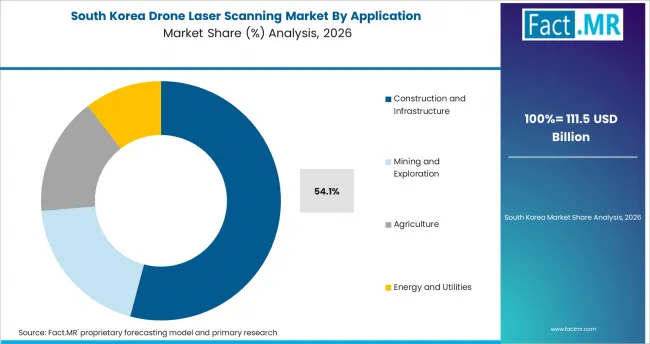
Drone Laser Scanning Market South Korea Market Share Analysis By Application | Source: Fact.MR
The South Korea drone laser scanning market is projected to grow at a CAGR of 18.2% through 2036. Demand is supported by advanced manufacturing activity and technology-driven procurement.
- Advanced manufacturing base supports high-specification demand.
- Technology adoption rates outpace regional averages.
- Export-oriented production drives domestic equipment investment.
Drone Laser Scanning Market Opportunity in UK
The UK drone laser scanning market is projected to grow at a CAGR of 18% through 2036. Demand is supported by steady institutional demand and growing connected product adoption.
- Institutional demand provides a stable procurement base.
- Connected product adoption is increasing among commercial buyers.
- Regulatory standards support higher-specification equipment.
Japan Drone Laser Scanning Demand and Growth Drivers
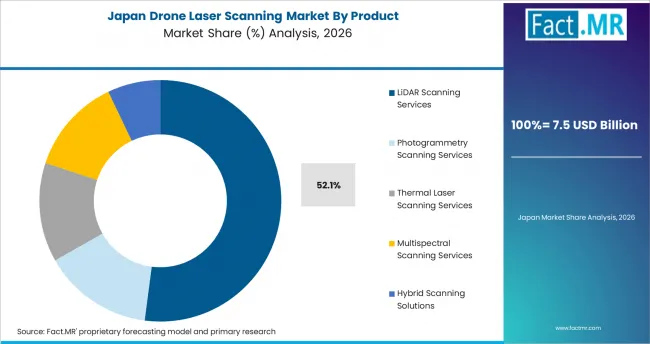
Drone Laser Scanning Market Japan Market Share Analysis By Product | Source: Fact.MR
The Japan drone laser scanning market is projected to grow at a CAGR of 17.5% through 2036. Demand is supported by quality-focused procurement, aging infrastructure replacement, and precision manufacturing demand.
- Quality-focused procurement supports premium product segments.
- Aging infrastructure creates replacement and modernization demand.
- Domestic manufacturing precision standards influence specifications.
Competitive Benchmarking and Company Positioning
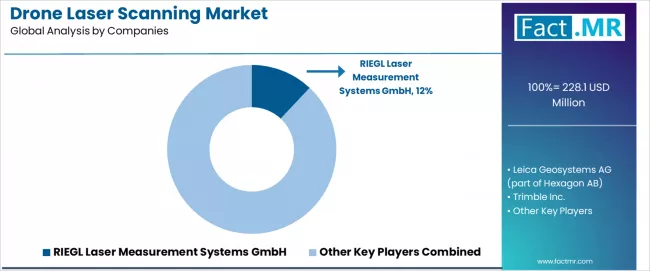
Drone Laser Scanning Market Analysis By Company | Source: Fact.MR
Drone Laser Scanning Market Analysis By Company
- Leica Geosystems AG (part of Hexagon AB), RIEGL Laser Measurement Systems GmbH, Trimble Inc., Topcon Corporation hold established positions in the global drone laser scanning market.
- DJI Innovations, FARO Technologies, Inc., Teledyne Optech, Hexagon AB participate across specific segments, price tiers, and geographic markets.
- Technology integration and service capability are increasingly important differentiators.
The competitive landscape is moderately fragmented. Leica Geosystems AG (part of Hexagon AB), RIEGL Laser Measurement Systems GmbH, Trimble Inc., Topcon Corporation compete through product breadth, technical capability, and distribution reach.
DJI Innovations, FARO Technologies, Inc., Teledyne Optech, Hexagon AB maintain relevance across specific customer groups and channel positions.
Velodyne Lidar, Inc., Quantum-Systems GmbH, GeoSLAM Ltd. compete through focused offerings and niche strength.
Key Companies in the Drone Laser Scanning Market
- Leica Geosystems AG (part of Hexagon AB), RIEGL Laser Measurement Systems GmbH, Trimble Inc., Topcon Corporation are among the leading players globally.
- DJI Innovations, FARO Technologies, Inc., Teledyne Optech, Hexagon AB hold established positions across key segments.
- Velodyne Lidar, Inc., Quantum-Systems GmbH, GeoSLAM Ltd. compete through focused offerings and regional strength.
Recent Industry Developments
- Leica Geosystems AG (part of Hexagon AB), Drone LiDAR System Enhancement (January 2026)
- Leica Geosystems introduced an upgraded drone-mounted LiDAR system with improved point density and range performance, reinforcing its position as the technology leader in precision aerial laser scanning for survey and mapping applications.
- RIEGL Laser Measurement Systems GmbH, Sensor Development and Market Expansion (2025)
- RIEGL advanced its drone LiDAR sensor portfolio with new lightweight, high-performance scanning modules targeting infrastructure inspection and forestry mapping applications.
- Trimble Inc., Geospatial Platform Integration (2025)
- Trimble expanded its geospatial data platform with improved integration between drone-captured LiDAR data and its construction and infrastructure management software, supporting end-to-end survey-to-design workflows.
- DJI Innovations, Commercial Drone LiDAR Platform Launch (February 2026)
- DJI continued enhancing enterprise drone platforms supporting integrated LiDAR workflows for surveying and industrial inspection applications.
Leading Companies Shaping the Drone Laser Scanning Market
- Leica Geosystems AG (part of Hexagon AB)
- RIEGL Laser Measurement Systems GmbH
- Trimble Inc.
- Topcon Corporation
- DJI Innovations
- FARO Technologies, Inc.
- Teledyne Optech
- Hexagon AB
- Velodyne Lidar, Inc.
- Quantum-Systems GmbH
- GeoSLAM Ltd.
Sources and Research References
- Leica Geosystems AG (part of Hexagon AB). Product portfolio updates and market activity.
- RIEGL Laser Measurement Systems GmbH. Product portfolio updates and market activity.
- Trimble Inc.. Product portfolio updates and market activity.
- Industry association statistics, regulatory publications, and trade data.
- Primary interviews with manufacturers, operators, and end users.
This bibliography is provided for reader reference and is not exhaustive. The full report contains the complete reference list and detailed citations.
Key Questions This Report Addresses
- What is the current and future size of the Drone Laser Scanning Market?
- How fast is the drone laser scanning market expected to grow between 2026 and 2036?
- Which product type is likely to lead the market by 2026?
- Which application segment is expected to account for the highest demand by 2026?
- What factors are driving demand globally?
- How is the shift toward advanced configurations influencing the market?
- Why is USA emerging as the fastest-growing market?
- Which countries are projected to show the fastest growth through 2036?
- Who are the key companies active in the Drone Laser Scanning Market?
- How does Fact.MR estimate and validate the market forecast?
Drone Laser Scanning Market Definition
The drone laser scanning market covers commercial services and systems using LiDAR, photogrammetry, thermal, and multispectral drone-mounted sensors for geospatial data capture across survey, mapping, inspection, and monitoring applications. It includes regional and global market size and forecasts for 2026 to 2036 across product type, application, end use, technology, and region.
Drone Laser Scanning Market Inclusions
- The scope covers global and regional market size and forecasts for 2026 to 2036 across product, application, end use, technology, formulation, distribution channel, and region.
- It includes regional demand analysis across major geographies.
- The report includes pricing and cost analysis across entry-level, mid-range, and premium products.
- It covers technology trends, market drivers and constraints, and the competitive landscape.
Drone Laser Scanning Market Exclusions
- The scope excludes products and services not purpose-built for the defined application scope.
- It excludes standalone software platforms and services sold independently.
- The report excludes custom-built non-commercial systems and unbranded products with limited market visibility.
Drone Laser Scanning Market Research Methodology
- The methodology combines secondary research, primary interviews, and forecast modelling.
- It draws on 120+ secondary sources and benchmarks 65+ company product portfolios.
- Market sizing covers 30+ countries through a demand-side model, supported by top-down validation.
- Key inputs include end-use activity levels, infrastructure spending, technology adoption rates, and regulatory conditions.
- The model cross-checks demand with shipments, pricing trends, channel mix, and product launches.
- Primary validation includes 25+ interviews across manufacturers, operators, and end users.
- Final estimates go through trade-flow checks, sales-pattern review, and sensitivity testing.
Segmentation
Scope of Analysis
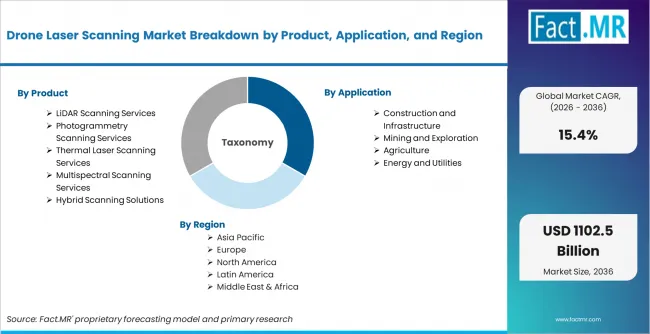
Drone Laser Scanning Market Breakdown By Product, Application, And Region | Source: Fact.MR
| Parameter | Details |
|---|---|
| Quantitative Units | USD 263.2 billion to USD 1102.5 billion, at a CAGR of 15.4% |
| Market Definition | The Drone Laser Scanning Market covers commercial services and systems using LiDAR, photogrammetry, thermal, and multispectral drone-mounted sensors for geospatial data capture across survey, mapping, inspection, and monitoring applications. |
| Regions Covered | North America, Latin America, Europe, East Asia, South Asia and Pacific, Middle East and Africa |
| Countries Covered | USA, Mexico, Germany, France, South Korea, UK, Japan, 30 plus countries |
| Key Companies | Leica Geosystems AG (part of Hexagon AB), RIEGL Laser Measurement Systems GmbH, Trimble Inc., Topcon Corporation, DJI Innovations, FARO Technologies, Inc., Teledyne Optech, Hexagon AB, Velodyne Lidar, Inc., Quantum-Systems GmbH, GeoSLAM Ltd. |
| Forecast Period | 2026 to 2036 |
| Approach | Hybrid demand-side and top-down methodology built on country-level application demand, product benchmarking, pricing analysis, and primary interviews |
Source: Fact.MR analysis. Updated May 22, 2026
Drone Laser Scanning Market Segmentation
-
Drone Laser Scanning Market Segmented by Product:
- LiDAR Scanning Services
- Airborne LiDAR Services
- Topographic LiDAR Scanning
- Corridor Mapping Services
- Terrestrial Integrated LiDAR Services
- Drone Mounted Ground Mapping
- Hybrid Mapping Solutions
- Airborne LiDAR Services
- Photogrammetry Scanning Services
- 2D Mapping Services
- Orthomosaic Mapping
- Aerial Survey Imaging
- 3D Modeling Services
- 3D Reconstruction Models
- Digital Surface Modeling
- 2D Mapping Services
- Thermal Laser Scanning Services
- Heat Mapping Services
- Thermal Terrain Analysis
- Infrastructure Heat Detection
- Energy Inspection Services
- Solar Farm Thermal Scanning
- Power Grid Heat Mapping
- Heat Mapping Services
- Multispectral Scanning Services
- Agriculture Scanning Services
- Crop Health Mapping
- Soil Condition Analysis
- Environmental Monitoring Services
- Vegetation Analysis
- Water Resource Monitoring
- Agriculture Scanning Services
- Hybrid Scanning Solutions
- Integrated Sensor Services
- LiDAR and Imaging Fusion
- Multi Sensor Mapping Systems
- Advanced Mapping Services
- High Precision Surveying
- Digital Twin Creation
- Integrated Sensor Services
- LiDAR Scanning Services
-
Drone Laser Scanning Market Segmented by Application:
- Construction and Infrastructure
- Site Surveying
- Pre Construction Mapping
- Land Assessment Surveys
- Project Monitoring
- Construction Progress Tracking
- Structural Analysis
- Site Surveying
- Mining and Exploration
- Mineral Exploration
- Resource Mapping
- Geological Surveying
- Mine Monitoring
- Open Pit Monitoring
- Underground Mapping
- Mineral Exploration
- Agriculture
- Precision Farming
- Crop Health Monitoring
- Soil Mapping
- Irrigation Management
- Water Distribution Analysis
- Field Condition Monitoring
- Precision Farming
- Energy and Utilities
- Power Infrastructure
- Transmission Line Mapping
- Substation Surveying
- Renewable Energy
- Solar Farm Mapping
- Wind Farm Site Analysis
- Power Infrastructure
- Construction and Infrastructure
-
Drone Laser Scanning Market Segmented by End Use:
- Industrial Sector
- Construction Companies
- Infrastructure Developers
- Engineering Firms
- Mining Companies
- Mineral Extraction Firms
- Exploration Companies
- Construction Companies
- Agriculture Sector
- Farming Enterprises
- Large Scale Farms
- Agricultural Cooperatives
- Agri Tech Companies
- Precision Farming Providers
- Agri Analytics Firms
- Farming Enterprises
- Energy Sector
- Utility Companies
- Electric Power Providers
- Grid Operators
- Renewable Energy Companies
- Solar Energy Firms
- Wind Energy Operators
- Utility Companies
- Government Sector
- Public Authorities
- Municipal Bodies
- Survey Departments
- Defense Organizations
- Military Mapping Units
- Border Survey Agencies
- Public Authorities
- Industrial Sector
-
Drone Laser Scanning Market Segmented by Technology:
- LiDAR Technology
- Time of Flight Systems
- Pulse Based LiDAR
- High Altitude Scanning Systems
- Phase Shift Systems
- Continuous Wave LiDAR
- Short Range High Accuracy Systems
- Time of Flight Systems
- Imaging Technology
- Optical Imaging Systems
- High Resolution Cameras
- HD Video Systems
- Multispectral Imaging
- Vegetation Index Sensors
- Agricultural Analysis Sensors
- Optical Imaging Systems
- Navigation Technology
- GPS Based Systems
- Satellite Navigation Systems
- Real Time Positioning Systems
- Inertial Navigation Systems
- Gyroscopic Systems
- Integrated Positioning Units
- GPS Based Systems
- Data Processing Technology
- Cloud Processing
- Remote Data Platforms
- Storage Systems
- Analytics Systems
- AI Based Processing
- 3D Data Modeling Systems
- Cloud Processing
- LiDAR Technology
-
Drone Laser Scanning Market Segmented by Formulation:
- Service Delivery Models
- Project Based Services
- Short Term Survey Projects
- Custom Mapping Services
- Subscription Services
- Monitoring Service Contracts
- Data Analytics Subscriptions
- Project Based Services
- Operational Models
- In House Operations
- Enterprise Drone Teams
- Surveying Departments
- Outsourced Services
- Third Party Drone Operators
- Managed Service Providers
- In House Operations
- Integrated Service Systems
- End to End Solutions
- Data Capture to Analytics
- Full Lifecycle Mapping Services
- Modular Services
- Standalone Data Collection
- Standalone Data Processing
- End to End Solutions
- Specialized Service Systems
- High Precision Services
- Survey Grade Mapping
- Engineering Grade Analysis
- Compliance Services
- Regulatory Survey Services
- Geospatial Compliance Mapping
- High Precision Services
- Service Delivery Models
-
Drone Laser Scanning Market Segmented by Distribution Channel:
- Direct Contracts
- Enterprise Contracts
- Construction Project Contracts
- Mining Survey Agreements
- Government Contracts
- Public Infrastructure Projects
- Defense Survey Contracts
- Enterprise Contracts
- Service Providers
- Drone Service Companies
- Surveying Service Firms
- Mapping Solution Providers
- Technology Providers
- Software Platform Providers
- Analytics Solution Vendors
- Drone Service Companies
- Channel Partners
- Regional Operators
- Authorized Survey Operators
- Local Service Providers
- Solution Resellers
- Technology Resellers
- Geospatial Vendors
- Regional Operators
- Aftermarket Services
- Maintenance Services
- Drone Maintenance Providers
- Sensor Calibration Services
- Upgrade Services
- Hardware Upgrade Providers
- Software Enhancement Services
- Maintenance Services
- Direct Contracts
-
Drone Laser Scanning Market by Region:
- North America
- USA
- Canada
- Mexico
- Latin America
- Brazil
- Chile
- Rest of Latin America
- Western Europe
- Germany
- UK
- Italy
- Spain
- France
- Nordic
- BENELUX
- Rest of Western Europe
- Eastern Europe
- Russia
- Poland
- Hungary
- Balkan & Baltic
- Rest of Eastern Europe
- East Asia
- China
- Japan
- South Korea
- South Asia and Pacific
- India
- ASEAN
- Australia & New Zealand
- Rest of South Asia and Pacific
- Middle East & Africa
- Kingdom of Saudi Arabia
- Other GCC Countries
- Turkiye
- South Africa
- Other African Union
- Rest of Middle East & Africa
- North America
Frequently Asked Questions
How big is the drone laser scanning market in 2025?
What will be the size of the drone laser scanning market in 2036?
How much will the drone laser scanning market grow between 2026 and 2036?
What are the key product types in the drone laser scanning market?
Which application segment will contribute significant share in the drone laser scanning market in 2026?
Who worked on this report


Preview the report firsthand - request a free sample
Free SampleGet the brochure for pricing and purchase details
Download PDF