Fixed Wing Drone Market Size, Share, Growth and Forecast (2026 - 2036)

The Fixed Wing Drone Market is segmented by Payload (Less than 25 kg, 25 to 150 kg, Above 150 kg), Application (Filming & Photography, Inspection & Maintenance, Mapping & Surveying, Precision Agriculture, Surveillance & Monitoring), End-use Industry (Agriculture & Forestry, Delivery & Logistics, Media & Entertainment, Construction & Mining, Oil & Gas, Security & Law Enforcement), Sales Channel (Online, Offline, OEMs, Aftermarket), Region. Forecast for 2026 to 2036.

Fact.MR analysis indicates that fixed wing drone demand is moving toward long-distance mapping and surveillance missions. The 25 to 150 kg payload segment is projected to lead by payload. OEMs are expected to remain the leading sales channel during the forecast period.

Fixed Wing Drone Market Size, Market Forecast and Outlook by Fact.MR

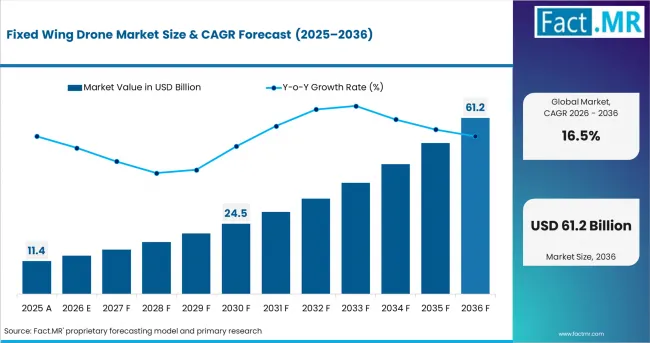
  • The fixed wing drone market crossed a valuation of USD 9.7 billion in 2025. Demand is set to reach USD 11.4 billion in 2026 at a CAGR of 16.5% during the forecast period. Mission demand lifts the valuation to USD 52.5 billion through 2036 as defense users and industrial operators need longer flight endurance.
  • Drone operators are shifting from short-range imaging toward longer aerial missions. Fixed wing platforms serve this shift because they cover large project areas with fewer flight cycles. FAA’s 2025 BVLOS proposal includes requirements for operations and aircraft manufacturing. It covers safe separation and record keeping. [1]
Fixed Wing Drone Market Fixed Wing Drone Market Fixed Wing Drone Market

Summary of fixed wing drone market

  • Market Definition
    • Fixed wing drones are unmanned aircraft built for longer flight time and large-area coverage. Scope is defined by airframe type, payload capacity, mission use, sales channel, and commercial or defense deployment.
  • fixed wing drone market
    • Defense program managers need fixed wing drones for longer ISR missions because the airframe supports wider coverage and safer standoff operations.
    • Survey operations heads use fixed wing platforms to cover farms, mines and construction sites with fewer flight cycles.
    • Utility inspection managers require stable aerial data across pipelines, transmission lines and grid corridors where linear coverage is important.
  • Key Segments Analyzed
    • 25 to 150 kg Payload: The 25 to 150 kg payload segment is projected to account for 65.5% share of fixed wing drone demand by payload in 2026 because it supports heavier sensors and longer flight time.
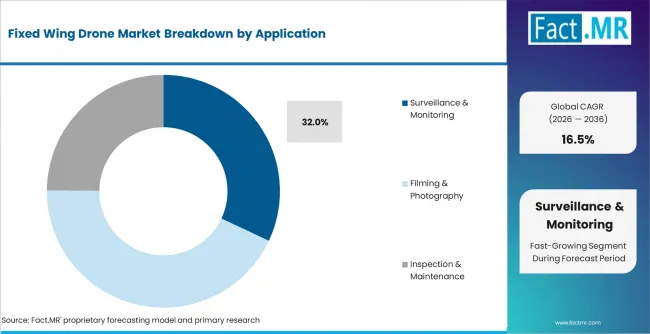
    • Surveillance & Monitoring: Defense and public safety users need wide-area coverage from fewer flights. Surveillance & monitoring is projected to account for 32.0% share of fixed wing drone demand by application in 2026.
    • Security & Law Enforcement: Security & law enforcement is estimated to capture 29.0% share of fixed wing drone demand by end-use industry in 2026 because ISR missions need long flight time and stable payload output.
    • OEMs: OEMs are projected to represent 53.5% share of fixed wing drone demand by sales channel in 2026 because buyers need platform setup and training support.
    • Geography: The United States is forecast to grow at 17.2% CAGR in fixed wing drone demand from 2026 to 2036 because BVLOS rulemaking supports longer commercial missions.
  • Analyst Opinion at Fact.MR
    • Shambhu Nath Jha, Senior Analyst at Fact.MR, notes, “Fixed wing drone growth is tied to mission reliability more than airframe novelty. Buyers want longer range and stable payload output. Suppliers will gain if they combine aircraft performance with training and data delivery.”
  • Strategic Implications
    • Drone manufacturers must align fixed wing designs with BVLOS readiness, mission endurance and payload stability.
    • Industrial operators should assess drones through coverage per flight and data reliability. Integration with mapping software should guide platform selection.
    • Manufacturers can improve retention by offering mission planning and pilot training with the platform. Data support after each flight adds service value.
  • Methodology
    • Fact.MR interviews drone operators and defense program managers, due to inputs from survey firms and utility inspection managers.
    • Research reviews aviation rules and product datasheets, with company disclosures used for supplier checks.
    • Estimates use platform demand and payload class mix, because regional drone readiness used for validation.
    • Forecasts are validated through supplier checks and operator feedback, with regulatory review used for application-level checks.
Metric Details
Industry Size (2026) USD 11.4 billion
Industry Value (2036) USD 52.5 billion
CAGR (2026 to 2036) 16.5%

The main inflection point emerges as BVLOS approvals become more standardized and repeatable across commercial operations. Industrial operators accelerating this transition through trained pilots and formal operating procedures. Structured compliance workflows move fixed wing drones beyond occasional project work. They become scheduled aerial data assets within routine industrial operations.

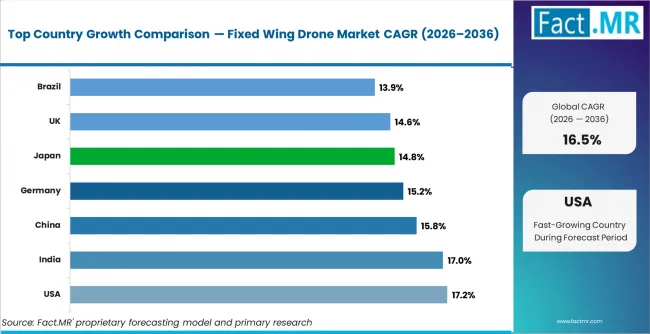
United States fixed wing drone demand is expected to grow at 17.2% CAGR from 2026 to 2036, supported by BVLOS progress and wider use in long-distance inspection. India is likely to record 17.0% CAGR, with defense localization and infrastructure mapping lifting adoption. China is forecast to post 15.8% CAGR as domestic manufacturing scale supports industrial monitoring. Germany is projected to grow at 15.2% CAGR through precision agriculture and surveying demand. Japan may register 14.8% CAGR as disaster assessment use expands. UK demand is likely to rise at 14.6% CAGR, while Brazil records 13.9% CAGR through farm surveillance.

Segmental Analysis

Fixed Wing Drone Market Analysis by Payload

Fixed Wing Drone Market Analysis By Payload

The 25 to 150 kg payload segment is projected to account for 65.5% share of fixed wing drone demand by payload in 2026 because this range supports heavier sensors and longer missions. Surveying and surveillance users need platforms that can carry imaging payloads without cutting flight utility. Delair describes DT46 as a fixed wing platform designed for long endurance and BVLOS operations under applicable regulations. [2]

  • Mission Endurance: Mid-range payload drones support longer flight plans across mapping and inspection tasks. Their balanced weight profile helps operators cover wider areas with fewer flight interruptions.
  • Sensor Use: Operators can deploy imaging payloads with stable mission output. Better payload handling improves data capture during agriculture drone surveys and asset inspection.
  • Platform Choice: Payload capacity guides launch method and route planning. Heavier payload needs push operators toward platforms with stronger airframes and better field reliability.

Fixed Wing Drone Market Analysis by Application
Fixed Wing Drone Market Analysis By Application

Surveillance & monitoring leads because fixed wing drones can cover large sites with fewer flights. Defense and public safety users need long-range views across difficult terrain. The segment is projected to grow for 32.0% share of fixed wing drone demand by application in 2026 because surveillance missions need endurance and stable sensor output.

  • Area Coverage: Surveillance missions need longer flight time across borders and remote assets. Fixed wing drones help operators cover wider routes with fewer flight stops.
  • Inspection Demand: Utilities use fixed wing platforms for longer route coverage. Power lines, pipelines, and rail corridors benefit from steady flight range.
  • Mapping Need: Survey users value consistent data across large land areas. Fixed wing platforms support uniform capture across farms and construction sites.

Fixed Wing Drone Market Analysis by End-use Industry

Fixed Wing Drone Market Analysis By End Use Industry

Security & law enforcement remains the leading end-use industry. Defense users need longer flight duration and stable payload output for reconnaissance missions. Security & law enforcement is estimated to capture 29.0% share of fixed wing drone demand by end-use industry in 2026 because ISR missions need extended aerial inspection services. EASA’s U-space work supports safer long-distance drone operations in Europe. [2]

  • Defense Demand: ISR missions require flight endurance and stable payload output. Fixed wing drones support long-range surveillance across border zones and sensitive defense areas.
  • Public Safety Use: Agencies need aerial views during emergency response. Fixed wing platforms help track disaster zones and search operations.
  • Infrastructure Link: Security-grade systems serve asset monitoring across utilities and transport corridors. Strong range helps operators inspect critical sites with fewer flight cycles.

Fixed Wing Drone Market Analysis by Sales Channel

Fixed Wing Drone Market Analysis By Sales Channel

OEMs stay central in fixed wing drone sales because platforms need configuration and training before deployment. Enterprise buyers often require payload matching, flight planning guidance, and maintenance access for repeat missions. OEMs are expected to account for 53.5% share of fixed wing drone demand by sales channel in 2026. Direct manufacturer support is preferred because defense agencies and utility operators need assured platform compatibility. Mapping operators need timely service response and reliable technical support across field operations.

  • Configuration Support: OEMs help match airframes with mission needs. Payload type, range, and launch conditions influence platform selection.
  • Training Need: Fixed wing systems need pilot training and flight planning support. Skilled operation helps reduce mission risk and improves data quality.
  • Service Depth: Maintenance access affects repeat use in defense accounts. Reliable service support keeps fleets ready for surveillance and field deployment.

Fixed Wing Drone Market Drivers, Restraints, and Opportunities

Fixed Wing Drone Market Opportunity Matrix Growth Vs Value

BVLOS readiness forms the main demand base for fixed wing drones. FAA’s 2025 BVLOS proposal aims to normalize flights beyond visual line of sight through defined operating and safety requirements. Fixed wing platforms benefit from this shift because long-distance missions need predictable approvals and clearer compliance routes. Utility inspection, border surveillance, infrastructure mapping, and agricultural monitoring require aircraft that can cover large areas without constant visual contact. Stronger BVLOS rules can help enterprises plan wider deployments with lower approval uncertainty.

Airspace integration and operator readiness remain the main restraints. FAA’s proposed rule covers aircraft manufacturing, safe separation, operational authorization, security, and record keeping. These requirements may slow adoption for companies that lack trained pilots or internal compliance capacity. Smaller operators may face higher setup costs before commercial deployment.

Opportunities in the Fixed Wing Drone Market

  • BVLOS Operations: Suppliers can grow through platforms built for long-range missions. Fixed wing drones suit inspection and mapping work that needs stable flight beyond direct visual control.
  • Defense ISR: Fixed wing drones can serve missions that need long flight time. Defense agencies use these platforms for border checks and persistent field awareness.
  • Industrial Mapping: Utilities and survey firms need wide-area data with fewer flights. Longer range supports faster coverage across pipelines and large land assets.

Regional Analysis

Top Country Growth Comparison Fixed Wing Drone Market Cagr (2026 2036)

Based on regional analysis, the fixed wing drone market is segmented into North America, Latin America, Western Europe, Eastern Europe, East Asia, South Asia and Pacific, and Middle East and Africa across 30 plus countries.

Country CAGR (2026 to 2036)
United States 17.2%
India 17.0%
China 15.8%
Germany 15.2%
Japan 14.8%
UK 14.6%
Brazil 13.9%

Source: Fact.MR analysis, based on proprietary forecasting model and primary research.
Fixed Wing Drone Market Cagr Analysis By Country

North America Fixed Wing Drone Market Analysis

Fixed Wing Drone Market Country Value Analysis

North America shows strong demand because BVLOS rulemaking and defense use are advancing together. The United States remains the largest country opportunity in the region. Fixed wing drones serve mapping, public safety, and infrastructure inspection. Supplier strength in North America is linked to regulatory support and mission-ready platforms.

  • United States: Fixed wing drone demand in the United States is projected to record 17.2% CAGR from 2026 to 2036 as FAA BVLOS rulemaking supports longer commercial missions. Defense and public safety users need stable payload performance for surveillance, emergency response, and wide-area monitoring. Utility inspection and infrastructure mapping needs add steady enterprise demand. Suppliers with compliance support and maintenance access can gain stronger positions in enterprise accounts.

South Asia and Pacific Fixed Wing Drone Market Analysis

South Asia and Pacific benefits from infrastructure mapping and defense modernization. India is the key growth market because local drone manufacturing and public-sector use cases are expanding. Industrial operators keep close control over platform cost. Longer-range platforms gain interest for large projects that reduce multicopter productivity.

  • India: Infrastructure mapping and defense localization support fixed wing drone use in India. Demand for fixed wing drones in India is anticipated to rise at 17.0% CAGR from 2026 to 2036 as public-sector mapping and industrial monitoring move demand beyond basic imaging. Road, rail, and energy projects need longer flight coverage across large sites. Suppliers with local service access and training support can improve adoption outside major metro regions.

East Asia Fixed Wing Drone Market Analysis
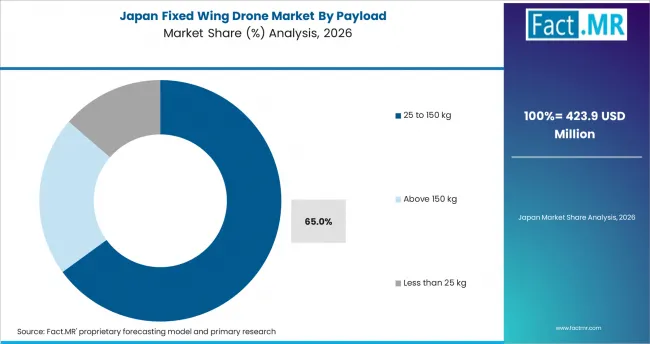
Fixed Wing Drone Market Japan Market Share Analysis By Payload

East Asia demand is supported by manufacturing strength and industrial monitoring. China remains a major platform supply base and a large domestic demand center. Japan has a measured growth profile because adoption follows regulated operating models. Regional competition is shaped by price-performance balance and payload integration.

  • China: China is forecast to post 15.8% CAGR in fixed wing drone demand from 2026 to 2036 as local manufacturing supports platform access and faster product updates. China had over 2 million registered UAVs in 2024, and cumulative annual UAV flight hours surpassed 26 million hours, supporting repeat demand across inspection and security operations. [4]
  • Japan: Inspection and disaster response needs support fixed wing drone use in Japan. Japan’s fixed wing drone demand is expected to grow at 14.8% CAGR from 2026 to 2036 because difficult terrain increases the value of longer flights. Supplier support will affect the shift from trials to routine operations.

Western Europe Fixed Wing Drone Market Analysis
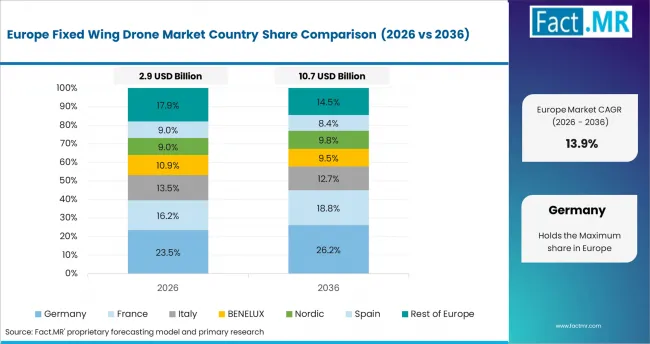
Fixed Wing Drone Market Europe Country Market Share Analysis, 2026 & 2036

Western Europe demand is shaped by regulated drone integration and industrial inspection needs. Germany leads through industrial monitoring and defense-linked adoption. The UK supports fixed wing drone use through public safety and surveying.

  • Germany: Germany is projected to reach 15.2% CAGR in fixed wing drone demand over the assessment period as industrial inspection and defense monitoring need longer aerial coverage. Germany is the 4th‑largest commercial drone market globally, and commercial drone use in the country is projected to grow strongly from 2022 to 2030, driven by expanding applications in infrastructure inspection and security operations. [3]
  • UK: Public safety and infrastructure inspection support fixed wing drone demand in the UK. The UK is expected to expand at 14.6% CAGR from 2026 to 2036 because operators need longer flights for inspection and survey work. Adoption improves as flight permissions and data delivery become easier to manage.

Latin America Fixed Wing Drone Market Analysis

Latin America demand is concentrated in agriculture, mining, and public safety applications. Brazil leads regional demand because large land areas make fixed wing platforms useful for survey and monitoring tasks. Cost sensitivity remains important. Operator training and local service access will shape adoption outside major cities.

  • Brazil: Agriculture and mining support fixed wing drone use in Brazil. Fixed wing drone demand in Brazil is projected to record 13.9% CAGR over the forecast period as large land areas create demand for fewer flight cycles. Farm monitoring and mine surveying need stable coverage across remote sites. Service accessmand operator training will influence repeat purchases among commercial users.

Competitive Aligners for Market Players

Fixed Wing Drone Market Analysis By Company

Fixed wing drone competition includes defense drone suppliers, mapping platform makers, and industrial UAV manufacturers. Alti UAS, Arcturus UAV, A-Techsyn, Autel Robotics, AVY, DJI, Carbonix, Delair, IdeaForge, Lockheed Martin, Quantum-Systems, and Textron compete through endurance, payload integration, and service coverage. Differentiation depends on mission range, sensor compatibility, training support, and maintenance access. Defense accounts value reliability, while commercial operators prioritize mapping quality and lower flight-cycle requirements.

Competitive advantage comes from mission reliability and regulatory readiness. Delair positions its DT61 for very long-distance observation across land and sea areas. DT46 is presented as a platform designed for BVLOS regulation. These claims support Delair’s role in inspection, security, and wide-area monitoring applications. Suppliers that combine endurance with compliance support are better placed for enterprise and public-sector accounts.

Portfolio depth is becoming more important as buyers move from single flights to scheduled aerial data programs. Suppliers that combine aircraft performance with operator training are better placed through 2036. Low-cost drones may serve basic imaging. High-value accounts will favor proven mission systems.

Key Players in Fixed Wing Drone Market

  • Alti UAS
  • Arcturus UAV, Inc.
  • A-Techsyn
  • Autel Robotics
  • AVY
  • DJI
  • Bluebird Aero Systems Ltd.
  • Carbonix
  • Delair
  • Elroy Air
  • Height Technologies
  • Ideaforge
  • Lockheed Martin Corporation
  • Quantum-Systems GmbH
  • Textron Inc.

Bibliography

  • [1]. Federal Aviation Administration. (2025). Beyond Visual Line of Sight (BVLOS). FAA.
  • [2]. European Union Aviation Safety Agency. (2025). EASA certifies ANRA Technologies as first U-space service provider. EASA.
  • [3] International Trade Administration. (2024, May 31). Germany aerospace civil drone market. U.S. Department of Commerce.
  • [4] Civil Aviation Administration of China. (2025, December 24). CAAC releases two mandatory national standards for UAV.

This Report Addresses

  • Strategic intelligence on fixed wing drone demand across mapping, surveillance, inspection, agriculture, and industrial monitoring globally.
  • Market forecast from USD 11.4 billion in 2026 to USD 52.5 billion by 2036 at a CAGR of 16.5%.
  • Growth opportunity mapping across United States BVLOS readiness, India defense localization, China manufacturing scale, Germany industrial inspection, and Japan infrastructure monitoring.
  • Segment analysis by payload, application, end-use industry, sales channel, and region.
  • Regional outlook covering North America BVLOS rulemaking, East Asia manufacturing depth, Europe U-space progress, South Asia public-sector mapping, and Latin America wide-area monitoring.
  • Competitive analysis of Alti UAS, Arcturus UAV, Autel Robotics, DJI, Carbonix, Delair, Ideaforge, Lockheed Martin, Quantum-Systems, and Textron.
  • Product assessment covering fixed wing drones, fixed wing VTOL systems, payload-integrated platforms, tactical ISR drones, and mapping drones.
  • Report delivered through PDF, Excel datasets, and presentation formats, supported by primary interviews, regulatory review, supplier portfolio analysis, operator checks, and application-level validation.

Fixed Wing Drone Market Definition

The fixed wing drone market covers unmanned aircraft that use fixed wings to generate lift during flight. These platforms are used for mapping, inspection, surveillance, agriculture, and logistics-related missions. The market differs from rotary drones because fixed wing systems focus on range and endurance.

Fixed Wing Drone Market Inclusions

The scope includes fixed wing drones, fixed wing VTOL drones, mapping drones, tactical ISR drones, payload-integrated platforms, and ground control systems sold with the drone. Systems used for inspection, surveying, precision agriculture, surveillance, and defense reconnaissance are included if fixed wing flight is the core operating mode.

Fixed Wing Drone Market Exclusions

The scope excludes rotary-only drones, toy drones, passenger eVTOL aircraft, manned aircraft, stand-alone sensors, and drone software sold without fixed wing system integration. Drone services are excluded unless bundled with platform sales. Weapons and munitions are excluded from this platform-focused scope.

Fixed Wing Drone Market Research Methodology

Primary Research:
Primary research includes interviews with defense drone program managers and survey operations heads. Utility inspection managers, agricultural technology managers, and fixed wing drone suppliers are covered separately.

Desk Research:
Desk research reviews aviation rulemaking and drone product datasheets. Defense contract references, company disclosures, operator manuals, and commercial drone regulations are reviewed separately.

Market-Sizing and Forecasting:
Forecasting uses platform demand and payload class demand, with BVLOS readiness linked to defense purchase signals.

Data Validation and Update Cycle:
Forecasts are validated through supplier checks, operator interviews, regulatory tracking, and regional drone program review.

Scope of the Report

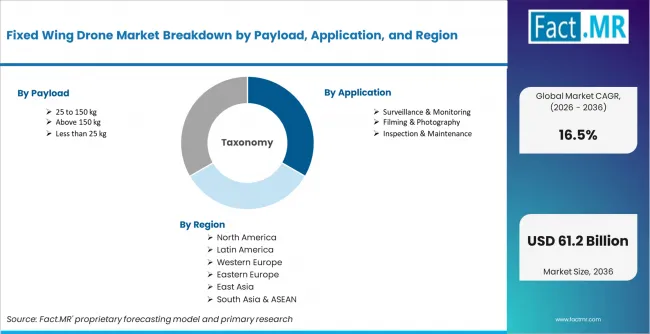
Fixed Wing Drone Market Breakdown By Payload, Application, And Region

Attribute Details
Quantitative Units USD 11.4 billion in 2026 to USD 52.5 billion by 2036, at a CAGR of 16.5%
Market Definition Unmanned fixed wing aircraft used for long-range mapping, inspection, surveillance, agriculture, and logistics-related missions.
Payload Less than 25 kg, 25 to 150 kg, Above 150 kg
Application Filming & Photography, Inspection & Maintenance, Mapping & Surveying, Precision Agriculture, Surveillance & Monitoring
End-use Industry Agriculture & Forestry, Delivery & Logistics, Media & Entertainment, Construction & Mining, Oil & Gas, Security & Law Enforcement
Sales Channel Online, Offline, OEMs, Aftermarket
Regions Covered North America, Latin America, Western Europe, Eastern Europe, East Asia, South Asia and Pacific, Middle East and Africa
Countries Covered United States, India, China, Germany, Japan, UK, Brazil, and 30 plus countries
Key Companies Profiled Alti UAS, Arcturus UAV, A-Techsyn, Autel Robotics, AVY, DJI, Bluebird Aero Systems, Carbonix, Delair, Elroy Air, Ideaforge, Latitude Engineering, Lockheed Martin, Quantum-Systems, Sunbirds, Textron
Forecast Period 2026 to 2036
Approach Hybrid top-down and bottom-up model using platform demand, payload class mix, BVLOS readiness, application spending, and primary interviews with drone buyers.

Fixed Wing Drone Market Analysis by Segments

  • By Payload:

    • Less than 25 kg
    • 25 to 150 kg
    • Above 150 kg
  • By Application:

    • Filming & Photography
    • Inspection & Maintenance
    • Mapping & Surveying
    • Precision Agriculture
    • Surveillance & Monitoring
  • By End-use Industry:

    • Agriculture & Forestry
    • Delivery & Logistics
    • Media & Entertainment
    • Construction & Mining
    • Oil & Gas
    • Security & Law Enforcement
  • By Sales Channel:

    • Online
    • Offline
    • OEMs
    • Aftermarket
  • Region:

    • North America
      • United States
      • Canada
    • Europe
      • Germany
      • United Kingdom
      • France
      • Italy
      • Spain
    • Asia Pacific
      • China
      • Japan
      • South Korea
      • Taiwan
      • Singapore
    • Latin America
      • Brazil
      • Mexico
      • Argentina
    • Middle East & Africa
      • GCC Countries
      • South Africa
      • Israel

- Frequently Asked Questions -

How large is the fixed wing drone market in 2025?

The fixed wing drone market was valued at USD 9.7 billion in 2025.

What is the expected value in 2026?

Demand is estimated to reach USD 11.4 billion in 2026.

What is the forecast value by 2036?

The fixed wing drone market is forecast to reach USD 52.5 billion by 2036.

What CAGR is projected for 2026 to 2036?

Fact.MR projects a CAGR of 16.5% for fixed wing drone demand from 2026 to 2036.

Which payload segment leads demand?

The 25 to 150 kg payload segment leads with 65.5% share of fixed wing drone demand by payload in 2026.

Which application accounts for the highest share?

Surveillance & monitoring leads with 32.0% share of fixed wing drone demand by application in 2026.

Which end-use industry leads demand?

Security & law enforcement leads with 29.0% share of fixed wing drone demand by end-use industry in 2026.

Which sales channel accounts for the highest share?

OEMs lead with 53.5% share of fixed wing drone demand by sales channel in 2026.

Which country shows the fastest growth?

The United States is projected to grow at 17.2% CAGR in fixed wing drone demand from 2026 to 2036.

Why do 25 to 150 kg payload drones lead demand?

This payload class leads because it supports longer missions and heavier sensor packages.

Why does surveillance & monitoring lead application demand?

Surveillance & monitoring leads because fixed wing drones cover large areas with fewer flight cycles.

Why do OEMs lead sales channels?

OEMs lead because buyers need configuration, training, and service support.

Why are fixed wing drones preferred for mapping?

Fixed wing drones can cover larger land areas than rotary platforms during a single flight.

What is the main restraint in this market?

The main restraint is the need for clear airspace approvals and trained operators.

What supports demand in the United States?

BVLOS rulemaking and defense demand support fixed wing drone adoption in the United States.

What supports demand in India?

Defense localization and infrastructure mapping support fixed wing drone demand in India.

What supports demand in China?

Manufacturing scale and industrial monitoring support fixed wing drone demand in China.

Why is BVLOS important for fixed wing drones?

BVLOS permissions support longer missions and match fixed wing drone strengths.

Why is payload integration important?

Payload integration affects mission range and data quality.

What defines competition in this market?

Competition is based on endurance, payload compatibility, operator training, and regulatory support.

Who are the leading companies?

Leading companies include Alti UAS, Arcturus UAV, Autel Robotics, DJI, Delair, Ideaforge, Lockheed Martin, Quantum-Systems, and Textron.

Table of Content

  1. Executive Summary
    • Global Market Outlook
    • Demand to side Trends
    • Supply to side Trends
    • Technology Roadmap Analysis
    • Analysis and Recommendations
  2. Market Overview
    • Market Coverage / Taxonomy
    • Market Definition / Scope / Limitations
  3. Research Methodology
    • Chapter Orientation
    • Analytical Lens and Working Hypotheses
      • Market Structure, Signals, and Trend Drivers
      • Benchmarking and Cross-market Comparability
      • Research Design and Evidence Framework
        • Desk Research Programme (Secondary Evidence)
          • Company Annual and Sustainability Reports
          • Peer-reviewed Journals and Academic Literature
          • Corporate Websites, Product Literature, and Technical Notes
          • Earnings Decks and Investor Briefings
          • Statutory Filings and Regulatory Disclosures
          • Technical White Papers and Standards Notes
          • Trade Journals, Industry Magazines, and Analyst Briefs
          • Conference Proceedings, Webinars, and Seminar Materials
          • Government Statistics Portals and Public Data Releases
          • Press Releases and Reputable Media Coverage
          • Specialist Newsletters and Curated Briefings
          • Sector Databases and Reference Repositories
          • Fact.MR Internal Proprietary Databases and Historical Market Datasets
          • Subscription Datasets and Paid Sources
          • Social Channels, Communities, and Digital Listening Inputs
          • Additional Desk Sources
        • Expert Input and Fieldwork (Primary Evidence)
          • Primary Modes
            • Qualitative Interviews and Expert Elicitation
            • Quantitative Surveys and Structured Data Capture
            • Blended Approach
          • Why Primary Evidence is Used
          • Field Techniques
            • Interviews
            • Surveys
            • Board Members
            • Presidents and Vice Presidents
            • R&D and Innovation Heads
            • Technical Specialists
            • Domain Subject-matter Experts
            • Scientists
            • Physicians and Other Healthcare Professionals
          • Governance, Ethics, and Data Stewardship
            • Research Ethics
            • Data Integrity and Handling
        • Tooling, Models, and Reference Databases
      • Data Engineering and Model Build
        • Data Acquisition and Ingestion
        • Cleaning, Normalisation, and Verification
        • Synthesis, Triangulation, and Analysis
      • Quality Assurance and Audit Trail
    • Market Background
      • Market Dynamics
        • Drivers
        • Restraints
        • Opportunity
        • Trends
      • Scenario Forecast
        • Demand in Optimistic Scenario
        • Demand in Likely Scenario
        • Demand in Conservative Scenario
      • Opportunity Map Analysis
      • Product Life Cycle Analysis
      • Supply Chain Analysis
      • Investment Feasibility Matrix
      • Value Chain Analysis
      • PESTLE and Porter’s Analysis
      • Regulatory Landscape
      • Regional Parent Market Outlook
      • Production and Consumption Statistics
      • Import and Export Statistics
    • Global Market Analysis 2021 to 2025 and Forecast, 2026 to 2036
      • Historical Market Size Value (USD Million) Analysis, 2021 to 2025
      • Current and Future Market Size Value (USD Million) Projections, 2026 to 2036
        • Y to o to Y Growth Trend Analysis
        • Absolute $ Opportunity Analysis
    • Global Market Pricing Analysis 2021 to 2025 and Forecast 2026 to 2036
    • Global Market Analysis 2021 to 2025 and Forecast 2026 to 2036, By Payload
      • Introduction / Key Findings
      • Historical Market Size Value (USD Million) Analysis By Payload , 2021 to 2025
      • Current and Future Market Size Value (USD Million) Analysis and Forecast By Payload , 2026 to 2036
        • 25 to 150 kg
        • Above 150 kg
        • Less than 25 kg
      • Y to o to Y Growth Trend Analysis By Payload , 2021 to 2025
      • Absolute $ Opportunity Analysis By Payload , 2026 to 2036
    • Global Market Analysis 2021 to 2025 and Forecast 2026 to 2036, By Application
      • Introduction / Key Findings
      • Historical Market Size Value (USD Million) Analysis By Application, 2021 to 2025
      • Current and Future Market Size Value (USD Million) Analysis and Forecast By Application, 2026 to 2036
        • Surveillance & Monitoring
        • Filming & Photography
        • Inspection & Maintenance
        • Mapping & Surveying
        • Precision Agriculture
      • Y to o to Y Growth Trend Analysis By Application, 2021 to 2025
      • Absolute $ Opportunity Analysis By Application, 2026 to 2036
    • Global Market Analysis 2021 to 2025 and Forecast 2026 to 2036, By End-use Industry
      • Introduction / Key Findings
      • Historical Market Size Value (USD Million) Analysis By End-use Industry, 2021 to 2025
      • Current and Future Market Size Value (USD Million) Analysis and Forecast By End-use Industry, 2026 to 2036
        • Security & Law Enforcement
        • Agriculture & Forestry
        • Delivery & Logistics
        • Media & Entertainment
        • Construction & Mining
        • Oil & Gas
      • Y to o to Y Growth Trend Analysis By End-use Industry, 2021 to 2025
      • Absolute $ Opportunity Analysis By End-use Industry, 2026 to 2036
    • Global Market Analysis 2021 to 2025 and Forecast 2026 to 2036, By Sales Channel
      • Introduction / Key Findings
      • Historical Market Size Value (USD Million) Analysis By Sales Channel, 2021 to 2025
      • Current and Future Market Size Value (USD Million) Analysis and Forecast By Sales Channel, 2026 to 2036
        • OEMs
        • Online
        • Offline
        • Aftermarket
      • Y to o to Y Growth Trend Analysis By Sales Channel, 2021 to 2025
      • Absolute $ Opportunity Analysis By Sales Channel, 2026 to 2036
    • Global Market Analysis 2021 to 2025 and Forecast 2026 to 2036, By Region
      • Introduction
      • Historical Market Size Value (USD Million) Analysis By Region, 2021 to 2025
      • Current Market Size Value (USD Million) Analysis and Forecast By Region, 2026 to 2036
        • North America
        • Latin America
        • Western Europe
        • Eastern Europe
        • East Asia
        • South Asia and Pacific
        • Middle East & Africa
      • Market Attractiveness Analysis By Region
    • North America Market Analysis 2021 to 2025 and Forecast 2026 to 2036, By Country
      • Historical Market Size Value (USD Million) Trend Analysis By Market Taxonomy, 2021 to 2025
      • Market Size Value (USD Million) Forecast By Market Taxonomy, 2026 to 2036
        • By Country
          • USA
          • Canada
          • Mexico
        • By Payload
        • By Application
        • By End-use Industry
        • By Sales Channel
      • Market Attractiveness Analysis
        • By Country
        • By Payload
        • By Application
        • By End-use Industry
        • By Sales Channel
      • Key Takeaways
    • Latin America Market Analysis 2021 to 2025 and Forecast 2026 to 2036, By Country
      • Historical Market Size Value (USD Million) Trend Analysis By Market Taxonomy, 2021 to 2025
      • Market Size Value (USD Million) Forecast By Market Taxonomy, 2026 to 2036
        • By Country
          • Brazil
          • Chile
          • Rest of Latin America
        • By Payload
        • By Application
        • By End-use Industry
        • By Sales Channel
      • Market Attractiveness Analysis
        • By Country
        • By Payload
        • By Application
        • By End-use Industry
        • By Sales Channel
      • Key Takeaways
    • Western Europe Market Analysis 2021 to 2025 and Forecast 2026 to 2036, By Country
      • Historical Market Size Value (USD Million) Trend Analysis By Market Taxonomy, 2021 to 2025
      • Market Size Value (USD Million) Forecast By Market Taxonomy, 2026 to 2036
        • By Country
          • Germany
          • UK
          • Italy
          • Spain
          • France
          • Nordic
          • BENELUX
          • Rest of Western Europe
        • By Payload
        • By Application
        • By End-use Industry
        • By Sales Channel
      • Market Attractiveness Analysis
        • By Country
        • By Payload
        • By Application
        • By End-use Industry
        • By Sales Channel
      • Key Takeaways
    • Eastern Europe Market Analysis 2021 to 2025 and Forecast 2026 to 2036, By Country
      • Historical Market Size Value (USD Million) Trend Analysis By Market Taxonomy, 2021 to 2025
      • Market Size Value (USD Million) Forecast By Market Taxonomy, 2026 to 2036
        • By Country
          • Russia
          • Poland
          • Hungary
          • Balkan & Baltic
          • Rest of Eastern Europe
        • By Payload
        • By Application
        • By End-use Industry
        • By Sales Channel
      • Market Attractiveness Analysis
        • By Country
        • By Payload
        • By Application
        • By End-use Industry
        • By Sales Channel
      • Key Takeaways
    • East Asia Market Analysis 2021 to 2025 and Forecast 2026 to 2036, By Country
      • Historical Market Size Value (USD Million) Trend Analysis By Market Taxonomy, 2021 to 2025
      • Market Size Value (USD Million) Forecast By Market Taxonomy, 2026 to 2036
        • By Country
          • China
          • Japan
          • South Korea
        • By Payload
        • By Application
        • By End-use Industry
        • By Sales Channel
      • Market Attractiveness Analysis
        • By Country
        • By Payload
        • By Application
        • By End-use Industry
        • By Sales Channel
      • Key Takeaways
    • South Asia and Pacific Market Analysis 2021 to 2025 and Forecast 2026 to 2036, By Country
      • Historical Market Size Value (USD Million) Trend Analysis By Market Taxonomy, 2021 to 2025
      • Market Size Value (USD Million) Forecast By Market Taxonomy, 2026 to 2036
        • By Country
          • India
          • ASEAN
          • Australia & New Zealand
          • Rest of South Asia and Pacific
        • By Payload
        • By Application
        • By End-use Industry
        • By Sales Channel
      • Market Attractiveness Analysis
        • By Country
        • By Payload
        • By Application
        • By End-use Industry
        • By Sales Channel
      • Key Takeaways
    • Middle East & Africa Market Analysis 2021 to 2025 and Forecast 2026 to 2036, By Country
      • Historical Market Size Value (USD Million) Trend Analysis By Market Taxonomy, 2021 to 2025
      • Market Size Value (USD Million) Forecast By Market Taxonomy, 2026 to 2036
        • By Country
          • Kingdom of Saudi Arabia
          • Other GCC Countries
          • Turkiye
          • South Africa
          • Other African Union
          • Rest of Middle East & Africa
        • By Payload
        • By Application
        • By End-use Industry
        • By Sales Channel
      • Market Attractiveness Analysis
        • By Country
        • By Payload
        • By Application
        • By End-use Industry
        • By Sales Channel
      • Key Takeaways
    • Key Countries Market Analysis
      • USA
        • Pricing Analysis
        • Market Share Analysis, 2025
          • By Payload
          • By Application
          • By End-use Industry
          • By Sales Channel
      • Canada
        • Pricing Analysis
        • Market Share Analysis, 2025
          • By Payload
          • By Application
          • By End-use Industry
          • By Sales Channel
      • Mexico
        • Pricing Analysis
        • Market Share Analysis, 2025
          • By Payload
          • By Application
          • By End-use Industry
          • By Sales Channel
      • Brazil
        • Pricing Analysis
        • Market Share Analysis, 2025
          • By Payload
          • By Application
          • By End-use Industry
          • By Sales Channel
      • Chile
        • Pricing Analysis
        • Market Share Analysis, 2025
          • By Payload
          • By Application
          • By End-use Industry
          • By Sales Channel
      • Germany
        • Pricing Analysis
        • Market Share Analysis, 2025
          • By Payload
          • By Application
          • By End-use Industry
          • By Sales Channel
      • UK
        • Pricing Analysis
        • Market Share Analysis, 2025
          • By Payload
          • By Application
          • By End-use Industry
          • By Sales Channel
      • Italy
        • Pricing Analysis
        • Market Share Analysis, 2025
          • By Payload
          • By Application
          • By End-use Industry
          • By Sales Channel
      • Spain
        • Pricing Analysis
        • Market Share Analysis, 2025
          • By Payload
          • By Application
          • By End-use Industry
          • By Sales Channel
      • France
        • Pricing Analysis
        • Market Share Analysis, 2025
          • By Payload
          • By Application
          • By End-use Industry
          • By Sales Channel
      • India
        • Pricing Analysis
        • Market Share Analysis, 2025
          • By Payload
          • By Application
          • By End-use Industry
          • By Sales Channel
      • ASEAN
        • Pricing Analysis
        • Market Share Analysis, 2025
          • By Payload
          • By Application
          • By End-use Industry
          • By Sales Channel
      • Australia & New Zealand
        • Pricing Analysis
        • Market Share Analysis, 2025
          • By Payload
          • By Application
          • By End-use Industry
          • By Sales Channel
      • China
        • Pricing Analysis
        • Market Share Analysis, 2025
          • By Payload
          • By Application
          • By End-use Industry
          • By Sales Channel
      • Japan
        • Pricing Analysis
        • Market Share Analysis, 2025
          • By Payload
          • By Application
          • By End-use Industry
          • By Sales Channel
      • South Korea
        • Pricing Analysis
        • Market Share Analysis, 2025
          • By Payload
          • By Application
          • By End-use Industry
          • By Sales Channel
      • Russia
        • Pricing Analysis
        • Market Share Analysis, 2025
          • By Payload
          • By Application
          • By End-use Industry
          • By Sales Channel
      • Poland
        • Pricing Analysis
        • Market Share Analysis, 2025
          • By Payload
          • By Application
          • By End-use Industry
          • By Sales Channel
      • Hungary
        • Pricing Analysis
        • Market Share Analysis, 2025
          • By Payload
          • By Application
          • By End-use Industry
          • By Sales Channel
      • Kingdom of Saudi Arabia
        • Pricing Analysis
        • Market Share Analysis, 2025
          • By Payload
          • By Application
          • By End-use Industry
          • By Sales Channel
      • Turkiye
        • Pricing Analysis
        • Market Share Analysis, 2025
          • By Payload
          • By Application
          • By End-use Industry
          • By Sales Channel
      • South Africa
        • Pricing Analysis
        • Market Share Analysis, 2025
          • By Payload
          • By Application
          • By End-use Industry
          • By Sales Channel
    • Market Structure Analysis
      • Competition Dashboard
      • Competition Benchmarking
      • Market Share Analysis of Top Players
        • By Regional
        • By Payload
        • By Application
        • By End-use Industry
        • By Sales Channel
    • Competition Analysis
      • Competition Deep Dive
        • Alti UAS
          • Overview
          • Product Portfolio
          • Profitability by Market Segments (Product/Age /Sales Channel/Region)
          • Sales Footprint
          • Strategy Overview
            • Marketing Strategy
            • Product Strategy
            • Channel Strategy
        • Arcturus UAV, Inc.
        • A-Techsyn
        • Autel Robotics
        • AVY
        • DJI
        • Bluebird Aero Systems Ltd.
        • Carbonix
        • Delair
        • Elroy Air
        • Height Technologies
        • Ideaforge
        • Lockheed Martin Corporation
        • Quantum-Systems GmbH
        • Textron Inc.
  4. Assumptions & Acronyms Used

List Of Table

  • Table 1: Global Market Value (USD Million) Forecast by Region, 2021 to 2036
  • Table 2: Global Market Value (USD Million) Forecast by Payload , 2021 to 2036
  • Table 3: Global Market Value (USD Million) Forecast by Application, 2021 to 2036
  • Table 4: Global Market Value (USD Million) Forecast by End-use Industry, 2021 to 2036
  • Table 5: Global Market Value (USD Million) Forecast by Sales Channel, 2021 to 2036
  • Table 6: North America Market Value (USD Million) Forecast by Country, 2021 to 2036
  • Table 7: North America Market Value (USD Million) Forecast by Payload , 2021 to 2036
  • Table 8: North America Market Value (USD Million) Forecast by Application, 2021 to 2036
  • Table 9: North America Market Value (USD Million) Forecast by End-use Industry, 2021 to 2036
  • Table 10: North America Market Value (USD Million) Forecast by Sales Channel, 2021 to 2036
  • Table 11: Latin America Market Value (USD Million) Forecast by Country, 2021 to 2036
  • Table 12: Latin America Market Value (USD Million) Forecast by Payload , 2021 to 2036
  • Table 13: Latin America Market Value (USD Million) Forecast by Application, 2021 to 2036
  • Table 14: Latin America Market Value (USD Million) Forecast by End-use Industry, 2021 to 2036
  • Table 15: Latin America Market Value (USD Million) Forecast by Sales Channel, 2021 to 2036
  • Table 16: Western Europe Market Value (USD Million) Forecast by Country, 2021 to 2036
  • Table 17: Western Europe Market Value (USD Million) Forecast by Payload , 2021 to 2036
  • Table 18: Western Europe Market Value (USD Million) Forecast by Application, 2021 to 2036
  • Table 19: Western Europe Market Value (USD Million) Forecast by End-use Industry, 2021 to 2036
  • Table 20: Western Europe Market Value (USD Million) Forecast by Sales Channel, 2021 to 2036
  • Table 21: Eastern Europe Market Value (USD Million) Forecast by Country, 2021 to 2036
  • Table 22: Eastern Europe Market Value (USD Million) Forecast by Payload , 2021 to 2036
  • Table 23: Eastern Europe Market Value (USD Million) Forecast by Application, 2021 to 2036
  • Table 24: Eastern Europe Market Value (USD Million) Forecast by End-use Industry, 2021 to 2036
  • Table 25: Eastern Europe Market Value (USD Million) Forecast by Sales Channel, 2021 to 2036
  • Table 26: East Asia Market Value (USD Million) Forecast by Country, 2021 to 2036
  • Table 27: East Asia Market Value (USD Million) Forecast by Payload , 2021 to 2036
  • Table 28: East Asia Market Value (USD Million) Forecast by Application, 2021 to 2036
  • Table 29: East Asia Market Value (USD Million) Forecast by End-use Industry, 2021 to 2036
  • Table 30: East Asia Market Value (USD Million) Forecast by Sales Channel, 2021 to 2036
  • Table 31: South Asia and Pacific Market Value (USD Million) Forecast by Country, 2021 to 2036
  • Table 32: South Asia and Pacific Market Value (USD Million) Forecast by Payload , 2021 to 2036
  • Table 33: South Asia and Pacific Market Value (USD Million) Forecast by Application, 2021 to 2036
  • Table 34: South Asia and Pacific Market Value (USD Million) Forecast by End-use Industry, 2021 to 2036
  • Table 35: South Asia and Pacific Market Value (USD Million) Forecast by Sales Channel, 2021 to 2036
  • Table 36: Middle East & Africa Market Value (USD Million) Forecast by Country, 2021 to 2036
  • Table 37: Middle East & Africa Market Value (USD Million) Forecast by Payload , 2021 to 2036
  • Table 38: Middle East & Africa Market Value (USD Million) Forecast by Application, 2021 to 2036
  • Table 39: Middle East & Africa Market Value (USD Million) Forecast by End-use Industry, 2021 to 2036
  • Table 40: Middle East & Africa Market Value (USD Million) Forecast by Sales Channel, 2021 to 2036

List Of Figures

  • Figure 1: Global Market Pricing Analysis
  • Figure 2: Global Market Value (USD Million) Forecast 2021-2036
  • Figure 3: Global Market Value Share and BPS Analysis by Payload , 2026 and 2036
  • Figure 4: Global Market Y-o-Y Growth Comparison by Payload , 2026-2036
  • Figure 5: Global Market Attractiveness Analysis by Payload
  • Figure 6: Global Market Value Share and BPS Analysis by Application, 2026 and 2036
  • Figure 7: Global Market Y-o-Y Growth Comparison by Application, 2026-2036
  • Figure 8: Global Market Attractiveness Analysis by Application
  • Figure 9: Global Market Value Share and BPS Analysis by End-use Industry, 2026 and 2036
  • Figure 10: Global Market Y-o-Y Growth Comparison by End-use Industry, 2026-2036
  • Figure 11: Global Market Attractiveness Analysis by End-use Industry
  • Figure 12: Global Market Value Share and BPS Analysis by Sales Channel, 2026 and 2036
  • Figure 13: Global Market Y-o-Y Growth Comparison by Sales Channel, 2026-2036
  • Figure 14: Global Market Attractiveness Analysis by Sales Channel
  • Figure 15: Global Market Value (USD Million) Share and BPS Analysis by Region, 2026 and 2036
  • Figure 16: Global Market Y-o-Y Growth Comparison by Region, 2026-2036
  • Figure 17: Global Market Attractiveness Analysis by Region
  • Figure 18: North America Market Incremental Dollar Opportunity, 2026-2036
  • Figure 19: Latin America Market Incremental Dollar Opportunity, 2026-2036
  • Figure 20: Western Europe Market Incremental Dollar Opportunity, 2026-2036
  • Figure 21: Eastern Europe Market Incremental Dollar Opportunity, 2026-2036
  • Figure 22: East Asia Market Incremental Dollar Opportunity, 2026-2036
  • Figure 23: South Asia and Pacific Market Incremental Dollar Opportunity, 2026-2036
  • Figure 24: Middle East & Africa Market Incremental Dollar Opportunity, 2026-2036
  • Figure 25: North America Market Value Share and BPS Analysis by Country, 2026 and 2036
  • Figure 26: North America Market Value Share and BPS Analysis by Payload , 2026 and 2036
  • Figure 27: North America Market Y-o-Y Growth Comparison by Payload , 2026-2036
  • Figure 28: North America Market Attractiveness Analysis by Payload
  • Figure 29: North America Market Value Share and BPS Analysis by Application, 2026 and 2036
  • Figure 30: North America Market Y-o-Y Growth Comparison by Application, 2026-2036
  • Figure 31: North America Market Attractiveness Analysis by Application
  • Figure 32: North America Market Value Share and BPS Analysis by End-use Industry, 2026 and 2036
  • Figure 33: North America Market Y-o-Y Growth Comparison by End-use Industry, 2026-2036
  • Figure 34: North America Market Attractiveness Analysis by End-use Industry
  • Figure 35: North America Market Value Share and BPS Analysis by Sales Channel, 2026 and 2036
  • Figure 36: North America Market Y-o-Y Growth Comparison by Sales Channel, 2026-2036
  • Figure 37: North America Market Attractiveness Analysis by Sales Channel
  • Figure 38: Latin America Market Value Share and BPS Analysis by Country, 2026 and 2036
  • Figure 39: Latin America Market Value Share and BPS Analysis by Payload , 2026 and 2036
  • Figure 40: Latin America Market Y-o-Y Growth Comparison by Payload , 2026-2036
  • Figure 41: Latin America Market Attractiveness Analysis by Payload
  • Figure 42: Latin America Market Value Share and BPS Analysis by Application, 2026 and 2036
  • Figure 43: Latin America Market Y-o-Y Growth Comparison by Application, 2026-2036
  • Figure 44: Latin America Market Attractiveness Analysis by Application
  • Figure 45: Latin America Market Value Share and BPS Analysis by End-use Industry, 2026 and 2036
  • Figure 46: Latin America Market Y-o-Y Growth Comparison by End-use Industry, 2026-2036
  • Figure 47: Latin America Market Attractiveness Analysis by End-use Industry
  • Figure 48: Latin America Market Value Share and BPS Analysis by Sales Channel, 2026 and 2036
  • Figure 49: Latin America Market Y-o-Y Growth Comparison by Sales Channel, 2026-2036
  • Figure 50: Latin America Market Attractiveness Analysis by Sales Channel
  • Figure 51: Western Europe Market Value Share and BPS Analysis by Country, 2026 and 2036
  • Figure 52: Western Europe Market Value Share and BPS Analysis by Payload , 2026 and 2036
  • Figure 53: Western Europe Market Y-o-Y Growth Comparison by Payload , 2026-2036
  • Figure 54: Western Europe Market Attractiveness Analysis by Payload
  • Figure 55: Western Europe Market Value Share and BPS Analysis by Application, 2026 and 2036
  • Figure 56: Western Europe Market Y-o-Y Growth Comparison by Application, 2026-2036
  • Figure 57: Western Europe Market Attractiveness Analysis by Application
  • Figure 58: Western Europe Market Value Share and BPS Analysis by End-use Industry, 2026 and 2036
  • Figure 59: Western Europe Market Y-o-Y Growth Comparison by End-use Industry, 2026-2036
  • Figure 60: Western Europe Market Attractiveness Analysis by End-use Industry
  • Figure 61: Western Europe Market Value Share and BPS Analysis by Sales Channel, 2026 and 2036
  • Figure 62: Western Europe Market Y-o-Y Growth Comparison by Sales Channel, 2026-2036
  • Figure 63: Western Europe Market Attractiveness Analysis by Sales Channel
  • Figure 64: Eastern Europe Market Value Share and BPS Analysis by Country, 2026 and 2036
  • Figure 65: Eastern Europe Market Value Share and BPS Analysis by Payload , 2026 and 2036
  • Figure 66: Eastern Europe Market Y-o-Y Growth Comparison by Payload , 2026-2036
  • Figure 67: Eastern Europe Market Attractiveness Analysis by Payload
  • Figure 68: Eastern Europe Market Value Share and BPS Analysis by Application, 2026 and 2036
  • Figure 69: Eastern Europe Market Y-o-Y Growth Comparison by Application, 2026-2036
  • Figure 70: Eastern Europe Market Attractiveness Analysis by Application
  • Figure 71: Eastern Europe Market Value Share and BPS Analysis by End-use Industry, 2026 and 2036
  • Figure 72: Eastern Europe Market Y-o-Y Growth Comparison by End-use Industry, 2026-2036
  • Figure 73: Eastern Europe Market Attractiveness Analysis by End-use Industry
  • Figure 74: Eastern Europe Market Value Share and BPS Analysis by Sales Channel, 2026 and 2036
  • Figure 75: Eastern Europe Market Y-o-Y Growth Comparison by Sales Channel, 2026-2036
  • Figure 76: Eastern Europe Market Attractiveness Analysis by Sales Channel
  • Figure 77: East Asia Market Value Share and BPS Analysis by Country, 2026 and 2036
  • Figure 78: East Asia Market Value Share and BPS Analysis by Payload , 2026 and 2036
  • Figure 79: East Asia Market Y-o-Y Growth Comparison by Payload , 2026-2036
  • Figure 80: East Asia Market Attractiveness Analysis by Payload
  • Figure 81: East Asia Market Value Share and BPS Analysis by Application, 2026 and 2036
  • Figure 82: East Asia Market Y-o-Y Growth Comparison by Application, 2026-2036
  • Figure 83: East Asia Market Attractiveness Analysis by Application
  • Figure 84: East Asia Market Value Share and BPS Analysis by End-use Industry, 2026 and 2036
  • Figure 85: East Asia Market Y-o-Y Growth Comparison by End-use Industry, 2026-2036
  • Figure 86: East Asia Market Attractiveness Analysis by End-use Industry
  • Figure 87: East Asia Market Value Share and BPS Analysis by Sales Channel, 2026 and 2036
  • Figure 88: East Asia Market Y-o-Y Growth Comparison by Sales Channel, 2026-2036
  • Figure 89: East Asia Market Attractiveness Analysis by Sales Channel
  • Figure 90: South Asia and Pacific Market Value Share and BPS Analysis by Country, 2026 and 2036
  • Figure 91: South Asia and Pacific Market Value Share and BPS Analysis by Payload , 2026 and 2036
  • Figure 92: South Asia and Pacific Market Y-o-Y Growth Comparison by Payload , 2026-2036
  • Figure 93: South Asia and Pacific Market Attractiveness Analysis by Payload
  • Figure 94: South Asia and Pacific Market Value Share and BPS Analysis by Application, 2026 and 2036
  • Figure 95: South Asia and Pacific Market Y-o-Y Growth Comparison by Application, 2026-2036
  • Figure 96: South Asia and Pacific Market Attractiveness Analysis by Application
  • Figure 97: South Asia and Pacific Market Value Share and BPS Analysis by End-use Industry, 2026 and 2036
  • Figure 98: South Asia and Pacific Market Y-o-Y Growth Comparison by End-use Industry, 2026-2036
  • Figure 99: South Asia and Pacific Market Attractiveness Analysis by End-use Industry
  • Figure 100: South Asia and Pacific Market Value Share and BPS Analysis by Sales Channel, 2026 and 2036
  • Figure 101: South Asia and Pacific Market Y-o-Y Growth Comparison by Sales Channel, 2026-2036
  • Figure 102: South Asia and Pacific Market Attractiveness Analysis by Sales Channel
  • Figure 103: Middle East & Africa Market Value Share and BPS Analysis by Country, 2026 and 2036
  • Figure 104: Middle East & Africa Market Value Share and BPS Analysis by Payload , 2026 and 2036
  • Figure 105: Middle East & Africa Market Y-o-Y Growth Comparison by Payload , 2026-2036
  • Figure 106: Middle East & Africa Market Attractiveness Analysis by Payload
  • Figure 107: Middle East & Africa Market Value Share and BPS Analysis by Application, 2026 and 2036
  • Figure 108: Middle East & Africa Market Y-o-Y Growth Comparison by Application, 2026-2036
  • Figure 109: Middle East & Africa Market Attractiveness Analysis by Application
  • Figure 110: Middle East & Africa Market Value Share and BPS Analysis by End-use Industry, 2026 and 2036
  • Figure 111: Middle East & Africa Market Y-o-Y Growth Comparison by End-use Industry, 2026-2036
  • Figure 112: Middle East & Africa Market Attractiveness Analysis by End-use Industry
  • Figure 113: Middle East & Africa Market Value Share and BPS Analysis by Sales Channel, 2026 and 2036
  • Figure 114: Middle East & Africa Market Y-o-Y Growth Comparison by Sales Channel, 2026-2036
  • Figure 115: Middle East & Africa Market Attractiveness Analysis by Sales Channel
  • Figure 116: Global Market - Tier Structure Analysis
  • Figure 117: Global Market - Company Share Analysis

Fixed Wing Drone Market