- Base Value(2025): 10297 Mn
- Forecast Value (2035): 23714 Mn
- CAGR (2035): 9.5%
Drone Bearing Market Outlook 2025 to 2035
The global drone bearing market is expected to reach USD 23,714 million by 2035, up from USD 10,297 million in 2025. During the forecast period 2025 to 2035, the industry is projected to expand at a CAGR of 8.7%.
The drone bearing market has been driven by end-user interest in long-lasting, customizable performance characteristics and anticipated linear growth in the high-end UAV components category. Technological advancements and mission-focused preferences continue to propel market expansion.
Quick Stats for Drone Bearing Market
- Industry Value (2025): USD 10,297 Million
- Projected Value (2035): USD 23,714 Million
- Forecast CAGR (2025 to 2035): 8.7%
- Leading Segment (2025): Ball Bearings (37% Market Share)
- Fastest Growing Country (2025-2035): India (11.3% CAGR)
- Top Key Players: SKF Group, The Timken Company, NSK Ltd., NTN Corporation, and Schaeffler Group
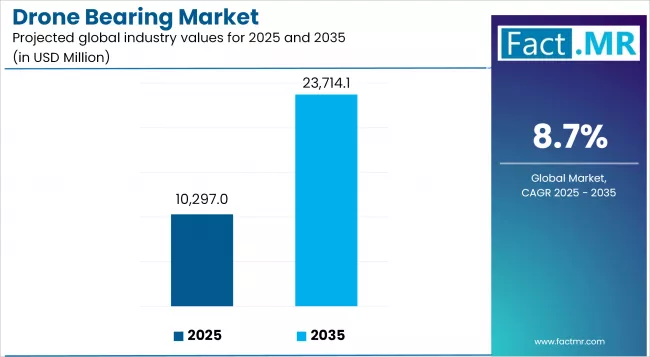
Drone Bearing Market Industry Value Analysis | Source: Fact.MR
What are the drivers of the drone bearing market?
The drone bearing market is undergoing gradual increase with increasing demands of the end-users to long-term and personalized performance on UAV platforms. With operators moving towards premium and mission-ready parts the trend now seems to be more on niche upgrades, becoming standard fits on airframes, similar to the standardization of propellers or ESCs. Mostly used in conjunction with motors, gearboxes, gimbals, and payload mounts, high precision bearings provide superior flight, longer hover time, reduced noise, and long-lasting rotor, servo, and stabilization loads.
Increased attention to safety and reliability promotes adoption in addition to users associating low-friction, low-vibration operation with confidence and operational comfort. Increased access to closed-loop, sealed, and corrosion-free, such as hybrid ceramic designs and clean-room greases, expands the markets to commercial, defense and hobbyist markets.
Access in developing regions is expanding through e-commerce distributors, direct-to-maker storefronts and better access in specialty electronics and hobby outlets. Development of lubrication chemistry, thin-section geometries and engineered surfaces (DLC, TiN) allow extended service life and uniform performance in a broad temperature and humidity spectrum.
Trends in sustainability are also toward lighter architectures, alloys that are recyclable, and longer life cycles to minimize replacement waste. Repeat buying is also speeded up by standardization of OEM platform and retrofit packages.
What are the regional trends of the drone bearing market?
The drone bearing market has a different momentum in the world regions. The U.S. is a leader in a mature market with strong UAV usage in defense, public safety, and industrial inspection in North America. Buyers are demanding not only functional reliability, but performance refinement, and upgrades that minimize vibration are becoming the norm, as well as longer service life. Developed aerospace supply chains and global bearing and motor brand presence allow stable product innovation.
There is also steady expansion in Europe, especially in the U.K., Germany and France where sustainability requirements and airworthiness standards are influencing procurement. Lightweight, low noise, and REACH and RoHS compliant designs are becoming popular. The regulatory framework is pushing toward greener lubricants, material traceability and increased transparency.
Asia Pacific is the fastest expanding region driven by increasing capital spending and accelerating commercialization in China, India and Indonesia. Local and international players are expanding portfolios and localizing specifications to local applications in agriculture, mapping, and logistics.
In the Middle East and Africa, development is being centralized in developed cities and special economic zones. Security, oil and gas inspection and infrastructure monitoring drive procurement to support demands of corrosion resistant and high temperature solutions.
Brazil and Mexico are on the lead as growing robotics ecosystems embrace hygienic-like maintenance standards. Chile and Colombia are on the right track and urban operators are incorporating bearings in preventative maintenance.
What are the challenges and restraining factors of the Drone Bearing market?
The drone bearing market has a few limitations which curtail the growth. One major issue is the price and instability of aerospace quality steels, ceramic balls, precise cages and special purpose lubricants. These inputs increase the costs of a unit and place high-spec bearings beyond the reach of cost sensitive platforms. Qualification and certification cycles can be time and cost-consuming, particularly where defense export controls or airworthiness documentation are involved.
Environmental and regulatory pressures are on the rise in some of the main jurisdictions. PFAS, greases, plating chemistries and noise restrictions are becoming stricter, compelling manufacturers to redesign even as they maintain low friction and corrosion resistance a non-trivial engineering trade-off. Harsh operational environment, dust, salt spray, shock loads, broad temperature variations accelerate wear; sealing increases durability but increases drag and decreases flight performance.
Fragmented supply chains and fake bearings on the internet increase the risks associated with reliability. The effect of tolerances or heat treatment variation can create vibration, reduced motor life and in severe incidents in-flight failures which destroy airframes and reputations.
Other limiting factors are maintenance practices, the benefits of design are frequently nullified by improper installation, excessive lubrication or contamination during field swaps.
Threats of substitution are still present. Large-diameter stator direct-drive motors, niche gimbals using magnetic suspensions, and polymer-bushing linkages with low loads (such as aircraft low-load motors) can lead to a smaller number of bearings per plane. In the developing markets, adoption is limited due to low levels of technical support, importation and duty, and lack of understanding of lifecycle economics, although it can be overcome with time through continued learning and material development.
Country-Wise Insights
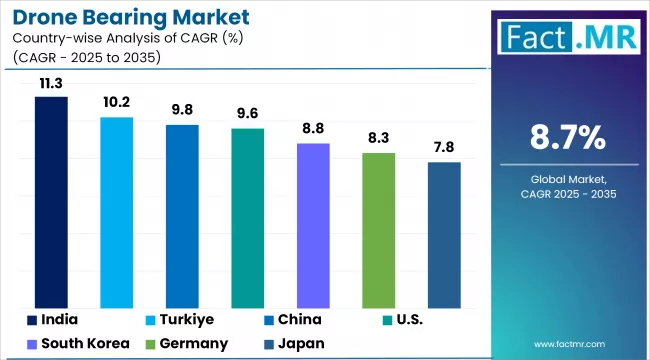
Drone Bearing Market Cagr Analysis By Country | Source: Fact.MR
Safety Certifications and Advanced Supply Chains Propel U.S. Adoption of Precision Drone Bearings Across Industries
The U.S. drone bearing market is taking off with operators focused on long life performance, low noise, and consistent uptime. Suppliers are moving towards safer lubricants and traceable alloys as buyers are increasingly demanding components that have clean-material claims, including PFAS-free greases and RoHS/REACH compliant chemistry, and/or recyclable packaging. The advantage is supporting a shift toward lightweight thin-section, hybrid-ceramic and sealed, maintenance-free designs that balance rotors, gimbals and powertrains.
Reforms in machining, heat treatment, and surface finishing are hastening as a result of policy-based sustainability objectives and more rigid sourcing criteria. The expanded online distribution and direct-to-operator channels are enhancing access to suburban public safety departments, energy utilities and SMB integrators. Mission-based designs, inspection, mapping, and first response promote repeat purchases consistent with duty cycles.
The most important elements are safety, quality, and performance, which increases interest in bearings that combine low friction with strong sealing to dust, water, and shock. The development of long-life greases, DLC/TiN finishes and accuracy cages will continue. With the continuing increase in maintenance literacy and fleet size, high-spec bearings are becoming standard equipment in UAV operations throughout the U.S.
Digital Manufacturing and Localized Supply Resilience Accelerate China’s Drone Bearing Scale-Up for Agriculture and Logistics
The drone-based landscape in China is growing at an accelerated rate, and it has been underpinned by an increased investment in precision agriculture, surveying, and last-mile logistics. The desire of urban and peri-urban operators to have more extended service periods and flight characteristics is creating pressure on high-RPM, low-vibration assemblies. Local product development is being influenced by preferences towards corrosion protection, use of metric standards and sealing that is resistant to humidity.
The new trends focus on technology-oriented designs namely: thin-wall geometries, hybrid-ceramic rolling elements, and time-release lubrication system which remains performance stable despite changes in temperature. The agendas of sustainability and innovation are driving cleaner oil R&D, reduced-waste machining, and recycle cages.
Meanwhile, changing regulatory frameworks informs safer chemistries and more transparent records, which enable uptake in industrial and municipal fleets. Strong e-commerce platforms and expanding specialty retail expand access to SMEs and maker markets. As cultural convergence moves towards pragmatist, outcome-oriented machinery and growing manufacturing belts, China is registering steady growth in all metropolitan regions and optimized cross-regional bells.
Cultural Pragmatism and Value Engineering Expand India’s Market for Durable Drone Bearings in Critical Sectors
The drone bearing market in India is growing progressively due to urbanization, increasing incomes, and increased reliability consciousness in the infrastructure inspection, agriculture, and mining sectors. Bearings are also becoming the preferred upgrade by operators who see them as a low-cost way to cut vibration, increase hover life, and guard against dust and high temperatures that harm motors. Engineered polymers, stainless steels and hybrid-ceramic are well aligned with local operating conditions.
Affordability and access continue to be the core: domestic manufacturers and distributors provide smaller MOQs, modular spares kits, and a service of e-commerce fulfillment to support MSMEs and community drone programs. Organized retailers of electronics and specialized resellers are extending their presence in Tier-2 and Tier-3 cities and enhancing access to sealed and corrosion resistant variants.
Changing standards in safety and materials compliance are influencing formulation and documentation practice to enable buyers to compare lifecycle value and not just initial price. With knowledge disseminating outside of the metro centers, those brands that offer a mix of longevity and price awareness, and those that customize their specifications to meet the demands of each region and its cargo, are poised to tap into the continued segmentation of the diversified UAV ecosystem in India.
Category-Wise Analysis
Hybrid Ceramics and Thin-Section Ball Bearings Lead UAV Precision and Endurance
Ball bearings are still the standard of choice in motors, gimbals, and gearboxes, and thin-section geometries have allowed weight-saving without compromising stiffness. Hybrid ceramic designs (ceramic balls, steel races) provide reduced rolling resistance, reduced-temperature operation over high RPM, and longer service life-important on multirotor platforms with high startstop cycles. Roller bearings are becoming common in high load hubs and gear stages with combined radial and axial forces, whilst plain bearings still have a place in low speed linkages where dust or shock is a problem.
Flight-control surfaces and payload lifts are moving to actuation-centric designs: ball screws and roller screws, with repeatable positioning and enhanced duty life. OEMs are configuring sealed, service-free versions of mission-ready, and aftermarket is taking on pre-shimmed, drop-in assemblies that are easy to replace in the field.
Fleet scale bearing type decisions are becoming more and more dictated by total lifecycle economics, reduced vibration, reduced unplanned swaps, predictable performance over temperature and humidity extremes.
Rotary-Wing Duty Cycles and Field Uptime Drive Platform-Specific Bearing Adoption
The growth engine is rotary-wing (also known as multirotor) aircraft, which require stability at high RPM, low noise, and thermal recovery, which in turn prefer precision ball bearings with advanced cages and long-life greases.
Fixed-wing UAVs value glide efficiency and control-surface repeatability and begin to adopt screws and low-drag bearings in assemblies exposed to airstream. On all platforms, the engine systems and electrified drive systems establish high performance standards: low runout, low noise, and shock-resistance.
Compact bearings on hinges, pods and retractable mounts in aerostructures enable modular payloads and rapid-turn missions. Platform-level standardization and qualification are stressed in OEM channels, and the aftermarket grows with kitted spares, e-commerce distribution, and downtime-reducing calibration services.
The outcome is a platform-by-platform optimization in which bearing selection matches mission profiles, such as long-hover inspection versus high-speed mapping, with thrust efficiency, heat management, and serviceability.
Advanced Materials and Coatings Propel Lightweight, Heat-Resilient Bearing Architectures
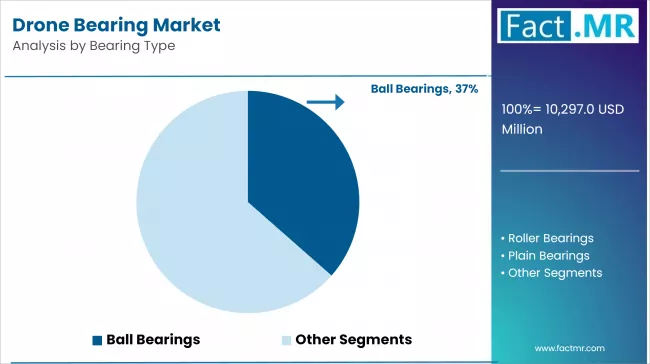
Drone Bearing Market Analysis By Bearing Type | Source: Fact.MR
Specifications are being redefined by materials innovation. Durability during rain, salt, and dust is anchored by using metal alloys (stainless, corrosion-resistant, steels), whereas cutting rotating mass and thermal shock resistance during aggressive duty cycles are achieved by using ceramics. Cages, seals, and some plain bearings with low-friction starts and dry-running insurance are increasingly using engineered plastics and polymers; fiber-reinforced composites are in housings and brackets to minimize system weight.
Coatings - DLC, TiN and anti-corrosive coatings, further inhibit wear and micro-pitting, maintaining noise and vibration levels below levels that impact sensors and video connections. Grease chemistries and recyclability goals are being shaped by sustainability and compliance and are pushing buyers to lubricants with no PFAS or traceable materials without sacrificing durability.
To de-risk supply, OEM programs are moving toward dual-source of metals and ceramics, and the aftermarket consumer is looking at materials that can withstand the variability in installation. Collectively these innovations in the metals, ceramics, polymers, engineered plastics and composites enable a transition to lighter, cooler and longer lasting drone bearing systems.
Competitive Analysis
The drone bearing market is on the rise as operators demand longer life, low noise, and precise and repeatable performance across missions of the UAV. As compliance, safety and sustainability pressures increase, once niche, premium bearings are becoming mainstream. Companies are developing hybrid-ceramic designs, sealed long life greases, PFAS-free chemistries and all-recyclable housings. Demand leans towards certified materials, traceability and sourcing that is free of counterfeits.
The market is consolidating with global players growing through OEM relationships, regional assembly, and application specific R&D. Brands are focusing on high value segments such as inspection, defense, logistics and improving reliability with coatings, thin section geometries and drop-in retrofit kits around the world.
Key players in the drone bearing market include SKF Group, The Timken Company, NSK Ltd., RBC Bearings Incorporated, Schaeffler Group, NTN Corporation, JTEKT Corporation, GGB Bearings Technology, Kaman Corporation, UMBRAGROUP S.p.A. and Thomson Industries, Inc.
Recent Development
- In August 2025, SKF Group agreed to divest its non-core aerospace operation in Elgin, Illinois, to Carco PRP Group, sharpening focus on core aeroengine and aerostructure bearings. The deal, expected to close in Q4 2025, aligns with SKF’s plan to reinvest in digitalization, automation, and factory modernization—supporting high-spec supply for UAV and aerospace customers.
Fact.MR has provided detailed information about the price points of key manufacturers of Drone Bearing Market positioned across regions, sales growth, production capacity, and speculative technological expansion, in the recently published report.
Segmentation
Segmentation of Drone Bearing Market
-
By Platform :
- Fixed-Wing
- Rotary-Wing
- Unmanned Aerial Vehicles
-
By Bearing Type :
- Ball Bearings
- Roller Bearings
- Plain Bearings
- Roller Screws
- Ball Screws
-
By Application :
- Engine Systems
- Aerostructures
- Others
-
By Material :
- Metal
- Ceramic
- Polymer
- Engineered Plastic
- Fiber-Reinforced Composites
-
By Sales Channel :
- OEM
- Aftermarket
-
By Region :
- North America
- Latin America
- Western Europe
- Eastern Europe
- East Asia
- South Asia & Pacific
- Middle East & Africa
Frequently Asked Questions
What was the Global Drone Bearing Market Size Reported by Fact.MR for 2025?
Who are the Major Players Operating in the Drone Bearing Market?
What is the Estimated Valuation of the Drone Bearing Market in 2035?
What Value CAGR did the Drone Bearing Market Exhibit Over the Last Five Years?
Who worked on this report


Preview the report firsthand - request a free sample
Free SampleGet the brochure for pricing and purchase details
Download PDF