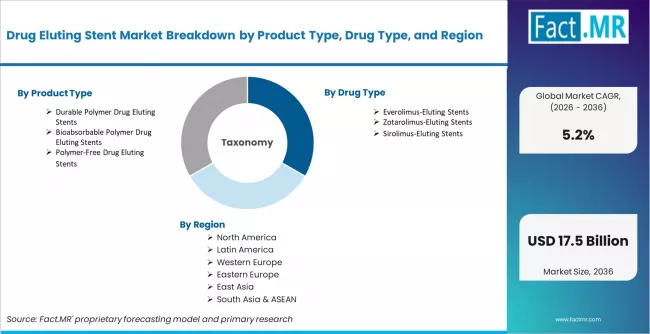
Drug Eluting Stent Market Size, Share, Growth and Forecast (2026 - 2036)

The Drug Eluting Stent Market is segmented by Product Type , Drug Type, Application, End Use , and Region. Forecast for 2026 to 2036.

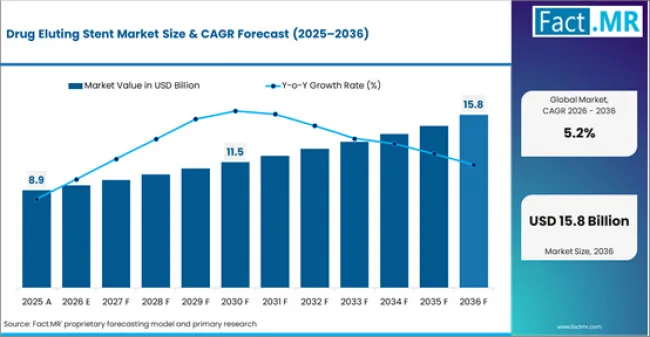
Drug Eluting Stent Market The Drug Eluting Stent Market is segmented by Product Type , Drug Type, Application, End Use , and Region. Forecast for 2026 to 2036. According to Fact.MR estimates The drug eluting stent market was valued at USD 8.9 billion in 2025. According to Fact.MR, demand is projected to reach USD 9.5 billion in 2026 and expand to USD 15.8 billion by 2036, reflecting a CAGR of 5.2% during the forecast period.
Drug Eluting Stent Market Forecast and Outlook By Fact.MR

  • The drug eluting stent market was valued at USD 8.9 billion in 2025.
  • According to Fact.MR, demand is projected to reach USD 9.5 billion in 2026 and expand to USD 15.8 billion by 2036, reflecting a CAGR of 5.2% during the forecast period.

Drug Eluting Stent Market Market Value Analysis

Metric Value
Estimated Value in 2026 USD 9.5 billion
Forecast Value in 2036 USD 15.8 billion
Forecast CAGR (2026 to 2036) 5.2%

Summary of Drug Eluting Stent Market

  • Market Definition
    • The Drug Eluting Stent (DES) Market includes the production and sale of specially coated stents used to open blocked arteries in patients with Coronary Artery Disease. These stents slowly release medication to help prevent the artery from narrowing again after Angioplasty. The market is growing due to the increasing number of heart disease cases, greater use of minimally invasive treatments, and ongoing improvements in stent technology.
  • Demand Drivers
    • Newer-generation DES remain core devices in contemporary coronary revascularization practice.
    • DES platforms continue to evolve through drug, polymer, and delivery-system refinements.
    • Complex PCI, high-bleeding-risk management, and broader lesion coverage continue to support product demand.
  • Key Segments Analyzed
    • By Product Type: Durable Polymer Drug Eluting Stents are estimated to lead with approximately 41% share in 2026, supported by broad installed base and continuing clinical use.
    • By Drug Type: Everolimus-Eluting Stents are expected to hold approximately 29% share in 2026, driven by wide contemporary use.
    • By Application: Coronary Artery Disease is projected to account for approximately 52% share in 2026, supported by routine PCI demand.
    • By End Use: Hospitals are expected to contribute approximately 47% share in 2026, backed by concentration of PCI procedures.
    • By Geography: India leads growth at 6.1% CAGR through 2036, supported by expanding interventional capacity.
  • Analyst Opinion at FACT.MR
    • Shambhu Nath Jha states, “This market should be viewed as a coronary revascularization performance category rather than a mature metal-device segment. Buyers are not only paying for scaffolding. They are paying for deliverability, restenosis control, and procedural confidence across complex lesion sets.”
  • Strategic Implications
    • Invest in DES platforms that combine proven drug performance with stronger deliverability in complex anatomy.
    • Build technical sales capability around lesion coverage, polymer strategy, and DAPT-linked clinical positioning rather than stent profile alone.
    • Position newer-generation DES where operators want balance across healing, flexibility, and complex PCI use.

The market is expected to generate an absolute opportunity of USD 6.3 billion between 2026 and 2036, supported by sustained interventional cardiology demand. Growth is being driven by continued PCI volumes, strong clinical preference for newer-generation DES, and ongoing use in complex lesions and high-risk patient groups. European Society of Cardiology materials from 2024 position contemporary DES as the benchmark comparator in coronary revascularization trials, reinforcing their central role in treatment pathways. Medtronic also highlights its Resolute Onyx platform for complex PCI and high-bleeding-risk patients, supported by short dual antiplatelet therapy (DAPT) evidence.

India is projected to lead with a CAGR of 6.1% through 2036, driven by expanding interventional cardiology capacity and wider PCI adoption. China follows at 5.8%, supported by large coronary disease treatment volumes and growing cath lab infrastructure. The United States is expected to grow at 5.1%, underpinned by mature PCI use and replacement demand for newer-generation DES platforms. Germany records 4.7%, backed by structured revascularization practice and advanced cath lab usage. Brazil grows at 4.5%, supported by rising cardiac intervention access.

Segmental Analysis

Drug Eluting Stent Market Analysis by Product Type
Drug Eluting Stent Market Analysis By Product Type

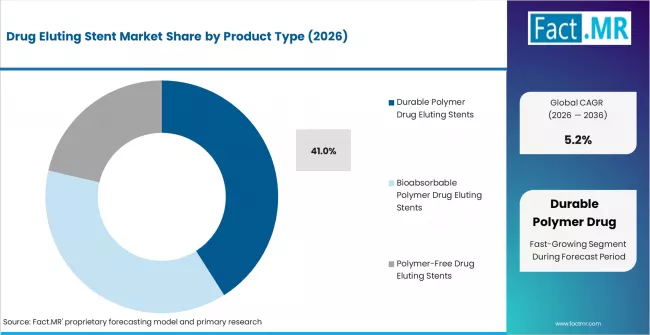
Durable polymer drug eluting stents are expected to capture nearly 41% share in 2026, supported by their deep integration into standard coronary intervention workflows and consistent clinical performance. Medtronic continues to position its Onyx Frontier and Resolute Onyx platforms as core offerings in this segment.

  • Durable polymer DES lead because they combine broad clinical familiarity with established product availability.
  • Bioabsorbable polymer DES remain attractive where healing profile and polymer-resorption messaging matter.
  • Specialty DES gain relevance where large proximal vessels, bifurcations, or high-complexity lesions need tailored platform design.

Drug Eluting Stent Market Analysis by Drug Type
Drug Eluting Stent Market Analysis By Drug Type

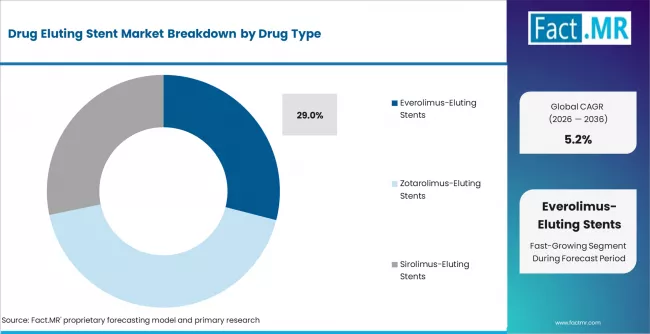
Everolimus-Eluting Stents are expected to hold approximately 29% share in 2026, because everolimus-eluting platforms remain prominent in current coronary stent portfolios, including SYNERGY XD. Zotarolimus-eluting platforms also remain highly relevant through Resolute Onyx and Onyx Frontier. [4]

  • Everolimus-eluting stents lead because they maintain strong representation in current DES portfolios.
  • Zotarolimus-eluting stents remain attractive where complex PCI and broad lesion indications matter.
  • Other limus-family DES gain relevance where local portfolio mix and operator preference vary across regions.

Drug Eluting Stent Market Analysis by Application
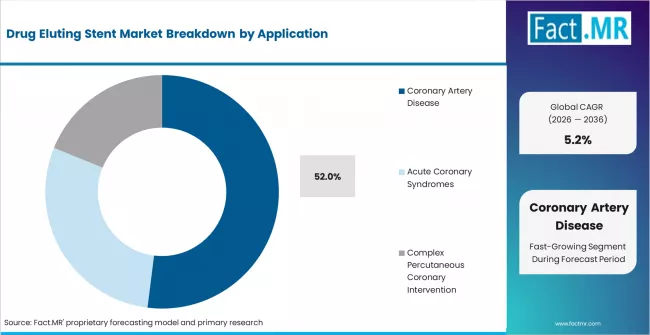
Drug Eluting Stent Market Analysis By Application

Coronary Artery Disease is projected to account for approximately 52% share in 2026, as DES remain most directly tied to routine PCI for coronary lesions. Medtronic describes Resolute Onyx as a DES for coronary artery disease, and ESC materials continue to frame contemporary DES as the benchmark in coronary revascularization comparisons.

  • Coronary artery disease leads because it remains the core therapeutic use case for DES.
  • Acute coronary syndromes remain important where PCI and post-stenting therapy continue to drive device demand. [3]
  • Complex PCI gains relevance where operators need devices suited to bifurcations, chronic total occlusions, and large proximal vessels.

Drug Eluting Stent Market Analysis by End Use
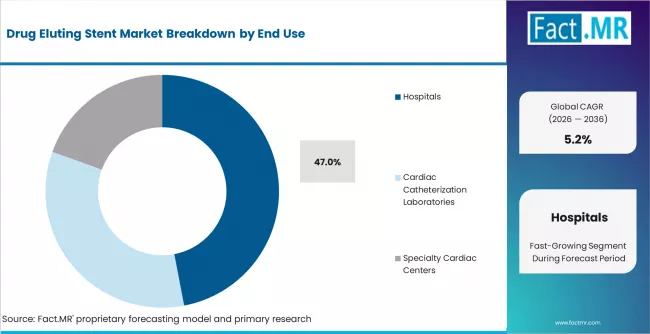
Drug Eluting Stent Market Analysis By End Use

Hospitals are expected to contribute approximately 47% share in 2026. This segment leads because hospitals continue to host the largest share of PCI-capable cath labs and acute coronary intervention capacity. These end-use shares are model-based estimates grounded in the fact that DES implantation remains concentrated in hospital-based interventional settings and specialty cardiac centers rather than distributed outpatient inventory channels. Product positioning from major DES suppliers remains focused on professional hospital and cath lab use.

  • Hospitals lead because they anchor most acute and scheduled PCI activity.
  • Cardiac catheterization laboratories remain attractive where procedural specialization drives product turnover.
  • Specialty cardiac centers gain traction where complex PCI volumes are higher.

Drivers, Restraints, and Opportunities
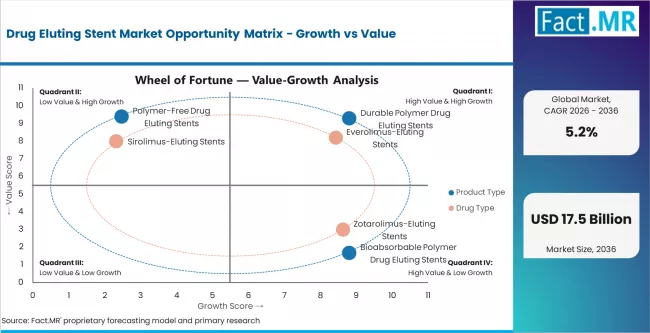
Drug Eluting Stent Market Opportunity Matrix Growth Vs Value

The market is being shaped by the need to keep PCI effective across more complex anatomy and more demanding patient profiles. Structural demand is anchored in the continued role of DES in reducing restenosis and supporting modern coronary intervention. ESC trial communication in 2024 and supplier positioning for complex PCI both reinforce the continuing importance of contemporary DES platforms. [1]

The main restraint is that the market is clinically mature and closely tied to procedural, reimbursement, and post-PCI antiplatelet considerations. ESC commentary continues to emphasize DAPT strategy after PCI, which keeps therapy management closely linked to stent use. In addition, highly established product classes can face incremental, rather than disruptive, innovation cycles.

  • Complex PCI remains the clearest opportunity where operators want stents with stronger lesion coverage and deliverability.
  • Bioabsorbable polymer designs create stronger value where healing and polymer strategy influence buying decisions.
  • Lesion-specific platforms offer higher-value opportunity where large proximal vessels or specialized anatomy need tailored designs.

Regional Analysis

The market is assessed across North America, Europe, Asia Pacific, Latin America, and Middle East and Africa, covering 40+ countries with demand profiles shaped by PCI volume, cath lab access, coronary disease burden, and product availability. The country growth rates below are model-based estimates.

Top Country Growth Comparison Drug Eluting Stent Market Cagr (2026 2036)

Country CAGR (2026 to 2036)
India 6.1%
China 5.8%
United States 5.1%
Germany 4.7%
Brazil 4.5%

North America Drug Eluting Stent Market Analysis
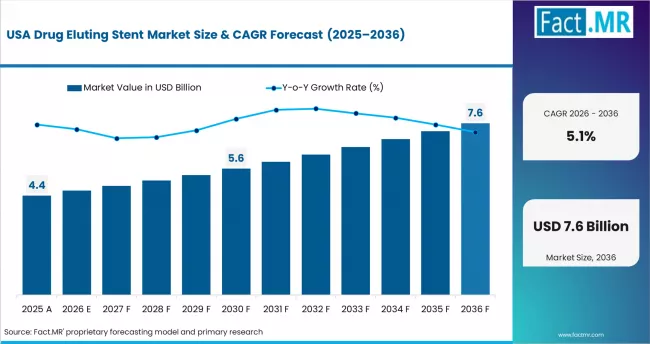
Drug Eluting Stent Market Country Value Analysis

North America remains an important commercial region because it combines mature PCI infrastructure, strong hospital cath lab capacity, and steady replacement demand for advanced DES platforms. Clinical practice in the region is well aligned with guideline-based coronary intervention, and hospitals maintain access to a broad range of contemporary stent technologies.

  • United States: Mature PCI utilization and strong product availability support growth. The market is projected to expand at approximately 5.1% CAGR through 2036, driven by consistent procedure volumes, replacement cycles, and ongoing preference for newer-generation DES with improved safety and efficacy profiles.

Europe Drug Eluting Stent Market Analysis
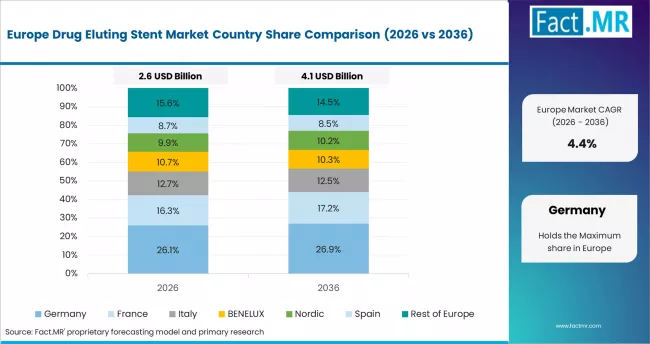
Drug Eluting Stent Market Europe Country Market Share Analysis, 2026 & 2036

Europe remains a technically structured region where adoption is closely tied to guideline-led PCI practices, established revascularization protocols, and access to contemporary DES technologies. Clinical consistency and strong regulatory oversight shape product selection and usage patterns across the region.

  • Germany: Germany plays a central role in the European interventional cardiology landscape due to its advanced hospital infrastructure and high PCI volumes. The market is projected to grow at around 4.7% CAGR through 2036, supported by continued demand for high-performance DES in coronary revascularization procedures. Adoption is driven by adherence to clinical guidelines, availability of advanced devices, and focus on improving patient outcomes through optimized stent technology.

Asia Pacific and Latin America Drug Eluting Stent Market Analysis

Asia Pacific offers the strongest long-term expansion potential because it combines increasing coronary disease burden, expanding interventional cardiology capacity, and improving hospital infrastructure. Latin America contributes through gradual expansion in cardiac care access and procedure volumes.

  • India: Expanding interventional cardiology capacity and broader access to PCI procedures support demand. The market is projected to grow at close to 6.1% CAGR through 2036, driven by rising awareness, improving healthcare infrastructure, and increasing penetration of DES in both public and private hospitals.
  • China: High coronary intervention volumes and expanding healthcare capacity support growth. The market is expected to expand at approximately 5.8% CAGR through 2036, with continued adoption of advanced DES across major cardiac centers.
  • Brazil: Rising access to cardiac interventions and improving hospital capabilities support steady growth. The market is projected to grow at around 4.5% CAGR through 2036, driven by increasing PCI procedures and broader availability of DES technologies.

Competitive Aligners for Market Players
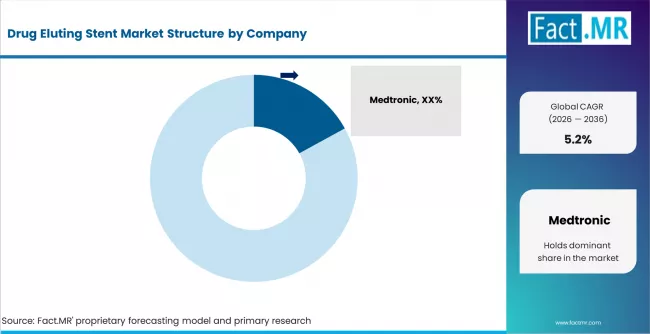
Drug Eluting Stent Market Analysis By Company

The market is moderately concentrated at the coronary-device and interventional cardiology platform level, while broader deployment remains hospital- and operator-controlled. Competitive strength comes from the ability to combine deliverability, drug-polymer performance, and lesion-specific design. Suppliers need more than a stent claim. They need a clear explanation of how the platform improves procedural confidence across routine and complex PCI settings. [2]

Competitive advantage is defined by polymer strategy, drug-elution profile, flexibility, strength, and relevance to complex PCI use cases.

Key Players

  • Medtronic
  • Boston Scientific
  • Abbott
  • Biotronik
  • MicroPort
  • Cardinal Health

Bibliography

  • [1] European Society of Cardiology. 2024 clinical communication discussing contemporary drug-eluting stents as benchmark comparators in coronary revascularization research.
  • [2] Medtronic. Resolute Onyx DES and Onyx Frontier DES materials describing zotarolimus-eluting coronary stent features, complex PCI positioning, and short-DAPT-supported use in selected patients.
  • [3] European Society of Cardiology. 2024 commentary on DAPT after acute coronary syndrome and PCI.
  • [4] Boston Scientific. SYNERGY XD product materials describing an everolimus-eluting, bioabsorbable polymer coronary stent designed for pushability, strength, flexibility, and healing.

This Report Addresses

  • Strategic intelligence on drug eluting stent demand across coronary artery disease treatment, complex PCI, and newer-generation stent design adoption.
  • Market forecast from USD 9.5 billion in 2026 to USD 15.8 billion by 2036 at a CAGR of 5.2%.
  • Growth opportunity mapping across durable polymer DES, bioabsorbable polymer DES, everolimus and zotarolimus platforms, and lesion-specific coronary stent systems.
  • Segment analysis by product type, drug type, application, end use, and region.
  • Regional outlook covering North America, Europe, Asia Pacific, Latin America, and Middle East and Africa.
  • Competitive analysis of major participants serving coronary DES, interventional cardiology platforms, and PCI device ecosystems.
  • Coronary intervention analysis covering restenosis control, polymer strategy, DAPT-linked management, and complex lesion treatment needs.
  • Market interpretation built around sustained PCI demand, newer-generation platform adoption, and continued preference for high-performance coronary DES.

Scope of Report

Drug Eluting Stent Market Breakdown By Product Type, Drug Type, And Region

Attribute Details
Quantitative Units USD 9.5 billion (2026) to USD 15.8 billion (2036), at a CAGR of 5.2%
Market Definition Coronary stent systems that release antiproliferative drugs locally to help reduce restenosis after percutaneous coronary intervention
Product Type Segmentation Durable Polymer Drug Eluting Stents, Bioabsorbable Polymer Drug Eluting Stents, Polymer-Free Drug Eluting Stents, Dual-Therapy and Specialty Drug Eluting Stents, Others
Drug Type Segmentation Everolimus-Eluting Stents, Zotarolimus-Eluting Stents, Sirolimus-Eluting Stents, Biolimus-Eluting Stents, Others
Application Segmentation Coronary Artery Disease, Acute Coronary Syndromes, Complex Percutaneous Coronary Intervention, In-Stent Restenosis Management, Others
End Use Segmentation Hospitals, Cardiac Catheterization Laboratories, Specialty Cardiac Centers, Others
Regions Covered North America, Europe, Asia Pacific, Latin America, Middle East and Africa
Countries Covered United States, Germany, China, India, Brazil, Japan, and 40+ countries
Forecast Period 2026 to 2036
Approach Hybrid top-down and bottom-up model using PCI procedure intensity, product adoption, lesion-complexity trends, and primary interviews with cardiology and cath lab stakeholders

Drug Eluting Stent Market by Segments

  • By Product Type:

    • Durable Polymer Drug Eluting Stents
    • Bioabsorbable Polymer Drug Eluting Stents
    • Polymer-Free Drug Eluting Stents
    • Dual-Therapy and Specialty Drug Eluting Stents
    • Others
  • By Drug Type:

    • Everolimus-Eluting Stents
    • Zotarolimus-Eluting Stents
    • Sirolimus-Eluting Stents
    • Biolimus-Eluting Stents
    • Others
  • By Application:

    • Coronary Artery Disease
    • Acute Coronary Syndromes
    • Complex Percutaneous Coronary Intervention
    • In-Stent Restenosis Management
    • Others
  • By End Use:

    • Hospitals
    • Cardiac Catheterization Laboratories
    • Specialty Cardiac Centers
    • Others
  • By Region:

    • North America
      • United States
      • Canada
      • Mexico
      • Latin America
    • Brazil
      • Argentina
      • Chile
      • Rest of Latin America
      • Western Europe
    • Germany
      • France
      • United Kingdom
      • Italy
      • Spain
      • Nordic Countries
      • BENELUX
      • Rest of Western Europe
    • Eastern Europe
      • Russia
      • Poland
      • Hungary
      • Balkan and Baltic
      • Rest of Eastern Europe
    • East Asia
      • China
      • Japan
      • South Korea
    • South Asia and Pacific
      • India
      • ASEAN
      • Australia and New Zealand
      • Rest of South Asia and Pacific
    • Middle East and Africa
      • Kingdom of Saudi Arabia
      • Other GCC Countries
      • Turkey
      • South Africa
      • Rest of Middle East and Africa

- Frequently Asked Questions -

How large is the global drug eluting stent market in 2025?

The global market was valued at USD 8.9 billion in 2025.

What will the market size be in 2026?

Demand is estimated to reach USD 9.5 billion in 2026.

What is the projected market size by 2036?

The market is projected to reach USD 15.8 billion by 2036, generating USD 6.3 billion in absolute opportunity over the forecast period.

What is the expected CAGR from 2026 to 2036?

Fact.MR projects a CAGR of 5.2% during the 2026 to 2036 period.

Which product type is poised to lead the market?

Durable Polymer Drug Eluting Stents are estimated to lead with approximately 41% share in 2026.

Which application segment holds the largest share?

Coronary Artery Disease is expected to hold approximately 52% share in 2026.

Which country shows the fastest growth?

India is projected to lead growth at 6.1% CAGR through 2036.

What is driving demand for drug eluting stents?

Demand is being driven by continued PCI volume, preference for newer-generation coronary stents, and ongoing need for restenosis control in routine and complex lesions.

What is the key challenge in this market?

The main challenge is balancing product differentiation in a clinically mature category while post-PCI antiplatelet strategy, reimbursement, and procedural practice continue to shape buying decisions.

Table of Content

  1. Executive Summary
    • Global Market Outlook
    • Demand to side Trends
    • Supply to side Trends
    • Technology Roadmap Analysis
    • Analysis and Recommendations
  2. Market Overview
    • Market Coverage / Taxonomy
    • Market Definition / Scope / Limitations
  3. Research Methodology
    • Chapter Orientation
    • Analytical Lens and Working Hypotheses
      • Market Structure, Signals, and Trend Drivers
      • Benchmarking and Cross-market Comparability
      • Market Sizing, Forecasting, and Opportunity Mapping
    • Research Design and Evidence Framework
      • Desk Research Programme (Secondary Evidence)
        • Company Annual and Sustainability Reports
        • Peer-reviewed Journals and Academic Literature
        • Corporate Websites, Product Literature, and Technical Notes
        • Earnings Decks and Investor Briefings
        • Statutory Filings and Regulatory Disclosures
        • Technical White Papers and Standards Notes
        • Trade Journals, Industry Magazines, and Analyst Briefs
        • Conference Proceedings, Webinars, and Seminar Materials
        • Government Statistics Portals and Public Data Releases
        • Press Releases and Reputable Media Coverage
        • Specialist Newsletters and Curated Briefings
        • Sector Databases and Reference Repositories
        • Fact.MR Internal Proprietary Databases and Historical Market Datasets
        • Subscription Datasets and Paid Sources
        • Social Channels, Communities, and Digital Listening Inputs
        • Additional Desk Sources
      • Expert Input and Fieldwork (Primary Evidence)
        • Primary Modes
          • Qualitative Interviews and Expert Elicitation
          • Quantitative Surveys and Structured Data Capture
          • Blended Approach
        • Why Primary Evidence is Used
        • Field Techniques
          • Interviews
          • Surveys
          • Focus Groups
          • Observational and In-context Research
          • Social and Community Interactions
        • Stakeholder Universe Engaged
          • C-suite Leaders
          • Board Members
          • Presidents and Vice Presidents
          • R&D and Innovation Heads
          • Technical Specialists
          • Domain Subject-matter Experts
          • Scientists
          • Physicians and Other Healthcare Professionals
        • Governance, Ethics, and Data Stewardship
          • Research Ethics
          • Data Integrity and Handling
      • Tooling, Models, and Reference Databases
    • Data Engineering and Model Build
      • Data Acquisition and Ingestion
      • Cleaning, Normalisation, and Verification
      • Synthesis, Triangulation, and Analysis
    • Quality Assurance and Audit Trail
  4. Market Background
    • Market Dynamics
      • Drivers
      • Restraints
      • Opportunity
      • Trends
    • Scenario Forecast
      • Demand in Optimistic Scenario
      • Demand in Likely Scenario
      • Demand in Conservative Scenario
    • Opportunity Map Analysis
    • Product Life Cycle Analysis
    • Supply Chain Analysis
    • Investment Feasibility Matrix
    • Value Chain Analysis
    • PESTLE and Porter’s Analysis
    • Regulatory Landscape
    • Regional Parent Market Outlook
    • Production and Consumption Statistics
    • Import and Export Statistics
  5. Global Market Analysis 2021 to 2025 and Forecast, 2026 to 2036
    • Historical Market Size Value (USD Million) Analysis, 2021 to 2025
    • Current and Future Market Size Value (USD Million) Projections, 2026 to 2036
      • Y to o to Y Growth Trend Analysis
      • Absolute $ Opportunity Analysis
  6. Global Market Pricing Analysis 2021 to 2025 and Forecast 2026 to 2036
  7. Global Market Analysis 2021 to 2025 and Forecast 2026 to 2036, By Product Type
    • Introduction / Key Findings
    • Historical Market Size Value (USD Million) Analysis By Product Type , 2021 to 2025
    • Current and Future Market Size Value (USD Million) Analysis and Forecast By Product Type , 2026 to 2036
      • Durable Polymer Drug Eluting Stents
      • Bioabsorbable Polymer Drug Eluting Stents
      • Polymer-Free Drug Eluting Stents
    • Y to o to Y Growth Trend Analysis By Product Type , 2021 to 2025
    • Absolute $ Opportunity Analysis By Product Type , 2026 to 2036
  8. Global Market Analysis 2021 to 2025 and Forecast 2026 to 2036, By Drug Type
    • Introduction / Key Findings
    • Historical Market Size Value (USD Million) Analysis By Drug Type, 2021 to 2025
    • Current and Future Market Size Value (USD Million) Analysis and Forecast By Drug Type, 2026 to 2036
      • Everolimus-Eluting Stents
      • Zotarolimus-Eluting Stents
      • Sirolimus-Eluting Stents
    • Y to o to Y Growth Trend Analysis By Drug Type, 2021 to 2025
    • Absolute $ Opportunity Analysis By Drug Type, 2026 to 2036
  9. Global Market Analysis 2021 to 2025 and Forecast 2026 to 2036, By Application
    • Introduction / Key Findings
    • Historical Market Size Value (USD Million) Analysis By Application, 2021 to 2025
    • Current and Future Market Size Value (USD Million) Analysis and Forecast By Application, 2026 to 2036
      • Coronary Artery Disease
      • Acute Coronary Syndromes
      • Complex Percutaneous Coronary Intervention
    • Y to o to Y Growth Trend Analysis By Application, 2021 to 2025
    • Absolute $ Opportunity Analysis By Application, 2026 to 2036
  10. Global Market Analysis 2021 to 2025 and Forecast 2026 to 2036, By End Use
    • Introduction / Key Findings
    • Historical Market Size Value (USD Million) Analysis By End Use, 2021 to 2025
    • Current and Future Market Size Value (USD Million) Analysis and Forecast By End Use, 2026 to 2036
      • Hospitals
      • Cardiac Catheterization Laboratories
      • Specialty Cardiac Centers
    • Y to o to Y Growth Trend Analysis By End Use, 2021 to 2025
    • Absolute $ Opportunity Analysis By End Use, 2026 to 2036
  11. Global Market Analysis 2021 to 2025 and Forecast 2026 to 2036, By Region
    • Introduction
    • Historical Market Size Value (USD Million) Analysis By Region, 2021 to 2025
    • Current Market Size Value (USD Million) Analysis and Forecast By Region, 2026 to 2036
      • North America
      • Latin America
      • Western Europe
      • Eastern Europe
      • East Asia
      • South Asia and Pacific
      • Middle East & Africa
    • Market Attractiveness Analysis By Region
  12. North America Market Analysis 2021 to 2025 and Forecast 2026 to 2036, By Country
    • Historical Market Size Value (USD Million) Trend Analysis By Market Taxonomy, 2021 to 2025
    • Market Size Value (USD Million) Forecast By Market Taxonomy, 2026 to 2036
      • By Country
        • USA
        • Canada
        • Mexico
      • By Product Type
      • By Drug Type
      • By Application
      • By End Use
    • Market Attractiveness Analysis
      • By Country
      • By Product Type
      • By Drug Type
      • By Application
      • By End Use
    • Key Takeaways
  13. Latin America Market Analysis 2021 to 2025 and Forecast 2026 to 2036, By Country
    • Historical Market Size Value (USD Million) Trend Analysis By Market Taxonomy, 2021 to 2025
    • Market Size Value (USD Million) Forecast By Market Taxonomy, 2026 to 2036
      • By Country
        • Brazil
        • Chile
        • Rest of Latin America
      • By Product Type
      • By Drug Type
      • By Application
      • By End Use
    • Market Attractiveness Analysis
      • By Country
      • By Product Type
      • By Drug Type
      • By Application
      • By End Use
    • Key Takeaways
  14. Western Europe Market Analysis 2021 to 2025 and Forecast 2026 to 2036, By Country
    • Historical Market Size Value (USD Million) Trend Analysis By Market Taxonomy, 2021 to 2025
    • Market Size Value (USD Million) Forecast By Market Taxonomy, 2026 to 2036
      • By Country
        • Germany
        • UK
        • Italy
        • Spain
        • France
        • Nordic
        • BENELUX
        • Rest of Western Europe
      • By Product Type
      • By Drug Type
      • By Application
      • By End Use
    • Market Attractiveness Analysis
      • By Country
      • By Product Type
      • By Drug Type
      • By Application
      • By End Use
    • Key Takeaways
  15. Eastern Europe Market Analysis 2021 to 2025 and Forecast 2026 to 2036, By Country
    • Historical Market Size Value (USD Million) Trend Analysis By Market Taxonomy, 2021 to 2025
    • Market Size Value (USD Million) Forecast By Market Taxonomy, 2026 to 2036
      • By Country
        • Russia
        • Poland
        • Hungary
        • Balkan & Baltic
        • Rest of Eastern Europe
      • By Product Type
      • By Drug Type
      • By Application
      • By End Use
    • Market Attractiveness Analysis
      • By Country
      • By Product Type
      • By Drug Type
      • By Application
      • By End Use
    • Key Takeaways
  16. East Asia Market Analysis 2021 to 2025 and Forecast 2026 to 2036, By Country
    • Historical Market Size Value (USD Million) Trend Analysis By Market Taxonomy, 2021 to 2025
    • Market Size Value (USD Million) Forecast By Market Taxonomy, 2026 to 2036
      • By Country
        • China
        • Japan
        • South Korea
      • By Product Type
      • By Drug Type
      • By Application
      • By End Use
    • Market Attractiveness Analysis
      • By Country
      • By Product Type
      • By Drug Type
      • By Application
      • By End Use
    • Key Takeaways
  17. South Asia and Pacific Market Analysis 2021 to 2025 and Forecast 2026 to 2036, By Country
    • Historical Market Size Value (USD Million) Trend Analysis By Market Taxonomy, 2021 to 2025
    • Market Size Value (USD Million) Forecast By Market Taxonomy, 2026 to 2036
      • By Country
        • India
        • ASEAN
        • Australia & New Zealand
        • Rest of South Asia and Pacific
      • By Product Type
      • By Drug Type
      • By Application
      • By End Use
    • Market Attractiveness Analysis
      • By Country
      • By Product Type
      • By Drug Type
      • By Application
      • By End Use
    • Key Takeaways
  18. Middle East & Africa Market Analysis 2021 to 2025 and Forecast 2026 to 2036, By Country
    • Historical Market Size Value (USD Million) Trend Analysis By Market Taxonomy, 2021 to 2025
    • Market Size Value (USD Million) Forecast By Market Taxonomy, 2026 to 2036
      • By Country
        • Kingdom of Saudi Arabia
        • Other GCC Countries
        • Turkiye
        • South Africa
        • Other African Union
        • Rest of Middle East & Africa
      • By Product Type
      • By Drug Type
      • By Application
      • By End Use
    • Market Attractiveness Analysis
      • By Country
      • By Product Type
      • By Drug Type
      • By Application
      • By End Use
    • Key Takeaways
  19. Key Countries Market Analysis
    • USA
      • Pricing Analysis
      • Market Share Analysis, 2025
        • By Product Type
        • By Drug Type
        • By Application
        • By End Use
    • Canada
      • Pricing Analysis
      • Market Share Analysis, 2025
        • By Product Type
        • By Drug Type
        • By Application
        • By End Use
    • Mexico
      • Pricing Analysis
      • Market Share Analysis, 2025
        • By Product Type
        • By Drug Type
        • By Application
        • By End Use
    • Brazil
      • Pricing Analysis
      • Market Share Analysis, 2025
        • By Product Type
        • By Drug Type
        • By Application
        • By End Use
    • Chile
      • Pricing Analysis
      • Market Share Analysis, 2025
        • By Product Type
        • By Drug Type
        • By Application
        • By End Use
    • Germany
      • Pricing Analysis
      • Market Share Analysis, 2025
        • By Product Type
        • By Drug Type
        • By Application
        • By End Use
    • UK
      • Pricing Analysis
      • Market Share Analysis, 2025
        • By Product Type
        • By Drug Type
        • By Application
        • By End Use
    • Italy
      • Pricing Analysis
      • Market Share Analysis, 2025
        • By Product Type
        • By Drug Type
        • By Application
        • By End Use
    • Spain
      • Pricing Analysis
      • Market Share Analysis, 2025
        • By Product Type
        • By Drug Type
        • By Application
        • By End Use
    • France
      • Pricing Analysis
      • Market Share Analysis, 2025
        • By Product Type
        • By Drug Type
        • By Application
        • By End Use
    • India
      • Pricing Analysis
      • Market Share Analysis, 2025
        • By Product Type
        • By Drug Type
        • By Application
        • By End Use
    • ASEAN
      • Pricing Analysis
      • Market Share Analysis, 2025
        • By Product Type
        • By Drug Type
        • By Application
        • By End Use
    • Australia & New Zealand
      • Pricing Analysis
      • Market Share Analysis, 2025
        • By Product Type
        • By Drug Type
        • By Application
        • By End Use
    • China
      • Pricing Analysis
      • Market Share Analysis, 2025
        • By Product Type
        • By Drug Type
        • By Application
        • By End Use
    • Japan
      • Pricing Analysis
      • Market Share Analysis, 2025
        • By Product Type
        • By Drug Type
        • By Application
        • By End Use
    • South Korea
      • Pricing Analysis
      • Market Share Analysis, 2025
        • By Product Type
        • By Drug Type
        • By Application
        • By End Use
    • Russia
      • Pricing Analysis
      • Market Share Analysis, 2025
        • By Product Type
        • By Drug Type
        • By Application
        • By End Use
    • Poland
      • Pricing Analysis
      • Market Share Analysis, 2025
        • By Product Type
        • By Drug Type
        • By Application
        • By End Use
    • Hungary
      • Pricing Analysis
      • Market Share Analysis, 2025
        • By Product Type
        • By Drug Type
        • By Application
        • By End Use
    • Kingdom of Saudi Arabia
      • Pricing Analysis
      • Market Share Analysis, 2025
        • By Product Type
        • By Drug Type
        • By Application
        • By End Use
    • Turkiye
      • Pricing Analysis
      • Market Share Analysis, 2025
        • By Product Type
        • By Drug Type
        • By Application
        • By End Use
    • South Africa
      • Pricing Analysis
      • Market Share Analysis, 2025
        • By Product Type
        • By Drug Type
        • By Application
        • By End Use
  20. Market Structure Analysis
    • Competition Dashboard
    • Competition Benchmarking
    • Market Share Analysis of Top Players
      • By Regional
      • By Product Type
      • By Drug Type
      • By Application
      • By End Use
  21. Competition Analysis
    • Competition Deep Dive
      • Medtronic
        • Overview
        • Product Portfolio
        • Profitability by Market Segments (Product/Age /Sales Channel/Region)
        • Sales Footprint
        • Strategy Overview
          • Marketing Strategy
          • Product Strategy
          • Channel Strategy
      • Boston Scientific
      • Abbott
      • Biotronik
      • MicroPort
      • Cardinal Health
  22. Assumptions & Acronyms Used

List Of Table

  • Table 1: Global Market Value (USD Million) Forecast by Region, 2021 to 2036
  • Table 2: Global Market Value (USD Million) Forecast by Product Type, 2021 to 2036
  • Table 3: Global Market Value (USD Million) Forecast by Drug Type, 2021 to 2036
  • Table 4: Global Market Value (USD Million) Forecast by Application, 2021 to 2036
  • Table 5: Global Market Value (USD Million) Forecast by End Use, 2021 to 2036
  • Table 6: North America Market Value (USD Million) Forecast by Country, 2021 to 2036
  • Table 7: North America Market Value (USD Million) Forecast by Product Type, 2021 to 2036
  • Table 8: North America Market Value (USD Million) Forecast by Drug Type, 2021 to 2036
  • Table 9: North America Market Value (USD Million) Forecast by Application, 2021 to 2036
  • Table 10: North America Market Value (USD Million) Forecast by End Use, 2021 to 2036
  • Table 11: Latin America Market Value (USD Million) Forecast by Country, 2021 to 2036
  • Table 12: Latin America Market Value (USD Million) Forecast by Product Type, 2021 to 2036
  • Table 13: Latin America Market Value (USD Million) Forecast by Drug Type, 2021 to 2036
  • Table 14: Latin America Market Value (USD Million) Forecast by Application, 2021 to 2036
  • Table 15: Latin America Market Value (USD Million) Forecast by End Use, 2021 to 2036
  • Table 16: Western Europe Market Value (USD Million) Forecast by Country, 2021 to 2036
  • Table 17: Western Europe Market Value (USD Million) Forecast by Product Type, 2021 to 2036
  • Table 18: Western Europe Market Value (USD Million) Forecast by Drug Type, 2021 to 2036
  • Table 19: Western Europe Market Value (USD Million) Forecast by Application, 2021 to 2036
  • Table 20: Western Europe Market Value (USD Million) Forecast by End Use, 2021 to 2036
  • Table 21: Eastern Europe Market Value (USD Million) Forecast by Country, 2021 to 2036
  • Table 22: Eastern Europe Market Value (USD Million) Forecast by Product Type, 2021 to 2036
  • Table 23: Eastern Europe Market Value (USD Million) Forecast by Drug Type, 2021 to 2036
  • Table 24: Eastern Europe Market Value (USD Million) Forecast by Application, 2021 to 2036
  • Table 25: Eastern Europe Market Value (USD Million) Forecast by End Use, 2021 to 2036
  • Table 26: East Asia Market Value (USD Million) Forecast by Country, 2021 to 2036
  • Table 27: East Asia Market Value (USD Million) Forecast by Product Type, 2021 to 2036
  • Table 28: East Asia Market Value (USD Million) Forecast by Drug Type, 2021 to 2036
  • Table 29: East Asia Market Value (USD Million) Forecast by Application, 2021 to 2036
  • Table 30: East Asia Market Value (USD Million) Forecast by End Use, 2021 to 2036
  • Table 31: South Asia and Pacific Market Value (USD Million) Forecast by Country, 2021 to 2036
  • Table 32: South Asia and Pacific Market Value (USD Million) Forecast by Product Type, 2021 to 2036
  • Table 33: South Asia and Pacific Market Value (USD Million) Forecast by Drug Type, 2021 to 2036
  • Table 34: South Asia and Pacific Market Value (USD Million) Forecast by Application, 2021 to 2036
  • Table 35: South Asia and Pacific Market Value (USD Million) Forecast by End Use, 2021 to 2036
  • Table 36: Middle East & Africa Market Value (USD Million) Forecast by Country, 2021 to 2036
  • Table 37: Middle East & Africa Market Value (USD Million) Forecast by Product Type, 2021 to 2036
  • Table 38: Middle East & Africa Market Value (USD Million) Forecast by Drug Type, 2021 to 2036
  • Table 39: Middle East & Africa Market Value (USD Million) Forecast by Application, 2021 to 2036
  • Table 40: Middle East & Africa Market Value (USD Million) Forecast by End Use, 2021 to 2036

List Of Figures

  • Figure 1: Global Market Pricing Analysis
  • Figure 2: Global Market Value (USD Million) Forecast 2021-2036
  • Figure 3: Global Market Value Share and BPS Analysis by Product Type, 2026 and 2036
  • Figure 4: Global Market Y-o-Y Growth Comparison by Product Type, 2026 to 2036
  • Figure 5: Global Market Attractiveness Analysis by Product Type
  • Figure 6: Global Market Value Share and BPS Analysis by Drug Type, 2026 and 2036
  • Figure 7: Global Market Y-o-Y Growth Comparison by Drug Type, 2026 to 2036
  • Figure 8: Global Market Attractiveness Analysis by Drug Type
  • Figure 9: Global Market Value Share and BPS Analysis by Application, 2026 and 2036
  • Figure 10: Global Market Y-o-Y Growth Comparison by Application, 2026 to 2036
  • Figure 11: Global Market Attractiveness Analysis by Application
  • Figure 12: Global Market Value Share and BPS Analysis by End Use, 2026 and 2036
  • Figure 13: Global Market Y-o-Y Growth Comparison by End Use, 2026 to 2036
  • Figure 14: Global Market Attractiveness Analysis by End Use
  • Figure 15: Global Market Value (USD Million) Share and BPS Analysis by Region, 2026 and 2036
  • Figure 16: Global Market Y-o-Y Growth Comparison by Region, 2026 to 2036
  • Figure 17: Global Market Attractiveness Analysis by Region
  • Figure 18: North America Market Incremental Dollar Opportunity, 2026 to 2036
  • Figure 19: Latin America Market Incremental Dollar Opportunity, 2026 to 2036
  • Figure 20: Western Europe Market Incremental Dollar Opportunity, 2026 to 2036
  • Figure 21: Eastern Europe Market Incremental Dollar Opportunity, 2026 to 2036
  • Figure 22: East Asia Market Incremental Dollar Opportunity, 2026 to 2036
  • Figure 23: South Asia and Pacific Market Incremental Dollar Opportunity, 2026 to 2036
  • Figure 24: Middle East & Africa Market Incremental Dollar Opportunity, 2026 to 2036
  • Figure 25: North America Market Value Share and BPS Analysis by Country, 2026 and 2036
  • Figure 26: North America Market Value Share and BPS Analysis by Product Type, 2026 and 2036
  • Figure 27: North America Market Y-o-Y Growth Comparison by Product Type, 2026 to 2036
  • Figure 28: North America Market Attractiveness Analysis by Product Type
  • Figure 29: North America Market Value Share and BPS Analysis by Drug Type, 2026 and 2036
  • Figure 30: North America Market Y-o-Y Growth Comparison by Drug Type, 2026 to 2036
  • Figure 31: North America Market Attractiveness Analysis by Drug Type
  • Figure 32: North America Market Value Share and BPS Analysis by Application, 2026 and 2036
  • Figure 33: North America Market Y-o-Y Growth Comparison by Application, 2026 to 2036
  • Figure 34: North America Market Attractiveness Analysis by Application
  • Figure 35: North America Market Value Share and BPS Analysis by End Use, 2026 and 2036
  • Figure 36: North America Market Y-o-Y Growth Comparison by End Use, 2026 to 2036
  • Figure 37: North America Market Attractiveness Analysis by End Use
  • Figure 38: Latin America Market Value Share and BPS Analysis by Country, 2026 and 2036
  • Figure 39: Latin America Market Value Share and BPS Analysis by Product Type, 2026 and 2036
  • Figure 40: Latin America Market Y-o-Y Growth Comparison by Product Type, 2026 to 2036
  • Figure 41: Latin America Market Attractiveness Analysis by Product Type
  • Figure 42: Latin America Market Value Share and BPS Analysis by Drug Type, 2026 and 2036
  • Figure 43: Latin America Market Y-o-Y Growth Comparison by Drug Type, 2026 to 2036
  • Figure 44: Latin America Market Attractiveness Analysis by Drug Type
  • Figure 45: Latin America Market Value Share and BPS Analysis by Application, 2026 and 2036
  • Figure 46: Latin America Market Y-o-Y Growth Comparison by Application, 2026 to 2036
  • Figure 47: Latin America Market Attractiveness Analysis by Application
  • Figure 48: Latin America Market Value Share and BPS Analysis by End Use, 2026 and 2036
  • Figure 49: Latin America Market Y-o-Y Growth Comparison by End Use, 2026 to 2036
  • Figure 50: Latin America Market Attractiveness Analysis by End Use
  • Figure 51: Western Europe Market Value Share and BPS Analysis by Country, 2026 and 2036
  • Figure 52: Western Europe Market Value Share and BPS Analysis by Product Type, 2026 and 2036
  • Figure 53: Western Europe Market Y-o-Y Growth Comparison by Product Type, 2026 to 2036
  • Figure 54: Western Europe Market Attractiveness Analysis by Product Type
  • Figure 55: Western Europe Market Value Share and BPS Analysis by Drug Type, 2026 and 2036
  • Figure 56: Western Europe Market Y-o-Y Growth Comparison by Drug Type, 2026 to 2036
  • Figure 57: Western Europe Market Attractiveness Analysis by Drug Type
  • Figure 58: Western Europe Market Value Share and BPS Analysis by Application, 2026 and 2036
  • Figure 59: Western Europe Market Y-o-Y Growth Comparison by Application, 2026 to 2036
  • Figure 60: Western Europe Market Attractiveness Analysis by Application
  • Figure 61: Western Europe Market Value Share and BPS Analysis by End Use, 2026 and 2036
  • Figure 62: Western Europe Market Y-o-Y Growth Comparison by End Use, 2026 to 2036
  • Figure 63: Western Europe Market Attractiveness Analysis by End Use
  • Figure 64: Eastern Europe Market Value Share and BPS Analysis by Country, 2026 and 2036
  • Figure 65: Eastern Europe Market Value Share and BPS Analysis by Product Type, 2026 and 2036
  • Figure 66: Eastern Europe Market Y-o-Y Growth Comparison by Product Type, 2026 to 2036
  • Figure 67: Eastern Europe Market Attractiveness Analysis by Product Type
  • Figure 68: Eastern Europe Market Value Share and BPS Analysis by Drug Type, 2026 and 2036
  • Figure 69: Eastern Europe Market Y-o-Y Growth Comparison by Drug Type, 2026 to 2036
  • Figure 70: Eastern Europe Market Attractiveness Analysis by Drug Type
  • Figure 71: Eastern Europe Market Value Share and BPS Analysis by Application, 2026 and 2036
  • Figure 72: Eastern Europe Market Y-o-Y Growth Comparison by Application, 2026 to 2036
  • Figure 73: Eastern Europe Market Attractiveness Analysis by Application
  • Figure 74: Eastern Europe Market Value Share and BPS Analysis by End Use, 2026 and 2036
  • Figure 75: Eastern Europe Market Y-o-Y Growth Comparison by End Use, 2026 to 2036
  • Figure 76: Eastern Europe Market Attractiveness Analysis by End Use
  • Figure 77: East Asia Market Value Share and BPS Analysis by Country, 2026 and 2036
  • Figure 78: East Asia Market Value Share and BPS Analysis by Product Type, 2026 and 2036
  • Figure 79: East Asia Market Y-o-Y Growth Comparison by Product Type, 2026 to 2036
  • Figure 80: East Asia Market Attractiveness Analysis by Product Type
  • Figure 81: East Asia Market Value Share and BPS Analysis by Drug Type, 2026 and 2036
  • Figure 82: East Asia Market Y-o-Y Growth Comparison by Drug Type, 2026 to 2036
  • Figure 83: East Asia Market Attractiveness Analysis by Drug Type
  • Figure 84: East Asia Market Value Share and BPS Analysis by Application, 2026 and 2036
  • Figure 85: East Asia Market Y-o-Y Growth Comparison by Application, 2026 to 2036
  • Figure 86: East Asia Market Attractiveness Analysis by Application
  • Figure 87: East Asia Market Value Share and BPS Analysis by End Use, 2026 and 2036
  • Figure 88: East Asia Market Y-o-Y Growth Comparison by End Use, 2026 to 2036
  • Figure 89: East Asia Market Attractiveness Analysis by End Use
  • Figure 90: South Asia and Pacific Market Value Share and BPS Analysis by Country, 2026 and 2036
  • Figure 91: South Asia and Pacific Market Value Share and BPS Analysis by Product Type, 2026 and 2036
  • Figure 92: South Asia and Pacific Market Y-o-Y Growth Comparison by Product Type, 2026 to 2036
  • Figure 93: South Asia and Pacific Market Attractiveness Analysis by Product Type
  • Figure 94: South Asia and Pacific Market Value Share and BPS Analysis by Drug Type, 2026 and 2036
  • Figure 95: South Asia and Pacific Market Y-o-Y Growth Comparison by Drug Type, 2026 to 2036
  • Figure 96: South Asia and Pacific Market Attractiveness Analysis by Drug Type
  • Figure 97: South Asia and Pacific Market Value Share and BPS Analysis by Application, 2026 and 2036
  • Figure 98: South Asia and Pacific Market Y-o-Y Growth Comparison by Application, 2026 to 2036
  • Figure 99: South Asia and Pacific Market Attractiveness Analysis by Application
  • Figure 100: South Asia and Pacific Market Value Share and BPS Analysis by End Use, 2026 and 2036
  • Figure 101: South Asia and Pacific Market Y-o-Y Growth Comparison by End Use, 2026 to 2036
  • Figure 102: South Asia and Pacific Market Attractiveness Analysis by End Use
  • Figure 103: Middle East & Africa Market Value Share and BPS Analysis by Country, 2026 and 2036
  • Figure 104: Middle East & Africa Market Value Share and BPS Analysis by Product Type, 2026 and 2036
  • Figure 105: Middle East & Africa Market Y-o-Y Growth Comparison by Product Type, 2026 to 2036
  • Figure 106: Middle East & Africa Market Attractiveness Analysis by Product Type
  • Figure 107: Middle East & Africa Market Value Share and BPS Analysis by Drug Type, 2026 and 2036
  • Figure 108: Middle East & Africa Market Y-o-Y Growth Comparison by Drug Type, 2026 to 2036
  • Figure 109: Middle East & Africa Market Attractiveness Analysis by Drug Type
  • Figure 110: Middle East & Africa Market Value Share and BPS Analysis by Application, 2026 and 2036
  • Figure 111: Middle East & Africa Market Y-o-Y Growth Comparison by Application, 2026 to 2036
  • Figure 112: Middle East & Africa Market Attractiveness Analysis by Application
  • Figure 113: Middle East & Africa Market Value Share and BPS Analysis by End Use, 2026 and 2036
  • Figure 114: Middle East & Africa Market Y-o-Y Growth Comparison by End Use, 2026 to 2036
  • Figure 115: Middle East & Africa Market Attractiveness Analysis by End Use
  • Figure 116: Global Market - Tier Structure Analysis
  • Figure 117: Global Market - Company Share Analysis

Drug Eluting Stent Market