- Market Value (2025): USD 737.7 Mn
- Estimated Value (2026): USD 900 Mn
- Forecast Value (2036): USD 6574 Mn
- CAGR (2026-2036): 22.0%
What is the Edge Vision Modules Market forecast to be worth by 2036?
USD 900 million in 2026 to USD 6,574 million by 2036 at a 22.0% CAGR.
- The edge vision modules market reached USD 737.7 million in 2025.
- Demand is projected to increase from USD 900 million in 2026 to USD 6,574 million by 2036.
- The market is forecast to record a 22.0% CAGR from 2026 to 2036 as automation teams and robot builders move image processing closer to machines.
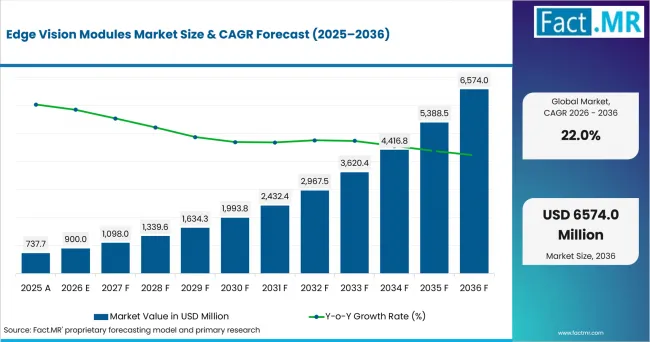
Edge Vision Modules Market Value Analysis | Source: Fact.MR
What are the defining numbers behind Edge Vision Modules Market growth?
USD 5,674 million absolute opportunity is expected between 2026 and 2036.
- Demand Drivers in the Market
- Factory automation teams need compact cameras that classify defects inside production cells. The International Federation of Robotics reported in September 2025 that 542,000 industrial robots were installed worldwide in 2024.
- Warehouse operators need OCR-code reading and object detection at the loading point. Embedded vision modules reduce data movement when labels and packages are scanned continuously.
- Robot integrators need 3D perception inside compact robot packages. Module kits that pair stereo imaging with software support shorten setup work for navigation and picking.
- Device developers need board-level cameras that fit smaller housings. e-con Systems introduced STURDeCAM88 in April 2025 as a rugged 4K HDR front-view camera designed for mobility applications.
- Key Segments Analyzed
- By Module: Smart cameras are expected to hold 47.0% share in 2026 since integrated image capture and processing lower installation work for machine builders.
- By Task: Classification is projected to account for 31.0% share in 2026 due to demand for pass-or-fail sorting and defect labelling in automated cells.
- By Processor: GPU is anticipated to capture 46.0% share in 2026 owing to its fit with parallel image workloads and deep-learning inference.
- By End Use: Automation is estimated to represent 25.0% share in 2026 as factories place compact vision at inspection points and robot workcells.
- By Interface: MIPI-board is forecast to hold 45.0% share in 2026 as embedded products need direct camera-to-board integration with low space demand.
- Analyst Opinion at Fact.MR
- Shambhu Nath Jha, Principal Consultant at Fact.MR, states, “Edge vision modules are drawing attention as buyers want inspection intelligence inside the machine. Demand is expected to favor suppliers that combine optics, embedded processing and integration support. The better commercial position belongs to vendors that make camera setup easier for automation teams and product engineers.”
- Strategic Implications
- Module vendors should package cameras with reference software so plant engineers can validate classification results before full automation spending.
- Processor suppliers should document latency and thermal behavior since GPU and NPU choices shape enclosure design in compact machines.
- System integrators should target pilot lines and training routes. UKRI’s Robotics Adoption Hubs competition opened on 24 February 2026 with a total fund of GBP 38 million for one-stop hubs to help end-users adopt robotics and autonomous systems.
- Camera suppliers should align interface kits with MIPI-board and industrial Ethernet needs so OEMs can reuse designs across product families.
The UK is projected to record 27.6% CAGR through 2036 supported by robotics adoption hubs and online-retail vision use cases. South Korea is forecast to post 26.8% as dense factory automation and electronics production support module design. The USA is anticipated to reach 24.8% owing to fulfillment automation and domestic integration demand. Germany is estimated to record 19.6% given its machine-builder base. Japan is expected to advance at 19.1% with robot installations and camera-module engineering.
How does the Edge Vision Modules Market break down by segment?
Smart cameras lead Module at 47.0%; GPU leads Processor at 46.0%.
Which Module dominates?
Smart cameras are expected to hold 47.0% share in 2026.
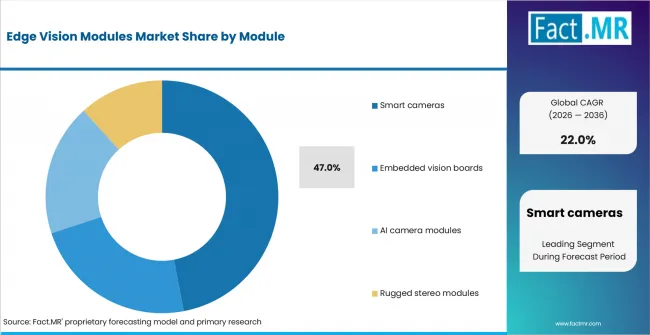
Edge Vision Modules Market Analysis By Module | Source: Fact.MR
Smart cameras lead by combining imaging, processing and software in one package. Integrated designs give automation teams a direct path to AI-based image processing on the device.
That design is suited to inspection cells where teams want fewer external components. It also supports compact robot and packaging lines that need repeatable camera settings across many stations.
What leads the Task segment?
Classification is projected to account for 31.0% share in 2026.
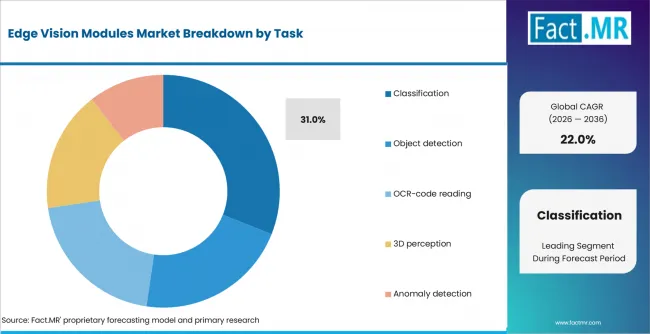
Edge Vision Modules Market Analysis By Task | Source: Fact.MR
Classification leads Task as many machine-vision projects start with a clear sorting question. The system checks whether an item is correct or defective. It then sends the result to a controller, robot or line worker.
The U.S. Census Bureau reported in May 2026 that first-quarter U.S. retail e-commerce sales reached USD 326.7 billion. Larger parcel flows are expected to support OCR-code reading and classification modules in fulfillment operations.
How does Processor shape demand?
GPU is anticipated to capture 46.0% share in 2026.
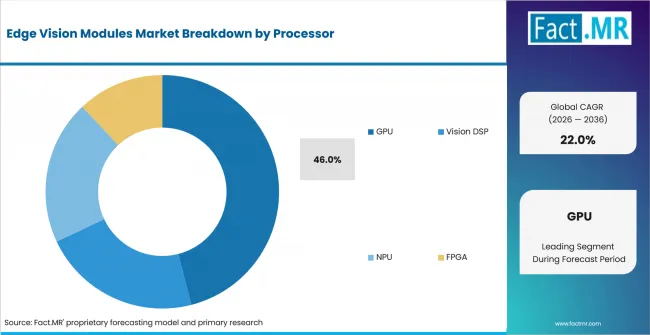
Edge Vision Modules Market Analysis By Processor | Source: Fact.MR
GPU processors hold a large position since image models require many parallel operations. Compact modules use GPU capacity to classify defects, detect objects and process multiple frames close to the machine.
Teledyne FLIR OEM announced the Boson+ IQ Development Kit in September 2025 with Prism software and a Qualcomm Dragonwing QCS8550 processor. That type of development supports thermal and visible-edge perception where compact processing is central to product design.
What supports Automation within End Use?
Automation is estimated to represent 25.0% share in 2026.
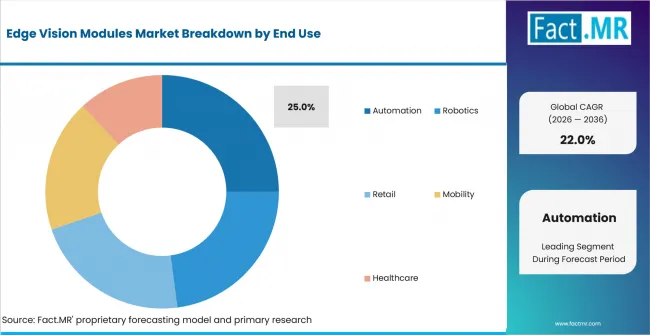
Edge Vision Modules Market Analysis By End Use | Source: Fact.MR
Automation leads End Use as production lines need inspection modules that fit near conveyors, grippers and fixtures. Edge vision modules fit these cells by reducing cabinet space and simplifying signal routing.
Basler AG and Orbbec announced their industrial 3D-vision partnership on March 25, 2026 and said the first result, the Basler AG Stereo mini 3D camera, would be presented at LogiMAT 2026 for logistics and factory-automation applications. That type of compact perception hardware gives module suppliers a clear route into robot guidance and quality checks.
What leads the Interface segment?
MIPI-board is forecast to hold 45.0% share in 2026.
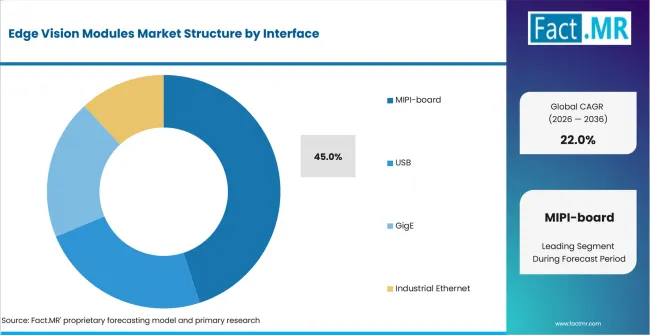
Edge Vision Modules Market Analysis By Interface | Source: Fact.MR
MIPI-board leads Interface as embedded products often need a short camera path to the processor. This reduces enclosure size and power use for device makers that integrate camera modules directly into robots, scanners and compact inspection devices.
Interface choice affects how quickly an OEM can move from prototype to repeatable build. MIPI-board modules are expected to remain attractive where product teams value low board space and stable image transfer.
What is accelerating Edge Vision Modules Market adoption, and what is holding it back?
Demand is expected to rise through automation, embedded AI and compact module design.
Drivers Impact Analysis
| DRIVER | (~) % IMPACT ON CAGR | GEOGRAPHIC RELEVANCE | IMPACT TIMELINE |
|---|---|---|---|
| Factory automation and robot guidance | +2.4% | North America, East Asia, Western Europe | Short term (<= 2 years) |
| On-device AI classification | +1.8% | Global | Medium term (2-4 years) |
| Compact embedded product design | +1.4% | East Asia, North America | Medium term (2-4 years) |
| Retail and logistics code reading | +1.0% | USA, UK, Japan, South Korea | Long term (>= 4 years) |
Source: Fact.MR analysis. Updated Aug 25, 2026
- Factory automation and robot guidance: More robot cells are expected to require local vision modules for positioning, inspection and part handling inside constrained workspaces.
- On-device AI classification: Edge processing is anticipated to reduce data transfer and support faster decisions when inspection results must reach controllers quickly.
- Compact embedded product design: Smaller devices are projected to favor MIPI-board and smart camera formats that limit cable length and board space.
Opportunity Impact Analysis
| OPPORTUNITY | (~) % IMPACT ON CAGR | GEOGRAPHIC RELEVANCE | IMPACT TIMELINE |
|---|---|---|---|
| 3D perception for robots and AMRs | +1.5% | East Asia, Western Europe | Medium term (2-4 years) |
| Thermal and low-light embedded modules | +1.1% | North America, Japan | Long term (>= 4 years) |
| Vision kits for smaller OEMs | +0.8% | Global | Short term (<= 2 years) |
Source: Fact.MR analysis. Updated Aug 25, 2026
- 3D perception for robots and AMRs: Compact stereo modules are expected to widen use in navigation and picking where mobile robots need depth data inside crowded facilities.
- Thermal and low-light embedded modules: Developers are expected to add thermal perception where visible cameras lose detail in low-light or high-contrast operating environments.
- Vision kits for smaller OEMs: Reference designs and camera software are anticipated to lower integration time for companies that lack large imaging teams.
Restraints Impact Analysis
| RESTRAINT | (~) % IMPACT ON CAGR | GEOGRAPHIC RELEVANCE | IMPACT TIMELINE |
|---|---|---|---|
| Validation time for lighting and lenses | -0.8% | Global | Short term (<= 2 years) |
| Thermal limits in compact housings | -0.6% | North America, East Asia | Medium term (2-4 years) |
| Industrial interface fragmentation | -0.4% | Western Europe, East Asia | Long term (>= 4 years) |
Source: Fact.MR analysis. Updated Aug 25, 2026
- Validation time for lighting and lenses: Module adoption is expected to slow when applications require repeated testing across part colors and surface finishes.
- Thermal limits in compact housings: Higher on-device processing is anticipated to create heat-management work for sealed devices and mobile robots.
- Industrial interface fragmentation: Multiple interface choices are projected to increase engineering effort when OEMs serve factories with different control architectures.
Which countries are scaling the Edge Vision Modules Market through 2036?
- The country comparison spans 8.5 percentage points and forms three practical growth bands across the forecast period.
- The UK remains 0.8 percentage point above South Korea through robotics adoption support and online retail inspection use cases.
- South Korea remains 2.0 percentage points above the USA as high robot density and electronics production support embedded vision pilots.
- The USA remains 5.2 percentage points above Germany through fulfillment automation and domestic integration demand.
- Germany remains 0.5 percentage point above Japan through industrial automation depth and machine-builder qualification work.
- Japan closes the displayed range through robot installations, camera-module engineering and retail digitization.
Comparable CAGRs create different entry conditions due to robot density, automation budgets, e-commerce volume and module-integration skill. Full report coverage includes North America, Latin America, Western Europe, Eastern Europe, East Asia, South Asia & Pacific, Middle East & Africa.
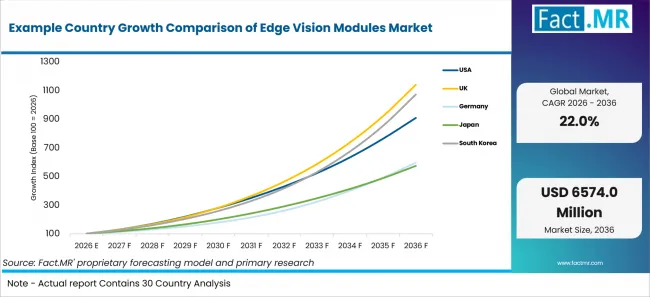
Example Country Growth Comparison Of Edge Vision Modules Market | Source: Fact.MR
| Country | CAGR (2026-2036) |
|---|---|
| UK | 27.6% |
| South Korea | 26.8% |
| USA | 24.8% |
| Germany | 19.6% |
| Japan | 19.1% |
Source: Fact.MR analysis. Updated Aug 25, 2026
What supports the UK’s growth?
27.6% CAGR, backed by robotics adoption hubs and online retail values.
The UK edge vision module outlook is supported by robotics support and retail digitization. The Department for Science, Innovation and Technology announced a GBP 52 million Robotics Adoption Programme in January 2026, including plans for around five Robotics Adoption Hubs across the country. ONS reported in March 2026 that online spending values in the three months to February 2026 were 12.1% higher than in the same period a year earlier. Those indicators support smart cameras and MIPI-board modules for warehouse pilots, shelf monitoring and small factory cells.
How is South Korea scaling demand?
26.8% CAGR, supported by robot density and electronics-linked vision processing.
South Korea combines factory automation with electronics production. The Ministry of Data and Statistics reported in August 2026 that online-shopping transaction value reached KRW 24.6067 trillion in June 2026, up 10.7% year over year. The International Federation of Robotics reported in April 2026 that the Republic of Korea recorded a robot density of 1,220 operational industrial robots per 10,000 manufacturing employees in 2024. Camera modules are therefore expected to be used in display inspection, mobile robots and code-reading systems where local image processing keeps response times low.
What supports USA adoption?
24.8% CAGR, led by fulfillment automation and factory integration.
The USA outlook is tied to parcel flows and industrial automation upgrades. The U.S. Census Bureau reported in June 2026 an advance estimate of USD 763.7 billion for U.S. retail and food services sales in May 2026. IFR reported in April 2026 that the United States had a 2024 robot density of 307 operational industrial robots per 10,000 manufacturing employees.
What is supporting Germany’s adoption?
19.6% CAGR, reinforced by robot density and machinery-order recovery.
Germany remains a machine-builder market where integration quality carries heavy weight. IFR reported in April 2026 that Germany had a 2024 robot density of 449 operational industrial robots per 10,000 manufacturing employees. Destatis initially reported in February 2026 that seasonally and calendar-adjusted manufacturing orders rose 7.8% month over month in December 2025; the figure was subsequently revised to 6.4%. Edge vision modules are expected to fit robot guidance and inspection cells where OEMs need repeatable camera packages.
How does Japan perform?
19.1% CAGR, led by robot use and retail digitization.
Japan’s growth is shaped by precision automation and compact electronics design. METI reported in August 2025 that Japan’s B2C e-commerce market reached JPY 26.1 trillion in 2024, up 5.1% year over year. IFR reported in April 2026 that Japan had a 2024 robot density of 446 operational industrial robots per 10,000 manufacturing employees. Those conditions support AI camera modules and MIPI-board formats in robotics, logistics and device inspection.
Who leads the Edge Vision Modules Market?
Basler AG is an active provider through industrial cameras, 3D stereo systems and machine-vision software used by robotics and logistics teams. Its portfolio supports module-level perception for automated mobile robots and factory automation.
Allied Vision Technologies GmbH competes through smart cameras and embedded machine-vision platforms. Its portfolio fits edge processing where AI applications run directly on camera hardware.
Teledyne FLIR participates through thermal and visible imaging modules. Its OEM portfolio supports developers that need thermal perception for autonomous systems and embedded monitoring.
Cognex Corporation participates through smart cameras and vision systems used in industrial automation. e-con Systems participates through embedded cameras and rugged mobility modules. IDS Imaging Development Systems GmbH is included due to its industrial camera portfolio across embedded and 3D machine-vision integration.
Which companies are the key providers?
Key companies include Basler AG, Cognex Corporation, Teledyne FLIR, e-con Systems, Allied Vision Technologies GmbH, IDS Imaging Development Systems GmbH.
- Basler AG
- Cognex Corporation
- Teledyne FLIR
- e-con Systems
- Allied Vision Technologies GmbH
- IDS Imaging Development Systems GmbH
Bibliography
- International Federation of Robotics. (2025, September 25). World Robotics 2025 report – INDUSTRIAL ROBOTS – released by IFR: Global robot demand in factories doubles over 10 years.
- International Federation of Robotics. (2026, April 8). Robot density surges in Europe, Asia, and Americas.
- U.S. Census Bureau. (2026, May 18). Quarterly retail e-commerce sales: 1st quarter 2026.
- U.S. Census Bureau. (2026, June 17). Advance monthly sales for retail and food services, May 2026.
- Office for National Statistics. (2026, March 27). Retail sales, Great Britain: February 2026.
- Department for Science, Innovation and Technology. (2026, January 16). Red tape to be slashed for British robotics and defence innovators. GOV.UK.
- UK Research and Innovation. (2026, February 26). Robotics adoption hubs.
- Federal Statistical Office. (2026, February 5). New orders in manufacturing in December 2025: +7.8% on the previous month.
- Ministry of Economy, Trade and Industry. (2025, August 26). Results of FY2024 E-Commerce Market Survey compiled.
- Ministry of Data and Statistics. (2026, August 3). Online shopping in June 2026.
- Basler AG. (2026, March 25). Basler AG and Orbbec launch technology partnership for industrial 3D vision in logistics and factory automation.
- Allied Vision Technologies GmbH. (2025, November 18). Allied Vision launches Alecs: The open smart camera for next-generation vision applications.
- Teledyne FLIR OEM. (2025, September 2). Teledyne FLIR OEM launches Boson+ IQ Thermal Imaging Development Kit at DSEI UK 2025.
- e-con Systems Inc. (2025, April 28). e-con Systems launches 4K 140dB HDR Front View Camera for Mobility.
- e-con Systems Inc. (2025, July 9). e-con Systems® launches ONVIF-compliant 4K HDR GigE camera for smart vision applications.
This Report Answers
- The report explains where edge vision modules are used across module type, task, processor, end use and interface.
- Segment analysis identifies the subsegments that account for the largest 2026 shares and the buying reasons behind those positions.
- Country analysis examines the listed markets and the automation or retail mechanisms supporting module demand.
- Competitive analysis reviews current providers across smart cameras, embedded cameras, thermal modules and industrial machine vision.
- Application analysis assesses how classification, OCR-code reading and 3D perception influence supplier selection.
What does the Edge Vision Modules Market cover?
The Edge Vision Modules Market covers smart camera systems, embedded vision boards, AI camera modules and rugged stereo modules used to process images near machines. It also covers video-as-sensor deployments where camera data becomes a direct input for detection or classification.
The assessment covers automation and robotics uses. It also covers retail, mobility and healthcare applications. It includes links with robot vision systems and 3D machine vision where compact modules support perception inside production and logistics environments.
What is included in the scope?
The scope includes commercial camera modules, embedded processing boards and smart camera assemblies used by OEMs and system integrators. It covers industrial visioneers that package imaging capability with software support for industrial users.
It includes module-level hardware linked to optical sensor modules and broader sensor platforms when the product performs edge image capture or processing. Interface support spans MIPI-board, USB, GigE and Industrial Ethernet configurations.
What is excluded from the scope?
Full surveillance systems, general cloud analytics platforms and standalone image sensors are outside direct coverage. Cameras enter coverage only when embedded module functions are part of the product. Adjacent software-only areas such as edge AI tuning kits are referenced only when they support on-device vision deployment.
The scope is limited to module-level vision products. Full retail-store platforms such as frictionless retail infrastructure are outside direct coverage. Revenue enters the assessment only when clearly tied to edge camera modules. smart machine infrastructure is treated as a downstream environment for direct module deployment.
How Was the Analysis Built?
The analysis draws on 120+ sources, 35+ company portfolios, 25+ countries, and more than 20 industry interviews.
- Primary Research: Primary research includes discussions with manufacturers, service providers, technology developers, distributors, end users, procurement teams, and subject-matter experts. These conversations examine purchasing priorities, product adoption, operational challenges, approval requirements, competitive positioning, and the factors that influence wider market acceptance.
- Desk Research: Desk research covers government statistics, regulatory publications, company filings, trade data, technical studies, industry associations, standards, public policy, and other authoritative sources. Every source used in the analysis is documented in the bibliography.
- Market Sizing and Forecasting: Market estimates combine historical performance, demand indicators, pricing and volume trends, segment shares, company participation, country-level growth, adoption patterns, investment activity, and barriers to market expansion.
- Data Validation and Update Cycle: Findings are validated by comparing primary interviews with public data, company activity, regulatory changes, trade patterns, and industry developments. Regular updates review new product launches, capacity changes, partnerships, approvals, procurement trends, and shifts in commercial adoption.
Segmentation
What is the report’s scope and coverage?
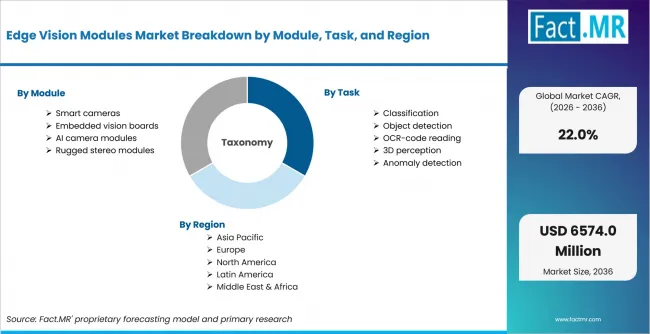
Edge Vision Modules Market Breakdown By Module, Task, And Region | Source: Fact.MR
| Attribute | Details |
|---|---|
| Quantitative Units | USD million in 2026 to USD million by 2036 at a CAGR |
| Market Definition | Compact camera and embedded vision modules that combine image capture, processing hardware and software support for machine vision at the edge. |
| Module | Smart cameras; Embedded vision boards; AI camera modules; Rugged stereo modules |
| Task | Classification; Object detection; OCR-code reading; 3D perception; Anomaly detection |
| Processor | GPU; Vision DSP; NPU; FPGA |
| End Use | Automation; Robotics; Retail; Mobility; Healthcare |
| Interface | MIPI-board; USB; GigE; Industrial Ethernet |
| Regions Covered | North America; Latin America; Western Europe; Eastern Europe; East Asia; South Asia & Pacific; Middle East & Africa |
| Countries Covered | USA; UK; Germany; Japan; South Korea |
| Key Companies Profiled | Basler AG, Cognex Corporation, Teledyne FLIR, e-con Systems, Allied Vision Technologies GmbH, IDS Imaging Development Systems GmbH |
| Forecast Period | 2026 to 2036 |
| Approach | Hybrid top-down and bottom-up approach using camera module demand, automation deployment, embedded processor use, interface mix, country growth and provider portfolio review. |
Source: Fact.MR analysis. Updated Aug 25, 2026
How is the market segmented?
-
By Module
- Smart cameras
- Embedded vision boards
- AI camera modules
- Rugged stereo modules
-
By Task
- Classification
- Object detection
- OCR-code reading
- 3D perception
- Anomaly detection
-
By Processor
- GPU
- Vision DSP
- NPU
- FPGA
-
By End Use
- Automation
- Robotics
- Retail
- Mobility
- Healthcare
-
By Interface
- MIPI-board
- USB
- GigE
- Industrial Ethernet
-
By Region
- North America
- Latin America
- Western Europe
- Eastern Europe
- East Asia
- South Asia & Pacific
- Middle East & Africa
Frequently Asked Questions
How big is the edge vision modules market in 2026?
What is the CAGR of the edge vision modules market from 2026 to 2036?
Which module leads the edge vision modules market?
Which task leads the edge vision modules market?
Who are the leading companies in the edge vision modules market?
Who worked on this report


Preview the report firsthand - request a free sample
Free SampleGet the brochure for pricing and purchase details
Download PDF